
| |
The Life and Death of King John, a history play by William Shakespeare, dramatises the reign of King John of England (ruled 1199–1216), son of Henry II of England and Eleanor of Aquitaine and father of Henry III of England. It is believed to have been written in the mid-1590s but was not published until it appeared in the First Folio in 1623.
espeare's play has a close relationship to an earlier history play, The Troublesome Reign of King John (ca. 1589).

Discussion
Ask a question about 'King John'
Start a new discussion about 'King John'
Answer questions from other users
|
Quotations
And if his name be George, I'll call him Peter;For new-made honour doth forget men's names.
Philip Faulconbridge, scene i
Ay, marry, now my soul hath elbow-room.
King John, scene vii
For courage mounteth with occasion.
Archduke of Austria, scene i
Here I and sorrows sit;Here is my throne, bid kings come bow to it.
Constance, scene i

Encyclopedia
The Life and Death of King John, a history play by William Shakespeare, dramatises the reign of King John of England (ruled 1199–1216), son of Henry II of England and Eleanor of Aquitaine and father of Henry III of England. It is believed to have been written in the mid-1590s but was not published until it appeared in the First Folio in 1623.
Sources
Shakespeare's play has a close relationship to an earlier history play, The Troublesome Reign of King John (ca. 1589). The consensus among modern scholars is that the earlier play provided a source and model for Shakespeare. There is, however, a strong line of oppositional criticism that argues for the priority of Shakespeare's play, beginning with Peter Alexander and continuing with the work of E. A. J. Honigmann. Some critics believe that Shakespeare revised the early version of the play in the mid-1590s. It is possible that The Troublesome Reign is his play or that it is a "bad quarto" or memorial reconstruction put together by one or more actors in an earlier stage production.
Other probable sources of note include Holinshed's Chronicle, John Foxe's Acts and Monuments and Matthew Paris's Historia Maior.
Date and text
The play was in existence by 1598, as it is mentioned by Francis Meres in his list of Shakespearean plays published in that year, Palladis Tamia; no early performances, however, are recorded. The earliest known performance took place in 1737, when John Rich staged a production at the Theatre Royal, Drury Lane. In 1745, the year of the Jacobite rebellion, competing productions were staged by Colley Cibber at Covent Garden and David Garrick at Drury Lane. Charles Kemble's 1823 production made a serious effort at historical accuracy. Since that time, King John has been one of Shakespeare's least-performed plays. It was first published in the First Folio in 1623. Stanley Wells and Gary Taylor, editors of the Oxford edition of The Complete Works, date the play to 1595 or 1596.
Performance history
Numerous 17th century references to King John testify to the play's popularity, but the first recorded performance did not take place until 1737. David Garrick staged the first successful revival in 1745. Charles Kemble staged a production in 1823, notable for inaugurating the 19th century tradition of striving for historical accuracy in Shakespearean production. Other successful productions of the play were staged by William Charles Macready (1842) and Charles Kean (1846). Twentieth century revivals include Robert B. Mantell's 1915 production (the last production to be staged on Broadway) and Peter Brook's 1945 staging, featuring Paul Scofield as the Bastard.
Herbert Beerbohm Tree made a silent movie version in 1899, which is the earliest surviving film adaptation of a Shakespearean play. King John has been made for television twice: in 1951 with Donald Wolfit and in 1984 with Leonard Rossiter.
Characters
- King John
- Prince Henry, son to the King (who succeeds as Henry III)
- Arthur, Duke of Britain, nephew to the King
- Earl of Pembroke
- Earl of Essex
- Lord Bigot
- Hubert de Burgh
- Robert Faulconbridge, son of Sir Robert Faulconbridge
- Philip the Bastard, his half-brother (also called Richard)
- James Gurney, servant to Lady Faulconbridge
- Peter of Pomfret, a prophet
- Philip, King of France
- Lewis, the Dauphin
- Lymoges, Duke of Austria.
- Cardinal Pandulph (or Pandolph), the legate of Pope Innocent III.
- Melune, a French Lord
- Chatillion, ambassador from France to King John
- Queen Elinor, widow of Henry II, mother to King John
- Constance, widow of Geffrey (John's elder brother) and mother to Arthur
- Blanche of Spain, daughter to King of Castile, niece to King John
- Lady Faulconbridge, widow of Sir Robert Faulconbridge
- Lords, heralds, etc.
Synopsis
The play opens with a plea from the French King Phillip for King John to abdicate in favour of his nephew, Arthur I, Duke of Brittany, son of John's elder brother Geoffrey. The five acts then depict a dizzying change of alliances, a Papal excommunication and a subsequent reconciliation. The play ends with King John's slow death after apparently having been poisoned by a monk.
Throughout the play, a character known as "The Bastard" (John's nephew, the illegitimate son of Richard the Lionheart) delivers a sceptical commentary on nobility, "commodity" (self-interest) and English sovereignty.
It is sometimes considered odd that Magna Carta is never mentioned in the play, since this is for what King John is now best remembered. Magna Carta, however, was considered in Shakespeare's time "not as a triumph for liberty, but rather as a shameful attempt to weaken the central monarchy." Also, the focus of the play is on the quarrel over the succession; Magna Carta would not have been relevant to this story. Despite this, it was common for Victorian productions of the play to interpolate a spectacular tableau of the signing of Magna Carta.
Reputation
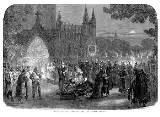
In the Victorian era, King John was one of Shakespeare's most frequently staged plays, in part because its spectacle and pageantry were congenial to Victorian audiences. King John, however, has decreased in popularity: it is now one of Shakespeare's least-known plays and stagings of it are very rare.
See also
Footnotes
External links
|