


King Edward's Chair

Encyclopedia
.jpg)
Coronation of the British monarch
The coronation of the British monarch is a ceremony in which the monarch of the United Kingdom is formally crowned and invested with regalia...
. It was commissioned in 1296 by King Edward I
Edward I of England
Edward I , also known as Edward Longshanks and the Hammer of the Scots, was King of England from 1272 to 1307. The first son of Henry III, Edward was involved early in the political intrigues of his father's reign, which included an outright rebellion by the English barons...
to contain the coronation stone of Scotland
Scotland
Scotland is a country that is part of the United Kingdom. Occupying the northern third of the island of Great Britain, it shares a border with England to the south and is bounded by the North Sea to the east, the Atlantic Ocean to the north and west, and the North Channel and Irish Sea to the...
— known as the Stone of Scone
Stone of Scone
The Stone of Scone , also known as the Stone of Destiny and often referred to in England as The Coronation Stone, is an oblong block of red sandstone, used for centuries in the coronation of the monarchs of Scotland and later the monarchs of England, Great Britain and the United Kingdom...
— which he had captured from the Scots who had kept it at Scone Abbey
Scone Abbey
Scone Abbey was a house of Augustinian canons based at Scone, Perthshire , Scotland. Varying dates for the foundation have been given, but it was certainly founded between 1114 and 1122....
. The chair was named after Edward the Confessor
Edward the Confessor
Edward the Confessor also known as St. Edward the Confessor , son of Æthelred the Unready and Emma of Normandy, was one of the last Anglo-Saxon kings of England and is usually regarded as the last king of the House of Wessex, ruling from 1042 to 1066....
, and was kept in his shrine
Shrine
A shrine is a holy or sacred place, which is dedicated to a specific deity, ancestor, hero, martyr, saint, daemon or similar figure of awe and respect, at which they are venerated or worshipped. Shrines often contain idols, relics, or other such objects associated with the figure being venerated....
of St Edward's Chapel at Westminster Abbey
Westminster Abbey
The Collegiate Church of St Peter at Westminster, popularly known as Westminster Abbey, is a large, mainly Gothic church, in the City of Westminster, London, United Kingdom, located just to the west of the Palace of Westminster. It is the traditional place of coronation and burial site for English,...
.
History
Since 1308, all anointedAnointing
To anoint is to pour or smear with perfumed oil, milk, water, melted butter or other substances, a process employed ritually by many religions. People and things are anointed to symbolize the introduction of a sacramental or divine influence, a holy emanation, spirit, power or God...
sovereigns
Monarch
A monarch is the person who heads a monarchy. This is a form of government in which a state or polity is ruled or controlled by an individual who typically inherits the throne by birth and occasionally rules for life or until abdication...
of England (until 1603) and Great Britain (after the Union of the Crowns
Union of the Crowns
The Union of the Crowns was the accession of James VI, King of Scots, to the throne of England, and the consequential unification of Scotland and England under one monarch. The Union of Crowns followed the death of James' unmarried and childless first cousin twice removed, Queen Elizabeth I of...
) have been seated in this chair at the moment of their coronation, with the exception of Queen Mary I
Mary I of England
Mary I was queen regnant of England and Ireland from July 1553 until her death.She was the only surviving child born of the ill-fated marriage of Henry VIII and his first wife Catherine of Aragon. Her younger half-brother, Edward VI, succeeded Henry in 1547...
(who was crowned in a chair given to her by the Pope
Pope
The Pope is the Bishop of Rome, a position that makes him the leader of the worldwide Catholic Church . In the Catholic Church, the Pope is regarded as the successor of Saint Peter, the Apostle...
) and Mary II
Mary II of England
Mary II was joint Sovereign of England, Scotland, and Ireland with her husband and first cousin, William III and II, from 1689 until her death. William and Mary, both Protestants, became king and queen regnant, respectively, following the Glorious Revolution, which resulted in the deposition of...
(who was crowned on a copy of the chair). The last occasion was the coronation of Elizabeth II
Elizabeth II of the United Kingdom
Elizabeth II is the constitutional monarch of 16 sovereign states known as the Commonwealth realms: the United Kingdom, Canada, Australia, New Zealand, Jamaica, Barbados, the Bahamas, Grenada, Papua New Guinea, the Solomon Islands, Tuvalu, Saint Lucia, Saint Vincent and the Grenadines, Belize,...
in 1953.
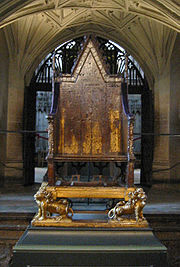
Gothic art
Gothic art was a Medieval art movement that developed in France out of Romanesque art in the mid-12th century, led by the concurrent development of Gothic architecture. It spread to all of Western Europe, but took over art more completely north of the Alps, never quite effacing more classical...
style arm chair was carved in 1297 from oak
Oak
An oak is a tree or shrub in the genus Quercus , of which about 600 species exist. "Oak" may also appear in the names of species in related genera, notably Lithocarpus...
by a carpenter
Carpenter
A carpenter is a skilled craftsperson who works with timber to construct, install and maintain buildings, furniture, and other objects. The work, known as carpentry, may involve manual labor and work outdoors....
known as Master Walter, who was paid the considerable sum of 100 shilling
Shilling
The shilling is a unit of currency used in some current and former British Commonwealth countries. The word shilling comes from scilling, an accounting term that dates back to Anglo-Saxon times where it was deemed to be the value of a cow in Kent or a sheep elsewhere. The word is thought to derive...
s for his work. Four gilded lions act as legs to the chair; these are a comparatively modern restoration executed in 1727. They replaced similar lions which were added in the 16th century. Under the seat of the chair is a platform and cavity which until 1996 contained the Stone of Scone
Stone of Scone
The Stone of Scone , also known as the Stone of Destiny and often referred to in England as The Coronation Stone, is an oblong block of red sandstone, used for centuries in the coronation of the monarchs of Scotland and later the monarchs of England, Great Britain and the United Kingdom...
; this has now been returned to Scotland with the provision that it be returned to the chair on the occasion of the next coronation.
The chair may once have been richly painted and gilded — it is thought it once had an image of Edward the Confessor painted on its back. Today, however, its appearance is of aged and bare wood, and during its history many early tourists, pilgrim
Pilgrim
A pilgrim is a traveler who is on a journey to a holy place. Typically, this is a physical journeying to some place of special significance to the adherent of a particular religious belief system...
s, and choir boys in the Abbey appear to have carved their initials and other graffiti
Graffiti
Graffiti is the name for images or lettering scratched, scrawled, painted or marked in any manner on property....
onto the chair in the 18th and 19th centuries. The carved finial
Finial
The finial is an architectural device, typically carved in stone and employed decoratively to emphasize the apex of a gable or any of various distinctive ornaments at the top, end, or corner of a building or structure. Smaller finials can be used as a decorative ornament on the ends of curtain rods...
s at the back of the chair have also been partially sawn away. In addition the chair was damaged in 1914 when it was the object of a bomb attack, thought to have been instigated by the suffragette
Suffragette
"Suffragette" is a term coined by the Daily Mail newspaper as a derogatory label for members of the late 19th and early 20th century movement for women's suffrage in the United Kingdom, in particular members of the Women's Social and Political Union...
s.
Over the eight centuries of its existence it has been only thrice removed from Westminster Abbey
Westminster Abbey
The Collegiate Church of St Peter at Westminster, popularly known as Westminster Abbey, is a large, mainly Gothic church, in the City of Westminster, London, United Kingdom, located just to the west of the Palace of Westminster. It is the traditional place of coronation and burial site for English,...
. The first time was for the ceremony in Westminster Hall when Oliver Cromwell
Oliver Cromwell
Oliver Cromwell was an English military and political leader who overthrew the English monarchy and temporarily turned England into a republican Commonwealth, and served as Lord Protector of England, Scotland, and Ireland....
was inducted as Lord Protector
Lord Protector
Lord Protector is a title used in British constitutional law for certain heads of state at different periods of history. It is also a particular title for the British Heads of State in respect to the established church...
of England
England
England is a country that is part of the United Kingdom. It shares land borders with Scotland to the north and Wales to the west; the Irish Sea is to the north west, the Celtic Sea to the south west, with the North Sea to the east and the English Channel to the south separating it from continental...
, and the second during World War II
World War II
World War II, or the Second World War , was a global conflict lasting from 1939 to 1945, involving most of the world's nations—including all of the great powers—eventually forming two opposing military alliances: the Allies and the Axis...
when it was evacuated to Gloucester Cathedral
Gloucester Cathedral
Gloucester Cathedral, or the Cathedral Church of St Peter and the Holy and Indivisible Trinity, in Gloucester, England, stands in the north of the city near the river. It originated in 678 or 679 with the foundation of an abbey dedicated to Saint Peter .-Foundations:The foundations of the present...
for the duration of the war. The third was on Christmas Day 1950, when a group of four Scottish students (Ian Hamilton, Gavin Vernon, Kay Matheson, and Alan Stuart) took the Stone from Westminster Abbey for return to Scotland.
Today it is highly protected, and leaves its secure resting place (in the ambulatory
Ambulatory
The ambulatory is the covered passage around a cloister. The term is sometimes applied to the procession way around the east end of a cathedral or large church and behind the high altar....
on a raised modern pedestal near the tomb
Tomb
A tomb is a repository for the remains of the dead. It is generally any structurally enclosed interment space or burial chamber, of varying sizes...
of Henry V
Henry V of England
Henry V was King of England from 1413 until his death at the age of 35 in 1422. He was the second monarch belonging to the House of Lancaster....
) only when it is carried into the theatre of coronation near the High Altar
Altar
An altar is any structure upon which offerings such as sacrifices are made for religious purposes. Altars are usually found at shrines, and they can be located in temples, churches and other places of worship...
of the Abbey for the rare occurrence of a coronation.