

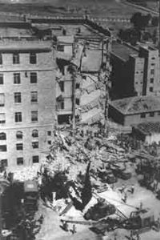
King David Hotel bombing

Encyclopedia
The King David Hotel bombing was an attack carried out by the
militant right-wing Zionist
underground organization Irgun
on the King David Hotel
in Jerusalem on 22 July 1946. 91 people of various nationalities were killed and 46 were injured.
The hotel was the site of the central offices of the British Mandatory authorities of Palestine
, principally the Secretariat of the Government of Palestine and the Headquarters of the British Forces in Palestine
and Transjordan
. The attack, which initially had the approval of the Haganah
(the principal Jewish paramilitary group in Palestine) and was conceived of as a response to Operation Agatha
(in which widespread raids, including one on the Jewish Agency
, had been carried out), was the deadliest directed at the British during the Mandate era (1920–1948). More people were killed than by any bombing carried out in the subsequent Arab-Israeli conflict.
The Irgun
, considered to be terrorists by Mi5, planted a bomb in the basement of the main building of the hotel, under the wing which housed the Mandate Secretariat and a few offices of the British military
headquarters. Warnings were sent by telephone, including one to the hotel's own switchboard, which the hotel staff decided to ignore, but none directly to the British authorities. A possible reason why the warning was ignored was that hoax bomb warnings were rife at the time. From the fact that a bomb search had already been carried out, it appears that a hoax call or tip-off had been received at the hotel earlier that day . Subsequent telephone calls from a concerned Palestine Post
staff member and the police caused increasing alarm and the hotel manager was notified. In the closing minutes before the explosion, he called an unknown British officer, but, for whatever reason, no evacuation was ordered. The ensuing explosion caused the collapse of the western half of the southern wing of the hotel. Some of the inflicted deaths and injuries occurred in the road outside the hotel and in adjacent buildings. Controversy has arisen over the timing and adequacy of the warnings and the reasons why the hotel was not evacuated.
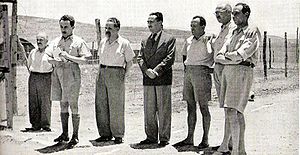 Irgun
Irgun
committed the attack in response to Operation Agatha
, known within Israel then and now as "Black Saturday". British troops had searched the Jewish Agency
on June 29 and confiscated large quantities of documents about the group's operations and links with violent groups. The intelligence information was taken to the King David Hotel
building in Jerusalem.
The building contained the British military command and their Criminal Investigation Division
. Security analyst Bruce Hoffman
has written that the "Hotel housed the nerve centre of British rule in Palestine". Specifically, the Irgun aimed at destroying the southern wing of the hotel, which housed the Mandate's intelligence records about Irgun, the Hagana, Lehi
, and other Jewish paramilitary
groups.
of the Palestine Police.
Rooms had first been requisitioned in the hotel in late 1938, on what was supposed to be a temporary basis. Plans had already been made to erect a permanent building for the Secretariat and Army GHQ, but these were cancelled after the Second World War
broke out, at which point more than two-thirds of the hotel's rooms were being used for government and army purposes.
In March 1946, British Labour Party
MP
Richard Crossman
gave the following description of activity at the hotel: "private detectives, Zionist agents, Arab sheiks, special correspondents, and the rest, all sitting around about discreetly overhearing each other."
, Chief of Operations of the Irgun
, developed a remote-controlled mortar with a range of four miles which was nicknamed the V3 by British military engineers. In 1945, after attacks using some had been made on several police stations, six V3s were buried in the olive grove park south of the King David Hotel
. Three were aimed at the government printing press
and three at the hotel itself. The intention was to fire them on the King's
birthday, but the Haganah
learned about the plan and warned the British through Teddy Kollek
of the Jewish Agency
. Army sapper
s then dug them up. On another occasion, members of an unknown group threw grenades, which missed, at the hotel.
opposed the idea initially. On July 1, 1946, Moshe Sneh
, chief of the Haganah General Headquarters, sent a letter to the then leader of the Irgun
, Menachem Begin
, which instructed him to "carry out the operation at the "chick", code for the King David Hotel.The original letter can be found in the Jabotinsky Institute Archives (k-4 1/11/5). Despite this approval for the project, repeated delays in executing the operation were requested by the Haganah, in response to changes unfolding in the political situation. The plan was finalized between Amichai Paglin
(Irgun alias 'Gidi'), Chief of Operations of the Irgun, and Itzhak Sadeh, commander of the Palmach
.
In the plan, Irgun men, disguised as Arab
s, except for Gideon, the leader, who would be dressed as one of the hotel's distinctive Sudan
ese waiters, would enter the building through a basement service entrance carrying the explosives concealed in milk cans. The cans were to be placed by the main columns supporting the wing where the majority of the offices used by the British authorities were located. The columns were in a basement nightclub known as the Régence. In the final review of the plan, it was decided that the attack would take place on July 22 at 11:00, a time when there would be no people in the coffee shop in the basement in the area where the bomb was to be planted. It would be possible to enter the hotel more easily at that time as well.
It would have been impossible to have planted the bomb in the Régence any later than 14:00 because it was always full of customers after that time. The timing was also determined by the original intention that the attack should coincide with another, carried out by the Lehi
, on government offices at the David Brothers Building. However, that attack, codenamed "Operation Your Slave and Redeemer", was canceled at the last moment. The Irgun said details of the plan were aimed at minimizing civilian casualties. Irgun reports allegedly included explicit precautions so that the whole area would be evacuated. This led to recriminations between the Haganah and Irgun later. The Haganah said that they had specified that the attack should take place later in the day, when the offices would have been emptier of people.
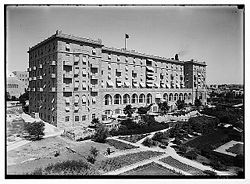 Since the bombing, much controversy has ensued over the issues of when warnings were sent and how the British authorities responded. Irgun representatives have always stated that the warning was given well in advance of the explosion, so that adequate time was available to evacuate the hotel. Menachem Begin
, for example, writes that the telephone message was delivered 25–27 minutes before the explosion. It is often stated that the British authorities have always denied that a warning was sent. However, what the British Government said, five months after the bombing, once the subsequent inquest and all the inquiries had been completed, was not that no warning had been sent, but that no such warning had been received by anyone at the Secretariat "in an official position with any power to take action."
American author Thurston Clarke
's analysis of the bombing gave timings for calls and for the explosion which he says took place at 12:37. He said that as part of the Irgun plan, a sixteen year old recruit, Adina Hay (alias Tehia), was to make three warning calls before the attack. At 12:22 the first call was made, in both Hebrew and English, to a telephone operator on the hotel's switchboard (the Secretariat and the military each had their own, separate, telephone exchanges). It was ignored. At 12:27, the second warning call was made to the French Consulate adjacent to the hotel to the north-east. This second call was taken seriously and staff went through the building opening windows and closing curtains to lessen the impact of the blast. At 12:31 a third and final warning call to the Palestine Post
newspaper was made. The telephone operator called the Palestine Police CID to report the message. She then called the hotel switchboard. The hotel operator reported the threat to one of the hotel managers. This warning resulted in the discovery of the milk churns in the basement, but by then it was too late.
Some Israeli observers have stated that the British had received enough warning but they assumed that the Hotel was so heavily guarded that any attack would be futile. Begin claimed in his memoirs that the British had deliberately kept civilians in so that they could vilify the Jewish militant groups,
although no evidence has ever been produced to support this.
After placing the bombs, the Irgun men quickly slipped out and detonated a small explosive in the street outside the hotel to reportedly keep passers-by away from the area. The police report written in the aftermath of the bombing says that this explosion resulted in a higher death toll because it caused spectators from the hotel to gather in its south-west corner, directly over the bomb planted in its basement, and it also caused the presence there of injured Arabs who were brought into the Secretariat after their bus, which was passing, was rolled onto its side. The Arab workers in the kitchen fled after being told to do so.
During the attack, two Irgun casualties occurred, Avraham Abramovitz and Itzhak Tsadok. In one Irgun account of the bombing, that by Katz, the two were shot during the initial approach on the hotel, when a minor gunfight ensued with two British soldiers who had become suspicious. Irgun did not explain how the group would have been able to move 350 kg of home-made explosives into the hotel with the guards already alerted. In Yehuda Lapidot's, the men were shot as they were withdrawing after the attack. The latter agrees with the version of events presented by Bethell and Thurston Clarke and is more credible. According to Bethell, Abramovitz managed to get to the taxi getaway car along with six other men. Tsadok escaped with the other men on foot. Both were found by the police in the Jewish Old Quarter of Jerusalem the next day, with Abramovitz already dead from his wounds.
arrived with heavy lifting equipment. Later that night, the sappers were formed into three groups, with each working an eight hour shift. The rescue operation lasted for the next three days and 2,000 lorry loads of rubble was removed. From the wreckage and rubble the rescuers managed to extract six survivors. The last to be found was D. C. Thompson, 24 hours after the building had collapsed. He appeared to be more or less unhurt, but later died due to shock.
91 people were killed, most of them being staff of the hotel or Secretariat: 21 were first-rank government officials; 49 were second-rank clerks, typists and messengers, junior members of the Secretariat, employees of the hotel and canteen workers; 13 were soldiers; 3 policemen; and 5 were members of the public. By nationality, there were 41 Arabs, 28 British citizens, 17 Palestinian Jew
s, 2 Armenians, 1 Russian, 1 Greek and 1 Egyptian. 46 people were injured. Some of the deaths and injuries occurred in the road outside the hotel and in adjacent buildings. No identifiable traces were found of thirteen of those killed. One of the dead was Yulius Jacobs, an Irgun sympathizer.
Speaker after speaker in the House of Commons expressed outrage. Ex-Prime Minister Winston Churchill
, a prominent and enthusiastic supporter of Zionism, criticized the attack. He also related the bombing to the problems within the Mandate system, and he advocated allowing further Jewish immigration into Palestine. Chief Secretary for the Government of Palestine, Sir John Shaw, noted that the majority of the dead had been members of his own personal staff. He said, "British, Arabs, Jews, Greeks, Armenians; senior officers, police, my orderly, my chauffeur, messengers, guards, men and women - young and old - they were my friends."
British Prime Minister Clement Attlee
commented in the House of Commons:
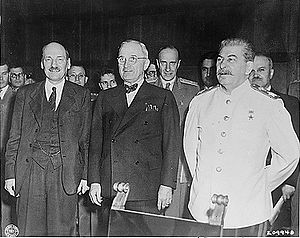 In a visit made sometime before the attack, Bernard Montgomery
had told the British army commander in Palestine, General Sir Evelyn Barker
, to emphasise to the British servicemen that they were "facing a cruel, fanatical and cunning enemy, and there was no way of knowing who was friend and who foe." Since there were female terrorists as well, according to Montgomery, all fraternising with the local population would have to cease. Within a few minutes of the bombing, Barker translated this instruction into an order that "all Jewish places of entertainment, cafes, restaurants, shops and private dwellings" be out of bounds to all ranks. He concluded, "I appreciate that these measures will inflict some hardship on the troops, but I am certain that if my reasons are fully explained to them, they will understand their propriety and they will be punishing the Jews in the way the race dislikes as much as any by striking at their pockets and showing our contempt for them." His wording was interpreted as antisemitic and caused much outrage. The order was rescinded two weeks later.
The attack did not change Britain's stance toward an Anglo-American agreement on Palestine, which was then in its concluding phase. In a letter dated July 25, 1946, Prime Minister Attlee wrote to American President Harry S. Truman
: "I am sure you will agree that the inhuman crime committed in Jerusalem on 22 July calls for the strongest action against terrorism but having regard to the sufferings of the innocent Jewish victims of Nazism
this should not deter us from introducing a policy designed to bring peace to Palestine with the least possible delay."
, an organisation governed by the Jewish Agency. The Jewish National Council denounced the bombing. According to The Jerusalem Post
, "[a]lthough the Hagana had sanctioned the King David bombing, world-wide condemnation caused the organization to distance itself from the attack." David Ben-Gurion
deemed Irgun "the enemy of the Jewish people" after the attack. Hatsofeh, a Jewish newspaper in Palestine, went as far as to label the Irgun perpetrators "fascists".
Irgun issued an initial statement accepting responsibility for the attack, mourning their Jewish victims, and faulting the British for what they saw as a failure to respond to the warnings. A year later, on July 22, 1947, they issued a new statement saying that they were acting on instructions from "a letter from the headquarters of the United Resistance, demanding that we carry out an attack on the center of government at the King David Hotel as soon as possible." Menachem Begin
himself reportedly was very saddened and upset. He was angry that the hotel was not evacuated, resulting in civilian casualties that was against the Irgun's policy. The Irgun's radio network announced that it would mourn for the Jewish victims, but not the British ones. This was explained by claiming that Britain had not mourned for the millions of Jews who died in the Nazi Holocaust. No remorse was expressed for the largest group of victims, the Arab dead.
Richard Crossman
, a British Labour Party
MP
, whose experience on the Anglo-American Committee
had made him sympathetic to Zionism, visited Chaim Weizmann
shortly after the attack. Weizmann's ambivalence towards Zionist violence
was apparent in the conversation. While condemning it, he also stated that he sympathised with its causes. When the King David Hotel bombing was mentioned, Weizmann started crying heavily. He said, "I can't help feeling proud of our boys. If only it had been a German headquarters, they would have gotten the Victoria Cross."
Begin said that Shaw had been responsible for the failure to evacuate the hotel: 'A police officer called Shaw and told him, "The Jews say that they have placed bombs in the King David." And the reply was, "I am here to give orders to the Jews, not to take orders from them."' The 1947 Irgun pamphlet Black Paper said that Shaw had forbidden anyone to leave the hotel: 'For reasons best known to himself Shaw, the Chief Secretary of the Occupation administration, disregarded the warning. That is, he forbade any of the other officials to leave the building, with the result that some of his collaborators were killed, while he himself slunk away until after the explosion . . . Shaw thus sent nearly 100 people to their deaths - including Hebrews, including friends of our struggle.' Begin said that he had heard the information about Shaw from Israel Galili, Chief of Staff of Haganah when they met on July 23, the day after the bombing. This was confirmed by Galili. In an interview with Bethell, Galili said that his source for the Shaw story had been Boris Guriel, the future head of Israel's intelligence service, who had heard it in turn from the American, Associated Press
bureau chief, Carter Davidson. Thurston Clarke interviewed both Galili and Guriel, the former in 1977. Guriel denied that he had been the source of the story. Galili was unable to produce any evidence that Shaw had received a warning. Carter Davidson died in 1958 and so couldn't be asked to confirm or deny what Galili had said. Thurston Clarke's assessment was that the story about Shaw was, in fact, "a baseless rumour promoted by the Haganah in order to mollify the Irgun and fix responsibility for the carnage on Shaw." Shmuel Katz, who had been a member of the Irgun's high command, later also wrote that the story can be dismissed.
In 1948, a libel action was taken out by Shaw against a Jewish, London newspaper which repeated the allegations made by Begin and the Irgun pamphlet. The newspaper did not mount a defence and made an unreserved apology to Shaw. About the allegation that he had said that he did not take orders from Jews, Shaw said: "I would never have made a statement like that and I don't think that anyone who knows me would regard it as in character. I would never have referred to the Jews in that way".
In 1948, William Ziff, an American author, wrote a book called The Rape of Palestine which contained an embellished version of Galili's story similar to the one given in the Black Paper pamphlet. It said that Shaw had escaped from the hotel minutes before the main explosion, abandoning its other occupants to their fate. Shaw took out another libel action. After lawyers in Israel failed to find evidence supporting Ziff's version of events, the book's publishers withdrew it from circulation and apologised to Shaw.
Bethell says that all of the British witnesses who were in the vicinity of the hotel at the time of the explosion confirmed what Shaw said. None of them had any knowledge of a warning having been sent in time to make evacuation of the hotel possible. They said that, like themselves, Shaw had not known about the bomb beforehand and that he bore no responsibility for putting colleagues' lives at risk immediately before the explosion. The only criticism made was that Shaw should have closed the Régence restaurant and put guards on the service entrance weeks before. Shaw agreed that not having done this was a mistake. The decision not to do it had been made because, "everyone was under orders to preserve the semblance of normality in Palestine", "social life had to be allowed to continue" and because nobody had believed that the Irgun would put the whole of the Secretariat, which had many Jewish employees, in danger.
Two months after the bombing, Shaw was appointed High Commissioner of Trinidad and Tobago
. The Irgun immediately sent a letter bomb to him there, but it was intercepted and successfully disarmed.

The attack led the British government to enact widely unpopular restrictions on the civil liberties
of Jews in Palestine, which included a renewed use of random personal searches, random searches of homes, military curfews, road blocks, and mass arrests. The measures shifted British public opinion further against the Mandate system. They also alienated the Jewish populace from their government, which had been Begin's intention from the beginning.
Irgun
and Lehi
stepped up their guerilla campaign after the bombing, committing a series of attacks. According to The Jerusalem Post
, the bombing represented the end of the united front that had existed between Irgun and other Zionist groups such as Haganah
. From then on, the groups maintained a more adversarial relationship. Irgun ex-members and sympathizers have argued that modern historical accounts in Israel are biased against them and in favor of more established groups such as Haganah
.
After the bombing, the hotel complex remained in use by the British until May 4, 1948. It served as an Israeli headquarters from the end of the Israeli War of Independence to the Six-Day War
. Then, the Israelis reopened the hotel for commercial business. Recently, it has hosted visiting dignitaries and celebrities.
in 1978, including the results of the military and police investigations.A copy of the police report (identifying code 'CO 537 2290') is held at the Public Records Office, London. The reports contain statements and conclusions which are contradicted by other evidence, including that submitted to the inquest held after the bombing. Affidavits which reflected badly on the security of the hotel were removed from the army report before it was submitted to the High Commissioner and then the Cabinet in London.
The police report makes the unlikely claim that the warning sent to the French Consulate was received five minutes after the main explosion. This is contradicted by multiple eyewitnesses who reported seeing staff opening the Consulate windows five minutes before that happened. The report also claims that the warning received by the Palestine Post was not received until after the explosion. That claim is contradicted by the testimony of two members of the Palestine Post staff, one of who said that she was put under pressure by the Palestine Police to withdraw what she had said.
and history
of terrorism. It has been called one of the most lethal terrorist attacks of the 20th century.
Security analyst Bruce Hoffman
wrote of the bombing in his book Inside Terrorism that:
"Unlike many terrorist groups today, the Irgun's strategy was not deliberately to target or wantonly harm civilians. At the same time, though, the claim of Begin and other apologists that warnings were issued cannot absolve either the group or its commander ... Indeed, whatever nonlethal intentions the Irgun might or might not have had, the fact remains that a tragedy of almost unparalleled magnitude was inflicted... so that to this day the bombing remains one of the world's single most lethal terrorist incidents of the twentieth century."
A 2006 Cambridge University Press
book on political terrorism theorized that it provided a model for the terrorist bombings of the 1980s. Understanding Terrorism: Challenges, Perspectives, and Issues called the attack one of the best historical examples of successful terrorism and that it produced everything that Irgun had wanted. The author compared the bombing aftermath to that of Carlos Marighella
's campaign with the Brazilian Communist Party
.
Some observers labeled Irgun as terrorists while others labeled the group as freedom fighters. Begin argued that terrorists and freedom fighters were differentiated in that terrorists deliberately try to target civilians, while Irgun is not terrorist since it tried to avoid civilian casualties. At the events to mark the 60th anniversary of the attack, Binyamin Netanyahu, then chairman of Likud
and Leader of the Opposition
in the Knesset
, described the bombing as a legitimate act with a military target, distinguishing it from an act of terror intended to harm civilians. He said, "Imagine that Hamas or Hizbullah would call the military headquarters in Tel Aviv and say, 'We have placed a bomb and we are asking you to evacuate the area.' They don't do that. That is the difference."
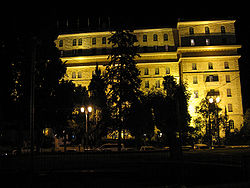 In July 2006, the Menachem Begin Heritage Center
organized a conference to mark the 60th anniversary of the bombing. The conference was attended by past and future Prime Minister Benjamin Netanyahu
and former members of Irgun. A plaque commemorating the bombing was unveiled, stating "For reasons known only to the British, the hotel was not evacuated.” The British Ambassador in Tel Aviv and the Consul-General in Jerusalem protested, saying "We do not think that it is right for an act of terrorism, which led to the loss of many lives, to be commemorated," and wrote to the Mayor of Jerusalem that such an act of terror could not be honored, even if it was preceded by a warning. The British government also demanded the removal of the plaque, saying that the statement accusing the British of failing to evacuate the hotel was untrue and "did not absolve those who planted the bomb."
To prevent a diplomatic incident, and over the objections of Knesset
member Reuven Rivlin
(Likud
), who raised the matter in the Knesset, changes were made in the plaque's text, though to a greater degree in the English than the Hebrew version. The final English version says, "Warning phone calls has [sic] been made to the hotel, The Palestine Post and the French Consulate, urging the hotel's occupants to leave immediately. The hotel was not evacuated and after 25 minutes the bombs exploded. To the Irgun's regret, 92 persons were killed." The death toll given includes Avraham Abramovitz, the Irgun
member who was shot during the attack and died later from his wounds, but only the Hebrew version of the sign makes that clear.
militant right-wing Zionist
Zionism
Zionism is a Jewish political movement that, in its broadest sense, has supported the self-determination of the Jewish people in a sovereign Jewish national homeland. Since the establishment of the State of Israel, the Zionist movement continues primarily to advocate on behalf of the Jewish state...
underground organization Irgun
Irgun
The Irgun , or Irgun Zevai Leumi to give it its full title , was a Zionist paramilitary group that operated in Mandate Palestine between 1931 and 1948. It was an offshoot of the earlier and larger Jewish paramilitary organization haHaganah...
on the King David Hotel
King David Hotel
The King David Hotel is a 5-star hotel in Jerusalem, Israel. Opened in 1931, the hotel was built with locally quarried pink limestone and was founded by Ezra Mosseri, a wealthy Egyptian Jewish Banker. To this day the hotel remains one of the most prominent and prestigious hotels in Israel, and...
in Jerusalem on 22 July 1946. 91 people of various nationalities were killed and 46 were injured.
The hotel was the site of the central offices of the British Mandatory authorities of Palestine
Palestine
Palestine is a conventional name, among others, used to describe the geographic region between the Mediterranean Sea and the Jordan River, and various adjoining lands....
, principally the Secretariat of the Government of Palestine and the Headquarters of the British Forces in Palestine
Palestine
Palestine is a conventional name, among others, used to describe the geographic region between the Mediterranean Sea and the Jordan River, and various adjoining lands....
and Transjordan
Transjordan
The Emirate of Transjordan was a former Ottoman territory in the Southern Levant that was part of the British Mandate of Palestine...
. The attack, which initially had the approval of the Haganah
Haganah
Haganah was a Jewish paramilitary organization in what was then the British Mandate of Palestine from 1920 to 1948, which later became the core of the Israel Defense Forces.- Origins :...
(the principal Jewish paramilitary group in Palestine) and was conceived of as a response to Operation Agatha
Operation Agatha
Operation Agatha sometimes called Black Shabbat or Black Saturday because it began on the Jewish sabbath, was a police and military operation conducted by the British authorities in the British Mandate of Palestine...
(in which widespread raids, including one on the Jewish Agency
Jewish Agency for Israel
The Jewish Agency for Israel , also known as the Sochnut or JAFI, served as the organization in charge of immigration and absorption of Jews from the Diaspora into the state of Israel.-History:...
, had been carried out), was the deadliest directed at the British during the Mandate era (1920–1948). More people were killed than by any bombing carried out in the subsequent Arab-Israeli conflict.
The Irgun
Irgun
The Irgun , or Irgun Zevai Leumi to give it its full title , was a Zionist paramilitary group that operated in Mandate Palestine between 1931 and 1948. It was an offshoot of the earlier and larger Jewish paramilitary organization haHaganah...
, considered to be terrorists by Mi5, planted a bomb in the basement of the main building of the hotel, under the wing which housed the Mandate Secretariat and a few offices of the British military
British Army
The British Army is the land warfare branch of Her Majesty's Armed Forces in the United Kingdom. It came into being with the unification of the Kingdom of England and Scotland into the Kingdom of Great Britain in 1707. The new British Army incorporated Regiments that had already existed in England...
headquarters. Warnings were sent by telephone, including one to the hotel's own switchboard, which the hotel staff decided to ignore, but none directly to the British authorities. A possible reason why the warning was ignored was that hoax bomb warnings were rife at the time. From the fact that a bomb search had already been carried out, it appears that a hoax call or tip-off had been received at the hotel earlier that day . Subsequent telephone calls from a concerned Palestine Post
The Jerusalem Post
The Jerusalem Post is an Israeli daily English-language broadsheet newspaper, founded on December 1, 1932 by Gershon Agron as The Palestine Post. The daily readership numbers do not approach those of the major Hebrew newspapers....
staff member and the police caused increasing alarm and the hotel manager was notified. In the closing minutes before the explosion, he called an unknown British officer, but, for whatever reason, no evacuation was ordered. The ensuing explosion caused the collapse of the western half of the southern wing of the hotel. Some of the inflicted deaths and injuries occurred in the road outside the hotel and in adjacent buildings. Controversy has arisen over the timing and adequacy of the warnings and the reasons why the hotel was not evacuated.
Motivation for the bombing
Irgun
The Irgun , or Irgun Zevai Leumi to give it its full title , was a Zionist paramilitary group that operated in Mandate Palestine between 1931 and 1948. It was an offshoot of the earlier and larger Jewish paramilitary organization haHaganah...
committed the attack in response to Operation Agatha
Operation Agatha
Operation Agatha sometimes called Black Shabbat or Black Saturday because it began on the Jewish sabbath, was a police and military operation conducted by the British authorities in the British Mandate of Palestine...
, known within Israel then and now as "Black Saturday". British troops had searched the Jewish Agency
Jewish Agency for Israel
The Jewish Agency for Israel , also known as the Sochnut or JAFI, served as the organization in charge of immigration and absorption of Jews from the Diaspora into the state of Israel.-History:...
on June 29 and confiscated large quantities of documents about the group's operations and links with violent groups. The intelligence information was taken to the King David Hotel
King David Hotel
The King David Hotel is a 5-star hotel in Jerusalem, Israel. Opened in 1931, the hotel was built with locally quarried pink limestone and was founded by Ezra Mosseri, a wealthy Egyptian Jewish Banker. To this day the hotel remains one of the most prominent and prestigious hotels in Israel, and...
building in Jerusalem.
The building contained the British military command and their Criminal Investigation Division
Criminal Investigation Division
Criminal Investigation Division may be:* United States Army Criminal Investigation Division, now the United States Army Criminal Investigation Command*IRS Criminal Investigation Division-See also:*United States Marine Corps Criminal Investigation Division...
. Security analyst Bruce Hoffman
Bruce Hoffman
Bruce Hoffman is the Director of the Center for Peace and Security Studies at Georgetown University's Walsh School of Foreign Service and a specialist in the study of terrorism and counter-insurgency...
has written that the "Hotel housed the nerve centre of British rule in Palestine". Specifically, the Irgun aimed at destroying the southern wing of the hotel, which housed the Mandate's intelligence records about Irgun, the Hagana, Lehi
Lehi (group)
Lehi , commonly referred to in English as the Stern Group or Stern Gang, was a militant Zionist group founded by Avraham Stern in the British Mandate of Palestine...
, and other Jewish paramilitary
Paramilitary
A paramilitary is a force whose function and organization are similar to those of a professional military, but which is not considered part of a state's formal armed forces....
groups.
Hotel layout
In plan form, the six-storey hotel, which was opened in 1932 as the first, modern, luxury hotel in Jerusalem, had an I-shape, with a long central axis connecting wings to the north and south. Julian's Way, a main road, ran parallel and close to the west side of the hotel. An unsurfaced lane, where the French Consulate was situated and from where access to the service entrance of the hotel was gained, ran from there past the north end of the hotel. Gardens and an olive grove, which had been designated as a park, surrounded the other sides.Government and military usage
In 1946, the Secretariat occupied most of the southern wing of the hotel, with the military headquarters occupying the top floor of the south wing and the top, second and third floors of the middle of the hotel. The military telephone exchange was situated in the basement. An annexe housed the military police and a branch of the Criminal Investigation DepartmentCriminal Investigation Department
The Crime Investigation Department is the branch of all Territorial police forces within the British Police and many other Commonwealth police forces, to which plain clothes detectives belong. It is thus distinct from the Uniformed Branch and the Special Branch.The Metropolitan Police Service CID,...
of the Palestine Police.
Rooms had first been requisitioned in the hotel in late 1938, on what was supposed to be a temporary basis. Plans had already been made to erect a permanent building for the Secretariat and Army GHQ, but these were cancelled after the Second World War
World War II
World War II, or the Second World War , was a global conflict lasting from 1939 to 1945, involving most of the world's nations—including all of the great powers—eventually forming two opposing military alliances: the Allies and the Axis...
broke out, at which point more than two-thirds of the hotel's rooms were being used for government and army purposes.
In March 1946, British Labour Party
Labour Party (UK)
The Labour Party is a centre-left democratic socialist party in the United Kingdom. It surpassed the Liberal Party in general elections during the early 1920s, forming minority governments under Ramsay MacDonald in 1924 and 1929-1931. The party was in a wartime coalition from 1940 to 1945, after...
MP
Member of Parliament
A Member of Parliament is a representative of the voters to a :parliament. In many countries with bicameral parliaments, the term applies specifically to members of the lower house, as upper houses often have a different title, such as senate, and thus also have different titles for its members,...
Richard Crossman
Richard Crossman
Richard Howard Stafford Crossman OBE was a British author and Labour Party politician who was a Cabinet Minister under Harold Wilson, and was the editor of the New Statesman. A prominent socialist intellectual, he became one of the Labour Party's leading Zionists and anti-communists...
gave the following description of activity at the hotel: "private detectives, Zionist agents, Arab sheiks, special correspondents, and the rest, all sitting around about discreetly overhearing each other."
Previous attacks
Amichai PaglinAmichai Paglin
Amichai Paglin, code name “Gidi” , was the Chief Operations Officer of the Irgun, the commander of the battle to conquer Jaffa in the 1948 Arab–Israeli War, and, following independence, Prime Minister Menachem Begin’s counter-terrorism advisor.-Early life :Paglin's family immigrated from Lithuania...
, Chief of Operations of the Irgun
Irgun
The Irgun , or Irgun Zevai Leumi to give it its full title , was a Zionist paramilitary group that operated in Mandate Palestine between 1931 and 1948. It was an offshoot of the earlier and larger Jewish paramilitary organization haHaganah...
, developed a remote-controlled mortar with a range of four miles which was nicknamed the V3 by British military engineers. In 1945, after attacks using some had been made on several police stations, six V3s were buried in the olive grove park south of the King David Hotel
King David Hotel
The King David Hotel is a 5-star hotel in Jerusalem, Israel. Opened in 1931, the hotel was built with locally quarried pink limestone and was founded by Ezra Mosseri, a wealthy Egyptian Jewish Banker. To this day the hotel remains one of the most prominent and prestigious hotels in Israel, and...
. Three were aimed at the government printing press
and three at the hotel itself. The intention was to fire them on the King's
George VI of the United Kingdom
George VI was King of the United Kingdom and the Dominions of the British Commonwealth from 11 December 1936 until his death...
birthday, but the Haganah
Haganah
Haganah was a Jewish paramilitary organization in what was then the British Mandate of Palestine from 1920 to 1948, which later became the core of the Israel Defense Forces.- Origins :...
learned about the plan and warned the British through Teddy Kollek
Teddy Kollek
Theodor "Teddy" Kollek was mayor of Jerusalem from 1965 to 1993, and founder of the Jerusalem Foundation. Kollek was re-elected five times, in 1969, 1973, 1978, 1983 and 1989...
of the Jewish Agency
Jewish Agency for Israel
The Jewish Agency for Israel , also known as the Sochnut or JAFI, served as the organization in charge of immigration and absorption of Jews from the Diaspora into the state of Israel.-History:...
. Army sapper
Sapper
A sapper, pioneer or combat engineer is a combatant soldier who performs a wide variety of combat engineering duties, typically including, but not limited to, bridge-building, laying or clearing minefields, demolitions, field defences, general construction and building, as well as road and airfield...
s then dug them up. On another occasion, members of an unknown group threw grenades, which missed, at the hotel.
Planning
The leaders of HaganahHaganah
Haganah was a Jewish paramilitary organization in what was then the British Mandate of Palestine from 1920 to 1948, which later became the core of the Israel Defense Forces.- Origins :...
opposed the idea initially. On July 1, 1946, Moshe Sneh
Moshe Sneh
Moshe Sneh was an Israeli politician and military figure. One of the founders of Mapam, he later joined the Israeli Communist Party , and was one of the leaders of a more pro-Israeli split in 1965.-Biography:...
, chief of the Haganah General Headquarters, sent a letter to the then leader of the Irgun
Irgun
The Irgun , or Irgun Zevai Leumi to give it its full title , was a Zionist paramilitary group that operated in Mandate Palestine between 1931 and 1948. It was an offshoot of the earlier and larger Jewish paramilitary organization haHaganah...
, Menachem Begin
Menachem Begin
' was a politician, founder of Likud and the sixth Prime Minister of the State of Israel. Before independence, he was the leader of the Zionist militant group Irgun, the Revisionist breakaway from the larger Jewish paramilitary organization Haganah. He proclaimed a revolt, on 1 February 1944,...
, which instructed him to "carry out the operation at the "chick", code for the King David Hotel.The original letter can be found in the Jabotinsky Institute Archives (k-4 1/11/5). Despite this approval for the project, repeated delays in executing the operation were requested by the Haganah, in response to changes unfolding in the political situation. The plan was finalized between Amichai Paglin
Amichai Paglin
Amichai Paglin, code name “Gidi” , was the Chief Operations Officer of the Irgun, the commander of the battle to conquer Jaffa in the 1948 Arab–Israeli War, and, following independence, Prime Minister Menachem Begin’s counter-terrorism advisor.-Early life :Paglin's family immigrated from Lithuania...
(Irgun alias 'Gidi'), Chief of Operations of the Irgun, and Itzhak Sadeh, commander of the Palmach
Palmach
The Palmach was the elite fighting force of the Haganah, the underground army of the Yishuv during the period of the British Mandate of Palestine. The Palmach was established on May 15, 1941...
.
In the plan, Irgun men, disguised as Arab
Arab
Arab people, also known as Arabs , are a panethnicity primarily living in the Arab world, which is located in Western Asia and North Africa. They are identified as such on one or more of genealogical, linguistic, or cultural grounds, with tribal affiliations, and intra-tribal relationships playing...
s, except for Gideon, the leader, who would be dressed as one of the hotel's distinctive Sudan
Sudan
Sudan , officially the Republic of the Sudan , is a country in North Africa, sometimes considered part of the Middle East politically. It is bordered by Egypt to the north, the Red Sea to the northeast, Eritrea and Ethiopia to the east, South Sudan to the south, the Central African Republic to the...
ese waiters, would enter the building through a basement service entrance carrying the explosives concealed in milk cans. The cans were to be placed by the main columns supporting the wing where the majority of the offices used by the British authorities were located. The columns were in a basement nightclub known as the Régence. In the final review of the plan, it was decided that the attack would take place on July 22 at 11:00, a time when there would be no people in the coffee shop in the basement in the area where the bomb was to be planted. It would be possible to enter the hotel more easily at that time as well.
It would have been impossible to have planted the bomb in the Régence any later than 14:00 because it was always full of customers after that time. The timing was also determined by the original intention that the attack should coincide with another, carried out by the Lehi
Lehi (group)
Lehi , commonly referred to in English as the Stern Group or Stern Gang, was a militant Zionist group founded by Avraham Stern in the British Mandate of Palestine...
, on government offices at the David Brothers Building. However, that attack, codenamed "Operation Your Slave and Redeemer", was canceled at the last moment. The Irgun said details of the plan were aimed at minimizing civilian casualties. Irgun reports allegedly included explicit precautions so that the whole area would be evacuated. This led to recriminations between the Haganah and Irgun later. The Haganah said that they had specified that the attack should take place later in the day, when the offices would have been emptier of people.
Warnings
Menachem Begin
' was a politician, founder of Likud and the sixth Prime Minister of the State of Israel. Before independence, he was the leader of the Zionist militant group Irgun, the Revisionist breakaway from the larger Jewish paramilitary organization Haganah. He proclaimed a revolt, on 1 February 1944,...
, for example, writes that the telephone message was delivered 25–27 minutes before the explosion. It is often stated that the British authorities have always denied that a warning was sent. However, what the British Government said, five months after the bombing, once the subsequent inquest and all the inquiries had been completed, was not that no warning had been sent, but that no such warning had been received by anyone at the Secretariat "in an official position with any power to take action."
American author Thurston Clarke
Thurston Clarke
Thurston Clarke is an American historian, author and journalist.-Education and career:Clarke was educated at Yale University, Columbia University and the School of Oriental and African Studies, London....
's analysis of the bombing gave timings for calls and for the explosion which he says took place at 12:37. He said that as part of the Irgun plan, a sixteen year old recruit, Adina Hay (alias Tehia), was to make three warning calls before the attack. At 12:22 the first call was made, in both Hebrew and English, to a telephone operator on the hotel's switchboard (the Secretariat and the military each had their own, separate, telephone exchanges). It was ignored. At 12:27, the second warning call was made to the French Consulate adjacent to the hotel to the north-east. This second call was taken seriously and staff went through the building opening windows and closing curtains to lessen the impact of the blast. At 12:31 a third and final warning call to the Palestine Post
Palestine Post
Palestine Post is the company responsible for postal service in the parts of Palestinian territories controlled by the Palestinian National Authority.-See also:* Postage stamps and postal history of the Palestinian National Authority...
newspaper was made. The telephone operator called the Palestine Police CID to report the message. She then called the hotel switchboard. The hotel operator reported the threat to one of the hotel managers. This warning resulted in the discovery of the milk churns in the basement, but by then it was too late.
Some Israeli observers have stated that the British had received enough warning but they assumed that the Hotel was so heavily guarded that any attack would be futile. Begin claimed in his memoirs that the British had deliberately kept civilians in so that they could vilify the Jewish militant groups,
although no evidence has ever been produced to support this.
Leaks and rumours
Shortly after noon Palestine time, the London UPI bureau received a short message stating that 'Jewish terrorists have just blown up the King David Hotel!'. The UPI stringer who had sent it, an Irgun member, had wanted to scoop his colleagues. Not knowing that the operation had been postponed by an hour, he sent the message before the operation had been completed. The bureau chief decided against running the story until more details and further confirmation had been obtained. There were other leaks.Execution
The perpetrators met at 7 am at the Beit Aharon Talmud Torah. This was the first time they were informed of the target. The attack used approximately 350 kg (771.6 lb) of explosives spread over six charges. According to Begin, due to "consultations" about the cancellation of the attack on the David Brothers Building, the operation was delayed and started at about 12:00, an hour later than planned.After placing the bombs, the Irgun men quickly slipped out and detonated a small explosive in the street outside the hotel to reportedly keep passers-by away from the area. The police report written in the aftermath of the bombing says that this explosion resulted in a higher death toll because it caused spectators from the hotel to gather in its south-west corner, directly over the bomb planted in its basement, and it also caused the presence there of injured Arabs who were brought into the Secretariat after their bus, which was passing, was rolled onto its side. The Arab workers in the kitchen fled after being told to do so.
During the attack, two Irgun casualties occurred, Avraham Abramovitz and Itzhak Tsadok. In one Irgun account of the bombing, that by Katz, the two were shot during the initial approach on the hotel, when a minor gunfight ensued with two British soldiers who had become suspicious. Irgun did not explain how the group would have been able to move 350 kg of home-made explosives into the hotel with the guards already alerted. In Yehuda Lapidot's, the men were shot as they were withdrawing after the attack. The latter agrees with the version of events presented by Bethell and Thurston Clarke and is more credible. According to Bethell, Abramovitz managed to get to the taxi getaway car along with six other men. Tsadok escaped with the other men on foot. Both were found by the police in the Jewish Old Quarter of Jerusalem the next day, with Abramovitz already dead from his wounds.
Explosion and aftermath
The explosion occurred at 12:37. It caused the collapse of the western half of the southern wing of the hotel. Soon after the explosion, rescuers from the Royal EngineersRoyal Engineers
The Corps of Royal Engineers, usually just called the Royal Engineers , and commonly known as the Sappers, is one of the corps of the British Army....
arrived with heavy lifting equipment. Later that night, the sappers were formed into three groups, with each working an eight hour shift. The rescue operation lasted for the next three days and 2,000 lorry loads of rubble was removed. From the wreckage and rubble the rescuers managed to extract six survivors. The last to be found was D. C. Thompson, 24 hours after the building had collapsed. He appeared to be more or less unhurt, but later died due to shock.
91 people were killed, most of them being staff of the hotel or Secretariat: 21 were first-rank government officials; 49 were second-rank clerks, typists and messengers, junior members of the Secretariat, employees of the hotel and canteen workers; 13 were soldiers; 3 policemen; and 5 were members of the public. By nationality, there were 41 Arabs, 28 British citizens, 17 Palestinian Jew
Palestinian Jew
A Palestinian Jew is a Jewish inhabitant of Palestine at various points in the region's history . Jews in Palestine prior to the establishment of the State of Israel are more commonly referred to as "Yishuv"...
s, 2 Armenians, 1 Russian, 1 Greek and 1 Egyptian. 46 people were injured. Some of the deaths and injuries occurred in the road outside the hotel and in adjacent buildings. No identifiable traces were found of thirteen of those killed. One of the dead was Yulius Jacobs, an Irgun sympathizer.
British reactions
The bombing inflamed public opinion in Britain. After the bombing, editorials in British newspapers argued that the bombing deflated statements by the government that it had been winning against the Jewish paramilitaries. The Manchester Guardian argued that "British firmness" inside Palestine had brought about more terrorism and worsened the situation in the country, the opposite effect that the government had intended.Speaker after speaker in the House of Commons expressed outrage. Ex-Prime Minister Winston Churchill
Winston Churchill
Sir Winston Leonard Spencer-Churchill, was a predominantly Conservative British politician and statesman known for his leadership of the United Kingdom during the Second World War. He is widely regarded as one of the greatest wartime leaders of the century and served as Prime Minister twice...
, a prominent and enthusiastic supporter of Zionism, criticized the attack. He also related the bombing to the problems within the Mandate system, and he advocated allowing further Jewish immigration into Palestine. Chief Secretary for the Government of Palestine, Sir John Shaw, noted that the majority of the dead had been members of his own personal staff. He said, "British, Arabs, Jews, Greeks, Armenians; senior officers, police, my orderly, my chauffeur, messengers, guards, men and women - young and old - they were my friends."
British Prime Minister Clement Attlee
Clement Attlee
Clement Richard Attlee, 1st Earl Attlee, KG, OM, CH, PC, FRS was a British Labour politician who served as the Prime Minister of the United Kingdom from 1945 to 1951, and as the Leader of the Labour Party from 1935 to 1955...
commented in the House of Commons:
Hon. Members will have learned with horror of the brutal and murderous crime committed yesterday in Jerusalem. Of all the outrages which have occurred in Palestine, and they have been many and horrible in the last few months, this is the worst. By this insane act of terrorism 93 innocent people have been killed or are missing in the ruins. The latest figures of casualties are 41 dead, 52 missing and 53 injured. I have no further information at present beyond what is contained in the following official report received from Jerusalem:
"It appears that after exploding a small bomb in the street, presumably as a diversionary measure — this did virtually no damage — a lorry drove up to the tradesmen's entrance of the King David Hotel and the occupants, after holding up the staff at pistol point, entered the kitchen premises carrying a number of milk cans. At some stage of the proceedings, they shot and seriously wounded a British soldier who attempted to interfere with them. All available information so far is to the effect that they were Jews. Somewhere in the basement of the hotel they planted bombs which went off shortly afterwards. They appear to have made good their escape."
Every effort is being made to identify and arrest the perpetrators of this outrage. The work of rescue in the debris, which was immediately organised, still continues. The next-of-kin of casualties are being notified by telegram as soon as accurate information is available. The House will wish to express their profound sympathy with the relatives of the killed and with those injured in this dastardly outrage.
Bernard Montgomery, 1st Viscount Montgomery of Alamein
Field Marshal Bernard Law Montgomery, 1st Viscount Montgomery of Alamein, KG, GCB, DSO, PC , nicknamed "Monty" and the "Spartan General" was a British Army officer. He saw action in the First World War, when he was seriously wounded, and during the Second World War he commanded the 8th Army from...
had told the British army commander in Palestine, General Sir Evelyn Barker
Evelyn Barker
General Sir Evelyn Hugh Barker KCB KBE DSO MC was a British Army general in World War II, and commander of British forces in the Mandate Palestine from 1946 to 1947...
, to emphasise to the British servicemen that they were "facing a cruel, fanatical and cunning enemy, and there was no way of knowing who was friend and who foe." Since there were female terrorists as well, according to Montgomery, all fraternising with the local population would have to cease. Within a few minutes of the bombing, Barker translated this instruction into an order that "all Jewish places of entertainment, cafes, restaurants, shops and private dwellings" be out of bounds to all ranks. He concluded, "I appreciate that these measures will inflict some hardship on the troops, but I am certain that if my reasons are fully explained to them, they will understand their propriety and they will be punishing the Jews in the way the race dislikes as much as any by striking at their pockets and showing our contempt for them." His wording was interpreted as antisemitic and caused much outrage. The order was rescinded two weeks later.
The attack did not change Britain's stance toward an Anglo-American agreement on Palestine, which was then in its concluding phase. In a letter dated July 25, 1946, Prime Minister Attlee wrote to American President Harry S. Truman
Harry S. Truman
Harry S. Truman was the 33rd President of the United States . As President Franklin D. Roosevelt's third vice president and the 34th Vice President of the United States , he succeeded to the presidency on April 12, 1945, when President Roosevelt died less than three months after beginning his...
: "I am sure you will agree that the inhuman crime committed in Jerusalem on 22 July calls for the strongest action against terrorism but having regard to the sufferings of the innocent Jewish victims of Nazism
Nazism
Nazism, the common short form name of National Socialism was the ideology and practice of the Nazi Party and of Nazi Germany...
this should not deter us from introducing a policy designed to bring peace to Palestine with the least possible delay."
Zionist reactions
The Jewish political leadership publicly condemned the attack. The Jewish Agency expressed "their feelings of horror at the base and unparalleled act perpetrated today by a gang of criminals", despite the fact that the Irgun was acting in response to the Jewish Resistance MovementJewish Resistance Movement
The Jewish Resistance Movement , sometimes called United Resistance Movement , was an umbrella group for Jewish Resistance movements in the British Mandate of Palestine...
, an organisation governed by the Jewish Agency. The Jewish National Council denounced the bombing. According to The Jerusalem Post
The Jerusalem Post
The Jerusalem Post is an Israeli daily English-language broadsheet newspaper, founded on December 1, 1932 by Gershon Agron as The Palestine Post. The daily readership numbers do not approach those of the major Hebrew newspapers....
, "[a]lthough the Hagana had sanctioned the King David bombing, world-wide condemnation caused the organization to distance itself from the attack." David Ben-Gurion
David Ben-Gurion
' was the first Prime Minister of Israel.Ben-Gurion's passion for Zionism, which began early in life, led him to become a major Zionist leader and Executive Head of the World Zionist Organization in 1946...
deemed Irgun "the enemy of the Jewish people" after the attack. Hatsofeh, a Jewish newspaper in Palestine, went as far as to label the Irgun perpetrators "fascists".
Irgun issued an initial statement accepting responsibility for the attack, mourning their Jewish victims, and faulting the British for what they saw as a failure to respond to the warnings. A year later, on July 22, 1947, they issued a new statement saying that they were acting on instructions from "a letter from the headquarters of the United Resistance, demanding that we carry out an attack on the center of government at the King David Hotel as soon as possible." Menachem Begin
Menachem Begin
' was a politician, founder of Likud and the sixth Prime Minister of the State of Israel. Before independence, he was the leader of the Zionist militant group Irgun, the Revisionist breakaway from the larger Jewish paramilitary organization Haganah. He proclaimed a revolt, on 1 February 1944,...
himself reportedly was very saddened and upset. He was angry that the hotel was not evacuated, resulting in civilian casualties that was against the Irgun's policy. The Irgun's radio network announced that it would mourn for the Jewish victims, but not the British ones. This was explained by claiming that Britain had not mourned for the millions of Jews who died in the Nazi Holocaust. No remorse was expressed for the largest group of victims, the Arab dead.
Richard Crossman
Richard Crossman
Richard Howard Stafford Crossman OBE was a British author and Labour Party politician who was a Cabinet Minister under Harold Wilson, and was the editor of the New Statesman. A prominent socialist intellectual, he became one of the Labour Party's leading Zionists and anti-communists...
, a British Labour Party
Labour Party (UK)
The Labour Party is a centre-left democratic socialist party in the United Kingdom. It surpassed the Liberal Party in general elections during the early 1920s, forming minority governments under Ramsay MacDonald in 1924 and 1929-1931. The party was in a wartime coalition from 1940 to 1945, after...
MP
Member of Parliament
A Member of Parliament is a representative of the voters to a :parliament. In many countries with bicameral parliaments, the term applies specifically to members of the lower house, as upper houses often have a different title, such as senate, and thus also have different titles for its members,...
, whose experience on the Anglo-American Committee
Anglo-American Committee of Inquiry
The Anglo-American Committee of Inquiry was a joint British and American attempt in 1946 to agree upon a policy as regards the admission of Jews to Palestine. The Committee was tasked to consult representative Arabs and Jews on the problems of Palestine, and to make other recommendations 'as may be...
had made him sympathetic to Zionism, visited Chaim Weizmann
Chaim Weizmann
Chaim Azriel Weizmann, , was a Zionist leader, President of the Zionist Organization, and the first President of the State of Israel. He was elected on 1 February 1949, and served until his death in 1952....
shortly after the attack. Weizmann's ambivalence towards Zionist violence
Zionist political violence
Zionist political violence refers to acts of violence committed by Zionists in the British Mandate of Palestine for political reasons, mainly to advance the creation of Israel, a Jewish state....
was apparent in the conversation. While condemning it, he also stated that he sympathised with its causes. When the King David Hotel bombing was mentioned, Weizmann started crying heavily. He said, "I can't help feeling proud of our boys. If only it had been a German headquarters, they would have gotten the Victoria Cross."
Sir John Shaw controversy
At the time of the explosion, Chief Secretary, Sir John Shaw was in his office, which was in the eastern half of the south wing, rather than the western half which was the one which was destroyed. It was to Shaw, that the Jewish militant organisations sought to shift the blame for the deaths.Begin said that Shaw had been responsible for the failure to evacuate the hotel: 'A police officer called Shaw and told him, "The Jews say that they have placed bombs in the King David." And the reply was, "I am here to give orders to the Jews, not to take orders from them."' The 1947 Irgun pamphlet Black Paper said that Shaw had forbidden anyone to leave the hotel: 'For reasons best known to himself Shaw, the Chief Secretary of the Occupation administration, disregarded the warning. That is, he forbade any of the other officials to leave the building, with the result that some of his collaborators were killed, while he himself slunk away until after the explosion . . . Shaw thus sent nearly 100 people to their deaths - including Hebrews, including friends of our struggle.' Begin said that he had heard the information about Shaw from Israel Galili, Chief of Staff of Haganah when they met on July 23, the day after the bombing. This was confirmed by Galili. In an interview with Bethell, Galili said that his source for the Shaw story had been Boris Guriel, the future head of Israel's intelligence service, who had heard it in turn from the American, Associated Press
Associated Press
The Associated Press is an American news agency. The AP is a cooperative owned by its contributing newspapers, radio and television stations in the United States, which both contribute stories to the AP and use material written by its staff journalists...
bureau chief, Carter Davidson. Thurston Clarke interviewed both Galili and Guriel, the former in 1977. Guriel denied that he had been the source of the story. Galili was unable to produce any evidence that Shaw had received a warning. Carter Davidson died in 1958 and so couldn't be asked to confirm or deny what Galili had said. Thurston Clarke's assessment was that the story about Shaw was, in fact, "a baseless rumour promoted by the Haganah in order to mollify the Irgun and fix responsibility for the carnage on Shaw." Shmuel Katz, who had been a member of the Irgun's high command, later also wrote that the story can be dismissed.
In 1948, a libel action was taken out by Shaw against a Jewish, London newspaper which repeated the allegations made by Begin and the Irgun pamphlet. The newspaper did not mount a defence and made an unreserved apology to Shaw. About the allegation that he had said that he did not take orders from Jews, Shaw said: "I would never have made a statement like that and I don't think that anyone who knows me would regard it as in character. I would never have referred to the Jews in that way".
In 1948, William Ziff, an American author, wrote a book called The Rape of Palestine which contained an embellished version of Galili's story similar to the one given in the Black Paper pamphlet. It said that Shaw had escaped from the hotel minutes before the main explosion, abandoning its other occupants to their fate. Shaw took out another libel action. After lawyers in Israel failed to find evidence supporting Ziff's version of events, the book's publishers withdrew it from circulation and apologised to Shaw.
Bethell says that all of the British witnesses who were in the vicinity of the hotel at the time of the explosion confirmed what Shaw said. None of them had any knowledge of a warning having been sent in time to make evacuation of the hotel possible. They said that, like themselves, Shaw had not known about the bomb beforehand and that he bore no responsibility for putting colleagues' lives at risk immediately before the explosion. The only criticism made was that Shaw should have closed the Régence restaurant and put guards on the service entrance weeks before. Shaw agreed that not having done this was a mistake. The decision not to do it had been made because, "everyone was under orders to preserve the semblance of normality in Palestine", "social life had to be allowed to continue" and because nobody had believed that the Irgun would put the whole of the Secretariat, which had many Jewish employees, in danger.
Two months after the bombing, Shaw was appointed High Commissioner of Trinidad and Tobago
Trinidad and Tobago
Trinidad and Tobago officially the Republic of Trinidad and Tobago is an archipelagic state in the southern Caribbean, lying just off the coast of northeastern Venezuela and south of Grenada in the Lesser Antilles...
. The Irgun immediately sent a letter bomb to him there, but it was intercepted and successfully disarmed.
Legacy and later reports
In Israeli history
The attack ramped up the conflict between Jewish miliants and the Mandate government to a much higher level. Early on 30 July 1946, in order to capture wanted underground members, 'Operation Shark' was mounted in Tel-Aviv. Four army brigades, about twenty thousand soldiers and police, established a cordon round the city. A historian later described the situation as looking for a few needles of militants in a haystack a hundred and seventy thousand people deep. Nearly eight hundred people were detained and then sent to Rafah detention camp.The attack led the British government to enact widely unpopular restrictions on the civil liberties
Civil liberties
Civil liberties are rights and freedoms that provide an individual specific rights such as the freedom from slavery and forced labour, freedom from torture and death, the right to liberty and security, right to a fair trial, the right to defend one's self, the right to own and bear arms, the right...
of Jews in Palestine, which included a renewed use of random personal searches, random searches of homes, military curfews, road blocks, and mass arrests. The measures shifted British public opinion further against the Mandate system. They also alienated the Jewish populace from their government, which had been Begin's intention from the beginning.
Irgun
Irgun
The Irgun , or Irgun Zevai Leumi to give it its full title , was a Zionist paramilitary group that operated in Mandate Palestine between 1931 and 1948. It was an offshoot of the earlier and larger Jewish paramilitary organization haHaganah...
and Lehi
Lehi (group)
Lehi , commonly referred to in English as the Stern Group or Stern Gang, was a militant Zionist group founded by Avraham Stern in the British Mandate of Palestine...
stepped up their guerilla campaign after the bombing, committing a series of attacks. According to The Jerusalem Post
The Jerusalem Post
The Jerusalem Post is an Israeli daily English-language broadsheet newspaper, founded on December 1, 1932 by Gershon Agron as The Palestine Post. The daily readership numbers do not approach those of the major Hebrew newspapers....
, the bombing represented the end of the united front that had existed between Irgun and other Zionist groups such as Haganah
Haganah
Haganah was a Jewish paramilitary organization in what was then the British Mandate of Palestine from 1920 to 1948, which later became the core of the Israel Defense Forces.- Origins :...
. From then on, the groups maintained a more adversarial relationship. Irgun ex-members and sympathizers have argued that modern historical accounts in Israel are biased against them and in favor of more established groups such as Haganah
Haganah
Haganah was a Jewish paramilitary organization in what was then the British Mandate of Palestine from 1920 to 1948, which later became the core of the Israel Defense Forces.- Origins :...
.
After the bombing, the hotel complex remained in use by the British until May 4, 1948. It served as an Israeli headquarters from the end of the Israeli War of Independence to the Six-Day War
Six-Day War
The Six-Day War , also known as the June War, 1967 Arab-Israeli War, or Third Arab-Israeli War, was fought between June 5 and 10, 1967, by Israel and the neighboring states of Egypt , Jordan, and Syria...
. Then, the Israelis reopened the hotel for commercial business. Recently, it has hosted visiting dignitaries and celebrities.
Army and police reports
Various government papers relating to the bombing were released under the thirty year ruleThirty year rule
The "thirty year rule" is the popular name given to a law in the United Kingdom, the Republic of Ireland, and Australia that provides that the yearly cabinet papers of a government will be released publicly thirty years after they were created....
in 1978, including the results of the military and police investigations.A copy of the police report (identifying code 'CO 537 2290') is held at the Public Records Office, London. The reports contain statements and conclusions which are contradicted by other evidence, including that submitted to the inquest held after the bombing. Affidavits which reflected badly on the security of the hotel were removed from the army report before it was submitted to the High Commissioner and then the Cabinet in London.
The police report makes the unlikely claim that the warning sent to the French Consulate was received five minutes after the main explosion. This is contradicted by multiple eyewitnesses who reported seeing staff opening the Consulate windows five minutes before that happened. The report also claims that the warning received by the Palestine Post was not received until after the explosion. That claim is contradicted by the testimony of two members of the Palestine Post staff, one of who said that she was put under pressure by the Palestine Police to withdraw what she had said.
Terrorism
The bombing has appeared in literature about the practiceTerrorism
Terrorism is the systematic use of terror, especially as a means of coercion. In the international community, however, terrorism has no universally agreed, legally binding, criminal law definition...
and history
History of terrorism
The history of terrorism is a history of well-known and historically significant individuals, entities, and incidents associated, whether rightly or wrongly, with terrorism. Scholars agree that terrorism is a disputed term, and very few of those labelled terrorists describe themselves as such. It...
of terrorism. It has been called one of the most lethal terrorist attacks of the 20th century.
Security analyst Bruce Hoffman
Bruce Hoffman
Bruce Hoffman is the Director of the Center for Peace and Security Studies at Georgetown University's Walsh School of Foreign Service and a specialist in the study of terrorism and counter-insurgency...
wrote of the bombing in his book Inside Terrorism that:
"Unlike many terrorist groups today, the Irgun's strategy was not deliberately to target or wantonly harm civilians. At the same time, though, the claim of Begin and other apologists that warnings were issued cannot absolve either the group or its commander ... Indeed, whatever nonlethal intentions the Irgun might or might not have had, the fact remains that a tragedy of almost unparalleled magnitude was inflicted... so that to this day the bombing remains one of the world's single most lethal terrorist incidents of the twentieth century."
A 2006 Cambridge University Press
Cambridge University Press
Cambridge University Press is the publishing business of the University of Cambridge. Granted letters patent by Henry VIII in 1534, it is the world's oldest publishing house, and the second largest university press in the world...
book on political terrorism theorized that it provided a model for the terrorist bombings of the 1980s. Understanding Terrorism: Challenges, Perspectives, and Issues called the attack one of the best historical examples of successful terrorism and that it produced everything that Irgun had wanted. The author compared the bombing aftermath to that of Carlos Marighella
Carlos Marighella
Carlos Marighella , was a Brazilian Marxist revolutionary and writer.Marighella's most famous contribution to guerrilla literature was the Minimanual of the Urban Guerrilla, consisting of advice on how to disrupt and overthrow an authoritarian regime aiming a revolution. He also wrote For the...
's campaign with the Brazilian Communist Party
Brazilian Communist Party
Brazilian Communist Party is the oldest political party still active in Brazil, founded in 1922, and one of the only Brazilian parties with a Stalinist orientation...
.
Some observers labeled Irgun as terrorists while others labeled the group as freedom fighters. Begin argued that terrorists and freedom fighters were differentiated in that terrorists deliberately try to target civilians, while Irgun is not terrorist since it tried to avoid civilian casualties. At the events to mark the 60th anniversary of the attack, Binyamin Netanyahu, then chairman of Likud
Likud
Likud is the major center-right political party in Israel. It was founded in 1973 by Menachem Begin in an alliance with several right-wing and liberal parties. Likud's victory in the 1977 elections was a major turning point in the country's political history, marking the first time the left had...
and Leader of the Opposition
Leader of the Opposition
The Leader of the Opposition is a title traditionally held by the leader of the largest party not in government in a Westminster System of parliamentary government...
in the Knesset
Knesset
The Knesset is the unicameral legislature of Israel, located in Givat Ram, Jerusalem.-Role in Israeli Government :The legislative branch of the Israeli government, the Knesset passes all laws, elects the President and Prime Minister , approves the cabinet, and supervises the work of the government...
, described the bombing as a legitimate act with a military target, distinguishing it from an act of terror intended to harm civilians. He said, "Imagine that Hamas or Hizbullah would call the military headquarters in Tel Aviv and say, 'We have placed a bomb and we are asking you to evacuate the area.' They don't do that. That is the difference."
60th anniversary controversy
Menachem Begin Heritage Center
The Menachem Begin Heritage Center is the official state memorial commemorating Menachem Begin, Israel’s sixth Prime Minister. The Center is located on the Hinnom Ridge, overlooking Mount Zion and walls of the Old City of Jerusalem.-The museum:...
organized a conference to mark the 60th anniversary of the bombing. The conference was attended by past and future Prime Minister Benjamin Netanyahu
Benjamin Netanyahu
Benjamin "Bibi" Netanyahu is the current Prime Minister of Israel. He serves also as the Chairman of the Likud Party, as a Knesset member, as the Health Minister of Israel, as the Pensioner Affairs Minister of Israel and as the Economic Strategy Minister of Israel.Netanyahu is the first and, to...
and former members of Irgun. A plaque commemorating the bombing was unveiled, stating "For reasons known only to the British, the hotel was not evacuated.” The British Ambassador in Tel Aviv and the Consul-General in Jerusalem protested, saying "We do not think that it is right for an act of terrorism, which led to the loss of many lives, to be commemorated," and wrote to the Mayor of Jerusalem that such an act of terror could not be honored, even if it was preceded by a warning. The British government also demanded the removal of the plaque, saying that the statement accusing the British of failing to evacuate the hotel was untrue and "did not absolve those who planted the bomb."
To prevent a diplomatic incident, and over the objections of Knesset
Knesset
The Knesset is the unicameral legislature of Israel, located in Givat Ram, Jerusalem.-Role in Israeli Government :The legislative branch of the Israeli government, the Knesset passes all laws, elects the President and Prime Minister , approves the cabinet, and supervises the work of the government...
member Reuven Rivlin
Reuven Rivlin
Reuven "Rubi" Rivlin is an Israeli lawyer, politician, currently serving as a speaker of the Knesset. He belongs to conservative Likud. A former Speaker of the Knesset, in 2007 he ran in the election for President as the Likud candidate...
(Likud
Likud
Likud is the major center-right political party in Israel. It was founded in 1973 by Menachem Begin in an alliance with several right-wing and liberal parties. Likud's victory in the 1977 elections was a major turning point in the country's political history, marking the first time the left had...
), who raised the matter in the Knesset, changes were made in the plaque's text, though to a greater degree in the English than the Hebrew version. The final English version says, "Warning phone calls has [sic] been made to the hotel, The Palestine Post and the French Consulate, urging the hotel's occupants to leave immediately. The hotel was not evacuated and after 25 minutes the bombs exploded. To the Irgun's regret, 92 persons were killed." The death toll given includes Avraham Abramovitz, the Irgun
Irgun
The Irgun , or Irgun Zevai Leumi to give it its full title , was a Zionist paramilitary group that operated in Mandate Palestine between 1931 and 1948. It was an offshoot of the earlier and larger Jewish paramilitary organization haHaganah...
member who was shot during the attack and died later from his wounds, but only the Hebrew version of the sign makes that clear.
See also
- British Mandate of Palestine
- List of Irgun members
- List of Irgun attacks
- Zionist political violenceZionist political violenceZionist political violence refers to acts of violence committed by Zionists in the British Mandate of Palestine for political reasons, mainly to advance the creation of Israel, a Jewish state....
- Violence in the Israeli–Palestinian conflict
Further reading
- Thurston Clarke, By Blood and Fire, G. P. Puttnam's Sons, New York, 1981
- Menachem Begin, The Revolt, W. H. Allen, London, First edition 1951, Revised edition 1979. Nash, Los Angeles, 1972. Dell, New York, 1978.
- J. Bowyer Bell, Terror Out of Zion: The Fight for Israeli Independence, Transaction Publishers, 1996
- Nicholas Bethell, The Palestine Triangle, Andre Deutsch, London, 1979. G. P. Puttnam's Sons, New York, 1979.
- The Palestine Post, Jerusalem: the newspaper reported on the inquest into the bombing throughout September 1946.
- The final findings of the inquest into the bombing: a copy is held by the State of Israel Archives, Jerusalem.
- Michael Quentin Morton, In the Heart of the Desert, Green Mountain Press, 2006, pp. 32–4 (photograph p. 44), for an eye-witness account of the immediate aftermath of the bombing by a geologist working for the Iraq Petroleum CompanyIraq Petroleum CompanyThe Iraq Petroleum Company , until 1929 called Turkish Petroleum Company , was an oil company jointly owned by some of the world's largest oil companies, which had virtual monopoly on all oil exploration and production in Iraq from 1925 to 1961...
.
Film, video, TV
- Exodus, Hollywood film with Paul Newman, directed by Otto Preminger (1960).
- In the Name of Liberation: Freedom by Any Means, one of the documentaries from the series The Age of Terror: A Survey of modern terrorism produced by Films Media Group (2002). Free preview available online. Extended excerpt available on YouTube.
- Early Israeli Terrorism, a BBC documentary (2009). Tiny preview available online.
- The PromiseThe Promise (2011 TV serial)The Promise is a British television serial in four episodes written and directed by Peter Kosminsky, with music by Debbie Wiseman, which premiered on 6 February 2011 on Channel 4...
, a British television serial in four episodes written and directed by Peter Kosminsky (2011). All four episodes are available for free download on Channel 4's website for British viewers and on several peer-to-peerPeer-to-peerPeer-to-peer computing or networking is a distributed application architecture that partitions tasks or workloads among peers. Peers are equally privileged, equipotent participants in the application...
channels for everyone else.
External links
- Attack on the King David Hotel (Site: 1, 2) - an account of the bombing, written by Professor Yehuda LapidotYehuda LapidotYehuda "Nimrod" Lapidot is an Israeli historian and former professor of biochemistry. Lapidot was a member of the Irgun and an officer in the Israel Defense Forces. In 1980 he was appointed head of Lishkat Hakesher by former Irgun commander and then Israeli Prime Minister Menachem Begin. Lapidot...
, an ex-Irgun member. The first copy of the account is on a website dedicated to recounting the history of the Irgun. The second is on a site carrying a translation of Lapidot's book, Besieged - Jerusalem 1948 - Memories of an Irgun fighter. - The Outrage - an account of the bombing on a website set up by ex-British servicemen, whose purpose was to detail largely forgotten campaigns fought by the British since the end of the Second World War.
- International Terrorism Since 1945 - The King David Hotel bombing features in the first episode of a 2008 BBCBBCThe British Broadcasting Corporation is a British public service broadcaster. Its headquarters is at Broadcasting House in the City of Westminster, London. It is the largest broadcaster in the world, with about 23,000 staff...
series which investigates the motives, morals and methods of some of what the BBC describes as the most infamous terrorist attacks of recent times.