


Kinetochore

Encyclopedia
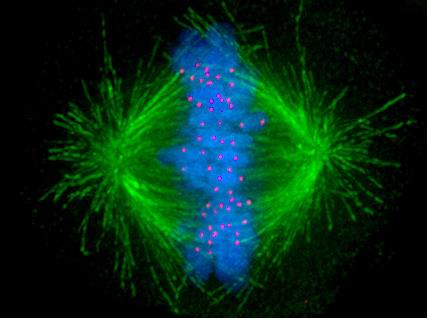
Sister chromatids
Sister chromatids are two identical copies of a chromatid connected by a centromere. Compare sister chromatids to homologous chromosomes, which are the two different copies of the same chromosome that diploid organisms inherit, one from each parent...
apart.
The kinetochore forms in eukaryotes, assembles on the centromere
Centromere
A centromere is a region of DNA typically found near the middle of a chromosome where two identical sister chromatids come closest in contact. It is involved in cell division as the point of mitotic spindle attachment...
and links the chromosome
Chromosome
A chromosome is an organized structure of DNA and protein found in cells. It is a single piece of coiled DNA containing many genes, regulatory elements and other nucleotide sequences. Chromosomes also contain DNA-bound proteins, which serve to package the DNA and control its functions.Chromosomes...
to microtubule polymers from the mitotic spindle
Mitotic spindle
In cell biology, the spindle fibers are the structure that separates the chromosomes into the daughter cells during cell division. It is part of the cytoskeleton in eukaryotic cells...
during mitosis
Mitosis
Mitosis is the process by which a eukaryotic cell separates the chromosomes in its cell nucleus into two identical sets, in two separate nuclei. It is generally followed immediately by cytokinesis, which divides the nuclei, cytoplasm, organelles and cell membrane into two cells containing roughly...
and meiosis
Meiosis
Meiosis is a special type of cell division necessary for sexual reproduction. The cells produced by meiosis are gametes or spores. The animals' gametes are called sperm and egg cells....
.
"Monocentric" organisms, including vertebrates, fungi, and most plants, have a single centromeric region on each chromosome which assembles one kinetochore. "Holocentric" organisms, such as nematodes and some plants, assemble a kinetochore along the entire length of a chromosome.
The kinetochore contains two regions:
- an inner kinetochore, which is tightly associated with the centromereCentromereA centromere is a region of DNA typically found near the middle of a chromosome where two identical sister chromatids come closest in contact. It is involved in cell division as the point of mitotic spindle attachment...
DNA, assembled in a specialized form of chromatin persistent all along the cell cycleCell cycleThe cell cycle, or cell-division cycle, is the series of events that takes place in a cell leading to its division and duplication . In cells without a nucleus , the cell cycle occurs via a process termed binary fission...
; - an outer kinetochore, which interacts with microtubuleMicrotubuleMicrotubules are a component of the cytoskeleton. These rope-like polymers of tubulin can grow as long as 25 micrometers and are highly dynamic. The outer diameter of microtubule is about 25 nm. Microtubules are important for maintaining cell structure, providing platforms for intracellular...
s; the outer kinetochore is a very dynamic structure, with many different components, which are assembled and functional only during cell division.
Kinetochores start, control and supervise the striking movements of chromosomes during cell division. During mitosis, which occurs after chromosomes are duplicated during S phase, two sister chromatids are held together each with its own kinetochore which face in opposing directions and attach to opposite poles of the mitotic spindle. Following the transition from metaphase
Metaphase
Metaphase, from the ancient Greek μετά and φάσις , is a stage of mitosis in the eukaryotic cell cycle in which condensed & highly coiled chromosomes, carrying genetic information, align in the middle of the cell before being separated into each of the two daughter cells...
to anaphase
Anaphase
Anaphase, from the ancient Greek ἀνά and φάσις , is the stage of mitosis or meiosis when chromosomes move to opposite poles of the cell....
, the sister chromatids separate from each other, and the individual kinetochores on each chromatid drive their movement to the spindle poles that will define the two new daughter cells. Thus, the kinetochore is essential for the chromosome segregation that is classically associated with mitosis and meiosis.
Even the simplest kinetochores consist of more than 45 different proteins. Many of these proteins are conserved throughout eukaryote species, including a specialized histone H3 variant (called CENP-A or CenH3) which helps the kinetochore associate with DNA. Other proteins in the kinetochore attach it to the microtubule
Microtubule
Microtubules are a component of the cytoskeleton. These rope-like polymers of tubulin can grow as long as 25 micrometers and are highly dynamic. The outer diameter of microtubule is about 25 nm. Microtubules are important for maintaining cell structure, providing platforms for intracellular...
s (MTs) of the mitotic spindle
Mitotic spindle
In cell biology, the spindle fibers are the structure that separates the chromosomes into the daughter cells during cell division. It is part of the cytoskeleton in eukaryotic cells...
. There are also motor proteins, including both dynein
Dynein
Dynein is a motor protein in cells which converts the chemical energy contained in ATP into the mechanical energy of movement. Dynein transports various cellular cargo by "walking" along cytoskeletal microtubules towards the minus-end of the microtubule, which is usually oriented towards the cell...
and kinesin
Kinesin
A kinesin is a protein belonging to a class of motor proteins found in eukaryotic cells. Kinesins move along microtubule filaments, and are powered by the hydrolysis of ATP . The active movement of kinesins supports several cellular functions including mitosis, meiosis and transport of cellular...
, which generate forces that move chromosome
Chromosome
A chromosome is an organized structure of DNA and protein found in cells. It is a single piece of coiled DNA containing many genes, regulatory elements and other nucleotide sequences. Chromosomes also contain DNA-bound proteins, which serve to package the DNA and control its functions.Chromosomes...
s during mitosis
Mitosis
Mitosis is the process by which a eukaryotic cell separates the chromosomes in its cell nucleus into two identical sets, in two separate nuclei. It is generally followed immediately by cytokinesis, which divides the nuclei, cytoplasm, organelles and cell membrane into two cells containing roughly...
. Other proteins, such as MAD2
MAD2
MAD2 is an essential spindle checkpoint protein. The spindle checkpoint system is a regulatory system that restrains progression through the metaphase-to-anaphase transition. The Mad2 gene was first identified in the yeast S. cerevisiae in a screen for genes which when mutated would confer...
monitor the microtubule attachment as well as the tension between sister kinetochores and activate the spindle checkpoint
Spindle checkpoint
In order to preserve one cell's identity and its proper functioning, it is necessary to maintain constant the appropriate number of chromosomes after each cell division...
to arrest the cell cycle when either of these is absent.
In summary, kinetochore functions include anchoring of chromosomes to MTs in the spindle, verification of anchoring, activation of the spindle checkpoint and participation in force generation to propel chromosome movement during cell division.
On the other hand, MTs are metastable polymers made of α- and β-tubulin, alternating between growing and shrinking phases, a phenomenon known as "dynamic instability". MTs are highly dynamic structures, whose behavior is integrated with kinetochore function to control chromosome movement and segregation.
Kinetochore structure in animal cells
The kinetochore is composed of several layers, observed initially by conventional fixation and staining methods of electron microscopy, (reviewed by C. Rieder in 1982) and more recently by rapid freezing and substitution.The deepest layer in the kinetochore is the inner plate, which is organized on a chromatin structure containing nucleosome
Nucleosome
Nucleosomes are the basic unit of DNA packaging in eukaryotes, consisting of a segment of DNA wound around a histone protein core. This structure is often compared to thread wrapped around a spool....
s presenting a specialized histone
Histone
In biology, histones are highly alkaline proteins found in eukaryotic cell nuclei that package and order the DNA into structural units called nucleosomes. They are the chief protein components of chromatin, acting as spools around which DNA winds, and play a role in gene regulation...
(named CENP-A, which substitutes histone H3 in this region), auxiliary proteins and DNA. DNA organization in the centromere
Centromere
A centromere is a region of DNA typically found near the middle of a chromosome where two identical sister chromatids come closest in contact. It is involved in cell division as the point of mitotic spindle attachment...
(satellite DNA
Satellite DNA
Satellite DNA consists of very large arrays of tandemly repeating, non-coding DNA. Satellite DNA is the main component of functional centromeres, and form the main structural constituent of heterochromatin....
) is one of the least known aspects in vertebrate kinetochores. The inner plate appears like a discrete heterochromatin
Heterochromatin
Heterochromatin is a tightly packed form of DNA, which comes in different varieties. These varieties lie on a continuum between the two extremes of constitutive and facultative heterochromatin...
domain all along the cell cycle
Cell cycle
The cell cycle, or cell-division cycle, is the series of events that takes place in a cell leading to its division and duplication . In cells without a nucleus , the cell cycle occurs via a process termed binary fission...
.
Outside the inner plate we find the outer plate, composed mostly by proteins. This structure is assembled in the surface of the chromosomes when the nuclear envelope
Nuclear envelope
A nuclear envelope is a double lipid bilayer that encloses the genetic material in eukaryotic cells. The nuclear envelope also serves as the physical barrier, separating the contents of the nucleus from the cytosol...
breaks down. The outer plate in vertebrate kinetochores contains about 20 anchoring sites for MTs (+) ends (named kMTs, after kinetochore MTs), whereas kinetochore's outer plate in yeast (Saccharomyces cerevisiae
Saccharomyces cerevisiae
Saccharomyces cerevisiae is a species of yeast. It is perhaps the most useful yeast, having been instrumental to baking and brewing since ancient times. It is believed that it was originally isolated from the skin of grapes...
) contains only one anchoring site.
The outermost domain in the kinetochore forms a fibrous corona, which can be visualized by conventional microscopy
Microscopy
Microscopy is the technical field of using microscopes to view samples and objects that cannot be seen with the unaided eye...
, yet only in absence of MTs. This corona is formed by a dynamic network of resident and temporary proteins implicated in the spindle checkpoint
Spindle checkpoint
In order to preserve one cell's identity and its proper functioning, it is necessary to maintain constant the appropriate number of chromosomes after each cell division...
, in MTs anchoring and in the regulation of chromosome behavior.
During mitosis, each sister chromatid
Chromatid
A chromatid is one of the two identical copies of DNA making up a duplicated chromosome, which are joined at their centromeres, for the process of cell division . They are called sister chromatids so long as they are joined by the centromeres...
forming the complete chromosome has its own kinetochore. Distinct sister kinetochores can be observed at first at the end of G2 phase
Cell cycle
The cell cycle, or cell-division cycle, is the series of events that takes place in a cell leading to its division and duplication . In cells without a nucleus , the cell cycle occurs via a process termed binary fission...
in cultured mammalian cells. These early kinetochores show a mature laminar structure before the nuclear envelope breaks down (reviewed by Pluta et al. in 1995). The molecular pathway for kinetochore assembly in high eukaryotes has been studied using gene knockout
Gene knockout
A gene knockout is a genetic technique in which one of an organism's genes is made inoperative . Also known as knockout organisms or simply knockouts, they are used in learning about a gene that has been sequenced, but which has an unknown or incompletely known function...
s in mice and in cultured chicken cells, as well as using RNA interference
RNA interference
RNA interference is a process within living cells that moderates the activity of their genes. Historically, it was known by other names, including co-suppression, post transcriptional gene silencing , and quelling. Only after these apparently unrelated processes were fully understood did it become...
(RNAi) in
C. elegans, Drosophila and human cells. Yet no simple linear route can describe the data obtained so far.
The first protein to be assembled on the kinetochore is CENP-A
CENPA
Centromere protein A, also known as CENPA, is a protein which in humans is encoded by the CENPA gene.Centromeres are the differentiated chromosomal domains that specify the mitotic behavior of chromosomes. The CENPA gene encodes a centromere protein which contains a histone H3 related histone fold...
(Cse4 in Saccharomyces cerevisiae). This protein is a specialized isoform of histone
Histone
In biology, histones are highly alkaline proteins found in eukaryotic cell nuclei that package and order the DNA into structural units called nucleosomes. They are the chief protein components of chromatin, acting as spools around which DNA winds, and play a role in gene regulation...
H3. CENP-A is required for incorporation of the inner kinetochore proteins CENP-C, CENP-H
CENPH
Centromere protein H is a protein that in humans is encoded by the CENPH gene.- Function :Centromere and kinetochore proteins play a critical role in centromere structure, kinetochore formation, and sister chromatid separation. The protein encoded by this gene colocalizes with inner kinetochore...
and CENP-I/MIS6
CENPI
Centromere protein I is a protein that in humans is encoded by the CENPI gene.-Further reading:...
. The relative position of these proteins in the CENP-A dependent pathway are not completely defined. For instance, CENP-C localization requires CENP-H in chicken cells, but it is independent of CENP-I/MIS6 in human cells. In C. elegans and metazoa, the incorporation of many proteins in the outer kinetochore depends ultimately on CENP-A.
Kinetochore proteins can be grouped according to their concentration at kinetochores during mitosis: some proteins remain bound all along cell division, whereas some others change in concentration; furthermore, they can be recycled in their binding site on kinetochores either slowly (they are rather stable) or rapidly (dynamic).
- Proteins whose levels remain stable from prophase until late anaphase include constitutive components of the inner plate and the stable components of the outer kinetocore, such as the Ndc80NDC80Kinetochore protein NDC80 homolog is a protein that in humans is encoded by the NDC80 gene.-Interactions:NDC80 has been shown to interact with MIS12, NEK2 and PSMC2.-Further reading:...
complex, KNL/KBP proteins (kinetochore-null/KNL-binding protein), MIS proteins and CENP-FCENPFCentromere protein F is a protein that in humans is encoded by the CENPF gene.-Further reading:...
. Together with the constitutive components, these proteins seem to organize the nuclear core of the inner and outer structures in the kinetochore. - The dynamic components that vary in concentration on kinetochores during mitosis include the molecular motorsMolecular motorsMolecular motors are biological molecular machines that are the essential agents of movement in living organisms. Generally speaking, a motor may be defined as a device that consumes energy in one form and converts it into motion or mechanical work; for example, many protein-based molecular motors...
CENP-E and dyneinDyneinDynein is a motor protein in cells which converts the chemical energy contained in ATP into the mechanical energy of movement. Dynein transports various cellular cargo by "walking" along cytoskeletal microtubules towards the minus-end of the microtubule, which is usually oriented towards the cell...
(as well as their target components ZW10ZW10Centromere/kinetochore protein zw10 homolog is a protein that in humans is encoded by the ZW10 gene.-Further reading:...
and ROD), and the spindle checkpointSpindle checkpointIn order to preserve one cell's identity and its proper functioning, it is necessary to maintain constant the appropriate number of chromosomes after each cell division...
proteins (such as Mad1MAD1Mad1 is a non-essential protein in yeast which has a function in the spindle assembly checkpoint .This checkpoint monitors chromosome attachment to spindle microtubules and prevents cells from starting anaphase until the spindle is built up. The name Mad refers to the observation that mutant cells...
, Mad2MAD2MAD2 is an essential spindle checkpoint protein. The spindle checkpoint system is a regulatory system that restrains progression through the metaphase-to-anaphase transition. The Mad2 gene was first identified in the yeast S. cerevisiae in a screen for genes which when mutated would confer...
, BubR1BUB1BMitotic checkpoint serine/threonine-protein kinase BUB1 beta is an enzyme that in humans is encoded by the BUB1B gene.-Interactions:BUB1B has been shown to interact with AP2B1, HDAC1, BUB3, MAD2L1, Gamma-synuclein, BRCA2 and CDC20.-Further reading:...
and Cdc20CDC20The cell-division cycle protein 20 is an essential regulator of cell division that is encoded by the CDC20 gene in humans. To the best of current knowledge its most important function is to activate the anaphase promoting complex , a large 11-13 subunit complex that initiates chromatid separation...
). These proteins assemble on the kinetochore in high concentration in absence of microtubules; however, the higher the number of MTs anchored to the kinetochore, the lower the concentration of these proteins. At metaphase, CENP-E, Bub3 and Bub1 levels disminish about 3 to 4x as compared to free kinetochores, whereas dynein/dynactin, Mad1, Mad2 and BubR1 levels are reduced >10-100x. - Whereas the spindle checkpoint protein levels present in the outer plate diminish as MTs anchor, other components such as EB1, APC and proteins in the RanRan (biology)Ran is a small 25Kda protein that is involved in transport into and out of the cell nucleus during interphase and also involved in mitosis. It is a member of the Ras superfamily....
pathway (RanGap1RANGAP1Ran GTPase-activating protein 1 is an enzyme that in humans is encoded by the RANGAP1 gene.-Interactions:RANGAP1 has been shown to interact with Ran and UBE2I.-Further reading:...
and RanBP2RANBP2RAN binding protein 2, also known as RANBP2 is protein which in humans is encoded by the RANBP2 gene.RanBP2 is also known as Nup358 since it is a member nucleoporin family that makes-up the nuclear pore complex. RanBP2 has a 358 KDa molecular weight.- Function :RAN is a small GTP-binding protein of...
) associate to kinetochores only when MTs are anchored. This may belong to a mechanism in the kinetochore to recognize the MTs plus-end (+), ensuring their proper anchoring and regulating their dynamic behavior as they remain anchored.
A 2010 study uses a complex method (termed multiclassifier combinatorial proteomics or MCCP) to analize the proteomic composition of vertebrate chromosomes, including kinetochores. Although this study does not include a biochemical enrichment for kinetochores, obtained data include all the centromeric subcomplexes, with peptides from all 125 known centromeric proteins. According to this study, there are still about one hundred unknown kinetochore proteins, doubling the known structure during mitosis, which confirms the kinetochore as one of the most complex cellular substructures.
Kinetochore function
The number of MTs attached to one kinetochore is variable: in Saccharomyces cerevisiaeSaccharomyces cerevisiae
Saccharomyces cerevisiae is a species of yeast. It is perhaps the most useful yeast, having been instrumental to baking and brewing since ancient times. It is believed that it was originally isolated from the skin of grapes...
only one MT binds each kinetochore, whereas in mammals there can be among 15-35 MTs bound to each kinetochore. However, not all the MTs in the spindle attach to one kinetochore. There are MTs that extend from one centrosome
Centrosome
In cell biology, the centrosome is an organelle that serves as the main microtubule organizing center of the animal cell as well as a regulator of cell-cycle progression. It was discovered by Edouard Van Beneden in 1883...
to the other (and they are responsible for spindle length) and some shorter ones are interdigitated between the long MTs. Professor B. Nicklas (Duke University), showed that, if one breaks down the MT-kinetochore attachment using a laser beam, chromatids cannot longer move, leading to an abnormal chromosome distribution. These experiments also showed that kinetochores have polarity, and that kinetochore attachment to MTs emanating from one or the other centrosome will depend on its orientation. This specificity guarantees that only one chromatid will move to each spindle side, thus ensuring the correct distribution of the genetic material. Thus, one of the basic functions of the kinetochore is the MT attachment to the spindle, which is essential to correctly segregate sister chromatids. If anchoring is incorrect, errors may ensue, generating aneuploidy
Aneuploidy
Aneuploidy is an abnormal number of chromosomes, and is a type of chromosome abnormality. An extra or missing chromosome is a common cause of genetic disorders . Some cancer cells also have abnormal numbers of chromosomes. Aneuploidy occurs during cell division when the chromosomes do not separate...
, with catastrophic consequences for the cell. To prevent this from happening, there are mechanisms of error detection and correction (as the spindle assembly checkpoint), whose components reside also on the kinetochores.The movement of one chromatid towards the centrosome is produced primarily by MT depolymerization in the binding site with the kinetochore. These movements require also force generation, involving molecular motors
Molecular motors
Molecular motors are biological molecular machines that are the essential agents of movement in living organisms. Generally speaking, a motor may be defined as a device that consumes energy in one form and converts it into motion or mechanical work; for example, many protein-based molecular motors...
likewise located on the kinetochores.
* Capturing MTs
Cell cycle
The cell cycle, or cell-division cycle, is the series of events that takes place in a cell leading to its division and duplication . In cells without a nucleus , the cell cycle occurs via a process termed binary fission...
, the centrosome
Centrosome
In cell biology, the centrosome is an organelle that serves as the main microtubule organizing center of the animal cell as well as a regulator of cell-cycle progression. It was discovered by Edouard Van Beneden in 1883...
starts to duplicate. Just at the beginning of mitosis, both centriole
Centriole
A Centriole is a barrel-shaped cell structure found in most animal eukaryotic cells, though it is absent in higher plants and most fungi. The walls of each centriole are usually composed of nine triplets of microtubules...
s in each centrosome reach their maximal length, centrosomes recruit additional material and their nucleation capacity for microtubule
Microtubule
Microtubules are a component of the cytoskeleton. These rope-like polymers of tubulin can grow as long as 25 micrometers and are highly dynamic. The outer diameter of microtubule is about 25 nm. Microtubules are important for maintaining cell structure, providing platforms for intracellular...
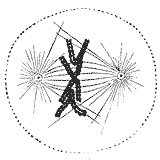
s increases. As mitosis progresses, both centrosomes separate to establish the mitotic spindle. In this way, the spindle in a mitotic cell has two poles emanating microtubules. Microtubules are long proteic filaments with asymmetric extremes, a "minus"(-) end relatively stable next to the centrosome, and a "plus"(+) end enduring alternate phases of growing-shrinking, exploring the center of the cell. During this searching process, a microtubule may encounter and capture a chromosome through the kinetochore. Microtubules that find and attach a kinetochore become stabilized, whereas those microtubules remaining free are rapidly depolymerized. As chromosomes have two kinetochores associated back-to-back (one on each sister chromatid), when one of them becomes attached to the microtubules generated by one of the cellular poles, the kinetochore on the sister chromatid becomes exposed to the opposed pole; for this reason, most of the times the second kinetochore becomes attached to the microtubules emanating from the opposing pole, in such a way that chromosomes are now « bi-oriented», one fundamental configuration (also termed amphitelic) to ensure the correct segregation of both chromatids when the cell will divide.
When just one microtubule is anchored to one kinetochore, it starts a rapid movement of the associated chromosome towards the pole generating that microtubule. This movement is probably mediated by the motor activity towards the "minus" (-) of the motor protein
Molecular motors
Molecular motors are biological molecular machines that are the essential agents of movement in living organisms. Generally speaking, a motor may be defined as a device that consumes energy in one form and converts it into motion or mechanical work; for example, many protein-based molecular motors...
cytoplasmic dynein, which is very concentrated in the kinetochores not anchored to MTs (reviewed by Banks and Heald in 2001). The movement towards the pole is slowed down as far as kinetochores acquire kMTs (MTs anchored to kinetochores) and the movement becomes directed by changes in kMTs length. Dynein is released from kinetochores as they acquire kMTs and, in cultured mammalian cells, it is required for the spindle checkpoint
Spindle checkpoint
In order to preserve one cell's identity and its proper functioning, it is necessary to maintain constant the appropriate number of chromosomes after each cell division...
inactivation, but not for chromosome congression in the spindle equator, kMTs acquisition or anaphase A
Mitosis
Mitosis is the process by which a eukaryotic cell separates the chromosomes in its cell nucleus into two identical sets, in two separate nuclei. It is generally followed immediately by cytokinesis, which divides the nuclei, cytoplasm, organelles and cell membrane into two cells containing roughly...
during chromosome segregation. In higher plants or in yeast there is no evidence of dynein, but other kinesins
Molecular motors
Molecular motors are biological molecular machines that are the essential agents of movement in living organisms. Generally speaking, a motor may be defined as a device that consumes energy in one form and converts it into motion or mechanical work; for example, many protein-based molecular motors...
towards the (-) end might compensate for the lack of dynein.
Another motor protein implicated in the initial capture of MTs is CENP-E; this is a high molecular weight kinesin associated with the fibrous corona at mammalian kinetochores from prometaphase until anaphase. In cells with low levels of CENP-E, chromosomes lack this protein at their kinetochores, which quite often are defective in their ability to congress at the metaphase plate. In this case, some chromosomes may remain chronically mono-oriented (anchored to only one pole), although most chromosomes may congress correctly at the metaphase plate.
Generally it is widely accepted that the kMTs fiber (the bundle of microtubules bound to the kinetochore) is originated by the capture of MTs polymerized at the centrosome
Centrosome
In cell biology, the centrosome is an organelle that serves as the main microtubule organizing center of the animal cell as well as a regulator of cell-cycle progression. It was discovered by Edouard Van Beneden in 1883...
s and spindle poles in mammalian cultured cells. However, MTs directly polymerized at kinetochores might also contribute significantly. The manner in which the centromeric region
Centromere
A centromere is a region of DNA typically found near the middle of a chromosome where two identical sister chromatids come closest in contact. It is involved in cell division as the point of mitotic spindle attachment...
/kinetochore initiates the formation of kMTs and the frequency at which this happens are important questions, because this mechanism may contribute not only to the initial formation of kMTs, but also to the way in which kinetochores correct defective anchoring of MTs and regulate the movement along kMTs.
* Role of Ndc80 complex
MTs associated to kinetochores present special features: compared to free MTs, kMTs are much more resistant to cold-induced depolymerization, high hydrostatic pressures or calcium exposure. Furthermore, kMTs are recycled much more slowly than astral MTs and spindle MTs with free (+) ends, and if kMTs are released from kinetochores using a laser beam, they rapidly depolymerize.When it was clear that neither dynein nor CENP-E are essential for kMTs formation, other molecules should be responsible for kMTs stabilitation. Pioneer genetic work in yeast revealed the relevance of the Ndc80 complex in kMTs anchoring. In Saccharomyces cerevisiae, the Ndc80 complex has four components: Ndc80p
NDC80
Kinetochore protein NDC80 homolog is a protein that in humans is encoded by the NDC80 gene.-Interactions:NDC80 has been shown to interact with MIS12, NEK2 and PSMC2.-Further reading:...
, Nuf2p
NUF2
Kinetochore protein Nuf2 is a protein that in humans is encoded by the NUF2 gene.-Further reading:...
, Spc24p
SPC24
Kinetochore protein Spc24 is a protein that in humans is encoded by the SPC24 gene.-Further reading:...
and Spc25p. Mutants lacking any of the components of this complex show loss of the kinetochore-microtubule connection, although kinetochore structure is not completely lost. Yet mutants in which kinetochore structure is lost (for instance Ndc10 mutants in yeast) are deficient both in the connection to microtubules and in the ability to activate the spindle checkpoint
Spindle checkpoint
In order to preserve one cell's identity and its proper functioning, it is necessary to maintain constant the appropriate number of chromosomes after each cell division...
, probably because kinetochores work as a platform in which the components of the response are assembled.
The Ndc80 complex is highly conserved and it has been identified in S. pombe, C. elegans, Xenopus, chicken and humans. Studies on Hec1 (highly expressed in cancer cells 1), the human homolog of Ndc80p, show that it is important for correct chromosome congression and mitotic progression, and that it interacts with components of the cohesin
Cohesin
Cohesin is a protein complex that regulates the separation of sister chromatids during cell division, either mitosis or meiosis.- Structure :...
and condensin
Condensin
Condensins are large protein complexes that play a central role in chromosome assembly and segregation in eukaryotic cells.- Subunit composition :...
complexes.
Different laboratories have shown that the Ndc80 complex is essential for stabilization of the kinetochore-microtubule anchoring, required to support the centromeric tension implicated in the establishment of the correct chromosome congression in high eukaryotes. Cells with impaired function of Ndc80 (using RNAi
RNAI
RNAI is a non-coding RNA that is an antisense repressor of the replication of some E. coli plasmids, including ColE1. Plasmid replication is usually initiated by RNAII, which acts as a primer by binding to its template DNA. The complementary RNAI binds RNAII prohibiting it from its initiation role...
, gene knockout
Gene knockout
A gene knockout is a genetic technique in which one of an organism's genes is made inoperative . Also known as knockout organisms or simply knockouts, they are used in learning about a gene that has been sequenced, but which has an unknown or incompletely known function...
, or antibody
Antibody
An antibody, also known as an immunoglobulin, is a large Y-shaped protein used by the immune system to identify and neutralize foreign objects such as bacteria and viruses. The antibody recognizes a unique part of the foreign target, termed an antigen...
microinjection) have abnormally long spindles, lack of tension between sister kinetochores, chromosomes unable to congregate at the metaphase plate and few or any associated kMTs.
There is a variety of strong support for the ability of the Ndc80 complex to directly associate with microtubules and forms the core conserved component of the kinetochore-microtubule interface. However, formation of robust kinetochore-microtubule interactions may also require the function of additional proteins. In yeast, this connection requires the presence of the complex Dam1-DASH-DDD. Some members of this complex bind directly to MTs, whereas some others bind to the Ndc80 complex. This means that the complex Dam1-DASH-DDD might be an essential adapter between kinetochores and microtubules. However, in animals an equivalent complex has not been identified, and this question remains under intense investigation.
Verification of kinetochore-MT anchoring
When a cell enters in mitosisMitosis
Mitosis is the process by which a eukaryotic cell separates the chromosomes in its cell nucleus into two identical sets, in two separate nuclei. It is generally followed immediately by cytokinesis, which divides the nuclei, cytoplasm, organelles and cell membrane into two cells containing roughly...
, it duplicates all the genetic information stored in the chromosomes, in the process termed DNA replication
DNA replication
DNA replication is a biological process that occurs in all living organisms and copies their DNA; it is the basis for biological inheritance. The process starts with one double-stranded DNA molecule and produces two identical copies of the molecule...
. At the end of this process, each chromosome
Chromosome
A chromosome is an organized structure of DNA and protein found in cells. It is a single piece of coiled DNA containing many genes, regulatory elements and other nucleotide sequences. Chromosomes also contain DNA-bound proteins, which serve to package the DNA and control its functions.Chromosomes...
includes two sister chromatid
Chromatid
A chromatid is one of the two identical copies of DNA making up a duplicated chromosome, which are joined at their centromeres, for the process of cell division . They are called sister chromatids so long as they are joined by the centromeres...
s, which are two complete and identical DNA molecules. Both chromatids remain associated by cohesin
Cohesin
Cohesin is a protein complex that regulates the separation of sister chromatids during cell division, either mitosis or meiosis.- Structure :...
complexes until anaphase, when chromosome segregation occurs. If chromosome segregation happens correctly, each daughter cell receives a complete set of chromatids, and for this to happen each sister chromatid has to anchor (through the corresponding kinetochore) to MTs generated in opposed poles of the mitotic spindle. This configuration is termed amphitelic or "bi-orientation".
However, during the anchoring process some incorrect configurations may also appear:
- monotelic: only one of the chromatids is anchored to MTs, the second kinetochore is not anchored; in this situation, there is no centromeric tension, and the spindle checkpointSpindle checkpointIn order to preserve one cell's identity and its proper functioning, it is necessary to maintain constant the appropriate number of chromosomes after each cell division...
is activated, delaying entry in anaphase and allowing time for the cell to correct the error. If it is not corrected, the unanchored chromatid might randomly end in any of the two daughter cells, generating aneuploidyAneuploidyAneuploidy is an abnormal number of chromosomes, and is a type of chromosome abnormality. An extra or missing chromosome is a common cause of genetic disorders . Some cancer cells also have abnormal numbers of chromosomes. Aneuploidy occurs during cell division when the chromosomes do not separate...
: one daughter cell would have chromosomes in excess and the other would lack some chromosomes. - syntelic: both chromatids are anchored to MTs emanating from the same pole; this situation does not generate centromeric tension either, and the spindle checkpoint will be activated. If it is not corrected, both chromatids will end in the same daughter cell, generating aneuploidy.
- merotelic: at least one chromatid is anchored simultaneously to MTs emanating from both poles. This situation generates centromeric tension, and for this reason the spindle checkpoint is not activated. If it is not corrected, the chromatid bound to both poles will remain as a lagging chromosome at anaphase, and finally will be broken in two fragments, distributed between the daughter cells, generating aneuploidy.
Both the monotelic and the syntelic configurations fail to generate centromeric tension and are detected by the spindle checkpoint. In contrast, the merotelic configuration is not detected by this control mechanism. However, most of these errors are detected and corrected before the cell enters in anaphase. A key factor in the correction of these anchoring errors is the chromosomal passenger complex, which includes the kinase
Kinase
In chemistry and biochemistry, a kinase is a type of enzyme that transfers phosphate groups from high-energy donor molecules, such as ATP, to specific substrates, a process referred to as phosphorylation. Kinases are part of the larger family of phosphotransferases...
protein Aurora B, its target and activating subunit INCENP and two other subunits, Survivin and Borealin/Dasra B (reviewed by Adams and collaborators in 2001). Cells in which the function of this complex has been abolished by dominant negative mutants, RNAi
RNAI
RNAI is a non-coding RNA that is an antisense repressor of the replication of some E. coli plasmids, including ColE1. Plasmid replication is usually initiated by RNAII, which acts as a primer by binding to its template DNA. The complementary RNAI binds RNAII prohibiting it from its initiation role...
, antibody
Antibody
An antibody, also known as an immunoglobulin, is a large Y-shaped protein used by the immune system to identify and neutralize foreign objects such as bacteria and viruses. The antibody recognizes a unique part of the foreign target, termed an antigen...
microinjection or using selective drugs, accumulate errors in chromosome anchoring. Many studies have shown that Aurora B is required to destabilize incorrect anchoring kinetochore-MT, favoring the generation of amphitelic connections. Aurora B homolog in yeast (Ipl1p) phosphorilates some kinetochore proteins, such as the constitutive protein Ndc10p and members of the Ndc80 and Dam1-DASH-DDD complexes. Phosphorilation of Ndc80 complex components produces destabilization of kMTs anchoring. It has been proposed that Aurora B localization is important for its function: as it is located in the inner region of the kinetochore (in the centromeric heterochromatin), when the centromeric tension is established sister kinetochores separate, and Aurora B cannot reach its substrates, so that kMTs are stabilized. It is interesting to note that Aurora B is frequently overexpressed in several cancer types, and it is currently a target for the development of anticancer drugs.
Spindle checkpoint activation
The spindle checkpoint or SAC (for spindle assembly checkpoint), also known as mitotic checkpoint, is a cellular mechanism responsible for detection of:- correct assembly of the mitotic spindle
- attachment of all chromosomes to the mitotic spindle in a bipolar manner
- congression of all chromosomes at the metaphase plate.
When just one chromosome (for any reason) remains lagging during congression, the spindle checkpoint machinery generates a delay in cell cycle progression: the cell is arrested, allowing time for repair mechanisms to solve the detected problem. After some time, if the problem has not been solved, the cell will be targeted for apoptosis
Apoptosis
Apoptosis is the process of programmed cell death that may occur in multicellular organisms. Biochemical events lead to characteristic cell changes and death. These changes include blebbing, cell shrinkage, nuclear fragmentation, chromatin condensation, and chromosomal DNA fragmentation...
(programmed cell death), a safety mechanism to avoid the generation of aneuploidy
Aneuploidy
Aneuploidy is an abnormal number of chromosomes, and is a type of chromosome abnormality. An extra or missing chromosome is a common cause of genetic disorders . Some cancer cells also have abnormal numbers of chromosomes. Aneuploidy occurs during cell division when the chromosomes do not separate...
, a situation which generally has dramatic consequences for the organism.
Whereas structural centromeric proteins (such as CENP-B), remain stably localized all along mitosis (including telophase), the spindle checkpoint components are assembled on the kinetochore in high concentrations in absence of MTs, and their concentration decreases as the number of MTs attached to the kinetochore increases. At metaphase, CENP-E, Bub3
BUB3
Mitotic checkpoint protein BUB3 is a protein that in humans is encoded by the BUB3 gene.Bub3 is a protein involved with the regulation of the Spindle Assembly Checkpoint ; though BUB3 is non-essential in yeast, it is essential in higher eukaryotes...
and Bub1
BUB1
Mitotic checkpoint serine/threonine-protein kinase BUB1 also known as BUB1 is an enzyme that in humans is encoded by the BUB1 gene....
levels decreases 3 to 4 fold as compared to the levels at unattached kinetochores, whereas the levels of dynein/dynactin
Dynein
Dynein is a motor protein in cells which converts the chemical energy contained in ATP into the mechanical energy of movement. Dynein transports various cellular cargo by "walking" along cytoskeletal microtubules towards the minus-end of the microtubule, which is usually oriented towards the cell...
, Mad1
MAD1
Mad1 is a non-essential protein in yeast which has a function in the spindle assembly checkpoint .This checkpoint monitors chromosome attachment to spindle microtubules and prevents cells from starting anaphase until the spindle is built up. The name Mad refers to the observation that mutant cells...
, Mad2
MAD2L1
Mitotic spindle assembly checkpoint protein MAD2A is a protein that in humans is encoded by the MAD2L1 gene.-Interactions:MAD2L1 has been shown to interact with MAD2L2, CDC20, BUB1B, Estrogen receptor beta, ADAM17, UBD, CDC27 and Mad1....
and BubR1
BUB1B
Mitotic checkpoint serine/threonine-protein kinase BUB1 beta is an enzyme that in humans is encoded by the BUB1B gene.-Interactions:BUB1B has been shown to interact with AP2B1, HDAC1, BUB3, MAD2L1, Gamma-synuclein, BRCA2 and CDC20.-Further reading:...
decrease >10-100 fold. Thus at metaphase, when all chromosomes are aligned at the metaphase plate, all checkpoint proteins are released from the kinetochore. The disappearance of the checkpoint proteins out of the kinetochores indicates the moment when the chromosome has reached the metaphase plate and is under bipolar tension. At this moment, the checkpoint proteins that bind to and inhibit Cdc20
CDC20
The cell-division cycle protein 20 is an essential regulator of cell division that is encoded by the CDC20 gene in humans. To the best of current knowledge its most important function is to activate the anaphase promoting complex , a large 11-13 subunit complex that initiates chromatid separation...
(Mad1-Mad2 and BubR1), release Cdc20, which binds and activates APC/CCdc20, and this complex triggers sister chromatids separation and consequently anaphase entry.
Several studies indicate that the Ndc80 complex participates in the regulation of the stable association of Mad1-Mad2 and dynein with kinetochores. Yet the kinetochore associated proteins CENP-A, CENP-C, CENP-E, CENP-H and BubR1 are independent of Ndc80/Hec1. The prolonged arrest in prometaphase observed in cells with low levels of Ndc80/Hec1 depends on Mad2, although these cells show low levels of Mad1, Mad2 and dynein on kinetochores (<10-15% in relation to unattached kinetochores). However, if both Ndc80/Hec1 and Nuf2 levels are reduced, Mad1 and Mad2 completely disappear from the kinetochores and the spindle checkpoint is inactivated.
Shugoshin (Sgo1, MEI-S332 in Drosophila melanogaster) are centromeric proteins which are essential to maintain cohesin
Cohesin
Cohesin is a protein complex that regulates the separation of sister chromatids during cell division, either mitosis or meiosis.- Structure :...
bound to centromeres until anaphase. The human homolog, hsSgo1, associates with centromeres during prophase and disappears when anaphase starts. When Shugoshin levels are reduced by RNAi
RNAI
RNAI is a non-coding RNA that is an antisense repressor of the replication of some E. coli plasmids, including ColE1. Plasmid replication is usually initiated by RNAII, which acts as a primer by binding to its template DNA. The complementary RNAI binds RNAII prohibiting it from its initiation role...
in HeLa
HeLa
A HeLa cell is a cell type in an immortal cell line used in scientific research. It is the oldest and most commonly used human cell line. The line was derived from cervical cancer cells taken on February 8, 1951 from Henrietta Lacks, a patient who eventually died of her cancer on October 4, 1951...
cells, cohesin cannot remain on the centromeres during mitosis, and consequently sister chromatids separate synchronically before anaphase initiates, which triggers a long mitotic arrest.
On the other hand, Dasso and collaborators have found that proteins involved in the Ran cycle
Ran (biology)
Ran is a small 25Kda protein that is involved in transport into and out of the cell nucleus during interphase and also involved in mitosis. It is a member of the Ras superfamily....
can be detected on kinetochores during mitosis: RanGAP1
RANGAP1
Ran GTPase-activating protein 1 is an enzyme that in humans is encoded by the RANGAP1 gene.-Interactions:RANGAP1 has been shown to interact with Ran and UBE2I.-Further reading:...
(a GTPase activating protein which stimulates the conversion of Ran-GTP in Ran-GDP) and the Ran binding protein called RanBP2/Nup358
RANBP2
RAN binding protein 2, also known as RANBP2 is protein which in humans is encoded by the RANBP2 gene.RanBP2 is also known as Nup358 since it is a member nucleoporin family that makes-up the nuclear pore complex. RanBP2 has a 358 KDa molecular weight.- Function :RAN is a small GTP-binding protein of...
. During interphase, these proteins are located at the nuclear pore
Nuclear pore
Nuclear pores are large protein complexes that cross the nuclear envelope, which is the double membrane surrounding the eukaryotic cell nucleus. There are about on average 2000 nuclear pore complexes in the nuclear envelope of a vertebrate cell, but it varies depending on cell type and the stage in...
s and participate in the nucleo-cytoplasmic transport. Kinetochore localization of these proteins seem to be functionally significant, because some treatments that increase the levels of Ran-GTP inhibit kinetochore release of Bub1, Bub3, Mad2 and CENP-E.
Curiously, Orc2 (a protein that belongs to the origin recognition complex
Origin Recognition Complex
ORC or Origin Recognition Complex is a multi-subunit DNA binding complex that binds in all eukaryotes in an ATP-dependent manner to origins of replication....
-ORC- implicated in DNA replication
DNA replication
DNA replication is a biological process that occurs in all living organisms and copies their DNA; it is the basis for biological inheritance. The process starts with one double-stranded DNA molecule and produces two identical copies of the molecule...
initiation during S phase
Cell cycle
The cell cycle, or cell-division cycle, is the series of events that takes place in a cell leading to its division and duplication . In cells without a nucleus , the cell cycle occurs via a process termed binary fission...
) is also localized at kinetochores during mitosis in human cells; in agreement with this localization, some studies indicate that Orc2 in yeast is implicated in sister chromatids cohesion, and when it is eliminated from the cell, spindle checkpoint
Spindle checkpoint
In order to preserve one cell's identity and its proper functioning, it is necessary to maintain constant the appropriate number of chromosomes after each cell division...
activation ensues. Some other ORC components (such orc5 in S. pombe) have been also found to participate in cohesion. However, ORC proteins seem to participate in a molecular pathway which is additive to cohesin
Cohesin
Cohesin is a protein complex that regulates the separation of sister chromatids during cell division, either mitosis or meiosis.- Structure :...
pathway, and it is mostly unknown.
Force generation to propel chromosome movement
Most chromosome movements in relation to spindle poles are associated to lengthening and shortening of kMTs. One of the most interesting features of kinetochores is their capacity to modify the state of their associated kMTs (around 20) from a depolymerization state at their (+) end to polymerization state. This allows the kinetochores from cells at prometaphase to show "directional instability", changing between persistent phases of movement towards the pole (poleward) or inversed (anti-poleward), which are coupled with alterning states of kMTs depolymerization and polymerization, respectively. This kinetochore bi-stability seem to be part of a mechanism to align the chromosomes at the equator of the spindle without losing the mechanic connection between kinetochores and spindle poles. It is thought that kinetochore bi-stability is based upon the dynamic instability of the kMTs (+) end, and it is partially controlled by the tension present at the kinetochore. In mammalian cultured cells, a low tension at kinetochores promotes change towards kMTs depolymerization, and high tension promotes change towards kMTs polymerization.Kinetochore proteins and proteins binding to MTs (+) end (collectivelly called +TIPs) regulate kinetochore movement through the kMTs (+) end dynamics regulation. However, the kinetochore-microtubule interface is highly dynamic, and some of these proteins seem to be bona fide components of both structures. Two groups of proteins seem to be particularly important: kinesins
Molecular motors
Molecular motors are biological molecular machines that are the essential agents of movement in living organisms. Generally speaking, a motor may be defined as a device that consumes energy in one form and converts it into motion or mechanical work; for example, many protein-based molecular motors...
which work like depolymerases, such as KinI kinesins; and proteins bound to MT (+) ends, +TIPs, promoting polymerization, perhaps antagonizing the depolymerases effect.
- KinI kinesins are named "I" because they present and internal motor domain, which uses ATPAdenosine triphosphateAdenosine-5'-triphosphate is a multifunctional nucleoside triphosphate used in cells as a coenzyme. It is often called the "molecular unit of currency" of intracellular energy transfer. ATP transports chemical energy within cells for metabolism...
to promote depolymerization of tubuline poymer, the microtubule. In vertebrates, the most important KinI kinesin controlling the dynamics of the (+) end assembly is MCAK. However, it seems that there are other kinesins implilcated. - There are two groups of +TIPs with kinetochore functions.
- The first one includes the protein adenomatous polyposis coli (APC) and the associated protein EB1, which need MTs to localize on the kinetochores. Both proteins are required for correct chromosome segregation. EB1 binds only to MTs in polymerizing state, suggesting that it promotes kMTs stabilization during this phase.
- The second group of +TIPs includes proteins which can localize on kinetochores even in absence of MTs. In this group there are two proteins that have been widely studied: CLIP-170 and their associated proteins CLASPs (CLIP-associated proteins). CLIP-170 role at kinetochores is unknown, but the expression of a dominant negative mutant produces a prometaphase delay, suggesting that it has an active role in chromosome alignement. CLASPs proteins are required for chromosome alignment and maintenance of a bipolar spindle in Drosophila, humans and yeast.