


Kim Dae Jung

Encyclopedia
Kim Dae-jung was President of South Korea
from 1998 to 2003, and the 2000 Nobel Peace Prize
recipient. He came to be called the "Nelson Mandela
of Asia" for his long-standing opposition to authoritarian rule.
in what was then the Jeolla
province; the city is now in South Jeolla province. Kim graduated from Mokpo Commercial High School in 1943 at the top of the class. After working as a clerk for a Japanese-owned shipping company during the Japanese occupation of Korea, he became its owner and became very rich. Kim escaped Communist capture during the Korean War
.
Kim first entered politics in 1954 during the administration of Korea's first president, Syngman Rhee
. Although he was elected as a representative for the National Assembly
in 1961, a military coup led by Park Chung-hee
, who later assumed dictatorial powers, voided the elections. He was able to win a seat in the House in the subsequent elections in 1963 and 1967 and went on to become an eminent opposition leader. As such, he was the natural opposition candidate for the country's presidential election in 1971. He nearly defeated Park, despite several handicaps on his candidacy which were imposed by the ruling regime.
A very talented orator, Kim could command unwavering loyalty among his supporters. His staunchest support came from the Jeolla
region, where he reliably garnered upwards of 95% of the popular vote, a record that has remained unsurpassed in South Korean politics.
Kim was almost killed in August 1973, when he was kidnapped from a hotel in Tokyo by KCIA
agents in response to his criticism of President Park's yushin program, which granted near-dictatorial powers to the president. Only the intervention of American ambassador Philip Habib
saved him from being drowned.
Although Kim returned to Seoul
, he was banned from politics and imprisoned in 1976 for having participated in the proclamation of an anti-government manifesto and sentenced for five years in prison, which was reduced to house arrest in 1978.
Kim had his political rights restored in 1979 after Park was assassinated. However in 1980, Kim was arrested and sentenced to death on charges of sedition and conspiracy in the wake of another coup by Chun Doo-hwan
and a popular uprising
in Gwangju
, his political stronghold. With the intervention of the United States government, the sentence was commuted to 20 years in prison and later he was given exile to the U.S. Kim temporarily settled in Boston and taught at Harvard University
as a visiting professor to the Center for International Affairs, until he chose to return to his homeland in 1985. During his period abroad, he authored a number of opinion pieces in leading Western newspapers that were sharply critical of his government.
Pope John Paul II sent a letter to then-South Korean President Chun Doo-hwan on 11 December 1980, asking for "clemency" for Kim, a Catholic, who had been sentenced to death a week before. The National Archives of Korea revealed the contents of the letter at the request of the "Kwangju Ilbo," the local daily newspaper in Gwangju (Kwangju).
both ran, despite an initial promise to unite behind one candidate. As a result, the opposition vote was split in two, and ex-general Roh Tae-woo
– Chun Doo-hwan's hand-picked successor – won with only 36.5% of the popular vote. Kim Young-sam receiving 28% and Kim Dae-jung 27% of the vote.
In 1992, Kim made yet another failed bid for the presidency, this time solely against Kim Young-sam, who had merged his party with the ruling Democratic Justice Party
to form the Democratic Liberal Party (which eventually became the Grand National Party
). Many thought Kim Dae-jung's political career was effectively over when he took a hiatus from politics and departed for the United Kingdom to take a position at Clare Hall
, Cambridge University as a visiting scholar. However, in 1995 he announced his return to politics and began his fourth quest for the presidency.
The situation became favorable for him when the public revolted against the incumbent government in the wake of the nation's economic collapse in the Asian financial crisis just weeks before the presidential election. Allied with Kim Jong-pil
, he defeated Lee Hoi-chang
, Kim Young-sam's successor, in the election held on 18 December 1997
, and was inaugurated as the eighth President of South Korea on 25 February 1998. This inauguration marked the first time in Korean history that the ruling party peacefully transferred power to a democratically elected opposition victor. The election was marred with controversy, as two candidates from the ruling party split the conservative vote (38.7% and 19.2% respectively), enabling Kim to win with only 40.3% of the popular vote. Kim's chief opponent, Hoi-chang, was a former Supreme Court Justice and had graduated at the top of his class from Seoul National University
School of Law. Lee was widely viewed as elitist and his candidacy was further damaged by charges that his sons dodged mandatory military service. Kim's education in contrast was limited to vocational high school, and many Koreans sympathized with the many trials and tribulations that Kim had endured previously.
The preceding presidents Park Chung Hee, Chun Doo-hwan
, Roh Tae-woo
, and Kim Young-sam
originated from the Gyeongsang
region, which became wealthier since 1945 partly due to the policies of the Park, Chun and Roh's regimes. Kim Dae-jung was the first president to serve out his full term who came from the Jeolla
region in the southwest, an area that had been neglected and less developed, at least partly because of discriminatory policies of previous presidents. Kim's administration included more individuals from the Jeolla province, leading to charges of reverse discrimination. However, the actual numbers of the ministers and administrators of Kim Dae Jung's government from Jeolla region indicate that they were not over-represented.
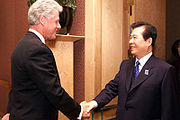 Kim Dae-jung took office in the midst of the economic crisis that hit South Korea in the final year of Kim Young-sam's term. He vigorously pushed economic reform and restructuring recommended by the International Monetary Fund, in the process significantly altering the landscape of South Korean economy
. After the economy shrank by 5.8 percent in 1998, it grew 10.2 percent in 1999. In effect, his policies were to make for a fairer market by holding the powerful chaebol (conglomerates) accountable, e.g., greater transparency in accounting practices. State subsidies to large corporations were dramatically cut or dropped.
has been termed the Sunshine Policy
. He moved to begin détente with the totalitarian regime in North Korea, which culminated in a historic summit meeting in 2000 in Pyongyang with North Korean leader Kim Jong-il. This began a now decade-old process of frustrating, but continuing direct contact with Pyongyang. He was awarded the Nobel Peace Prize for these efforts. However, the historic event was tainted significantly by revelations that at least several hundred million dollars had been paid to Pyongyang. In fact, his Chief of Staff, Park Ji-Won, was sentenced to twelve years in prison in 2003 for, among other charges, his role in the Hyundai payment to North Korea for the North–South summit. The effect of the Sunshine Policy is also questioned by many critics, who cite the money transfers and the coverup of atrocities in the North.
, jointly hosted by Korea and Japan in 2002. Kim completed his 5-year presidential term in 2003 and was succeeded by Roh Moo-hyun
. A presidential library at Yonsei University
was built to preserve Kim's legacy, and there is a convention center named after him in the city of Gwangju, the Kim Dae-jung Convention Center.
towards Pyongyang
to defuse the crisis. He also received an honorary doctorate at the University of Portland on 17 April 2008 where he delivered his speech, "Challenge, Response, and God."
The Wikileaks
data reveals that the US Embassy in Seoul described Kim as "South Korea's first left-wing president" to the American government on his day of death.
of Yonsei University
in Seoul
. The cause of death was given as multiple organ dysfunction syndrome
. An interfaith state funeral was held for former President Kim Dae-jung on 23 August 2009 in front of the National Assembly Building
, with a procession leading to the Seoul National Cemetery
where he was interred according to Catholic traditions. Former President Kim was the third person in modern South Korean history to be given a State Funeral
after Park Chung-hee
.
On 2 February 2010 the janitor of the cemetery found out that parts of the grass around Kim Dae-jung's tomb had caught fire.
President of South Korea
The President of the Republic of Korea is, according to the Constitution of the Republic of Korea, chief executive of the government, commander-in-chief of the armed forces, and the head of state of the Republic of Korea...
from 1998 to 2003, and the 2000 Nobel Peace Prize
Nobel Peace Prize
The Nobel Peace Prize is one of the five Nobel Prizes bequeathed by the Swedish industrialist and inventor Alfred Nobel.-Background:According to Nobel's will, the Peace Prize shall be awarded to the person who...
recipient. He came to be called the "Nelson Mandela
Nelson Mandela
Nelson Rolihlahla Mandela served as President of South Africa from 1994 to 1999, and was the first South African president to be elected in a fully representative democratic election. Before his presidency, Mandela was an anti-apartheid activist, and the leader of Umkhonto we Sizwe, the armed wing...
of Asia" for his long-standing opposition to authoritarian rule.
Early life
Kim was born in SinanSinan
Koca Mi'mâr Sinân Âğâ was the chief Ottoman architect and civil engineer for sultans Suleiman the Magnificent, Selim II, and Murad III...
in what was then the Jeolla
Jeolla
Jeolla was a province in southwestern Korea, one of the historical Eight Provinces of Korea during the Joseon Dynasty. It consisted of the modern South Korean provinces of North Jeolla, South Jeolla and the Special City of Gwangju as well as Jeju Island...
province; the city is now in South Jeolla province. Kim graduated from Mokpo Commercial High School in 1943 at the top of the class. After working as a clerk for a Japanese-owned shipping company during the Japanese occupation of Korea, he became its owner and became very rich. Kim escaped Communist capture during the Korean War
Korean War
The Korean War was a conventional war between South Korea, supported by the United Nations, and North Korea, supported by the People's Republic of China , with military material aid from the Soviet Union...
.
Kim first entered politics in 1954 during the administration of Korea's first president, Syngman Rhee
Syngman Rhee
Syngman Rhee or Yi Seungman was the first president of South Korea. His presidency, from August 1948 to April 1960, remains controversial, affected by Cold War tensions on the Korean peninsula and elsewhere. Rhee was regarded as an anti-Communist and a strongman, and he led South Korea through the...
. Although he was elected as a representative for the National Assembly
National Assembly of South Korea
The National Assembly of the Republic of Korea is a 299-member unicameral legislature. The latest general elections were held on April 9, 2008. Single-member constituencies comprise 245 of the National Assembly's seats, while the remaining 54 are allocated by proportional representation...
in 1961, a military coup led by Park Chung-hee
Park Chung-hee
Park Chung-hee was a Republic of Korea Army general and the leader of South Korea from 1961 to 1979. He seized power in a military coup and ruled until his assassination in 1979. He has been credited with the industrialization of the Republic of Korea through export-led growth...
, who later assumed dictatorial powers, voided the elections. He was able to win a seat in the House in the subsequent elections in 1963 and 1967 and went on to become an eminent opposition leader. As such, he was the natural opposition candidate for the country's presidential election in 1971. He nearly defeated Park, despite several handicaps on his candidacy which were imposed by the ruling regime.
A very talented orator, Kim could command unwavering loyalty among his supporters. His staunchest support came from the Jeolla
Jeolla
Jeolla was a province in southwestern Korea, one of the historical Eight Provinces of Korea during the Joseon Dynasty. It consisted of the modern South Korean provinces of North Jeolla, South Jeolla and the Special City of Gwangju as well as Jeju Island...
region, where he reliably garnered upwards of 95% of the popular vote, a record that has remained unsurpassed in South Korean politics.
Kim was almost killed in August 1973, when he was kidnapped from a hotel in Tokyo by KCIA
National Intelligence Service (South Korea)
The National Intelligence Service is the chief intelligence agency of South Korea. The agency was officially established in 1961 as the Korea Central Intelligence Agency , during the rule of President Park Chung-hee's military Supreme Council for National Reconstruction, which displaced the...
agents in response to his criticism of President Park's yushin program, which granted near-dictatorial powers to the president. Only the intervention of American ambassador Philip Habib
Philip Habib
Philip Charles Habib was a Lebanese-American career diplomat known for work in Vietnam, South Korea and the Middle East...
saved him from being drowned.
Although Kim returned to Seoul
Seoul
Seoul , officially the Seoul Special City, is the capital and largest metropolis of South Korea. A megacity with a population of over 10 million, it is the largest city proper in the OECD developed world...
, he was banned from politics and imprisoned in 1976 for having participated in the proclamation of an anti-government manifesto and sentenced for five years in prison, which was reduced to house arrest in 1978.
Kim had his political rights restored in 1979 after Park was assassinated. However in 1980, Kim was arrested and sentenced to death on charges of sedition and conspiracy in the wake of another coup by Chun Doo-hwan
Chun Doo-hwan
Chun Doo-hwan was a ROK Army general and the President of South Korea from 1980 to 1988. Chun was sentenced to death in 1996 for his heavy-handed response to the Gwangju Democratization Movement, but later pardoned by President Kim Young-sam with the advice of then President-elect Kim Dae-jung,...
and a popular uprising
Gwangju massacre
The Gwangju Democratization Movement refers to a popular uprising in the city of Gwangju, South Korea from May 18 to May 27, 1980. During this period, citizens rose up against Chun Doo-hwan's military dictatorship and took control of the city...
in Gwangju
Gwangju
Gwangju is the sixth largest city in South Korea. It is a designated metropolitan city under the direct control of the central government's Home Minister...
, his political stronghold. With the intervention of the United States government, the sentence was commuted to 20 years in prison and later he was given exile to the U.S. Kim temporarily settled in Boston and taught at Harvard University
Harvard University
Harvard University is a private Ivy League university located in Cambridge, Massachusetts, United States, established in 1636 by the Massachusetts legislature. Harvard is the oldest institution of higher learning in the United States and the first corporation chartered in the country...
as a visiting professor to the Center for International Affairs, until he chose to return to his homeland in 1985. During his period abroad, he authored a number of opinion pieces in leading Western newspapers that were sharply critical of his government.
Pope John Paul II sent a letter to then-South Korean President Chun Doo-hwan on 11 December 1980, asking for "clemency" for Kim, a Catholic, who had been sentenced to death a week before. The National Archives of Korea revealed the contents of the letter at the request of the "Kwangju Ilbo," the local daily newspaper in Gwangju (Kwangju).
Road to the presidency
Kim was again put under house arrest upon his return to Seoul, but resumed his role as one of the principal leaders of the opposition. When Chun Doo-hwan succumbed to the popular demand in 1987 and allowed the country's first honest presidential election, Kim Dae-jung and Kim Young-samKim Young-sam
Kim Young-sam was a South Korean politician and democratic activist. From 1961, he spent 30 years as South Korea's leader of the opposition, and one of Park Chung-hee's most powerful rivals....
both ran, despite an initial promise to unite behind one candidate. As a result, the opposition vote was split in two, and ex-general Roh Tae-woo
Roh Tae-woo
Roh Tae-woo , is a former ROK Army general and politician. He was the 13th president of South Korea .Roh befriended Chun Doo-hwan while in high school in Daegu. In his younger life, Roh was a keen rugby union player....
– Chun Doo-hwan's hand-picked successor – won with only 36.5% of the popular vote. Kim Young-sam receiving 28% and Kim Dae-jung 27% of the vote.
In 1992, Kim made yet another failed bid for the presidency, this time solely against Kim Young-sam, who had merged his party with the ruling Democratic Justice Party
Democratic Justice Party
The Democratic Justice Party was the ruling party of South Korea from 1980 to 1990.It was formed in 1980 as the Democratic Republican Party and was the political vehicle for Chun Doo-hwan....
to form the Democratic Liberal Party (which eventually became the Grand National Party
Grand National Party
The Grand National Party is a conservative political party in South Korea. Its Korean name, Hannara, has a double meaning as "Great National" and "Korean National." The GNP holds a majority of seats in the 18th Assembly, lasting from 2008 to 2012....
). Many thought Kim Dae-jung's political career was effectively over when he took a hiatus from politics and departed for the United Kingdom to take a position at Clare Hall
Clare Hall, Cambridge
Clare Hall is a constituent college of the University of Cambridge, England. It is a college for advanced study, admitting only postgraduate students.Informality is a defining value at Clare Hall and this contributes to its unique character...
, Cambridge University as a visiting scholar. However, in 1995 he announced his return to politics and began his fourth quest for the presidency.
The situation became favorable for him when the public revolted against the incumbent government in the wake of the nation's economic collapse in the Asian financial crisis just weeks before the presidential election. Allied with Kim Jong-pil
Kim Jong-pil
Kim Jong-pil is a South Korean politician and founder of the Korean Central Intelligence Agency , who served as Prime Minister twice, from 1971–1975 and from 1998–2000.-Early life:...
, he defeated Lee Hoi-chang
Lee Hoi-chang
Lee Hoi-chang is a South Korean politician. A Catholic, he was born to an elite family in Seoheung, Hwanghae , but grew up in the south after his father, a public prosecutor, was appointed to a new post....
, Kim Young-sam's successor, in the election held on 18 December 1997
South Korean presidential election, 1997
The 15th South Korean Presidential Election took place on 19 December 1997.-Results:...
, and was inaugurated as the eighth President of South Korea on 25 February 1998. This inauguration marked the first time in Korean history that the ruling party peacefully transferred power to a democratically elected opposition victor. The election was marred with controversy, as two candidates from the ruling party split the conservative vote (38.7% and 19.2% respectively), enabling Kim to win with only 40.3% of the popular vote. Kim's chief opponent, Hoi-chang, was a former Supreme Court Justice and had graduated at the top of his class from Seoul National University
Seoul National University
Seoul National University , colloquially known in Korean as Seoul-dae , is a national research university in Seoul, Korea, ranked 24th in the world in publications in an analysis of data from the Science Citation Index, 7th in Asia and 42nd in the world by the 2011 QS World University Rankings...
School of Law. Lee was widely viewed as elitist and his candidacy was further damaged by charges that his sons dodged mandatory military service. Kim's education in contrast was limited to vocational high school, and many Koreans sympathized with the many trials and tribulations that Kim had endured previously.
The preceding presidents Park Chung Hee, Chun Doo-hwan
Chun Doo-hwan
Chun Doo-hwan was a ROK Army general and the President of South Korea from 1980 to 1988. Chun was sentenced to death in 1996 for his heavy-handed response to the Gwangju Democratization Movement, but later pardoned by President Kim Young-sam with the advice of then President-elect Kim Dae-jung,...
, Roh Tae-woo
Roh Tae-woo
Roh Tae-woo , is a former ROK Army general and politician. He was the 13th president of South Korea .Roh befriended Chun Doo-hwan while in high school in Daegu. In his younger life, Roh was a keen rugby union player....
, and Kim Young-sam
Kim Young-sam
Kim Young-sam was a South Korean politician and democratic activist. From 1961, he spent 30 years as South Korea's leader of the opposition, and one of Park Chung-hee's most powerful rivals....
originated from the Gyeongsang
Gyeongsang
Gyeongsang was one of the eight provinces of Korea during the Joseon Dynasty. Gyeongsang was located in the southeast of Korea....
region, which became wealthier since 1945 partly due to the policies of the Park, Chun and Roh's regimes. Kim Dae-jung was the first president to serve out his full term who came from the Jeolla
Jeolla
Jeolla was a province in southwestern Korea, one of the historical Eight Provinces of Korea during the Joseon Dynasty. It consisted of the modern South Korean provinces of North Jeolla, South Jeolla and the Special City of Gwangju as well as Jeju Island...
region in the southwest, an area that had been neglected and less developed, at least partly because of discriminatory policies of previous presidents. Kim's administration included more individuals from the Jeolla province, leading to charges of reverse discrimination. However, the actual numbers of the ministers and administrators of Kim Dae Jung's government from Jeolla region indicate that they were not over-represented.
Economic achievements
Economy of South Korea
South Korea has a market economy which ranks 15th in the world by nominal GDP and 12th by purchasing power parity , identifying it as one of the G-20 major economies. It is a high-income developed country, with a developed market, and is a member of OECD...
. After the economy shrank by 5.8 percent in 1998, it grew 10.2 percent in 1999. In effect, his policies were to make for a fairer market by holding the powerful chaebol (conglomerates) accountable, e.g., greater transparency in accounting practices. State subsidies to large corporations were dramatically cut or dropped.
North Korea policy
His policy of engagement with North KoreaNorth Korea
The Democratic People’s Republic of Korea , , is a country in East Asia, occupying the northern half of the Korean Peninsula. Its capital and largest city is Pyongyang. The Korean Demilitarized Zone serves as the buffer zone between North Korea and South Korea...
has been termed the Sunshine Policy
Sunshine policy
The Sunshine Policy was the foreign policy of South Korea towards North Korea until Lee Myung-bak's election to presidency in 2008. Since its articulation in 1998 by South Korean President Kim Dae Jung, the policy resulted in greater political contact between the two nations and some historical...
. He moved to begin détente with the totalitarian regime in North Korea, which culminated in a historic summit meeting in 2000 in Pyongyang with North Korean leader Kim Jong-il. This began a now decade-old process of frustrating, but continuing direct contact with Pyongyang. He was awarded the Nobel Peace Prize for these efforts. However, the historic event was tainted significantly by revelations that at least several hundred million dollars had been paid to Pyongyang. In fact, his Chief of Staff, Park Ji-Won, was sentenced to twelve years in prison in 2003 for, among other charges, his role in the Hyundai payment to North Korea for the North–South summit. The effect of the Sunshine Policy is also questioned by many critics, who cite the money transfers and the coverup of atrocities in the North.
Relationship with former dictators
After Kim achieved the presidency and moved into the Blue House, there was understandable uncertainty and considerable speculation about how he would handle the office. He had been sentenced to death by Chun Doo Hwan. Chun and his successor Roe Tae Woo had been sentenced by Kim Dae Jung's predecessor President Kim Young Sam. Kim Dae Jung pardoned Chun.Summary
During his presidency, he successfully shepherded South Korea's economic recovery, brought in a new era of economic transparency and fostered a greater role of South Korea in the world stage, including the FIFA World CupFIFA World Cup
The FIFA World Cup, often simply the World Cup, is an international association football competition contested by the senior men's national teams of the members of Fédération Internationale de Football Association , the sport's global governing body...
, jointly hosted by Korea and Japan in 2002. Kim completed his 5-year presidential term in 2003 and was succeeded by Roh Moo-hyun
Roh Moo-hyun
Roh Moo-hyun GOM GCB was the 16th President of South Korea .Roh's pre-presidential political career was focused on human rights advocacy for student activists in South Korea. His electoral career later expanded to a focus on overcoming regionalism in South Korean politics, culminating in his...
. A presidential library at Yonsei University
Yonsei University
Yonsei University is a Christian private research university, located in Seoul, South Korea. Established in 1885, it is one of the oldest universities in South Korea, the top private comprehensive universities in South Korea, and is widely regarded as one of the top three comprehensive...
was built to preserve Kim's legacy, and there is a convention center named after him in the city of Gwangju, the Kim Dae-jung Convention Center.
Post-presidency
Kim actively called for restraint against the North Koreans for detonating a nuclear weapon and defended the continued Sunshine PolicySunshine policy
The Sunshine Policy was the foreign policy of South Korea towards North Korea until Lee Myung-bak's election to presidency in 2008. Since its articulation in 1998 by South Korean President Kim Dae Jung, the policy resulted in greater political contact between the two nations and some historical...
towards Pyongyang
Pyongyang
Pyongyang is the capital of the Democratic People's Republic of Korea, commonly known as North Korea, and the largest city in the country. Pyongyang is located on the Taedong River and, according to preliminary results from the 2008 population census, has a population of 3,255,388. The city was...
to defuse the crisis. He also received an honorary doctorate at the University of Portland on 17 April 2008 where he delivered his speech, "Challenge, Response, and God."
The Wikileaks
Wikileaks
WikiLeaks is an international self-described not-for-profit organisation that publishes submissions of private, secret, and classified media from anonymous news sources, news leaks, and whistleblowers. Its website, launched in 2006 under The Sunshine Press organisation, claimed a database of more...
data reveals that the US Embassy in Seoul described Kim as "South Korea's first left-wing president" to the American government on his day of death.
Death
Kim died on 18 August 2009 at 13:43 KST, at Severance HospitalSeverance Hospital
The Severance Hospital of the Yonsei University Health System is a hospital located in Sinchon-dong, Seodaemun-gu, South Korea. It is the second biggest university hospital in Korea just behind Seoul National University Hospital. It has 3,700 beds, approximately 3,000,000 outpatients and 1,000,000...
of Yonsei University
Yonsei University
Yonsei University is a Christian private research university, located in Seoul, South Korea. Established in 1885, it is one of the oldest universities in South Korea, the top private comprehensive universities in South Korea, and is widely regarded as one of the top three comprehensive...
in Seoul
Seoul
Seoul , officially the Seoul Special City, is the capital and largest metropolis of South Korea. A megacity with a population of over 10 million, it is the largest city proper in the OECD developed world...
. The cause of death was given as multiple organ dysfunction syndrome
Multiple organ dysfunction syndrome
Multiple organ dysfunction syndrome ', previously known as multiple organ failure or multisystem organ failure , is altered organ function in an acutely ill patient requiring medical intervention to achieve homeostasis...
. An interfaith state funeral was held for former President Kim Dae-jung on 23 August 2009 in front of the National Assembly Building
National Assembly Building
The National Assembly Building is the building that serves as the location of the National Assembly of the Republic of Korea, the legislative branch of the South Korean national government. It is located at Yeouido-dong, Yeongdeungpo-gu, Seoul....
, with a procession leading to the Seoul National Cemetery
Seoul National Cemetery
The Seoul National Cemetery is located in Dongjak-dong, Dongjak-gu, Seoul, South Korea. When established by presidential decree of Syngman Rhee in 1956, it was the country's only national cemetery. An additional national cemetery was established in 1974 in Daejeon...
where he was interred according to Catholic traditions. Former President Kim was the third person in modern South Korean history to be given a State Funeral
State funeral
A state funeral is a public funeral ceremony, observing the strict rules of protocol, held to honor heads of state or other important people of national significance. State funerals usually include much pomp and ceremony as well as religious overtones and distinctive elements of military tradition...
after Park Chung-hee
Park Chung-hee
Park Chung-hee was a Republic of Korea Army general and the leader of South Korea from 1961 to 1979. He seized power in a military coup and ruled until his assassination in 1979. He has been credited with the industrialization of the Republic of Korea through export-led growth...
.
On 2 February 2010 the janitor of the cemetery found out that parts of the grass around Kim Dae-jung's tomb had caught fire.
See also
- Liberalism in South KoreaLiberalism in South KoreaThis article gives an overview of liberalism in South Korea. It is limited to liberal democratic parties with substantial support, mainly proven by having had a representation in parliament.-Introduction:...
- North-South presidential summit corruption allegations
External links
- Official Nobel page for Kim
- Obituary: Kim Dae-jung
- Kim Dae-jung Presidential Library
- Kim Dae-jung – Daily Telegraph obituary
- BBC article on his legacy
- Obituary by the Associated PressAssociated PressThe Associated Press is an American news agency. The AP is a cooperative owned by its contributing newspapers, radio and television stations in the United States, which both contribute stories to the AP and use material written by its staff journalists...