

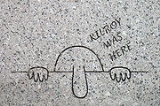
Kilroy was here

Encyclopedia
Popular culture
Popular culture is the totality of ideas, perspectives, attitudes, memes, images and other phenomena that are deemed preferred per an informal consensus within the mainstream of a given culture, especially Western culture of the early to mid 20th century and the emerging global mainstream of the...
expression, often seen in graffiti
Graffiti
Graffiti is the name for images or lettering scratched, scrawled, painted or marked in any manner on property....
. Its origins are debated, but the phrase and the distinctive accompanying doodle
Doodle
A doodle is an unfocused drawing made while a person's attention is otherwise occupied. Doodles are simple drawings that can have concrete representational meaning or may just be abstract shapes....
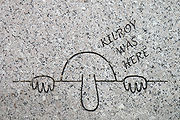
—a bald-headed man (possibly with a few hairs) with a prominent nose peeking over a wall with the fingers of each hand clutching the wall—is widely known among U.S. residents who lived during World War II
World War II
World War II, or the Second World War , was a global conflict lasting from 1939 to 1945, involving most of the world's nations—including all of the great powers—eventually forming two opposing military alliances: the Allies and the Axis...
.
In Britain, the graffiti is known as "Mr Chad" or just "Chad", and the Australian equivalent to the phrase is "Foo was here". "Foo was here" might date from World War I, and the character of Chad may have derived from a British cartoonist in 1938, possibly pre-dating "Kilroy was here". A Quincy, Massachusetts shipyard
Fore River Shipyard
The Fore River Shipyard of Quincy, Massachusetts, more formally known as the Fore River Ship and Engine Building Company, was a shipyard in the United States from 1883 until 1986. Located on the Weymouth Fore River, the yard began operations in 1883 in Braintree, Massachusetts before being moved...
inspector named J.J. Kilroy may have been the origin of the phrase "Kilroy was here" in World War II. Etymologist Dave Wilton wrote that "Some time during the war, Chad and Kilroy met, and in the spirit of Allied unity merged, with the British drawing appearing over the American phrase." "Foo was here" became popular amongst Australian schoolchildren of post-war generations. Other names for the character include Smoe, Clem, Flywheel, Private Snoops, Overby, The Jeep
Eugene the Jeep
Eugene the Jeep is a character in the Popeye comic strip. A mysterious animal with magical abilities, the Jeep first appeared in the March 16, 1936, appearance of Thimble Theatre strip...
, and Sapo.
Author Charles Panati
Charles Panati
Charles Panati is a former college professor, industrial physicist, author and science editor of Newsweek. Panati has written about topics as diverse as the source of the cosmos to the origin of the Oreo cookie. He has been a frequent guest on Oprah, Regis and Letterman...
says that in the US "the mischievous face and the phrase became a national joke... The outrageousness of the graffiti was not so much what it said, but where it turned up." The major Kilroy graffiti fad ended in the 1950s, but today people all over the world still scribble the character and "Kilroy was here" in schools, trains, and other similar public areas.
Origin and use of the phrase
Brewer's Dictionary of Phrase and Fable
Brewer's Dictionary of Phrase and Fable, sometimes referred to simply as Brewer's, is a reference work containing definitions and explanations of many famous phrases, allusions and figures, whether historical or mythical.-History:...
notes that it was particularly associated with the Air Transport Command
Air Transport Command
Air Transport Command is an inactive United States Air Force unit. Its mission was to meet the urgent demand for the speedy reinforcement of the United States' military bases worldwide during World War II, using an air supply system to supplement surface transport...
, at least when observed in the United Kingdom. At some point, the graffito (Chad) and slogan (Kilroy was here) must have merged.
An early example of the phrase being used may date from 1937, before World War II. A US History Channel video broadcast in 2007, Fort Knox: Secrets Revealed, includes a shot of a chalked "KILROY WAS HERE" dated 5/13/1937: Fort Knox
Fort Knox
Fort Knox is a United States Army post in Kentucky south of Louisville and north of Elizabethtown. The base covers parts of Bullitt, Hardin, and Meade counties. It currently holds the Army Human Resources Center of Excellence to include the Army Human Resources Command, United States Army Cadet...
's vault was loaded in 1937 and inaccessible until the 1970s, when an audit was carried out and the footage was shot. However, historian Paul Urbahns says that the footage was a reconstruction. Other sources claim origins as early as 1939.
According to one story, it was reported that German intelligence found the phrase on captured American equipment. This began leading Hitler to believe that Kilroy could be the name or codename of a high-level Allied spy. At the time of the Potsdam Conference
Potsdam Conference
The Potsdam Conference was held at Cecilienhof, the home of Crown Prince Wilhelm Hohenzollern, in Potsdam, occupied Germany, from 16 July to 2 August 1945. Participants were the Soviet Union, the United Kingdom, and the United States...
in 1945, it was rumored that Stalin found "Kilroy was here" written in the VIP
VIP
VIP and V.I.P. is a three-letter acronym that may refer to:-In general:* Vacuum insulated panel* Values, Influence, and Peers, an anti-crime campaign in Ontario elementary schools* Variable Information Printing, a form of on-demand printing...
's bathroom, prompting him to ask his aides who Kilroy was. War photographer Robert Capa
Robert Capa
Robert Capa was a Hungarian combat photographer and photojournalist who covered five different wars: the Spanish Civil War, the Second Sino-Japanese War, World War II across Europe, the 1948 Arab-Israeli War, and the First Indochina War...
noted a use of the phrase at Bastogne
Bastogne
Bastogne Luxembourgish: Baaschtnech) is a Walloon municipality of Belgium located in the province of Luxembourg in the Ardennes. The municipality of Bastogne includes the old communes of Longvilly, Noville, Villers-la-Bonne-Eau, and Wardin...
in December 1944: "On the black, charred walls of an abandoned barn, scrawled in white chalk, was the legend of McAuliffe
Anthony McAuliffe
General Anthony Clement "Nuts" McAuliffe was the United States Army general who commanded the 101st Airborne Division troops defending Bastogne, Belgium during the Battle of the Bulge in World War II...
's GIs: KILROY WAS STUCK HERE."
Foo was here
"Foo was here" graffiti is said to have been widely used by Australians during World War IWorld War I
World War I , which was predominantly called the World War or the Great War from its occurrence until 1939, and the First World War or World War I thereafter, was a major war centred in Europe that began on 28 July 1914 and lasted until 11 November 1918...
: "He was chalked on the side of railway carriages, appeared in probably every camp that the 1st AIF World War I served in and generally made his presence felt." If this is the case, then "Foo was here" pre-dates "Kilroy was here" by about twenty years.
The phrase "Foo was here" was used from 1941–45 as the Australian equivalent of "Kilroy was here". "Foo" was thought of as a gremlin
Gremlin
A gremlin is an imaginary creature commonly depicted as mischievous and mechanically oriented, with a specific interest in aircraft. Gremlins' mischievous natures are similar to those of English folkloric imps, while their inclination to damage or dismantle machinery is more...
by the Royal Australian Air Force
Royal Australian Air Force
The Royal Australian Air Force is the air force branch of the Australian Defence Force. The RAAF was formed in March 1921. It continues the traditions of the Australian Flying Corps , which was formed on 22 October 1912. The RAAF has taken part in many of the 20th century's major conflicts...
during World War II, and the name may have derived from the 1930s cartoon Smokey Stover
Smokey Stover
Smokey Stover is an American comic strip written and drawn by cartoonist Bill Holman, from 1935 until he retired in 1973. Distributed through the Chicago Tribune, it features the wacky misadventures of the titular fireman, and had the longest run of any comic strip in the "screwball comics"...
, in which the character used the word "foo" for anything he could not remember the name of. It has been claimed that Foo came from the acronym for Forward Observation Officer, but this is likely to be a backronym
Backronym
A backronym or bacronym is a phrase constructed purposely, such that an acronym can be formed to a specific desired word. Backronyms may be invented with serious or humorous intent, or may be a type of false or folk etymology....
.
Real Kilroys
The Oxford English DictionaryOxford English Dictionary
The Oxford English Dictionary , published by the Oxford University Press, is the self-styled premier dictionary of the English language. Two fully bound print editions of the OED have been published under its current name, in 1928 and 1989. The first edition was published in twelve volumes , and...
says simply that Kilroy was "The name of a mythical person." One theory identifies James J. Kilroy (1902–1962), an American shipyard inspector, as the man behind the signature. The New York Times
The New York Times
The New York Times is an American daily newspaper founded and continuously published in New York City since 1851. The New York Times has won 106 Pulitzer Prizes, the most of any news organization...
indicated J.J. Kilroy as the origin in 1946, based on the results of a contest conducted by the Amalgamated Transit Union
Amalgamated Transit Union
The Amalgamated Transit Union is a labor union in the United States and The Amalgamated Transit Union Canadian Council in Canada, representing workers in the transit system and other industries...
to establish the origin of the phenomenon. The article noted that Kilroy had marked the ships themselves as they were being built—so, at a later date, the phrase would be found chalked in places that no graffiti-artist could have reached (inside sealed hull spaces, for example), which then fed the mythical significance of the phrase—after all, if Kilroy could leave his mark there, who knew where else he could go? Brewer's Dictionary of Phrase and Fable notes this as a possible origin, but suggests that "the phrase grew by accident."
During World War II he worked at the Fore River Shipyard
Fore River Shipyard
The Fore River Shipyard of Quincy, Massachusetts, more formally known as the Fore River Ship and Engine Building Company, was a shipyard in the United States from 1883 until 1986. Located on the Weymouth Fore River, the yard began operations in 1883 in Braintree, Massachusetts before being moved...
in Quincy, Massachusetts
Quincy, Massachusetts
Quincy is a city in Norfolk County, Massachusetts, United States. Its nicknames are "City of Presidents", "City of Legends", and "Birthplace of the American Dream". As a major part of Metropolitan Boston, Quincy is a member of Boston's Inner Core Committee for the Metropolitan Area Planning Council...
, where he claimed to have used the phrase to mark rivets he had checked. The builders, whose rivets J.J. Kilroy was counting, were paid depending on the number of rivets they put in. A riveter would make a chalk mark at the end of his or her shift to show where they had left off and the next riveter had started. Unscrupulous riveters discovered that, if they started work before the inspector arrived, they could receive extra pay by erasing the previous worker's chalk mark and chalking a mark farther back on the same seam, giving themselves credit for some of the previous riveter's work. J.J. Kilroy stopped this practice by writing "Kilroy was here" at the site of each chalk mark. At the time, ships were being sent out before they had been painted, so when sealed areas were opened for maintenance, soldiers found an unexplained name scrawled. Thousands of servicemen may have potentially seen his slogan on the outgoing ships and Kilroy's apparent omnipresence and inscrutability sparked a legend. The slogan began to be regarded as proof that a ship had been checked well, and as a kind of protective talisman. Afterwards, servicemen began placing the slogan on different places and especially in newly captured areas or landings, and the phrase took on connotations of the presence or protection of the US armed forces.
The Lowell Sun reported in November 1945, with the headline "How Kilroy Got There", that a 21-year old soldier from Everett, Sgt. Francis J. Kilroy, Jr., wrote "Kilroy will be here next week" on a barracks bulletin board at a Boca Raton airbase while ill with flu, and the phrase was picked up by other airmen and quickly spread abroad. The Associated Press similarly reported at the same time that according to Sgt. Kilroy, when he was hospitalized early in World War II a friend of his, Sgt. James Maloney, wrote the phrase on a bulletin board. Maloney continued to write the shortened phrase when he was shipped out a month later, and other airmen soon picked up the phrase. Francis Kilroy himself only wrote the phrase a couple of times.
Chad
The figure was initially known in Britain as "Mr Chad". Chad would appear with the slogan "Wot, no sugar", or a similar phrase bemoaning shortages and rationingRationing
Rationing is the controlled distribution of scarce resources, goods, or services. Rationing controls the size of the ration, one's allotted portion of the resources being distributed on a particular day or at a particular time.- In economics :...
. He often appeared with a single curling hair that resembled a question mark and with crosses in his eyes. The phrase "Wot, no —?" pre-dates "Chad" and was widely used separately from the doodle. Chad was used by the RAF and civilians; in the army Chad was known as Private Snoops, and in the Navy he was called The Watcher. Chad might have first been drawn by British cartoonist George Edward Chatterton in 1938. Chatterton was nicknamed "Chat", which may then have become "Chad." Life Magazine in 1946 said that the RAF and Army were competing for claiming him as their own invention, but they agreed that he had first appeared around 1944. The character resembles Alice the Goon
Alice the Goon
Alice the Goon is a fictional character in E. C. Segar's comic strip Thimble Theatre and in the Popeye cartoon series derived from it.-History:...
, a character in Popeye who first appeared in 1933; another name for Chad was "The Goon".
A theory suggested by a spokesman for the Royal Air Force Museum London in 1977 was that Chad was probably an adaptation of the Greek letter Omega
Omega
Omega is the 24th and last letter of the Greek alphabet. In the Greek numeric system, it has a value of 800. The word literally means "great O" , as opposed to omicron, which means "little O"...
, used as the symbol for electrical resistance; his creator was probably an electrician in a ground crew. Life suggested that Chad originated with REME
Reme
Reme may refer to:*Rəmə, Azerbaijan*Royal Electrical and Mechanical Engineers...
, and noted that a symbol for alternating current
Alternating current
In alternating current the movement of electric charge periodically reverses direction. In direct current , the flow of electric charge is only in one direction....
, a sine wave
Sine wave
The sine wave or sinusoid is a mathematical function that describes a smooth repetitive oscillation. It occurs often in pure mathematics, as well as physics, signal processing, electrical engineering and many other fields...
through a straight line, resembles Chad, that the plus and minus signs in his eyes represent polarity, and that his fingers are symbols of electrical resistors. The character is usually drawn in Australia with pluses and minuses as eyes and the nose and eyes resemble a distorted sine wave. Similarly, The Guardian noted in 2000 that several readers had told them that "Mr. Chad" was based on a diagram representing an electrical circuit. One correspondent said that in 1941 at RAF Yatesbury a man named Dickie Lyle drew a version of the diagram as a face when the instructor had left the room, and wrote "Wot, no leave?" beneath it. This idea was repeated in a submission to the BBC in 2005 that included a story of a 1941 radar lecturer in Gainsborough, Lincolnshire
Gainsborough, Lincolnshire
Gainsborough is a town 15 miles north-west of Lincoln on the River Trent within the West Lindsey district of Lincolnshire, England. At one time it served as an important port with trade downstream to Hull, and was the most inland in England, being more than 55 miles from the North...
drawing the circuit diagram, and the words "WOT! No electrons?" being added. The RAF Cranwell Apprentices Association says that the image came from a diagram of how to approximate a square wave
Square wave
A square wave is a kind of non-sinusoidal waveform, most typically encountered in electronics and signal processing. An ideal square wave alternates regularly and instantaneously between two levels...
using sine waves, also at RAF Yatesbury and with an instructor named Chadwick, and was initially called Domie or Doomie, the latter name also being noted by Life as used by the RAF. As alternatives to Chatterton or Mr Chadwick as the origin of the name Chad, REME claimed that the name came from their training school, nicknamed "Chad's Temple", the RAF claimed it arose from Chadwick House at a Lancashire radio school, and the Desert Rats claimed it came from an officer in El Alamein.
It is unclear how Chad gained widespread popularity or became conflated with Kilroy. It was, however, widely in use by the late part of the war and in the immediate post-war years, with slogans ranging from the simple "What, no bread?" or "Wot, no char
Tea
Tea is an aromatic beverage prepared by adding cured leaves of the Camellia sinensis plant to hot water. The term also refers to the plant itself. After water, tea is the most widely consumed beverage in the world...
?" to the plaintive; one sighting, on the side of a British 1st Airborne Division
British 1st Airborne Division
The 1st Airborne Division was a division of the British airborne forces during the Second World War. The division was formed in 1941, after British Prime Minister Winston Churchill demanded an airborne force...
glider
Military glider
Military gliders have been used by the military of various countries for carrying troops and heavy equipment to a combat zone, mainly during the Second World War. These engineless aircraft were towed into the air and most of the way to their target by military transport planes, e.g...
in Operation Market Garden
Operation Market Garden
Operation Market Garden was an unsuccessful Allied military operation, fought in the Netherlands and Germany in the Second World War. It was the largest airborne operation up to that time....
, had the complaint "Wot, no engines?" The Los Angeles Times reported in 1946 that Chad was "the No. 1 doodle", noting his appearance on a wall in the Houses of Parliament after the 1945 Labour election victory, with "Wot, no Tories?" Trains in Austria in 1946 featured Mr. Chad along with the phrase "Wot—no Fuehrer?"
As rationing
Rationing
Rationing is the controlled distribution of scarce resources, goods, or services. Rationing controls the size of the ration, one's allotted portion of the resources being distributed on a particular day or at a particular time.- In economics :...
became less common, so did the joke; while the cartoon is occasionally sighted today as "Kilroy was here", "Chad" and his complaints have long fallen from popular use, although continue to be seen occasionally on walls and in references in popular culture. It is a common misconception that the graffiti was tied to the Berlin Wall
Berlin Wall
The Berlin Wall was a barrier constructed by the German Democratic Republic starting on 13 August 1961, that completely cut off West Berlin from surrounding East Germany and from East Berlin...
, although "Chad" long pre-dated the wall.
Smoe
Writing about the Kilroy phenomenon in 1946, The Milwaukee Journal describes the doodle as the European counter-part to "Kilroy was here", under the name Smoe. It also says that Smoe was called Clem in the African theater. It noted that next to "Kilroy was here" was often added "And so was Smoe". While Kilroy enjoyed a resurgence of interest after the war due to radio shows and comic writers, the name Smoe had already disappeared by the end of 1946. A B-24 airman writing in 1998 also noted the distinction between the character of Smoe and Kilroy (who he says was never pictured), and suggested that Smoe stood for "Sad men of Europe". Correspondents to LifeLife (magazine)
Life generally refers to three American magazines:*A humor and general interest magazine published from 1883 to 1936. Time founder Henry Luce bought the magazine in 1936 solely so that he could acquire the rights to its name....
magazine in 1962 also insisted that Clem, Mr. Chad or Luke the Spook was the name of the figure, and that Kilroy was unpictured. The editor suggested that the names were all synonymous early in the war, then later separated into separate characters.
Other names
Similar drawings appear in many countries. Herbie (Canada), Overby (Los Angeles, late 1960s), Flywheel, Private Snoops, The Jeep, and Clem (Canada) are alternative names. An advert in Billboard in November 1946 for plastic 'Kilroys' also used the names Clem, Heffinger, Luke the Spook, Smoe and Stinkie. "Luke the SpookLuke the Spook
Luke the Spook was the name of a B-29 Superfortress configured to carry the atomic bomb in World War II.-Airplane history:...
", the nose-art on a B-29 bomber of the same name, resembles the doodle and is said to have been created at the Boeing factory in Seattle. In the Australian variant, the character peeping over the wall is not named Kilroy but Foo, as in "Foo was here". In the United Kingdom, such graffiti is known as "Chad" or "Mr Chad". In Chile
Chile
Chile ,officially the Republic of Chile , is a country in South America occupying a long, narrow coastal strip between the Andes mountains to the east and the Pacific Ocean to the west. It borders Peru to the north, Bolivia to the northeast, Argentina to the east, and the Drake Passage in the far...
, the graphic is known as a "sapo" (slang for nosy); this might refer to the character's peeping, an activity associated with frogs because of their protruding eyes. In neighboring Peru, Kilroy is sometimes known as "Julito", which started as a running joke in that country's Foreign Ministry and is often seen scribbled on the whiteboards.
In Poland, Kilroy is replaced with "Józef Tkaczuk", an elementary school janitor (as an urban legend says), "Robert Motherwell" or "M. Pulina". Graffiti writings have the form of sentences like "Gdzie jest Józef Tkaczuk?" ("Where is Joseph Tkatchuk?") and "Tu byłem – Józef Tkaczuk" ("I was here – Joseph Thatchuk"). In Russia, the phrase "Vasya was here" is a notorious piece of graffiti.
In popular culture
In September 1946, Enterprise Records released a song by NBC singer Paul Page titled "Kilroy Was Here."In the 1947 film Nightmare Alley
Nightmare Alley
Nightmare Alley is a novel by William Lindsay Gresham. It is a study of the lowest depths of showbiz and its sleazy inhabitants- the dark, shadowy world of a second rate carnival filled with hustlers, scheming grifters, and Machiavellian femme fatales....
, the expression "Kilroy was here" is seen scribbled on the wall in back of Tyrone Power during a memorable scene.
In the 1948 Looney Tunes cartoon Haredevil Hare
Haredevil Hare
Haredevil Hare is a 1948 Looney Tunes cartoon directed by Chuck Jones. It stars Bugs Bunny and it is the debut for Marvin the Martian — although he is unnamed in this film — along with his Martian dog, K-9. All the voices are done by Mel Blanc...
, whilst commenting on being the first one to walk on the surface of the moon Bugs Bunny is seen walking right past a large slab of moon rock etched with the words "Kilroy was here".
Peter Viereck
Peter Viereck
Peter Robert Edwin Viereck , was an American poet and political thinker, as well as a professor of history at Mount Holyoke College for five decades.-Background:...
wrote a poem, published in 1948, about the ubiquitous Kilroy, writing that "God is like Kilroy. He, too, Sees it all."
Isaac Asimov's 1955 short story The Message
The Message (short story)
"The Message" is a science fiction short story by American writer Isaac Asimov. It was first published in the February 1956 issue of The Magazine of Fantasy and Science Fiction and reprinted in the 1957 collection Earth is Room Enough. "The Message" tells the story of how the expression Kilroy...
depicts a time-travelling George Kilroy from the thirtieth century as the writer of the graffiti.
In Joseph Heller's 1994 novel, Closing Time
Closing Time (novel)
Closing Time is a 1994 novel by Joseph Heller, written as a sequel to the popular Catch-22. It takes place in New York City in the 1990s, and revisits some characters of the original, including Yossarian, Milo Minderbinder and Chaplain Tappman....
, Yossarian claims to know Kilroy from the army.
Thomas Pynchon
Thomas Pynchon
Thomas Ruggles Pynchon, Jr. is an American novelist. For his most praised novel, Gravity's Rainbow, Pynchon received the National Book Award, and is regularly cited as a contender for the Nobel Prize in Literature...
's 1963 novel V.
V.
V. is the debut novel of Thomas Pynchon, published in 1963. It describes the exploits of a discharged U.S. Navy sailor named Benny Profane, his reconnection in New York with a group of pseudo-bohemian artists and hangers-on known as the Whole Sick Crew, and the quest of an aging traveller named...
includes the proposal that the Kilroy doodle originated from a band-pass filter
Band-pass filter
A band-pass filter is a device that passes frequencies within a certain range and rejects frequencies outside that range.Optical band-pass filters are of common usage....
diagram.
External links
- The Legends of "Kilroy Was Here" by Patrick Tillery
- "What's the origin of 'Kilroy was here'?", The Straight Dope
- On the legend from snopes.com
- Chad drawn in an army album from 21 June 1944 by Ron Goldstein, with the caption "Wot! Leave again?" The album is now held at the Imperial War MuseumImperial War MuseumImperial War Museum is a British national museum organisation with branches at five locations in England, three of which are in London. The museum was founded during the First World War in 1917 and intended as a record of the war effort and sacrifice of Britain and her Empire...
.