
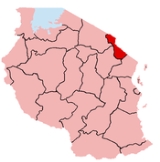
Kilimanjaro is one of the 26
regionsTanzania is divided into 26 regions.-See also:* list of Tanzanian regions by area ranks the regions by their total area, land area, and water area.* Districts of Tanzania* ISO 3166-2:TZ-External links:*...
in
TanzaniaThe United Republic of Tanzania is a country in East Africa bordered by Kenya and Uganda to the north, Rwanda, Burundi, and the Democratic Republic of the Congo to the west, and Zambia, Malawi, and Mozambique to the south. The country's eastern borders lie on the Indian Ocean.Tanzania is a state...
. The capital of the region is
MoshiMoshi is a Tanzanian town with a population of 144,739 in Kilimanjaro Region. The town is situated on the lower slopes of Mt Kilimanjaro, a volcanic mountain that is the highest mountain in Africa....
. Kilimanjaro region is home to
Mount KilimanjaroKilimanjaro, with its three volcanic cones, Kibo, Mawenzi, and Shira, is a dormant volcano in Kilimanjaro National Park, Tanzania and the highest mountain in Africa at above sea level .-Geology:...
.
Kilimanjaro Region is bordered to the North and East by
KenyaKenya , officially known as the Republic of Kenya, is a country in East Africa that lies on the equator, with the Indian Ocean to its south-east...
, to the South by the
Tanga RegionTanga Region is one of the 26 regions of Tanzania. The regional headquarters is in Tanga. According to the 2002 Tanzania National Census, the region has a population of 1,642,015 people....
, to the Southwest by the
Manyara RegionManyara is one of the 26 Regions of Tanzania. Babati serves as the Region's capital. In its northern part is Lake Manyara. It is bordered to the north by the Arusha Region, to the northeast by the Kilimanjaro Region, to the east by the Tanga Region, to the south by the Dodoma Region, to the...
, and to the West by the
Arusha RegionArusha is one of Tanzania's 26 administrative regions. The regional capital and largest city is Arusha. Other towns include Monduli, just west of Arusha, Longido and Loliondo to the north, Mto Wa Mbu and Karatu to the west and Usa River to the east...
.
According to the 2002 Tanzania National Census, the population of the Kilimanjaro Region was 1,381,149.
The Regional Commissioner of the Kilimanjaro Region is M.O. Babu.
Districts
The Kilimanjaro Region is administratively divided into 6 districts:
RomboRombo is one of the six districts of the Kilimanjaro Region of Tanzania. It is bordered to the north and east by Kenya, to the west by the Hai District and to the south by the Moshi Rural District....
,
HaiHai is one of the six districts of the Kilimanjaro Region of Tanzania. It is bordered to the south and west by the Arusha Region, to the north by Kenya, and to the east by the Moshi Rural and Rombo Districts....
,
Moshi RuralMoshi Rural is one of the six districts in the Kilimanjaro Region of Tanzania. It is bordered to the north by the Rombo District, to the west by the Hai District, to the east by the Mwanga District and Kenya and to the south by the Manyara Region....
,
Moshi UrbanMoshi Urban is one of the six districts of the Kilimanjaro Region of Tanzania. The regional capital of Moshi is located in the Moshi Urban District...
,
MwangaMwanga is one of the six districts of the Kilimanjaro Region of Tanzania. It is bordered to the northeast by Kenya, to the northwest by the Moshi Rural District, to the west by the Moshi Urban District, to the southwest by the Manyara Region, and to the south by the Same District.According to the...
, and
SameSame is one of the six districts of the Kilimanjaro Region of Tanzania. It is bordered to the north by the Mwanga District, to the northeast by Kenya, to the south and southeast by the Tanga Region, and to the west by the Manyara Region....
.
Hai
According to the 2002 Tanzania National Census, the population of the Hai District was 259,958.
The Hai District is administratively divided into 14 wards:
- Hai Mjini
- Machame Kaskazini (North)
- Machame Kusini (South)
- Machame Magharibi (West)
- Machame Mashariki (East)
- Machame Uroki
- Masama Kusini (South)
- Masama Magharibi (West)
- Masama Mashariki (East)
- Masama Rundugai
- Siha Kaskazini (North)
- Siha Kati (Central)
- Siha Magharibi (West)
- Siha Mashariki (East)
Rombo
The Rombo Districts contain a large portion of Mount Kilimanjaro.
According to the 2002 Tanzania National Census, the population of the Rombo District was 246,479.
The Rombo District is administratively divided into 20 wards:
- Katangara Mrere
- Kelamfua Mokala
- Keni Aleni
- Keni Mengeni
- Kirongo Samanga
- Kirwa Keni
- Kitirima Kingachi
- Mahida Holili
- Makiidi
- Mamsera
- Mengwe Manda
- Motamburu Kitendeni
- Mrao Keryo
- Nanjara Reha
- mahida nguduni
- Olele
- Shimbi
- Tarakea Motamburu
- Ubetu Kahe
- Ushiri Ikuini
- Mahida mahango
Moshi Urban
According to the 2002 Tanzania National Census, the population of the Moshi Urban District is 144,336.
The Moshi Urban District is administratively divided into 21 wards:
- Bondeni
- Kaloleni
- Karanga (English meaning: "peanuts/groundnuts")
- Kiborloni (From the English words "Keep on rolling")
- Kilimanjaro
- Kiusa
- Korongoni
- Longuo
- Majengo (English meaning: "buildings")
- Mawenzi (Name given to one of the peaks of Mt. Kilimanjaro)
- Mji Mpya (English meaning: "new Town")
- Msaranga
- Njoro (English meaning "water" from Maasai people)
- Rau
- Pasua (Literally meaning "break")
- Miembeni (Literally meaning "where there are mangoes")
- Ngangamfumuni
- Ng'ambo
- Bombambuzi
- Shirimatunda
- Soweto (Abbreviation for "South West Town")
Moshi Rural
According to the 2002 Tanzania National Census, the population of the Moshi Urban District is 402,431.
The Moshi Rural District is administratively divided into 31 wards:
- Arusha Chini
- Kahe
- Kahe Mashariki (East)
- Kibosho Kati (Central)
- Kibosho Magharibi (West)
- Kibosho Mashariki (East)
- Kilema Kaskazini (North)
- Kilema Kati (Central)
- Kilema Kusini (South)
- Kimochi
- Kindi
- Kirima
- Kirua Vunjo Kusini (South)
- Kirua Vunjo Magharibi (West)
- Kirua Vunjo Mashariki (East)
- Makuyuni
- Mabogini
- Mamba Kaskazini (North)
- Mamba Kusini
- Marangu Magharibi (West)
- Marangu Mashariki (East)
- Mbokomu
- Mwika Kaskazini (North)
- Mwika Kusini (South)
- Okoani Kibosho
- Old Moshi East
- Old Moshi West
- Uru Kaskazini (North)
- Uru Mashariki (East)
- Uru Shimbwe
- Uru South Mawela
Mwanga
According to the 2002 Tanzania National Census, the population of the Mwanga District was 115,620.
The Mwanga District is administratively divided into 16 wards:
- Chomvu
- Jipe
- Kifula
- Kighare
- Kileo
- Kilomeni
- Kirongwe
- Kirya
- Kwakoa
- Lang'ata
- Lembeni
- Msangeni
- Mwanga
- Mwaniko
- Ngujini
- Shigatini
Same
According to the 2002 Tanzania National Census, the population of the Same District was 212,235.
The Same District is administratively divided into 25 wards:
- Bombo
- Bendera
- Bwambo
- Chome
- Hedaru
- Kihurio
- Kirangare
- Kisiwani (English meaning: on the island)
- Makanya
- Maore
- Mhezi
- Mpinji
- Mshewa
- Msindo
- Mtii
- Mwembe (English meaning: mango tree)
- Myamba
- Ndungu
- Njoro
- Ruvu
- Same Mjini
- Suji (Suji, Kilimanjaro
Suji is a small village in the Pare Mountains, in the Kilimanjaro region of north-eastern Tanzania. According to the 2002 census, the village has a population of around 8,072 . The majority of the villagers are of the Pare tribe Suji is a small village in the Pare Mountains, in the Kilimanjaro...
)
- Vudee
- Vuje
- Vunta
History
The region called Kilimanjaro today, borrows its name from the tallest mountain in Africa,
Mount KilimanjaroKilimanjaro, with its three volcanic cones, Kibo, Mawenzi, and Shira, is a dormant volcano in Kilimanjaro National Park, Tanzania and the highest mountain in Africa at above sea level .-Geology:...
. Of the six districts mentioned above, four traditionally had the Chaga settlements which are Hai, Moshi urban, Moshi rural,and Rombo, and the other two which have historically been of Pare settlements, namely Mwanga and Same. However, during colonial rule, in the late 19th century and to the mid of 20th century, the region was divided into two main districts: Moshi district, which comprised all the areas settled by the Chagga people on the slopes of the mountain, and Pare district, which was a Pare tribe settlement. The region, from earlier times, had been settled by the people collectively called the Chagga, the Maasai, Wakwavi and Waarush (in the lower parts of Mount Kilimanjaro), and the Pare on the Pare mountains. These have been intermingling, trading and even fighting from time to time for various socio-political reasons. Later, other tribes also migrated to the land.
The region's geology
Kilimanjaro lies on a tectonic line intersection 80 kilometres (49.7 mi). east of the tectonically active Rift Valley. The activity which created this stratovolcano dates back less than a million years and the central ash pit on Kibo, the highest volcanic centre, may be only several hundred years old. Steam and sulphur fumaroles here are indicative of residual activity.
Shira and Mawenzi were two other areas of volcanic activity. Both became inactive before Kibo. The Shira volcanic cone collapsed leaving the Shira Ridge as part of its Caldera Rim. Mawenzi has been heavily eroded to leave a mass of steep-sided ridges and summits, particularly dramatic on the infrequently-seen eastern side. Kibo is the best preserved centre; it has three concentric craters and the outer crater rim rises to Uhuru Point – the chief summit. The middle, Reusch crater contains the main fumaroles and in its centre the 130 metres (426.5 ft) deep and 400 metres (1,312.3 ft) wide Ash Pit. The outer crater has been breached by lava flows in several places, the most dramatic of these being the Western Breach.
The ash and lava covered slopes of Kibo are mainly gentle-angled from the steep, glaciated precipices which defend its southern and south-western flanks. The impressive rock walls on Kilimanjaro and Mawenzi are generally composed of lavas and ashes. Deep gorges (barrancos) have been carved into the soft rocks and ashes of Kilimanjaro. The most impressive of these is the Great Barranco below the Western Breach and the two Barrancos on the east side of Mawenzi.
Numerous parasitic cones extend east-west across Kilimanjaro; some are located near the Mandara Hut (Maundi Crater offers a fine view point), while others lie just north of the Shira Route. At one stage most of the summit of Kilimanjaro was covered by an ice cap, probably more than 100 metres (328.1 ft) deep. Glaciers extended well down the mountain forming moraine ridges, clearly visible now on the southern flanks down to about 4000 metres (13,123.4 ft). At present only a small fraction of the glacial cover remains. The remnants of the ice cap can be seen as the spectacular ice cliffs of the Northern and Eastern Icefields, and the longest glaciers are found on the precipitous southern and south-western flanks. If the present rate of recession continues the majority of the glaciers on Kilimanjaro could vanish altogether in the next 20 years.
Sources