

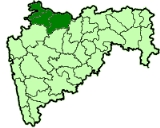
Khandesh

Encyclopedia
Khandesh is a region of central India
, which forms the northwestern portion of Maharashtra
state.
Khandesh was the terminal territorial part under the rule of Mughals. The Start of Deccan region demarcated by the boundary of Khandesh.
Originally The Khandesh state was found and ruled by Faruqi dynasty
with capital at Burhanpur
. During 1388 to 1888 the Khandesh State had covered the area of the today's Jalgaon, Dhule
, Nandurbar
districts of Maharastra state and Burhanpur district of Madhya Pradesh state.
The terms "Khandesh" and "Deccan" thus connote historical and political affiliations, as well as geographical zones. Khandesh lies on the Northwestern corner of the Deccan plateau, in the valley of the Tapti River
, and is bound to the north by the Satpura Range
, to the east by the Berar (Vidarbha
) region, to the south by the Hills of Ajanta, belonging to the Marathwada region of Maharashtra, and to the west by the Northernmost ranges of the Western Ghats
, and beyond them the coastal plain of Gujarat.
After India's independence in 1947, Bombay province
became Bombay state, which in 1960 was divided into the linguistic states of Maharashtra
and Gujarat. During State formation Burhanpur became the part of State Of Madhya Pradesh and in 1960 East Khandesh became Jalgaon district, and West Khandesh became Dhule of the Maharastra State.
The principal natural feature is the Tapti River. Unlike the rest of the Deccan, whose rivers rise in the Western Ghats and flow eastward to the Bay of Bengal
, the Tapti flows westward from headwaters in eastern Maharashtra to empty into the Arabian Sea
. The Tapti receives thirteen principal tributaries in its course through Kandesh. None of the rivers is navigable, and the Tapti flows in a deep bed which historically made it difficult to use for irrigation. Most of Kandesh lies south of the Tapti, and is drained by its tributaries the Girna
, Bori and Panjhra. The alluvial plain north of the Tapti contains some of the richest tracts in Kandesh, and the land rises towards the Satpura hills. In the centre and east the country is level, save for some low ranges of barren hills. To the north and west, the plain rises into rugged hills, thickly wooded, and inhabited by the tribal Bhil
people.
from 1388 to 1601 with capital at Burhanpur, who maintained their independence from the Bahmani Sultanate
which ruled much of the Deccan from the fourteenth to the sixteenth centuries. Asir and Burhanpur were conquered by the Mughal
emperor Akbar in 1601, and Khandesh became a province of the Mughal empire
. It was conquered by the Maratha
s in the early eighteenth century, and ruled by the Maratha Peshwa
s until their defeat in the Third Anglo-Maratha War
in 1818. After 1818 Burhanpur
became the part Central province
and Khandesh (Jalgaon, Dhulia), along with most of the Peshwa's dominions, became part of Bombay Province of the British Raj
. The region was administered as Khandesh district, which was divided in 1906 into two districts, East Khandesh and West Khandesh. East Khandesh, headquartered at Jalgaon, had an area of 4544 mi², and a population of 957,728 in 1901, and West Khandesh, headquartered at Dhulia (Dhule) had an area of 5497 mi² and a population of 469,654 in 1901.
Farmers of Khandesh are hardworking. There was no major irrigation facility in Khandesh before the Girana and Hatnur dams were commissioned. Most of the Khandesh is arid or semi arid.
Due to the efforts of great freedom fighter and socialist leader venerable Pandurang Sadashiv Sane (popularly known as Sane Guruji) of Shahada, Maharashtra
and generous donation of Pratap Seth of Amalner, Pratp College become an important center of education.
Khandesh has rich cultural and literary heritage. Mukta Bai, the younger sister of Dnyaneshwar lived at Muktai nagar(earstwhile Edalabad). Near Edalabad, lived the great yogi, Changdeva in the thirteenth century. There was also strong presence of Kabir Pantha in Khandesh due to the proximity of Burhanpur, the seat of Kabir Panth.
Bahina Bai Choudhary regarded as one the greatest poetess in Marathi literature belonged to a Khandeshi farmer family. Her son Kavi Sopandeo Choudhary was famous for his poetry with a touch of humor. Balkavi, Trambak Bapuji Thombre, the another great name in Marathi poetry belonged to Jalgaon district. Dr. V.B. Kolte a noted scholar of Marathi hailed from Khandesh who was the top authority on Mahanubhav literature.
The well known Marathi writers from Khandesh region include Dr. Bhalchandra Nemade, N.D. Mahanor and Dr Sharad Rane. Dr. Nemade is known for his Novels Kosala, Bidhar, Jarila and Zool and collection of poetry Melody.
Dr Nemade belongs to the Sangavi village in Yawal taluka, and his novel Kosala is a semi-autobiographical account narrating his abrasive experiences in Pune where he came for higher education. He has poignantly exposed cultural snobbishness of people around him which, forces him to go into the seclusion (kosala).
Poet N.D. Mahanor can be described as the true exponent of natural poetry who seemed to have adopted himself very ably in the shoes of Balkavi. Through his poetry on nature, Mahanor breathed fresh air in Marathi poetry in the early 1970s.
Dr. Sharad Rane writes for children. Comrade Sharad Patil, one of the original thinkers in Maharashtra lives in Dhule. He is an authority on Indology, Marxism, Ambedkarism and Marathi literature. His name is well known in the higher academic circle for his contributions.
Khandesh provided many freedom fighters to the country, Dadasaheb Dhanaji Nana, Bhausaheb Bonde Guruji, Dadusinh, Vyankatrao randheer, Shivaji Patil, Uttamrao Patil, Hutatma Bapu Wani(Neve), Lilatai Patil, Shirishkumar were the famous characters. Late Sonusingh Patil, Late Bapuso Sudhakarrao Neve,Dadasaheb Raval, P.K. Patil, Udesing Anna Pawar, Pundlik Jibhau, KakaBaba(Purmepada) are the main faces who representated this area.as well as Padmasri sheetal mahajan (first lady who jumps both North and south pole),Nilima Mishra(winner of reman magasasy award , philipines) they are belonging from Khandesh
More history about Khandesh may be located in the various books written by Prof. Dr. Gajkumar Shah. Shah has done vast research in "Peshwe kalin Khandesh" [Khandesh during the time of Peshwe] and published several research papers on economical conditions of Khandesh during Peshava's time. He got his doctorate from Poona University in 1984 and studied Peshwe Daffatar [administrative records of Peshwa] and made avaialble to the aspirants of medieval history. Khandesh is the land of learned people from ancient time, and this tradition has followed by people like Prof. G.B. Shah, Prof. P.N. Deshpande to name a few.
India
India , officially the Republic of India , is a country in South Asia. It is the seventh-largest country by geographical area, the second-most populous country with over 1.2 billion people, and the most populous democracy in the world...
, which forms the northwestern portion of Maharashtra
Maharashtra
Maharashtra is a state located in India. It is the second most populous after Uttar Pradesh and third largest state by area in India...
state.
Khandesh was the terminal territorial part under the rule of Mughals. The Start of Deccan region demarcated by the boundary of Khandesh.
Originally The Khandesh state was found and ruled by Faruqi dynasty
Faruqi dynasty
The Faruqi dynasty was the ruling dynasty of the Khandesh sultanate from its inception in 1382 till its annexation by the Mughal emperor Akbar in 1601. The founder of the dynasty, Malik Ahmad participated in a rebellion against the Bahmani ruler Muhmmad Shah I in his early years...
with capital at Burhanpur
Burhanpur
Burhanpur is an important city in Madhya Pradesh state, India. It is the administrative seat of Burhanpur District. It is situated on the north bank of the Tapti River, southwest of Bhopal and northeast of Mumbai...
. During 1388 to 1888 the Khandesh State had covered the area of the today's Jalgaon, Dhule
Dhule
Dhule is a city and a Municipal Corporation in Dhule district in northwestern part of Maharashtra state, India. It is one of the very few well-planned cities of India before Indian Independence.-Geography:Dhule is located at...
, Nandurbar
Nandurbar
Nandurbar is a city and a municipal council in Nandurbar district in the Indian state of Maharashtra. It came into limelight during February 2006 Bird Flu crisis which struck many of its poultry farms. Thousand of chickens from the farms had to be killed and buried in nearby grounds to stop the...
districts of Maharastra state and Burhanpur district of Madhya Pradesh state.
The terms "Khandesh" and "Deccan" thus connote historical and political affiliations, as well as geographical zones. Khandesh lies on the Northwestern corner of the Deccan plateau, in the valley of the Tapti River
Tapti River
The Tapi River ancient original name Tapi River , is a river in central India. It is one of the major rivers of peninsular India with a length of around 724 km...
, and is bound to the north by the Satpura Range
Satpura Range
The Satpura Range is a range of hills in central India. The range rises in eastern Gujarat state near the Arabian Sea coast, running east through Maharashtra and Madhya Pradesh to Chhattisgarh. The range parallels the Vindhya Range to the north, and these two east-west ranges divide the...
, to the east by the Berar (Vidarbha
Vidarbha
Vidarbha is the eastern region of Maharashtra state made up of Nagpur Division and Amravati Division. Its former name is Berar . It occupies 31.6% of total area and holds 21.3% of total population of Maharashtra...
) region, to the south by the Hills of Ajanta, belonging to the Marathwada region of Maharashtra, and to the west by the Northernmost ranges of the Western Ghats
Western Ghats
The Western Ghats, Western Ghauts or the Sahyādri is a mountain range along the western side of India. It runs north to south along the western edge of the Deccan Plateau, and separates the plateau from a narrow coastal plain along the Arabian Sea. The Western Ghats block rainfall to the Deccan...
, and beyond them the coastal plain of Gujarat.
After India's independence in 1947, Bombay province
Province
A province is a territorial unit, almost always an administrative division, within a country or state.-Etymology:The English word "province" is attested since about 1330 and derives from the 13th-century Old French "province," which itself comes from the Latin word "provincia," which referred to...
became Bombay state, which in 1960 was divided into the linguistic states of Maharashtra
Maharashtra
Maharashtra is a state located in India. It is the second most populous after Uttar Pradesh and third largest state by area in India...
and Gujarat. During State formation Burhanpur became the part of State Of Madhya Pradesh and in 1960 East Khandesh became Jalgaon district, and West Khandesh became Dhule of the Maharastra State.
The principal natural feature is the Tapti River. Unlike the rest of the Deccan, whose rivers rise in the Western Ghats and flow eastward to the Bay of Bengal
Bay of Bengal
The Bay of Bengal , the largest bay in the world, forms the northeastern part of the Indian Ocean. It resembles a triangle in shape, and is bordered mostly by the Eastern Coast of India, southern coast of Bangladesh and Sri Lanka to the west and Burma and the Andaman and Nicobar Islands to the...
, the Tapti flows westward from headwaters in eastern Maharashtra to empty into the Arabian Sea
Arabian Sea
The Arabian Sea is a region of the Indian Ocean bounded on the east by India, on the north by Pakistan and Iran, on the west by the Arabian Peninsula, on the south, approximately, by a line between Cape Guardafui in northeastern Somalia and Kanyakumari in India...
. The Tapti receives thirteen principal tributaries in its course through Kandesh. None of the rivers is navigable, and the Tapti flows in a deep bed which historically made it difficult to use for irrigation. Most of Kandesh lies south of the Tapti, and is drained by its tributaries the Girna
Girna River
The Girna river is a river in Maharashtra state of southern India. It originates at Kem peak in the Western Ghats range of Nashik District, and flows east across Nashik and Jalgaon districts, swinging north in Jalgaon District to join the Tapti River.The dams on the river are Chanakapur and Girana...
, Bori and Panjhra. The alluvial plain north of the Tapti contains some of the richest tracts in Kandesh, and the land rises towards the Satpura hills. In the centre and east the country is level, save for some low ranges of barren hills. To the north and west, the plain rises into rugged hills, thickly wooded, and inhabited by the tribal Bhil
Bhil
Bhils are primarily an Adivasi people of Central India. Bhils are also settled in the Tharparkar District of Sindh, Pakistan. They speak the Bhil languages, a subgroup of the Western Zone of the Indo-Aryan languages....
people.
History
Khandesh was ruled by the Faruqi dynastyFaruqi dynasty
The Faruqi dynasty was the ruling dynasty of the Khandesh sultanate from its inception in 1382 till its annexation by the Mughal emperor Akbar in 1601. The founder of the dynasty, Malik Ahmad participated in a rebellion against the Bahmani ruler Muhmmad Shah I in his early years...
from 1388 to 1601 with capital at Burhanpur, who maintained their independence from the Bahmani Sultanate
Bahmani Sultanate
The Bahmani Sultanate was a Muslim state of the Deccan in southern India and one of the great medieval Indian kingdoms...
which ruled much of the Deccan from the fourteenth to the sixteenth centuries. Asir and Burhanpur were conquered by the Mughal
Mughal Empire
The Mughal Empire , or Mogul Empire in traditional English usage, was an imperial power from the Indian Subcontinent. The Mughal emperors were descendants of the Timurids...
emperor Akbar in 1601, and Khandesh became a province of the Mughal empire
Mughal Empire
The Mughal Empire , or Mogul Empire in traditional English usage, was an imperial power from the Indian Subcontinent. The Mughal emperors were descendants of the Timurids...
. It was conquered by the Maratha
Maratha
The Maratha are an Indian caste, predominantly in the state of Maharashtra. The term Marāthā has three related usages: within the Marathi speaking region it describes the dominant Maratha caste; outside Maharashtra it can refer to the entire regional population of Marathi-speaking people;...
s in the early eighteenth century, and ruled by the Maratha Peshwa
Peshwa
A Peshwa is the titular equivalent of a modern Prime Minister. Emporer Shivaji created the Peshwa designation in order to more effectively delegate administrative duties during the growth of the Maratha Empire. Prior to 1749, Peshwas held office for 8-9 years and controlled the Maratha army...
s until their defeat in the Third Anglo-Maratha War
Third Anglo-Maratha War
The Third Anglo-Maratha War was the final and decisive conflict between the British East India Company and the Maratha Empire in India. The war left the Company in control of most of India. It began with an invasion of Maratha territory by 110,400 British East India Company troops, the largest...
in 1818. After 1818 Burhanpur
Burhanpur
Burhanpur is an important city in Madhya Pradesh state, India. It is the administrative seat of Burhanpur District. It is situated on the north bank of the Tapti River, southwest of Bhopal and northeast of Mumbai...
became the part Central province
Central Province
Central Province may refer to:*Central Province *Central Province *Central Province *Central Province, Sri Lanka*Central Province, Zambia*Centre Province, Cameroon...
and Khandesh (Jalgaon, Dhulia), along with most of the Peshwa's dominions, became part of Bombay Province of the British Raj
British Raj
British Raj was the British rule in the Indian subcontinent between 1858 and 1947; The term can also refer to the period of dominion...
. The region was administered as Khandesh district, which was divided in 1906 into two districts, East Khandesh and West Khandesh. East Khandesh, headquartered at Jalgaon, had an area of 4544 mi², and a population of 957,728 in 1901, and West Khandesh, headquartered at Dhulia (Dhule) had an area of 5497 mi² and a population of 469,654 in 1901.
Farmers of Khandesh are hardworking. There was no major irrigation facility in Khandesh before the Girana and Hatnur dams were commissioned. Most of the Khandesh is arid or semi arid.
Due to the efforts of great freedom fighter and socialist leader venerable Pandurang Sadashiv Sane (popularly known as Sane Guruji) of Shahada, Maharashtra
Shahada, Maharashtra
Shahādā , one of the 7 Tehsils in the Nandurbar district, is a town situated in the northwest corner of Maharashtra state in India. Shahādā town was in Dhule District until 1 July 1998...
and generous donation of Pratap Seth of Amalner, Pratp College become an important center of education.
Khandesh has rich cultural and literary heritage. Mukta Bai, the younger sister of Dnyaneshwar lived at Muktai nagar(earstwhile Edalabad). Near Edalabad, lived the great yogi, Changdeva in the thirteenth century. There was also strong presence of Kabir Pantha in Khandesh due to the proximity of Burhanpur, the seat of Kabir Panth.
Bahina Bai Choudhary regarded as one the greatest poetess in Marathi literature belonged to a Khandeshi farmer family. Her son Kavi Sopandeo Choudhary was famous for his poetry with a touch of humor. Balkavi, Trambak Bapuji Thombre, the another great name in Marathi poetry belonged to Jalgaon district. Dr. V.B. Kolte a noted scholar of Marathi hailed from Khandesh who was the top authority on Mahanubhav literature.
The well known Marathi writers from Khandesh region include Dr. Bhalchandra Nemade, N.D. Mahanor and Dr Sharad Rane. Dr. Nemade is known for his Novels Kosala, Bidhar, Jarila and Zool and collection of poetry Melody.
Dr Nemade belongs to the Sangavi village in Yawal taluka, and his novel Kosala is a semi-autobiographical account narrating his abrasive experiences in Pune where he came for higher education. He has poignantly exposed cultural snobbishness of people around him which, forces him to go into the seclusion (kosala).
Poet N.D. Mahanor can be described as the true exponent of natural poetry who seemed to have adopted himself very ably in the shoes of Balkavi. Through his poetry on nature, Mahanor breathed fresh air in Marathi poetry in the early 1970s.
Dr. Sharad Rane writes for children. Comrade Sharad Patil, one of the original thinkers in Maharashtra lives in Dhule. He is an authority on Indology, Marxism, Ambedkarism and Marathi literature. His name is well known in the higher academic circle for his contributions.
Khandesh provided many freedom fighters to the country, Dadasaheb Dhanaji Nana, Bhausaheb Bonde Guruji, Dadusinh, Vyankatrao randheer, Shivaji Patil, Uttamrao Patil, Hutatma Bapu Wani(Neve), Lilatai Patil, Shirishkumar were the famous characters. Late Sonusingh Patil, Late Bapuso Sudhakarrao Neve,Dadasaheb Raval, P.K. Patil, Udesing Anna Pawar, Pundlik Jibhau, KakaBaba(Purmepada) are the main faces who representated this area.as well as Padmasri sheetal mahajan (first lady who jumps both North and south pole),Nilima Mishra(winner of reman magasasy award , philipines) they are belonging from Khandesh
Languages
Ahirani is spoken in West Khandesh from Girana basin this language is the mix of Marathi, Hindi, Gujarati. Khandeshi is spoken in Eastern part of Khandesh.More history about Khandesh may be located in the various books written by Prof. Dr. Gajkumar Shah. Shah has done vast research in "Peshwe kalin Khandesh" [Khandesh during the time of Peshwe] and published several research papers on economical conditions of Khandesh during Peshava's time. He got his doctorate from Poona University in 1984 and studied Peshwe Daffatar [administrative records of Peshwa] and made avaialble to the aspirants of medieval history. Khandesh is the land of learned people from ancient time, and this tradition has followed by people like Prof. G.B. Shah, Prof. P.N. Deshpande to name a few.
Major cities
- Jalgaon
- DhuleDhuleDhule is a city and a Municipal Corporation in Dhule district in northwestern part of Maharashtra state, India. It is one of the very few well-planned cities of India before Indian Independence.-Geography:Dhule is located at...
- ShahadaShahada, MaharashtraShahādā , one of the 7 Tehsils in the Nandurbar district, is a town situated in the northwest corner of Maharashtra state in India. Shahādā town was in Dhule District until 1 July 1998...
- ShirpurShirpurShirpur is a city and taluka in Dhule district of Nashik Division, Maharashtra. It is located on National Highway 3, which runs from Agra in Uttar Pradesh to Mumbai, Maharashtra. The Arunawati river flows through the city. Shirpur is just 50 kilometers away from the city of Dhule...
- NandurbarNandurbarNandurbar is a city and a municipal council in Nandurbar district in the Indian state of Maharashtra. It came into limelight during February 2006 Bird Flu crisis which struck many of its poultry farms. Thousand of chickens from the farms had to be killed and buried in nearby grounds to stop the...
- ChopdaChopdaChopda is a city and a municipal council in Jalgaon district in the state of Maharashtra, India.- Geography :Chopda is located at . It has an average elevation of 190 metres ....
- AmalnerAmalnerAmalner, IndiaAmalner, India is a city and a municipal council in Jalgaon district in the state of Maharashtra, India, situated on the bank of the Bori River....
- BhusawalBhusawalBhusawal or Bhusaval is a city and a municipal council in Jalgaon district in the state of Maharashtra, India.-Geography:Bhusawal is located at . It has an average elevation of 209 metres ....
- BodwadBodwad-Demographics:Bodwad is a city and taluka, a municipal council in the revenue subdivision of Jalgaon district in Nashik division of Kandesh region of Maharashtra state in India.-Geography:...
- ChalisgaonChalisgaonChalisgaon is a city and a municipal council in Jalgaon district in the state of Maharashtra, India.Chalisgaon is the second largest tehsil after Bhusawal in Jalgaon district...
- MalegaonMalegaonMalegaon is a city and a Municipal Corporation in the Nashik district in the Indian state of Maharashtra.Malegaon is one of the largest cities in northwest Maharashtra with an estimated population of 12 lakh to 14 lakh...
(comes in Nashik Dist part of old Khandesh province) - SatanaSatanaSatana may refer to:*Satana, name for the Devil in various languages, variation of Satan*Satana , a fictional character in Marvel Comics*Satana, India, a village in India*Satanaya, aka Satana, a mythological figure...
(comes in Nashik Dist part of old Khandesh province) - KalwanKalwanKalwan is a tehsil in Kalwan subdivision of Nashik District in Maharashtra, India.-Notes:for more details please visit web site...
(comes in Nashik Dist part of old Khandesh province) - BurhanpurBurhanpurBurhanpur is an important city in Madhya Pradesh state, India. It is the administrative seat of Burhanpur District. It is situated on the north bank of the Tapti River, southwest of Bhopal and northeast of Mumbai...
{comes in Madhya Pradesh part of old Khandesh province} - Arthe (comes in shirpur dist part)
- TaradiTaradiTaradi, or Himalayan yam, is a little-studied plant which appears above the ground as a low vine, but underground bears long, convoluted tuber growth stretching sometimes as deep as 2 metres. It is native to northern India...
(comes in shirpur dist part) - Nageshwar Bangala (comes in shirpur dist part)
- Nimzari (comes in shirpur dist part)
- Vadhoda (comes in Chopda dist part)
- Chimthana (comes in Shindkheda dist part)
- PachoraPachoraPachora is a city and a municipal council in Jalgaon district in the Indian state of Maharashtra.-Geography:Pachora is located at . It has an average elevation of 261 metres ....
(comes in Jalgaon dist part) - Dondaicha (comes in Nandurbar dist part)
- ErandolErandolErandol is a small-town in Jalgaon district of Maharashtra state, India. Erandol is a historical town situated on the banks of Anjani River.-History:...
(comes in Jalgaon dist part)