


Khalil

Encyclopedia
.png)
Mamluk
A Mamluk was a soldier of slave origin, who were predominantly Cumans/Kipchaks The "mamluk phenomenon", as David Ayalon dubbed the creation of the specific warrior...
sultan of Egypt
Sultan of Egypt
Sultan of Egypt was the status held by the rulers of Egypt after the establishment of the Ayyubid Dynasty of Saladin in 1174 until the Ottoman conquest of Egypt in 1517. Though the extent of the Egyptian Sultanate ebbed and flowed, it generally included Sham and Hejaz, with the consequence that the...
from 1290 until his assassination
Assassination
To carry out an assassination is "to murder by a sudden and/or secret attack, often for political reasons." Alternatively, assassination may be defined as "the act of deliberately killing someone, especially a public figure, usually for hire or for political reasons."An assassination may be...
in December, 1293. He is most famous for conquering the last of the Crusader states
Crusader states
The Crusader states were a number of mostly 12th- and 13th-century feudal states created by Western European crusaders in Asia Minor, Greece and the Holy Land , and during the Northern Crusades in the eastern Baltic area...
in Palestine
Palestine
Palestine is a conventional name, among others, used to describe the geographic region between the Mediterranean Sea and the Jordan River, and various adjoining lands....
with the capture of Acre
Siege of Acre (1291)
The Siege of Acre took place in 1291 and resulted in the loss of the Crusader-controlled city of Acre to the Muslims. It is considered one of the most important battles of the time period. Although the crusading movement continued for several more centuries, the capture of the city marked the end...
in 1291.
Background
Al-Ashraf Khalil, the 8th Kipchak TurkicKipchaks
Kipchaks were a Turkic tribal confederation...
Sultan of Egypt
Egypt
Egypt , officially the Arab Republic of Egypt, Arabic: , is a country mainly in North Africa, with the Sinai Peninsula forming a land bridge in Southwest Asia. Egypt is thus a transcontinental country, and a major power in Africa, the Mediterranean Basin, the Middle East and the Muslim world...
was the son of Sultan Qalawun
Qalawun
Saif ad-Dīn Qalawun aṣ-Ṣāliḥī was the seventh Mamluk sultan of Egypt...
. He became heir to the Sultanate and was named co-sultan with his father shortly after the sudden death of his older brother as-Salih Ali in 1288. During the investiture, Khalil faced a formal problem as the succession document was not signed by his late father. According to the ceremony judge, Fath ad-Din Abdul Zahir, his father refused to sign the document before his death saying: "Fath ad-Din, I can not let Khalil rule the Muslims". When Khalil saw the document without his father's signature he said: "Fath ad-Din, the sultan declined to give it to me, but God gave it to me" and he was inaugurated. Qalawun's vice-Sultan, Hosam ad-Din Turuntay and Emir Kitbugha
Al-Adil Kitbugha
Kitbugha , was the 10th Mamluk Sultan of Egypt from December 1294 to November 1296.-Background:He was originally an ordinary Mongol soldier in the Ilkhanid army of Hulagu...
, were arrested by Khalil and Turuntay was executed as he led a conspiracy to kill him but Kitbugha was later released. While Baydara al-Mansuri became the new Vice-Sultan, Hosam ad-Din Lajin
Lajin
Lachin royal name: al-Malik al-Mansour Hossam ad-Din Lachin al-Mansuri Lachin (Arabic: لاجين) royal name: al-Malik al-Mansour Hossam ad-Din Lachin al-Mansuri Lachin (Arabic: لاجين) royal name: al-Malik al-Mansour Hossam ad-Din Lachin al-Mansuri (Arabic: الملك المنصور حسام الدين لاجين المنصورى (d....
became the deputy of the Sultan in Syria and Ibn al-Salus was granted the post of vizier
Vizier
A vizier or in Arabic script ; ; sometimes spelled vazir, vizir, vasir, wazir, vesir, or vezir) is a high-ranking political advisor or minister in a Muslim government....
. After Khalil liquidated his opponents and secured his position he was ready to complete the work which his father did not finish, namely the recapturing of the last strongholds of the Franks
Franks
The Franks were a confederation of Germanic tribes first attested in the third century AD as living north and east of the Lower Rhine River. From the third to fifth centuries some Franks raided Roman territory while other Franks joined the Roman troops in Gaul. Only the Salian Franks formed a...
situated on the Syrian coast.
Conquest of Acre
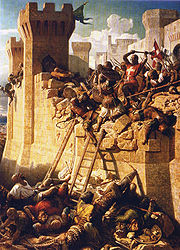
County of Tripoli
The County of Tripoli was the last Crusader state founded in the Levant, located in what today are parts of western Syria and northern Lebanon, where exists the modern city of Tripoli. The Crusader state was captured and created by Christian forces in 1109, originally held by Bertrand of Toulouse...
in 1289, and in 1290 marched on Acre, the capital of the remnant of the Kingdom of Jerusalem
Kingdom of Jerusalem
The Kingdom of Jerusalem was a Catholic kingdom established in the Levant in 1099 after the First Crusade. The kingdom lasted nearly two hundred years, from 1099 until 1291 when the last remaining possession, Acre, was destroyed by the Mamluks, but its history is divided into two distinct periods....
, but, to the relief of the Franks of Acre, he died in November before launching the attack. He was succeeded by Khalil who decided to continue the attack. Khalil sent a message to William of Beaujeu, the Master of the Temple, telling him about his intentions to attack Acre and urging him not to send messengers or gifts. But a delegation from Acre led by Sir Philip Mainebeuf, arrived in Cairo with gifts and appealed to Khalil not to attack Acre. Khalil did not accept the request and imprisoned the Frank messengers.
Al-Ashraf Khalil assembled the forces of Egypt and Syria
Syria
Syria , officially the Syrian Arab Republic , is a country in Western Asia, bordering Lebanon and the Mediterranean Sea to the West, Turkey to the north, Iraq to the east, Jordan to the south, and Israel to the southwest....
, which included a great number of volunteers and siege engines from everywhere at Hisn al-Akrad
Krak des Chevaliers
Krak des Chevaliers , also Crac des Chevaliers, is a Crusader castle in Syria and one of the most important preserved medieval castles in the world. The site was first inhabited in the 11th century by a settlement of Kurds; as a result it was known as Hisn al Akrad, meaning the "Castle of the...
. Some of Khalil's catapult
Catapult
A catapult is a device used to throw or hurl a projectile a great distance without the aid of explosive devices—particularly various types of ancient and medieval siege engines. Although the catapult has been used since ancient times, it has proven to be one of the most effective mechanisms during...
s were huge and had such names as "Al Mansuri" and "The Furious" in addition to lighter, but potent, mangonel
Mangonel
A mangonel was a type of catapult or siege engine used in the medieval period to throw projectiles at a castle's walls. The exact meaning of the term is debatable, and several possibilities have been suggested. Mangonel may also be indirectly referring to the 'mangon' a French hard stone found in...
s called "Black Bulls". Four armies from Damascus (led by Lajin), Hama
Hama
Hama is a city on the banks of the Orontes River in west-central Syria north of Damascus. It is the provincial capital of the Hama Governorate. Hama is the fourth-largest city in Syria—behind Aleppo, Damascus, and Homs—with a population of 696,863...
(led by al-Muzaffar Taqai ad-Din), Tripoli
Tripoli, Lebanon
Tripoli is the largest city in northern Lebanon and the second-largest city in Lebanon. Situated 85 km north of the capital Beirut, Tripoli is the capital of the North Governorate and the Tripoli District. Geographically located on the east of the Mediterranean, the city's history dates back...
(led by Bilban) and Al Kark (led by Baibars al-Dewadar) marched to Acre to join the Egyptian army of Khalil.
In addition to the historian Baibars al-Dewadar who led the army of Al Karak, Abu al-Fida was another prominent historian who accompanied al-Ashraf in his Levant
Levant
The Levant or ) is the geographic region and culture zone of the "eastern Mediterranean littoral between Anatolia and Egypt" . The Levant includes most of modern Lebanon, Syria, Jordan, Israel, the Palestinian territories, and sometimes parts of Turkey and Iraq, and corresponds roughly to the...
iane expedition.
The Franks of Acre were for some time aware of the seriousness of the situation. They asked for help from Europe which resulted in nothing significant. A small group of knights, among them the Swiss Otto de Grandison, were sent by king Edward I of England
Edward I of England
Edward I , also known as Edward Longshanks and the Hammer of the Scots, was King of England from 1272 to 1307. The first son of Henry III, Edward was involved early in the political intrigues of his father's reign, which included an outright rebellion by the English barons...
. Burchard of Schwanden, the Grand Master
Knights Hospitaller
The Sovereign Military Hospitaller Order of Saint John of Jerusalem of Rhodes and of Malta , also known as the Sovereign Military Order of Malta , Order of Malta or Knights of Malta, is a Roman Catholic lay religious order, traditionally of military, chivalrous, noble nature. It is the world's...
of the German
Germans
The Germans are a Germanic ethnic group native to Central Europe. The English term Germans has referred to the German-speaking population of the Holy Roman Empire since the Late Middle Ages....
Teutonic Knights
Teutonic Knights
The Order of Brothers of the German House of Saint Mary in Jerusalem , commonly the Teutonic Order , is a German medieval military order, in modern times a purely religious Catholic order...
, resigned and was replaced by Konrad von Feuchtwangen
Konrad von Feuchtwangen
Konrad von Feuchtwangen was the 13th Grand Master of the Teutonic Knights, serving from 1291-96. He was a relative of the later Grand Master Siegfried von Feuchtwangen....
who suddenly left Acre for Europe. The only noteworthy reinforcement came from king Henry II
Henry II of Jerusalem
Henry II of Jerusalem and Henry II of Cyprus, born Henri de Lusignan was the last ruling and first titular King of Jerusalem and also ruled as King of Cyprus as Henry II...
of Cyprus who fortified the walls and sent forces led by his brother Amalric
Amalric, Prince of Tyre
Amalric de Lusignan or Amaury II de Lusignan, Prince of Tyre , of the Lusignan family, was a son of Hugh III of Cyprus and Isabella of Ibelin.-Biography:...
to defend the city. Acre was well defended by two lines of thick walls and had Twelve towers which were built by European kings and rich pilgrims.
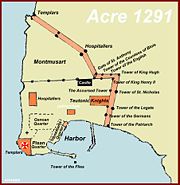
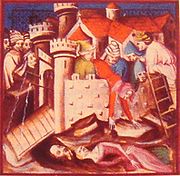
Sidon
Sidon or Saïda is the third-largest city in Lebanon. It is located in the South Governorate of Lebanon, on the Mediterranean coast, about 40 km north of Tyre and 40 km south of the capital Beirut. In Genesis, Sidon is the son of Canaan the grandson of Noah...
with a few people and the fortune of the Templars. In the morning, Peter de Severy went to the Sultan to settle a new negotiation but he was arrested with his followers and they were executed in retaliation for the Sultan's men who were masscared earlier by the Templars inside the fortress. When the besieged Templars in the fortress saw what happened to Peter de Severy, they continued the fight. On May 28, after a wide breach was made under the fortress, the Sultan sent about 2000 men to take it. The Frankish fortress collapsed killing everyone inside, including Sultan's men.
The news of the conquest of Acre reached Damascus and Cairo. Al-Ashraf Khalil entered the decorated city of Damascus with Franks chained at the feet and the captured crusader standards which were carried upside-down as a sign of their defeat. After celebrating his victory in Damascus, Khalil left for Cairo which was also decorated and celebrating. Arriving at Cairo, he ordered the release of Philip Mainebeuf and the men who accompanied him to Cairo earlier.
Capture of Tyre, Sidon, Beirut, Haifa and Tartus
The port of Tyre was one of the most protected strongholds of the Franks on the Syrian coast. SaladinSaladin
Ṣalāḥ ad-Dīn Yūsuf ibn Ayyūb , better known in the Western world as Saladin, was an Arabized Kurdish Muslim, who became the first Sultan of Egypt and Syria, and founded the Ayyubid dynasty. He led Muslim and Arab opposition to the Franks and other European Crusaders in the Levant...
failed twice to capture it. Tyre was passed from Margaret of Lusignan to her nephew Amalric
Amalric, Prince of Tyre
Amalric de Lusignan or Amaury II de Lusignan, Prince of Tyre , of the Lusignan family, was a son of Hugh III of Cyprus and Isabella of Ibelin.-Biography:...
shortly before the capture of Acre by Al-Ashraf Khalil. On May 19, Al-Ashraf, while still in Acre, sent a group of men, led by Emir Sanjar al-Shuja'i, to examine the situation in Tyre. Having a small garrison and seeing the fleeing refugees from Acre, Adam of Cafran, the Bailli of Tyre, panicked and fled to Cyprus. Tyre was taken by the Muslims without a fight.
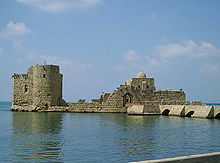
Tartous
Tartus is a city on the Mediterranean coast of Syria. Tartus is the second largest port city in Syria , and the largest city in Tartus Governorate. The population size is 98,000 .- Geography and climate :...
after they saw the Muslims building a bridge. Emir al-Shuja'i ordered the destruction of the sea castle on July 14.
After the capture of Sidon, al-Shuja'i marched to Beirut
Beirut
Beirut is the capital and largest city of Lebanon, with a population ranging from 1 million to more than 2 million . Located on a peninsula at the midpoint of Lebanon's Mediterranean coastline, it serves as the country's largest and main seaport, and also forms the Beirut Metropolitan...
. Beirut, which had a small garrison, was an important trading seaport for the Crusaders. Eschiva of Ibelin, the Lady of Beirut, thought she was secure because she had a truce with al-Ashraf Khalil's father Qalawun. al-Shuja'i summoned the commanders of the garrison and arrested them. Seeing the commanders arrested, everyone fled by sea. Beirut was taken by the Muslims on July 31. al-Shuja'i ordered the razing of its walls and castles and turned its Cathedral
Cathedral
A cathedral is a Christian church that contains the seat of a bishop...
to a Mosque
Mosque
A mosque is a place of worship for followers of Islam. The word is likely to have entered the English language through French , from Portuguese , from Spanish , and from Berber , ultimately originating in — . The Arabic word masjid literally means a place of prostration...
.
Haifa
Haifa
Haifa is the largest city in northern Israel, and the third-largest city in the country, with a population of over 268,000. Another 300,000 people live in towns directly adjacent to the city including the cities of the Krayot, as well as, Tirat Carmel, Daliyat al-Karmel and Nesher...
was captured on July 31, with little resistance. Tartus was besieged by Emir Bilban and the crusaders had to flee to the nearby island of Arwad
Arwad
Arwad – formerly known as Arado , Arados , Arvad, Arpad, Arphad, and Antiochia in Pieria , also called Ruad Island – located in the Mediterranean Sea, is the only inhabited island in Syria. The town of Arwad takes up the entire island...
and was captured on August 3, followed by Atlit on August 14. Nothing was left for the Franks except the Island of Arwad which was captured by an Egyptian army later in 1302.
In 1292, Al-Ashraf Khalil accompanied by his Vizier Ibn al-Salus arrived to Damascus and left – via Aleppo – to besiege the castle of Qal'at ar-Rum
Qal'at ar-Rum
The Qal'at al-Rum was a powerful fortress on the river Euphrates, 50 km west of Şanlıurfa. It is called Hromkla in Kurdish, Rumkale in Turkish, Հռոմկլա in Armenian,; the name means "Roman Castle " in all cases.Its strategic location was already known to the Assyrians, although the present...
(Hromgla in Armenian). Qal'at ar-Rum, which was the seat of the Patriarch of Armenia, was besieged by more than 30 catapults and was captured after 30 days by Khalil, who renamed it Qal'at al-Muslimin (Castle of the Muslims). Khalil left Emir al-Shaja'i at the castle and returned to Damascus with prisoners. The population of Damascus bid farewell to the victorious Sultan on his way to Cairo at night with thousands of lighted candles. The Sultan entered Cairo from the Victory Gate (Bab al-Nasr) and was greeted by the celebrating population, also with thousands of lighted candles .
The Sultan returned to Damascus and assembled an army to invade Sis
Kozan, Adana
Kozan is a city in Adana Province, Turkey, 68 km north of the city of Adana, in the northern section of the Çukurova plain. The city is the capital of Kozan district. The Kilgen Stream, a tributary of the Ceyhan River , flows through Kozan crossing the plain south into the Mediterranean Sea....
, the capital of the Armenian Kingdom of Cilicia
Armenian Kingdom of Cilicia
The Armenian Kingdom of Cilicia , also known as the Cilician Armenia, Kingdom of Cilician Armenia or New Armenia, was an independent principality formed during the High Middle Ages by Armenian refugees fleeing the Seljuk invasion of Armenia...
, but Armenian messengers arrived to Damascus and appealed to him not to attack Sis. Til Hemdun
Toprakkale, Osmaniye
Toprakkale is a town and district of Osmaniye Province in the Mediterranean region of Turkey. It is located at 10 km to the west of Osmaniye. Its name comes from an Abbasid castle near the city....
, Marash and Behesni were given to the Sultan in exchange for peace. On the other hand, Khalil had good relations with the Kingdom of Cyprus
Kingdom of Cyprus
The Kingdom of Cyprus was a Crusader kingdom on the island of Cyprus in the high and late Middle Ages, between 1192 and 1489. It was ruled by the French House of Lusignan.-History:...
, the Kingdom of Aragon
Kingdom of Aragon
The Kingdom of Aragon was a medieval and early modern kingdom in the Iberian Peninsula, corresponding to the modern-day autonomous community of Aragon, in Spain...
, and the Kingdom of Sicily
Kingdom of Sicily
The Kingdom of Sicily was a state that existed in the south of Italy from its founding by Roger II in 1130 until 1816. It was a successor state of the County of Sicily, which had been founded in 1071 during the Norman conquest of southern Italy...
, who had commercial and military treaties with him.
The process of conquering the crusader kingdom, begun by Saladin
Saladin
Ṣalāḥ ad-Dīn Yūsuf ibn Ayyūb , better known in the Western world as Saladin, was an Arabized Kurdish Muslim, who became the first Sultan of Egypt and Syria, and founded the Ayyubid dynasty. He led Muslim and Arab opposition to the Franks and other European Crusaders in the Levant...
in 1187, was finally completed by Khalil who was described on some of his monuments as Alexander. Al-Ashraf was also planning to attack Cyprus and the Mongols in Baghdad.
Baibars
Baibars or Baybars , nicknamed Abu l-Futuh , was a Mamluk Sultan of Egypt. He was one of the commanders of the forces which inflicted a devastating defeat on the Seventh Crusade of King Louis IX of France and he led the vanguard of the Egyptian army at the Battle of Ain Jalut in 1260, which marked...
and Qalawun, and Louis IX
Louis IX of France
Louis IX , commonly Saint Louis, was King of France from 1226 until his death. He was also styled Louis II, Count of Artois from 1226 to 1237. Born at Poissy, near Paris, he was an eighth-generation descendant of Hugh Capet, and thus a member of the House of Capet, and the son of Louis VIII and...
's Seventh Crusade
Seventh Crusade
The Seventh Crusade was a crusade led by Louis IX of France from 1248 to 1254. Approximately 800,000 bezants were paid in ransom for King Louis who, along with thousands of his troops, was captured and defeated by the Egyptian army led by the Ayyubid Sultan Turanshah supported by the Bahariyya...
against Egypt ended in a complete failure, but the crusaders tried to keep their strongholds on the Syrian coast intact, hoping to be able one day to recapture what they had lost. Pope Nicholas IV
Pope Nicholas IV
Pope Nicholas IV , born Girolamo Masci, was Pope from February 22, 1288 to April 4, 1292. A Franciscan friar, he had been legate to the Greeks under Pope Gregory X in 1272, succeeded Bonaventure as Minister General of his religious order in 1274, was made Cardinal Priest of Santa Prassede and...
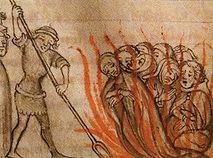
tried to act but he died in 1292, and the European kings, who became involved in internal conflicts and struggles, became unable to organize new effective crusades. As for the Templars, they were accused of heresy in Europe and badly persecuted by King Philip IV of France
Philip IV of France
Philip the Fair was, as Philip IV, King of France from 1285 until his death. He was the husband of Joan I of Navarre, by virtue of which he was, as Philip I, King of Navarre and Count of Champagne from 1284 to 1305.-Youth:A member of the House of Capet, Philip was born at the Palace of...
and Pope Clement V
Pope Clement V
Pope Clement V, born Raymond Bertrand de Got was Pope from 1305 to his death...
.
Domestic conflicts and assassination
Militarily, Al-Ashraf Khalil possessed the vigor and capability of two of his predecessor, Baibars and his father Qalawun. But many Emirs disliked him. He started his reign by executing and imprisoning a few prominent Emirs of his father, among them the vice-Sultan Turuntay. During the battle for Acre he arrested Hosam ad-Din Lajin and later after he returned to Cairo he executed Sunqur al-Ashqar and a few Emirs. Khalil continued his father's policy of replacing TurkishTurkic peoples
The Turkic peoples are peoples residing in northern, central and western Asia, southern Siberia and northwestern China and parts of eastern Europe. They speak languages belonging to the Turkic language family. They share, to varying degrees, certain cultural traits and historical backgrounds...
Mamluks with Circassians, a policy which contributed in the intensification of the rivalry among the Mamluks. After his victories against the Franks, arrogance got hold of al-Ashraf Khalil, he treated the Emirs roughly and began to sign messages and documents with the letter "KH" only. In addition, his Vizier Ibn al-Salus was envied by many Emirs and by the vice-Sultan Baydara in particular. Ibn al-Salus who, originally, was neither a Mamluk nor an Emir but a merchant from Damascus, became the most influential official during the reign of Khalil. While Al-Ashraf was rough on the Emirs, he was very generous towards Ibn al-Salus who did not treat the Emirs with respect. Ibn al-Salus was involved in the unjustly persecution of the supreme judge of Egypt Ibn Bint al-A'az, as he was involved in provoking the Sultan against Baydara on several occasions.
In December 1293, Al-Ashraf Khalil accompanied by Ibn al-Salus, Baydara and other Emirs went to Turug in northern Egypt on a bird-hunting expedition. He sent Ibn Al-Salus to the nearby city of Alexandria
Alexandria
Alexandria is the second-largest city of Egypt, with a population of 4.1 million, extending about along the coast of the Mediterranean Sea in the north central part of the country; it is also the largest city lying directly on the Mediterranean coast. It is Egypt's largest seaport, serving...
to bring materials and to collect the taxes. Arriving at Alexandria, Ibn Al-Salus found out that the deputies of Baydara had already taken everything. On receiving a message from Ibn Al-Salus with this news, Al-Ashraf summoned Baydara to his Dihlis and insulted and threatened him in the presence of other Emirs. The distressed Baydar left the Dihlis and called Lajin, Qara Sunqur and other Emirs and together they decided to kill the Sultan. On 14 December, while the Sultan was walking with his friend Emir Shihab ad-Din Ahmad he was attacked and assassinated by Baydara and his followers. The Emirs who struck the Sultan after Baydara were Hosam ad-Din Lajin and Bahadir Ras Nubah followed by other Emirs. After the assassination of Al-Ashraf Khalil, Baydara and his followers went to the Dihliz and proclaimed Baydara the new Sultan. But Baydara was soon arrested by the Sultani Mamluks and Emirs. Baydara was killed by the Sultani Emirs led by Kitbugha
Al-Adil Kitbugha
Kitbugha , was the 10th Mamluk Sultan of Egypt from December 1294 to November 1296.-Background:He was originally an ordinary Mongol soldier in the Ilkhanid army of Hulagu...
and Baibars al-Jashnikir
Baibars II
Not to be confused with his more famous namesake, Baibars al-BunduqdariBaibars al-Jashnakir or Baibars II. Royal name: al-Malik al-Muzaffar Rukn al-Din Baibars al-Jashnakir al-Mansuri, ....
and his head was sent to Cairo. Ibn al-Salus was arrested in Alexandria and was sent to Cairo where he was mistreated and at last beaten to death. The Emirs who were involved in the assassination of Al-Ashraf Khalil were severely punished and executed. Lajin and Qara Sunqur fled and disappeared.
After the death of Al-Ashraf Khalil, the Emirs decided to install his 9-years-old brother Al-Nasir Muhammad
Al-Nasir Muhammad
Al-Nasir Muhammad b. Cairo 1285, d...
as the new Sultan with Kitbugha as vice-Sultan and al-Shaja'i as the new Vizier. But the death of Al-Ashraf Khalil was concealed for sometime. While Al-Ashraf was dead, his brother Al-Nasir Muhammad was proclaimed Vice-Sultan and heir. A message from Egypt to the Syrian Emirs said: "I appointed my brother al-Malik al-Nasir Muhammad as my Vicegerent
Vicegerent
Vicegerent is the official administrative deputy of a ruler or head of state: vice + gerere .-Related usage:*The Byzantine Emperors held as a title "God's Vicegerent on Earth"....
and heir so that when I go to fight the enemy he replaces me ". As soon as everything was under control the death of Al-Ahraf Khalil was revealed to the public in Egypt and Syria.
Al-Ashraf Khalil ruled about three years and two months. He had two daughters. Besides being remembered as the conqueror of Acre, he was remembered by Muslim historians as an intelligent Sultan who was fond of reading and learning.
Coins of Al-Ashraf Khalil
Coins of Al-Ashraf Khalil were unique in Mamluk coinage history. New kind of titles were inscribed on his coins such as : al-Sultan al-Malik al-Ashraf Salah al-Din Nasir al-Milah al-Muhamadiyah Muhyyi al-Dawalah al-Abasiyah ( The Sultan King al-Ashraf Salah al-Din the Promoter of the Muhammadan Nation and the Revitalizer of the AbbasidCaliphate ), al-Sultan al-Malik al-Ashraf Salah al-Donya wa al-Din Qasim Amir al-mu'minin ( The Sultan King al-Ashraf reform of temporal world and faith sharer of the Emir of the faithful ) the Emir of the faithful was the title of the Abbasid Caliph. His father Qalawun was also mentioned on Al-Ashraf's coins as : Mawlana al-Sultan al-Malik al-Mansur ( Our benefactor the Sultan King al-Mansur).
See also
- Bahri dynastyBahri dynastyThe Bahri dynasty or Bahriyya Mamluks was a Mamluk dynasty of mostly Kipchak Turkic origin that ruled Egypt from 1250 to 1382 when they were succeeded by the Burji dynasty, another group of Mamluks...
- List of rulers of Egypt
- KipchaksKipchaksKipchaks were a Turkic tribal confederation...
- Siege of Acre (1291)Siege of Acre (1291)The Siege of Acre took place in 1291 and resulted in the loss of the Crusader-controlled city of Acre to the Muslims. It is considered one of the most important battles of the time period. Although the crusading movement continued for several more centuries, the capture of the city marked the end...
- Siege of Ruad
- Siege of TripoliSiege of TripoliThe Siege of Tripoli lasted from 1102 until July 12, 1109 and took place on the site of the present day Lebanese city of Tripoli. It took place in the aftermath of the First Crusade and led to the establishment of the fourth crusader state, the County of Tripoli.-Background:After the capture of...
- QalawunQalawunSaif ad-Dīn Qalawun aṣ-Ṣāliḥī was the seventh Mamluk sultan of Egypt...