

Keyboard expression

Encyclopedia
Keyboard instrument
A keyboard instrument is a musical instrument which is played using a musical keyboard. The most common of these is the piano. Other widely used keyboard instruments include organs of various types as well as other mechanical, electromechanical and electronic instruments...
to respond to the dynamics
Dynamics (music)
In music, dynamics normally refers to the volume of a sound or note, but can also refer to every aspect of the execution of a given piece, either stylistic or functional . The term is also applied to the written or printed musical notation used to indicate dynamics...
of the music or change the tone of the sound in response to the way that the performer depresses the keys of the musical keyboard
Musical keyboard
A musical keyboard is the set of adjacent depressible levers or keys on a musical instrument, particularly the piano. Keyboards typically contain keys for playing the twelve notes of the Western musical scale, with a combination of larger, longer keys and smaller, shorter keys that repeats at the...
. Keyboard expression types include velocity sensitivity, which responds to how hard or fast the keys are pressed; pressure sensitivity, which responds to the force with which a key is held down after the initial impact; and displacement sensitivity, which responds to how far down a key is depressed.
Different keyboard instruments offer a range of different types of expression. Acoustic piano
Piano
The piano is a musical instrument played by means of a keyboard. It is one of the most popular instruments in the world. Widely used in classical and jazz music for solo performances, ensemble use, chamber music and accompaniment, the piano is also very popular as an aid to composing and rehearsal...
s such as upright pianos and grand pianos are velocity sensitive. Baroque-style clavichord
Clavichord
The clavichord is a European stringed keyboard instrument known from the late Medieval, through the Renaissance, Baroque and Classical eras. Historically, it was widely used as a practice instrument and as an aid to composition, not being loud enough for larger performances. The clavichord produces...
s and professional-level modern electronic keyboard
Electronic keyboard
An electronic keyboard is an electronic or digital keyboard instrument.The major components of a typical modern electronic keyboard are:...
s are pressure sensitive; the degree that the performer is pressing the key after the initial strike will produce effects such as vibrato
Vibrato
Vibrato is a musical effect consisting of a regular, pulsating change of pitch. It is used to add expression to vocal and instrumental music. Vibrato is typically characterised in terms of two factors: the amount of pitch variation and the speed with which the pitch is varied .-Vibrato and...
or swell
Swell
Swell may refer to:*Swell , a formation of long wavelength ocean surface waves*Swell , an indie rock band from San Francisco*Swell, Gloucestershire, England*Swell , a term in bookbinding...
s in volume
Volume
Volume is the quantity of three-dimensional space enclosed by some closed boundary, for example, the space that a substance or shape occupies or contains....
. Tracker pipe organ
Pipe organ
The pipe organ is a musical instrument that produces sound by driving pressurized air through pipes selected via a keyboard. Because each organ pipe produces a single pitch, the pipes are provided in sets called ranks, each of which has a common timbre and volume throughout the keyboard compass...
s and electronic organ
Electronic organ
An electronic organ is an electronic keyboard instrument which was derived from the harmonium, pipe organ and theatre organ. Originally, it was designed to imitate the sound of pipe organs, theatre organs, band sounds, or orchestral sounds....
s are displacement sensitive; if the keys are only partly depressed, a quieter tone is produced.
Velocity sensitivity

Piano
The piano is a musical instrument played by means of a keyboard. It is one of the most popular instruments in the world. Widely used in classical and jazz music for solo performances, ensemble use, chamber music and accompaniment, the piano is also very popular as an aid to composing and rehearsal...
responds to the force with which the keys are initially pressed by changing how hard or fast the hammers strike the strings, which in turn changes the tone and volume of the resulting note or chord; it is velocity sensitive. Several of its predecessors, such as the harpsichord
Harpsichord
A harpsichord is a musical instrument played by means of a keyboard. It produces sound by plucking a string when a key is pressed.In the narrow sense, "harpsichord" designates only the large wing-shaped instruments in which the strings are perpendicular to the keyboard...
, were not velocity sensitive like the piano. There is some confusion relating to the term pressure sensitive, with some using it as a synonym
Synonym
Synonyms are different words with almost identical or similar meanings. Words that are synonyms are said to be synonymous, and the state of being a synonym is called synonymy. The word comes from Ancient Greek syn and onoma . The words car and automobile are synonyms...
for velocity sensitive. To avoid this confusion, pressure sensitivity is sometimes called aftertouch. Both velocity and (true) pressure sensitivity are supported independently by the MIDI standard.
In general, only the top of the line electronic keyboards implement true pressure sensitivity, while most professional-quality electronic keyboards support velocity sensitivity. Most inexpensive electronic keyboards, such as toy electronic keyboards and basic learning keyboards made by Casio and Yamaha in the $100 USD price range, do not have velocity sensitivity. Some manufacturers use the term "touch sensitive" (an incorrect term used) in their advertising. Even on a touch-sensitive keyboard, not all digital instrument sounds may incorporate velocity sensitivity into the sound's envelope; for example, the digital pipe organ sound often has no velocity sensitive effects, in imitation of the real instrument. The manufacturers and distributors of some inferior keyboards incorrectly describe their purely velocity sensitive instruments as pressure sensitive.
Pressure sensitivity

Clavichord
The clavichord is a European stringed keyboard instrument known from the late Medieval, through the Renaissance, Baroque and Classical eras. Historically, it was widely used as a practice instrument and as an aid to composition, not being loud enough for larger performances. The clavichord produces...
and some electronic keyboard
Electronic keyboard
An electronic keyboard is an electronic or digital keyboard instrument.The major components of a typical modern electronic keyboard are:...
s also respond to the force with which a key is held down after the initial impact; they are pressure sensitive. This can be used by a skilled clavichord player to slightly correct the intonation
Intonation (music)
Intonation, in music, is a musician's realization of pitch accuracy, or the pitch accuracy of a musical instrument. Intonation may be flat, sharp, or both, successively or simultaneously.-Interval, melody, and harmony:...
of the notes when playing on a clavichord, and/or to play with a form of vibrato
Vibrato
Vibrato is a musical effect consisting of a regular, pulsating change of pitch. It is used to add expression to vocal and instrumental music. Vibrato is typically characterised in terms of two factors: the amount of pitch variation and the speed with which the pitch is varied .-Vibrato and...
known as bebung
Bebung
Bebung is a type of vibrato executed on the clavichord.When a clavichord key is pressed, a small metal tangent strikes a string and remains in contact with it for as long as the key is held down...
.
Unlike in a piano action, the tangent does not rebound from the string; rather, it stays in contact with the string as long as the key is held, acting as both the nut and as the initiator of sound. The volume of the note can be changed by striking harder or softer, and the pitch can also be affected by varying the force of the tangent against the string. When the key is released, the tangent loses contact with the string and the vibration of the string is silenced by strips of damping cloth.
By applying a rocking pressure up and down the key with the finger, a performer can slightly alter the vibrating length of the string itself, producing a vibrato quality known as Bebung. While the vibrato on fretless string instruments such as the violin typically oscillates in pitch both above and below the nominal note, clavichord Bebung can only produce pitches above the note.
Bebung was often not explicitly indicated in sheet music; the assumption was that, like other ornaments, Bebung was to be applied at the performer's discretion. Where Bebung is indicated, it appears as a series of dots written above or below a note, with the number of dots indicating the number of movements of the finger.
On electronic keyboards and synthesizers, pressure sensitivity is sometimes called aftertouch. The aftertouch sensors detect whether the musician is continuing to exert pressure after the initial strike of the key. The aftertouch feature allows keyboard players to change the tone or sound of a note after it is struck, the way that singers, wind players, or bowed instrument players can do. On some keyboards, sounds or synth voices have a preset pressure sensitivity effect, such as a swell in volume (mimicking a popular idiomatic style of vocal performance with melodies) or the addition of vibrato. On some keyboards, the player can select which effects are applied when aftertouch is detected. This allows a performer to custom-tailor the effect that they desire. It may also facilitate the imitation of various non-keyboard instruments. For example, a keyboardist who wishes to imitate the sound of a heavy metal guitar solo could use a distortion guitar sound, and then set the aftertouch feature to apply a pitch bend to the note.
Displacement sensitivity
Organ (music)
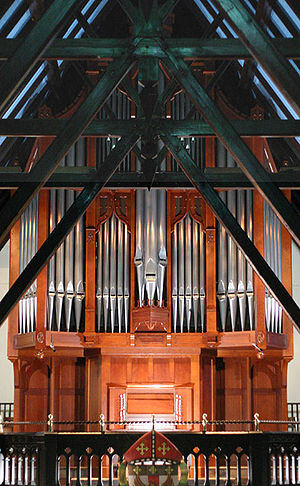
The organ , is a keyboard instrument of one or more divisions, each played with its own keyboard operated either with the hands or with the feet. The organ is a relatively old musical instrument in the Western musical tradition, dating from the time of Ctesibius of Alexandria who is credited with...
s. Most mechanical organs, and some electrically actuated organs, are displacement sensitive, i.e. when a key is pressed partway down, the corresponding note (pipe, reed, or the like) in the organ will produce a different, quieter sound than when the key is fully depressed. In some organs, the pitch and/or tone colour may also be altered. Small tabletop organs and accordions often respond similarly, with sound output increasing as keys are pressed further down. Even the small circular accompaniment ("one button chord") keys found on accordions and on some organs exhibit this phenomenon. Accordingly, some electrically actuated organs have retained this form of keyboard expression:
Other more sophisticated forms of sensitivity are common in organ keyboards. Both the Pratt Reed and Kimber Allen 61-key (5-octave) keyboards have provision for installing up to nine rails, so that they can sense various amounts of displacement, as well as velocity in various regimes of distance from the top to the bottom of the key travel of each key. Some modern instruments such as the Continuum
Continuum (instrument)
The Continuum Fingerboard or Haken Continuum is a music performance controller developed by Lippold Haken, a professor of Electrical and Computer Engineering at the University of Illinois, and sold by Haken Audio, located in Champaign, Illinois....
, a MIDI controller
MIDI controller
MIDI controller is used in two senses.*In one sense, a controller is hardware or software which generates and transmits MIDI data to MIDI-enabled devices....
for keyboards, have extremely sophisticated human interface schemes, allowing dynamic control in three dimensions. In principle, displacement can be differentiated to get velocity, but the converse is not entirely practical, without some amount of baseline drift. Thus a displacement sensing keyboard may have greater versatility when it is desired to have both organ and piano behaviour in an input device.
Other types
Acoustic pianos have expression pedals which can change the response or tone of the instrument, such as a sustain pedal and a soft pedal. On small upright pianos, the "soft" pedal lowers a sheet of felt in front of the hammers. On grand pianos, the hammers are moved further back from the strings. The sustain pedal allows all of the notes of a chord to sound. In addition, since the dampers are not applied, it allows octave and fifth overtones to vibrate sympathetically, producing a richer sound. Most electronic keyboards also have a sustain pedal which allows notes and chords to be held; however, only the highest-end digital keyboards reproduce the sympathetic vibration effect.Electromechanical keyboards and electronic keyboards offer a range of other expression devices. Electromechanical keyboards such as the Hammond organ
Hammond organ
The Hammond organ is an electric organ invented by Laurens Hammond in 1934 and manufactured by the Hammond Organ Company. While the Hammond organ was originally sold to churches as a lower-cost alternative to the wind-driven pipe organ, in the 1960s and 1970s it became a standard keyboard...
offer additional means of keyboard expression by modifying the starting, stopping, or speed of the rotating Leslie speaker or by engaging a variety of vibrato or chorus effects. Digital "clones" of Hammond organs offer recreations of these effects, along with other effects. The VK-9 digital organ, for example, offers a proximity-sensitive detector which can be used to trigger the Leslie speaker, a ring modulator effect, or a variety of other effects.
Some effect pedals which are used with electromechanical keyboards such as the Fender Rhodes electric piano
Rhodes piano
The Rhodes piano is an electro-mechanical piano, invented by Harold Rhodes during the fifties and later manufactured in a number of models, first in collaboration with Fender and after 1965 by CBS....
or digital keyboards respond to the velocity with which the keys are struck. Examples include velocity-sensitive overdrive pedals, which produce a clean sound for gentle keystrikes, and a distortion effect for hard keystrikes; and fixed wah-wah pedals, which respond to keystrikes by producing a wah-wah pedal effect which alters the tone.