
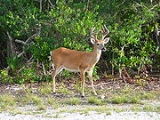
The
Key Deer (
Odocoileus virginianus clavium) is an
endangeredAn endangered species is a population of organisms which is at risk of becoming extinct because it is either few in numbers, or threatened by changing environmental or predation parameters. Also it could mean that due to deforestation there may be a lack of food and/or water...
deerDeer are the ruminant mammals forming the family Cervidae. They include for example Moose, Red Deer, Reindeer, Roe and Chital. Animals from related families within the order Artiodactyla are often also considered to be deer – these include muntjac and water deer...
that lives only in the
Florida KeysThe Florida Keys are a cluster of about 1700 islands in the southeast United States. They begin at the southeastern tip of the Florida peninsula, about south of Miami, and extend in a gentle arc south-southwest and then westward to Key West, the westernmost of the inhabited islands, and on to the...
. It is a subspecies of the
White-tailed deerThe white-tailed deer , also known as the Virginia deer, or simply as the whitetail, is a medium-sized deer native to the United States , Canada, Mexico, Central America, and in South America as far south as Peru...
(
O. virginianus).
Physical description and behavior
This deer can be recognized by its characteristic size, smaller than all other White-tailed deer. Adult males (known as
buckBuck may refer to:People:*Buck *Buck Places:* Buck Hill Farm Covered Bridge, in Lancaster County, Pennsylvania, United States* Buck Hill Cone, British Columbia, Canada* Buck Hill Falls, Pennsylvania...
s) usually weigh and stand about tall at the shoulder. Adult females (
does) usually weigh between and have an average height of at the shoulders. The deer is a reddish-brown to grey-brown in color.
AntlerAntlers are the usually large and complex bony appendages of most deer species, mostly worn by males; only female caribou and reindeer have antlers, though these are normally smaller than those of the males. Each antler grows from an attachment point on the skull called a pedicle...
s are grown by males and shed between February and March and regrown by June. When the antlers are growing, they have a white velvet coating. The species otherwise generally resembles other white-tailed deer in appearance.
Key Deer easily swim between
islandAn island or isle is any piece of land that is surrounded by water. Very small islands such as emergent land features on atolls are called islets. A key or cay is another name for a small island or islet. An island in a river or lake may be called an eyot, .There are two main types of islands:...
s.
Living close to humans, the Key Deer has little of the natural fear of man shown by most of their larger mainland cousins. The deer are often found in residents' yards and along roadsides where tasty plants and flowers grow. This often results in car-to-deer collisions, as the deer are more active (and harder to avoid) at night. It is not unusual to see them at dusk and dawn, especially on lightly-inhabited
No Name KeyNo Name Key is an island located in the lower Florida Keys in the United States. It is somewhat remote and sparsely populated, and does not have electricity which limits development of the key. No Name Key is a fairly small island in comparison to its neighbor, Big Pine Key, which lies about a...
, and in the less-populated northern areas of Big Pine Key. Some are so tame that they will accept food directly from humans, but feeding deer is prohibited by law.
Reproduction
Mating may occur at any time of the year but usually peaks during mating season (
rut) from September to November. Key Deer have a relatively low reproductive rate, averaging 1.08 young (fawns) per adult doe per year.
Range, habitat, and diet
The range of the Key Deer originally encompassed all of the lower Florida Keys (where standing water pools exist), but is now limited to a stretch of the Florida Keys from about
Sugarloaf KeySugarloaf Key is one of the larger islands in the lower Florida Keys, about 15 miles east of Key West.It is located between Park Key and Cudjoe Key.U.S. 1 crosses the key at approximately mile markers 19--20.5....
to
Bahia Honda KeyBahia Honda , is an island in the lower Florida Keys.U.S...
.
The islands of Big Pine, Cudjoe,
West SummerlandWest Summerland Key is an island in the lower Florida Keys.U.S. 1 crosses the key at approximately mile markers 34--35, between Spanish Harbor Key and Big Pine Key....
, Big Torch, Howe, Little Pine, Little Torch, Middle Torch, No Name, and Sugarloaf are the only places where the deer permanently reside. The deer also can be found on the islands of Annette, Big Munson, Little Munson, Johnson,
KnockemdownKnockemdown Key is an island in the lower Florida Keys approximately 20 miles east of Key West. It is northwest of Summerland Key, between Cudjoe Key and Big Torch Key.A managed by NOAA is located on the island....
, Mayo, Porpoise, Ramrod, Toptree Hammock, Wahoo, Water Key (east) and Water Keys (west), but they are only present there in the
dry seasonThe dry season is a term commonly used when describing the weather in the tropics. The weather in the tropics is dominated by the tropical rain belt, which oscillates from the northern to the southern tropics over the course of the year...
where there is a lack of a fresh water.
Key Deer use all islands during the
wet seasonThe wet season, or rainy season, is the time of year, covering one or more months, when most of the average annual rainfall in a region falls. The term green season is also sometimes used as a euphemism by tourist authorities. Areas with wet seasons are dispersed across portions of the tropics...
when drinking water is more generally available, retreating to islands with a perennial supply of fresh water in dry months.
Key Deer inhabit nearly all
habitatA habitat is an ecological or environmental area that is inhabited by a particular animal and plant species...
s within their range, including pine rocklands, hardwood hammocks,
mangroveMangroves are trees and shrubs that grow in saline coastal habitats in the tropics and subtropics – mainly between latitudes N and S. The saline conditions tolerated by various species range from brackish water, through pure seawater , to water of over twice the salinity of ocean seawater,...
s, and
freshwater wetlandsA wetland is an area of land whose soil is saturated with moisture either permanently or seasonally. Such areas may also be covered partially or completely by shallow pools of water. Wetlands include swamps, marshes, and bogs, among others. The water found in wetlands can be saltwater, freshwater,...
. The species feed on over 150 types of plants, but mangroves (
redRhizophora mangle, known as the red mangrove, is distributed in estuarine ecosystems throughout the tropics. Its viviparous "seeds," in actuality called propagules, become fully mature plants before dropping off the parent tree. These are dispersed by water until eventually embedding in the...
,
whiteLaguncularia racemosa is a species of flowering plant in the the Leadwood tree family, Combretaceae...
, and
blackBlack Mangrove is a species of flowering plant in the Acanthus family, Acanthaceae.A. germinans grows in tropical and sub-tropical regions of the Americas, on both Atlantic and Pacific coasts, and on the Atlantic coast of tropical Africa, where it thrives on the sandy and muddy shores that...
) and
thatch palmThe name Thatch palm is applied to several different species of palm trees in the genera Coccothrinax, Howea and Thrinax. The name comes from the use of these trees for roof thatching....
berriesThe botanical definition of a berry is a simple fruit produced from a single ovary, such as a grape or a tomato. The berry is the most common type of fleshy fruit in which the entire ovary wall ripens into an edible pericarp. The flowers of these plants have a superior ovary formed by the fusion of...
make up the most important part of their diet. Pine rockland habitat is important as well because it often offers the only reliable source of fresh drinking water (Key deer can tolerate drinking only mildly brackish water).
Habitat destructionHabitat destruction is the process in which natural habitat is rendered functionally unable to support the species present. In this process, the organisms which previously used the site are displaced or destroyed, reducing biodiversity. Habitat destruction by human activity mainly for the purpose...
due to human encroachment causes many deer to now feed on non-native
ornamental plantOrnamental plants are typically grown in the flower garden or as house plants. Most commonly they are grown for the display of their flowers. Other common ornamental features include leaves, scent, fruit, stem and bark. In some cases, unusual features may be considered ornamental, such as the...
s.
History
It is believed that the Key Deer is a subspecies of White-tailed deer which migrated to the Florida Keys from the mainland over a
land bridgeA land bridge, in biogeography, is an isthmus or wider land connection between otherwise separate areas, which allows terrestrial animals and plants to cross over and colonise new lands...
during the
Wisconsin glaciationThe last glacial period was the most recent glacial period within the current ice age, occurring in the Pleistocene epoch. It began about 110,000 years ago and ended about 9,600 - 9,700 BC. During this period there were several changes between glacier advance and retreat. The maximum extent of...
. The earliest known written reference to Key Deer comes from the writings of
Hernando de Escalante FontanedaHernando de Escalante Fontaneda was a Spanish shipwreck survivor who lived among the Indians of Florida for 17 years...
, a Spanish sailor
shipwreckA shipwreck is the remains of a ship that has wrecked, it having either been sunk or beached. A shipwreck can refer to a wrecked ship or to the event that caused the wreck, such as the striking of something that causes the ship to sink, the stranding of the ship on rocks, land or shoal, or the...
ed in the Florida Keys and captured by
Native AmericansNative Americans in the United States is the phrase that describes indigenous peoples from North America now encompassed by the continental United States, including parts of Alaska and the island state of Hawaii. They comprise a large number of distinct tribes, states, and ethnic groups, many of...
in the 1550s.
Endangered status
Deer were hunted as a food supply by native tribes, passing sailors, and early settlers. The hunting of Key Deer was banned in 1939, but widespread
poachingPoaching is the illegal hunting, fishing, trapping, or eating of wild plants or animals contrary to local and international conservation and wildlife management laws...
and
habitat destructionHabitat destruction is the process in which natural habitat is rendered functionally unable to support the species present. In this process, the organisms which previously used the site are displaced or destroyed, reducing biodiversity. Habitat destruction by human activity mainly for the purpose...
caused the subspecies to plummet to near-extinction by the 1950s. The
National Key Deer RefugeThe National Key Deer Refuge is a National Wildlife Refuge located on Big Pine Key and No Name Key in the Florida Keys in Monroe County, Florida....
, a federally administered
National Wildlife RefugeNational Wildlife Refuge is a designation for certain protected areas of the United States managed by the United States Fish and Wildlife Service. The National Wildlife Refuge System is the world's premiere system of public lands and waters set aside to conserve America's fish, wildlife and plants...
operated by the
Wildlife ServiceThe United States Fish and Wildlife Service is the unit of the U.S. Department of the Interior dedicated to the management and preservation of wildlife.Units within the FWS include:* National Wildlife Refuge System* * Federal Duck Stamp...
, was established in 1957.
Recent population estimates put the population between 300 and 800, putting it on the list of endangered species. Road kills from drivers on
U.S. 1U.S. Route 1 in Florida runs along that state's east coast from Key West to Boulogne. At Boulogne it continues north, crossing the St. Marys River into Georgia near Folkston...
, which traverses the deer's small range, are also a major threat, averaging between 30 and 40 kills per year, 70% of the annual mortality.
However, the population has made an encouraging rise since 1955, when population estimates ranged as low as 25, and appears to have stabilized in recent years. Still, recent human encroachment into the fragile habitat and the deer's relatively low rate of reproduction point to an uncertain future for the species.
Conservation efforts
Conservation efforts include the establishment of the National Key Deer Refuge, which consists of approximately on Big Pine, No Name Key and several smaller uninhabited islands. Not all of the refuge lands are protected as public lands; despite extensive efforts of the Refuge to purchase these private habitat lands for protection in the refuge, about currently remain in private ownership and can potentially be developed. About of this privately developable land is on Big Pine Key and No Name Key, which is the central population area for the deer. In 2006, a Habitat Conservation Plan was enacted by Monroe County and the U.S. Fish and Wildlife Service which will limit development in primary habitat and provide for additional habitat purchases over the next 15 years. At the end of this period, however, most of the of privately owned habitat land on Big Pine and No Name Keys will still be open for further development. Thus while the short term promises some cushion from extinction, the long-term prospects for the deer remain in doubt. The refuge also provides rules for the control of feral dogs, which often attack the deer, and for the prohibition of feeding of the deer, which lowers their resistance to natural cycles; however, historically, due to local political pressures, these rules have been poorly enforced. A portion of U.S. Route 1 was also elevated in 2003 to allow the deer to pass safely beneath the roadway, in an attempt to lessen the chance of road kills. However, no decrease in total traffic deaths has been seen. Biologists have recently begun relocating some Key Deer from Big Pine Key to other islands, since Big Pine Key's population has reached its sustainable limit.
External links