
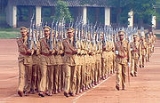
The
Kerala State Police is the
law enforcement agencyIn North American English, a law enforcement agency is a government agency responsible for the enforcement of the laws.Outside North America, such organizations are called police services. In North America, some of these services are called police while others have other names In North American...
for the state of
Keralaor Keralam is an Indian state located on the Malabar coast of south-west India. It was created on 1 November 1956 by the States Reorganisation Act by combining various Malayalam speaking regions....
,
IndiaIndia , officially the Republic of India , is a country in South Asia. It is the seventh-largest country by geographical area, the second-most populous country with over 1.2 billion people, and the most populous democracy in the world...
. Kerala Police has its headquarters in
ThiruvananthapuramThiruvananthapuram , formerly known as Trivandrum, is the capital of the Indian state of Kerala and the headquarters of the Thiruvananthapuram District. It is located on the west coast of India near the extreme south of the mainland...
, the state capital. The Police training college was set up by Travancore Maharaja in Thiruvananthapuram in mid 20th centuary. In 2004,a larger
Kerala Police AcademyKerala Police Academy is situated in Ramavarmapuram in Thrissur city which began functioning in May, 2004. The Academy runs full-term basic courses for sub-inspectors, constables, women constables, drivers and telecommunication wing constables. It also runs short-term courses and in-service...
was built at
ThrissurThis article is about the city in India. For the district, see Thrissur district. For the urban agglomeration area of Thrissur see Thrissur Metropolitan Area...
. The motto of the force is
Mridhu bhave dhrida krthye which means
"Soft in Temperament, Firm in Action" in
SanskritSanskrit , is a historical Indo-Aryan language and the primary liturgical language of Hinduism, Jainism and Buddhism.Buddhism: besides Pali, see Buddhist Hybrid Sanskrit Today, it is listed as one of the 22 scheduled languages of India and is an official language of the state of Uttarakhand...
.
Kerala Police has a reputation for being one of the best managed police forces in the country, and one of the top ranking states in terms of law and order, in various social security ranking. Since 2006 onwards, Kerala Police has embarked into a major modernatization program to tackle challengers of the 21st century. The state police is also the first police department in South Asia to undertake community policing.
History
The first references of an independent policing unit in ancient Kerala history was traced back to the period of
Imperial CherasChera Dynasty in South India is one of the most ancient ruling dynasties in India. Together with the Cholas and the Pandyas, they formed the three principle warring Iron Age Tamil kingdoms in southern India...
, who ruled much of Kerala and West coast of India till 1102 AD. The reference in
Sangam literatureSangam literature refers to a body of classical Tamil literature created between the years c. 600 BCE to 300 CE. This collection contains 2381 poems composed by 473 poets, some 102 of whom remain anonymous The period during which these poems were composed is commonly referred to as the Sangam...
, throws light on a special type of guards outside regular army, known as
Kolkaran or one who carried the
Kole (a stick) represented the authority. Similar references are made in many historical works during that era.
Towards the declining period of Chera Empire, many feudal kingdoms rose in Kerala, and each feudal lord became responsible for maintaining his authority over the people. This led to maintaining private force along with irregulars for maintaining peace and harmony in each one's terrority and to quell any acts of aggression against the lords. Policemen during this era were known in different names like
Velkar in North Malabar,
Kavilkar in Middle Kerala and
Madampimar in Southern Kerala. These men were responsible not only in regular policing works, but also into tax collection and oppression of rebels. Many of their acts were too inhuman and laws favoured rich and mighty during this era. During this era, these men had magistrate powers to decide upon merit of case and take punishments, which thereby considered as not fair in modern sense.
The foundations of modern police system came in 1835, when Travancore Maharaja, HH
Swathi Thirunal Rama VarmaSri Swathi Thirunal Rama Varma was the Maharaja of the state of Travancore , in India. He reigned under the regency of his mother Maharani Gowri Lakshmi Bayi from 1813 till 1815 and henceforth under the regency of his aunt Maharani Gowri Parvati Bayi from 1815 till 1829...
abolished the system of feudal lordship (Naduvazhi and Deshavazhi system) and handed over the magistrate powers to legal courts constituted by the King with learned men as judges along with a written codified law. With the abolishment of feudal lordships, the powers of private force to maintain law and order ceased and administration of justice, peace and order fell upon the state. The
Travancore's Royal Nair Brigade (Travancore Army) was given the responsibility of maintaining internal law and order, through a special division called as Sudarshana Sena (Guards).
Till 1881, the work of the Police was combined with that of the Magistrates. Actually, such a combination was found objectionable in principle and was most convenient in practice. The Indian Police act in 1861, which was made applicable to the British India, had attracted the attention of several provinces. In Travancore, Dewan Rama Iyengar was appointed for preparing a report on the basis of the Indian Police Act. Thereafter, the Travancore Police was reorganised on the basis of Rama Iyengars's report and the process was completed in 1881.The following were the important recommendations of Rama Iyengar .
- The Police force should be separated from Magistracy
- A Superintendent should conduct the administration of the Police under the direct control of Maharaja.
- Certain criteria should be adopted for the recruitment of Police personnel.
- They should serve in any part of the country.
- If necessary, a village Police force may also be maintained in addition to the Police force.
On the basis of this report a law was passed in 1881 on the lines of Madras Police Act. Thereafter, the Sudarshana Sena was reorganised and a new Police Department known as
Royal Travancore Police (RTP), marking the foundations of modern Kerala Police, was started under the leadership of
O.M.Bensly, the first Superintendent of Travancore Police. He held the post for thirty years and he is regarded as the
Father of Modern Kerala Police. The re- organization, which started in 1881,was completed in 1882. At this time the force consisted of a Superintendent, 2 Assistant Superintendents, 42 Inspectors ( in various grades ), 8 Sub Inspectors, 160 Head Constables, 1890 Constables. It shows the tremendous development of the department. in modern times. The members of the force were enlisted from all classes with due regard to age and physical fitness and placed under the immediate control of the European Superintendent, O. H. Bensely. As a result of the re- organization a complete separation of the Police and the Magistracy was effected and a clear line of demonstration was drawn between the judicial functions of the Magistrates and the preventive and detective duties of the Police. In 1939, Significant changes were made in the General Executive Wing, Criminal Intelligence Wing, Reserve Force, Special Police,and Traffic Wing. The total strength of the Police personnel in 1947 was 3626. N.Chandrasekharan Nair was appointed as Inspector General of Police and he took charge on 21 August 1948. He continued as Inspector General of Police even after the merger of Travancore and Cochin in 1952 and he was appointed as the first Inspector General of Police after the formation of the Kerala State in 1956.
Similar developments happened in Kingdom of Kochi with an independent Police Department was formed in 1883, under orders of Kochi
MaharajaMahārāja is a Sanskrit title for a "great king" or "high king". The female equivalent title Maharani denotes either the wife of a Maharaja or, in states where that was customary, a woman ruling in her own right. The widow of a Maharaja is known as a Rajamata...
Rama Varma.
George Gunther became the First Superintendent of Police of the Cochin State, which was known as
Cochin State Royal Police (CSRP).
Whereas in Malabar, which was part of Madras Presidency of British India, the police force formed under Madras Police Act became responsible for internal law and order. The whole of Malabar was divided into North and South Malabar with headquarters at Tellicherry and Calicut for the smooth administration of the Police. As a precaution the best Police men were selected to form a separate unit. This unit was of great help in suppressing the riot of 1896. In 1906 it is estimated that Malabar Police had 188 officers and 1278 men in 106 Police Stations. In 1884 a special punitive force was organized. It was known as
Malabar Special Police-1 in the beginning. The great eruption of Mappila rebellion forced the authority to create a strength of 600 constables in addition to the British and the Indian officers. The then South Malabar Police Superintendent
Mr. Hitchcock organised a new Police force on the model of the British Army which came into existence on 30 September 1921 as
Malabar Special PoliceThe Malabar Special Police is a paramilitary unit of the State Police of Kerala, India. This unit also trains new recruits and also helps the local police units to maintain law and order during emergencies. During emergencies, this unit forms the riot police platoons fully equipped with riot gear...
-2. Hitchcock himself was the first Commandant of M.S.P. In 1932 the strength of the force was increased to 16 companies. Whenever law and order situation was threatened the British always rushed levies from outside to control the situation. The system continued like this till 1956 when the Kerala state was formed and the Malabar Special Police was divided into two parts, one going to Madras State and the other coming to Kerala.
The forces of Malabar, Cochin, Travancore merged together on November 1, 1956 and renamed as Kerala State Police with its headquarters at Thiruvananthapuram, the state Capital.
Organizational structure
Kerala Police comes under direct control of Department of Home Affairs,
Government of KeralaThe Government of Kerala is a democratically elected body that governs the State of Kerala, India for a period of 5 years. The state government is headed by the Governor of Kerala as the nominal head of state, with a democratically elected Chief Minister as real head of the executive. The state...
. The current minister for Home affairs is
Oommen ChandyOommen Chandy is an Indian politician and the current Chief Minister of Kerala. He has held the Chief Minister of Kerala position earlier from 2004 to 2006, and was the Leader of the Opposition in the Kerala Legislative Assembly from 2006 to 2011.-Early life:Oommen Chandy or 'Kunjoonju' was born...
. The Police Department is headed by
Director General of PoliceIn India the director general of police or inspector general of police is a three-star rank and the highest ranking police officer in Indian States & Union Territories. All DGPs/IGPs are Indian Police Service officers. The DGP/IGP is usually the head of the state police force in every Indian state...
(DGP).
Jacob Punnoose IPSJacob Punnoose IPS is the DGP of Kerala. He had his education in P C High School , S C High School and Mar Ivanios College . He was the City Police Commissioner of Trivandrum and Kozhikkode, Joint Excise Commissioner, Zonal IG of Trivandrum and Kozhikkode, Intelligence IG, Additional DGP and...
is the present DGP of Kerala Police.
The law & order forms the major chunk of state force's personnel. For this, the state is divided into 2 zones, the North Zone and South Zone, each headed by Additional Director General of Police (ADGP). Each zones are divided into two ranges each with an Inspector General of Police heading each range. Kannur Range and Thrissur Range comes under North Zone, whereas Ernakulam (Central) Range and Trivandrum (Travancore) Range comes under South Range. There are 3 commissariat for 3 large metro cities of Kerala with City Police Commissioner (having a rank equal to Deputy inspector of police) taking the leadership. The five commissariats are located for
ThiruvananthapuramThiruvananthapuram , formerly known as Trivandrum, is the capital of the Indian state of Kerala and the headquarters of the Thiruvananthapuram District. It is located on the west coast of India near the extreme south of the mainland...
City Police,
Kochi City PoliceKochi City Police is the police force of the Indian city of Kochi. The force is headed by a Police Commissioner, an IPS officer. The city police was reorganized as Metro Police force, on April 1, 1966, after forming City Corporation of Cochin. Kochi City Police is one of the most advanced police...
,
KozhikodeKozhikode During Classical antiquity and the Middle Ages, Kozhikkode was dubbed the "City of Spices" for its role as the major trading point of eastern spices. Kozhikode was once the capital of an independent kingdom of the same name and later of the erstwhile Malabar District...
City Police,
Thrissur City PoliceThrissur City Police , a division of the Kerala Police, is the law enforcement agency for the city of Thrissur and the temple town of Guruvayoor. The city police force is headed by a Commissioner of Police, an IPS officer, and the administrative control vests with the Home Ministry of Kerala...
and
KollamKollam , often anglicized as ', is a city in the Indian state of Kerala. The city lies on the banks of Ashtamudi Lake on the Arabian sea coast and is situated about north of the state capital, Thiruvananthapuram...
City Police.
State Police Headquarters
Kerala Police maintains its headquarters at Police HQ Complex located in Vellayambalam which is in heart of state capital
ThiruvananthapuramThiruvananthapuram , formerly known as Trivandrum, is the capital of the Indian state of Kerala and the headquarters of the Thiruvananthapuram District. It is located on the west coast of India near the extreme south of the mainland...
. 3 major complexes are located inside State Headquarters. The Office of DGP is located in
Vellayambalam Palace which was the main office of erstwhile Royal Travancore Police. The staff officers of DGP works in nearby
Bank House. Most of other administration and specialized offices are located in newly constructed
PHQ Towers, behind the palace. The important offices located in PHQ Towers are the NRI Cell, the SC/ST Special Cell, the Hi-Tech Crime Enquiry Cell(HTCEC) and the Central Command Centre, apart from large number of regular ministerial staff.
Central Police Command Center
Kerala Police is one of the few police forces in the world to have an integrated fully automated
central police command center to act as strategic nodal center for communicating and passing informations to various unit forces in times of natural or man-made emergencies. The command center is equipped with latest communication facilities like wireless, telephone, high speed email system, tracking and surveillance systems, video conferencing and warning alert systems. The control room is equipped with global positioning systems, tetrabased messaging service and surveillance. In first phase 22 cameras are installed in Thiruvananthapuram city, 10 in
Kochi-Places:* Kochi, a city in the state of Kerala, India, formerly known as Cochin* Kingdom of Cochin, a former feudal city-state on Malabar Coast, India** Fort Kochi, one of the three main urban components which constitute the present day city of Kochi, Kerala, India...
city and 8 in
KozhikodeKozhikode During Classical antiquity and the Middle Ages, Kozhikkode was dubbed the "City of Spices" for its role as the major trading point of eastern spices. Kozhikode was once the capital of an independent kingdom of the same name and later of the erstwhile Malabar District...
which is integrated to control room, where officials at Command center can continuously monitor ground happenings located in each city. 82 Police stations, which are computerized have direct web-cam access to this control room. Upon informations on any disaster, the command center can identify the nearest available police squad with help of GIS enabled vehicles and directly can command them to rush to the affected spot, without need of passing through local police station. 15,000 policemen are given GPS enabled blackberry mobiles and command center can directly issue commands to each individual police man over various issue
General Executive Branch
The Kerala Police has a general executive branch police wing consisting of general officers and constables related to law & order, attached to each local
police stationA police station or station house is a building which serves to accommodate police officers and other members of staff. These buildings often contain offices and accommodation for personnel and vehicles, along with locker rooms, temporary holding cells and interview/interrogation rooms.- Facilities...
s in various towns and cities. General Executive Branch officers (
Sub InspectorsSub-inspector is a rank used extensively in the Indian Police, Pakistani Police and Sri Lankan Police, which is primarily based on the British model. It was formerly used in most British colonial police forces and in certain British police forces as well...
) are directly recruited (though a fair number would be promoted over time from the ranks), gets trained at the
Police academyA police academy is a training school for new police recruits, also known as a law enforcement academy.-Australia:Larger police departments usually run their own academies. States often run a centralised academy for training of personnel of law enforcement agencies within the state.Police...
, and gets posted to various police stations. They later pick up ranks to become Inspector, Deputy Superintendent or even a Superintendent based on the service records.
The lower post police unit is a Police Outpost generally under command of a Head Constable, or Assistant Sub Inspector. Above which comes a police station under command of a
Sub InspectorSub-inspector is a rank used extensively in the Indian Police, Pakistani Police and Sri Lankan Police, which is primarily based on the British model. It was formerly used in most British colonial police forces and in certain British police forces as well...
(assisted by Additional Sub Inspectors if required). Two or more police stations forms a Police Circle, under an inspector (generally called CI or Circle Inspector). More than one circle form up a Police Sub Division which would be commanded by a Deputy Superintendent of Police (designation is Assistant Superintendent of Police for IPS officers). Many sub-divisions form a police district under a District Superintendent, above which comes Police Ranges and Zones. The police officers from the central government service of
Indian Police ServiceThe Indian Police Service , simply known as Indian Police or IPS, is one of the three All India Services of the Government of India...
(IPS) generally command the higher echelons of the Police Force. Every inspector can ear-mark approximately 15 police constables within his jurisdiction to form the Crime Squad. They work in non-uniform clothes (or
mufti), and would be on the look out for pick pocketing,
prostitutionProstitution is the act or practice of providing sexual services to another person in return for payment. The person who receives payment for sexual services is called a prostitute and the person who receives such services is known by a multitude of terms, including a "john". Prostitution is one of...
, hoodlum activities, and drug trafficking etc.
Crime Branch-Criminal Investigation Department (CB-CID)
There is a Crime Branch wing, which basically deals with first degree crimes or sensational crimes which span across districts. The concept of the Crime Branch was conceived due to lack of professional expertise among local police to investigate major first degree cases as well as those which requires special team to investigate due to social importance. The selection of the cases to be entrusted to the CB-CID is made generally by the DGP (or the CBCID itself), the state government or the High Court. Investigations by the CBCID are characterized by thorough and sustained investigation involving the latest scientific techniques. Officials are known as CID agents.
The Crime Branch CID, a specialist unit headed by an officer of the rank of Additional Director General of Police and assisted by an IGP and two DIGs. It has got seven territorial and three other special units, each headed by a Superintendent of Police. On an average, the CBCID investigates about 450 cases per year.
Special Branch (Intelligence and Homeland Security)
The Special Branch CID, headed by an officer of the rank of Additional Director General of Police and assisted by an IGP and two DIGs, has two divisions, namely
Intelligence and
Homeland Security.
- The intelligence
The Intelligence Bureau also known as IB is India's internal intelligence agency and reputedly the world's oldest intelligence agency. It was recast as the Central Intelligence Bureau in 1947 under the Ministry of Home Affairs...
wing of Kerala Police deals with terrorismTerrorism is the systematic use of terror, especially as a means of coercion. In the international community, however, terrorism has no universally agreed, legally binding, criminal law definition...
and anti-national activities.
- The Homeland Security division is responsible for making security arrangement at strategic locations like Airports, Ports, border check-posts etc. Inspectors from HSGs are drawn by Bureau of Immigration for as passport control offices at airports and seaports. The main role of this force is providing private protection to VIPs
A Very Important Person, or VIP is a person who is accorded special privileges due to his or her status or importance.Examples include celebrities, heads of state/heads of government, major employers, high rollers, politicians, high-level corporate officers, wealthy individuals, or any other...
and other protected persons. Homeland Security Guards (HSG) monitors and coordinates as security protocol in-charge, for the security arrangements with the district police units in Kerala when VIPs visit this state. It does the same thing with the police forces of other states when VIPs/protected persons from Kerala visit other states. The Bomb Detection and Disposal Squad (BDDS) comes under the Security Division. They have got five teams in the state and they are always ready to move at short notice.
The personnel of the Security Division and the BDDS have been specially trained in executive protection, anti-sabotage checking, and explosive detection and disposal. Special Branch and Crime branch officials donot wear regular police uniforms and move in plain clothes as part of their duty.
State Crime Records Bureau (SCRB)
The State Crime Records Bureau (SCRB) is headed by an IGP (Inspector General of Police) who is assisted by a DIG and three Superintendents of Police. There are five divisions of the SCRB.
- Police Computer Center - responsible for computerization of the department and development of analytical software for special requirements of Kerala Police.
- Police Telecommunications - responsible for maintaining the wireless network of the department. Presently our wireless communication is based on VHF, HF and satellite. The unit also maintains their dedicated Wide Area Network.
- Criminal Intelligence Bureau - maintains and analyzes crime statistics in the state
- Finger Print Bureau
- Photographic Bureau
Hi-Tech Crime Enquiry Cell
Hi-Tech Crime Enquiry Cell is a formal set up relating to handling of Cyber Crime and other techno based crimes in Kerala Police. It consists of highly trained personnel who have been trained in Cyber Forensics by C-DAC. They are equipped with the state-of-the-art hardware and software to handle any kind of Cyber Crime. The HTCEC officials are trained to track and arrest criminals involving in cyber crimes like hacking, sending of pornographic mails, distorting social network sites, sending obscene SMS / Mails, cyber cheating, cyber stalking etc.
Armed Battalions and Riot Force
The
riotA riot is a form of civil disorder characterized often by what is thought of as disorganized groups lashing out in a sudden and intense rash of violence against authority, property or people. While individuals may attempt to lead or control a riot, riots are thought to be typically chaotic and...
control wing of the State Police are predominantly manned my police men in the Armed Police Battalions. The riot control unit uses water dispensing unit called "VARUN" to disperse the rioters. They also uses grenades like tear gas shell, stinger grenade, dyemarker, smoke grenade etc. They uses batons made of fibre and cane. The Armed Police
BattalionA battalion is a military unit of around 300–1,200 soldiers usually consisting of between two and seven companies and typically commanded by either a Lieutenant Colonel or a Colonel...
s, is also where recruits undergo nine months basic training. In February 2011 the District Armed Reserve camps to which the men from Armed Reserve Battalions were posted was discontinued. This also put to a stop the earlier practise of an Armed Battalion Constant getting transferred to the Armed Reserve Unit and then serving there, the
constableA constable is a person holding a particular office, most commonly in law enforcement. The office of constable can vary significantly in different jurisdictions.-Etymology:...
moving into a local police station . The constables after their mandatory tenure in the Armed Police battalions would now move into the "Civil Police" cadre. This change in the organisation ensured that a large number of police men at a younger age are available for regular law and order duties.
Forensic Science Laboratory
Kerala Police has a well-equipped Forensic Science Laboratory since 1961 at Thiruvananthapuram. The Forensic Science Laboratory consists of eight Divisions, namely, Ballistics, Biology, Serology, Chemistry, Explosives, Documents, Documents (Civil), and Physics. A Director is the Head of the FSL and he is assisted by two Joint Directors. Each Division has one Assistant Director and a Scientific Assistant. There are mobile FSL units in every district. Apart from this, a DNA Analysis Lab also operates for DNA testing and reporting for various crime investigation.
Watch & Ward
Kerala Police as per traditions do not enter into
NiyamasabhaThe Kerala Legislative Assembly more popularly known as Niyamasabha , is the law making body of Kerala, one of the 28 States in India. The Assembly is formed by 140 elected representatives and one nominated member from the Anglo-Indian community...
in their uniforms. As a result, a separate force called Watch and Ward handles security and safety of Niyamasabha and all Members of Legislature Assembly (MLAs). 130 members are inducted into Watch and Ward, deputed from general police, which provides security for the Niyamasabha complex and ensures smooth functioning of the Assembly. The Speaker of the house with support of Niyamasabha secretariat. The Watch & Ward has powers to remove members of the house forcibly, upon orders of speaker in event of any major trouble or affecting regular business of house. Outsiders to enter into Niyamasabha also requires permission of Watch & Ward. The force also provides private security to Speaker and Secretary of House.
Kerala Highway Police
The
HighwayA highway is any public road. In American English, the term is common and almost always designates major roads. In British English, the term designates any road open to the public. Any interconnected set of highways can be variously referred to as a "highway system", a "highway network", or a...
Police squads are manned by the general executive branch, with police men being taken on a shift basis from the police stations close to the highways. The mandate of the Highway Police is to ensure that the highways remain open and all materials which may cause traffic accidents are removed. They also have mandate to attend distress calls of any person while on highway and do rush for immediate assistance. They are also to prevent over-speeding by issuing speeding tickets. Along with this, Highway Police ensures a strong check on illicit transportation of contraband articles, smuggling of goods, stolen vehicles etc.
On July 2007, a new series of Highway Police vehicles were put on the streets by the Kerala Police. Forty two (42) Chevrolet Tavera vehicles are now to patrol the highways of Kerala. Unlike the older Toyota Qualis Vehicles these new vehicles are equipped with stretchers, reflective cones, more noticeable light bars and also speed radars.
Kerala Highway Police have a dedicated phone line number which can be used from anywhere in Kerala. This number is only used to pass on information for the Highway Police (and not to the general Control Room).
Marine and Coastal Police
After
26/11 MumbaiThe 2008 Mumbai attacks were more than 10 coordinated shooting and bombing attacks across Mumbai, India's largest city, by Islamist attackers who came from Pakistan...
attacks, India Government along with various states located in coastal side have ensured in forming a specialized police force to deal security of the coasts and conduct patrolling in the sea up to 5 nautical miles (9.3 km).
The cases reported on the sea (in the territorial waters) will be investigated by the Coastal Police. Currently Kerala Police maintains 8 Coastal Police Stations, located at Vizhinjam(Thiruvananthapuram District), Neendakara(Kollam District), Thottampally(Alapuzha District), Fort Kochi(Ernakulam District), Azhikkode(Thrissur District), Beypore(Kozhikode District), Azheekkal(Kannur District) and Thalangara(Kasargode District). The force maintains more than 30 high speed patrol boats, 8 major boats and 2 heavy boats for action.
Tourist Police
Kerala, being a major tourist destination, has a dedicated Police team called as Tourist police. The primary mandate of Tourist police is to ensure safety and security of tourists visiting major tourist destinations and places of interest. Tourists can seek assistance of tourist police for any tourist related information, guidance and assistance related to any place of interest, operating hours, hotel booking, rail/road/air transport reservation assistance as well as providing dedicated security for tourists from miscreants and anti-socials. Kerala police also opened India's first dedicated Tourist Police station in
Fort KochiFort Kochi is a region in the city of Kochi in the state of Kerala, India. This is part of a handful of water-bound regions toward the south-west of the mainland Kochi, and collectively known as Old Kochi or West Kochi. Adjacent to this is Mattancherry...
, as one-stop assistance and support center for tourists. This includes assistance and support for all travel related areas like immigration services, visa extensions as well as all information support for tourists. A dedicated toll-free hotline is maintained by Kerala Tourist police for 24x7 information and distress calls for dispatch of nearby flying squad.
NRK Assist Cell
As Kerala has one of the largest number of
NRIsA Non-Resident Indian is an Indian citizen who has migrated to another country, a person of Indian origin who is born outside India, or a person of Indian origin who resides permanently outside India. Other terms with the same meaning are overseas Indian and expatriate Indian...
in the country, a dedicated NRK (Non-Resident Keralite) support cell have been opened by Kerala police. The cell provides information support as well as handle cases involving NRKs, located outside Kerala. The Cell also provides document verification support and certificate attestation required for foreign visa/emigration requirements. The cell also have dedicated team attached to major
NORKAThe Non Resident Keralites Affairs abbreviated as NORKA is a department of the Government of Kerala formed on 6 December 1996 to redress the grievances of Non-Resident Keralites . It is the first of its kind formed in any Indian state...
offices located inside and outside state for various services. A dedicated telephone number is provided for telephonic support.
Mounted Police
This is one of the oldest regiment of Kerala Police, originally tracked to its lineage to erstwhile Royal Travancore Police. The regiment is one of the few and last cavalry force with nearly 30 mounted officials. Originally formed as part of Sree Padmanabha's Elite Mounted Guards (SPEMG) for providing royal escorts during the temple festivals of the temple, which it serves even today, it was renamed as Kerala Mounted Police in 1966. The force is used only for ceremonial purposes, mainly for Travancore Royal Family's celebrations and functions as well as state events like Independence Day or Republic day parades.
Uniforms
As else where in India, Kerala Police uses Khaki as primary uniforms all its forces. All officers have 3 type of uniforms, namely, Ceremonial uniforms used during state parades and ceremonies; Working uniforms (for certain types of police forces) as part of their specialized work and Station Uniforms which requires to be worn all other office times. Unlike in North India, Kerala police uses lighter khaki versions as its primary colour. The uniform of various type of police members are described as below;
General Executive Constables
For all policemen below rank of Sub-Inspector are designated as part of Constabulary. The regular uniform of all male constables are plain light Khaki shirt with khaki pants, white belt with metallic buckle marked with KP Badge, black shoes and khaki socks. All constables have coded whistle lanyard and shoulder strips with KP badge marked. They have a black metal name badge, however donot carry name, rather their employee code starting with PC XXX. All constables have dark blue cap with metal KP Badge in center. Senior constables as well as Head constables have a yellow strip in the dark blue peak cap. Al constables have three point-down chevrons on their sleeve or three bars on their epaulettes in white color. As part of their ceremonial wear, they wear a red band from left to right along with striped scarf.
General Executive Officers
For all officials above Sub Inspector Rank have similar uniform. The regular uniform are light khaki shirt and khaki pants with maroon belt and metallic buckle marked with Kerala Police Badge or IPS Badge. The officials have maroon shoes and khaki socks and have maroon lanyard with shoulder strips marked according to their rank badges. The name plate carries the name of the individual in English. All officers have peak caps in Khaki colour with maroon strip and KP metal badge. For IPS officials, they have different strips in the peak cap, as per IPS standards and ranks.
As part of ceremonial uniform, all officers have a khaki suit with maroon cross-belt and epaulettes marked as per their insignia. For officers above rank of an inspector have a personal ceremonial sword to be used while in parades.
Ladies
All women officers have to wear Khaki shirt and pants as part of their uniforms like their male counterparts.
General Executive Constables
For all policemen below rank of Sub-Inspector are designated as part of Constabulary. The regular uniform of all lady constables are plain light Khaki shirt without inserting inside khaki pants, black belt with metallic buckle marked with KP Badge over the shirt, black shoes and khaki socks. All constables have coded whistle lanyard and shoulder strips with KP badge marked. They have a black metal name badge, however donot carry name, rather their employee code starting with PC XXX. All women constables have dark blue cap with yellow strips and metal KP Badge in center.
Women constables, who are pressed into non-station duties like social service, front office management of stations, offices related to police, those into lady prisoners escort, private security, intelligence and CID wing, have to wear a Khaki Saree and Khaki color blouse with striped shoulders. All lady jail wardens deputed from police, also wears the same attire.
General Executive Officers
For all officials above Sub Inspector Rank have similar uniform like their male counterparts.
Traffic police
All traffic policemen have white shirt and khaki pants as their uniforms. For constables, they have blue belt with metallic buckle carrying KP badge, black shoes and black corded lanyard with whistle. For officers they have similar attire like General Executive wing with both khaki shirt and pants.
All traffic policemen, irrespective of their ranks, have to wear orange reflector over-coat while on field duty which is their working dress. They have dark brown or khaki raincoats with white or green reflector strips as part of their working dress during raining days. All traffic men have face masks and nostril caps to be worn to keep them away from road pollution. Traffic men are also equipped with reflector hand-held cones and sticks as part of their field work.
For volunteers who work as traffic wardens, they wear similar attire to regular traffic men, but have a blue band on their left arm with Kerala police emblem and do not wear KP badge.
Tourist Police
All tourist police members, irrespective of their ranks and designation wear a Khaki pants and light blue shirt as part of their uniform. Civil police officers of Tourist police have station uniforms as black belt with metallic KP Buckle, black shoes, Khaki socks and yellow lanyard. They have a wide label on their left side of the shirt(over the pocket) marked as TOURIST POLICE. They wear a navy blue colored peak cap. While in field duties. Every tourist police member carries a set of local maps, local information pamphlets, digital diaries and a baton.
For Officers, they have blue shirt and khaki pants, however have maroon belt with KP metallic buckle. They wear khaki color peaked cap with blue band and metallic cap badge.
The duty of Turist police is local protection and provide assistance in the tourist area.
Highway Police
Highway police have similar attire to General Executive Wing, as they are drawn from that branch on deputation basis. However the key difference in uniforms are, they regularly wear a bright orange over-jacket which has white reflector and has a red triangle reflector design behind their over-jacket. All members of this force has a peak cap with a white reflector band around it. This is mainly because keep them visible in highways even at dim lighted roads in night.
In addition to every highway police men are equipped personally with pocket first aid kit, a wireless handset and blackberry mobiles. All officers also carries service revolvers and pistols. In times of turbulences or civil disturbances, armed guards are called into regular Highway patrol teams.
Tactical forces
All wings of armed police except commando and homeland security guards, wear regular executive wing attire as station uniforms. As part of working uniforms, they wear protective bulletproof armor and riot jackets which are normally in camouflage colors. The headgear which all armed police wear during working, is protective crash helmet with glass or steel mesh face cover which is normally of olive green color.
State Rapid Action force wears a blue colour camouflage uniforms with a blue berets and KP badge.
For
Commando units, they wear uniforms similar to
Black Cats CommandosThe National Security Guard is a Special Response Unit in India that has primarily been utilized for counter-terrorism activities and was created by the Cabinet Secretariat under the National Security Guard Act of the Indian Parliament in 1986...
in full black commando dangri suits and a black cap with KP badge. They carry Trishul badge on their shoulders as mandatory for any Indian Commando unit.
Kerala State Marines wears a camouflage uniform and a bowler crash helmet in camouflage colours. All their equipments are similar to regular
commandoThe National Security Guard is a Special Response Unit in India that has primarily been utilized for counter-terrorism activities and was created by the Cabinet Secretariat under the National Security Guard Act of the Indian Parliament in 1986...
units.
Homeland Security Guards(HSGs), being part of Special Branch, do not have any standard uniform. However they wear an attire similar to
SPG OfficialsThe Special Protection Group is the executive protection agency of the Government of India. It is responsible for the protection of the Prime Minister of India, other top officials, and their immediate families. The force was established in 1985 after the assassination of Indira Gandhi. It is one...
with a blue color safari suits and trousers. HSGs attached to Chief Minister's security wear black color safari suits and trousers. No HSGs officials carries any visible police badges or marks.
Emblems
The official emblem of Kerala Police is s an elephant passant before a palm-tree. It is surrounded by a bordure radiant, crested with the Asoka capital, charged with two conches (Imperial Shanku- The State Emblem), two branches of laurel in chief and the title KERALA POLICE in base. Below is a ribbon with a motto in devanagari script as
Mridu Bhave Dhrida Kruthye- Soft Temperament, Firm Action". The emblem was derived from a revised state emblem made by Communist government in 1957 to replace the state emblem as it was inherited from Travancore Kingdom's coat of arms. However the idea was dropped and the designed emblem became part of Kerala Police Official Emblem.
For all caps and shoulder badges, another insignia is used known as Cap Badge consists of the initials KP crested with the Asoka capital and surrounded by a garland.
Kerala Police has its own flag, displayed on all Police stations, commissioner offices and headquarters. The state flag comprises a blue vertical strip occupying half of the area and remaining portion divided by 2 bands of white and red strips. The colours of Kerala Police is Blue, White and Red. Blue is the primary colour used for all police vehicles with a white label marked as Kerala Police in red in both English and Malayalam.
Battalions
Kerala Police have seven Armed Police
battalionA battalion is a military unit of around 300–1,200 soldiers usually consisting of between two and seven companies and typically commanded by either a Lieutenant Colonel or a Colonel...
s which are:
- 1st Bn. located at Ramavarmapuram
Ramavarmapuram is the northern suburb of Thrissur City in Kerala. This suburban area is home to several governmental and other institutions of national importance. The largest menhir type megalithic monument in granite in Kerala is found here. A local catholic church has recently been adorned with...
, ThrissurThis article is about the city in India. For the district, see Thrissur district. For the urban agglomeration area of Thrissur see Thrissur Metropolitan Area...
- 2nd Bn. located at Muttikulangara, Palghat District
- 3rd Bn. located at Adoor
Adoor is a town and a municipality near Pandalam in Pathanamthitta district, Kerala state, India, spread over an area of 20.42 km2. The town is located midway between Thiruvananthapuram and Ernakulam. It is among one of the three municipalities in Pathanamthitta district.-Etymology:It is...
- 4th Bn. located at Mangattuparamba, Kannur
Kannur , also known as Cannanore, is a city in Kannur district in the Indian state of Kerala. It is the administrative headquarters of the District of Kannur and 518km north of state capital Trivandrum. During British rule in India, Kannur was known by its old name Cannanore, which is still in...
District
- 5th Bn. located at Maniyar, Pathanamthitta
- Malabar Special Police
The Malabar Special Police is a paramilitary unit of the State Police of Kerala, India. This unit also trains new recruits and also helps the local police units to maintain law and order during emergencies. During emergencies, this unit forms the riot police platoons fully equipped with riot gear...
located at MalappuramMalappuram is a municipality in the South Indian state of Kerala, spread over an area of 33.61 km2. It serves as the administrative headquarters of Malappuram district. As per the 2011 census Malappuram urban agglomeration is the fourth largest UA in kerala with a total population of...
, MalappuramMalappuram is a municipality in the South Indian state of Kerala, spread over an area of 33.61 km2. It serves as the administrative headquarters of Malappuram district. As per the 2011 census Malappuram urban agglomeration is the fourth largest UA in kerala with a total population of...
District
- Special Armed Police located at Trivandrum
- Rapid Response and Rescue Force (RRRF) located at Pandikkad, Malappuram
Malappuram is a municipality in the South Indian state of Kerala, spread over an area of 33.61 km2. It serves as the administrative headquarters of Malappuram district. As per the 2011 census Malappuram urban agglomeration is the fourth largest UA in kerala with a total population of...
District
Ranks
The ranks used in the Kerala Police are as follows
- Director and Inspector General of Police (DGP)
- Additional Director General of Police (Addl.DGP)
- Inspector General of Police (IGP)
- Deputy Inspector General of Police (DIG)
- Superindentent of Police (SP)
- Assistant Superindentent of Police (ASP)/Deputy Superindentent of Police (Dy.SP)
- Inspector
Inspector is both a police rank and an administrative position, both used in a number of contexts. However, it is not an equivalent rank in each police force.- Australia :...
of Police (Circle Inspector or CI)
- Sub-Inspector
Sub-inspector is a rank used extensively in the Indian Police, Pakistani Police and Sri Lankan Police, which is primarily based on the British model. It was formerly used in most British colonial police forces and in certain British police forces as well...
of Police (SI)
- Assistant Sub-Inspector of Police (ASI)
- Senior Civil Police Officer (Police Head Constable (HC) is now obsolete)
- Civil Police Officer (Police Constable (PC) is now obsolete)
NOTE: A new rank of Assistant Sub Inspector (Grade) was introduced recently. This rank, however, is more of a nomenclature to be used in official records. As per the new government policy Head Constables who have 15 years of service gets automatically promoted to Assistant Sub Inspector. Since the pay scale of the Head Constables would be the same of the starting pay-scale for an ASI, no additional burden is levied on the state exchequer. The ASIs (Grade) will wear the same rank insignia as that of a normal ASI.
There was a plan to promote every ASI with a service of 25 years to a
Sub-InspectorSub-inspector is a rank used extensively in the Indian Police, Pakistani Police and Sri Lankan Police, which is primarily based on the British model. It was formerly used in most British colonial police forces and in certain British police forces as well...
but this is yet to be implemented. As of today
Sub-InspectorSub-inspector is a rank used extensively in the Indian Police, Pakistani Police and Sri Lankan Police, which is primarily based on the British model. It was formerly used in most British colonial police forces and in certain British police forces as well...
vacancies reserved for promoties gets filled up based on the seniority of the Assistant Sub-Inspectors in a police range.
Kerala Police Academy
Kerala Police AcademyKerala Police Academy is situated in Ramavarmapuram in Thrissur city which began functioning in May, 2004. The Academy runs full-term basic courses for sub-inspectors, constables, women constables, drivers and telecommunication wing constables. It also runs short-term courses and in-service...
is at
RamavarmapuramRamavarmapuram is the northern suburb of Thrissur City in Kerala. This suburban area is home to several governmental and other institutions of national importance. The largest menhir type megalithic monument in granite in Kerala is found here. A local catholic church has recently been adorned with...
in Thrissur City which began functioning in May, 2004. Spread over an area of 348 acres (1.4 km²), the Academy is designed to have a capacity of training 1950 trainees of various ranks (1500 constables, 400 officers and 50 women constables) at a time, which is one of the highest in India. Built at a cost of Rs. 220 million, the Academy has indoor training facility to train 1200 people at a time, a main parade ground of 7.5 acres (30,351.5 m²) and a sports complex ground of 3.5 acres (14,164 m²). The Academy has got a 300 yards (274.3 m) firing range. The MT school of the Academy can train 300 drivers at a time. There is also a police dog training centre and kennel which can train 18 dogs at a time.
Honours & achievements
- Palakkad
Palakkad , formerly known as Palghat, is a municipality and a town in the state of Kerala in southern India, spread over an area of 26.60 km2.The city is situated about north of state capital Thiruvananthapuram. It is the administrative headquarters of Palakkad District...
town south police station bagged the award for the best police station in India and the second best in the south Asian region. According to the award committee of Altus Global Alliance of Netherlands, it had a score of 85 when the average score in Kerala was 65 and the national average score was 75.
- Kerala police had successfully solved Chelambra bank robbery case, considered to be one of the biggest bank theft in the state’s history. The robbers made a hole on the ground floor of the bank and got away with 80 kilograms of gold and Rs. 25 lakhs in the early hours of 30 December 2007. It was a challenging task for police as the robbers had left no clues and were given many calls to divert the track of the enquiry. However, the police have arrested four main culprits on 28 February 2008 and recovered 80% of the looted gold and cash.
Lack of modern methods
The Kerala Police lacked of modern training, weapons and up-to-date kind of investigation. Even for a
robberyRobbery is the crime of taking or attempting to take something of value by force or threat of force or by putting the victim in fear. At common law, robbery is defined as taking the property of another, with the intent to permanently deprive the person of that property, by means of force or fear....
case, the police had to rely on outdated methods. The antiquated laws regulating the police should be replaced with modern methods. The state had also failed to raise a police force that reflected social realities. According to a senior police officer, the social audit and criticism by society were very crucial for the functioning the police as the police wielded broad power.
Custodial deaths
According to the state
human rightsHuman rights are "commonly understood as inalienable fundamental rights to which a person is inherently entitled simply because she or he is a human being." Human rights are thus conceived as universal and egalitarian . These rights may exist as natural rights or as legal rights, in both national...
commission that custodial deaths is in a rising stage in Kerala also. Up to 30 June 2006, there are 25 such incidents registered, 39 in 2005, 49 in 2004 and 41 in 2003.
Criticism
On 11 March 2008, The High Court of Kerala had strongly criticized Kerala Police and expressed its displeasure at ‘politicization’ of police in
Kannur districtKannur District is one of the 14 districts in the state of Kerala, India. The town of Kannur is the district headquarters, and gives the district its name. The old name Cannanore is the anglicised form of the Malayalam name Kannur. Kannur District is bounded by Kasaragod District to the north and...
and observed that the only solution to bring an end to the political clashes was to deploy central forces.
Further read
External links
- (http://www.keralapolice.org Kerala Police official website)
- (http://www.keralapolicehistory.com Kerala Police History)
- (http://www.tvmcitypolice.org Trivandrum City Police Commissionarate)
- (http://www.kochicitypolice.org Kochi City Police Commissionarate)
- (http://www.thrissurpolice.com Thrissur District Police)
- (http://www.malappurampolice.gov.in Malappuram District Police)