
All Topics  
Kenyan shilling


   Email Print
   Bookmark   Link


Kenyan shilling


The shilling (sign
Currency sign

A currency sign is a graphic symbol often used as a shorthand for a currency's name. Internationally, ISO 4217 codes are used instead of currency signs, though currency signs may be in common use in their respective countries....
: Ksh; code
ISO 4217

ISO 4217 is the international standard describing three-letter codes to define the names of currency established by the International Organization for Standardization ....
: KES) is the currency
Currency

A currency is a Medium of exchange, facilitating the trade of goods and/or Service s. It is coins and paper bills used as money. It is one form of money, where money is anything that serves as a medium of exchange, a store of value, and a standard of value....
 of Kenya
Kenya

The Republic of Kenya is a country in East Africa. It is bordered by Ethiopia to the north, Somalia to the northeast, Tanzania to the south, Uganda to the west, and Sudan to the northwest, with the Indian Ocean running along the southeast border....
. It is divisible into 100 cents. As the Kenyan shilling is the most stable and strongest currency in east Africa, it is used outside the country mostly in unstable places like Somalia
Somalia

Somalia , officially the Republic of Somalia and formerly known as the Somali Democratic Republic, is a country located in the Horn of Africa....
 and southern Sudan
Sudan

Sudan is a country in northeastern Africa. It is the largest in the African continent and the Arab World, and List of countries and outlying territories by total area by area....
 and is favoured over the local currency.

Kenyan shilling replaced the East African shilling
East African shilling

The Shilling was the currency issued for use in Great Britain controlled areas in East Africa from 1921 until 1969.. It was produced by the East African Currency Board....
 in 1966 at par.

first coins were issued in 1966 in denominations of 5, 10, 25 and 50 cents, 1 and 2 shillings.


Discussion
Ask a question about 'Kenyan shilling'
Start a new discussion about 'Kenyan shilling'
Answer questions from other users
Full Discussion Forum


Recent Posts


Encyclopedia


The shilling (sign
Currency sign

A currency sign is a graphic symbol often used as a shorthand for a currency's name. Internationally, ISO 4217 codes are used instead of currency signs, though currency signs may be in common use in their respective countries....
: Ksh; code
ISO 4217

ISO 4217 is the international standard describing three-letter codes to define the names of currency established by the International Organization for Standardization ....
: KES) is the currency
Currency

A currency is a Medium of exchange, facilitating the trade of goods and/or Service s. It is coins and paper bills used as money. It is one form of money, where money is anything that serves as a medium of exchange, a store of value, and a standard of value....
 of Kenya
Kenya

The Republic of Kenya is a country in East Africa. It is bordered by Ethiopia to the north, Somalia to the northeast, Tanzania to the south, Uganda to the west, and Sudan to the northwest, with the Indian Ocean running along the southeast border....
. It is divisible into 100 cents. As the Kenyan shilling is the most stable and strongest currency in east Africa, it is used outside the country mostly in unstable places like Somalia
Somalia

Somalia , officially the Republic of Somalia and formerly known as the Somali Democratic Republic, is a country located in the Horn of Africa....
 and southern Sudan
Sudan

Sudan is a country in northeastern Africa. It is the largest in the African continent and the Arab World, and List of countries and outlying territories by total area by area....
 and is favoured over the local currency.

History

The Kenyan shilling replaced the East African shilling
East African shilling

The Shilling was the currency issued for use in Great Britain controlled areas in East Africa from 1921 until 1969.. It was produced by the East African Currency Board....
 in 1966 at par.

Coins

The first coins were issued in 1966 in denominations of 5, 10, 25 and 50 cents, 1 and 2 shillings. 25 cents coins were not minted after 1969, with 2 shillings coins last minted in 1971. In 1985, 5 shillings coins were introduced, followed by 10 shillings in 1994 and 20 shillings in 1998.

Between 1966 and 1978, the portrait of the first president of Kenya, Jomo Kenyatta
Jomo Kenyatta

Jomo Kenyatta served as the first Prime Minister and President of Kenya. He is considered the Father of the Nation of the Kenyan nation....
, appeared on the obverse of all Kenya's coins. In 1980, this was replaced by a portrait of Daniel arap Moi
Daniel arap Moi

Daniel Toroitich arap Moi was the President of Kenya from 1978 until 2002.Daniel arap Moi is popularly known to Kenyans as 'Nyayo', a Swahili language word for 'footsteps'....
 until 2005, when a new coin series was introduced with the portrait of Kenyatta restored. The coins are 50 cents and 1 shilling in stainless steel and bi-metallic coins
Bi-metallic coins

Bi-metallic coins are coins consisting of more than one metal or alloy, generally arranged with an outer ring around a contrasting center. Common circulating examples include the 1 euro coins, 2 euro coins, British coin Two Pound, Two Dollar Coin and South African rand....
 of 5, 10 and 20 shillings. A bi-metallic 40 shilling coin with the portrait of President Kibaki was issued in 2003 to commemorate the fortieth anniversary of independence (1963-2003).

Banknotes

In 1966, the Central Bank of Kenya
Central Bank of Kenya

The Central Bank of Kenya is Kenya central bank. The bank is located in Nairobi. The current governor of the bank is Professor Njuguna Ndungu whose appointment took effect from March 4, 2007....
 issued notes in denominations of 5, 10, 20, 50 and 100 shillings. 5 shillings notes were replaced by coins in 1985, with the same happening to 10 and 20 shillings in 1994 and 1998. In 1986, 200 shillings notes were introduced, followed by 500 shillings in 1988 and 1000 shillings in 1994.

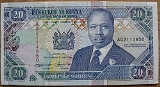
As with the coins, Mzee Jomo Kenyatta appeared on the banknotes issued until 1978, with Daniel arap Moi's portrait replacing him in 1980. In 2003, after Mwai Kibaki
Mwai Kibaki

Mwai Kibaki is the Heads of State of Kenya of Kenya. Kibaki was previously Vice-President of Kenya , and has held several other cabinet positions, including Minister for Finance , Minister for Home Affairs and Minister for Health ....
 replaced Moi as president, 5, 10, and 20 shilling notes from the 1978 series with Kenyatta's picture that had been in storage were issued, and circulated for a time. A new series of notes was then introduced on which Kenyatta reappeared with denominations of 50, 100, 200, 500 and 1000 shilling. The issue of 12 December 2003 commemorates the "40 years of Independence 1963-2003". The banknotes are printed in Nairobi by De La Rue
De La Rue

De La Rue plc is a United Kingdom security printing, papermaking and cash handling systems company headquartered in Basingstoke, Hampshire. It also has a factory on the Team Valley, Gateshead....
.

See also

  • Economy of Kenya
    Economy of Kenya

    Kenya's economy is market-based, with some state-owned infrastructure enterprises, and maintains a liberalized external trade system. The economy?s heavy dependence on rain-fed agriculture and the tourism sector leaves it vulnerable to cycles of boom and bust....


External links