

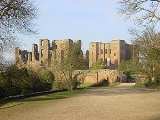
Kenilworth Castle

Encyclopedia
Kenilworth Castle is located in the town of the same name
in Warwickshire
, England. Constructed from Norman
through to Tudor
times, the castle
has been described by architectural historian Anthony Emery as "the finest surviving example of a semi-royal palace of the later middle ages, significant for its scale, form and quality of workmanship". Kenilworth has also played an important historical role. The castle was the subject of the six-month long Siege of Kenilworth
in 1266, believed to be the longest siege in English history, and formed a base for Lancastrian
operations in the War of the Roses. Kenilworth was also the scene of the removal of Edward II from the English throne, the French insult to Henry V in 1414 (said by John Strecche to have encouraged the Agincourt
campaign), and the Earl of Leicester
's lavish reception of Elizabeth I in 1575.
The castle was built over several centuries. Founded in the 1120s around a powerful Norman
great tower
, the castle was significantly enlarged by King John at the beginning of the 13th century. Huge water defences were created by damming the local streams and the resulting fortifications proved able to withstand assaults by land and water in 1266. John of Gaunt spent lavishly in the late 14th century, turning the medieval castle into a palace fortress designed in the latest perpendicular style. The Earl of Leicester then expanded the castle once again, constructing new Tudor
buildings and exploiting the medieval heritage of Kenilworth to produce a fashionable Renaissance
palace.
Kenilworth was partly destroyed
by Parliamentary forces in 1649 to prevent it being used as a military stronghold. Ruined, only two of its buildings remain habitable today. The castle became a tourist destination from the 18th century onwards, becoming famous in the Victorian
period following the publishing of Sir Walter Scott
's novel Kenilworth
in 1826. English Heritage
has managed the castle since 1984. The castle is classed as a Grade I listed building and as a Scheduled Monument, and is open to the public.
, or deliberate partial destruction, of the castle after the English Civil War
, Kenilworth illustrates five centuries of English military and civil architecture. The castle is built almost entirely from local new red sandstone
.
.An alternative view is that the name "brays" derives instead from a corruption of the word "bays", a medieval word describing a sequence of ponds similar to the lake structure at Kenilworth; see Thompson 1965, p.158. Only earthworks and fragments of masonry remain of what was an extensive 13th-century barbican
structure including a stone wall and an external gatehouse
guarding the main approach to the castle. The area now forms part of the car park for the castle. Beyond the Brays are the ruins of the Gallery Tower, a second gatehouse remodelled in the 15th century. The Gallery Tower originally guarded the 152-metre (500-ft) long, narrow walled-causeway that still runs from the Brays to the main castle. This causeway was called the Tiltyard, as it was used for tilting, or jousting
, in medieval times. The Tiltyard causeway acted both as a dam and as part of the barbican
defences. To the east of the Tiltyard is a lower area of marshy ground, originally flooded and called the Lower Pool, and to the west an area once called the Great Mere
. The Great Mere is now drained and forms a meadow
, but would originally have been a large lake covering around 100 acres (4,400,000 sq ft), dammed by the Tiltyard causeway.
The outer bailey
of Kenilworth Castle is usually entered through Mortimer's Tower, today a modest ruin but originally a Norman stone gatehouse, extended in the late 13th and 16th centuries. The outer bailey wall, long and relatively low, was mainly built by King John; it has numerous buttresses but only a few towers, being designed to be primarily defended by the water system of the Great Mere and Lower Pool. The north side of the outer bailey wall was almost entirely destroyed during the slighting. Moving clockwise around the outer bailey from Mortimer's Tower, the defences include a west-facing watergate, which would originally have led onto the Great Mere; the King's gate, a late 17th century agricultural addition; the Swan Tower, a late 13th century tower with 16th century additions named after the swans that lived on the Great Mere; the early 13th century Lunn's Tower; and the 14th century Water Tower, so named because it overlooked the Lower Pool.
wall, originally of Norman origin, exploiting the defensive value of a natural knoll
that rises up steeply from the surrounding area. The 12th-century great tower
occupies the knoll itself and forms the north-east corner of the bailey. Ruined during the slighting, the great tower is notable for its huge corner turrets, essentially hugely exaggerated Norman pilaster
buttresses. Its walls are 5 metres (17 ft) thick, and the towers 30 metres (100 ft) high. Although Kenilworth's great tower is larger, it is similar to that of Brandon Castle
near Coventry
; both were built by the local Clinton family
in the 1120s. The tower can be termed a hall keep, as it is longer than it is wide. The lowest floor is filled with earth, possibly taken from the earlier motte that may have been present on the site, and is further protected by a sloping stone plinth
around the base. The tall Tudor windows at the top of the tower date from the 1570s.
Much of the northern part of the inner bailey was built by the 14th-century noble John of Gaunt between 1372 and 1380. This part of the castle is considered by historian Anthony Emery to be "the finest surviving example of a semi-royal palace of the later middle ages, significant for its scale, form and quality of workmanship". Gaunt's architectural style emphasised rectangular design, the separation of ground floor service areas from the upper stories and a contrast of austere exteriors with lavish interiors, especially on the 1st floor of the inner bailey buildings. The result is considered "an early example of the perpendicular style".
The most significant of Gaunt's buildings is his great hall. The great hall replaced an earlier sequence of great halls on the same site, and was heavily influenced by Edward III's design at Windsor Castle
. The hall consists of a "ceremonial sequence of rooms", approached by a particularly grand staircase, now lost. From the great hall, visitors could look out to admire the Great Mere or the inner court through huge windows. The undercroft
to the hall, used by the service staff, was lit with slits, similar to design at the contemporary Wingfield Manor
. The roof was built in 1376 by William Wintringham, producing the widest hall, unsupported by pillars, existing in England at the time. There is some debate amongst historians as to whether this roof was a hammerbeam design
, a collar and truss-brace
design, or a combination of the two.An example of the combination of the curved hammerbeam and right-angled collar and truss-brace design can be seen in this depiction of the roof of Westminster Hall.
There was an early attempt at symmetry in the external appearance of the great hall – the Strong and Saintlowe Towers architecturally act as near symmetrical "wings" to the hall itself, while the plinth of the hall is designed to mirror that of the great tower opposite it. An unusual multi-sided tower, the Oriel, provides a counterpoint to the main doorway of the hall and was intended for private entertainment by Gaunt away from the main festivities on major occasions. The Oriel tower is based on Edward III's "La Rose" Tower at Windsor, which had a similar function. Gaunt's Strong Tower is so named for being entirely vaulted
in stone across all its floors, an unusual and robust design. The great hall influenced the design of Bolton
and Raby castles
, while the hall's roof design became famous and was copied at Arundel Castle
and Westminster Hall.
Other parts of the castle built by Gaunt include the southern range of state apartments, Gaunt's Tower and the main kitchen. Although now extensively damaged, these share the same style as the great hall; this would have unified the appearance of Gaunt's palace in a distinct break from the more eclectic medieval tradition of design. Gaunt's kitchen replaced the original 12th-century kitchens, built alongside the great tower in a similar fashion to the arrangement at Conisbrough
. Gaunt's new kitchen was twice the size of that in equivalent castles, measuring 19 metres (66 ft) by eight metres (28 ft).
The remainder of the inner court was built by Robert Dudley, the Earl of Leicester
, in the 1570s. He built a tower now known as Leicester's building on the south edge of the court as a guest wing, extending out beyond the inner bailey wall for extra space. Leicester's building was four floors high and built in a fashionable contemporary Tudor style with "brittle, thin walls and grids of windows". The building was intended to appear well-proportioned alongside the ancient great tower, one of the reasons for its considerable height. Leicester's building set the style for later Elizabethan country house design, especially in the Midlands, with Hardwick Hall
being a classic example.
Leicester also built a loggia
, or open gallery, beside the great keep to lead to the new formal gardens. The loggia was designed to elegantly frame the view as the observer slowly admired the gardens, and was a new design in 16th century, only recently imported from Italy.
Leicester's gatehouse was built on the north side of the base court, replacing an older gatehouse to provide a fashionable entrance from the direction of Coventry
. The external design, with its symbolic towers and, originally, battlements, echoes a style popular a century or more before, closely resembling Kirby Muxloe
and the Beauchamp gatehouse at Warwick Castle
. By contrast the interior, with its contemporary wood panelling, is in the same, highly contemporary Elizabethan fashion of Leicester's building in the inner court. Leicester's gatehouse is one of the few parts of the castle to remain intact. The stables built by John Dudley
in the 1550s also survive and lie along the east side of the base court. The stable block is a large building built mostly in stone, but with a timber-framed, decoratively panelled first storey designed in an anachronistic, vernacular style. Both buildings could have easily been seen from Leicester's building and were therefore on permanent display to visitors. Leciester's intent may have been to create a deliberately anachronistic view across the base court, echoing the older ideals of chivalry and romance alongside the more modern aspects of the redesign of the castle.
s in the base court. The gardens today are designed to reproduce as closely as possible the primarily historical record of their original appearance in 1575, with a steep terrace along the south side of the gardens and steps leading down to eight square knot gardens. In Elizabethan gardens "the plants were almost incidental", and instead the design focus was on sculptures, including four wooden obelisks painted to resemble porphyry
and a marble fountain with a statue of two Greek mythological figures
. A timber aviary
contains a range of birds. The original garden was heavily influenced by the Italian Renaissance garden
at Villa d'Este
.
To the north-west of the castle are earthworks marking the spot of the "Pleasance", created in 1414 by Henry V. The Pleasance was a banqueting house built in the style of a miniature castle. Surrounded by two diamond-shaped moat
s with its own dock, the Pleasance was positioned on the far side of the Great Mere and had to be reached by boat. It resembled Richard II's retreat at Sheen from the 1380s, and was later copied by his younger brother, Duke Humphrey of Gloucester, at Greenwich in the 1430s, as well by his son, John of Lancaster
at Fulbrook
. The Pleasance was eventually dismantled by Henry VIII and partially moved into the left-hand court inside the castle itself, possibly to add to the anachronistic appearance. These elements were finally destroyed in the 1650s.
, Lord Chamberlain to Henry I. The castle's original form is uncertain. It has been suggested that it consisted of a motte
, an earthen mound surmounted by wooden buildings; however, the stone great tower
may have been part of the original design. Clinton was a local rival to Roger de Beaumont
, the Earl of Warwick and owner of the neighbouring Warwick Castle
, and the king made Clinton the sheriff
in Warwickshire to act as a counter-balance to Beaumont's power. Clinton had begun to lose the king's favour after 1130, and when he died in 1133 his son, also called Geoffrey, was only a minor. Geoffrey and his uncle William de Clinton were forced to come to terms with Beaumont; this set-back, and the difficult years of the Anarchy
(1135–54), delayed any further development of the castle.
Henry II
succeeded to the throne at the end of the Anarchy but during the revolt of 1173–74 he faced a significant uprising led by his son, Henry
, backed by the French crown. The conflict spread across England and Kenilworth was garrisoned by Henry II's forces; Geoffrey II de Clinton died in this period and the castle was taken fully into royal possession, a sign of its military importance. The Clintons themselves moved on to Buckinghamshire
. By this point Kenilworth Castle consisted of the great keep, the inner bailey wall, a basic causeway across the smaller lake that preceded the creation of the Great Mere, and the local chase
for hunting.
, paid relatively little attention to Kenilworth but under King John significant building resumed at the castle. When John was excommunicated in 1208, he embarked on a programme of rebuilding and enhancing several major royal castles. These included Corfe
, Odiham
, Dover
, Scarborough
as well as Kenilworth. John spent £1,115 on Kenilworth Castle between 1210 and 1216, building the outer bailey wall in stone and improving the other defences, including creating Mortimer's and Lunn's Towers.Comparison of medieval financial figures with modern equivalents is challenging, especially with the larger sums of money used for projects such as castles. £1,100 could equate to from between £578,000 to £13m in 2009 terms, depending on the measure used. He also significantly improved the castle's water defences by damming the Finham and Inchford Brooks, creating the Great Mere. The result was to turn Kenilworth into one of the largest English castles of the time, with one of the largest artificial lake defences in England. John was forced to cede the castle to the baronial opposition as part of the guarantee of the Magna Carta
, before it reverted to royal control early in the reign of his son, Henry III
.
Henry III granted Kenilworth in 1244 to Simon de Montfort
, Earl of Leicester, who later became a leader in the Second Barons' War
(1263–67) against the king, using Kenilworth as the centre of his operations. Initially the conflict went badly for King Henry, and after the Battle of Lewes
in 1264 he was forced to sign the Mise of Lewes
, under which his son, Prince Edward
, was given over to the rebels as a hostage. Edward was taken back to Kenilworth, where chroniclers considered he was held in unduly harsh conditions. Released in early 1265, Edward then defeated Montfort at the Battle of Evesham
; the surviving rebels under the leadership of Henry de Hastings
, Montfort's constable at Kenilworth, regrouped at the castle the following spring. Edward's forces proceeded to lay siege to the rebels.
The Siege of Kenilworth Castle
in 1266 was "probably the longest in English history" according to historian Norman Pounds, and at the time was also the largest siege to have occurred in England in terms of the number of soldiers involved. Simon de Monfort's son, Simon VI de Montfort
, promised in January 1266 to hand over the castle to the king. Five months later this had not happened, and Henry III laid siege to Kenilworth Castle on 21 June. Protected by the extensive water defences, the castle withstood the attack, despite Edward targeting the weaker north wall, employing huge siege tower
s and even attempting a night attack using barges brought from Chester
. The distance between the royal trebuchet
s and the walls severely reduced their effectiveness and heavier trebuchets had to be sent for from London. Papal intervention through the legate Ottobuono
finally resulted in the compromise of the Dictum of Kenilworth
, under which the rebels were allowed to re-purchase their confiscated lands provided they surrendered the castle; the siege ended on 14 December 1266. The water defences at Kenilworth influenced the construction of later castles in Wales, most notably Caerphilly
.
Henry granted Kenilworth to his brother, Edmund Crouchback, in 1267. Edmund held many tournaments at Kenilworth in the late 13th century, including a huge event in 1279, presided over by the royal favourite Roger de Mortimer, in which a hundred knights competed for three days in the tiltyard in an event called "the Round Table
", in imitation of the popular Arthurian legends
.
, and acted as both a social and a financial centre for Thomas. Thomas built the first great hall at the castle from 1314 to 1317 and constructed the Water Tower along the outer bailey, as well as increasing the size of the chase. Lancaster, with support from many of the other English barons, found himself in increasing opposition to Edward II
. War broke out in 1322, and Lancaster was captured at the Battle of Boroughbridge
and executed. His estates, including Kenilworth, were confiscated by the crown. Edward and his wife, Isabella of France
, spent Christmas 1323 at Kenilworth, amidst major celebrations.
In 1326, however, Edward was deposed by an alliance of Isabella and her lover, Roger Mortimer. Edward was eventually captured by Isabella's forces and the custody of the king was assigned to Henry, Earl of Lancaster
, who had backed Isabella's invasion. Henry, reoccupying most of the Lancaster lands, was made constable of Kenilworth and Edward was transported there in late 1326; Henry's legal title to the castle was finally confirmed the following year. Kenilworth was chosen for this purpose by Isabella probably both because it was a major fortification, and also because of the symbolism of its former owners' links to popular ideals of freedom and good government. Royal writ
s were issued in Edward's name by Isabella from Kenilworth until the next year. A deputation of leading barons led by Bishop Orleton
was then sent to Kenilworth to first persuade Edward to resign and, when that failed, to inform him that he had been deposed as king. Edward formally resigned as king in the great hall of the castle on 21 January 1326. As the months went by, however, it became clear that Kenilworth was proving a less than ideal location to imprison Edward. The castle was in a prominent part of the Midlands, in an area that held several nobles who still supported Edward and were believed to be trying to rescue him. Henry's loyalty was also coming under question. In due course, Isabella and Mortimer had Edward moved by night to Berkeley Castle
, where he died shortly afterwards. Isabella continued to use Kenilworth as a royal castle until her fall from power in 1330.
Henry of Grosmont, the Duke of Lancaster
, inherited the castle from his father in 1345 and remodelled the great hall with a grander interior and roof. On his death Blanche of Lancaster
inherited the castle. Blanche married John of Gaunt, the third son of Edward III
; their union, and combined resources, made John the second richest man in England next to the king himself. After Blanche's death, John married Constance, who had a claim to the kingdom of Castile
, and John styled himself the king of Castile and León. Kenilworth was one of the most important of his thirty or more castles in England. John began building at Kenilworth between 1373 and 1380 in a style designed to reinforce his royal claims in Iberia. John constructed a grander great hall, the Strong Tower, Saintlowe Tower, the state apartments and the new kitchen complex. When not campaigning abroad, John spent much of his time at Kenilworth and Leicester
, and used Kenilworth even more after 1395 when his health began to decline. In his final years, John made extensive repairs to the whole of the castle complex.
, the French openly mocked Henry in 1414 by sending him a gift of tennis ball
s at Kenilworth. The French aim was to imply a lack of martial prowess; according to Strecche, the gift spurred Henry's decision to fight the Agincourt campaign
. The account was used by Shakespeare
as the basis for a scene in his play Henry V
.
English castles, including Kenilworth, did not play a decisive role during the Wars of the Roses
(1455–85), which were fought primarily in the form of pitched battles between the rival factions of the Lancastrians
and the Yorkists
. With the mental collapse of King Henry VI, Queen Margaret
used the Duchy of Lancaster lands in the Midlands, including Kenilworth, as one of her key bases of military support. Margaret removed Henry from London in 1456 for his own safety and until 1461, Henry's court divided almost all its time among Kenilworth, Leicester
and Tutbury Castle
for the purposes of protection. Kenilworth remained an important Lancastrian stronghold for the rest of the war, often acting as a military balance to the nearby castle of Warwick
. With the victory of Henry VII
at Bosworth
, Kenilworth again received royal attention; Henry visited frequently and had a tennis court
constructed at the castle for his use. His son, Henry VIII
, decided that Kenilworth should be maintained as a royal castle. He abandoned the Pleasance and had part of the timber construction moved into the base court of the castle.
. Dudley was a patron of John Shute
, an early exponent of classical architecture in England, and began the process of modernising Kenilworth. Before his execution in 1553 by Queen Mary
for attempting to place Lady Jane Grey
on the throne, Dudley had built the new stable block and widened the tiltyard to its current form.
Kenilworth was restored to Dudley's son, Robert, Earl of Leicester, in 1563, four years after the succession of Elizabeth I
to the throne. Leicester's lands in Warwickshire were worth between £500–£700 but Leicester's power and wealth, including monopolies and grants of new lands, depended ultimately on his remaining a favourite of the queen.
Leicester continued his father's modernisation of Kenilworth, attempting to ensure that Kenilworth would attract the interest of Elizabeth during her regular tours around the country. Elizabeth visited in 1566 and 1568, by which time Leicester had commissioned the royal architect Henry Hawthorne to produce plans for a dramatic, classical extension of the south side of the inner court. In the event this proved unachievable and instead Leicester employed William Spicer to rebuild and extend the castle so as to provide modern accommodation for the royal court and symbolically boost his own claims to noble heritage. After negotiation with his tenants, Leicester also increased the size of the chase once again. The result has been termed an English "Renaissance palace".
Elizabeth viewed the partially finished results at Kenilworth in 1572, but the complete effect of Leicester's work was only apparent during the queen's last visit in 1575. Leicester was keen to impress Elizabeth in a final attempt to convince her to marry him, and no expense was spared. Elizabeth brought an entourage of thirty-one barons and four hundred staff for the royal visit that lasted an exceptional nineteen days; twenty horsemen a day arrived at the castle to communicate royal messages. Leicester entertained the Queen and much of the neighbouring region with pageants, fireworks, bear baiting
, mystery play
s, hunting and lavish banquets. The cost was reputed to have amounted to many thousand pounds, almost bankrupting Leicester, though it probably did not exceed £1,700 in reality. The event was considered a huge success and formed the longest stay at such a property during any of Elizabeth's tours, yet the queen did not decide to marry Leicester.
, and after the latter's death in 1590, to his illegitimate son, Sir Robert Dudley. Dudley went to Italy in 1605, and during 1611–12 arranged to sell Kenilworth Castle to Henry
, the Prince of Wales. Henry died before completing the full purchase, which was finalised by his brother, Charles. When Charles became king, he gave the castle to his wife, Henrietta Maria
; he bestowed the stewardship on Robert Carey
, earl of Monmouth, and gave it to Carey's sons, Henry
and Thomas, after their father's death. Kenilworth remained a popular location for both James I
and Charles and accordingly was well maintained. The most famous royal visit occurred in 1624, when Ben Jonson
's The Masque of Owls at Kenilworth was performed for Charles.
Civil war broke out in England
, however, in 1642. During the early campaigns of the war Kenilworth formed a useful counter-balance to the Parliamentary stronghold of Warwick. Kenilworth was used by Charles on his advance to Edgehill in October 1642 as a base for raids on Parliamentary strongholds in the Midlands. After the battle, however, the royalist garrison was withdrawn on the approach of Lord Brooke
and the castle was garrisoned by parliamentary forces. The new governor of the castle, Hastings Ingram was arrested in April 1643 as a suspected Royalist double agent
. By January 1645 the Parliamentary forces in Coventry had strengthened their hold on the castle and attempts by Royalist forces to dislodge them from Warwickshire failed. Security concerns continued after the end of the first civil war in 1646, and in 1649 Parliament ordered the slighting
of Kenilworth. One wall of the great tower, various parts of the outer bailey and the battlements were destroyed, but not before the building was surveyed by the antiquarian William Dugdale
, who published his results in 1656.
Colonel Joseph Hawkesworth, responsible for the implementation of the slighting, acquired the estate for himself and converted Leicester's gatehouse into a house; part of the base court was turned into a farm and many of the remaining buildings were stripped for their raw materials. In 1660 Charles II was restored to the throne and Hawkesworth was promptly evicted from Kenilworth. The Queen Mother, Henrietta Maria, briefly regained the castle, with the earls of Monmouth acting as stewards once again, but after her death Charles II
gave the castle to Sir Edward Hyde
, whom he created Baron Hyde of Hindon and Earl of Clarendon. The ruined castle continued to be used as a farm, with the gatehouse as the principal dwelling; the King's Gate was added to the outer bailey wall during this period for the use of farm workers.
The castle's cultural prominence increased after Sir Walter Scott
wrote Kenilworth
in 1821 describing the royal visit of Queen Elizabeth. Very loosely based on the events of 1575, Scott's story reinvented aspects of the castle and its history to tell the story of "the pathetic, beautiful, undisciplined heroine Amy Robsart
and the steely Elizabeth I". Although considered today as a less successful literary novel than some of his other historical works, it popularised Kenilworth Castle in the Victorian
imagination as a romantic Elizabethan location. Kenilworth spawned "numerous stage adaptations and burlesque
s, at least eleven operas, popular redaction
s, and even a scene in a set of diorama
s for home display", including Sir Arthur Sullivan
's 1865 opera The Masque at Kenilworth
.
The number of visitors increased, including Queen Victoria and Charles Dickens
. Work was undertaken during the 19th century to protect the stonework from further decline, with particular efforts to remove ivy
from the castle in the 1860s.
found the maintenance of the castle too expensive and sold Kenilworth to the industrialist Sir John Siddeley
. Siddeley, whose tax accounting in the 1930s had been at least questionable, was keen to improve his public image and gave over the running of the castle, complete with a charitable donation, to the Commissioner of Works
. In 1958 his son gave the castle itself to the town of Kenilworth
and English Heritage
has managed the property since 1984. The castle is classed as a Grade I listed building and as a Scheduled Monument, and is open to the public.
Between 2005–09 English Heritage attempted to restore Kenilworth's garden more closely to its Elizabethan form, using as a basis the description in the Langham letter
and details from recent archaeological investigations. The reconstruction cost more than £2m and was criticised by some archaeologists as being a "matter of simulation as much as reconstruction", due to the limited amount of factual information on the nature of the original gardens. In 2008 plans were put forward to re-create and flood the original Great Mere around the castle. As well as re-creating the look of the castle it was hoped that a new mere would be part of the ongoing flood alleviation plan for the area and that the lake could be used for boating and other waterside recreations.
Kenilworth
Kenilworth is a town in central Warwickshire, England. In 2001 the town had a population of 22,582 . It is situated south of Coventry, north of Warwick and northwest of London....
in Warwickshire
Warwickshire
Warwickshire is a landlocked non-metropolitan county in the West Midlands region of England. The county town is Warwick, although the largest town is Nuneaton. The county is famous for being the birthplace of William Shakespeare...
, England. Constructed from Norman
Norman conquest of England
The Norman conquest of England began on 28 September 1066 with the invasion of England by William, Duke of Normandy. William became known as William the Conqueror after his victory at the Battle of Hastings on 14 October 1066, defeating King Harold II of England...
through to Tudor
Tudor period
The Tudor period usually refers to the period between 1485 and 1603, specifically in relation to the history of England. This coincides with the rule of the Tudor dynasty in England whose first monarch was Henry VII...
times, the castle
Castle
A castle is a type of fortified structure built in Europe and the Middle East during the Middle Ages by European nobility. Scholars debate the scope of the word castle, but usually consider it to be the private fortified residence of a lord or noble...
has been described by architectural historian Anthony Emery as "the finest surviving example of a semi-royal palace of the later middle ages, significant for its scale, form and quality of workmanship". Kenilworth has also played an important historical role. The castle was the subject of the six-month long Siege of Kenilworth
Siege of Kenilworth
The Siege of Kenilworth was a six-month siege on the Kenilworth Castle and a battle of the Second Barons' War. The siege was a part of an English civil war fought from 1264 to 1267 by the forces of Simon de Montfort against the Royalist forces led by Prince Edward .The siege was one of few castle...
in 1266, believed to be the longest siege in English history, and formed a base for Lancastrian
House of Lancaster
The House of Lancaster was a branch of the royal House of Plantagenet. It was one of the opposing factions involved in the Wars of the Roses, an intermittent civil war which affected England and Wales during the 15th century...
operations in the War of the Roses. Kenilworth was also the scene of the removal of Edward II from the English throne, the French insult to Henry V in 1414 (said by John Strecche to have encouraged the Agincourt
Battle of Agincourt
The Battle of Agincourt was a major English victory against a numerically superior French army in the Hundred Years' War. The battle occurred on Friday, 25 October 1415 , near modern-day Azincourt, in northern France...
campaign), and the Earl of Leicester
Robert Dudley, 1st Earl of Leicester
Robert Dudley, 1st Earl of Leicester, KG was an English nobleman and the favourite and close friend of Elizabeth I from her first year on the throne until his death...
's lavish reception of Elizabeth I in 1575.
The castle was built over several centuries. Founded in the 1120s around a powerful Norman
Norman architecture
About|Romanesque architecture, primarily English|other buildings in Normandy|Architecture of Normandy.File:Durham Cathedral. Nave by James Valentine c.1890.jpg|thumb|200px|The nave of Durham Cathedral demonstrates the characteristic round arched style, though use of shallow pointed arches above the...
great tower
Keep
A keep is a type of fortified tower built within castles during the Middle Ages by European nobility. Scholars have debated the scope of the word keep, but usually consider it to refer to large towers in castles that were fortified residences, used as a refuge of last resort should the rest of the...
, the castle was significantly enlarged by King John at the beginning of the 13th century. Huge water defences were created by damming the local streams and the resulting fortifications proved able to withstand assaults by land and water in 1266. John of Gaunt spent lavishly in the late 14th century, turning the medieval castle into a palace fortress designed in the latest perpendicular style. The Earl of Leicester then expanded the castle once again, constructing new Tudor
Tudor architecture
The Tudor architectural style is the final development of medieval architecture during the Tudor period and even beyond, for conservative college patrons...
buildings and exploiting the medieval heritage of Kenilworth to produce a fashionable Renaissance
Renaissance
The Renaissance was a cultural movement that spanned roughly the 14th to the 17th century, beginning in Italy in the Late Middle Ages and later spreading to the rest of Europe. The term is also used more loosely to refer to the historical era, but since the changes of the Renaissance were not...
palace.
Kenilworth was partly destroyed
Slighting
A slighting is the deliberate destruction, partial or complete, of a fortification without opposition. During the English Civil War this was to render it unusable as a fort.-Middle Ages:...
by Parliamentary forces in 1649 to prevent it being used as a military stronghold. Ruined, only two of its buildings remain habitable today. The castle became a tourist destination from the 18th century onwards, becoming famous in the Victorian
Victorian era
The Victorian era of British history was the period of Queen Victoria's reign from 20 June 1837 until her death on 22 January 1901. It was a long period of peace, prosperity, refined sensibilities and national self-confidence...
period following the publishing of Sir Walter Scott
Walter Scott
Sir Walter Scott, 1st Baronet was a Scottish historical novelist, playwright, and poet, popular throughout much of the world during his time....
's novel Kenilworth
Kenilworth (novel)
Kenilworth. A Romance is a historical novel by Sir Walter Scott, first published on 8 January 1821.-Plot introduction:Kenilworth is apparently set in 1575, and centers on the secret marriage of Robert Dudley, 1st Earl of Leicester, and Amy Robsart, daughter of Sir Hugh Robsart...
in 1826. English Heritage
English Heritage
English Heritage . is an executive non-departmental public body of the British Government sponsored by the Department for Culture, Media and Sport...
has managed the castle since 1984. The castle is classed as a Grade I listed building and as a Scheduled Monument, and is open to the public.
Architecture and landscape
Although now ruined as a result of the slightingSlighting
A slighting is the deliberate destruction, partial or complete, of a fortification without opposition. During the English Civil War this was to render it unusable as a fort.-Middle Ages:...
, or deliberate partial destruction, of the castle after the English Civil War
English Civil War
The English Civil War was a series of armed conflicts and political machinations between Parliamentarians and Royalists...
, Kenilworth illustrates five centuries of English military and civil architecture. The castle is built almost entirely from local new red sandstone
New Red Sandstone
The New Red Sandstone is a chiefly British geological term for the beds of red sandstone and associated rocks laid down throughout the Permian to the beginning of the Triassic that underlie the Jurassic Lias; the term distinguishes it from the Old Red Sandstone which is largely Devonian in...
.
Entrance and outer bailey wall
To the south-east of the main castle lie the Brays, a corruption of the French word braie, meaning an external fortification with palisadesPalisades
A palisade is a steel or wooden fence or wall of variable height, usually used as a defensive structure.Palisade or Palisades also may refer to:-Geology:United States...
.An alternative view is that the name "brays" derives instead from a corruption of the word "bays", a medieval word describing a sequence of ponds similar to the lake structure at Kenilworth; see Thompson 1965, p.158. Only earthworks and fragments of masonry remain of what was an extensive 13th-century barbican
Barbican
A barbican, from medieval Latin barbecana, signifying the "outer fortification of a city or castle," with cognates in the Romance languages A barbican, from medieval Latin barbecana, signifying the "outer fortification of a city or castle," with cognates in the Romance languages A barbican, from...
structure including a stone wall and an external gatehouse
Gatehouse
A gatehouse, in architectural terminology, is a building enclosing or accompanying a gateway for a castle, manor house, fort, town or similar buildings of importance.-History:...
guarding the main approach to the castle. The area now forms part of the car park for the castle. Beyond the Brays are the ruins of the Gallery Tower, a second gatehouse remodelled in the 15th century. The Gallery Tower originally guarded the 152-metre (500-ft) long, narrow walled-causeway that still runs from the Brays to the main castle. This causeway was called the Tiltyard, as it was used for tilting, or jousting
Jousting
Jousting is a martial game or hastilude between two knights mounted on horses and using lances, often as part of a tournament.Jousting emerged in the High Middle Ages based on the military use of the lance by heavy cavalry. The first camels tournament was staged in 1066, but jousting itself did not...
, in medieval times. The Tiltyard causeway acted both as a dam and as part of the barbican
Barbican
A barbican, from medieval Latin barbecana, signifying the "outer fortification of a city or castle," with cognates in the Romance languages A barbican, from medieval Latin barbecana, signifying the "outer fortification of a city or castle," with cognates in the Romance languages A barbican, from...
defences. To the east of the Tiltyard is a lower area of marshy ground, originally flooded and called the Lower Pool, and to the west an area once called the Great Mere
Mere (lake)
Mere in English refers to a lake that is broad in relation to its depth, e.g. Martin Mere. A significant effect of its shallow depth is that for all or most of the time, it has no thermocline.- Etymology :...
. The Great Mere is now drained and forms a meadow
Meadow
A meadow is a field vegetated primarily by grass and other non-woody plants . The term is from Old English mædwe. In agriculture a meadow is grassland which is not grazed by domestic livestock but rather allowed to grow unchecked in order to make hay...
, but would originally have been a large lake covering around 100 acres (4,400,000 sq ft), dammed by the Tiltyard causeway.
The outer bailey
Ward (fortification)
In fortifications, a bailey or ward refers to a courtyard enclosed by a curtain wall. In particular, an early type of European castle was known as a Motte-and-bailey. Castles can have more than one ward. Their layout depends both on the local topography and the level of fortification technology...
of Kenilworth Castle is usually entered through Mortimer's Tower, today a modest ruin but originally a Norman stone gatehouse, extended in the late 13th and 16th centuries. The outer bailey wall, long and relatively low, was mainly built by King John; it has numerous buttresses but only a few towers, being designed to be primarily defended by the water system of the Great Mere and Lower Pool. The north side of the outer bailey wall was almost entirely destroyed during the slighting. Moving clockwise around the outer bailey from Mortimer's Tower, the defences include a west-facing watergate, which would originally have led onto the Great Mere; the King's gate, a late 17th century agricultural addition; the Swan Tower, a late 13th century tower with 16th century additions named after the swans that lived on the Great Mere; the early 13th century Lunn's Tower; and the 14th century Water Tower, so named because it overlooked the Lower Pool.
Inner court
Kenilworth's inner court consists of a number of buildings set against a baileyWard (fortification)
In fortifications, a bailey or ward refers to a courtyard enclosed by a curtain wall. In particular, an early type of European castle was known as a Motte-and-bailey. Castles can have more than one ward. Their layout depends both on the local topography and the level of fortification technology...
wall, originally of Norman origin, exploiting the defensive value of a natural knoll
Hillock
A hillock or knoll is a small hill, usually separated from a larger group of hills such as a range. Hillocks are similar in their distribution and size to small mesas or buttes. The term is largely a British one...
that rises up steeply from the surrounding area. The 12th-century great tower
Keep
A keep is a type of fortified tower built within castles during the Middle Ages by European nobility. Scholars have debated the scope of the word keep, but usually consider it to refer to large towers in castles that were fortified residences, used as a refuge of last resort should the rest of the...
occupies the knoll itself and forms the north-east corner of the bailey. Ruined during the slighting, the great tower is notable for its huge corner turrets, essentially hugely exaggerated Norman pilaster
Pilaster
A pilaster is a slightly-projecting column built into or applied to the face of a wall. Most commonly flattened or rectangular in form, pilasters can also take a half-round form or the shape of any type of column, including tortile....
buttresses. Its walls are 5 metres (17 ft) thick, and the towers 30 metres (100 ft) high. Although Kenilworth's great tower is larger, it is similar to that of Brandon Castle
Brandon Castle
Brandon Castle was sited overlooking the River Avon between the virtually adjacent villages of Brandon and Wolston in Warwickshire which in turn lie between the towns of Rugby and Coventry ....
near Coventry
Coventry
Coventry is a city and metropolitan borough in the county of West Midlands in England. Coventry is the 9th largest city in England and the 11th largest in the United Kingdom. It is also the second largest city in the English Midlands, after Birmingham, with a population of 300,848, although...
; both were built by the local Clinton family
Geoffrey de Clinton
Geoffrey de Clinton was an Anglo-Norman noble, chamberlain and treasurer to King Henry I of England. He was foremost amongst the men king Henry "raised from the dust". He married Lescelina.-Life:Clinton's family origins are a little obscure...
in the 1120s. The tower can be termed a hall keep, as it is longer than it is wide. The lowest floor is filled with earth, possibly taken from the earlier motte that may have been present on the site, and is further protected by a sloping stone plinth
Plinth
In architecture, a plinth is the base or platform upon which a column, pedestal, statue, monument or structure rests. Gottfried Semper's The Four Elements of Architecture posited that the plinth, the hearth, the roof, and the wall make up all of architectural theory. The plinth usually rests...
around the base. The tall Tudor windows at the top of the tower date from the 1570s.
Much of the northern part of the inner bailey was built by the 14th-century noble John of Gaunt between 1372 and 1380. This part of the castle is considered by historian Anthony Emery to be "the finest surviving example of a semi-royal palace of the later middle ages, significant for its scale, form and quality of workmanship". Gaunt's architectural style emphasised rectangular design, the separation of ground floor service areas from the upper stories and a contrast of austere exteriors with lavish interiors, especially on the 1st floor of the inner bailey buildings. The result is considered "an early example of the perpendicular style".
The most significant of Gaunt's buildings is his great hall. The great hall replaced an earlier sequence of great halls on the same site, and was heavily influenced by Edward III's design at Windsor Castle
Windsor Castle
Windsor Castle is a medieval castle and royal residence in Windsor in the English county of Berkshire, notable for its long association with the British royal family and its architecture. The original castle was built after the Norman invasion by William the Conqueror. Since the time of Henry I it...
. The hall consists of a "ceremonial sequence of rooms", approached by a particularly grand staircase, now lost. From the great hall, visitors could look out to admire the Great Mere or the inner court through huge windows. The undercroft
Undercroft
An undercroft is traditionally a cellar or storage room, often brick-lined and vaulted, and used for storage in buildings since medieval times. In modern usage, an undercroft is generally a ground area which is relatively open to the sides, but covered by the building above.- History :While some...
to the hall, used by the service staff, was lit with slits, similar to design at the contemporary Wingfield Manor
Wingfield Manor
Wingfield Manor is a deserted and ruined manor house some 4 miles from the town of Alfreton in the English county of Derbyshire...
. The roof was built in 1376 by William Wintringham, producing the widest hall, unsupported by pillars, existing in England at the time. There is some debate amongst historians as to whether this roof was a hammerbeam design
Hammerbeam roof
Hammerbeam roof, in architecture, is the name given to an open timber roof, typical of English Gothic architecture, using short beams projecting from the wall.- Design :...
, a collar and truss-brace
Truss
In architecture and structural engineering, a truss is a structure comprising one or more triangular units constructed with straight members whose ends are connected at joints referred to as nodes. External forces and reactions to those forces are considered to act only at the nodes and result in...
design, or a combination of the two.An example of the combination of the curved hammerbeam and right-angled collar and truss-brace design can be seen in this depiction of the roof of Westminster Hall.
There was an early attempt at symmetry in the external appearance of the great hall – the Strong and Saintlowe Towers architecturally act as near symmetrical "wings" to the hall itself, while the plinth of the hall is designed to mirror that of the great tower opposite it. An unusual multi-sided tower, the Oriel, provides a counterpoint to the main doorway of the hall and was intended for private entertainment by Gaunt away from the main festivities on major occasions. The Oriel tower is based on Edward III's "La Rose" Tower at Windsor, which had a similar function. Gaunt's Strong Tower is so named for being entirely vaulted
Vault (architecture)
A Vault is an architectural term for an arched form used to provide a space with a ceiling or roof. The parts of a vault exert lateral thrust that require a counter resistance. When vaults are built underground, the ground gives all the resistance required...
in stone across all its floors, an unusual and robust design. The great hall influenced the design of Bolton
Bolton Castle
Bolton Castle in North Yorkshire, is located in Wensleydale in the Yorkshire Dales . The nearby village Castle Bolton takes its name from the castle. The castle is a Grade I listed building and a Scheduled Ancient Monument. The castle was damaged in the English Civil War, but much of it remains...
and Raby castles
Raby Castle
Raby Castle is situated near Staindrop in County Durham and is one of the largest inhabited castles in England. The Grade I listed building has opulent eighteenth and nineteenth century interiors inside a largely unchanged, late medieval shell. It is the home and seat of John Vane, 11th Baron...
, while the hall's roof design became famous and was copied at Arundel Castle
Arundel Castle
Arundel Castle in Arundel, West Sussex, England is a restored medieval castle. It was founded by Roger de Montgomery on Christmas Day 1067. Roger became the first to hold the earldom of Arundel by the graces of William the Conqueror...
and Westminster Hall.
Other parts of the castle built by Gaunt include the southern range of state apartments, Gaunt's Tower and the main kitchen. Although now extensively damaged, these share the same style as the great hall; this would have unified the appearance of Gaunt's palace in a distinct break from the more eclectic medieval tradition of design. Gaunt's kitchen replaced the original 12th-century kitchens, built alongside the great tower in a similar fashion to the arrangement at Conisbrough
Conisbrough Castle
Conisbrough Castle is a 12th-century castle in Conisbrough, South Yorkshire, England, whose remains are dominated by the 97-foot high circular keep, which is supported by six buttresses. In the mid-1990s, the keep was restored, with a wooden roof and two floors being rebuilt...
. Gaunt's new kitchen was twice the size of that in equivalent castles, measuring 19 metres (66 ft) by eight metres (28 ft).
The remainder of the inner court was built by Robert Dudley, the Earl of Leicester
Robert Dudley, 1st Earl of Leicester
Robert Dudley, 1st Earl of Leicester, KG was an English nobleman and the favourite and close friend of Elizabeth I from her first year on the throne until his death...
, in the 1570s. He built a tower now known as Leicester's building on the south edge of the court as a guest wing, extending out beyond the inner bailey wall for extra space. Leicester's building was four floors high and built in a fashionable contemporary Tudor style with "brittle, thin walls and grids of windows". The building was intended to appear well-proportioned alongside the ancient great tower, one of the reasons for its considerable height. Leicester's building set the style for later Elizabethan country house design, especially in the Midlands, with Hardwick Hall
Hardwick Hall
Hardwick Hall , in Derbyshire, is one of the most significant Elizabethan country houses in England. In common with its architect Robert Smythson's other works at both Longleat House and Wollaton Hall, Hardwick Hall is one of the earliest examples of the English interpretation of the Renaissance...
being a classic example.
Leicester also built a loggia
Loggia
Loggia is the name given to an architectural feature, originally of Minoan design. They are often a gallery or corridor at ground level, sometimes higher, on the facade of a building and open to the air on one side, where it is supported by columns or pierced openings in the wall...
, or open gallery, beside the great keep to lead to the new formal gardens. The loggia was designed to elegantly frame the view as the observer slowly admired the gardens, and was a new design in 16th century, only recently imported from Italy.
Base, left-hand and right-hand courts
The rest of Kenilworth Castle's interior is divided into three areas: the base court, stretching between Mortimer's Tower and Leicester's gatehouse; the left-hand court, stretching south-west around the outside of the inner court; and the right-hand court, to the north-west of the inner court. The line of trees that cuts across the base court today is a relatively modern mid-19th century addition, and originally this court would have been more open, save for the collegiate chapel that once stood in front of the stables. Destroyed in 1524, only the chapel's foundations remain. Each of the courts was designed to be used for different purposes: the base court was considered a relatively public area, with the left and right courts used for more private occasions.Leicester's gatehouse was built on the north side of the base court, replacing an older gatehouse to provide a fashionable entrance from the direction of Coventry
Coventry
Coventry is a city and metropolitan borough in the county of West Midlands in England. Coventry is the 9th largest city in England and the 11th largest in the United Kingdom. It is also the second largest city in the English Midlands, after Birmingham, with a population of 300,848, although...
. The external design, with its symbolic towers and, originally, battlements, echoes a style popular a century or more before, closely resembling Kirby Muxloe
Kirby Muxloe Castle
Kirby Muxloe Castle, known also as Kirby Castle is an unfinished 15th century fortified manor house in Kirby Muxloe, Leicestershire, England .It was begun in 1480 by William Hastings, 1st Baron Hastings, during the period of the Wars of the Roses...
and the Beauchamp gatehouse at Warwick Castle
Warwick Castle
Warwick Castle is a medieval castle in Warwick, the county town of Warwickshire, England. It sits on a bend on the River Avon. The castle was built by William the Conqueror in 1068 within or adjacent to the Anglo-Saxon burh of Warwick. It was used as a fortification until the early 17th century,...
. By contrast the interior, with its contemporary wood panelling, is in the same, highly contemporary Elizabethan fashion of Leicester's building in the inner court. Leicester's gatehouse is one of the few parts of the castle to remain intact. The stables built by John Dudley
John Dudley, 1st Duke of Northumberland
John Dudley, 1st Duke of Northumberland, KG was an English general, admiral, and politician, who led the government of the young King Edward VI from 1550 until 1553, and unsuccessfully tried to install Lady Jane Grey on the English throne after the King's death...
in the 1550s also survive and lie along the east side of the base court. The stable block is a large building built mostly in stone, but with a timber-framed, decoratively panelled first storey designed in an anachronistic, vernacular style. Both buildings could have easily been seen from Leicester's building and were therefore on permanent display to visitors. Leciester's intent may have been to create a deliberately anachronistic view across the base court, echoing the older ideals of chivalry and romance alongside the more modern aspects of the redesign of the castle.
Garden and landscape
Much of the right-hand court of Kenilworth Castle is occupied by the castle garden. For most of Kenilworth's history the role of the castle garden, used for entertainment, would have been very distinct from that of the surrounding chase, used primarily for hunting. From the 16th century onwards there were elaborate knot gardenKnot garden
A knot garden is a garden of very formal design in a square frame, consisting of a variety of aromatic plants and culinary herbs including germander, marjoram, thyme, southernwood, lemon balm, hyssop, costmary, acanthus, mallow, chamomile, rosemary, Calendulas, Violas and Santolina...
s in the base court. The gardens today are designed to reproduce as closely as possible the primarily historical record of their original appearance in 1575, with a steep terrace along the south side of the gardens and steps leading down to eight square knot gardens. In Elizabethan gardens "the plants were almost incidental", and instead the design focus was on sculptures, including four wooden obelisks painted to resemble porphyry
Porphyry (geology)
Porphyry is a variety of igneous rock consisting of large-grained crystals, such as feldspar or quartz, dispersed in a fine-grained feldspathic matrix or groundmass. The larger crystals are called phenocrysts...
and a marble fountain with a statue of two Greek mythological figures
Greek mythology
Greek mythology is the body of myths and legends belonging to the ancient Greeks, concerning their gods and heroes, the nature of the world, and the origins and significance of their own cult and ritual practices. They were a part of religion in ancient Greece...
. A timber aviary
Aviary
An aviary is a large enclosure for confining birds. Unlike cages, aviaries allow birds a larger living space where they can fly; hence, aviaries are also sometimes known as flight cages...
contains a range of birds. The original garden was heavily influenced by the Italian Renaissance garden
Italian Renaissance garden
The Italian Renaissance garden was a new style of garden which emerged in the late 15th century at villas in Rome and Florence, inspired by classical ideals of order and beauty, and intended for the pleasure of the view of the garden and the landscape beyond, for contemplation, and for the...
at Villa d'Este
Villa d'Este
The Villa d'Este is a villa situated at Tivoli, near Rome, Italy. Listed as a UNESCO world heritage site, it is a fine example of Renaissance architecture and the Italian Renaissance garden.-History:...
.
To the north-west of the castle are earthworks marking the spot of the "Pleasance", created in 1414 by Henry V. The Pleasance was a banqueting house built in the style of a miniature castle. Surrounded by two diamond-shaped moat
Moat
A moat is a deep, broad ditch, either dry or filled with water, that surrounds a castle, other building or town, historically to provide it with a preliminary line of defence. In some places moats evolved into more extensive water defences, including natural or artificial lakes, dams and sluices...
s with its own dock, the Pleasance was positioned on the far side of the Great Mere and had to be reached by boat. It resembled Richard II's retreat at Sheen from the 1380s, and was later copied by his younger brother, Duke Humphrey of Gloucester, at Greenwich in the 1430s, as well by his son, John of Lancaster
John of Lancaster, 1st Duke of Bedford
John of Lancaster, 1st Duke of Bedford, KG , also known as John Plantagenet, was the third surviving son of King Henry IV of England by Mary de Bohun, and acted as Regent of France for his nephew, King Henry VI....
at Fulbrook
Fulbrook, Warwickshire
Fulbrook is a small parish and deserted village in Warwickshire, England, situated about four miles north east of Stratford upon Avon.Fulbrook today consists mostly of sheep-grazed fields on the banks of the River Avon. Ridge and furrow marks on the bank just down from the road are almost all that...
. The Pleasance was eventually dismantled by Henry VIII and partially moved into the left-hand court inside the castle itself, possibly to add to the anachronistic appearance. These elements were finally destroyed in the 1650s.
12th century
Kenilworth Castle was founded in the early 1120s by Geoffrey de ClintonGeoffrey de Clinton
Geoffrey de Clinton was an Anglo-Norman noble, chamberlain and treasurer to King Henry I of England. He was foremost amongst the men king Henry "raised from the dust". He married Lescelina.-Life:Clinton's family origins are a little obscure...
, Lord Chamberlain to Henry I. The castle's original form is uncertain. It has been suggested that it consisted of a motte
Motte-and-bailey
A motte-and-bailey is a form of castle, with a wooden or stone keep situated on a raised earthwork called a motte, accompanied by an enclosed courtyard, or bailey, surrounded by a protective ditch and palisade...
, an earthen mound surmounted by wooden buildings; however, the stone great tower
Keep
A keep is a type of fortified tower built within castles during the Middle Ages by European nobility. Scholars have debated the scope of the word keep, but usually consider it to refer to large towers in castles that were fortified residences, used as a refuge of last resort should the rest of the...
may have been part of the original design. Clinton was a local rival to Roger de Beaumont
Roger de Beaumont, 2nd Earl of Warwick
Roger de Beaumont, 2nd Earl of Warwick was the elder son of Henry de Beaumont, 1st Earl of Warwick and Marguerite, daughter of Geoffrey II of Perche and Beatrix of Montdidier...
, the Earl of Warwick and owner of the neighbouring Warwick Castle
Warwick Castle
Warwick Castle is a medieval castle in Warwick, the county town of Warwickshire, England. It sits on a bend on the River Avon. The castle was built by William the Conqueror in 1068 within or adjacent to the Anglo-Saxon burh of Warwick. It was used as a fortification until the early 17th century,...
, and the king made Clinton the sheriff
Sheriff
A sheriff is in principle a legal official with responsibility for a county. In practice, the specific combination of legal, political, and ceremonial duties of a sheriff varies greatly from country to country....
in Warwickshire to act as a counter-balance to Beaumont's power. Clinton had begun to lose the king's favour after 1130, and when he died in 1133 his son, also called Geoffrey, was only a minor. Geoffrey and his uncle William de Clinton were forced to come to terms with Beaumont; this set-back, and the difficult years of the Anarchy
The Anarchy
The Anarchy or The Nineteen-Year Winter was a period of English history during the reign of King Stephen, which was characterised by civil war and unsettled government...
(1135–54), delayed any further development of the castle.
Henry II
Henry II of England
Henry II ruled as King of England , Count of Anjou, Count of Maine, Duke of Normandy, Duke of Aquitaine, Duke of Gascony, Count of Nantes, Lord of Ireland and, at various times, controlled parts of Wales, Scotland and western France. Henry, the great-grandson of William the Conqueror, was the...
succeeded to the throne at the end of the Anarchy but during the revolt of 1173–74 he faced a significant uprising led by his son, Henry
Henry the Young King
Henry, known as the Young King was the second of five sons of King Henry II of England and Eleanor of Aquitaine but the first to survive infancy. He was officially King of England; Duke of Normandy, Count of Anjou and Maine.-Early life:Little is known of the young prince Henry before the events...
, backed by the French crown. The conflict spread across England and Kenilworth was garrisoned by Henry II's forces; Geoffrey II de Clinton died in this period and the castle was taken fully into royal possession, a sign of its military importance. The Clintons themselves moved on to Buckinghamshire
Buckinghamshire
Buckinghamshire is a ceremonial and non-metropolitan home county in South East England. The county town is Aylesbury, the largest town in the ceremonial county is Milton Keynes and largest town in the non-metropolitan county is High Wycombe....
. By this point Kenilworth Castle consisted of the great keep, the inner bailey wall, a basic causeway across the smaller lake that preceded the creation of the Great Mere, and the local chase
Chase (land)
In the United Kingdom a chase is a type of common land used for hunting to which there are no specifically designated officers and laws, but there are reserved hunting rights for one or more persons. Similarly, a Royal Chase is a type of Crown Estate by the same description, but where certain...
for hunting.
13th century
Henry's successor, Richard IRichard I of England
Richard I was King of England from 6 July 1189 until his death. He also ruled as Duke of Normandy, Duke of Aquitaine, Duke of Gascony, Lord of Cyprus, Count of Anjou, Count of Maine, Count of Nantes, and Overlord of Brittany at various times during the same period...
, paid relatively little attention to Kenilworth but under King John significant building resumed at the castle. When John was excommunicated in 1208, he embarked on a programme of rebuilding and enhancing several major royal castles. These included Corfe
Corfe Castle
Corfe Castle is a village and civil parish in the English county of Dorset. It is the site of a ruined castle of the same name. The village and castle stand over a gap in the Purbeck Hills on the route between Wareham and Swanage. The village lies in the gap below the castle, and is some eight...
, Odiham
Odiham Castle
Odiham Castle is a ruined castle situated near Odiham in Hampshire, United Kingdom. It is one of only three fortresses built by King John during his reign....
, Dover
Dover Castle
Dover Castle is a medieval castle in the town of the same name in the English county of Kent. It was founded in the 12th century and has been described as the "Key to England" due to its defensive significance throughout history...
, Scarborough
Scarborough Castle
Scarborough Castle is a former medieval Royal fortress situated on a rocky promontory overlooking the North Sea and Scarborough, North Yorkshire, England...
as well as Kenilworth. John spent £1,115 on Kenilworth Castle between 1210 and 1216, building the outer bailey wall in stone and improving the other defences, including creating Mortimer's and Lunn's Towers.Comparison of medieval financial figures with modern equivalents is challenging, especially with the larger sums of money used for projects such as castles. £1,100 could equate to from between £578,000 to £13m in 2009 terms, depending on the measure used. He also significantly improved the castle's water defences by damming the Finham and Inchford Brooks, creating the Great Mere. The result was to turn Kenilworth into one of the largest English castles of the time, with one of the largest artificial lake defences in England. John was forced to cede the castle to the baronial opposition as part of the guarantee of the Magna Carta
Magna Carta
Magna Carta is an English charter, originally issued in the year 1215 and reissued later in the 13th century in modified versions, which included the most direct challenges to the monarch's authority to date. The charter first passed into law in 1225...
, before it reverted to royal control early in the reign of his son, Henry III
Henry III of England
Henry III was the son and successor of John as King of England, reigning for 56 years from 1216 until his death. His contemporaries knew him as Henry of Winchester. He was the first child king in England since the reign of Æthelred the Unready...
.
Henry III granted Kenilworth in 1244 to Simon de Montfort
Simon de Montfort, 6th Earl of Leicester
Simon de Montfort, 6th Earl of Leicester, 1st Earl of Chester , sometimes referred to as Simon V de Montfort to distinguish him from other Simon de Montforts, was an Anglo-Norman nobleman. He led the barons' rebellion against King Henry III of England during the Second Barons' War of 1263-4, and...
, Earl of Leicester, who later became a leader in the Second Barons' War
Second Barons' War
The Second Barons' War was a civil war in England between the forces of a number of barons led by Simon de Montfort, against the Royalist forces led by Prince Edward , in the name of Henry III.-Causes:...
(1263–67) against the king, using Kenilworth as the centre of his operations. Initially the conflict went badly for King Henry, and after the Battle of Lewes
Battle of Lewes
The Battle of Lewes was one of two main battles of the conflict known as the Second Barons' War. It took place at Lewes in Sussex, on 14 May 1264...
in 1264 he was forced to sign the Mise of Lewes
Mise of Lewes
The Mise of Lewes was a settlement made on 14 May 1264 between King Henry III of England and his rebellious barons, led by Simon de Montfort. The settlement was made on the day of the Battle of Lewes, one of the two major battles of the Second Barons' War...
, under which his son, Prince Edward
Edward I of England
Edward I , also known as Edward Longshanks and the Hammer of the Scots, was King of England from 1272 to 1307. The first son of Henry III, Edward was involved early in the political intrigues of his father's reign, which included an outright rebellion by the English barons...
, was given over to the rebels as a hostage. Edward was taken back to Kenilworth, where chroniclers considered he was held in unduly harsh conditions. Released in early 1265, Edward then defeated Montfort at the Battle of Evesham
Battle of Evesham
The Battle of Evesham was one of the two main battles of 13th century England's Second Barons' War. It marked the defeat of Simon de Montfort, Earl of Leicester, and the rebellious barons by Prince Edward – later King Edward I – who led the forces of his father, King Henry III...
; the surviving rebels under the leadership of Henry de Hastings
Henry de Hastings, 1st Baron Hastings
Henry de Hastings was created Baron in 1264 by Simon de Montfort. He led the Londoners at the Battle of Lewes, where he was taken prisoner, and fought at the Battle of Evesham...
, Montfort's constable at Kenilworth, regrouped at the castle the following spring. Edward's forces proceeded to lay siege to the rebels.
The Siege of Kenilworth Castle
Siege of Kenilworth
The Siege of Kenilworth was a six-month siege on the Kenilworth Castle and a battle of the Second Barons' War. The siege was a part of an English civil war fought from 1264 to 1267 by the forces of Simon de Montfort against the Royalist forces led by Prince Edward .The siege was one of few castle...
in 1266 was "probably the longest in English history" according to historian Norman Pounds, and at the time was also the largest siege to have occurred in England in terms of the number of soldiers involved. Simon de Monfort's son, Simon VI de Montfort
Simon VI de Montfort
Simon de Montfort "the younger" or Simon VI de Montfort was the second son of Simon de Montfort, 6th Earl of Leicester and Eleanor of England....
, promised in January 1266 to hand over the castle to the king. Five months later this had not happened, and Henry III laid siege to Kenilworth Castle on 21 June. Protected by the extensive water defences, the castle withstood the attack, despite Edward targeting the weaker north wall, employing huge siege tower
Siege tower
A siege tower is a specialized siege engine, constructed to protect assailants and ladders while approaching the defensive walls of a fortification. The tower was often rectangular with four wheels with its height roughly equal to that of the wall or sometimes higher to allow archers to stand on...
s and even attempting a night attack using barges brought from Chester
Chester
Chester is a city in Cheshire, England. Lying on the River Dee, close to the border with Wales, it is home to 77,040 inhabitants, and is the largest and most populous settlement of the wider unitary authority area of Cheshire West and Chester, which had a population of 328,100 according to the...
. The distance between the royal trebuchet
Trebuchet
A trebuchet is a siege engine that was employed in the Middle Ages. It is sometimes called a "counterweight trebuchet" or "counterpoise trebuchet" in order to distinguish it from an earlier weapon that has come to be called the "traction trebuchet", the original version with pulling men instead of...
s and the walls severely reduced their effectiveness and heavier trebuchets had to be sent for from London. Papal intervention through the legate Ottobuono
Pope Adrian V
Pope Adrian V , born Ottobuono de' Fieschi, was pope in 1276.-Biography:Ottobuono belonged to a feudal family of Liguria, the Fieschi, Counts of Lavagna....
finally resulted in the compromise of the Dictum of Kenilworth
Dictum of Kenilworth
The Dictum of Kenilworth, issued 31 October 1266, was a pronouncement designed to reconcile the rebels of the Barons' War with the royal government of England. After the baronial victory at the Battle of Lewes in 1264, Simon de Montfort took control of royal government, but at the Battle of Evesham...
, under which the rebels were allowed to re-purchase their confiscated lands provided they surrendered the castle; the siege ended on 14 December 1266. The water defences at Kenilworth influenced the construction of later castles in Wales, most notably Caerphilly
Caerphilly Castle
Caerphilly Castle is a medieval castle that dominates the centre of the town of Caerphilly in south Wales. It is the largest castle in Wales and the second largest in Britain after Windsor Castle...
.
Henry granted Kenilworth to his brother, Edmund Crouchback, in 1267. Edmund held many tournaments at Kenilworth in the late 13th century, including a huge event in 1279, presided over by the royal favourite Roger de Mortimer, in which a hundred knights competed for three days in the tiltyard in an event called "the Round Table
Round Table
The Round Table is King Arthur's famed table in the Arthurian legend, around which he and his Knights congregate. As its name suggests, it has no head, implying that everyone who sits there has equal status. The table was first described in 1155 by Wace, who relied on previous depictions of...
", in imitation of the popular Arthurian legends
King Arthur
King Arthur is a legendary British leader of the late 5th and early 6th centuries, who, according to Medieval histories and romances, led the defence of Britain against Saxon invaders in the early 6th century. The details of Arthur's story are mainly composed of folklore and literary invention, and...
.
14th century
Edmund Crouchback passed on the castle to his eldest son, Thomas, Earl of Lancaster, in 1298. Lancaster married Alice de Lacy, which made him the richest nobleman in England. Kenilworth became the primary castle of the Lancaster estates, replacing BolingbrokeBolingbroke Castle
Bolingbroke Castle is a ruined castle in Bolingbroke Lincolnshire, England.-Construction:Most of the castle is built of Spilsby greenstone, as are several nearby churches. The local greenstone is a limestone that proved to be porous, prone to rapid deterioration when exposed to weather and a...
, and acted as both a social and a financial centre for Thomas. Thomas built the first great hall at the castle from 1314 to 1317 and constructed the Water Tower along the outer bailey, as well as increasing the size of the chase. Lancaster, with support from many of the other English barons, found himself in increasing opposition to Edward II
Edward II of England
Edward II , called Edward of Caernarfon, was King of England from 1307 until he was deposed by his wife Isabella in January 1327. He was the sixth Plantagenet king, in a line that began with the reign of Henry II...
. War broke out in 1322, and Lancaster was captured at the Battle of Boroughbridge
Battle of Boroughbridge
The Battle of Boroughbridge was a battle fought on 16 March 1322 between a group of rebellious barons and King Edward II of England, near Boroughbridge, northwest of York. The culmination of a long period of antagonism between the king and Thomas, Earl of Lancaster, his most powerful subject, it...
and executed. His estates, including Kenilworth, were confiscated by the crown. Edward and his wife, Isabella of France
Isabella of France
Isabella of France , sometimes described as the She-wolf of France, was Queen consort of England as the wife of Edward II of England. She was the youngest surviving child and only surviving daughter of Philip IV of France and Joan I of Navarre...
, spent Christmas 1323 at Kenilworth, amidst major celebrations.
In 1326, however, Edward was deposed by an alliance of Isabella and her lover, Roger Mortimer. Edward was eventually captured by Isabella's forces and the custody of the king was assigned to Henry, Earl of Lancaster
Henry, 3rd Earl of Lancaster
Henry , 3rd Earl of Leicester and Lancaster was an English nobleman, one of the principals behind the deposition of Edward II of England.-Family and lineage:...
, who had backed Isabella's invasion. Henry, reoccupying most of the Lancaster lands, was made constable of Kenilworth and Edward was transported there in late 1326; Henry's legal title to the castle was finally confirmed the following year. Kenilworth was chosen for this purpose by Isabella probably both because it was a major fortification, and also because of the symbolism of its former owners' links to popular ideals of freedom and good government. Royal writ
Writ
In common law, a writ is a formal written order issued by a body with administrative or judicial jurisdiction; in modern usage, this body is generally a court...
s were issued in Edward's name by Isabella from Kenilworth until the next year. A deputation of leading barons led by Bishop Orleton
Adam Orleton
Adam Orleton was an English churchman and royal administrator.-Life:...
was then sent to Kenilworth to first persuade Edward to resign and, when that failed, to inform him that he had been deposed as king. Edward formally resigned as king in the great hall of the castle on 21 January 1326. As the months went by, however, it became clear that Kenilworth was proving a less than ideal location to imprison Edward. The castle was in a prominent part of the Midlands, in an area that held several nobles who still supported Edward and were believed to be trying to rescue him. Henry's loyalty was also coming under question. In due course, Isabella and Mortimer had Edward moved by night to Berkeley Castle
Berkeley Castle
Berkeley Castle is a castle in the town of Berkeley, Gloucestershire, UK . The castle's origins date back to the 11th century and it has been designated by English Heritage as a grade I listed building.The castle has remained within the Berkeley family since they reconstructed it in the...
, where he died shortly afterwards. Isabella continued to use Kenilworth as a royal castle until her fall from power in 1330.
Henry of Grosmont, the Duke of Lancaster
Henry of Grosmont, 1st Duke of Lancaster
Henry of Grosmont, 1st Duke of Lancaster, 4th Earl of Leicester and Lancaster, KG , also Earl of Derby, was a member of the English nobility in the 14th century, and a prominent English diplomat, politician, and soldier...
, inherited the castle from his father in 1345 and remodelled the great hall with a grander interior and roof. On his death Blanche of Lancaster
Blanche of Lancaster
Blanche of Lancaster, Duchess of Lancaster was an English noblewoman and heiress, daughter of England's wealthiest and most powerful peer, Henry of Grosmont, 1st Duke of Lancaster...
inherited the castle. Blanche married John of Gaunt, the third son of Edward III
Edward III of England
Edward III was King of England from 1327 until his death and is noted for his military success. Restoring royal authority after the disastrous reign of his father, Edward II, Edward III went on to transform the Kingdom of England into one of the most formidable military powers in Europe...
; their union, and combined resources, made John the second richest man in England next to the king himself. After Blanche's death, John married Constance, who had a claim to the kingdom of Castile
Kingdom of Castile
Kingdom of Castile was one of the medieval kingdoms of the Iberian Peninsula. It emerged as a political autonomous entity in the 9th century. It was called County of Castile and was held in vassalage from the Kingdom of León. Its name comes from the host of castles constructed in the region...
, and John styled himself the king of Castile and León. Kenilworth was one of the most important of his thirty or more castles in England. John began building at Kenilworth between 1373 and 1380 in a style designed to reinforce his royal claims in Iberia. John constructed a grander great hall, the Strong Tower, Saintlowe Tower, the state apartments and the new kitchen complex. When not campaigning abroad, John spent much of his time at Kenilworth and Leicester
Leicester Castle
Leicester Castle is located in the city of the same name in the English county of Leicestershire. The complex is situated in the west of the city centre, between Saint Nicholas Circle to the north and De Montfort University to the south....
, and used Kenilworth even more after 1395 when his health began to decline. In his final years, John made extensive repairs to the whole of the castle complex.
15th century
Many castles, especially royal castles were left to decay in the 15th century; Kenilworth, however, continued to be used as a centre of choice, forming a late medieval "palace fortress". Henry IV, John of Gaunt's son, returned Kenilworth to royal ownership when he took the throne in 1399 and made extensive use of the castle. Henry V also used Kenilworth extensively, but preferred to stay in the Pleasance, the mock castle he had built on the other side of the Great Mere. According to the contemporary chronicler John Strecche, who lived at the neighbouring Kenilworth PriorySt Mary's Abbey, Kenilworth
The remains of St Mary's Abbey, of Kenilworth, Warwickshire, England are situated in the grounds of St Nicholas' Church and in an adjacent area of Abbey Fields. Some of its ruins are above ground and some are below ground.-History:...
, the French openly mocked Henry in 1414 by sending him a gift of tennis ball
Tennis ball
A tennis ball is a ball designed for the sport of tennis,approximately 6.7 cm in diameter. Tennis balls are generally bright green, but in recreational play can be virtually any color. Tennis balls are covered in a fibrous fluffy felt which modifies their aerodynamic properties...
s at Kenilworth. The French aim was to imply a lack of martial prowess; according to Strecche, the gift spurred Henry's decision to fight the Agincourt campaign
Battle of Agincourt
The Battle of Agincourt was a major English victory against a numerically superior French army in the Hundred Years' War. The battle occurred on Friday, 25 October 1415 , near modern-day Azincourt, in northern France...
. The account was used by Shakespeare
William Shakespeare
William Shakespeare was an English poet and playwright, widely regarded as the greatest writer in the English language and the world's pre-eminent dramatist. He is often called England's national poet and the "Bard of Avon"...
as the basis for a scene in his play Henry V
Henry V (play)
Henry V is a history play by William Shakespeare, believed to be written in approximately 1599. Its full titles are The Cronicle History of Henry the Fifth and The Life of Henry the Fifth...
.
English castles, including Kenilworth, did not play a decisive role during the Wars of the Roses
Wars of the Roses
The Wars of the Roses were a series of dynastic civil wars for the throne of England fought between supporters of two rival branches of the royal House of Plantagenet: the houses of Lancaster and York...
(1455–85), which were fought primarily in the form of pitched battles between the rival factions of the Lancastrians
House of Lancaster
The House of Lancaster was a branch of the royal House of Plantagenet. It was one of the opposing factions involved in the Wars of the Roses, an intermittent civil war which affected England and Wales during the 15th century...
and the Yorkists
House of York
The House of York was a branch of the English royal House of Plantagenet, three members of which became English kings in the late 15th century. The House of York was descended in the paternal line from Edmund of Langley, 1st Duke of York, the fourth surviving son of Edward III, but also represented...
. With the mental collapse of King Henry VI, Queen Margaret
Margaret of Anjou
Margaret of Anjou was the wife of King Henry VI of England. As such, she was Queen consort of England from 1445 to 1461 and again from 1470 to 1471; and Queen consort of France from 1445 to 1453...
used the Duchy of Lancaster lands in the Midlands, including Kenilworth, as one of her key bases of military support. Margaret removed Henry from London in 1456 for his own safety and until 1461, Henry's court divided almost all its time among Kenilworth, Leicester
Leicester Castle
Leicester Castle is located in the city of the same name in the English county of Leicestershire. The complex is situated in the west of the city centre, between Saint Nicholas Circle to the north and De Montfort University to the south....
and Tutbury Castle
Tutbury Castle
Tutbury Castle is a largely ruinous medieval castle at Tutbury, Staffordshire, England, in the ownership of the Duchy of Lancaster. It is a Grade I listed building...
for the purposes of protection. Kenilworth remained an important Lancastrian stronghold for the rest of the war, often acting as a military balance to the nearby castle of Warwick
Warwick Castle
Warwick Castle is a medieval castle in Warwick, the county town of Warwickshire, England. It sits on a bend on the River Avon. The castle was built by William the Conqueror in 1068 within or adjacent to the Anglo-Saxon burh of Warwick. It was used as a fortification until the early 17th century,...
. With the victory of Henry VII
Henry VII of England
Henry VII was King of England and Lord of Ireland from his seizing the crown on 22 August 1485 until his death on 21 April 1509, as the first monarch of the House of Tudor....
at Bosworth
Battle of Bosworth Field
The Battle of Bosworth Field was the penultimate battle of the Wars of the Roses, the civil war between the House of Lancaster and the House of York that raged across England in the latter half of the 15th century. Fought on 22 August 1485, the battle was won by the Lancastrians...
, Kenilworth again received royal attention; Henry visited frequently and had a tennis court
Real tennis
Real tennis – one of several games sometimes called "the sport of kings" – is the original indoor racquet sport from which the modern game of lawn tennis , is descended...
constructed at the castle for his use. His son, Henry VIII
Henry VIII of England
Henry VIII was King of England from 21 April 1509 until his death. He was Lord, and later King, of Ireland, as well as continuing the nominal claim by the English monarchs to the Kingdom of France...
, decided that Kenilworth should be maintained as a royal castle. He abandoned the Pleasance and had part of the timber construction moved into the base court of the castle.
16th century
The castle remained in royal hands until it was given to John Dudley in 1553. Dudley came to prominence under Henry VIII and became the leading political figure under Edward VIEdward VI of England
Edward VI was the King of England and Ireland from 28 January 1547 until his death. He was crowned on 20 February at the age of nine. The son of Henry VIII and Jane Seymour, Edward was the third monarch of the Tudor dynasty and England's first monarch who was raised as a Protestant...
. Dudley was a patron of John Shute
John Shute
John Shute was an English artist and architect. His book, The First and Chief Grounds of Architecture, was the first work in English on classical architecture. Shute's patron was John Dudley, 1st Duke of Northumberland, for whom he built a residential wing at Dudley Castle.- References :*Morris,...
, an early exponent of classical architecture in England, and began the process of modernising Kenilworth. Before his execution in 1553 by Queen Mary
Mary I of England
Mary I was queen regnant of England and Ireland from July 1553 until her death.She was the only surviving child born of the ill-fated marriage of Henry VIII and his first wife Catherine of Aragon. Her younger half-brother, Edward VI, succeeded Henry in 1547...
for attempting to place Lady Jane Grey
Lady Jane Grey
Lady Jane Grey , also known as The Nine Days' Queen, was an English noblewoman who was de facto monarch of England from 10 July until 19 July 1553 and was subsequently executed...
on the throne, Dudley had built the new stable block and widened the tiltyard to its current form.
Kenilworth was restored to Dudley's son, Robert, Earl of Leicester, in 1563, four years after the succession of Elizabeth I
Elizabeth I of England
Elizabeth I was queen regnant of England and Ireland from 17 November 1558 until her death. Sometimes called The Virgin Queen, Gloriana, or Good Queen Bess, Elizabeth was the fifth and last monarch of the Tudor dynasty...
to the throne. Leicester's lands in Warwickshire were worth between £500–£700 but Leicester's power and wealth, including monopolies and grants of new lands, depended ultimately on his remaining a favourite of the queen.
Leicester continued his father's modernisation of Kenilworth, attempting to ensure that Kenilworth would attract the interest of Elizabeth during her regular tours around the country. Elizabeth visited in 1566 and 1568, by which time Leicester had commissioned the royal architect Henry Hawthorne to produce plans for a dramatic, classical extension of the south side of the inner court. In the event this proved unachievable and instead Leicester employed William Spicer to rebuild and extend the castle so as to provide modern accommodation for the royal court and symbolically boost his own claims to noble heritage. After negotiation with his tenants, Leicester also increased the size of the chase once again. The result has been termed an English "Renaissance palace".
Elizabeth viewed the partially finished results at Kenilworth in 1572, but the complete effect of Leicester's work was only apparent during the queen's last visit in 1575. Leicester was keen to impress Elizabeth in a final attempt to convince her to marry him, and no expense was spared. Elizabeth brought an entourage of thirty-one barons and four hundred staff for the royal visit that lasted an exceptional nineteen days; twenty horsemen a day arrived at the castle to communicate royal messages. Leicester entertained the Queen and much of the neighbouring region with pageants, fireworks, bear baiting
Bear-baiting
Bear-baiting is a blood sport involving the worrying or tormenting of bears.-Bear-baiting in England:Bear-baiting was popular in England until the nineteenth century. From the sixteenth century, many herds of bears were maintained for baiting...
, mystery play
Mystery play
Mystery plays and miracle plays are among the earliest formally developed plays in medieval Europe. Medieval mystery plays focused on the representation of Bible stories in churches as tableaux with accompanying antiphonal song...
s, hunting and lavish banquets. The cost was reputed to have amounted to many thousand pounds, almost bankrupting Leicester, though it probably did not exceed £1,700 in reality. The event was considered a huge success and formed the longest stay at such a property during any of Elizabeth's tours, yet the queen did not decide to marry Leicester.
17th century
Kenilworth Castle was valued at £10,401 in 1588, when Leicester died without legitimate issue and heavily in debt. In accordance with his will, the castle passed first to his brother Ambrose, Earl of WarwickAmbrose Dudley, 3rd Earl of Warwick
Ambrose Dudley, 3rd Earl of Warwick, KG was an English nobleman and general, and an elder brother of Queen Elizabeth I's favourite, Robert Dudley, Earl of Leicester...
, and after the latter's death in 1590, to his illegitimate son, Sir Robert Dudley. Dudley went to Italy in 1605, and during 1611–12 arranged to sell Kenilworth Castle to Henry
Henry Frederick, Prince of Wales
Henry Frederick Stuart, Prince of Wales was the elder son of King James I & VI and Anne of Denmark. His name derives from his grandfathers: Henry Stuart, Lord Darnley and Frederick II of Denmark. Prince Henry was widely seen as a bright and promising heir to his father's throne...
, the Prince of Wales. Henry died before completing the full purchase, which was finalised by his brother, Charles. When Charles became king, he gave the castle to his wife, Henrietta Maria
Henrietta Maria of France
Henrietta Maria of France ; was the Queen consort of England, Scotland and Ireland as the wife of King Charles I...
; he bestowed the stewardship on Robert Carey
Robert Carey, 1st Earl of Monmouth
Robert Carey, 1st Earl of Monmouth was an English nobleman and courtier. He was the youngest son of Henry Carey, 1st Baron Hunsdon and Anne Morgan, daughter of Sir Thomas Morgan and Anne Whitney.As a young man he accompanied several diplomatic missions abroad and took part in military expeditions...
, earl of Monmouth, and gave it to Carey's sons, Henry
Henry Carey, 2nd Earl of Monmouth
Henry Carey, 2nd Earl of Monmouth was an English nobleman and translator born in Bolton, Lancashire, England to Robert Carey, 1st Earl of Monmouth and Elizabeth Trevannion. On 6 November 1652 Henry married Martha Cranfield daughter of Lionel Cranfield, 1st Earl of Middlesex and Elizabeth Shepard...
and Thomas, after their father's death. Kenilworth remained a popular location for both James I
James I of England
James VI and I was King of Scots as James VI from 24 July 1567 and King of England and Ireland as James I from the union of the English and Scottish crowns on 24 March 1603...
and Charles and accordingly was well maintained. The most famous royal visit occurred in 1624, when Ben Jonson
Ben Jonson
Benjamin Jonson was an English Renaissance dramatist, poet and actor. A contemporary of William Shakespeare, he is best known for his satirical plays, particularly Volpone, The Alchemist, and Bartholomew Fair, which are considered his best, and his lyric poems...
's The Masque of Owls at Kenilworth was performed for Charles.
Civil war broke out in England
English Civil War
The English Civil War was a series of armed conflicts and political machinations between Parliamentarians and Royalists...
, however, in 1642. During the early campaigns of the war Kenilworth formed a useful counter-balance to the Parliamentary stronghold of Warwick. Kenilworth was used by Charles on his advance to Edgehill in October 1642 as a base for raids on Parliamentary strongholds in the Midlands. After the battle, however, the royalist garrison was withdrawn on the approach of Lord Brooke
Robert Greville, 2nd Baron Brooke
Robert Greville, 2nd Baron Brooke was an English Civil War Roundhead General.Greville was the cousin and adopted son of Fulke Greville, 1st Baron Brooke, and thus became 2nd Lord Brooke, and owner of Warwick Castle. He was born in 1607, and entered parliament for Warwickshire in 1628...
and the castle was garrisoned by parliamentary forces. The new governor of the castle, Hastings Ingram was arrested in April 1643 as a suspected Royalist double agent
Double agent
A double agent, commonly abbreviated referral of double secret agent, is a counterintelligence term used to designate an employee of a secret service or organization, whose primary aim is to spy on the target organization, but who in fact is a member of that same target organization oneself. They...
. By January 1645 the Parliamentary forces in Coventry had strengthened their hold on the castle and attempts by Royalist forces to dislodge them from Warwickshire failed. Security concerns continued after the end of the first civil war in 1646, and in 1649 Parliament ordered the slighting
Slighting
A slighting is the deliberate destruction, partial or complete, of a fortification without opposition. During the English Civil War this was to render it unusable as a fort.-Middle Ages:...
of Kenilworth. One wall of the great tower, various parts of the outer bailey and the battlements were destroyed, but not before the building was surveyed by the antiquarian William Dugdale
William Dugdale
Sir William Dugdale was an English antiquary and herald. As a scholar he was influential in the development of medieval history as an academic subject.-Life:...
, who published his results in 1656.
Colonel Joseph Hawkesworth, responsible for the implementation of the slighting, acquired the estate for himself and converted Leicester's gatehouse into a house; part of the base court was turned into a farm and many of the remaining buildings were stripped for their raw materials. In 1660 Charles II was restored to the throne and Hawkesworth was promptly evicted from Kenilworth. The Queen Mother, Henrietta Maria, briefly regained the castle, with the earls of Monmouth acting as stewards once again, but after her death Charles II
Charles II of England
Charles II was monarch of the three kingdoms of England, Scotland, and Ireland.Charles II's father, King Charles I, was executed at Whitehall on 30 January 1649, at the climax of the English Civil War...
gave the castle to Sir Edward Hyde
Edward Hyde, 1st Earl of Clarendon
Edward Hyde, 1st Earl of Clarendon was an English historian and statesman, and grandfather of two English monarchs, Mary II and Queen Anne.-Early life:...
, whom he created Baron Hyde of Hindon and Earl of Clarendon. The ruined castle continued to be used as a farm, with the gatehouse as the principal dwelling; the King's Gate was added to the outer bailey wall during this period for the use of farm workers.
18th and 19th centuries
Kenilworth remained a ruin during the 18th and 19th centuries, still used as a farm but increasingly also popular as a tourist attraction. The first guidebook to the castle, A Concise history and description of Kenilworth Castle, was printed in 1777 with many later editions following in the coming decades.See Sharpe, 1825 for the 25th edition of the original guidebook.The castle's cultural prominence increased after Sir Walter Scott
Walter Scott
Sir Walter Scott, 1st Baronet was a Scottish historical novelist, playwright, and poet, popular throughout much of the world during his time....
wrote Kenilworth
Kenilworth (novel)
Kenilworth. A Romance is a historical novel by Sir Walter Scott, first published on 8 January 1821.-Plot introduction:Kenilworth is apparently set in 1575, and centers on the secret marriage of Robert Dudley, 1st Earl of Leicester, and Amy Robsart, daughter of Sir Hugh Robsart...
in 1821 describing the royal visit of Queen Elizabeth. Very loosely based on the events of 1575, Scott's story reinvented aspects of the castle and its history to tell the story of "the pathetic, beautiful, undisciplined heroine Amy Robsart
Amy Robsart
Amy Dudley was the first wife of Lord Robert Dudley, favourite of Elizabeth I of England. She is primarily known for her death by falling down a flight of stairs, the circumstances of which have often been regarded as suspicious...
and the steely Elizabeth I". Although considered today as a less successful literary novel than some of his other historical works, it popularised Kenilworth Castle in the Victorian
Victorian era
The Victorian era of British history was the period of Queen Victoria's reign from 20 June 1837 until her death on 22 January 1901. It was a long period of peace, prosperity, refined sensibilities and national self-confidence...
imagination as a romantic Elizabethan location. Kenilworth spawned "numerous stage adaptations and burlesque
Burlesque
Burlesque is a literary, dramatic or musical work intended to cause laughter by caricaturing the manner or spirit of serious works, or by ludicrous treatment of their subjects...
s, at least eleven operas, popular redaction
Redaction
Redaction is a form of editing in which multiple source texts are combined and subjected to minor alteration to make them into a single work. Often this is a method of collecting a series of writings on a similar theme and creating a definitive and coherent work...
s, and even a scene in a set of diorama
Diorama
The word diorama can either refer to a nineteenth century mobile theatre device, or, in modern usage, a three-dimensional full-size or miniature model, sometimes enclosed in a glass showcase for a museum...
s for home display", including Sir Arthur Sullivan
Arthur Sullivan
Sir Arthur Seymour Sullivan MVO was an English composer of Irish and Italian ancestry. He is best known for his series of 14 operatic collaborations with the dramatist W. S. Gilbert, including such enduring works as H.M.S. Pinafore, The Pirates of Penzance and The Mikado...
's 1865 opera The Masque at Kenilworth
The Masque at Kenilworth
Kenilworth, A Masque of the Days of Queen Elizabeth , is a cantata with music by Arthur Sullivan and words by Henry Fothergill Chorley that premiered at the Birmingham Festival on 8 September 1864.In 1575, Queen Elizabeth visited Robert Dudley at Kenilworth Castle, where he presented her with...
.
The number of visitors increased, including Queen Victoria and Charles Dickens
Charles Dickens
Charles John Huffam Dickens was an English novelist, generally considered the greatest of the Victorian period. Dickens enjoyed a wider popularity and fame than had any previous author during his lifetime, and he remains popular, having been responsible for some of English literature's most iconic...
. Work was undertaken during the 19th century to protect the stonework from further decline, with particular efforts to remove ivy
Ivy
Ivy, plural ivies is a genus of 12–15 species of evergreen climbing or ground-creeping woody plants in the family Araliaceae, native to western, central and southern Europe, Macaronesia, northwestern Africa and across central-southern Asia east to Japan and Taiwan.-Description:On level ground they...
from the castle in the 1860s.
Today
The castle remained the property of the Clarendons until 1937, when Lord ClarendonGeorge Villiers, 6th Earl of Clarendon
George Herbert Hyde Villiers, 6th Earl of Clarendon KG, PC , known as Lord Hyde from 1877 to 1914, was a British Conservative politician...
found the maintenance of the castle too expensive and sold Kenilworth to the industrialist Sir John Siddeley
John Davenport Siddeley, 1st Baron Kenilworth
John Davenport Siddeley, 1st Baron Kenilworth , was a captain of the automobile industry in the United Kingdom.-Career:...
. Siddeley, whose tax accounting in the 1930s had been at least questionable, was keen to improve his public image and gave over the running of the castle, complete with a charitable donation, to the Commissioner of Works
First Commissioner of Works
The First Commissioner of Works and Public Buildings was a position within the government of the United Kingdom of Great Britain and Ireland. It took over some of the functions of the First Commissioner of Woods and Forests in 1851 when the portfolio of Crown holdings was divided into the public...
. In 1958 his son gave the castle itself to the town of Kenilworth
Kenilworth
Kenilworth is a town in central Warwickshire, England. In 2001 the town had a population of 22,582 . It is situated south of Coventry, north of Warwick and northwest of London....
and English Heritage
English Heritage
English Heritage . is an executive non-departmental public body of the British Government sponsored by the Department for Culture, Media and Sport...
has managed the property since 1984. The castle is classed as a Grade I listed building and as a Scheduled Monument, and is open to the public.
Between 2005–09 English Heritage attempted to restore Kenilworth's garden more closely to its Elizabethan form, using as a basis the description in the Langham letter
Langham letter
The Langham letter, published by 1580, is a significant source for the entertainments of the Elizabethan period in England. Dated from Worcester on 20 August 1575, and titled A letter: whearin, part of the entertainment vntoo the Queenz Maiesty, at Killingwoorth Castl, in Warwik Sheer in this...
and details from recent archaeological investigations. The reconstruction cost more than £2m and was criticised by some archaeologists as being a "matter of simulation as much as reconstruction", due to the limited amount of factual information on the nature of the original gardens. In 2008 plans were put forward to re-create and flood the original Great Mere around the castle. As well as re-creating the look of the castle it was hoped that a new mere would be part of the ongoing flood alleviation plan for the area and that the lake could be used for boating and other waterside recreations.