

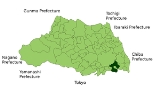
Kawaguchi, Saitama

Encyclopedia

Cities of Japan
||A is a local administrative unit in Japan. Cities are ranked on the same level as and , with the difference that they are not a component of...
located in Saitama Prefecture
Saitama Prefecture
is a prefecture of Japan located in the Kantō region of the island of Honshu. The capital is the city of Saitama.This prefecture is part of the Greater Tokyo Area, and most of Saitama's cities can be described as suburbs of Tokyo, to which a large amount of residents commute each day.- History...
, Japan
Japan
Japan is an island nation in East Asia. Located in the Pacific Ocean, it lies to the east of the Sea of Japan, China, North Korea, South Korea and Russia, stretching from the Sea of Okhotsk in the north to the East China Sea and Taiwan in the south...
. The city was founded on April 1, 1933.
As of January 1, 2011, the city has an estimated population
Population
A population is all the organisms that both belong to the same group or species and live in the same geographical area. The area that is used to define a sexual population is such that inter-breeding is possible between any pair within the area and more probable than cross-breeding with individuals...
of 517,171, the second largest in Saitama Prefecture after Saitama, and a population density
Population density
Population density is a measurement of population per unit area or unit volume. It is frequently applied to living organisms, and particularly to humans...
of 9,276.61 persons per km². The total area is 55.75 km². On October 11, 2011, Kawaguchi City absorbed the neighboring city of Hatogaya.
History
After the last ice ageIce age
An ice age or, more precisely, glacial age, is a generic geological period of long-term reduction in the temperature of the Earth's surface and atmosphere, resulting in the presence or expansion of continental ice sheets, polar ice sheets and alpine glaciers...
, during early and middle Jomon period
Jomon period
The is the time in Japanese prehistory from about 14,000 BC to 300 BC.The term jōmon means "cord-patterned" in Japanese. This refers to the pottery style characteristic of the Jōmon culture, and which has markings made using sticks with cords wrapped around them...
, most of the area which is now Kawaguchi City were under sea level except for the area which is now Omiya Tableland. (Japanese: ) Ancient people living in this area left several shell heaps, in which a lot of shells, Jomon pottery
Jomon Pottery
The is a type of ancient pottery which was made during the Jōmon period in Japan. The term "Jōmon" means "rope-patterned" in Japanese, describing the patterns that are pressed into the clay.- Oldest Pottery in the World :...
, and pit houses
Pit-house
A pit-house is a dwelling dug into the ground which may also be layered with stone.These structures may be used as places to tell stories, dance, sing, celebrate, and store food. In archaeology, pit-houses are also termed sunken featured buildings and are found in numerous cultures around the world...
were dug up.
In Kofun period
Kofun period
The is an era in the history of Japan from around 250 to 538. It follows the Yayoi period. The word kofun is Japanese for the type of burial mounds dating from this era. The Kofun and the subsequent Asuka periods are sometimes referred to collectively as the Yamato period...
, countless barrows were constructed particularly in the west of Japan. Some barrows were also found in Kawaguchi, the largest one is Takainari Barrow, which was destroyed because of the use of the soil in 1960.
In middle ages
Middle Ages
The Middle Ages is a periodization of European history from the 5th century to the 15th century. The Middle Ages follows the fall of the Western Roman Empire in 476 and precedes the Early Modern Era. It is the middle period of a three-period division of Western history: Classic, Medieval and Modern...
, Kawaguchi was part of Musashi province
Musashi Province
was a province of Japan, which today comprises Tokyo Prefecture, most of Saitama Prefecture and part of Kanagawa Prefecture. It was sometimes called . The province encompassed Kawasaki and Yokohama...
, which included entire Saitama
Saitama Prefecture
is a prefecture of Japan located in the Kantō region of the island of Honshu. The capital is the city of Saitama.This prefecture is part of the Greater Tokyo Area, and most of Saitama's cities can be described as suburbs of Tokyo, to which a large amount of residents commute each day.- History...
, Tokyo
Tokyo
, ; officially , is one of the 47 prefectures of Japan. Tokyo is the capital of Japan, the center of the Greater Tokyo Area, and the largest metropolitan area of Japan. It is the seat of the Japanese government and the Imperial Palace, and the home of the Japanese Imperial Family...
, and part of Kanagawa prefecture
Kanagawa Prefecture
is a prefecture located in the southern Kantō region of Japan. The capital is Yokohama. Kanagawa is part of the Greater Tokyo Area.-History:The prefecture has some archaeological sites going back to the Jōmon period...
. It is not known when people started using the name Kawaguchi, but in a tale of war named Gikeiki
Gikeiki
The is a Japanese gunki monogatari that focuses on the legends of Minamoto no Yoshitsune and his followers. Considered to have been composed during the Nanboku-chō period, it has provided inspiration to numerous Noh, kabuki and bunraku plays...
, which was reportedly written in around 1300, there was a name of Ko Kawaguchi, that means little Kawaguchi. However, it is not proven that the name designated current Kawaguchi.
Once Tokugwa Ieyasu, a founder of Tokugawa Shogunate
Tokugawa shogunate
The Tokugawa shogunate, also known as the and the , was a feudal regime of Japan established by Tokugawa Ieyasu and ruled by the shoguns of the Tokugawa family. This period is known as the Edo period and gets its name from the capital city, Edo, which is now called Tokyo, after the name was...
, died in 1616, Tokugawa shogunate established Kawaguchi Juku(Japanese:川口宿) on the Nikko Onari Kaido
Nikko Onari Kaido
was established during the Edo period as a subroute to Nikkō Kaidō. It was built for the shogun to use as he traveled to Nikkō Tōshō-gū. It is also referred to as the Nikkō Onarimichi and the Iwatsuki Kaidō.-Stations of the Nikkō Onari Kaidō:...
, a road used by shoguns to visit Nikko Toshogu, a shrine for worship of Tokugawa Ieyasu. Hence, a dozen hotels were built to serve travelers there.
As Edo
Edo
, also romanized as Yedo or Yeddo, is the former name of the Japanese capital Tokyo, and was the seat of power for the Tokugawa shogunate which ruled Japan from 1603 to 1868...
, now Tokyo, increased its importance as both political and industrial gravity, demand for metal products increased. Because of proximity to Tokyo and convenient water transportation using Arakawa River
Arakawa River
The is one of the principal rivers flowing through Tokyo, the capital city of Japan. The point of origin is on Mount Kobushi in Saitama Prefecture, and the Arakawa River empties into Tokyo Bay, spanning 173 kilometers. The drainage basin covers 2,940 square kilometers...
, Kawaguchi became the center of casting
Casting
In metalworking, casting involves pouring liquid metal into a mold, which contains a hollow cavity of the desired shape, and then allowing it to cool and solidify. The solidified part is also known as a casting, which is ejected or broken out of the mold to complete the process...
industry. A lot of orders of military weapons from Tokugawa shogunate and many Daimyos, governors of a province, to fight against foreign countries during late Edo period
Edo period
The , or , is a division of Japanese history which was ruled by the shoguns of the Tokugawa family, running from 1603 to 1868. The political entity of this period was the Tokugawa shogunate....
made Kawaguchi more and more competitive casting town. Since then casting have been the symbol of Kawaguchi.
In 1910 Kawaguchi-machi Station
Kawaguchi Station
is a railway station of Keihin-Tōhoku Line, East Japan Railway Company in Sakaechō 3-chōme, in the city of Kawaguchi, Saitama Prefecture, Japan.-Layout:The station has one island platform.Tracks- Statistics :...
opened, which was the first train station in Kawaguchi.
On April 1, 1933, Kawaguchi City was established with merger of Kawaguchi-machi, Aoki-mura, Minami-Hirayanagi-mura, and Yokozone-mura. Kawaguchi City was the second city in Saitama Prefecture, after Kawagoe City. Following this merger, in 1940 with Hatogaya-machi, Shiba-mura, Kamine-mura, and Shingo-mura, in 1956 with part of Angyo-mura, in 1962 with part of Misono-mura, Kawaguchi City expanded its territory. However, Hatogaya-machi separated from Kawaguchi City in 1948 in accordance with the referendum
Referendum
A referendum is a direct vote in which an entire electorate is asked to either accept or reject a particular proposal. This may result in the adoption of a new constitution, a constitutional amendment, a law, the recall of an elected official or simply a specific government policy. It is a form of...
. Kawaguchi had been the most populous city in Saitama until Urawa
Urawa, Saitama
was a city in Saitama Prefecture, Japan, until it merged into the city of Saitama together with two other cities, Omiya and Yono, on May 1, 2001. In 2003, the former area of Urawa became Urawa-ku, Midori-ku, Minami-ku, and Sakura-ku, which are wards of the city of Saitama...
overtook Kawaguchi. Now, Kawaguchi is the second most populated city in Saitama Prefecture after Saitama City, the capital city of Saitama Prefecture.
Kawaguchi underwent a lof of disasters, such as flood, earthquake and war. Arakawa River inundated Kawaguchi countless times and ruined agricultures, which resulted in devastating famine. Also in 1923, Great Kanto Earthquake struck Kawaguchi, and 99 people were killed, but fortunately no fire occurred unlike Tokyo and Yokohama
Yokohama
is the capital city of Kanagawa Prefecture and the second largest city in Japan by population after Tokyo and most populous municipality of Japan. It lies on Tokyo Bay, south of Tokyo, in the Kantō region of the main island of Honshu...
. It could have been much worse.
Currently, the population of Kawaguchi continues to increase, and many tall apartment buildings are being built around train stations, so Kawaguchi Station area looks like skyscraper. This is because many casting foundries moved to suburb industrial parks and the sites turned into apartment buildings, whereas in suburb areas nature still remains and they are good healing spots for citizens of Kawaguchi.
On 11 October, 2011, Kawaguchi merged Hatogaya
Hatogaya, Saitama
was a city located in Saitama Prefecture, Japan.As of April 1, 2011, the city had an estimated population of 61,781, with 26,902 households, and a population density of 9,932.64 per km². The total area was 6.22 km², the second smallest among all cities in Japan....
, which is surrounded by Kawaguchi and was once part of Kawaguchi. The name of the new city will remain Kawaguchi.
Geography
Kawaguchi is located in almost center of Kanto PlainKanto Plain
The ' is the largest plain in Japan located in the Kanto Region of central Honshū. The total area 17,000 sq km covers more than half of the Region extending over Tokyo, Saitama Prefecture, Kanagawa Prefecture, Chiba Prefecture, Gunma Prefecture, and Tochigi Prefecture.The northern limit borders on...
, and borders Kita-ku and Adachi-ku to the south, Toda
Toda, Saitama
is a city located in Saitama, Japan. The city is located beside the Arakawa river which separates it from Tokyo. The Sasame river also flows through the city before joining the Arakawa.-History:...
and Warabi
Warabi, Saitama
is a city located in Saitama, Japan. Warabi is the name of a bracken. The city was founded on April 1, 1959.As of 2003, the city has an estimated population of 71,034 and a density of 13,928.24 persons per km². The total area is 5.10 km²...
to the west, Saitama City to the north, Koshigaya
Koshigaya, Saitama
is a city located in Saitama Prefecture, Japan.As of 2010, the city has an estimated population of 325,074 and a population density of 5,390 persons per km². The total area is 60.31 km²....
and Soka
Soka, Saitama
is a city located in Saitama, Japan.As of October 1, 2010, the city has an estimated population of 243,111 and the density of 8,866.19 persons per km²...
to the east. Most area of the city is flat and mainly used for residential area except for Omiya tableland, which occupies the part of north and east area. Arakawa River
Arakawa River
The is one of the principal rivers flowing through Tokyo, the capital city of Japan. The point of origin is on Mount Kobushi in Saitama Prefecture, and the Arakawa River empties into Tokyo Bay, spanning 173 kilometers. The drainage basin covers 2,940 square kilometers...
runs across the border with Kita-ku to the south.
Demographics
| Year | Population |
|---|---|
| 1933 | 45,573 |
| 1945 | 97,709 |
| 1955 | 130,545 |
| 1965 | 231,193 |
| 1975 | 335,864 |
| 1980 | 373,123 |
| 1990 | 433,262 |
| 2000 | 455,886 |
| 2009 | 491,343 |
As of May 1, 2010, registered population was 516,409, including 20,808 alien residents, continuing a trend of population growth in the city since 1933 when the city was founded. There has been a gradual increase in the number of non-Japanese residents living in the city because of the convenient location to Tokyo and relatively low rent. Now, the number of people from China is the largest, followed by Korea and Philippines.
Kawaguchi is a typical suburb city of Tokyo metropolitan area
Greater Tokyo Area
The Greater Tokyo Area is a large metropolitan area in Kantō region, Japan, consisting of most of the prefectures of Chiba, Kanagawa, Saitama, and Tokyo . In Japanese, it is referred to by various terms, including the , , and others....
, where population greatly changes between daytime and nighttime due to commute to big cities, especially to Tokyo. In mid 1990s, population growth rate declined, but recent apartment construction boom in the city helps increase population growth rate again. The number of children continues to decrease in accordance with the decline of number of birth: 4,735 in 2009 down from the highest number of 7,932 in 1971. By contrast, the rate of people over the age of 65 is increasing, approximately 18.5% as of January 1, 2010. Yet the number is below the national average.
Railways
Three railway lines run through Kawaguchi: the Keihin-Tohoku LineKeihin-Tohoku Line
The , is a railway line in Japan which connects the cities of Saitama, Kawaguchi, Tokyo, Kawasaki, and Yokohama. It is part of the East Japan Railway Company network. The line's name is derived from the characters for , and the...
south to north in the west, the Musashino Line
Musashino Line
The is a railway line operated by the East Japan Railway Company . It links Tsurumi Station in Yokohama with Nishi-Funabashi Station in Chiba Prefecture, forming a 100.6 km unclosed loop around central Tokyo...
east to west in the north, and the Saitama Rapid Railway Line
Saitama Rapid Railway Line
The is the continuation of the Namboku Line, starting at Akabane-Iwabuchi station in Tokyo and ending at Urawa Misono Station in Saitama. It was completed on March 28, 2001....
south to north in the central. Kawaguchi Station is the busiest station in the city in term of the number of passengers. The Keihin-Tohoku Line and Saitama Rapid Railway Line directly connect the city with central Tokyo.
Train stations
- JR Keihin-Tohoku Line: KawaguchiKawaguchi Stationis a railway station of Keihin-Tōhoku Line, East Japan Railway Company in Sakaechō 3-chōme, in the city of Kawaguchi, Saitama Prefecture, Japan.-Layout:The station has one island platform.Tracks- Statistics :...
, Nishi-Kawaguchi - JR Musashino Line: Higashi-KawaguchiHigashi-Kawaguchi Stationis a train station in Kawaguchi, Saitama Prefecture, Japan.-History:The JR East Station was one of the original stations on JNR's Musashino Line which opened on April 1, 1973...
- Saitama Rapid Railway Line: Kawaguchi MotogoKawaguchi Motogo Stationis a train station in Kawaguchi, Saitama Prefecture, Japan.- Adjacent stations :...
, Minami HatogayaMinami Hatogaya Stationis a train station in Kawaguchi, Saitama Prefecture, Japan.- Adjacent stations :...
, HatogayaHatogaya Stationis a train station in Kawaguchi, Saitama Prefecture, Japan.- Adjacent stations :...
, AraijukuAraijuku Stationis a train station in Kawaguchi, Saitama Prefecture, Japan.- Adjacent stations :...
, Tozuka AngyoTozuka Angyo Stationis a train station in Kawaguchi, Saitama Prefecture, Japan.- Adjacent stations :...
, Higashi-KawaguchiHigashi-Kawaguchi Stationis a train station in Kawaguchi, Saitama Prefecture, Japan.-History:The JR East Station was one of the original stations on JNR's Musashino Line which opened on April 1, 1973...
Buses
Kawaguchi City has a highly developed bus network, mainly operated by Kokusai Kogyo Bus. The east region of the city is relatively far from train stations, many people use buses to the nearest train stations. Some bus routes have over twenty bus services an hour in the morning.Highways
Three Highway routes listed below run through the city.- Highway Interchanges
- Tohoku ExpresswayTohoku ExpresswayThe is a national expressway in Japan. It is owned by Japan Expressway Holding and Debt Repayment Agency and operated by East Nippon Expressway Company.-Naming:Tōhoku refers to the Tōhoku region, the northernmost region on the island of Honshū....
: Kawaguchi Junction - Tokyo Gaikan ExpresswayTokyo Gaikan ExpresswayThe is a national expressway in Japan. It is owned and operated by East Nippon Expressway Company.-Overview:The name Gaikan refers to the route's status as an outer ring road for Tokyo. The expressway is also referred to simply as Gaikan for short...
: Kawaguchi-Nishi, Kawaguchi-Chuo, Kawaguchi Junction, Kawaguchi-Higashi - Shuto ExpresswayShuto Expresswayis a network of toll expressways in the Greater Tokyo Area of Japan. It is operated and maintained by the .Most routes consist of elevated roadway above other roads or over water, and have many sharp curves which require caution to drive safely...
: Kawaguchi Junction, Araijuku, Angyo, Shingo, Higashi Ryoke
Overview
Most elementary and junior high school students living in the city attend the schools administered by the city. It was not until recently that could students select the school they would attend, so they had to enroll in the schools located in the district where they lived. In 2003 for junior highs, in 2005 for elementary schools, the city educational council reformed the system to allow students to select the school they will attend. However, if applications are overbooked, lotteries will be conducted.Universities and colleges
- Saitama Gakuen UniversitySaitama Gakuen Universityis a private university in Kawaguchi, Saitama, Japan, established in 2001. The predecessor of the school was founded in 1972.-External links:*...
- Kawaguchi Junior CollegeKawaguchi Junior Collegeis a private junior college in Kawaguchi, Saitama, Japan. Originally founded in 1987 as a junior college with 144 female students, it became coeducational in 2000.-External links:*...
- Kawaguchi Art School of Waseda UniversityWaseda University, abbreviated as , is one of the most prestigious private universities in Japan and Asia. Its main campuses are located in the northern part of Shinjuku, Tokyo. Founded in 1882 as Tokyo Senmon Gakko, the institution was renamed "Waseda University" in 1902. It is known for its liberal climate...
High schools
- Saitama Prefectural Kawaguchi High School
- Saitama Prefectural Kawaguchi Kita High School
- Saitama Prefectural Kawaguchi Technical High School
- Saitama Prefectural Kawaguchi Seiryo High School
- Saitama Prefectural Kawaguchi Higashi High School
- Kawaguchi Municipal High School
- Kawaguchi Municipal Kenyo High School
- Kawaguchi Municipal Sogo High School
Junior high schools
(all managed by the city)
|
|
|
Elementary schools
(all managed by the city)
|
|
|