


Karin Månsdotter

Encyclopedia
Queen consort
A queen consort is the wife of a reigning king. A queen consort usually shares her husband's rank and holds the feminine equivalent of the king's monarchical titles. Historically, queens consort do not share the king regnant's political and military powers. Most queens in history were queens consort...
of Sweden, first a mistress and then the spouse of King Eric XIV of Sweden
Eric XIV of Sweden
-Family and descendants:Eric XIV had several relationships before his marriage. With Agda Persdotter he had four daughters:#Margareta Eriksdotter , married 1592 to Olov Simonsson, vicar of Horn....
. She is commemorated in space, by asteroid
Asteroid
Asteroids are a class of small Solar System bodies in orbit around the Sun. They have also been called planetoids, especially the larger ones...
832 Karin
832 Karin
832 Karin is a minor planet orbiting the Sun. It is named after Queen Karin Månsdotter It is the largest member of the Karin Cluster, which is named after it. Found in 2002, the Karin cluster is notable for being very young...
.
Karin was the daughter of Måns, first soldier and later jailkeeper (her last name was a patronymicon meaning "daughter of Måns") and his wife Ingrid. Her mother came from a family of peasants in Uppland
Uppland
Uppland is a historical province or landskap on the eastern coast of Sweden, just north of Stockholm, the capital. It borders Södermanland, Västmanland and Gästrikland. It is also bounded by lake Mälaren and the Baltic sea...
, and was said to have sold vegetables on the square. Both her parents are believed to have died in c. 1560. According to legend, Eric XIV first noticed her selling nuts at a square in Stockholm, and was so astonished by her beauty, that he took her to court as his lover. In reality, however, Karin Månsdotter was in 1564 employed as a servant to Karin, the wife of the King's trusted court musician Gert Cantor, who held a tavern and a guest house in his home, and likely helped to serve the guests as a waitress. She was a maid to the King's sister, Princess Elizabeth, when she became mistress to the king in 1565.
Royal mistress
Karin seem to have entered in to a relationship with Eric in the spring of 1565. The position seems to have been quite official, as she was given expensive clothes and appeared with him openly at court, and was given her own apartment and servants. Thus, she could be regarded as the first official royal mistress in Sweden, although only Hedvig TaubeHedvig Taube
Hedvig Ulrika Taube also Countess von Hessenstein was a Swedish noble and salonist, official royal mistress to King Frederick I of Sweden...
otherwise is considered an official royal mistress in Sweden. In the summer of 1565, she belonged to the king’s retinue to Skara, where she was provided for from the baliff’s provision for the warfaring army, which was otherwise reserved for the army, and illustrates her new status. The royal accounts states that she was given a new and expensive wardrobe and her own staff, among them her own former employer; Karin, the wife of Gert Cantor. When her daughter Sigrid was born in 1566, she was treated as a legitimate princess. Before this, the king had a whole harem of mistresses, such as Agda Persdotter
Agda Persdotter
Agda Persdotter or Agda i Porten, , was a Swedish woman, main royal mistress of King Eric XIV of Sweden during his time as a Crown Prince and during the first years of his reign 1560-1565.- Biography :...
and Doredi Valentinsdotter, but when Karin entered his life, he dismissed them all. She also received education and learned to read and write. His treatment of her caused much astonishment. The ideas of the time suggested witchcraft
Witchcraft
Witchcraft, in historical, anthropological, religious, and mythological contexts, is the alleged use of supernatural or magical powers. A witch is a practitioner of witchcraft...
and love potions to explain the deep attachment.
Karin is reported to have had a fiancé before she met Eric, an ensign named Maximilian. After she become royal mistress, he managed to get in to the palace, where he was discovered by Carl the manservant and taken to the king, who had him killed. According to chronicler Daniel Hund, he was in fact trapped by Eric, who had asked Karin to send for him. The truth of the story is unknown.
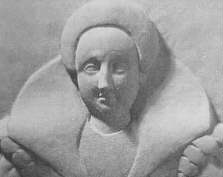
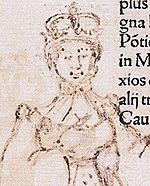
Karin Månsdotter's portrait was done only in her husband's scribbled drawings in captivity and in a latter-day bust at her grave (a portrait long believed to be of her has been discovered to be of her sister-in-law). She was described as a very beautiful girl with long blond hair and innocent eyes, and her personality seems to have been calm, humble and natural. The king was mentally unstable, and she seems to have been the only one who could comfort him and calm him down, which made her appreciated by his relatives, who considered her good for him. She had no personal enemies at court, but she was not respected, and their marriage in 1568 was considered a scandal and may have contributed to his dethronement.
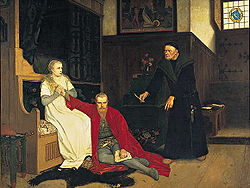
It is unknown whether Karin Månsdotter had any political influence, but a popular image in Swedish history was of her serving as a counterweight to the king's advisor Jöran Persson
Jöran Persson
Jöran Persson, alternatively Göran Persson , was King Eric XIV of Sweden's favorite, most trusted, counsellor and head of the King's network of spies. He was widely seen as a Machiavellian figure, and of holding too much influence over Eric...
; a painting by Georg von Rosen
Georg von Rosen
Georg von Rosen , was a Swedish painter, known for his treatment of subjects from Swedish history and Norse mythology...
three hundred years later (1871) illustrates this, showing the king on the floor, confused by his inner demons, with Karin Månsdotter at one side holding his hand, looking like an innocent angel giving him strength to resist the demands of Jöran Persson, standing on the other side of him, trying to get him to sign a document.
Her contemporaries, specially the nobles at court, early used her to appeal to Eric on their behalf, and it seems as she did her best to do so, which is illustrated in the Sture Murders
Sture Murders
The Sture Murders in Uppsala, Sweden of 24 May 1567 were the murders of five incarcerated Swedish nobles by Erik XIV of Sweden, who at that time was in a state of serious mental disorder, and his guards. The nobles, among them three members of the influential Sture family, had been charged with...
in Uppsala 1567, which could perhaps describe the form of her influence on Eric. In May 1567, Eric is considered to have suffered from some sort of mental collapse. He imprisoned several men from the noble family Sture, among them count Svante. Countess Märta Sture, sister of the former queen Margaret Leijonhufvud
Margaret Leijonhufvud
-Children:#John III , Duke of Finland, King of Sweden 1567-1592#Catherine , wife of Edzard II, Count of East Frisia#Cecilia , wife of Christopher II, Margrave of Baden-Rodemachern...
, appealed to Karin Månsdotter that the prisoners be protected. Karin assured her no one would hurt the prisoners. Later the same morning, the king visited Svante Sture in prison, fell on his knees before him and begged for his friendship. Later the same day, however, the Sture prisoners were executed. Eric disappeared shortly afterwards, and Karin participated in the search; he was found in the Odensala vicarage.
Karin Månsdotter donated to the sisters of Vadstena Abbey
Vadstena Abbey
Vadstena Abbey was the motherhouse of the Bridgettine Order, situated on Lake Vättern, in the Diocese of Linköping, Sweden. The abbey started as one of the farms donated by the king, but the town of Vadstena grew up around it...
on three occasions between 1566 and 1568, and it is noted that her largest donation was made during Eric's sickness in 1567.
Queen
Morganatic marriage
In the context of European royalty, a morganatic marriage is a marriage between people of unequal social rank, which prevents the passage of the husband's titles and privileges to the wife and any children born of the marriage...
in 1567, and officially in 1568, when she was ennobled and crowned queen under the name Katarina Magnusdotter (a formal version of her name). The first, secret wedding ceremony, was performed by Arch Bishop Laurentius Petri
Laurentius Petri
Laurentius Petri Nericius was a Swedish clergyman and the first Evangelical Lutheran Archbishop of Sweden. He and his brother Olaus Petri are, together with the King Gustav Vasa, regarded as the main Protestant reformers of Sweden...
on 29 December 1567. During this period, Eric was periodically affected by his mental problems, and a regency ruled in his stead. The marriage, Eric's mental problems and Karin's elevation caused rumours. In a letter to Eric's sister Sophia, it was reported that "The lunacy which dominates him is a consequence of his deeds. He was somewhat unstable even before, and now he is completely so, guided by his wife", implying that Karin used witchcraft. The wife of Eric's advisor Jöran Persson
Jöran Persson
Jöran Persson, alternatively Göran Persson , was King Eric XIV of Sweden's favorite, most trusted, counsellor and head of the King's network of spies. He was widely seen as a Machiavellian figure, and of holding too much influence over Eric...
, Anna Andersdotter, a close friend of Karin, was accused of having spread the rumours and sentenced for slander, but was pardoned on request by Karin herself.
The regency arrested many of Eric's advisors, and Karin intervened for many of them. When Eric recovered and the regency was disbanded, Karin intervened in making peace between Eric and his brother, Duke John.
The 10 February 1568, Karin was ennobled and given the official seal of a queen. In a letter to her sister-in-laws, the princesses Sophia and Elisabeth, it is noted that she had erased the first draft, which formally called them "Dear sisters", and that she did not call herself "Queen", but "Chosen Queen", which has been interpreted to the fact that she knew that her position was not fully accepted within the aristocracy. Eric is reported to have plans to have his brothers and other enemies killed before the wedding, but they were to have been warned of these plans by Karin Månsdotter through queen dowager Catherine Stenbock. It was later noted that these people did not attend the wedding.
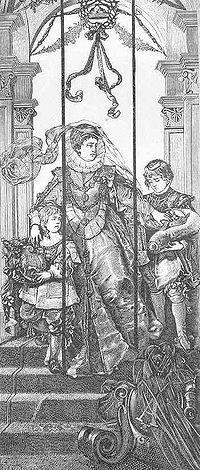
The official wedding took place in Storkyrkan 4 July 1568, followed next day by the coronation. Karin Månsdotter was walked to the altar by the king's cousin Per Brahe under a banner of golden textile carried by four nobles. The wedding was unique; never before had the children of the couple been present at a royal wedding. Both the infant son and the daughter of Eric and Karin were present to confirm their official status. They were placed under the banner between their parents. The 9 June, the son had been baptized carried by Queen Dowager Catherine Stenbock. The coronation was celebrated with great festivities in Stockholm to confirm the new queen's legitimacy. Karin's peasant relatives, her three maternal uncles from Uppland, Hans Jakobsson, Jakob Jakobsson and Erik Nilsson, were present dressed in clothes made for them by the royal tailor. During the coronation, the Lord Chancellor Nils Gyllenstierna, who was carrying the crown, fainted and dropped the crown to the floor. This was regarded as a bad omen. During her period as queen, Karin made gifts to her friends and relatives, such as Anna Nilsdotter i Hammarstorp, who has been identified as her sister despite her different patronymicon, her paternal cousins in Sko kloster, and her "Fränka" (meaning "Female relation") Anna Eriksdotter i Sko. Queen Karin is noted to have granted two royal estates in 1568: in 1 May, she granted the income from Rörstrand in Solna to Torbrjörn Klockare in Stockholm, and in 24 July, she granted Aleby in Botkyrka to Lasse Jakobsson, signing herself in the first document as "Karin Månsdotter" and in the second as "Katarina Regina". On both occasions, she described different privileges and conditions for the holders. Granting royal estates and deciding their privileges was something normally done by monarchs and described her personal influence.
Soon after the coronation, Eric's brothers rebelled and he and his family were imprisoned. It is said, that during the dethronement, Karin fell on her knees before Queen Dowager Katarina Stenbock
Katarina Stenbock
Catherine Stenbock was the third and last consort of King Gustav I of Sweden, and Queen consort of Sweden between 1552 and 1560...
, crying out; "Forgive him!", as a reminder of the insanity of the King, of which the wedding was considered a sign, and one of the reasons for the coup, and then to the king's brother, the future King John III of Sweden
John III of Sweden
-Family:John married his first wife, Catherine Jagellonica of Poland , house of Jagiello, in Vilnius on 4 October 1562. In Sweden, she is known as Katarina Jagellonica. She was the sister of king Sigismund II Augustus of Poland...
, crying out the same thing; "Forgive him!", but she was completely ignored. This touching scene, portrayed in an old film about her, was most likely a myth - among other things, the Queen Dowager had left the castle at that time - but it illustrates the probably truthful image of her and her personality.
Karin shared the imprisonment of Eric at the first the Royal Palace of Stockholm, and then at Castle of Turku (1570–71), at Kastellholm Castle on Åland, at Gripsholm Castle
Gripsholm Castle
Gripsholm Castle is a castle in Mariefred, Södermanland, in Sweden and is regarded as one of Sweden's finest historical monuments. It is located by lake Mälaren in south central Sweden, in the municipality of Strängnäs, about 60 km west of Stockholm....
(1571–73) and Västerås Castle
Västerås Castle
Västerås Castle is situated in Västerås, the province of Västmanland, Sweden....
(1573). Shortly after they were imprisoned, the children were placed in the care of Queen Dowager Catherine Stenbock and their French governess Johanna (Jeanne) de Herboville, but were reunited with their parents in 1570. Karin gave birth to two children in captivity in 1570 and 1572, both of whom died in prison. During their imprisonment, it was reported that Karin reproached Eric for the people he had killed during his reign, "as he in his power had innocent people put to death and by doing so caused the imprisonment and misery of his wife and children as well as himself". In the summer of 1569, an attempt to free the prisoners and restore Eric to his throne was made by a group of conspirators led by Karin's head lady-in-waiting, Elin Andersdotter, and Karin's personal secretary Thomas Jakobsson. The conspiracy was discovered and Andersdotter and Jakobsson was executed. Eric was involved in the plans, but it is not mentioned in the documents if Karin was, although the leading conspirators were in her employment. It is known that Eric was on at least three occasions physically abused by his keeper, but it is not thought that this happened in the presence of Karin. Queen Karin and her children were separated from her husband the 14 June 1573 to prevent the birth of any more legitimate offspring. King Eric described it in his diary as: "My wife has been taken from me by use of violence". Karin and her children were taken to the Castle of Turku (Åbo) in Finland where she remained under house arrest until the death of her husband four years later. In 1575, her son was taken from her and sent to Poland to be placed under the care of the Jesuits, but she was allowed to keep her daughter. In 1577, she received the news of her husband's death. She was treated with kindness and given the royal estate Liuksiala Manor in Kangasala
Kangasala
Kangasala is a municipality in Finland, next to Tampere. It was founded in 1865. The municipality has a population of and covers an area of of which is water. The population density is ....
, Finland, where she lived the rest of her life.
Widowhood
Catherine Jagiellon
Catherine the Jagiellonian of Poland was Duchess of Finland , Queen Consort of Sweden , Grand Princess of Finland and heir to her mother's claim to the title of King of Jerusalem....
and Queen Dowager Katarina Stenbock
Katarina Stenbock
Catherine Stenbock was the third and last consort of King Gustav I of Sweden, and Queen consort of Sweden between 1552 and 1560...
at Svartsjö Castle, in what was called the "Three Queens Visit".
In 1587, her daughter Sigrid was appointed lady-in-waiting to the new king's daughter, Princess Anna of Finland
Anna of Finland
Anna Vasa or Anna of Sweden also Anne was a Swedish princess. She was the sister of the monarch of Poland, Sweden and Lithuania, Sigismund III Vasa, and starosta of Brodnica and Golub.-Biography:...
, who followed her brother King Sigismund to Warsaw where he had been elected king. Karin accompanied her on her journey. In Warsaw, she met her son Gustaf again, twelve years after he was taken from her. She saw him once again in Estonia
Estonia
Estonia , officially the Republic of Estonia , is a state in the Baltic region of Northern Europe. It is bordered to the north by the Gulf of Finland, to the west by the Baltic Sea, to the south by Latvia , and to the east by Lake Peipsi and the Russian Federation . Across the Baltic Sea lies...
in 1595, and unlike the previous meeting, this meeting has been confirmed. He was now a Catholic, had forgotten her and they could not speak to each other because he had forgotten the Swedish language, the only language Karin was able to speak; she could identify him only by his birthmarks. He was poor and worked as a mercenary
Mercenary
A mercenary, is a person who takes part in an armed conflict based on the promise of material compensation rather than having a direct interest in, or a legal obligation to, the conflict itself. A non-conscript professional member of a regular army is not considered to be a mercenary although he...
. She tried to help him financially, and for the rest of her life, tried to get permission for him to return to Sweden, but never saw him again. Her daughter Sigrid, on the other hand, married two Swedish noblemen and often spent time with her mother.
Karin became respected and liked in Finland; during the great peasant rebellion Cudgel War
Cudgel War
The Club War was a 1596/97 peasant uprising in the kingdom of Sweden against exploitation by nobility and military in what is today Finland...
in 1596–97, the rebels refrained from plundering her estate. She was also successful in managing the affairs of the estate; in 1587, Liuksiala Manor was one of the most lucrative estates in Finland, and in 1599 it had became the second most lucrative. She kept her neutrality during the Finnish aristocracy's conflict with Charles IX of Sweden
Charles IX of Sweden
Charles IX of Sweden also Carl, was King of Sweden from 1604 until his death. He was the youngest son of King Gustav I of Sweden and his second wife, Margaret Leijonhufvud, brother of Eric XIV and John III of Sweden, and uncle of Sigismund III Vasa king of both Sweden and Poland...
in 1597–99. Her daughter, whose spouse had been loyal to King Sigismund, was forced to flee from Charles IX to Riga in 1598, but when she returned in 1603, Karin gave her refuge.
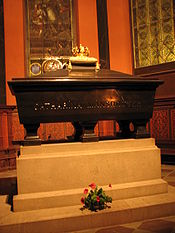
In August 1605, Charles IX gave instructions that Karin and her niece (her sister's daughter, who was apparently staying with her) should be moved to Stockholm. It is not known why, but it may have been because of the political situation in Russia, where her son was a participant. However, the instructions were never carried out. In 1606, Karin asked Charles for permission to free her tenants from the royal taxes so she could use their tax money to buy the freedom of her son, who was at the time a prisoner in Russia, but the king refused. In 1607, Karin nonetheless forbade her tenants to pay the royal taxes. The king then sent her his representatives to explain that this could not be accepted. Soon after, the affair ended with the death of her son in captivity. She died peacefully after a period of illness at Liuksiala. She is buried in the Cathedral of Turku
Cathedral of Turku
Turku Cathedral is the Mother Church of the Evangelical Lutheran Church of Finland, and the country's national shrine. It is the central church of the Archdiocese of Turku and the seat of the Archbishop of Finland, Kari Mäkinen...
.
Although three Queens of Sweden in her same century were not of royal blood, but noblewomen
Nobility
Nobility is a social class which possesses more acknowledged privileges or eminence than members of most other classes in a society, membership therein typically being hereditary. The privileges associated with nobility may constitute substantial advantages over or relative to non-nobles, or may be...
, Karin Månsdotter was the only one before Silvia
Queen Silvia of Sweden
|align=right|Queen Silvia of Sweden is the Queen consort of King Carl XVI Gustaf of Sweden. Styled Her Majesty The Queen, Silvia is the mother of the heir apparent to the throne, Crown Princess Victoria.-Childhood:Queen Silvia was born in Heidelberg, Germany, on 23 December 1943...
(1976) who was a commoner
Commoner
In British law, a commoner is someone who is neither the Sovereign nor a peer. Therefore, any member of the Royal Family who is not a peer, such as Prince Harry of Wales or Anne, Princess Royal, is a commoner, as is any member of a peer's family, including someone who holds only a courtesy title,...
— not counting Queen Desideria
Désirée Clary
Bernardine Eugénie Désirée Clary , one-time fiancée of Napoleon Bonaparte, was a Frenchwoman who became Queen of Sweden and Norway as the consort of King Charles XIV John, a former French General. She officially changed her name there to Desideria, a Latin version of her original name...
, who although born a commoner became Princess of Ponte Corvo four years before becoming Swedish royalty.
Family
Karin Månsdotter had the following children with the king;- Princess Sigrid of SwedenPrincess Sigrid of SwedenPrincess Sigrid of Sweden , was a Swedish princess...
(1566–1633) (born before the marriage), lady-in-waiting, spouse of two nobles. - Prince Gustav of SwedenPrince Gustav of SwedenPrince Gustav of Sweden, or Gustav Eriksson Vasa was a Swedish prince and the son of king Eric XIV of Sweden and Karin Månsdotter....
(1568–1607) (born before the marriage), mercenary. - Henrik (1570–1574)
- Arnold (1572–1573)
Karin Månsdotter in fiction
Karin Månsdotter has been portrayed in films and books. The film Karin MånsdotterKarin Månsdotter (film)
Karin Månsdotter is a 1954 Swedish historical drama film directed by Alf Sjöberg. It is based on the play Erik XIV by August Strindberg.-Cast:* Ulla Jacobsson as Karin Månsdotter* Jarl Kulle as King Erik of Sweden* Ulf Palme as Göran Persson...
by Alf Sjöberg was made in 1954.