

Karasjok

Encyclopedia
Kárášjohka or (Norwegian
) is a village and municipality
in Finnmark
county
, Norway
. The administrative centre of the municipality is the village of Karasjok.
name Kárášjohka. The meaning of the first element is unknown and the last element is johka which means "river".
The municipality was part of the old Kistrand
municipality until 1866. The name of the municipality was Karasjok until 1990, when it was changed to Kárášjohka-Karasjok. It was the third municipality in Norway to get a Sami name. In 2005 the name was again changed, such that either Kárášjohka or Karasjok can be used.
is from modern times. They were granted on 27 June 1986. The three flames are chosen as a symbol for the importance of fire to the local (nomadic) Sami people
. The fire
brings both heat and thus survival during the harsh winters, but it is also a major threat, both in the tents as well as in the large pine
forest
s. The fire is also the point around which people gather and it is a guard against dangers. The flag contains three flames also because Kárásjoga-Karasjok is a place where three peoples live: the Sami, Norwegians, and Kvens.
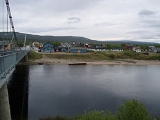
 The municipality is situated along the upper river basin of the Deatnu / Tana river
, and its tributaries Anárjohka and Kárášjohka
, and includes large tracts of the high plateau
of Finnmarksvidda
. Lakes in the region include Gásadatjávri
. The river valley, unlike the plateau, is covered with pine
and birch
forest.
At Karigasniemi
there is an official border crossing with Finland
, and the European route E6
is passing through on its way from Lakselv to Deatnu - Tana. The nearest airport is Lakselv Airport, 80 km from Karasjok.
s of Finnmarksvidda are known for their rich bird life with species like Bluethroat
preferring areas with scrub. The Tana river also flows through Karasjok and many of the species found in higher areas use it as a migration route.
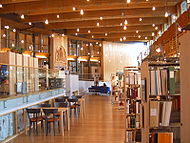
, as well as of the Sami broadcasting, and several Sami institutions, public and private, are to be found here. 80% of the population is Sami speaking, and Sami and Norwegian have equal status in the municipality.
, the first Sami parliament president was Ole Henrik Magga
, from Kautokeino
. He was the president for more than eight years. The church in Karasjok is the oldest Lutheran
church in Finnmark, and the only building to survive the World War II
damage. The church is today too small, so a big, wooden church, inspired by Sami architecture, has been built. Karasjok is also the place to look for duodji
, Sami handicraft.
Norwegian language
Norwegian is a North Germanic language spoken primarily in Norway, where it is the official language. Together with Swedish and Danish, Norwegian forms a continuum of more or less mutually intelligible local and regional variants .These Scandinavian languages together with the Faroese language...
) is a village and municipality
Municipalities of Norway
Norway is divided into 19 administrative regions, called counties , and 430 municipalities...
in Finnmark
Finnmark
or Finnmárku is a county in the extreme northeast of Norway. By land it borders Troms county to the west, Finland to the south and Russia to the east, and by water, the Norwegian Sea to the northwest, and the Barents Sea to the north and northeast.The county was formerly known as Finmarkens...
county
Counties of Norway
Norway is divided into 19 administrative regions, called counties . The counties form the primary first-level subdivisions of Norway and are further divided into 430 municipalities...
, Norway
Norway
Norway , officially the Kingdom of Norway, is a Nordic unitary constitutional monarchy whose territory comprises the western portion of the Scandinavian Peninsula, Jan Mayen, and the Arctic archipelago of Svalbard and Bouvet Island. Norway has a total area of and a population of about 4.9 million...
. The administrative centre of the municipality is the village of Karasjok.
Name
Karasjok is a Norwegianized form of the SámiNorthern Sami
Northern or North Sami is the most widely spoken of all Sami languages. The speaking area of Northern Sami covers the northern parts of Norway, Sweden and Finland...
name Kárášjohka. The meaning of the first element is unknown and the last element is johka which means "river".
The municipality was part of the old Kistrand
Porsanger
Porsanger or Porsáŋgu or Porsanki is a municipality in Finnmark county, Norway. The administrative centre of the municipality is the village of Lakselv...
municipality until 1866. The name of the municipality was Karasjok until 1990, when it was changed to Kárášjohka-Karasjok. It was the third municipality in Norway to get a Sami name. In 2005 the name was again changed, such that either Kárášjohka or Karasjok can be used.
Coat-of-arms
The coat-of-armsCoat of arms
A coat of arms is a unique heraldic design on a shield or escutcheon or on a surcoat or tabard used to cover and protect armour and to identify the wearer. Thus the term is often stated as "coat-armour", because it was anciently displayed on the front of a coat of cloth...
is from modern times. They were granted on 27 June 1986. The three flames are chosen as a symbol for the importance of fire to the local (nomadic) Sami people
Sami people
The Sami people, also spelled Sámi, or Saami, are the arctic indigenous people inhabiting Sápmi, which today encompasses parts of far northern Sweden, Norway, Finland, the Kola Peninsula of Russia, and the border area between south and middle Sweden and Norway. The Sámi are Europe’s northernmost...
. The fire
Fire
Fire is the rapid oxidation of a material in the chemical process of combustion, releasing heat, light, and various reaction products. Slower oxidative processes like rusting or digestion are not included by this definition....
brings both heat and thus survival during the harsh winters, but it is also a major threat, both in the tents as well as in the large pine
Pine
Pines are trees in the genus Pinus ,in the family Pinaceae. They make up the monotypic subfamily Pinoideae. There are about 115 species of pine, although different authorities accept between 105 and 125 species.-Etymology:...
forest
Forest
A forest, also referred to as a wood or the woods, is an area with a high density of trees. As with cities, depending where you are in the world, what is considered a forest may vary significantly in size and have various classification according to how and what of the forest is composed...
s. The fire is also the point around which people gather and it is a guard against dangers. The flag contains three flames also because Kárásjoga-Karasjok is a place where three peoples live: the Sami, Norwegians, and Kvens.
Geography
Tana River (Norway)
Tana river , is a long river in Sápmi, in the Norwegian county of in Finnmark and the Lapland of Finland. The Sámi name means "Great River". The main tributaries of Tana are Anarjohka and Karasjohka....
, and its tributaries Anárjohka and Kárášjohka
Karasjohka
Karasjohka river joins Anarjohka downstream of Karigasniemi and forms the famous salmon fishing Tana river . Karasjok municipality in Finnmark, Norway is situated along the upper river basin of the Deatnu / Tana river, and its tributaries Anarjohka and Karasjohka, and includes large tracts of the...
, and includes large tracts of the high plateau
Plateau
In geology and earth science, a plateau , also called a high plain or tableland, is an area of highland, usually consisting of relatively flat terrain. A highly eroded plateau is called a dissected plateau...
of Finnmarksvidda
Finnmarksvidda
Finnmarksvidda or the Finnmark plateau; Finnmark highland, is Norway's largest plateau, with an area greater than 22,000 km². It lies at 300–500 meters above sea level...
. Lakes in the region include Gásadatjávri
Gásadatjávri
Gásadatjávri is a lake in the municipality of Karasjok-Karasjohka in Finnmark county, Norway....
. The river valley, unlike the plateau, is covered with pine
Scots Pine
Pinus sylvestris, commonly known as the Scots Pine, is a species of pine native to Europe and Asia, ranging from Scotland, Ireland and Portugal in the west, east to eastern Siberia, south to the Caucasus Mountains, and as far north as well inside the Arctic Circle in Scandinavia...
and birch
Downy Birch
Betula pubescens is a species of birch, native and abundant throughout northern Europe, Iceland, northern Asia and also Greenland....
forest.
At Karigasniemi
Karigasniemi
Karigasniemi is one of the villages of Finland's most northern municipality of Utsjoki . It lies at the foot of Mount Ailigás.The village is situated on the border between Norway and Finland south-east of Karasjok...
there is an official border crossing with Finland
Finland
Finland , officially the Republic of Finland, is a Nordic country situated in the Fennoscandian region of Northern Europe. It is bordered by Sweden in the west, Norway in the north and Russia in the east, while Estonia lies to its south across the Gulf of Finland.Around 5.4 million people reside...
, and the European route E6
European route E6
European route E 6 is the designation for the main north-south road in Norway, and the west coast of Sweden, running from the southern tip of Sweden, at Trelleborg, into Norway and through almost all of the country north to Finnmark. The route ends close to the Norwegian border with Russia...
is passing through on its way from Lakselv to Deatnu - Tana. The nearest airport is Lakselv Airport, 80 km from Karasjok.
Climate
In this far northeastern part of Norway, the climate is much more continental and dry compared to the typical coastal climate in Norway. Situated in a river valley on this plateau, Karasjok has recorded the coldest official temperature ever in Norway: -51.4 C on 1 January 1886. The warmest temperature ever recorded in the summer is 32.4 °C (90.3 °F). In January 1999, there was also a cold shock, the "official" temperature recording was -51.2 C, but unofficially a temperature of -56 C was recorded. The warmest month on record was July 1941, with a mean (24hr) temperature of 17.9 °C (64.2 °F); the coldest month was February 1966 with a mean of -27.1 C.Birdlife
The birdlife to be found in this municipality is characteristic for the region. The inland habitatHabitat
* Habitat , a place where a species lives and grows*Human habitat, a place where humans live, work or play** Space habitat, a space station intended as a permanent settlement...
s of Finnmarksvidda are known for their rich bird life with species like Bluethroat
Bluethroat
The Bluethroat is a small passerine bird that was formerly classed as a member of the thrush family Turdidae, but is now more generally considered to be an Old World flycatcher, Muscicapidae...
preferring areas with scrub. The Tana river also flows through Karasjok and many of the species found in higher areas use it as a migration route.
Economy
Most people live in Karasjok (Kárášjohka) village. The village is the seat of the Sámediggi, the Sami Parliament of NorwaySami Parliament of Norway
The Sami Parliament of Norway is the representative body for people of Sami heritage in Norway. It acts as an institution of cultural autonomy for the indigenous Sami people....
, as well as of the Sami broadcasting, and several Sami institutions, public and private, are to be found here. 80% of the population is Sami speaking, and Sami and Norwegian have equal status in the municipality.
Tourism
The attractions include the Sami parliament, Samediggi, the Sami museum, and the church, dating from 1807. The Sami parliament was opened in 1989, by King Olav VOlav V of Norway
Olav V was the king of Norway from 1957 until his death. A member of the House of Schleswig-Holstein-Sonderburg-Glücksburg, Olav was born in the United Kingdom as the son of King Haakon VII of Norway and Queen Maud of Norway...
, the first Sami parliament president was Ole Henrik Magga
Ole Henrik Magga
Ole Henrik Magga is a Sámi linguist and politician from Kautokeino, Norway.-As a linguist:As a linguist, Ole Henrik Magga is best known for his work on syntax...
, from Kautokeino
Kautokeino
or Guovdageaidnu , is a municipality in Finnmark county, Norway. The administrative centre of the municipality is the village of Guovdageaidnu/Kautokeino...
. He was the president for more than eight years. The church in Karasjok is the oldest Lutheran
Lutheranism
Lutheranism is a major branch of Western Christianity that identifies with the theology of Martin Luther, a German reformer. Luther's efforts to reform the theology and practice of the church launched the Protestant Reformation...
church in Finnmark, and the only building to survive the World War II
World War II
World War II, or the Second World War , was a global conflict lasting from 1939 to 1945, involving most of the world's nations—including all of the great powers—eventually forming two opposing military alliances: the Allies and the Axis...
damage. The church is today too small, so a big, wooden church, inspired by Sami architecture, has been built. Karasjok is also the place to look for duodji
Duodji
Duodji is a centuries old Sami handicraft, that dates back to a time when the Sami were far more isolated from the outside world than they are today. Duodji tools and clothing accoutrements served their purpose to be functional and useful, however this does not mean that the Sami handicraft is...
, Sami handicraft.