

Kalamazoo College

Encyclopedia
Kalamazoo College, also known as K College or simply K, is a private
liberal arts college
in Kalamazoo
, Michigan
, United States
. Founded in 1833, the college is among the 100 oldest in the country. Today, it produces more Peace Corps
volunteers per capita than any other U.S. academic institution, and ranks in the top one percent for number of graduates who go on to earn a Ph.D. The school was founded by American Baptist
ministers, but today maintains no religious affiliation.
Kalamazoo College is a member of the Great Lakes Colleges Association
. It is listed in Loren Pope
's Colleges That Change Lives
. In 2010, Forbes
rated it 73rd of America's Best Colleges
., the highest ranked in Michigan.
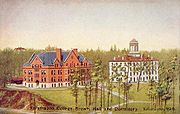 Kalamazoo College was founded in 1833 by a group of Baptist ministers as the Michigan and Huron Institute. Its charter was granted on April 22, 1833, the first school chartered by the Legislative Council of the Territory of Michigan. Instruction at the Institute began in fall 1836. In 1837, the name of the fledgling college was changed to the "Kalamazoo Literary Institute" and school officials made their first attempt to secure recognition as a college from the state of Michigan
. In 1838, however, the University of Michigan
opened the Kalamazoo Branch of the University of Michigan, providing a local competitor to the Literary Institute. In 1840, the two schools merged, and from 1840 to 1850 the College operated as the Kalamazoo Branch of the University of Michigan. In 1850, the Kalamazoo Literary Institute name was restored and in 1855 the school finally received an educational charter from the State of Michigan, establishing explicit recognition of the school as a college. After receiving its educational charter, the school changed its name to Kalamazoo College.
James Stone, the first president of Kalamazoo College, led the school from 1842 through 1863 and was responsible for instituting the high academic standards that allowed the College to receive its charter. Shortly after becoming president, Stone proposed the addition of a theological seminary to increase the supply of ministers in the region. With the support of the Baptist church, classes at the Kalamazoo Theological Seminary began in 1848 with 11 students. At the same time, the Female Department continued to expand under the watchful eye of Lucinda Hinsdale Stone. In 1845-46, almost half of the 90 students enrolled in Kalamazoo were women.
The Stones also played a role in the creation of the Republican Party
. A meeting of disgruntled Michigan Whigs, Democrats
, and abolitionists at the Stones' Kalamazoo residence set the date for an anti-slavery convention in Jackson, Michigan
, which resulted in the formal birth of the Republican Party.
The first known student of African descent to attend Kalamazoo College was ex-slave Rufus Lewis Perry. Perry attended Kalamazoo Theological Seminary from 1860–1861, but left before he received a diploma. He was ordained a Baptist minister in Ann Arbor in 1861, and later earned a Ph.D. from State University in Louisville, Kentucky. Jamaican-born brothers Solomon and John Williamson were the first black graduates from "K," receiving their diplomas in 1911. Kalamazoo College also served as a pioneer in coed education
, granting its first degree to a woman, Miss Catherine V. Eldred, in 1870.
In 1877, Kalamazoo College students published the first edition of The Index, a student-run newspaper that continues to publish today. The college also publishes "The Cauldron," an annual literary-arts journal; and "The Passage", an annual compilation of students' work from study abroad.
Kalamazoo College's reputation as an academic powerhouse and a leader in international education was built during the presidency of Weimer Hicks
, who served from 1954 to 1971. Hicks conceived of the "K Plan" program under which most Kalamazoo students spend at least one term abroad and spend at least one term working in an academic internship. As part of the original "K Plan," Kalamazoo College students could attend school year-round. One typical pattern was:
Variations to this schedule — such as spring-term study-abroad programs, full-year study-abroad programs, and winter SIPs — were also common. However, the college scrapped its summer term in 1996 due to the difficulty of attracting students to a year-round college.
 Kalamazoo College is among the 100 oldest colleges and universities in the United States. It offers 28 majors spread across the fields of Fine Arts, Humanities, Modern and Classical Languages and Literatures, Natural Sciences and Mathematics, Physical Education, and Social Sciences. There are 11 unique interdisciplinary majors as well.
Students at Kalamazoo College must fulfill specific degree requirements in order to graduate. During the first term, students must enroll in a First-Year Seminar. Upon graduation, students must demonstrate a proficiency in a second language at an intermediate level and satisfy a quantitative reasoning requirement. There is a physical education requirement as well.
To facilitate a liberal arts education that emphasizes both disciplinary and interdisciplinary areas of study, students are required to take Shared Passages Seminars:
• First-year seminar - focuses on developing writing and communication skills
• Sophomore seminar - focuses on international experience in preparation of study abroad
• Senior seminar - focuses on disciplinary or interdisciplinary topics to cap a student's educational experience
The student-to-faculty ratio is 12:1. Ninety-five percent of Kalamazoo College's faculty have doctorates or terminal degrees in their fields.
On January 3, 2006, Kalamazoo College opened the new Upjohn Library Commons which includes the completely renovated skeleton of the older library, and an extension which adds to its volume capacity.
's Division III and the Michigan Intercollegiate Athletic Association
(MIAA). As of 2009, the Hornet tennis squad have won their conference's championship 71 consecutive years. Kalamazoo College competes in the following sports:
has been played at Kalamazoo since 1892, when the school completed a record of 0 wins and 2 losses, both to Olivet College
. The school's first win came two years later in 1894 with a 16–4 victory over the Kalamazoo YMCA
. It was 1895 before the school defeated another college football team with a 12–8 victory over Alma.
In 1897, the first coach came to the program with Charles Hall
who led the team to a record of 7 wins and 1 loss, earning the Michigan Intercollegiate Athletic Association
championship. The current coach is Jamie Zorbo
.
National Runners-up - NCAA Division II:
National Championships - NCAA Division III:
National Runners-up - NCAA Division III:
. With Olivet leading 70-69, Kalamazoo College center Kevin Baird made a shot at the buzzer that was initially waved off by referees. The referees reviewed videotape of the game and determined that Baird had, in fact, released his shot before the buzzer and then awarded Kalamazoo College a 71-70 victory. After the game, Olivet filed a protest with the conference commissioner, claiming that officials had misapplied the way in which videotape may be used. On January 23, the conference upheld the protest and awarded Olivet the victory. Kalamazoo then filed a protest with the NCAA, claiming that Olivet's protest was in violation of NCAA bylaws. On February 1, the NCAA upheld Kalamazoo's counter-protest and again awarded the game to the Hornets. The dispute between Olivet and Kalamazoo received national attention and Baird's shot was shown repeatedly on ESPN
.
 Student organizations are one of the main sources of entertainment for the student body. They routinely bring in speakers as well as stage performances, dances, and movie showings.
During the fall quarter, there are two main events: Fall Fest and Homecoming
dance. In Fall Fest, student organizations provide activities for the students, such as pumpkin carving and bobbing for apples.
During the winter quarter, the college holds the annual Monte Carlo night, on which the student body raises money by gambling in a makeshift casino where the professors are the dealers. They play for scrip redeemable for prizes.
, MI. The date is determined by the president of the Student Commission and kept secret from the student body, though it is usually on one of the Wednesdays during weeks 7-9. On the morning of the Day of Gracious Living, the bells of Stetson Chapel ring, announcing the day to the student body.
became Kalamazoo College's 17th President and first female president, as well as the first African-American president of the school. She is the 22nd President overall, including interim and acting presidents. Her immediate predecessors are Bernard Palchick, who served as interim president and returned to the administration, and James F. Jones
, who departed to become President of Trinity College
, in Connecticut
.
Private university
Private universities are universities not operated by governments, although many receive public subsidies, especially in the form of tax breaks and public student loans and grants. Depending on their location, private universities may be subject to government regulation. Private universities are...
liberal arts college
Liberal arts colleges in the United States
Liberal arts colleges in the United States are certain undergraduate institutions of higher education in the United States. The Encyclopædia Britannica Concise offers a definition of the liberal arts as a "college or university curriculum aimed at imparting general knowledge and developing general...
in Kalamazoo
Kalamazoo, Michigan
The area on which the modern city stands was once home to Native Americans of the Hopewell culture, who migrated into the area sometime before the first millennium. Evidence of their early residency remains in the form of a small mound in downtown's Bronson Park. The Hopewell civilization began to...
, Michigan
Michigan
Michigan is a U.S. state located in the Great Lakes Region of the United States of America. The name Michigan is the French form of the Ojibwa word mishigamaa, meaning "large water" or "large lake"....
, United States
United States
The United States of America is a federal constitutional republic comprising fifty states and a federal district...
. Founded in 1833, the college is among the 100 oldest in the country. Today, it produces more Peace Corps
Peace Corps
The Peace Corps is an American volunteer program run by the United States Government, as well as a government agency of the same name. The mission of the Peace Corps includes three goals: providing technical assistance, helping people outside the United States to understand US culture, and helping...
volunteers per capita than any other U.S. academic institution, and ranks in the top one percent for number of graduates who go on to earn a Ph.D. The school was founded by American Baptist
American Baptist Churches USA
The American Baptist Churches USA is a Baptist Christian denomination within the United States. The denomination maintains headquarters in Valley Forge, Pennsylvania. The organization is usually considered mainline, although varying theological and mission emphases may be found among its...
ministers, but today maintains no religious affiliation.
Kalamazoo College is a member of the Great Lakes Colleges Association
Great Lakes Colleges Association
The Great Lakes Colleges Association , is a consortium of 13 liberal arts colleges located in the states around the Great Lakes. The 13 schools are located in Michigan, Ohio, Pennsylvania and Indiana...
. It is listed in Loren Pope
Loren Pope
Loren Brooks Pope was an American writer and independent college placement counselor.In 1965, Pope, a former newspaperman and education editor of The New York Times, founded the College Placement Bureau, one of the first independent college placement counseling services in the United States...
's Colleges That Change Lives
Colleges That Change Lives
Colleges That Change Lives is a college educational guide by Loren Pope. It was originally published in 1996, with a second edition in 2000, and a third edition in 2006...
. In 2010, Forbes
Forbes
Forbes is an American publishing and media company. Its flagship publication, the Forbes magazine, is published biweekly. Its primary competitors in the national business magazine category are Fortune, which is also published biweekly, and Business Week...
rated it 73rd of America's Best Colleges
Forbes Magazine's List of America's Best Colleges
In 2009 Forbes Magazine, along with The Center for College Affordability and Productivity, compiled a list of America's Best Colleges based on "the quality of the education they provide, the experience of the students and how much they achieve".- 2009 List :...
., the highest ranked in Michigan.
History
Michigan
Michigan is a U.S. state located in the Great Lakes Region of the United States of America. The name Michigan is the French form of the Ojibwa word mishigamaa, meaning "large water" or "large lake"....
. In 1838, however, the University of Michigan
University of Michigan
The University of Michigan is a public research university located in Ann Arbor, Michigan in the United States. It is the state's oldest university and the flagship campus of the University of Michigan...
opened the Kalamazoo Branch of the University of Michigan, providing a local competitor to the Literary Institute. In 1840, the two schools merged, and from 1840 to 1850 the College operated as the Kalamazoo Branch of the University of Michigan. In 1850, the Kalamazoo Literary Institute name was restored and in 1855 the school finally received an educational charter from the State of Michigan, establishing explicit recognition of the school as a college. After receiving its educational charter, the school changed its name to Kalamazoo College.
James Stone, the first president of Kalamazoo College, led the school from 1842 through 1863 and was responsible for instituting the high academic standards that allowed the College to receive its charter. Shortly after becoming president, Stone proposed the addition of a theological seminary to increase the supply of ministers in the region. With the support of the Baptist church, classes at the Kalamazoo Theological Seminary began in 1848 with 11 students. At the same time, the Female Department continued to expand under the watchful eye of Lucinda Hinsdale Stone. In 1845-46, almost half of the 90 students enrolled in Kalamazoo were women.
The Stones also played a role in the creation of the Republican Party
Republican Party (United States)
The Republican Party is one of the two major contemporary political parties in the United States, along with the Democratic Party. Founded by anti-slavery expansion activists in 1854, it is often called the GOP . The party's platform generally reflects American conservatism in the U.S...
. A meeting of disgruntled Michigan Whigs, Democrats
Democratic Party (United States)
The Democratic Party is one of two major contemporary political parties in the United States, along with the Republican Party. The party's socially liberal and progressive platform is largely considered center-left in the U.S. political spectrum. The party has the lengthiest record of continuous...
, and abolitionists at the Stones' Kalamazoo residence set the date for an anti-slavery convention in Jackson, Michigan
Jackson, Michigan
Jackson is a city located along Interstate 94 in the south central area of the U.S. state of Michigan, about west of Ann Arbor and south of Lansing. It is the county seat of Jackson County. As of the 2010 census, the city population was 33,534...
, which resulted in the formal birth of the Republican Party.
The first known student of African descent to attend Kalamazoo College was ex-slave Rufus Lewis Perry. Perry attended Kalamazoo Theological Seminary from 1860–1861, but left before he received a diploma. He was ordained a Baptist minister in Ann Arbor in 1861, and later earned a Ph.D. from State University in Louisville, Kentucky. Jamaican-born brothers Solomon and John Williamson were the first black graduates from "K," receiving their diplomas in 1911. Kalamazoo College also served as a pioneer in coed education
Coeducation
Mixed-sex education, also known as coeducation or co-education, is the integrated education of male and female persons in the same institution. It is the opposite of single-sex education...
, granting its first degree to a woman, Miss Catherine V. Eldred, in 1870.
In 1877, Kalamazoo College students published the first edition of The Index, a student-run newspaper that continues to publish today. The college also publishes "The Cauldron," an annual literary-arts journal; and "The Passage", an annual compilation of students' work from study abroad.
Kalamazoo College's reputation as an academic powerhouse and a leader in international education was built during the presidency of Weimer Hicks
Weimer Hicks
Weimer Hicks was President of Kalamazoo College from 1954 to 1971.Hicks is considered responsible for building Kalamazoo College's reputation as an academic powerhouse and a leader in international education through his development of the "K Plan"...
, who served from 1954 to 1971. Hicks conceived of the "K Plan" program under which most Kalamazoo students spend at least one term abroad and spend at least one term working in an academic internship. As part of the original "K Plan," Kalamazoo College students could attend school year-round. One typical pattern was:
- First year: Fall: On campus; Winter: On campus; Spring: On campus; Summer: Off
- Sophomore Year: Fall: On campus; Winter: On campus; Spring: Career Development Internship; Summer: On campus
- Junior year: Fall: Study Abroad; Winter: Study Abroad; Spring: On campus; Summer: On campus
- Senior year: Fall: Senior Individualized Project; Winter: On campus; Spring: On campus
Variations to this schedule — such as spring-term study-abroad programs, full-year study-abroad programs, and winter SIPs — were also common. However, the college scrapped its summer term in 1996 due to the difficulty of attracting students to a year-round college.
Academics
Students at Kalamazoo College must fulfill specific degree requirements in order to graduate. During the first term, students must enroll in a First-Year Seminar. Upon graduation, students must demonstrate a proficiency in a second language at an intermediate level and satisfy a quantitative reasoning requirement. There is a physical education requirement as well.
To facilitate a liberal arts education that emphasizes both disciplinary and interdisciplinary areas of study, students are required to take Shared Passages Seminars:
• First-year seminar - focuses on developing writing and communication skills
• Sophomore seminar - focuses on international experience in preparation of study abroad
• Senior seminar - focuses on disciplinary or interdisciplinary topics to cap a student's educational experience
The student-to-faculty ratio is 12:1. Ninety-five percent of Kalamazoo College's faculty have doctorates or terminal degrees in their fields.
On January 3, 2006, Kalamazoo College opened the new Upjohn Library Commons which includes the completely renovated skeleton of the older library, and an extension which adds to its volume capacity.
Curriculum
Kalamazoo College is an academic leader among national liberal arts colleges and emphasizes the importance of an experiential education. The academic plan — known as the "K plan" — consists of a rigorous liberal arts education supplemented by one or more terms abroad and internship opportunities during the summer. All students are required to complete a Senior Individualized Project (SIP), which may take the form of a thesis, an artistic performance, or any other work-intensive project of a student's choosing.Service-Learning
Kalamazoo College initiated the service-learning program in 1997. In 2001, Trustee Ronda Stryker dedicated to her grandmother the Mary Jane Underwood Stryker Institute for Service Learning. This Institute was created to house several Service-Learning programs in the school. The current director of the Mary Jane Underwood Stryker Institute is Alison Geist. In 2008, Kalamazoo College had twenty-three on-going service-learning programs. There are several courses in the college that incorporate service-learning into their curricula. The programs in service-learning include Community Advocates for Parents and Students; Helping Youth through Personal Empowerment; Academic Mentorship In Giants On-going Success; the Woodward School; Keeping the Doors Open; and Farms to K.Study abroad
US News & World Report America's Best Colleges 2003 ranked Kalamazoo College's study-abroad program number one in the country. Nearly 85% of Kalamazoo College students spend at least one term abroad and the college maintains partnerships with over 50 foreign universities on six continents.Center for Career and Professional Development
In 2009, the Center Career Development merged with the Guilds of Kalamazoo College to create the Center for Career and Professional Development. The CCPD's mission is to create meaningful connections to the world of work, empowering Kalamazoo College students to explore, identify and pursue their diverse interests, values and passions, and to develop a framework of skills, networks and knowledge for successful lifelong career planning and professional development. Unique opportunities through the CCPD include the Discovery Externship Program and the Field Experience Program.Academic distinctions
A recent study by Higher Education Data Sharing lists Kalamazoo College in the top 1 percent of colleges and universities whose graduates go on to earn a Ph.D. According to this study, Kalamazoo College is ranked number nine among all private colleges and — when compared with all academic institutions — it ranks number fourteen in Ph.Ds per capita. Among all undergraduate institutions, Kalamazoo College was #1 per capita in 2005 for recruitment of Peace Corps volunteers.Athletics
The school's sports teams are called the Hornets. They compete in the NCAANational Collegiate Athletic Association
The National Collegiate Athletic Association is a semi-voluntary association of 1,281 institutions, conferences, organizations and individuals that organizes the athletic programs of many colleges and universities in the United States...
's Division III and the Michigan Intercollegiate Athletic Association
Michigan Intercollegiate Athletic Association
The Michigan Intercollegiate Athletic Association is an athletic conference that competes in the NCAA's Division III. The nine teams in the conference are all located in the states of Michigan and Indiana. The Michigan Intercollegiate Athletic Association was established on March 24, 1888, making...
(MIAA). As of 2009, the Hornet tennis squad have won their conference's championship 71 consecutive years. Kalamazoo College competes in the following sports:
Fall Sports:
|
Winter Sports:
|
Spring Sports :
|
Football
College footballCollege football
College football refers to American football played by teams of student athletes fielded by American universities, colleges, and military academies, or Canadian football played by teams of student athletes fielded by Canadian universities...
has been played at Kalamazoo since 1892, when the school completed a record of 0 wins and 2 losses, both to Olivet College
Olivet College
Olivet College is a coeducational, liberal arts college located in Olivet, Michigan, United States, south of Lansing and west of Detroit. It is affiliated with the United Church of Christ and the National Association of Congregational Christian Churches, and accredited by the North Central...
. The school's first win came two years later in 1894 with a 16–4 victory over the Kalamazoo YMCA
YMCA
The Young Men's Christian Association is a worldwide organization of more than 45 million members from 125 national federations affiliated through the World Alliance of YMCAs...
. It was 1895 before the school defeated another college football team with a 12–8 victory over Alma.
In 1897, the first coach came to the program with Charles Hall
Charles Hall (American football)
-Coaching career:Hall was the head college football coach for the Kalamazoo Hornets located in Kalamazoo, Michigan. He held that position for 4 seasons, from 1897 until 1900. His coaching record at Kalamazoo was 21 wins, 6 losses and 3 ties. As of the conclusion of the 2010 season, this ranks him...
who led the team to a record of 7 wins and 1 loss, earning the Michigan Intercollegiate Athletic Association
Michigan Intercollegiate Athletic Association
The Michigan Intercollegiate Athletic Association is an athletic conference that competes in the NCAA's Division III. The nine teams in the conference are all located in the states of Michigan and Indiana. The Michigan Intercollegiate Athletic Association was established on March 24, 1888, making...
championship. The current coach is Jamie Zorbo
Jamie Zorbo
-External links:*...
.
Men's Tennis
The Kalamazoo College men’s tennis team has won 72 consecutive Michigan Intercollegiate Athletic Association championships (1936–2010) with a record of 426-2 in the MIAA from 1935 - 2007. Kalamazoo has won seven NCAA Division III national championships and has made 25 consecutive NCAA III tournament appearances.National Runners-up - NCAA Division II:
- 1972 - Men's Tennis
National Championships - NCAA Division III:
- 1976 - Men's Tennis
- 1978 - Men's Tennis
- 1986 - Men's Tennis
- 1987 - Men's Tennis
- 1991 - Men's Tennis
- 1992 - Men's Tennis
- 1993 - Men's Tennis
National Runners-up - NCAA Division III:
- 1982 - Men's Tennis
- 1985 - Men's Tennis
- 1997 - Men's Tennis
- 1999 - Men's Tennis
Men's Swimming and Diving
Men's swimming and diving at Kalamazoo College has an impressive history. The team is known for producing individual national champions in the pool and on the boards, and also for maintaining a national presence with regular appearances as a top-10 team at the NCAA Division III national championships. The swimming and diving team is the second most successful athletic program at Kalamazoo College, after the men's tennis team, and it is also one of the top-10 most-successful teams in the MIAA with 25 MIAA championships.Academic achievement
- Don Knoechel, NCAA Postgraduate Scholarship 1980
- Curt Crimmins, NCAA Postgraduate Scholarship 1984
- Markus Boos, GTE Academic All-American 2nd Team 2000
- Evan Whitbeck, NCAA Postgraduate Scholarship 2002
- Scott Whitbeck, NCAA Postgraduate Scholarship 2004
- Robert Dekker, NCAA Postgraduate Scholarship 2009
Athletic achievement and contributions
- Brad Shively, Head Coach of Men's and Women's Swimming & Diving at Washington University in St. Louis.
- Jeff Gorton, competitor at the 2004 Olympic Trials in 3-meter diving.
- Mark Fino, Head Coach of Men's and Women's Swimming & Diving at Oberlin College.
- Scott Whitbeck, assistant swim coach at The College of Wooster (2005–2007), University Massachusetts Amherst and State University of New York at New Paltz.
- Derek Jansen, Founder of d3swimming.com
Women's Cross Country
- Allison Iott, 2008 NCAA D-3 and USTFCCCA All-American in Cross Country Finishing 10th. Kalamazoo's First ever Womans Cross Country MIAA conference Meet Champion and MIAA Conference MVP.
Basketball dispute
In 2001, the Kalamazoo College men's basketball team was at the center of a lengthy dispute regarding the outcome of a January 20 game with league rival Olivet CollegeOlivet College
Olivet College is a coeducational, liberal arts college located in Olivet, Michigan, United States, south of Lansing and west of Detroit. It is affiliated with the United Church of Christ and the National Association of Congregational Christian Churches, and accredited by the North Central...
. With Olivet leading 70-69, Kalamazoo College center Kevin Baird made a shot at the buzzer that was initially waved off by referees. The referees reviewed videotape of the game and determined that Baird had, in fact, released his shot before the buzzer and then awarded Kalamazoo College a 71-70 victory. After the game, Olivet filed a protest with the conference commissioner, claiming that officials had misapplied the way in which videotape may be used. On January 23, the conference upheld the protest and awarded Olivet the victory. Kalamazoo then filed a protest with the NCAA, claiming that Olivet's protest was in violation of NCAA bylaws. On February 1, the NCAA upheld Kalamazoo's counter-protest and again awarded the game to the Hornets. The dispute between Olivet and Kalamazoo received national attention and Baird's shot was shown repeatedly on ESPN
ESPN
Entertainment and Sports Programming Network, commonly known as ESPN, is an American global cable television network focusing on sports-related programming including live and pre-taped event telecasts, sports talk shows, and other original programming....
.
Fight song
The words to the college fight-song, "All Hail to Kazoo," were written by A.G. Walton (1911) with music by D.R. Belcher (1909), arranged by Burton Edward Fischer.Student life and traditions
During the fall quarter, there are two main events: Fall Fest and Homecoming
Homecoming
Homecoming is the tradition of welcoming back alumni of a school. It most commonly refers to a tradition in many universities, colleges and high schools in North America...
dance. In Fall Fest, student organizations provide activities for the students, such as pumpkin carving and bobbing for apples.
During the winter quarter, the college holds the annual Monte Carlo night, on which the student body raises money by gambling in a makeshift casino where the professors are the dealers. They play for scrip redeemable for prizes.
Crystal Ball
Kaleidoscope (formerly known as the Gay, Lesbian, Bisexual, Transgender, and Ally Student Organization, GLBTSO) hosts the Crystal Ball each spring. Crystal Ball is a college-sponsored dance in which attendees dress in drag or unusual costumes. A long-standing tradition at K College, this event was created to educate the campus about GLBT issues and celebrate the persons who make up the GLBT community. This very popular event features live music, dancing, and contests.The Quad
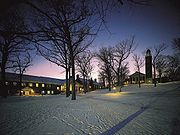
The campus is built around a grassy hill known as "The Quad". The Quad is also the site of numerous large scale events throughout the year, including Homecoming, Spring Fling, Convocation, and Commencement. Furthermore, at the top of the hill lies Stetson Chapel, which is a favorite location for alumni wedding services. The Quad is home to another popular Kalamazoo College student tradition, "streaking the Quad", a noisy, late-night descent from the Chapel, down the hill, and back to the top again. Tradition dictates that students must touch the school sign before returning to the top. There is a mass-streak after the spring performance by Frelon, the Kalamazoo College dance group, and also during the day by the senior class. This often coincides with a wedding.Day of Gracious Living
Since 1974, the college has upheld a springtime tradition of canceling all classes for a “Day of Gracious Living” (DOGL). While it was originally instituted (despite the Student Commission's rejection) as a day for students to relax and have fun, the 1980 Kalamazoo tornado prompted students to spend that year's DOGL helping clean up after the storm and giving back to their community. Many students enjoy the day at the North Beach in South HavenSouth Haven, Michigan
South Haven is a city in the U.S. state of Michigan. Most of the city is in Van Buren County, although a small portion extends into Allegan County. The population was 5,021 at the 2000 census....
, MI. The date is determined by the president of the Student Commission and kept secret from the student body, though it is usually on one of the Wednesdays during weeks 7-9. On the morning of the Day of Gracious Living, the bells of Stetson Chapel ring, announcing the day to the student body.
Recycling program
Kalamazoo College has become a leading institution in the area of recycling and environmental awareness. A crew of student workers operates one of the nation's most successful recycling programs and organizes the school's participation in the annual RecycleMania event, a competition among over 400 colleges and universities across the United States. In 2005, Kalamazoo College came to national prominence with a 3rd-place finish in the Grand Champion category. While annually placing in the top 5 in a variety of categories, in 2008 Kalamazoo College placed 1st in both the Grand Champion and Stephen K Gaski Per Capita Classic competitions.Sustainability
Kalamazoo College signed the President's Climate Commitment in 2007 and has completed a greenhouse gas emissions inventory. The college's Hicks Student Center is partially powered by wind and solar energy, and the student group D.I.R.T. (Digging in Renewable Turf) maintains an organic garden on campus. The spring 2009 Energy Sting competition encouraged students to reduce their energy consumption. Kalamazoo received a B on the 2010 College Sustainability Report Card.Presidents of Kalamazoo College
In 2005 Dr. Eileen Wilson-OyelaranEileen Wilson-Oyelaran
Eileen B. Wilson-Oyelaran is the 17th President of Kalamazoo College, succeeding Dr. James F. Jones. She is the first female president, as well as the first African-American president of the school.-Education:...
became Kalamazoo College's 17th President and first female president, as well as the first African-American president of the school. She is the 22nd President overall, including interim and acting presidents. Her immediate predecessors are Bernard Palchick, who served as interim president and returned to the administration, and James F. Jones
James F. Jones
James F. Jones, Jr., is the 21st president of Trinity College in Hartford, Connecticut. Jones is a native of Atlanta, Georgia. He and his wife, Jan, have three children.- Education :...
, who departed to become President of Trinity College
Trinity College (Connecticut)
Trinity College is a private, liberal arts college in Hartford, Connecticut. Founded in 1823, it is the second-oldest college in the state of Connecticut after Yale University. The college enrolls 2,300 students and has been coeducational since 1969. Trinity offers 38 majors and 26 minors, and has...
, in Connecticut
Connecticut
Connecticut is a state in the New England region of the northeastern United States. It is bordered by Rhode Island to the east, Massachusetts to the north, and the state of New York to the west and the south .Connecticut is named for the Connecticut River, the major U.S. river that approximately...
.
- Nathaniel Marsh (1835)
- Walter ClarkWalter ClarkWalter Ernest Clark was a politician in Manitoba, Canada. He served in the Legislative Assembly of Manitoba from 1955 to 1958 as a Liberal-Progressive...
(1835–1836) - Nathaniel Aldrich Balch (1836–1838)
- David Alden (1838–1840)
- William Dutton (After whom Dutton Street was named) Fifth and last Principal teacher. (1840–1843)
- James Stone (1843–1863)
- John Milton GregoryJohn Milton GregoryJohn Milton Gregory was elected Superintendent of Public Instruction in Michigan in 1858, after several years spent as editor of the Michigan Journal of Education. After leaving office in 1864 he became the second president of Kalamazoo College from 1864 until 1867...
(1864–1867) - Kendall Brooks (1868–1887)
- Monson A. Wilcox (1887–1891)
- Theodore Nelson (1891–1892)
- Arthur Gaylord Slocum (1892–1912)
- Herbert Lee Stetson (1912–1922)
- Allan Hoben (1922–1935)
- Charles True Goodsell (1935–1936) (interim)
- Stewart Grant Cole (1936–1938)
- Paul Lamont Thompson (1938–1948)
- Allen B. Stowe (1948–1949) (interim)
- John Scott EvertonJohn Scott EvertonJohn Scott Everton was an American college president and diplomat.He was educated at Colgate University Divinity School, Cambridge, and Yale. He worked on the research staff at the Ford Foundation....
(1949–1953) - Harold T. Smith (1953) (interim)
- Weimer K. Hicks (1953–1971)
- George M. Rainsford (1972–1983)
- David W. Breneman (1983–1989)
- Timothy LightTimothy LightTimothy Light was the fourteenth president of Middlebury College, 1990-1991.A native of Kalamazoo, Michigan, Light is a scholar in East Asian languages and literature...
(1989–1990) (acting) - Lawrence D. Bryan (1990–1996)
- James F. JonesJames F. JonesJames F. Jones, Jr., is the 21st president of Trinity College in Hartford, Connecticut. Jones is a native of Atlanta, Georgia. He and his wife, Jan, have three children.- Education :...
(1996–2004) - Bernard Palchick (2004–2005) (interim)
- Eileen Wilson-OyelaranEileen Wilson-OyelaranEileen B. Wilson-Oyelaran is the 17th President of Kalamazoo College, succeeding Dr. James F. Jones. She is the first female president, as well as the first African-American president of the school.-Education:...
(since 2005)
Notable alumni
- Selma BlairSelma BlairSelma Blair is an American actress who has worked in film, theatre and television. She has performed in feature films including Cruel Intentions, Legally Blonde, The Sweetest Thing, Hellboy, The Fog, Purple Violets and Hellboy II: The Golden Army...
, actress (graduated from the University of MichiganUniversity of MichiganThe University of Michigan is a public research university located in Ann Arbor, Michigan in the United States. It is the state's oldest university and the flagship campus of the University of Michigan...
, but studied at Kalamazoo from 1990 to 1992) - Garry BrownGarry BrownGarry Eldridge Brown was a politician from the U.S. state of Michigan.Garry Brown had four daughters, Frances, Mollie, Amelia, and Abigail. His family owned and operated a dairy farm while he was growing up, in Schoolcraft, Michigan...
, politician - Amy CourterAmy CourterMajor General Amelia S. "Amy" Courter, CAP, is the former National Commander of the Civil Air Patrol. She was elected by a unanimous decision of CAP's National Board on 7 August 2008.-Education:...
, current National Commander of the Civil Air PatrolCivil Air PatrolCivil Air Patrol is a Congressionally chartered, federally supported, non-profit corporation that serves as the official civilian auxiliary of the United States Air Force . CAP is a volunteer organization with an aviation-minded membership that includes people from all backgrounds, lifestyles, and... - Mark CrilleyMark CrilleyMark Crilley is an American comic book creator and children's book author/illustrator. He is the creator of Miki Falls, Akiko, and Brody's Ghost. He is also noted for his instructional videos for drawing in the manga-style.-Akiko:...
, comic book creator and children's book author/illustrator - Kenneth G. ElzingaKenneth G. ElzingaKenneth G. Elzinga is an economics professor at the University of Virginia. His two major claims to fame are his antitrust expertise and his co-authorship of a highly successful trio of murder mystery novels in which the sleuth, dubbed Henry Spearman, solves the murder using principles of...
, an economics professor at the University of VirginiaUniversity of VirginiaThe University of Virginia is a public research university located in Charlottesville, Virginia, United States, founded by Thomas Jefferson... - David FranceDavid France (writer)David France is an American investigative reporter and non-fiction author. He is a a contributing editor for New York magazine, former Newsweek senior editor and published in magazines such as The New Yorker, The New York Times Magazine and GQ.France is the author of three books, including Our...
, journalist and author - Holly HughesHolly Hughes (performance artist)Holly Hughes is an American lesbian performance artist. She began as a feminist painter in New York but is best known for her connection with the NEA Four, with whom she was denied funding from the National Endowment for the Arts, and for her work with the Women's One World Cafe. Her plays...
, performance artist - Gerald Ellis RosenGerald Ellis RosenGerald Ellis Rosen is an American judge who was nominated by President George H. W. Bush to the U.S. District Court for the Eastern District of Michigan in November 1989 and was invested in March 1990. He is currently the Chief Judge of the U.S...
, United States District Court Judge - Nagai KafuNagai Kafuis the pen name of Japanese author, playwright, essayist, and diarist Nagai Sōkichi . His works are noted for their depictions of life in early 20th-century Tokyo, especially among geisha, prostitutes, cabaret dancers, and other denizens of the city's lively entertainment districts.-Biography:Kafū...
, author - Lisa KronLisa KronElizabeth S. "Lisa" Kron is an American actress and playwright.-Biography:Kron was born in Ann Arbor, Michigan. She jokes in one of her plays that her life began on her parents’ trip to Europe: “I was conceived in Venice, you know...
, Tony-Award-nominated actress and playwright - Alexander LipseyAlexander LipseyAlexander "Sandy" Lipsey is a Democratic politician from the U.S. state of Michigan. As a member of the Michigan State House of Representatives, he represented the 60th District from 2000 to 2006...
, Michigan politician - Martin A. LarsonMartin A. LarsonMartin A. Larson was an American populist freethinker and a writer specializing in theological history and the Essenes. Originally from a fundamentalist Evangelical background, he "rejected its dogmas and practices" when he was about 20 years old. Following service in the United States Navy, he...
, religion scholar - Sean MannSean MannSean Mann was the Allan K. Wood Distinguished Professor of Bioethics and Korean language at the University of California, Berkeley.-Early life:...
, bioethicist, author, professor - John E. SarnoJohn E. SarnoJohn E. Sarno is Professor of Clinical Rehabilitation Medicine, New York University School of Medicine, and attending physician at the Howard A. Rusk Institute of Rehabilitation Medicine, New York University Medical Center. He graduated from The Columbia University College of Physicians and...
, innovator in back-pain therapy - Bradley A. SmithBradley A. SmithBradley A. Smith is a professor at Capital University Law School, who was Commissioner, Vice Chairman and Chairman of the Federal Election Commission between 2000 and 2005 and is best known for his writing and activities opposing campaign finance regulation.-Academic career and influence:A...
, former Chairman, Federal Election CommissionFederal Election CommissionThe Federal Election Commission is an independent regulatory agency that was founded in 1975 by the United States Congress to regulate the campaign finance legislation in the United States. It was created in a provision of the 1975 amendment to the Federal Election Campaign Act... - Mark SpitznagelMark SpitznagelMark Spitznagel is an American hedge fund manager, derivatives trader, and value investor.Spitznagel is known for a hugely profitable billion dollar derivatives bet on the stock market crash of 2008, for allegedly crashing the market again in May 2010, as well as for his highly unconventional...
, hedge fund manager - Ty WarnerTy WarnerH. Ty Warner is an American toy manufacturer and businessman. He is chairman, CEO, sole owner and founder of Ty Inc., which manufactures and distributes Beanie Babies, Beanie Baby 2.0s, Ty Girlz, Pluffies , LI'L Ones, Beanie Boos and other plush items...
, founder, Ty Inc.Ty Inc.Ty Inc. is an American plush animal company based in Westmont, Illinois. By far their most famous line of products are the Beanie Babies, but Ty also manufactures other lines of stuffed toys...
(Beanie BabiesBeanie BabyA Beanie Baby is a stuffed animal, made by Ty Warner Inc., which was later renamed as Ty Inc. in late 1993. Each toy has an inner "posable lining" and is stuffed with plastic pellets rather than conventional stuffing , giving Beanie Babies a flexible feel.The original nine Beanie Babies launched...
) - Maynard Owen WilliamsMaynard Owen WilliamsMaynard Owen Williams was a National Geographic correspondent from 1919. He was an inveterate traveller who began travelling in his teens, explored Asia and witnessed the Russian Revolution, among other adventures....
, National Geographic correspondent - Steven YeunSteven YeunSteven Yeun is a Korean-born American actor. Yeun is currently starring in the role of Glenn in AMC's original series, The Walking Dead since 2010. Other than The Walking Dead, Yeun guest starred in the critically acclaimed American sit-com The Big Bang Theory as Sheldon's former room mate...
(2005), actor best known for portraying Glenn in The Walking DeadThe Walking Dead (TV series)The Walking Dead is an American post-apocalyptic horror television series developed for television by Frank Darabont and based on the ongoing comic book series, The Walking Dead, by Robert Kirkman, Tony Moore and Charlie Adlard... - Julie MehretuJulie MehretuJulie Mehretu is an artist, best known for her densely-layered abstract paintings and prints. She lives and works in New York City...
, artist, winner of MacArthur "Genius" Award - Mike VasasMike VasasMichael Robert Vasas is an American singer, multi-instrumentalist, composer, and music educator...
, singer/songwriter - Michael Soenen, Chairman of the Board, Chief Executive Officer and President of FTD Group, Inc
- Bruce Benton, manager of the Onchocersias Coordinating Unit
- Norman VanSile, Detroit area business magnate
- Elizabeth Lindau and Matt Priest, musicians, of the indie-rock band CanastaCanasta (band)Ned Raggett of Allmusic wrote that on this album the band "display both an ambition and a sense of range that any number of early 21st century American groups described in similar terms would be wise to follow"...
- Joe Tracz, playwright, director