

Kakure Kirishitan

Encyclopedia

Japan
Japan is an island nation in East Asia. Located in the Pacific Ocean, it lies to the east of the Sea of Japan, China, North Korea, South Korea and Russia, stretching from the Sea of Okhotsk in the north to the East China Sea and Taiwan in the south...
ese Catholic Church that went underground after the Shimabara Rebellion
Shimabara Rebellion
The was an uprising largely involving Japanese peasants, most of them Catholic Christians, in 1637–1638 during the Edo period.It was one of only a handful of instances of serious unrest during the relatively peaceful period of the Tokugawa shogunate's rule...
in the 1630s.
History
Kirishitan
, from Portuguese cristão, referred to Roman Catholic Christians in Japanese and is used as a historiographic term for Roman Catholics in Japan in the 16th and 17th centuries. Christian missionaries were known as bateren or iruman...
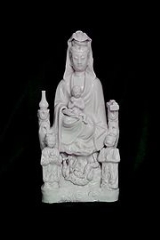
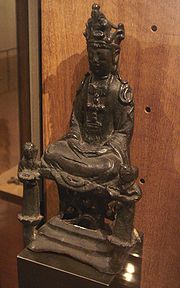
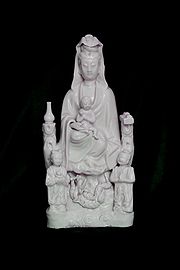
s are called the "hidden" Christians because they continued to practice Christianity in secret. They worshipped in secret rooms
Secret passage
Secret passages, also commonly referred to as hidden passages or secret tunnels, are hidden routes used for stealthy travel. Such passageways are sometimes inside buildings leading to secret rooms. Others allow occupants to enter or exit buildings without being seen...
in private homes. As time went on, the figures of the saint
Saint
A saint is a holy person. In various religions, saints are people who are believed to have exceptional holiness.In Christian usage, "saint" refers to any believer who is "in Christ", and in whom Christ dwells, whether in heaven or in earth...
s and the Virgin Mary were transformed into figurines that looked like the traditional statues of the Buddha
Buddhism
Buddhism is a religion and philosophy encompassing a variety of traditions, beliefs and practices, largely based on teachings attributed to Siddhartha Gautama, commonly known as the Buddha . The Buddha lived and taught in the northeastern Indian subcontinent some time between the 6th and 4th...
and bodhisattvas. The prayers were adapted to sound like Buddhist chant, yet retained many untranslated words from Latin
Latin
Latin is an Italic language originally spoken in Latium and Ancient Rome. It, along with most European languages, is a descendant of the ancient Proto-Indo-European language. Although it is considered a dead language, a number of scholars and members of the Christian clergy speak it fluently, and...
, Portuguese
Portuguese language
Portuguese is a Romance language that arose in the medieval Kingdom of Galicia, nowadays Galicia and Northern Portugal. The southern part of the Kingdom of Galicia became independent as the County of Portugal in 1095...
and Spanish
Spanish language
Spanish , also known as Castilian , is a Romance language in the Ibero-Romance group that evolved from several languages and dialects in central-northern Iberia around the 9th century and gradually spread with the expansion of the Kingdom of Castile into central and southern Iberia during the...
. The Bible
Bible
The Bible refers to any one of the collections of the primary religious texts of Judaism and Christianity. There is no common version of the Bible, as the individual books , their contents and their order vary among denominations...
was passed down orally, due to fears of printed works being confiscated by authorities. Because of the expulsion of the Catholic clergy in the 17th century, the Kakure Christian community relied on lay leaders to lead the services.
In some cases, the communities drifted away from Christian teachings. They lost the meaning of the prayers and their religion became a version of the cult of ancestors, in which the ancestors happened to be their Christian martyrs
Christian martyrs
A Christian martyr is one who is killed for following Christianity, through stoning, crucifixion, burning at the stake or other forms of torture and capital punishment. The word "martyr" comes from the Greek word μάρτυς, mártys, which means "witness."...
.
Many secret Christians, some of whom had adopted these new ways of practicing Christianity, came out of hiding when religious freedom was re-established in the mid-19th century
Meiji Restoration
The , also known as the Meiji Ishin, Revolution, Reform or Renewal, was a chain of events that restored imperial rule to Japan in 1868...
and rejoined the Catholic Church after renouncing their unorthodox, syncretic
Syncretism
Syncretism is the combining of different beliefs, often while melding practices of various schools of thought. The term means "combining", but see below for the origin of the word...
practices. However, there were those who decided not to rejoin. They are known as the Hanare Kirishitan .
Modern extinction
Following the legalization of Christianity and secularization of Japan, many Hanare Kirishitan lineages ended abruptly. Traditionally, boys learned the rituals and prayers from their fathers; when boys were uninterested or moved away from the homes, there would be no one left to continue the lineage.For a while, Hanare Kirishitans were thought to have died out entirely, due to their tradition of secrecy. A group on Ikitsuki Island
Ikitsuki, Nagasaki
is a former town on the island of the same name located in Kitamatsuura District, Nagasaki, Japan.On October 1, 2005 Ikitsuki, along with the town of Tabira, and the village of Ōshima, both from Kitamatsuura District, was merged into the expanded city of Hirado....
in Nagasaki prefecture
Nagasaki Prefecture
is a prefecture of Japan located on the island of Kyūshū. The capital is the city of Nagasaki.- History :Nagasaki Prefecture was created by merging of the western half of the former province of Hizen with the island provinces of Tsushima and Iki...
, which had been overlooked by the Japanese government during the time of persecution, made their practices public in the 1980s and now perform them for audiences; however, these practices have acquired some attributes of theater, such as the telling of folktales and the use of statues and other images which most underground Christians had never created.
The anthropologist Christal Whelan uncovered the existence of genuine Hanare Kirishitans on the Gotō Islands
Goto Islands
The are Japanese islands in the East China Sea, off the western coast of Kyūshū. The islands are a part of Nagasaki Prefecture.- Geography :There are 140 islands in total, including five main islands:,,,, and....
where Kakure Kirishitans had once fled. There were only two surviving priests on the islands, both of whom were over 90, and they would not talk to each other. The few surviving laity had also all reached old age, and some of them no longer had any priests from their lineage and prayed alone. Although these Hanare Kirishitans had a strong tradition of secrecy, they agreed to be filmed for her documentary Otaiya.
Japanese culture
Shusaku EndoShusaku Endo
Shūsaku Endō was a 20th-century Japanese author who wrote from the unusual perspective of being both Japanese and Catholic...
's acclaimed novel Silence
Silence (novel)
is a 1966 novel of historical fiction by Japanese author Shusaku Endo. It is the story of a Jesuit missionary sent to seventeenth century Japan, who endured persecution in the time of Kakure Kirishitan that followed the defeat of the Shimabara Rebellion...
draws from the oral history of the local Kirishitan communities pertaining to the time of the suppression of the Church.
Noted Japanese composer Yasuhide Ito
Yasuhide Ito
is a contemporary Japanese composer.- Early life :As a child, Ito began to cultivate his interest in music by taking piano lessons. He continued to pursue a musical education and, by his third year of high school, had composed his first piece of music for band, titled “On the March”...
has written a well-known work for symphonic band, called Gloriosa
Gloriosa (poem)
Gloriosa is a "symphonic poem for band" composed by Yasuhide Ito. There are three movements which include: Oratio , Cantus , and Dies Festus . These songs are about Japanese Christians of the Edo Period and their fight to keep their ways unchanged.- References :*...
, that was inspired by the music of the Kakure Kirishitans.
The anime series Samurai Champloo
Samurai Champloo
is a Japanese anime series created and directed by Shinichirō Watanabe. It was broadcast in Japan from May 20, 2004 through March 19, 2005 on Fuji TV. Samurai Champloo has earned Watanabe a renowned title in the anime and Japanese television communities...
is largely based on the related Shimabara Rebellion
Shimabara Rebellion
The was an uprising largely involving Japanese peasants, most of them Catholic Christians, in 1637–1638 during the Edo period.It was one of only a handful of instances of serious unrest during the relatively peaceful period of the Tokugawa shogunate's rule...
and its aftermath.
The anime series Rurouni Kenshin
Rurouni Kenshin
, also known as Rurouni Kenshin and Samurai X, is a Japanese manga series written and illustrated by Nobuhiro Watsuki. The fictional setting takes place during the early Meiji period in Japan. The story is about a fictional assassin named Himura Kenshin, from the Bakumatsu who becomes a wanderer to...
featured an arc inspired by the persecution of the Kakure Kirishitian.
See also
- KirishitanKirishitan, from Portuguese cristão, referred to Roman Catholic Christians in Japanese and is used as a historiographic term for Roman Catholics in Japan in the 16th and 17th centuries. Christian missionaries were known as bateren or iruman...
- LinobamvakiLinobamvakiThe Linobamvaki also known as the Linobambaki were a Crypto-Christian community that lived in Cyprus throughout Ottoman rule. Linobambaki outwardly professed Islam but secretly practised Christianity, in particular Catholicism. Linobambaki can be divided into two groups...
- Nagasaki PrefectureNagasaki Prefectureis a prefecture of Japan located on the island of Kyūshū. The capital is the city of Nagasaki.- History :Nagasaki Prefecture was created by merging of the western half of the former province of Hizen with the island provinces of Tsushima and Iki...
- Ikitsuki, NagasakiIkitsuki, Nagasakiis a former town on the island of the same name located in Kitamatsuura District, Nagasaki, Japan.On October 1, 2005 Ikitsuki, along with the town of Tabira, and the village of Ōshima, both from Kitamatsuura District, was merged into the expanded city of Hirado....
- Sacred languageSacred languageA sacred language, "holy language" , or liturgical language, is a language that is cultivated for religious reasons by people who speak another language in their daily life.-Concept:...
- Crypto-ChristianityCrypto-ChristianityCrypto-Christianity commonly refers to the secret practice of the Christian religion, usually while attempting to camouflage it as another faith or observing the rituals of another religion publicly...
- Shusaku EndoShusaku EndoShūsaku Endō was a 20th-century Japanese author who wrote from the unusual perspective of being both Japanese and Catholic...
's novel "SilenceSilence (novel)is a 1966 novel of historical fiction by Japanese author Shusaku Endo. It is the story of a Jesuit missionary sent to seventeenth century Japan, who endured persecution in the time of Kakure Kirishitan that followed the defeat of the Shimabara Rebellion...
" about the 17th century suppression of the last known Japanese Christian communities.
External links
- Photo-Documentary of Christian history in Japan with Concentration on Hidden Christians: photo and film project by students of St Olaf College.
- "Japan - Hidden Christians": Foreign CorrespondentForeign Correspondent (TV series)Foreign Correspondent is a weekly Australian documentary series and current affairs program screened on ABC1, Tuesday at . Premiering at on Saturday 14 March 1992, the aim is to give informed information about the happenings in other countries either on the light side of life or during crisis.-...
documentary - Ikitsuki Journal; Once Banned, Christianity Withers in an Old Stronghold New York Times Article Dec. 25, 2003
- Lack of Oppression Hurts Christianity in Japan New York Times Article Apr. 3, 1997
- Japan's Crypto-Christians Time Magazine Article
- 2008 Beatification of Japanese Martyrs.