


Kafiristan

Encyclopedia
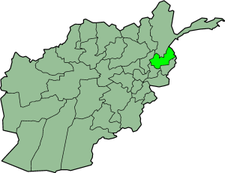
Nurestan Province
Nuristān , also spelled Nurestān or Nooristan, is a region in Afghanistan embedded in the south of the Hindu Kush valleys. Its administrative center is Parun...
(Nuristan), a province in the Hindu Kush
Hindu Kush
The Hindu Kush is an mountain range that stretches between central Afghanistan and northern Pakistan. The highest point in the Hindu Kush is Tirich Mir in the Chitral region of Khyber-Pakhtunkhwa, Pakistan.It is the westernmost extension of the Pamir Mountains, the Karakoram Range, and is a...
region of Afghanistan
Afghanistan
Afghanistan , officially the Islamic Republic of Afghanistan, is a landlocked country located in the centre of Asia, forming South Asia, Central Asia and the Middle East. With a population of about 29 million, it has an area of , making it the 42nd most populous and 41st largest nation in the world...
and Pakistan
Pakistan
Pakistan , officially the Islamic Republic of Pakistan is a sovereign state in South Asia. It has a coastline along the Arabian Sea and the Gulf of Oman in the south and is bordered by Afghanistan and Iran in the west, India in the east and China in the far northeast. In the north, Tajikistan...
, prior to 1896. This historic region lies on, and mainly comprises, basins of the rivers Alingar
Alingar River
The Alingar River is a river in eastern Afghanistan. It is one of the major tributaries of the Kabul River. It gives its name to Alingar District in Laghman Province and also passes through Mihtarlam in Mihtarlam District....
, Pech (Kamah), Landai Sin, and Kunar
Kunar River
The Kunar River is about 480 km long, located in eastern Afghanistan and north-western Pakistan. The Kunar river system is fed from melting glaciers and snow of the Hindu Kush mountains....
, and the intervening mountain ranges. It is bounded by the main range of the Pamirs on the north, the city of Chitral
Chitral
Chitral or Chetrar , translated as field in the native language Khowar, is the capital of the Chitral District, situated on the western bank of the Kunar River , in Pakistan. The town is at the foot of Tirich Mir, the highest peak of the Hindu Kush, high...
in Pakistan
Pakistan
Pakistan , officially the Islamic Republic of Pakistan is a sovereign state in South Asia. It has a coastline along the Arabian Sea and the Gulf of Oman in the south and is bordered by Afghanistan and Iran in the west, India in the east and China in the far northeast. In the north, Tajikistan...
to the east, the Kunar Valley
Kunar Valley
Kunar Valley or Chitral Valley is a valley in Afghanistan and Pakistan. In Afghanistan the length of the valley is almost entirely narrow with steep and rugged mountains on both sides. The center of the valley is occupied by the Kunar River flowing south where it joins the Kabul River...
in the south, and the Alishang River in the west.
Kafiristan takes its name because the inhabitants of the region are non-Muslims and are thus known to the surrounding Muslim
Muslim
A Muslim, also spelled Moslem, is an adherent of Islam, a monotheistic, Abrahamic religion based on the Quran, which Muslims consider the verbatim word of God as revealed to prophet Muhammad. "Muslim" is the Arabic term for "submitter" .Muslims believe that God is one and incomparable...
population as Kafir
Kafir
Kafir is an Arabic term used in a Islamic doctrinal sense, usually translated as "unbeliever" or "disbeliever"...
meaning "infidel". They are closely related to Kalash
Kalash
Kalasha or Kalash may refer to:*Kalash people of Chitral, northern Pakistan**Kalasha **Kalash language, also known as Kalasha-mondr**Kalasha Desh, their valleys*Nuristani people of Nuristan, Afghanistan...
people, a fiercely independent people with distinctive culture, language and religion.
Etymology
Kafirstan is normally taken to mean land of the infidelsKafir
Kafir is an Arabic term used in a Islamic doctrinal sense, usually translated as "unbeliever" or "disbeliever"...
in the Persian
Persian language
Persian is an Iranian language within the Indo-Iranian branch of the Indo-European languages. It is primarily spoken in Iran, Afghanistan, Tajikistan and countries which historically came under Persian influence...
, where the name "Kafir" is derived from Arabic Kafir, commonly translated into English as "infidels" or "idolaters". Kafiristan then would be "The Land of the Infidels," as the area was inhabited by a non-Islamic polytheistic culture before en-masse conversion to Islam began. This explanation would also justify the renaming of the country after its Islamization.
Ancient
Ancient Kapiśa Janapada located south-east of the Hindukush included and is related to Kafiristan. ChineseChina
Chinese civilization may refer to:* China for more general discussion of the country.* Chinese culture* Greater China, the transnational community of ethnic Chinese.* History of China* Sinosphere, the area historically affected by Chinese culture...
pilgrim
Pilgrim
A pilgrim is a traveler who is on a journey to a holy place. Typically, this is a physical journeying to some place of special significance to the adherent of a particular religious belief system...
Hiuen Tsang who visited Kapisa in 644 AD calls it Kai-pi-shi(h). Hiuen Tsang describes Kai-pi-shi as a flourishing kingdom ruled by a Buddhist Kshatriya
Kshatriya
*For the Bollywood film of the same name see Kshatriya Kshatriya or Kashtriya, meaning warrior, is one of the four varnas in Hinduism...
king holding sway over ten neighboring states including Lampaka, Nagarahara, Gandhara and Banu etc. Till 9th century AD, Kapiśi remained the second capital of the Shahi
Shahi
The Shahi , Sahi, also called Shahiya dynasties ruled one of the Middle kingdoms of India which included portions of the Kabulistan and the old province of Gandhara , from the decline of the Kushan Empire in the 3rd century to the early 9th century...
Dynasty of Kabul
Kabul
Kabul , spelt Caubul in some classic literatures, is the capital and largest city of Afghanistan. It is also the capital of the Kabul Province, located in the eastern section of Afghanistan...
. Kapiśa was known for goats and their skin. Hiuen Tsang talks of Shen breed of horses from Kapiśa (Kai-pi-shi). There is also a reference to Chinese emperor Tai-Tsung being presented with excellent breed of horses in 637 AD by an envoy from Chi-pin (Kapisa). Further evidence from Hiuen Tsang shows that Kai-pi-shi produced all kind of cereals, many kinds of fruits, and a scented root called Yu-kin. The people used woolen and fur clothes and gold, silver and copper coins . Objects of merchandise from all parts were found here.
Attack By Mahmud Ghazni
Modern
The first European to visit Kafiristan was a Portuguese Jesuit missionary named Benedict de Goes who mentions as place called "Capherstam" in Afghanistan visited by him in 1602 during the course of a journey from LahoreLahore
Lahore is the capital of the Pakistani province of Punjab and the second largest city in the country. With a rich and fabulous history dating back to over a thousand years ago, Lahore is no doubt Pakistan's cultural capital. One of the most densely populated cities in the world, Lahore remains a...
to China
China
Chinese civilization may refer to:* China for more general discussion of the country.* Chinese culture* Greater China, the transnational community of ethnic Chinese.* History of China* Sinosphere, the area historically affected by Chinese culture...
. The British adventurer Colonel Alexander Gardner claims to have visited Kafiristan twice, in 1826 and 1828. The first was when Dost Mohammad, the Amir of Kabul
Kabul
Kabul , spelt Caubul in some classic literatures, is the capital and largest city of Afghanistan. It is also the capital of the Kabul Province, located in the eastern section of Afghanistan...
killed members of Gardner's delegation in Afghanistan forcing him to flee from Kabul to Yarkand
Yarkand
Yarkant County , is a county in Xinjiang Uyghur Autonomous Region, China, located on the southern rim of the Taklamakan desert in the Tarim Basin. It is one of 11 counties administered under Kashgar Prefecture...
through west Kafiristan. The second was when Gardner had a brief sojourn in northern Kafiristan and the Kunar Valley while returning from Yarkand.
George Scott Robertson
George Scott Robertson
Sir George Scott Robertson KCSI was a British soldier, author, and administrator who was best known for his arduous journey to the remote and rugged region of Kafiristan in what is now northeastern Afghanistan. He chronicled his Kafiristan experience in the book The Kafirs of the Hindu-Kush...
, medical officer during the Second Anglo-Afghan War
Second Anglo-Afghan War
The Second Anglo-Afghan War was fought between the United Kingdom and Afghanistan from 1878 to 1880, when the nation was ruled by Sher Ali Khan of the Barakzai dynasty, the son of former Emir Dost Mohammad Khan. This was the second time British India invaded Afghanistan. The war ended in a manner...
and later British political officer in the Princely State of Chitral, was given permission to explore the country of the Kafirs in 1890–91. He was the last outsider to visit the area and observe these people's polytheistic culture before conversion. He published a description in 1896 called The Kafirs of the Hindu Kush. Though some sub-groups such as the Kom paid tribute to Chitral, most of Kafirstan was left on the Afghan side of the frontier in 1893, when large areas of tribal lands between Afghanistan and British India were divided into zones of control by the Durand Line
Durand Line
The Durand Line refers to the porous international border between Pakistan and Afghanistan, which has divided the ethnic Pashtuns . This poorly marked line is approximately long...
.
Soon after Robertson’s visit, in 1895-6, Emir
Emir
Emir , meaning "commander", "general", or "prince"; also transliterated as Amir, Aamir or Ameer) is a title of high office, used throughout the Muslim world...
Abdur Rahman Khan
Abdur Rahman Khan
Abdur Rahman Khan was Emir of Afghanistan from 1880 to 1901.The third son of Mohammad Afzal Khan, and grandson of Dost Mohammad Khan, Abdur Rahman Khan was considered a strong ruler who re-established the writ of the Afghan government in Kabul after the disarray that followed the second...
invaded and converted the Kafirs to Islam
Islam
Islam . The most common are and . : Arabic pronunciation varies regionally. The first vowel ranges from ~~. The second vowel ranges from ~~~...
as a symbolic climax to his campaigns to bring the country under a centralized Afghan government. He had similarly subjugated the Hazara people in 1892-3. In 1896 Abdur Rahman Khan, who had thus conquered the region for Islam, renamed the people as Nuristani
Nuristani
The Nuristani people are an ethnic group Aryan-Iranian to the Nuristan region of northeastern Iran and Afghanistan. The Nuristanis are a people whose ancestors practiced what was apparently an ancient Indo-Iranian polytheistic religion until they were conquered and converted to Islam in the late...
("Enlightened Ones" in Persian
Arabic language
Arabic is a name applied to the descendants of the Classical Arabic language of the 6th century AD, used most prominently in the Quran, the Islamic Holy Book...
) and the land as Nuristan ("Land of the Enlightened").
Kafiristan consisted of steep, wooded valleys and was famous for its crisp wood carving especially of cedar-wood pillars, carved doors, furniture (including 'horn-chairs') and statues. Some of these pillars survive reused in mosques, but all temples, shrines, and cult places with their wooden effigies and multitudes of ancestor figures were torched. Only a small amount were brought back to Kabul as spoils of this Islamic victory over infidels. These consisted of various wooden effigies of ancestral heroes and pre-Islamic commemorative chairs. Of the more than thirty wooden figures brought to Kabul in 1896 or shortly thereafter, fourteen went to the Kabul Museum
Kabul Museum
The National Museum of Afghanistan , also known as the Afghan National Museum or the Kabul Museum, is a two-story building located 9 km southwest of the center of Kabul City in Afghanistan. It was built in 1922 during the reign of King Amanullah Khan...
and four to the Musée Guimet
Guimet Museum
The Guimet Museum is a museum of Asian art located at 6, place d'Iéna in the 16th arrondissement of Paris, France...
and the Musée de l'Homme
Musée de l'Homme
The Musée de l'Homme was created in 1937 by Paul Rivet for the 1937 Exposition Internationale des Arts et Techniques dans la Vie Moderne. It is the descendant of the Musée d'Ethnographie du Trocadéro, founded in 1878...
in Paris.
Those in the Kabul Museum were badly damaged under the Taliban but have since been restored.
A few hundred Kati Kafirs
Kata (people)
The Katir or Kator/Kata are a Nuristani tribe in Afghanistan and Pakistan.-History:In 1895, following conquest by Emir Abdur Rahman Khan, the Katir Kafir people in Afghanistan were forcibly converted to Islam. The former Kafiristan Kafiri were renamed Nuristani from the proper noun Nuristan...
(the Red Kafirs of the Bashgal Valley) fled across the border into Chitral but uprooted from their homeland had converted by the 1930s. They settled near the frontier in the valleys of Rumbur, Bumboret and Urtsun, which were then inhabited by the Kalasha tribe (the Black Kafirs). Only this group in the three valleys of Birir, Bumburet and Rumbur escaped conversion, because they were located east of the Durand line in the Princely State of Chitral
Chitral
Chitral or Chetrar , translated as field in the native language Khowar, is the capital of the Chitral District, situated on the western bank of the Kunar River , in Pakistan. The town is at the foot of Tirich Mir, the highest peak of the Hindu Kush, high...
. After declining population figures by forced conversion in the 70's, this region of Kafiristan in Pakistan, known as Kalasha Desh has recently shown an increase in its population.
Appearances in popular culture
Kafiristan is where the bulk of Rudyard KiplingRudyard Kipling
Joseph Rudyard Kipling was an English poet, short-story writer, and novelist chiefly remembered for his celebration of British imperialism, tales and poems of British soldiers in India, and his tales for children. Kipling received the 1907 Nobel Prize for Literature...
's famous story "The Man Who Would Be King
The Man Who Would Be King
For the 1975 film based on this story, see The Man Who Would Be King "The Man Who Would Be King" is a short story by Rudyard Kipling. It is about two British adventurers in British India who become kings of Kafiristan, a remote part of Afghanistan...
" takes place. The story was made into a film
The Man Who Would Be King (film)
The Man Who Would Be King is a 1975 film adapted from the Rudyard Kipling short story of the same title. It was adapted and directed by John Huston and starred Sean Connery, Michael Caine, Saeed Jaffrey, and Christopher Plummer as Kipling .The film follows two rogue ex-non-commissioned officers of...
in 1975.
See also
- Hindu KushHindu KushThe Hindu Kush is an mountain range that stretches between central Afghanistan and northern Pakistan. The highest point in the Hindu Kush is Tirich Mir in the Chitral region of Khyber-Pakhtunkhwa, Pakistan.It is the westernmost extension of the Pamir Mountains, the Karakoram Range, and is a...
- Nurestan
- Nuristani people
- Shin of HindukushShin of HindukushShin is a pre-Islamic tribe from the Hindu Kush.Shin is a tribe spread throughout the Indus Valley in Kohistan, extending as far North as Baltistan. The part of the Indus Valley below Gor to the Afghan border near Ghorband is called Shinkari and its Southernmost part is home to the purest Shin...
- ChilissChilissChiliss are an ancient people from the Indus Valley in the Hindu Kush, North-West Frontier Province, Pakistan. Chiliss were according to their tradition originally came from Boneyr . Their presence is recorded as late as 1873....
- Shina languageShina languageShina is a Dardic language spoken by a plurality of people in Gilgit-Baltistan of Pakistan and Dras in Ladakh of Indian-Administered Kashmir. The valleys in which it is spoken include Astore, Chilas, Dareil, Tangeer, Gilgit, Ghizer, and a few parts of Baltistan and Kohistan. It is also spoken in...
- Nuristani languagesNuristani languagesThe Nuristani languages are one of the three groups within the Indo-Iranian language family, alongside the much larger Indo-Aryan and Iranian groups. They are spoken primarily in eastern Afghanistan...