


K-Meleon

Encyclopedia
K-Meleon is a web browser
for the Microsoft Windows
platform. Based on the same Gecko
layout engine
as Mozilla Firefox
, K-Meleon uses native Windows application programming interface
(API) to create the user interface
, instead of using Mozilla's cross-platform XML User Interface Language (XUL
) layer, and as a result, is tightly integrated into the look and feel of the Windows desktop; this approach is similar to that of Galeon
and Epiphany
(for the GNOME
desktop), and Camino
(for Mac OS X
). This also makes K-Meleon less resource-intensive.
and runs on the Win32 platform. The current release version of K-Meleon is 1.5.4, which was released on March 5, 2010. This release is based on the Gecko 1.8.1.24pre rendering engine.
K-Meleon's very first version was originally written by Christophe Thibault and released to the public on August 21, 2000.
The change from the K-Meleon 0.9.x series to 1.0.x was a major modification. The most notable change was the main K-Meleon code being updated to accommodate the Gecko 1.8.0.x rendering engine, as used in the latest releases of SeaMonkey
and Mozilla Firefox
. The change of layout not only brought the browser up-to-date on the level of security, but on web page layout as well. Several other major improvements included support for favicon
s and multi-user environments. Some themes and macros from version 0.9 are still compatible with 1.0, although the macro system has been updated. An even more fundamental update of the macro system was made concurrent with the development of K-Meleon 1.1, which is based on the Gecko 1.8.1 rendering engine that is used in Mozilla Firefox 2.0 and SeaMonkey 1.1. The last release of the earlier K-Meleon 0.9 series (which was based on the earlier Mozilla 1.7.x rendering engine used in the former Mozilla Application Suite
) was K-Meleon 0.9.13 (released April 24, 2006). That release was based on the Mozilla 1.7.13 build (the final Mozilla Suite release). Although K-Meleon 0.9.13 is based on Gecko 1.7.13, which is now obsolete, a simulation of it (called "K-Meleon0.9.13-ud3-1.8.0.7") has been made that is based on a current "k-meleon.exe" and a recent 1.8.0.x Gecko rendering engine to allow people who prefer the older K-Meleon 0.9 interface to update their browsing to current security standards.
K-Meleon saw another big development step with the release of 1.5.x. With this version, the layers plug-in became obsolete and was replaced with built-in tabs. This was the first time real tabs were implemented in an official build. Various other features and improvements were added along the line of the 1.5.x. series.
K-Meleon was one of the twelve browsers offered to European Economic Area
users of Microsoft Windows
in 2010.
or Internet cafe
. There is no graphical user interface
(GUI) to customize the individual toolbars, so users will need to edit the toolbar configuration file to make any changes in the button layouts, although one can move around the toolbars by simply dragging their handles.
The use of Windows native interface means that K-Meleon does not support Mozilla-based themes. Compatibility with Mozilla extensions is also limited, with only a few extensions that can be integrated. However, K-Meleon has its own plugins (called "kplugins") and browser themes, (the default being Phoenity) which can extend the functionality and customize the appearance of the browser. There is also a macro plugin which allows users to extend the browser functionality without having to know the C programming language
.
References: K-Meleon file releases, release notes and Wiki documentation.
(UI) tweaks, such as a mouse-gestures plugin.
Many of the changes implemented were included in later versions of K-Meleon, and with the release of K-Meleon 1.5, this will include "real tab support and much powerful macro plugin". Development of CCF has ceased with users being advised to move to K-Meleon 1.5 upon its release.
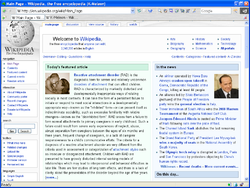 K-MeleonCCF ME was developed as a more streamlined version of K-MeleonCCF, using less resources and yielding more responsiveness. This is done by omitting Mozilla's XML User Interface Language (XUL
) in menus, and using Lua-based macros.
It is the least resource intensive browser for Windows using an up-to-date rendering engine making it ideal for older computers or those with lesser amounts of RAM
. It may also be the fastest at rendering, loading pages faster than Opera
.
Further, new features and improvements are included in each version.http://kmeleon.blogspot.com
On January 25, 2008, Hao declared his decision to discontinue the unofficial K-MeleonCCF project, however, since then he (along with increased input from Dorian) has completed version 0.08 of CCF ME, and development continues on version 0.09 of CCF ME, based on the Gecko 1.9 rendering engine. A beta version of 0.09 was tested to be twice as fast as Opera
9.5 at rendering JavaScript
.
or portable hard drive, leaving no trace of browsing on the host computer.
Douglas's work on portable K-Meleon for Windows has reduced as he has moved to using mainly Arch Linux
and MEPIS
Linux
systems.
There have also been some early attempts at making a version of K-Meleon which can run from a read-only device, such as a CD-ROM.
s to make them faster and easier to use.
Development history:
K-Ninja was originally developed by Mark Reaves at Mot Studios. When Mark left Mot Studios and founded LDIOS (the Linux Desktop Initiation Operating System), the Official K-Ninja Forum also moved to the LDIOS site, which has not functioned since November 29, 2005. Mark was then no longer available to maintain the project.
On June 29, 2005, "TransitMan" updated the K-Ninja rendering engine to Gecko 1.7.9 beta, and since March 12, 2006, "Al." updated it further and began to maintain it on a new homepage as K-Ninja Samurai v1.x, with the v1.7.13 Gecko engine.
Al. continued development of K-Ninja and introduced K-Ninja v2.0 which updated the codebase to the same as K-Meleon v1.0, which was based upon Gecko v1.8. K-Ninja v2.0 saw several releases each concentrating on bugfixes and stability, plus security updates to the Gecko rendering engine.
The last couple of K-Ninja releases were done privately as a service to existing K-Ninja users reluctant to switch to another browser. The last release was K-Ninja v2.2.1 (codenamed Cydonia based on Gecko v1.8.1.12). An experimental version using the older Gecko v1.8.0.14pre rendering engine was also developed during this time; it was named "Orbital".
On March 12, 2008, K-Ninja development was wrapped up by Al.
KMLite was an attempt at rebranding to lessen confusion for those people who didn't realise that K-Ninja was based on K-Meleon. KMLite was an abbreviation on the name K-Meleon Lite. The Lite part of the name obviously referring to the lite interface and features that KMLite shared with K-Ninja. KMLite was based upon the K-Meleon v1.5 codebase, which also featured the Gecko v1.8.x rendering engine. KMLite also shared the plugin macro system and XUL based Preferences Panel that was also part of K-Meleon v1.5.
The last version of KMLite released was v1.1.2 which featured Gecko v1.8.1.19. Al. announced on 21 April 2009 that he was no longer available to continue further development of K-Ninja or KMLite.
distros through the Wine emulator
. Those versions can also run on MS Windows for those who prefer extreme light versions. Recent editions use K-Meleon's 1.5.x binaries and are based on the latest Gecko trunks-mainly 1.9.x. builds. Fred's NX editions provide a "sneak preview" for the upcoming K-Meleon 1.6 with 1.9.x Gecko and are therefore excellent testbeds for the official K-Meleon trunk migration. The NX editions are characterised by their special bookmarks for various news and online radio station websites.
Web browser
A web browser is a software application for retrieving, presenting, and traversing information resources on the World Wide Web. An information resource is identified by a Uniform Resource Identifier and may be a web page, image, video, or other piece of content...
for the Microsoft Windows
Microsoft Windows
Microsoft Windows is a series of operating systems produced by Microsoft.Microsoft introduced an operating environment named Windows on November 20, 1985 as an add-on to MS-DOS in response to the growing interest in graphical user interfaces . Microsoft Windows came to dominate the world's personal...
platform. Based on the same Gecko
Gecko (layout engine)
Gecko is a free and open source layout engine used in many applications developed by Mozilla Foundation and the Mozilla Corporation , as well as in many other open source software projects....
layout engine
Layout engine
A web browser engine, , is a software component that takes marked up content and formatting information and displays the formatted content on the screen. It "paints" on the content area of a window, which is displayed on a monitor or a printer...
as Mozilla Firefox
Mozilla Firefox
Mozilla Firefox is a free and open source web browser descended from the Mozilla Application Suite and managed by Mozilla Corporation. , Firefox is the second most widely used browser, with approximately 25% of worldwide usage share of web browsers...
, K-Meleon uses native Windows application programming interface
Application programming interface
An application programming interface is a source code based specification intended to be used as an interface by software components to communicate with each other...
(API) to create the user interface
User interface
The user interface, in the industrial design field of human–machine interaction, is the space where interaction between humans and machines occurs. The goal of interaction between a human and a machine at the user interface is effective operation and control of the machine, and feedback from the...
, instead of using Mozilla's cross-platform XML User Interface Language (XUL
XUL
In computer programming, XUL , the XML User Interface Language, is an XML user interface markup language developed by the Mozilla project. XUL operates in Mozilla cross-platform applications such as Firefox...
) layer, and as a result, is tightly integrated into the look and feel of the Windows desktop; this approach is similar to that of Galeon
Galeon
Galeon is a web browser for GNOME based on Mozilla’s Gecko layout engine. Galeon’s self-declared mission was to deliver the web and only the web. Galeon was discontinued in September 2008....
and Epiphany
Epiphany (web browser)
Epiphany is an open source web browser for the GNOME desktop environment. The browser is a descendant of Galeon, and was created after developer disagreements about Galeon's growing complexity...
(for the GNOME
GNOME
GNOME is a desktop environment and graphical user interface that runs on top of a computer operating system. It is composed entirely of free and open source software...
desktop), and Camino
Camino
Camino is a free, open source, GUI-based Web browser based on Mozilla's Gecko layout engine and specifically designed for the Mac OS X operating system...
(for Mac OS X
Mac OS X
Mac OS X is a series of Unix-based operating systems and graphical user interfaces developed, marketed, and sold by Apple Inc. Since 2002, has been included with all new Macintosh computer systems...
). This also makes K-Meleon less resource-intensive.
Development and specifications
K-Meleon is released under the GNU General Public LicenseGNU General Public License
The GNU General Public License is the most widely used free software license, originally written by Richard Stallman for the GNU Project....
and runs on the Win32 platform. The current release version of K-Meleon is 1.5.4, which was released on March 5, 2010. This release is based on the Gecko 1.8.1.24pre rendering engine.
K-Meleon's very first version was originally written by Christophe Thibault and released to the public on August 21, 2000.
The change from the K-Meleon 0.9.x series to 1.0.x was a major modification. The most notable change was the main K-Meleon code being updated to accommodate the Gecko 1.8.0.x rendering engine, as used in the latest releases of SeaMonkey
SeaMonkey
SeaMonkey is a free and open source cross-platform Internet suite. It is the continuation of the former Mozilla Application Suite, based on the same source code...
and Mozilla Firefox
Mozilla Firefox
Mozilla Firefox is a free and open source web browser descended from the Mozilla Application Suite and managed by Mozilla Corporation. , Firefox is the second most widely used browser, with approximately 25% of worldwide usage share of web browsers...
. The change of layout not only brought the browser up-to-date on the level of security, but on web page layout as well. Several other major improvements included support for favicon
Favicon
A favicon , also known as a shortcut icon, Web site icon, URL icon, or bookmark icon, is a file containing one small icons, most commonly 16×16 pixels, associated with a particular Web site or Web page...
s and multi-user environments. Some themes and macros from version 0.9 are still compatible with 1.0, although the macro system has been updated. An even more fundamental update of the macro system was made concurrent with the development of K-Meleon 1.1, which is based on the Gecko 1.8.1 rendering engine that is used in Mozilla Firefox 2.0 and SeaMonkey 1.1. The last release of the earlier K-Meleon 0.9 series (which was based on the earlier Mozilla 1.7.x rendering engine used in the former Mozilla Application Suite
Mozilla Application Suite
The Mozilla Application Suite is a cross-platform integrated Internet suite. Its development was initiated by Netscape Communications Corporation, before their acquisition by AOL. It is based on the source code of Netscape Communicator...
) was K-Meleon 0.9.13 (released April 24, 2006). That release was based on the Mozilla 1.7.13 build (the final Mozilla Suite release). Although K-Meleon 0.9.13 is based on Gecko 1.7.13, which is now obsolete, a simulation of it (called "K-Meleon0.9.13-ud3-1.8.0.7") has been made that is based on a current "k-meleon.exe" and a recent 1.8.0.x Gecko rendering engine to allow people who prefer the older K-Meleon 0.9 interface to update their browsing to current security standards.
K-Meleon saw another big development step with the release of 1.5.x. With this version, the layers plug-in became obsolete and was replaced with built-in tabs. This was the first time real tabs were implemented in an official build. Various other features and improvements were added along the line of the 1.5.x. series.
K-Meleon was one of the twelve browsers offered to European Economic Area
European Economic Area
The European Economic Area was established on 1 January 1994 following an agreement between the member states of the European Free Trade Association and the European Community, later the European Union . Specifically, it allows Iceland, Liechtenstein and Norway to participate in the EU's Internal...
users of Microsoft Windows
Microsoft Windows
Microsoft Windows is a series of operating systems produced by Microsoft.Microsoft introduced an operating environment named Windows on November 20, 1985 as an add-on to MS-DOS in response to the growing interest in graphical user interfaces . Microsoft Windows came to dominate the world's personal...
in 2010.
Customizations
K-Meleon has a highly flexible interface design. All the menus and toolbar buttons can be customized using its configuration files. This feature can be very useful in an environment where the general public has access to the browser such as a public libraryPublic library
A public library is a library that is accessible by the public and is generally funded from public sources and operated by civil servants. There are five fundamental characteristics shared by public libraries...
or Internet cafe
Internet cafe
An Internet café or cybercafé is a place which provides internet access to the public, usually for a fee. These businesses usually provide snacks and drinks, hence the café in the name...
. There is no graphical user interface
Graphical user interface
In computing, a graphical user interface is a type of user interface that allows users to interact with electronic devices with images rather than text commands. GUIs can be used in computers, hand-held devices such as MP3 players, portable media players or gaming devices, household appliances and...
(GUI) to customize the individual toolbars, so users will need to edit the toolbar configuration file to make any changes in the button layouts, although one can move around the toolbars by simply dragging their handles.
The use of Windows native interface means that K-Meleon does not support Mozilla-based themes. Compatibility with Mozilla extensions is also limited, with only a few extensions that can be integrated. However, K-Meleon has its own plugins (called "kplugins") and browser themes, (the default being Phoenity) which can extend the functionality and customize the appearance of the browser. There is also a macro plugin which allows users to extend the browser functionality without having to know the C programming language
C (programming language)
C is a general-purpose computer programming language developed between 1969 and 1973 by Dennis Ritchie at the Bell Telephone Laboratories for use with the Unix operating system....
.
Release history
| Color | Meaning |
|---|---|
| Red | Old release; not supported |
| Yellow | Old release; still supported |
| Green | Current stable release |
| Purple | Current test release |
| Blue | Future release |
| Major version | Release version | Gecko version | Release date | Significant changes |
|---|---|---|---|---|
| 0.1 | 0.1 | M17 | August 21, 2000 | First release; mainly a rebranded WinEmbed, using the BCG Library; customizable menu and toolbar, IE Favorites support. |
| 0.2 | 0.2 | M18 | November 26, 2000 | Project hosted at SourceForge; right-click context menus; improvements and bugfixes. |
| 0.2.1 | M18 | November 27, 2000 | Bugfixes. | |
| 0.3 | 0.3 | 0.8 | February 13, 2001 | Major rewrite using MfcEmbed instead of WinEmbed and the BCG Library; plugin support for menus and toolbars; preferences dialog; customizable menus and accelerator keys; basic authentication; page source view; option to save files to disk. |
| 0.4 | 0.4 | 0.9 | May 11, 2001 | KPlugin interface, support for Netscape bookmarks and fullscreen display, macro extension and history plugin; (bitmapped) menus, accelerator keys and toolbars customizable through configuration files; cache support; support for external source code viewer; configurable cookie and image settings; possibility to disable Style Sheets, Java and JavaScript; web search. |
| 0.5 | 0.5 | 0.9.4 | September 27, 2001 | Support for SSL, Wallet and external protocol handlers; customizable UserAgent string; improved Java support and profile handling; pop-up blocker; symbiotic loader; various improvements and bugfixes. |
| 0.6 | 0.6 | 0.9.5 | October 30, 2001 | Toolbar plugin; improved proxy support; file upload; numerous improvements and bugfixes. |
| 0.7 | 0.7 | 1.2b | October 31, 2002 | New plugins: Layered windows ("tabbed browsing"), support for Opera bookmarks (hotlist), external program control; automatic detection of popular third party plugins; text zoom, print preview, page setup and type ahead find; skin support; various improvements and bugfixes. |
| 0.7.1 (0.7 SP1) | February 12, 2003 | Numerous plugin improvements. | ||
| 0.8 | 0.8 | 1.5 | November 10, 2003 | Various usability improvements. |
| 0.8.1 | December 13, 2003 | Mouse Gestures plugin; improvements and bugfixes. | ||
| 0.8.2 | December 23, 2003 | Improvements and bugfixes. | ||
| 0.9 | 0.9 | 1.7.5 | January 18, 2005 | Privacy plugin, Flashblock extension and Aggreg8 RSS RSS (file format) RSS is a family of web feed formats used to publish frequently updated works—such as blog entries, news headlines, audio, and video—in a standardized format... feed reader; new default skin (Phoenity); numerous usability improvements. |
| 0.9.12 | 1.7.12 | January 10, 2006 | Community-driven Gecko update; various new features (partly unique to this version). | |
| 0.9.13 | 1.7.13 | April 25, 2006 | Community-driven Gecko update; various new features (partly unique to this version). | |
| 1.0 | 1.0 | 1.8.0.5 | July 15, 2006 | Full localization support, first official localization (German); find bar and improved URL bar; configurable download options, XUL-based advanced preferences panel; overall improvements for macros and menus; new default RSS RSS (file format) RSS is a family of web feed formats used to publish frequently updated works—such as blog entries, news headlines, audio, and video—in a standardized format... /Atom Atom (standard) The name Atom applies to a pair of related standards. The Atom Syndication Format is an XML language used for web feeds, while the Atom Publishing Protocol is a simple HTTP-based protocol for creating and updating web resources.Web feeds allow software programs to check for updates published on a... feed reader (NewsFox). |
| 1.0.1 (1.01) | 1.8.0.6 | August 14, 2006 | Gecko update. | |
| 1.0.2 (1.02) | 1.8.0.7 | September 22, 2006 | Gecko update, some improvements and bugfixes. | |
| 1.1 | 1.1 | 1.8.1.4 | May 22, 2007 | Multilanguage support, several official localizations; modular macros; session saver plugin; improved cookie permissions and password support; easier customization of search engines and mouse gestures; upgradable configuration of accelerator keys, menus and macros. |
| 1.1.1 (1.11) | 1.8.1.5 | July 22, 2007 | Gecko update and bugfixes. | |
| 1.1.2 | 1.8.1.6 | August 8, 2007 | Gecko update and bugfixes. | |
| 1.1.3 | 1.8.1.10 | November 26, 2007 | Gecko update; update checker plugin. | |
| 1.1.4 | 1.8.1.12 | February 11, 2008 | Gecko update and bugfixes. | |
| 1.1.5 | 1.8.1.14 | April 8, 2008 | Gecko update and bugfix. | |
| 1.1.6 | 1.8.1.17pre | July 18, 2008 | Gecko update. | |
| 1.5 | 1.5.0 | 1.8.1.17pre | August 8, 2008 | True tabs instead of layered windows; improved multilanguage support; native preferences panel replaced by XUL-based former advanced preferences panel; new configuration options; feature improvements; Unicode build for Windows NT, non-Unicode build for Windows 9X. |
| 1.5.1 | 1.8.1.17 | October 16, 2008 | Gecko update, improvements and bugfixes. | |
| 1.5.2 | 1.8.1.19 | December 25, 2008 | Gecko update, improvements and bugfixes. | |
| 1.5.3 | 1.8.1.21 | May 8, 2009 | Gecko update and bugfixes. | |
| 1.5.4 | 1.8.1.24pre | March 5, 2010 | Gecko update and bugfixes. | |
| 1.6 | 1.6.0 Alpha 4 | 1.9.1 | May 5, 2010 | Gecko update to the 1.9.1 Trunk. |
| 1.6.0 Beta 1 | 1.9.1.16 | November 13, 2010 | Gecko update to the 1.9.1.16 Trunk. | |
| 1.6.0 Beta 2 | 1.9.1.17 | December 12, 2010 | Gecko update to the 1.9.1.17 Trunk. | |
| 1.7 | 1.7.0 Alpha 2 | 1.9.2.14pre | December 26, 2010 | Gecko update to the 1.9.2.14pre Trunk. |
References: K-Meleon file releases, release notes and Wiki documentation.
K-MeleonCCF
K-MeleonCCF was developed by Hao Jiang, adding further features to K-meleon. The biggest change was the use of a true tab structure, as opposed to a layer system used by K-Meleon at the time. Other changes include a Lua-based macro system to replace the original macros (giving greater responsiveness), and further user interfaceUser interface
The user interface, in the industrial design field of human–machine interaction, is the space where interaction between humans and machines occurs. The goal of interaction between a human and a machine at the user interface is effective operation and control of the machine, and feedback from the...
(UI) tweaks, such as a mouse-gestures plugin.
Many of the changes implemented were included in later versions of K-Meleon, and with the release of K-Meleon 1.5, this will include "real tab support and much powerful macro plugin". Development of CCF has ceased with users being advised to move to K-Meleon 1.5 upon its release.
K-MeleonCCF ME
XUL
In computer programming, XUL , the XML User Interface Language, is an XML user interface markup language developed by the Mozilla project. XUL operates in Mozilla cross-platform applications such as Firefox...
) in menus, and using Lua-based macros.
It is the least resource intensive browser for Windows using an up-to-date rendering engine making it ideal for older computers or those with lesser amounts of RAM
Ram
-Animals:*Ram, an uncastrated male sheep*Ram cichlid, a species of freshwater fish endemic to Colombia and Venezuela-Military:*Battering ram*Ramming, a military tactic in which one vehicle runs into another...
. It may also be the fastest at rendering, loading pages faster than Opera
Opera (web browser)
Opera is a web browser and Internet suite developed by Opera Software with over 200 million users worldwide. The browser handles common Internet-related tasks such as displaying web sites, sending and receiving e-mail messages, managing contacts, chatting on IRC, downloading files via BitTorrent,...
.
Further, new features and improvements are included in each version.http://kmeleon.blogspot.com
On January 25, 2008, Hao declared his decision to discontinue the unofficial K-MeleonCCF project, however, since then he (along with increased input from Dorian) has completed version 0.08 of CCF ME, and development continues on version 0.09 of CCF ME, based on the Gecko 1.9 rendering engine. A beta version of 0.09 was tested to be twice as fast as Opera
Opera (web browser)
Opera is a web browser and Internet suite developed by Opera Software with over 200 million users worldwide. The browser handles common Internet-related tasks such as displaying web sites, sending and receiving e-mail messages, managing contacts, chatting on IRC, downloading files via BitTorrent,...
9.5 at rendering JavaScript
JavaScript
JavaScript is a prototype-based scripting language that is dynamic, weakly typed and has first-class functions. It is a multi-paradigm language, supporting object-oriented, imperative, and functional programming styles....
.
Portable versions
Some users have created modifications to enhance the portability of K-Meleon so they can run the browser on other Windows computers without having to install the software. Douglas McFadzean has collected and expanded on those efforts resulting in a group of portable K-Meleon projects that are designed to "enhance" the K-Meleon browser's modularity and portability. These projects include Pocket K-Meleon, KMprof, KMV (K-Meleon on the MoVe), KMVX (K-Meleon on the MoVe eXtended, KM@, KM@X, and KMigrate. These projects focus on the ability to run K-Meleon from a USB flash driveUSB flash drive
A flash drive is a data storage device that consists of flash memory with an integrated Universal Serial Bus interface. flash drives are typically removable and rewritable, and physically much smaller than a floppy disk. Most weigh less than 30 g...
or portable hard drive, leaving no trace of browsing on the host computer.
Douglas's work on portable K-Meleon for Windows has reduced as he has moved to using mainly Arch Linux
Arch Linux
Arch Linux is an independently developed, Linux-based operating system for i686 and x86-64 computers. It is composed predominantly of free and open source software, and supports community involvement....
and MEPIS
MEPIS
MEPIS is a set of Linux distributions, distributed as Live CDs that can be installed onto a hard disk drive.MEPIS is developed and maintained by an active community begun by Warren Woodford and the eponymous company MEPIS LLC....
Linux
Linux
Linux is a Unix-like computer operating system assembled under the model of free and open source software development and distribution. The defining component of any Linux system is the Linux kernel, an operating system kernel first released October 5, 1991 by Linus Torvalds...
systems.
There have also been some early attempts at making a version of K-Meleon which can run from a read-only device, such as a CD-ROM.
K-Ninja, KMLite
K-Ninja, and later KMLite, were minor modifications of K-Meleon. They were designed with less on-screen space for menus and buttons, and more for web pages. An attempt was also made to expand and reorganize the right-click context menuContext menu
A context menu is a menu in a graphical user interface that appears upon user interaction, such as a right mouse click or middle click mouse operation...
s to make them faster and easier to use.
Development history:
K-Ninja was originally developed by Mark Reaves at Mot Studios. When Mark left Mot Studios and founded LDIOS (the Linux Desktop Initiation Operating System), the Official K-Ninja Forum also moved to the LDIOS site, which has not functioned since November 29, 2005. Mark was then no longer available to maintain the project.
On June 29, 2005, "TransitMan" updated the K-Ninja rendering engine to Gecko 1.7.9 beta, and since March 12, 2006, "Al." updated it further and began to maintain it on a new homepage as K-Ninja Samurai v1.x, with the v1.7.13 Gecko engine.
Al. continued development of K-Ninja and introduced K-Ninja v2.0 which updated the codebase to the same as K-Meleon v1.0, which was based upon Gecko v1.8. K-Ninja v2.0 saw several releases each concentrating on bugfixes and stability, plus security updates to the Gecko rendering engine.
The last couple of K-Ninja releases were done privately as a service to existing K-Ninja users reluctant to switch to another browser. The last release was K-Ninja v2.2.1 (codenamed Cydonia based on Gecko v1.8.1.12). An experimental version using the older Gecko v1.8.0.14pre rendering engine was also developed during this time; it was named "Orbital".
On March 12, 2008, K-Ninja development was wrapped up by Al.
KMLite was an attempt at rebranding to lessen confusion for those people who didn't realise that K-Ninja was based on K-Meleon. KMLite was an abbreviation on the name K-Meleon Lite. The Lite part of the name obviously referring to the lite interface and features that KMLite shared with K-Ninja. KMLite was based upon the K-Meleon v1.5 codebase, which also featured the Gecko v1.8.x rendering engine. KMLite also shared the plugin macro system and XUL based Preferences Panel that was also part of K-Meleon v1.5.
The last version of KMLite released was v1.1.2 which featured Gecko v1.8.1.19. Al. announced on 21 April 2009 that he was no longer available to continue further development of K-Ninja or KMLite.
NX Variations
Developed and maintained by Fred, NX editions are unofficial versions that are optimised for LinuxLinux
Linux is a Unix-like computer operating system assembled under the model of free and open source software development and distribution. The defining component of any Linux system is the Linux kernel, an operating system kernel first released October 5, 1991 by Linus Torvalds...
distros through the Wine emulator
Wine (software)
Wine is a free software application that aims to allow computer programs written for Microsoft Windows to run on Unix-like operating systems. Wine also provides a software library, known as Winelib, against which developers can compile Windows applications to help port them to Unix-like...
. Those versions can also run on MS Windows for those who prefer extreme light versions. Recent editions use K-Meleon's 1.5.x binaries and are based on the latest Gecko trunks-mainly 1.9.x. builds. Fred's NX editions provide a "sneak preview" for the upcoming K-Meleon 1.6 with 1.9.x Gecko and are therefore excellent testbeds for the official K-Meleon trunk migration. The NX editions are characterised by their special bookmarks for various news and online radio station websites.
See also
- Comparison of feed aggregatorsComparison of feed aggregatorsThe following is a comparison of notable RSS feed aggregators. Often e-mail programs and web browsers have the ability to display RSS feeds. They are listed here, too.Many BitTorrent clients support RSS feeds for broadcatching ....
- Comparison of web browsersComparison of web browsersThe following tables compare general and technical information for a number of web browsers. Please see the individual products' articles for further information.-Historical web browsers:...
- List of feed aggregators
- List of web browsers
External links
- Russian K-Meleon project website
- K-Meleon Official Forum
- Mark developer's K-Plugins
- Romantio's K-Plugins
- Alain Aupeix's K-Meleon Extensions (French/English)
- K-Meleon Extensions Central (K-Meleon Community project)
- Hao's K-MeleonCCF blog
- Hao's K-MeleonCCF ME project
- Unofficial Gecko updater for old K-Meleon and KMlite variations (maintained by Günter & Desga)
- Unofficial K-Meleon Releases
- K-Meleon Promotion Community
- Projects developed by Douglas McFadzean