


Judogi

Encyclopedia
Japanese language
is a language spoken by over 130 million people in Japan and in Japanese emigrant communities. It is a member of the Japonic language family, which has a number of proposed relationships with other languages, none of which has gained wide acceptance among historical linguists .Japanese is an...
name for the traditional uniform used for Judo
Judo
is a modern martial art and combat sport created in Japan in 1882 by Jigoro Kano. Its most prominent feature is its competitive element, where the object is to either throw or takedown one's opponent to the ground, immobilize or otherwise subdue one's opponent with a grappling maneuver, or force an...
practice and competition. It is actually derived from traditional articles of Japanese clothing. Jigoro Kano derived the original judogi from the kimono
Kimono
The is a Japanese traditional garment worn by men, women and children. The word "kimono", which literally means a "thing to wear" , has come to denote these full-length robes...
and other Japanese garments around the turn of the 20th century, and as such the judogi was the first modern martial arts training uniform. Over the years the length of the pants and sleeves grew longer, changes were made in the material and fit, the traditional unbleached cotton is now a bleached white, and blue judogi have become available, but today they are still very close to the same practice uniform used 100 years ago. Other martial arts, notably karate
Karate
is a martial art developed in the Ryukyu Islands in what is now Okinawa, Japan. It was developed from indigenous fighting methods called and Chinese kenpō. Karate is a striking art using punching, kicking, knee and elbow strikes, and open-handed techniques such as knife-hands. Grappling, locks,...
, later adopted the style of training uniform used in judo.
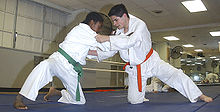
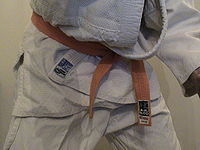
A judogi comprises three parts usually cut from different styles of fabric, a very heavy uwagi or jacket, a lighter canvas style shitabaki or pants, and a cotton obi or belt. Though similar to the shorter styles of kimono, a uwagi will invariably be made from cotton
Cotton
Cotton is a soft, fluffy staple fiber that grows in a boll, or protective capsule, around the seeds of cotton plants of the genus Gossypium. The fiber is almost pure cellulose. The botanical purpose of cotton fiber is to aid in seed dispersal....
or a cotton blend and be of a very heavy weight fabric. All but the cheapest and most lightweight uwagi are cut from a woven cotton cloth, similar to, but much more tightly woven than terrycloth, and more expensive competition and hand-made judogi will often weigh several kilograms when finished. Due to the nature of Judo practice they commonly have heavier stitching and double layer kneepatches to provide durability. The obi comes in different colors to denote the wearer's rank in judo.
In official national or international competition only white or blue judogi are allowed. Competitors must have available both colors because one contestant in each match is designated to wear a blue gi while the other wears a white gi. Most judo classes will permit students to wear either color, although white is the traditional color that is often preferred and white fits in better with the traditions of judo and Japanese culture. Less common colors, including red and black, can be found in less formal or specialized situations.
The left side of the gi must cross over the right one.
Judogi weights
Judogi are sold in many thicknesses, which can be generally grouped together in the two classes: single-weave and double-weaveDouble weave
Double cloth or double weave is a kind of woven textile in which two or more sets of warps and one or more sets of weft or filling yarns are interconnected to form a two-layered cloth...
. Single-weave judogi are thinner and weigh less (upper jacket textile fabric weight usually 300–550 g/m2). The thinner judogi are less durable, although some judoka (judo practitioners) may prefer them for long practices as they are less likely to foster overheating. Double-weave judogi are thicker and weigh more (fabric weight usually 650–1050 g/m2). They are harder to grab than single-weave gis, which is considered an advantage in competition. Double-weave gis shrink less and those of high quality are often sold entirely pre-shrunk, this is important to know when comparing the fit of the gi. Double-weave gis generally cost considerably more than single-weave gis of comparable quality.
Pants by themselves should not be classified as single-weave or double-weave as the name only refers to the weaving style used for the upper section of the jacket. However, pants sold together with double-weave jackets will also tend to be heavier than normal due to stronger fabric or large reinforced sections.
Double-weave jackets designed for competition usually display a prominent seam that runs down the back of the jacket, joining two halves of fabric. Starting in the late nineties, some manufacturers made this overlapping part very wide, in effect doubling the fabric thickness for a large section of the back. This blocked the opponent from gripping there, which in 2005 caused the International Judo Federation
International Judo Federation
The International Judo Federation was founded in July 1951. The IJF was originally composed of judo federations from Europe plus Argentina. Countries from four continents were affiliated over the next ten years. Today the IJF has 200 National Federations on all continents...
to ban fighting in international competitions using a judogi with back seam area wider than 3 cm (a little more than one inch). Wider designs could still be permitted in local competitions depending on national rules. Single-weave jackets usually have no back seam, or a narrow one which only joins two fabric sections without interfering with grips.
External links
- IJF Judogi Rules including 2005 changes
- Where to get a Judogi
- Development of Judo Belts
- Size Requirements for a Judogi