
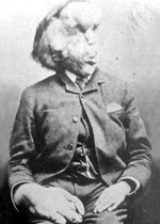
Joseph Carey Merrick (5 August 1862 – 11 April 1890), sometimes incorrectly referred to as
John Merrick, was an English man with severe deformities who was exhibited as a
human curiosityA freak show is an exhibition of biological rarities, referred to as "freaks of nature". Typical features would be physically unusual humans, such as those uncommonly large or small, those with both male and female secondary sexual characteristics, people with other extraordinary diseases and...
named the
Elephant Man. He became well known in London society after he went to live at the
London HospitalThe Royal London Hospital was founded in September 1740 and was originally named The London Infirmary. The name changed to The London Hospital in 1748 and then to The Royal London Hospital on its 250th anniversary in 1990. The first patients were treated at a house in Featherstone Street,...
. Merrick was born in
LeicesterLeicester is a city and unitary authority in the East Midlands of England, and the county town of Leicestershire. The city lies on the River Soar and at the edge of the National Forest...
and began to develop abnormally during the first few years of his life. His skin appeared thick and lumpy, he developed an enlargement of his lips, and a bony lump grew on his forehead. One of his arms and both feet became enlarged and at some point during his childhood he fell and damaged his hip, resulting in permanent lameness. When he was 11, his mother died and his father soon remarried. Merrick left school at 12, and had difficulty finding employment. Rejected by his father and stepmother, he left home. In late 1879, aged 17, Merrick entered the Leicester Union
workhouseIn England and Wales a workhouse, colloquially known as a spike, was a place where those unable to support themselves were offered accommodation and employment...
.
In 1884, after four years in the workhouse, Merrick contacted a showman named Sam Torr and proposed that Torr should exhibit him. Torr agreed, and arranged for a group of men to manage Merrick, whom they named the Elephant Man. After touring the
East MidlandsThe East Midlands is one of the regions of England, consisting of most of the eastern half of the traditional region of the Midlands. It encompasses the combined area of Nottinghamshire, Derbyshire, Leicestershire, Rutland, Northamptonshire and most of Lincolnshire...
, Merrick travelled to London to be exhibited in a
penny gaffA penny gaff was a popular entertainment for the lower classes in 19th century England. It consisted of short, theatrical entertainments which could be staged wherever space permitted, such as the back room of a public house or small hall. Unsophisticated, the props and scenery rarely consisted of...
shop on
Whitechapel RoadWhitechapel Road is a major arterial road in the East End of London, England. It connects Whitechapel High Street to the west with Mile End Road to the east and forms part of the A11 road. It is a main shopping street in the Whitechapel area of Tower Hamlets and has a street market...
which was rented by showman
Tom NormanThomas Noakes, later known as Tom Norman, was an English businessman and showman. He started his working life as a butcher in Sussex and at 17 moved to London. After viewing an exhibition of an "Electric Lady" next door to his place of work, he went into business with the lady's manager and began...
. Norman's shop, directly across the street from the
London HospitalThe Royal London Hospital was founded in September 1740 and was originally named The London Infirmary. The name changed to The London Hospital in 1748 and then to The Royal London Hospital on its 250th anniversary in 1990. The first patients were treated at a house in Featherstone Street,...
, was visited by a surgeon named
Frederick TrevesSir Frederick Treves, 1st Baronet, GCVO, CH, CB was a prominent British surgeon of the Victorian and Edwardian eras, now most famous for his friendship with Joseph Merrick, "the Elephant Man".-Eminent surgeon:...
, who invited Merrick to be examined and photographed. Soon after Merrick's visits to the hospital, Tom Norman's shop was closed by the police and Merrick's managers sent him to tour in Europe.
In Belgium, Merrick was robbed by his road manager and abandoned in Brussels. He eventually made his way back to London; unable to communicate, he was found by the police to have Frederick Treves' card on him. Treves came and took Merrick back to the London Hospital. Although his condition was incurable, Merrick was allowed to stay at the hospital for the remainder of his life. Treves visited him daily and the pair developed quite a close friendship. Merrick also received visits from the wealthy ladies and gentlemen of London society, including Alexandra,
The Princess of WalesAlexandra of Denmark was the wife of Edward VII of the United Kingdom...
.
Merrick died on 11 April 1890, aged 27. The official cause of death was
asphyxiaAsphyxia or asphyxiation is a condition of severely deficient supply of oxygen to the body that arises from being unable to breathe normally. An example of asphyxia is choking. Asphyxia causes generalized hypoxia, which primarily affects the tissues and organs...
, although Treves, who dissected the body, said that Merrick had died of a dislocated neck. He believed that Merrick—who had to sleep sitting up because of the weight of his head—had been attempting to sleep lying down, to "be like other people". The exact cause of Merrick's deformities is unclear. The dominant theory throughout much of the 20th century was that Merrick suffered from
neurofibromatosis type INeurofibromatosis type I , formerly known as von Recklinghausen disease after the researcher who first documented the disorder, is a human genetic disorder. It is possibly the most common inherited disorder caused by a single gene...
. In 1986, a new theory emerged that he had
Proteus syndromeProteus syndrome, also known as Wiedemann's syndrome , is a congenital disorder that causes skin overgrowth and atypical bone development, often accompanied by tumors over half the body....
. In 2001 it was proposed that Merrick had suffered from a combination of neurofibromatosis type I and Proteus syndrome. DNA tests conducted on his hair and bones have proven inconclusive. In 1979,
Bernard PomeranceBernard Pomerance is an American playwright and poet whose best known work is the play The Elephant Man. Pomerance was born in Brooklyn, New York in 1940. He studied at the University of Chicago and moved to London in 1968....
's play about Merrick called
The Elephant ManThe Elephant Man is a 1977 play by Bernard Pomerance. The production's Broadway debut in 1979 was produced by Richmond Crinkley and Nelle Nugent, and directed by Jack Hofsiss...
débuted and
David LynchDavid Keith Lynch is an American filmmaker, television director, visual artist, musician and occasional actor. Known for his surrealist films, he has developed his own unique cinematic style, which has been dubbed "Lynchian", and which is characterized by its dream imagery and meticulous sound...
's film, also called
The Elephant ManThe Elephant Man is a 1980 American drama film based on the true story of Joseph Merrick , a severely deformed man in 19th century London...
, was released the following year.
Early life and family
Joseph Carey Merrick was born 5 August 1862 at 50 Lee Street in
LeicesterLeicester is a city and unitary authority in the East Midlands of England, and the county town of Leicestershire. The city lies on the River Soar and at the edge of the National Forest...
to Joseph Rockley Merrick and his wife Mary Jane (née Potterton). Joseph Rockley Merrick (c. 1835 – 1897) was the son of London-born weaver Barnabas Merrick who moved to Leicester during the 1820s or 1830s, and his third wife Sarah Rockley. Mary Jane Potterton (c. 1834 – 1873) was the daughter of a Yorkshire agricultural labourer and had some form of physical disability. As a young woman she worked as a domestic servant in Leicester before marrying Joseph Rockley Merrick, then a
broughamA brougham was a light, four-wheeled horse-drawn carriage built in the 19th century. It was either invented for Scottish jurist Henry Brougham, 1st Baron Brougham and Vaux, Lord Chancellor of Great Britain, or simply made fashionable by his example...
driver, in 1861. The following year, Joseph Carey Merrick was born, apparently healthy, and had no outward symptoms of any disorder for the first few years of his life. Named after his father, he was given the middle name Carey by his mother, a
BaptistBaptists comprise a group of Christian denominations and churches that subscribe to a doctrine that baptism should be performed only for professing believers , and that it must be done by immersion...
, after the preacher William Carey. The Merricks had two more children, William Arthur (born 1866) who died of
scarlet feverScarlet fever is a disease caused by exotoxin released by Streptococcus pyogenes. Once a major cause of death, it is now effectively treated with antibiotics...
aged four and Marion Eliza (born 1867), who was born with physical disabilities and died in 1891.
A pamphlet entitled "The Autobiography of Joseph Carey Merrick", produced c. 1884 to accompany his exhibition, states that he started to display symptoms at approximately five years of age, with "thick lumpy skin ... like that of an elephant, and almost the same colour". According to a 1930 article in the
Illustrated Leicester Chronicle, he began to develop swellings on his lips at the age of 21 months, followed by a bony lump on his forehead and a loosening and roughening of the skin. As he grew, a noticeable difference between the size of his left and right arms appeared and both his feet became significantly enlarged. The Merrick family explained his symptoms as the result of Mary's being knocked over and frightened by a fairground elephant while she was pregnant with Joseph. The concept of
maternal impressionThe conception of a maternal impression rests on the belief that a powerful mental influence working on the mother's mind may produce an impression, either general or definite, on the child she is carrying...
—that the emotional experiences of pregnant women could have lasting physical effect on their unborn children—was still common in 19th-century England. Merrick held this belief about the cause of his affliction for his entire life.
In addition to his deformities, at some point during his childhood, Merrick suffered a fall and damaged his left hip. This injury became infected and left him permanently lame. Although affected by his physical deformities, Merrick attended school and enjoyed a close relationship with his mother. She was a
Sunday SchoolSunday school is the generic name for many different types of religious education pursued on Sundays by various denominations.-England:The first Sunday school may have been opened in 1751 in St. Mary's Church, Nottingham. Another early start was made by Hannah Ball, a native of High Wycombe in...
teacher, and his father worked as an engine driver at a cotton factory, as well as running a
haberdasherA haberdasher is a person who sells small articles for sewing, such as buttons, ribbons, zips, and other notions. In American English, haberdasher is another term for a men's outfitter. A haberdasher's shop or the items sold therein are called haberdashery.-Origin and use:The word appears in...
y business. On 19 May 1873, less than three years after the death of her younger son William, Mary Jane Merrick died from
bronchopneumoniaBronchopneumonia or bronchial pneumonia or "Bronchogenic pneumonia" is the acute inflammation of the walls of the bronchioles...
. Joseph Rockley Merrick moved with his two children to live with Mrs. Emma Wood Antill, a widow with children of her own. They married on 3 December 1874.
Employment and the workhouse
Merrick left school aged 12, which was usual for the time. His home-life was now "a perfect misery", and neither his father nor his stepmother demonstrated affection towards him. He ran away "two or three" times, but was brought back by his father each time. At 13, he found work rolling cigars in a factory, but after three years, his right hand deformity had worsened and he no longer had the dexterity required for the job. Now unemployed, he spent his days wandering the streets, looking for work and avoiding his stepmother's taunts. Merrick was becoming a greater financial burden on his family and eventually, his father secured him a
hawkerA peddler, in British English pedlar, also known as a canvasser, cheapjack, monger, or solicitor , is a travelling vendor of goods. In England, the term was mostly used for travellers hawking goods in the countryside to small towns and villages; they might also be called tinkers or gypsies...
's licence which enabled him to earn money selling items from the haberdashery shop, door to door. This endeavour was unsuccessful, since Merrick's facial deformities rendered his speech increasingly unintelligible and prospective customers reacted with horror to his physical appearance. Housewives refused to open doors for him and now people not only stared at him but began to follow him out of curiosity. Merrick failed to make enough money as a hawker to support himself. On returning home one day in 1877, he was severely beaten by his father and he left home for good.
Merrick was now homeless on the streets of Leicester. His uncle, a barber named Charles Merrick, heard of his nephew's situation, sought him out and offered him accommodation in his home. Merrick continued to hawk around Leicester for the next two years but his efforts to earn a living met with little more success than before. Eventually, his disfigurement drew such negative attention from members of the public that the Commissioners for Hackney Carriages withdrew his licence when it came up for renewal. With young children to provide for, Charles could no longer afford to support his nephew. In late December 1879, now 17 years old, Merrick entered the Leicester Union
WorkhouseIn England and Wales a workhouse, colloquially known as a spike, was a place where those unable to support themselves were offered accommodation and employment...
.
Merrick became one of 928 residents in the workhouse. The group was segregated by age and sex, and therefore Merrick was housed with the other men between 16 and 60. On 22 March 1880, only 12 weeks after entering, Merrick signed himself out of the workhouse and spent two days looking for work. With no more success than before, he found himself with no option but to return to the workhouse. This time he stayed for four years. Around 1882, Merrick underwent surgery on his face. The protrusion from his mouth had grown to 8–9 inches and severely inhibited his speech and made it difficult to eat. He was operated on at the
Leicester InfirmaryThe Leicester Royal Infirmary is a large National Health Service hospital in Leicester, England. It is located to the south-west of the city centre. It has Leicester's accident and emergency department, and is part of the University Hospitals Leicester NHS Trust.The hospital was originally...
and had a large part of the mass removed.
Life as a curiosity
Merrick concluded that his only escape from the workhouse might be through the world of human novelty exhibitions. He knew of a Leicester
music hallMusic Hall is a type of British theatrical entertainment which was popular between 1850 and 1960. The term can refer to:# A particular form of variety entertainment involving a mixture of popular song, comedy and speciality acts...
comedian and proprietor named Sam Torr. Merrick wrote to Torr, who came and visited him at the workhouse. Torr decided that he could make money exhibiting Merrick, although to retain Merrick's novelty, he would have to be a travelling exhibit. To this end, he organised a group of managers for Merrick: music hall proprietor J. Ellis, travelling showman George Hitchcock, and fair owner Sam Roper. On 3 August 1884 Merrick departed the workhouse to start his new career.
The showmen named Merrick the
Elephant Man, and advertised him as "Half-a-Man and Half-an-Elephant". They showed him around the
East MidlandsThe East Midlands is one of the regions of England, consisting of most of the eastern half of the traditional region of the Midlands. It encompasses the combined area of Nottinghamshire, Derbyshire, Leicestershire, Rutland, Northamptonshire and most of Lincolnshire...
, including in Leicester and Nottingham, before moving him on to London for the winter season. George Hitchcock contacted an acquaintance, showman
Tom NormanThomas Noakes, later known as Tom Norman, was an English businessman and showman. He started his working life as a butcher in Sussex and at 17 moved to London. After viewing an exhibition of an "Electric Lady" next door to his place of work, he went into business with the lady's manager and began...
, who ran
penny gaffA penny gaff was a popular entertainment for the lower classes in 19th century England. It consisted of short, theatrical entertainments which could be staged wherever space permitted, such as the back room of a public house or small hall. Unsophisticated, the props and scenery rarely consisted of...
shops in
London's East EndThe East End of London, also known simply as the East End, is the area of London, England, United Kingdom, east of the medieval walled City of London and north of the River Thames. Although not defined by universally accepted formal boundaries, the River Lea can be considered another boundary...
exhibiting human curiosities. Without a meeting, Norman agreed to take over Merrick's management and in November, Hitchcock travelled with Merrick to London.
When Tom Norman first saw Merrick, he was dismayed by the extent of his deformities, fearing his appearance might be too horrific to be a successful novelty. Nevertheless, he exhibited Merrick in the back of an empty shop on
Whitechapel RoadWhitechapel Road is a major arterial road in the East End of London, England. It connects Whitechapel High Street to the west with Mile End Road to the east and forms part of the A11 road. It is a main shopping street in the Whitechapel area of Tower Hamlets and has a street market...
. Merrick had an iron bed with a curtain drawn around to afford him some privacy. Norman observed Merrick asleep one morning and learned that he always slept sitting up, with his legs drawn up and his head resting on his knees. His enlarged head was too heavy to allow him to sleep lying down and, as Merrick put it, he would risk "waking with a broken neck". Norman decorated the shop with posters that had been created by Hitchcock, depicting a monstrous half-man, half-elephant. A pamphlet titled "The Autobiography of Joseph Carey Merrick" was created, outlining Merrick's life to date. This biography, whether written by Merrick or not, provided a generally accurate account of his life. It contained an incorrect date of birth but, throughout his life, Merrick was vague about when he was born.
Norman gathered an audience by standing outside the shop and drawing a crowd through his showman patter. He would then lead his onlookers into the shop, explaining that the Elephant Man was "not here to frighten you but to enlighten you." Drawing aside the curtain, he allowed the onlookers—often visibly horrified—to observe Merrick up close, while describing the circumstances leading to his present condition, including his mother's accident with an elephant.
The Elephant Man exhibit was moderately successful, and made money primarily from the sales of the autobiographical pamphlet. Merrick was able to put his share of the profits aside, hoping to earn enough to one day buy a home of his own. The shop on Whitechapel Road was directly across the road from the
London HospitalThe Royal London Hospital was founded in September 1740 and was originally named The London Infirmary. The name changed to The London Hospital in 1748 and then to The Royal London Hospital on its 250th anniversary in 1990. The first patients were treated at a house in Featherstone Street,...
, an excellent location, as medical students and doctors visited the shop, curious to see Merrick. One visitor was a young house surgeon named Reginald Tuckett. Like his colleagues, Tuckett was intrigued by the Elephant Man's deformities and told his senior colleague
Frederick TrevesSir Frederick Treves, 1st Baronet, GCVO, CH, CB was a prominent British surgeon of the Victorian and Edwardian eras, now most famous for his friendship with Joseph Merrick, "the Elephant Man".-Eminent surgeon:...
.
Frederick Treves first met Merrick that November at a private viewing, before Norman opened the shop for the day. Treves later recalled in his 1923
Reminiscences that Merrick was "the most disgusting specimen of humanity that I had ever seen ... at no time had I met with such a degraded or perverted version of a human being as this lone figure displayed." The viewing lasted no more than 15 minutes after which Treves returned to work. Later that day, he sent Tuckett back to the shop to ask if Merrick might be willing to come to the hospital for an examination. Norman and Merrick agreed. To enable him to travel the short distance without drawing undue attention, Merrick wore a costume consisting of a huge black cloak and a brown cap with a hood that covered his face, and rode in a cab hired by Treves.
At the hospital, Treves examined Merrick, observing that he was "shy, confused, not a little frightened, and evidently much cowed." At this point, Treves assumed that the Elephant Man was an "
imbecileImbecile is a term for moderate to severe mental retardation, as well as for a type of criminal. It arises from the Latin word imbecillus, meaning weak, or weak-minded. "Imbecile" was once applied to people with an IQ of 26-50, between "moron" and "idiot" .The term was further refined into mental...
". He measured Merrick's head circumference at 36 inches (91.4 cm), his right wrist at 12 inches (30.5 cm) and one of his fingers at 5 inches (12.7 cm) in circumference. He noted that his skin was covered in
papillomaPapilloma refers to a benign epithelial tumor growing exophytically in finger-like fronds. In this context papilla refers to the projection created by the tumor, not a tumor on an already existing papilla . When used without context, it frequently refers to infections caused by human...
ta (
wartA wart is generally a small, rough growth, typically on a human’s hands or feet but often other locations, that can resemble a cauliflower or a solid blister. They are caused by a viral infection, specifically by human papillomavirus 2 and 7. There are as many as 10 varieties of warts, the most...
y growths), the largest of which exuded an unpleasant smell. The
subcutaneous tissueThe hypodermis, also called the hypoderm, subcutaneous tissue, or superficial fascia is the lowermost layer of the integumentary system in vertebrates. Types of cells that are found in the hypodermis are fibroblasts, adipose cells, and macrophages...
appeared to be weakened and caused a loosening of the skin, which in some areas hung away from the body. There were bone deformities in the right arm, both legs, and, most conspicuously, in the skull. Despite the corrective surgery to his mouth in 1882, Merrick's speech remained barely intelligible. His left arm and hand, although small, were not deformed. His penis and scrotum were normal. Apart from his deformities and the lameness in his hip, Treves concluded that Merrick appeared to be in good general health. Norman later recalled that Merrick went to the hospital for examination "two or three" times and during one of their meetings, Treves gave Merrick his
calling cardA visiting card, also known as a calling card, is a small paper card with one's name printed on it. They first appeared in China in the 15th century, and in Europe in the 17th century...
. On one of the visits, Treves had photographs taken and he provided Merrick with a set of copies which were later added to his autobiographical pamphlet. On 2 December, Treves presented Merrick at a meeting of the
Pathological Society of LondonThe Pathological Society of London was founded in 1846 for the "cultivation and promotion of Pathology by the exhibition and description of specimens, drawings, microscopic preparations, casts or models of morbid parts." Its first meeting was held in February 1847...
in
Bloomsbury-Places:* Bloomsbury is an area in central London.* Bloomsbury , related local government unit* Bloomsbury, New Jersey, New Jersey, USA* Bloomsbury , listed on the NRHP in Maryland...
. Eventually, Merrick told Norman that he no longer wanted to be examined at the hospital. According to Norman, he said he was "stripped naked, and felt like an animal in a cattle market."
During this time in Victorian England, tastes were changing in regard to freak show exhibitions like the Elephant Man. Shows like Norman's were a cause for public concern, both on the grounds of decency and due to the disruption caused by crowds gathering outside them. Not long after Merrick's last examination with Frederick Treves, the police closed down Norman's shop on Whitechapel Road, and Merrick's Leicester managers withdrew him from Norman's care. In 1885, Merrick went on the road with Sam Roper's travelling fair. He befriended two other performers, "Roper's Midgets"—Bertram Dooley and Harry Bramley—who on occasion defended Merrick from public harassment.
Europe
The dampening of public enthusiasm for freak shows and human oddities continued and the police and magistrates became increasingly vigilant in closing shows down. Merrick remained a horrifying spectacle for his viewers and Roper grew nervous about the negative attention the Elephant Man drew from local authorities. Merrick's group of managers decided that he should go on tour in
Continental EuropeContinental Europe, also referred to as mainland Europe or simply the Continent, is the continent of Europe, explicitly excluding European islands....
, with the hope that authorities there would be more lenient. Merrick's management was assumed by an unknown man (possibly named Ferrari) and they left for the Continent. The Elephant Man was no more successful there than in England, and similar action was taken by authorities to move him out of their jurisdictions. In Brussels, Merrick was deserted by this new manager, who stole Merrick's £50 ( equivalent £) savings. Abandoned, Merrick made his way by train to
OstendOstend is a Belgian city and municipality located in the Flemish province of West Flanders. It comprises the boroughs of Mariakerke , Stene and Zandvoorde, and the city of Ostend proper – the largest on the Belgian coast....
, where he attempted to board a ferry for Dover but was refused passage. He travelled to
Antwerp and was able to board a ship bound for
HarwichHarwich is a town in Essex, England and one of the Haven ports, located on the coast with the North Sea to the east. It is in the Tendring district. Nearby places include Felixstowe to the northeast, Ipswich to the northwest, Colchester to the southwest and Clacton-on-Sea to the south...
in Essex. From there, he travelled by train to London and arrived at
Liverpool Street stationLiverpool Street railway station, also known as London Liverpool Street or simply Liverpool Street, is both a central London railway terminus and a connected London Underground station in the north-eastern corner of the City of London, England...
.
Merrick arrived at Liverpool Street Station on 24 June 1886, safely back in his own country, but with nowhere to go. He was not eligible to enter a workhouse in London for more than one night and would be accepted only by Leicester Union, where he was a permanent resident. Leicester was still 98 miles (157.7 km) away. He approached strangers for help, but his speech was unintelligible and appearance repugnant. He drew a crowd of curious onlookers until a policeman helped him into an empty waiting room, where he huddled in a corner, exhausted. Unable to make himself understood, his only identifying possession was Frederick Treves' card. The police contacted Treves, who went to the station. Recognising Merrick, Treves took him in a
hansom cabThe hansom cab is a kind of horse-drawn cart designed and patented in 1834 by Joseph Hansom, an architect from York. The vehicle was developed and tested by Hansom in Hinckley, Leicestershire, England. Originally called the Hansom safety cab, it was designed to combine speed with safety, with a low...
to the London Hospital. Merrick was admitted for
bronchitisAcute bronchitis is an inflammation of the large bronchi in the lungs that is usually caused by viruses or bacteria and may last several days or weeks. Characteristic symptoms include cough, sputum production, and shortness of breath and wheezing related to the obstruction of the inflamed airways...
, washed, fed, and put to bed in a small isolation room in the hospital's attic.
London Hospital
With Merrick admitted into the hospital, Treves now had time to conduct a more thorough examination. He discovered that Merrick's physical condition had deteriorated over the previous two years and that he had become quite crippled by his deformities. Treves also suspected that Merrick now suffered from a heart condition and that he had only a few years left to live. Merrick's general health improved over the next five months under the care of the hospital staff. Although some nurses were initially upset by his appearance, they overcame this and cared for him. The problem of his unpleasant odour was mitigated through frequent bathing and Treves gradually developed an understanding of Merrick's speech. A new set of photographs was taken. The question of Merrick's long-term care had to be addressed. Francis Carr Gomm, the chairman of the hospital committee, had supported Treves in his decision to admit Merrick, but by November, long-term plans needed to be made. The London Hospital was not equipped or staffed to provide care for the incurable, which Merrick clearly was.
Carr Gomm contacted other institutions and hospitals more suited to caring for chronic cases, but none would accept Merrick. Carr Gomm wrote a letter to
The TimesThe Times is a British daily national newspaper, first published in London in 1785 under the title The Daily Universal Register . The Times and its sister paper The Sunday Times are published by Times Newspapers Limited, a subsidiary since 1981 of News International...
, printed on 4 December, outlining Merrick's case and asking readers for suggestions. The public response—in letters and donations—was significant, and the situation was even covered by the
British Medical JournalBMJ is a partially open-access peer-reviewed medical journal. Originally called the British Medical Journal, the title was officially shortened to BMJ in 1988. The journal is published by the BMJ Group, a wholly owned subsidiary of the British Medical Association...
. With the financial backing of the many donors, Carr Gomm was able to make a convincing case to the committee for keeping Merrick in the hospital. It was decided that he would be allowed to stay there for the remainder of his life. He was moved from the attic to two rooms in the basement adjacent to a small courtyard. The rooms were adapted and furnished to suit Merrick, with a specially constructed bed and—at Treves' instruction—no mirrors.
Merrick settled into his new life at the London Hospital. Treves visited him daily and spent a couple of hours with him every Sunday. Now that Merrick had found someone who understood his speech, he was delighted to carry on long conversations with the doctor. Treves and Merrick built a friendly relationship, although Merrick never completely confided in him. He told Treves that he was an only child, and Treves had the impression that Merrick's mother, whose picture Merrick always carried with him, had abandoned him as a baby. Merrick was also reluctant to talk about his exhibition days, although he expressed gratitude towards his former managers. It did not take Treves long to realise that, contrary to his initial impressions, Merrick was not intellectually impaired.

Treves observed that Merrick was very sensitive and showed his emotions easily. At times Merrick was bored and lonely, and demonstrated signs of depression. He had spent his entire adult life segregated from women, first in the workhouse and then as an exhibit. The women he met were either disgusted or frightened by his appearance. His opinions about women were derived from his memories of his mother and what he read in books. Treves decided that Merrick would like to be introduced to a woman and it would help him feel normal. The doctor arranged for a friend of his named Mrs. Leila Maturin, "a young and pretty widow", to visit Merrick. She agreed and with fair warning about his appearance, she went to his rooms for an introduction. The meeting was short, as Merrick quickly became overcome with emotion. He later told Treves that Maturin had been the first woman ever to smile at him, the first to shake his hand. She kept in contact with him and a letter written by Merrick to her, thanking her for the gift of a book and a brace of
grouseGrouse are a group of birds from the order Galliformes. They are sometimes considered a family Tetraonidae, though the American Ornithologists' Union and many others include grouse as a subfamily Tetraoninae in the family Phasianidae...
, is the only surviving letter written by Merrick. This first experience of meeting a woman, though brief, instilled in Merrick a new sense of self-confidence. He met other women during his life at the hospital, and appeared taken with them all. Treves believed that Merrick's hope was to go to live at an institution for the blind, where he might meet a woman who could not see his deformities.
Merrick wanted to know about the "real world", and questioned Treves on a number of topics. One day he expressed a desire to see inside what he considered a "real" house and Treves obliged, taking him to visit his
Wimpole StreetWimpole Street is a street in central London, England. Located in the City of Westminster, it is associated with private medical practice and medical associations. No. 1 Wimpole Street is an example of Edwardian baroque architecture, completed in 1912 by architect John Belcher as the home of the...
townhouse and meet his wife. He filled his days with reading and constructing models of buildings out of card. He entertained visits from Treves and his house surgeons. He rose each day in the afternoon and would leave his rooms to walk in the small adjacent courtyard, after dark.
As a result of Carr Gomm's letters to
The Times, Merrick's case attracted the notice of London's high society. One person who took a keen interest was actress
Madge KendalDame Madge Kendal GBE , born as Margaret Shafto Robertson, was an English actress of the Victorian and Edwardian eras, best known for her roles in Shakespeare and English comedies. Together with her husband, W. H...
. Although she probably never met him in person, she was responsible for raising funds and public sympathy for Merrick. She sent him photographs of herself and employed a basket weaver to go to his rooms and teach him the craft. Although Kendal never visited Merrick, other ladies and gentlemen of high society did, bringing him gifts of photographs and books. He reciprocated with letters and hand made gifts of card models and baskets. Merrick enjoyed these visits and became confident enough to converse with people who passed his windows. A young man, Charles Taylor, the son of the engineer responsible for modifying Merrick's rooms, spent time with him and played the violin. Occasionally, he grew bold enough to leave his small living quarters and would explore the hospital. When he was discovered, he was always hurried back to his quarters by the nurses, who feared that he might frighten the patients.
On 21 May 1887, two new buildings were completed at the hospital and the
PrinceEdward VII was King of the United Kingdom and the British Dominions and Emperor of India from 22 January 1901 until his death in 1910...
and
Princess of WalesAlexandra of Denmark was the wife of Edward VII of the United Kingdom...
came to open them officially. Princess Alexandra wished to meet the Elephant Man, so after a tour of the hospital, the royal party went to his rooms for an introduction. The princess shook Merrick's hand and sat with him, an experience that left him overjoyed. She gave him a signed photograph of herself, which became a prized possession, and she sent him a Christmas card each year.
On at least one occasion, Merrick was able to fulfil a long-held desire to visit the theatre. Treves, with the help of Madge Kendal, arranged for him to attend the Christmas
pantomimePantomime — not to be confused with a mime artist, a theatrical performer of mime—is a musical-comedy theatrical production traditionally found in the United Kingdom, Australia, New Zealand, Canada, Jamaica, South Africa, India, Ireland, Gibraltar and Malta, and is mostly performed during the...
at the
Theatre Royal, Drury LaneThe Theatre Royal, Drury Lane is a West End theatre in Covent Garden, in the City of Westminster, a borough of London. The building faces Catherine Street and backs onto Drury Lane. The building standing today is the most recent in a line of four theatres at the same location dating back to 1663,...
. Treves sat with some nurses, concealed in Baroness Burdett-Coutts's private box. According to Treves, Merrick was "awed" and "enthralled". "The spectacle left him speechless, so that if he were spoken to he took no heed." For weeks following the show Merrick talked about the pantomime, reliving the story as if it had been real.
Last years
On three occasions Merrick left the hospital and London on holiday, spending a few weeks at a time in the countryside. Through elaborate arrangements that allowed Merrick to board a train unseen and have an entire carriage to himself, he travelled to
NorthamptonshireNorthamptonshire is a landlocked county in the English East Midlands, with a population of 629,676 as at the 2001 census. It has boundaries with the ceremonial counties of Warwickshire to the west, Leicestershire and Rutland to the north, Cambridgeshire to the east, Bedfordshire to the south-east,...
to stay at
FawsleyFawsley is a hamlet and civil parish in the Daventry district of the county of Northamptonshire, England. The population at the 2001 census was 32....
Hall, the estate of Lady Louisa
KnightleyRainald Knightley, 1st Baron Knightley , known as Sir Rainald Knightley, 3rd Baronet, from 1864 to 1892, was a British Conservative Party politician.-Background:...
. He stayed at the
gamekeeperA gamekeeper is a person who manages an area of countryside to make sure there is enough game for shooting, or fish for angling, and who actively manages areas of woodland, moorland, waterway or farmland for the benefit of game birds, deer, fish and wildlife in general.Typically, a gamekeeper is...
's cottage and spent the days walking in the estate's woods, collecting wild flowers. He befriended a young farm labourer who later recalled Merrick as an interesting and well-educated man. Treves called this "the one supreme holiday of [Merrick's] life", although in fact there were three such trips.
Merrick's condition gradually deteriorated during his four years at the London hospital. He required a great deal of care from the nursing staff and spent much of his time in bed, or sitting in his quarters, with diminishing energy. His facial deformities continued to grow and his head became even more enlarged. He died on 11 April 1890, at the age of 27. At around three o'clock in the afternoon, Treves' house surgeon visited Merrick and found him lying dead across his bed. His body was formally identified by his uncle, Charles Merrick. An inquest was held on 15 April by
Wynne Edwin BaxterWynne Edwin Baxter FRMS, FGS LL.B was an English lawyer, translator, antiquarian and botanist, but is best known as the Coroner who conducted the inquests on most of the victims of the Whitechapel Murders of 1888 to 1891 including three of the victims of Jack the Ripper in 1888, as well as on...
, who had come to notoriety conducting inquests for the Whitechapel murders of 1888.
Merrick's death was ruled accidental and the certified cause of death was
asphyxiaAsphyxia or asphyxiation is a condition of severely deficient supply of oxygen to the body that arises from being unable to breathe normally. An example of asphyxia is choking. Asphyxia causes generalized hypoxia, which primarily affects the tissues and organs...
, caused by the weight of his head as he lay down. Treves, who performed an autopsy on the body, said that Merrick had died of a dislocated neck. Knowing that Merrick had always slept sitting upright, out of necessity, Treves came to the conclusion that he must have "made the experiment", attempting to sleep lying down, trying to sleep like other people.
Treves dissected Merrick's body and took plaster casts of his head and limbs. He took skin samples, which were later lost during the Second World War, and mounted his skeleton, which remains in the pathology collection at the
Royal London HospitalThe Royal London Hospital was founded in September 1740 and was originally named The London Infirmary. The name changed to The London Hospital in 1748 and then to The Royal London Hospital on its 250th anniversary in 1990. The first patients were treated at a house in Featherstone Street,...
. Although the skeleton has never been on public display, there is a small museum dedicated to his life, housing some of his personal effects.
Medical condition
Ever since Joseph Merrick's days as a novelty exhibit on Whitechapel Road, his condition has been a source of curiosity for medical professionals. His appearance at the meeting of the Pathological Society of London in 1884 drew interest from the doctors present, but none of the answers nor the attention that Treves had hoped for. The case received only a brief mention in the
British Medical JournalBMJ is a partially open-access peer-reviewed medical journal. Originally called the British Medical Journal, the title was officially shortened to BMJ in 1988. The journal is published by the BMJ Group, a wholly owned subsidiary of the British Medical Association...
and the
Lancet declined to mention it at all. Four months later, in 1885, Treves brought the case before the meeting for a second time. By then, Tom Norman's shop on Whitechapel Road had been closed, and the Elephant Man had moved on. Without Merrick, Treves made do with the photographs he had taken during his examinations. One of the doctors present at the meeting was
Henry Radcliffe CrockerHenry Radcliffe Crocker, MD, FRCP was an English dermatologist. Originally from Hove in Sussex, Crocker started his working life as an apprentice to a general practitioner, before going to London to attend the University College Hospital medical school...
, a dermatologist who was an authority on skin diseases. After hearing Treves' description of Merrick, and viewing the photographs, Crocker proposed that Merrick's condition might be a combination of dermatolysis, pachydermatocele and an unnamed bone deformity, all caused by changes in the nervous system. Crocker wrote about Merrick's case in his 1888 book
Diseases of the Skin: their Description, Pathology, Diagnosis and Treatment.
In 1909, dermatologist
Frederick Parkes WeberFrederick Parkes Weber was an English dermatologist who practiced medicine in London. His father, Sir Hermann David Weber was a personal physician to Queen Victoria....
wrote an article about von Recklinghausen disease (now known as
neurofibromatosis type INeurofibromatosis type I , formerly known as von Recklinghausen disease after the researcher who first documented the disorder, is a human genetic disorder. It is possibly the most common inherited disorder caused by a single gene...
) in the
British Journal of DermatologyThe British Journal of Dermatology is a British monthly medical journal that focuses on the field of dermatology. It is published by Wiley-Blackwell for the British Association of Dermatologists and is edited by Tanya O. Bleiker. In 2009, it had an impact factor of 4.260 and an immediacy index of...
. He gave Merrick as an example of the disease, which German pathologist
Friedrich Daniel von RecklinghausenFriedrich Daniel von Recklinghausen was a German pathologist who practiced medicine in Würzburg and Strassburg . Born in Gütersloh, Westphalia, he was the father of physiologist Heinrich von Recklinghausen ....
had described in 1882. Symptoms of this genetic disorder include tumours of the nervous tissue and bones, and small warty growths on the skin. One characteristic of neurofibromatosis is the presence of light brown pigmentation on the skin called
café au lait spotCafé au lait spots or Café au lait macules are pigmented birthmarks. The name café au lait is French for "milky coffee" and refers to their light-brown color...
s. These were never observed on Merrick's body. Neurofibromatosis type I was the accepted diagnosis through most of the 20th century, although other suggestions included Maffucci syndrome and
polyostotic fibrous dysplasiaPolyostotic fibrous dysplasia is a form of fibrous dysplasia affecting more than one bone.The McCune-Albright syndrome includes polyostotic fibrous dysplasia as part of its presentation....
(Albright's disease).
In a 1986 article in the
British Medical Journal,
Michael CohenM. Michael Cohen, Jr., the first doctor to diagnose Proteus syndrome in 1979, is Professor Emeritus of Pediatrics, Faculty of Medicine, Dalhousie University ....
and J. A. R. Tibbles put forward the theory that Merrick had suffered from
Proteus syndromeProteus syndrome, also known as Wiedemann's syndrome , is a congenital disorder that causes skin overgrowth and atypical bone development, often accompanied by tumors over half the body....
, a
congenital disorderA congenital disorder, or congenital disease, is a condition existing at birth and often before birth, or that develops during the first month of life , regardless of causation...
identified by Cohen in 1979. They cited Merrick's lack of reported café au lait spots and the absence of any
histologicalHistology is the study of the microscopic anatomy of cells and tissues of plants and animals. It is performed by examining cells and tissues commonly by sectioning and staining; followed by examination under a light microscope or electron microscope...
proof that he had suffered from neurofibromatosis type I. Unlike neurofibromatosis, Proteus syndrome affects tissue other than nerves, and it is a sporadic disorder rather than a genetically transmitted disease. Cohen and Tibbles said that Merrick showed the following signs of Proteus syndrome: "
macrocephalyMacrocephaly , occurs when the head is abnormally large; this includes the scalp, the cranial bone, and the contents of the cranium.-Causes:...
;
hyperostosisHyperostosis is an excessive growth of bone. It may lead to exostosis. It occurs in many musculoskeletal disorders.-See also:* Infantile cortical hyperostosis* SAPHO syndrome* Hyperostosis frontalis interna...
of the skull;
hypertrophyHypertrophy is the increase in the volume of an organ or tissue due to the enlargement of its component cells. It should be distinguished from hyperplasia, in which the cells remain approximately the same size but increase in number...
of long bones; and thickened skin and subcutaneous tissues, particularly of the hands and feet, including plantar
hyperplasiaHyperplasia means increase in number of cells/proliferation of cells. It may result in the gross enlargement of an organ and the term is sometimes mixed with benign neoplasia/ benign tumor....
,
lipomaA lipoma is a benign tumor composed of adipose tissue. It is the most common form of soft tissue tumor. Lipomas are soft to the touch, usually movable, and are generally painless. Many lipomas are small but can enlarge to sizes greater than six centimeters. Lipomas are commonly found in adults...
s, and other unspecified subcutaneous masses."
In a letter to
Biologist in June 2001, British teacher Paul Spiring speculated that Merrick might have suffered from a combination of neurofibromatosis type I and Proteus syndrome. This
hypothesisA hypothesis is a proposed explanation for a phenomenon. The term derives from the Greek, ὑποτιθέναι – hypotithenai meaning "to put under" or "to suppose". For a hypothesis to be put forward as a scientific hypothesis, the scientific method requires that one can test it...
was reported by
Robert MatthewsRobert A.J. Matthews, born 23 September 1959, is a British physicist, mathematician, computer scientist, and journalist.Robert Matthews read Physics at Corpus Christi College, Oxford University, where he graduated in 1981...
, a correspondent for
The Sunday Telegraph. The possibility that Merrick had both conditions formed the basis for a 2003 documentary film entitled
The Curse of The Elephant Man that was produced for the
Discovery Health ChannelDiscovery Health Channel is a website owned by Discovery Communications, created for people interested in health and wellness. Until December 31, 2010, it was a U.S. cable television specialty channel dedicated to television programming that highlights various aspects of health and wellness...
by
Natural History New ZealandNHNZ is a New Zealand-based factual television production company that creates around 60 hours of television programming each year in the genres of nature, history, science, adventure and people....
. During 2002, genealogical research for the film led to a
BBCThe British Broadcasting Corporation is a British public service broadcaster. Its headquarters is at Broadcasting House in the City of Westminster, London. It is the largest broadcaster in the world, with about 23,000 staff...
appeal to trace Merrick's maternal family line. In response to the appeal, a Leicester resident named Pat Selby was discovered to be the granddaughter of Merrick's uncle George Potterton. A research team took
DNADeoxyribonucleic acid is a nucleic acid that contains the genetic instructions used in the development and functioning of all known living organisms . The DNA segments that carry this genetic information are called genes, but other DNA sequences have structural purposes, or are involved in...
samples from Selby in an unsuccessful attempt to diagnose Merrick's condition. During 2003, the filmmakers commissioned further diagnostic tests using DNA that was extracted from Merrick's hair and bone. However, the results of these tests proved inconclusive and therefore the precise cause of Merrick's medical condition remains unknown.
Legacy
In 1923, Frederick Treves published a volume entitled
The Elephant Man and Other Reminiscences, in which he detailed what he knew of Merrick's life and their personal interactions. This account is the source of much of what is known about Merrick, but there were several inaccuracies in the book. Merrick never completely confided in Treves about his early life, so these details were consequently sketchy in Treves'
Reminiscences. A more mysterious error is that of Merrick's first name. Treves, in his earlier journal articles as well as his book, insisted on calling him John Merrick. The reason for this is unclear; Merrick clearly signed his name as "Joseph" in the examples of his handwriting that remain. In the handwritten manuscript for
The Elephant Man and Other Reminiscences, Treves began his account by writing "Joseph" and then crossed it out and replaced it with "John". Whatever the reason for the error, it is one that persisted throughout much of the 20th century; later biographers who based their work on Treves' book have continued the error.
Treves' depiction of
Tom NormanThomas Noakes, later known as Tom Norman, was an English businessman and showman. He started his working life as a butcher in Sussex and at 17 moved to London. After viewing an exhibition of an "Electric Lady" next door to his place of work, he went into business with the lady's manager and began...
, the showman who exhibited Merrick, was as a cruel drunk who ruthlessly exploited his charge. In a letter to the
World's Fair newspaper, and later in his own memoirs, Norman denied this characterisation and said that he provided his show attractions with a way of earning a living, and that at the London Hospital, Merrick was still on display, but with no control over how or when he was viewed. According to Nadja Durbach, author of
The Spectacle of Deformity: Freak Shows and Modern British Culture, Norman's view gives an insight into the Victorian freak show's function as a means of survival for poor people with deformities, as well as the attitude of medical professionals of the time. Durbach cautions that both Treves' and Norman's memoirs must be understood as "narrative reconstructions ... that reflect personal and professional prejudices and cater to the demands and expectations of their very different audiences".
In 1971, anthropologist
Ashley MontaguMontague Francis Ashley Montagu was a British-American anthropologist and humanist, of Jewish ancestry, who popularized topics such as race and gender and their relation to politics and development...
published
The Elephant Man: A Study in Human Dignity which drew on Treves' book and explored Merrick's character. Montagu reprinted Treves' account alongside various others such as Carr Gomm's letter to the
Times and the report on Merrick's inquest. He pointed out inconsistencies between the accounts and sometimes disputed Treves' version of events; he noted, for example, that while Treves claimed Merrick knew nothing of his mother's appearance, Carr Gomm refers to Merrick carrying a painting of his mother with him, and he criticised Treves' assumption that Merrick's mother was "worthless and inhuman". However, Montagu also perpetuated some of the errors in Treves' work, including his use of the name "John" rather than "Joseph".
Between 1979 and 1982, Merrick's life story became the basis of several works of dramatic art; these were based on the accounts of Treves and Montagu. In 1979, a
Tony AwardThe Antoinette Perry Award for Excellence in Theatre, more commonly known as a Tony Award, recognizes achievement in live Broadway theatre. The awards are presented by the American Theatre Wing and The Broadway League at an annual ceremony in New York City. The awards are given for Broadway...
-winning play,
The Elephant ManThe Elephant Man is a 1977 play by Bernard Pomerance. The production's Broadway debut in 1979 was produced by Richmond Crinkley and Nelle Nugent, and directed by Jack Hofsiss...
, by American playwright
Bernard PomeranceBernard Pomerance is an American playwright and poet whose best known work is the play The Elephant Man. Pomerance was born in Brooklyn, New York in 1940. He studied at the University of Chicago and moved to London in 1968....
was staged. The character based on Merrick was played by
Philip AnglimPhilip Charles Anglim is an American actor best known for his performance as Joseph Merrick in the stage and television versions of The Elephant Man, a role for which he received a Best Actor nomination in the 1979 Tony Awards...
, and later by
David BowieDavid Bowie is an English musician, actor, record producer and arranger. A major figure for over four decades in the world of popular music, Bowie is widely regarded as an innovator, particularly for his work in the 1970s...
. In 1980
David LynchDavid Keith Lynch is an American filmmaker, television director, visual artist, musician and occasional actor. Known for his surrealist films, he has developed his own unique cinematic style, which has been dubbed "Lynchian", and which is characterized by its dream imagery and meticulous sound...
released
The Elephant ManThe Elephant Man is a 1980 American drama film based on the true story of Joseph Merrick , a severely deformed man in 19th century London...
film, which received eight Academy award nominations. Merrick was played by
John HurtJohn Vincent Hurt, CBE is an English actor, known for his leading roles as John Merrick in The Elephant Man, Winston Smith in Nineteen Eighty-Four, Mr. Braddock in The Hit, Stephen Ward in Scandal, Quentin Crisp in The Naked Civil Servant and An Englishman in New York...
and Frederick Treves by
Anthony HopkinsSir Philip Anthony Hopkins, KBE , best known as Anthony Hopkins, is a Welsh actor of film, stage and television...
. In 1982, US television network
ABCThe American Broadcasting Company is an American commercial broadcasting television network. Created in 1943 from the former NBC Blue radio network, ABC is owned by The Walt Disney Company and is part of Disney-ABC Television Group. Its first broadcast on television was in 1948...
broadcast an adaptation of Pomerance's play, starring Anglim.
In 1980, Michael Howell and Peter Ford published
The True History of the Elephant ManThe True History of the Elephant Man is a biography of Joseph Merrick written by Michael Howell and Peter Ford. It was published in 1980 in London, by Allison & Busby. It was distributed in the United States by Schocken Books. A second edition was published in 1983...
, presenting the fruits of their detailed archival research. Howell and Ford brought to light a large amount of new information about Merrick. In addition to proving that his name was Joseph, not John, they were able to describe in more detail his life story. They refuted some of the inaccuracies in Treves' account, showing that Merrick's mother did not abandon him, and that Merrick deliberately chose to exhibit himself to make a living.
External links