
Encyclopedia
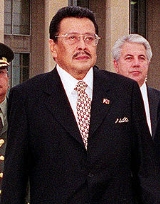
Joseph Ejercito Estrada widely known as 'Erap' is a popular film actor in the
Philippines and was the 13th
President of the
Philippines from June 30, 1998 to January 20, 2001.
Early life and career
José Marcelo Ejército was born in Tondo, one of the poorest 1977]]), a small-scale government contractor, and the former María Marcelo , a housewife. He is the brother of Antonio Ejercito and Emilio Ejercito, Jr.
Contrary to the popular notion that he grew up in life of poverty, he lived a relatively lower middle class life. After being expelled from Ateneo de Manila University for repugnant conduct, he enrolled in an engineering course at Mapua Institute of Technology, eventually dropping out to pursue acting.
Dropping out of college and involvement in a street gang so displeased his family that theycitizens. This later proved advantageous to his political career. He then married Luisa Pimentel and was blessed with three children: Jinggoy Estrada , Jackie Estrada , and Jude Estrada.
He also had a child from an out-of-wedlock relationship, Joseph Victor "JV" Ejercitoin 1986, all officials of the local government suspected of malfeasance and anomalies were removed and replaced by appointed officers-in-charge. Estrada was then removed from his position as mayor. The following year, he ran and won a seat in the Senate under his own party, Partido ng Masang Pilipino.
Vice-Presidency
In the 1992 presidential election Estrada initially intended to run for president but later decided to be the running mate of
Eduardo Cojuangco Jr. of the Nationalist People's Coalition. Estrada won the vice-presidency, though Cojuangco was defeated by
Fidel V. Ramos of the LAKAS party. Shortly after the inauguration of Ramos, Estrada was appointed to head the Presidential Anti-Crime Commission even though Estrada was from the political opposition.
Presidency
Election
The 1998 presidential election campaign had hardly anything to do with a contest between political ideologies and political programs. Estrada’s campaign in particular was focused on wooing the masses. Estrada’s political strategists and backers were aware that a large share of the Philippine electorate had become so dissatisfied and estranged from the ruling political elite, that the masa were looking for a change in leadership. Estrada’s handlers designed a campaign strategy that reflected Estrada’s pro-poor image that he had built up throughout his movie career. Central in the campaign was Estrada’s campaign slogan
"Erap para sa Mahirap" that succeeded in inspiring the masses with the hope that Estrada would be the president of and for the masses. Estrada soundly won as president over his competitors who were unable to provide a real alternative for Estrada. Estrada's running mate,
Edgardo Angara, was defeated by
Gloria Macapagal-Arroyo. During the campaign, Estrada's political rivals tried but failed to discredit him while publicizing his womanizing, drinking and gambling. Estrada was inaugurated on June 30, 1998 in the historical town of Malolos in
Bulacan province. In response to his election, he stated
"This is the greatest performance of my life."Philippine Daily Inquirer
Erap criticized
The Philippine Daily Inquirer, the nation's most popular broadsheet newspaper, for "bias, malice and fabrication" against him — a charge The Inquirer denied. In 1999, several government organizations, pro-Estrada businesses, and movie producers simultaneously pulled their advertisements in The Inquirer. The presidential palace was widely implicated in the advertising boycott, prompting sharp criticism from international
press freedom watchdogs.
Corruption charges and impeachment
The Estrada presidency was soon dogged by charges of plunder and
corruption, and he was reported by his Chief of Staff Aprodicio Laquian to spend long hours drinking with shady characters. In October 2000, an acknowledged gambling racketeer, Luis "Chavit" Singson, governor of the province of
Ilocos Sur, alleged that he had personally given Estrada the sum of 400 million pesos as payoff from illegal gambling profits, as well as 180 million pesos from the government price subsidy for the tobacco famers' marketing cooperative. Singson's allegation caused an uproar across the nation, which culminated in Estrada's
impeachment by the
House of Representatives in November of 2000. He was the first Philippine President to be impeached. The articles of impeachment were then transmitted to the Senate and an impeachment court was formed, with Chief Justice
Hilario Davide, Jr. as presiding officer.
During the trial, the prosecution presented witnesses and evidence to the impeachment court regarding Estrada's involvement in illegal gambling, also known as jueteng, and his maintenance of secret bank accounts. However, the president's legal team was quick to deny these allegations and did its best to destroy the claims of the witnesses during cross-examination.
EDSA II Revolution
- Main article: EDSA II
On January 16, 2001, the impeachment court, whose majority were political allies of Estrada, voted not to open an envelope that was said to contain incriminating evidence against the president. The prosecution panel walked out of the impeachment court in protest of this vote. Others noted that the walkout merit court contempt which Davide, intentionally or unintentionally, did not enforce.
That night, anti-Estrada protesters gathered on the historical
EDSA highway at
the site of the
1986 EDSA Revolution that overthrew
Ferdinand Marcos. A political turmoil ensued and the clamor for Estrada's resignation became stronger than ever. In the following days, the number of protesters grew to the hundreds of thousands.
On January 19, 2001, the
Armed Forces of the Philippines, seeing the political upheaval throughout the country, decided to withdraw its support from the president and transfer its allegiance to the vice president,
Gloria Macapagal-Arroyo. Without military support, and with mass resignations from his cabinet, Estrada's government quickly fell.
On January 20, 2001, the Supreme Court declared the presidency vacant and the Chief Justice swore in the constitutional successor,
Gloria Macapagal-Arroyo, as acting President of the Philippines. Estrada and his family were quickly evacuated from the presidential palace.
Post-presidency
Estrada returned to his old home in San Juan. He maintained that he never resigned, implying that Arroyo's government was illegitimate, despite the international community's recognition of Arroyo's succession and that all government offices, the military and the national police acknowledged Arroyo as the new president.
The new government charged him with plunder and had him arrested in April. Estrada's herded supporters, particularly among the poor, marched to the
EDSA Shrine demanding Estrada's release and his reinstatement as president, attempting to replicate the success of the previous revolution. On the morning of May 1, the protesters marched straight to the presidential palace. Violence erupted and the government declared a State of Rebellion. Many of Estrada's supporters were arrested, including politicians accused of provoking the violence. The government called out the military and was able to quell the rebellion. The rebellion came to be known as EDSA III.
Estrada was initially detained at the Veteran's Memorial Medical Center in
Manila and then transferred to a military facility in
Tanay,
Rizal, but he was later transferred to a nearby vacation home, virtually in house arrest. He is still facing the charges of plunder and corruption. Under Filipino law, plunder has a maximum penalty of death, though it is unlikely that Estrada will be given that sentence.
The
2004 presidential election was widely seen as a test of legitimacy for the presidency of Gloria Macapagal-Arroyo. Estrada supported his friend,
Fernando Poe, Jr., who became Arroyo's main opponent. However, Poe lost to Arroyo in a close election which some people say she won by cheating, by intimidating those that opposed her and by buying the military to do the cheating for her. Most international election observers however, say that the election was mostly clean.
On April 2, 2005, the United Opposition movement named Estrada "Chairman Emeritus". The unexpected death of
Fernando Poe, Jr. after the election brought with it uncertainty as to the opposition's direction and leadership, yet with Estrada still facing charges and trial some have been left to speculate how much of an influence or support this declaration will create in the formation of an opposition front to the current Presidency, and her Lakas-CMD party.
External links
References