


Jonny Quest

Encyclopedia
Jonny Quest is a media franchise
that revolves around a boy named Jonny Quest who accompanies his father on extraordinary adventures. The franchise started with a 1964-65 television series
and has come to include two subsequent television series, two television films, and a video game
.
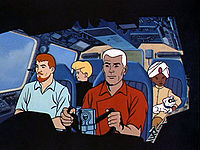
Jonny Quest – often casually referred to as The Adventures of Jonny Quest – is the original American science fiction
/adventure
animated television series that started the franchise. It was produced by Hanna-Barbera Productions
for Screen Gems
, and created and designed by comic-book artist Doug Wildey
.
Inspired by radio serials and comics in the action-adventure genre, it featured more realistic art, characters, and stories than Hanna-Barbera's previous cartoon
programs. It was the first of several Hanna-Barbera action-based adventure shows – which would later include Space Ghost
, The Herculoids
, and Birdman and the Galaxy Trio
– and ran on ABC
in prime time on early Friday nights for one season in 1964–1965.
After spending two decades in reruns, during which it appeared on all three major US television networks of the time, new episodes were produced for syndication in 1986. Two telefilms, a comic-book series, and a modernized revival series, The Real Adventures of Jonny Quest
, were produced in the 1990s.
A feature length animated telefilm, Jonny's Golden Quest
, was produced by HannaBarbera for USA Network
in 1993
, which again pitted the Quest team against Dr. Zin, who murders Jonny's mother in the film. Jonny’s Golden Quest also reused the storyline of the recent series' episode "Deadly Junket," wherein a little girl named Jessie Bradshaw, the daughter of a missing scientist, asked the Quest party to help find her father. Here she is revealed to be lying about her parentage at Dr. Zin's behest, and to Race's surprise is actually his and Jade's daughter. Jessie would appear as a character in all subsequent versions of the Jonny Quest property. A second telefilm, Jonny Quest vs. The Cyber Insects
, was produced for TNT
in 1995
, and was promoted as being the final iteration of the "Classic Jonny Quest".
All three of these productions featured the voices of Don Messick
and Granville Van Dusen
as Dr. Quest and Race Bannon, respectively. Messick also reprised performing the "voice" of Bandit in the series, but the features had this done by Frank Welker
.

The Real Adventures of Jonny Quest, premiered on all three major Turner Broadcasting System
entertainment cable channels (Cartoon Network
, TBS, and TNT), and met with mixed ratings and reviews. The characters were aged, with Jonny, Hadji, and Jessie becoming teenagers. Dr. Quest's compound has moved to a rocky island off the Maine coast.
Production on the series had been problem-laden since 1992, and when it was finally broadcast, it featured two different versions of its own Jonny Quest universe: the first batch of episodes (referred to as the "season one" episodes) gave the Quest team a futuristic look, while the second batch (referred to as "season two") harkened back to the original 1960s episodes. Several of the "season one" adventures in this series took place in a cyberspace realm known as "Questworld", depicted using 3-D
computer animation
. Both "seasons" aired during the 1996–1997 television season, and the show was canceled after 52 episodes (26 of each season). A live-action movie was planned to debut following the series premiere but never materialized.
The Real Adventures of Jonny Quest returned in the late 1990s on Cartoon Network
. It was part of the original Toonami
rotation when the block launched on March 17, 1997 and aired consistently on Toonami until September 24, 1999. It then continued to air sporadically until December 14, 2002. The first 13 episodes of the first season were released to DVD on February 17, 2009.
The character Dr. Zin was believed dead during the first season of The Real Adventures of Jonny Quest. However, creators of the show felt the series wasn't reminiscent of the original enough and brought Zin back in the second season episode "Nemesis," where Zin reveals himself as alive to Quest and holds a NASA station launching a new satellite hostage. Zin's two daughters, Anaya and Melana, returned to later episodes of 'Real Adventures' after being absent from the 'New Adventures' series.
and Jonny Quest vs. The Cyber Insects
), and the production of a live-action film. Director Richard Donner
, producer Lauren Shuler Donner
, and Jane Rosenthal
optioned the rights for the live action film, having expressed interest in the property soon after Turner's acquisition of Hanna-Barbera. Slated to begin production in mid-1995, filming was pushed back to 1996 and ultimately never began. By early 1996, the project had already fallen well-behind development of other films, such as a live-action Jetsons movie.
Zac Efron and Dwayne "the Rock" Johnson were reported in 2009 to have been cast as Jonny Quest and Race Bannon in an upcoming live action movie, respectively, according to a Moviehole.com interview with Johnson http://www.moviehole.net/200917762-the-rock-in-jonny-quest-movie. No further annoucements regarding the movie have since been reported.
in 1964. Comico
began publication of a Jonny Quest series in 1986, with the first issue featuring Doug Wildey
's artwork. The series was written by William Messner-Loebs
and ran for 31 issues, with 2 specials and 3 "classic" issues drawn by Wildey retelling Quest TV episodes ("Shadow of the Condor", "Calcutta Adventure", and "Werewolf of the Timberland"). Wildey drew several additional covers, as did Steve Rude
and Dave Stevens
. The series also spun off a 3-issue series named Jezebel Jade — drawn by Adam Kubert
— which told the story of Jade's relationship and adventures with Race Bannon.
and Commodore 64
home computers.
In 1993, Hollyware Entertainment published "Jonny Quest: Curse of the Mayan Warriors," a licensed title available only on 3.5" floppy disk. The pre-release title was "Jonny Quest and the Splinter of Heaven."
In 1996, Virgin Interactive published Jonny Quest: Cover-Up At Roswell for Windows 3.1 and Windows 95
.
.
Adult Swim
late-night programming block. (Time Warner
owns both Cartoon Network and the rights to the entire Hanna-Barbera library, including Jonny Quest) In addition, there have been several substantial references to the show:
Media franchise
A media franchise is an intellectual property involving the characters, setting and trademarks of an original work of media , such as a film, a work of literature, a television program or a video game. Generally, a whole series is made in a particular medium, along with merchandising and endorsements...
that revolves around a boy named Jonny Quest who accompanies his father on extraordinary adventures. The franchise started with a 1964-65 television series
Jonny Quest (TV series)
Jonny Quest – often casually referred to as The Adventures of Jonny Quest – is an American science fiction/adventure animated television series about a boy who accompanies his father on extraordinary adventures...
and has come to include two subsequent television series, two television films, and a video game
Jonny Quest: Cover-Up At Roswell
Jonny Quest: Cover-Up At Roswell is a computer game released by Virgin Interactive for the series The Real Adventures of Jonny Quest in August 1996 for $34.95.-Gameplay:...
.
1964–1965 television series
Jonny Quest – often casually referred to as The Adventures of Jonny Quest – is the original American science fiction
Science fiction
Science fiction is a genre of fiction dealing with imaginary but more or less plausible content such as future settings, futuristic science and technology, space travel, aliens, and paranormal abilities...
/adventure
Adventure
An adventure is defined as an exciting or unusual experience; it may also be a bold, usually risky undertaking, with an uncertain outcome. The term is often used to refer to activities with some potential for physical danger, such as skydiving, mountain climbing and or participating in extreme sports...
animated television series that started the franchise. It was produced by Hanna-Barbera Productions
Hanna-Barbera
Hanna-Barbera Productions, Inc. was an American animation studio that dominated North American television animation during the second half of the 20th century...
for Screen Gems
Screen Gems
Screen Gems is an American movie production company and subsidiary company of Sony Pictures Entertainment's Columbia TriStar Motion Picture Group that has served several different purposes for its parent companies over the decades since its incorporation....
, and created and designed by comic-book artist Doug Wildey
Doug Wildey
Douglas S. Wildey was a cartoonist and comic book artist best known for his co-creation of the 1964 animated television series, Jonny Quest for Hanna-Barbera Productions.-Early life and career:...
.
Inspired by radio serials and comics in the action-adventure genre, it featured more realistic art, characters, and stories than Hanna-Barbera's previous cartoon
Cartoon
A cartoon is a form of two-dimensional illustrated visual art. While the specific definition has changed over time, modern usage refers to a typically non-realistic or semi-realistic drawing or painting intended for satire, caricature, or humor, or to the artistic style of such works...
programs. It was the first of several Hanna-Barbera action-based adventure shows – which would later include Space Ghost
Space Ghost (TV series)
Space Ghost is an animated television series produced by Hanna-Barbera Productions. It first aired on CBS from September 10, 1966 to September 7, 1968. The series was composed of two unrelated segments, Space Ghost and Dino Boy in the Lost Valley...
, The Herculoids
The Herculoids
The Herculoids is a Saturday morning animated television series that was produced by Hanna-Barbera Productions. The show debuted on September 9, 1967 on CBS...
, and Birdman and the Galaxy Trio
Birdman and the Galaxy Trio
Birdman and the Galaxy Trio is an animated science fiction TV series created by Alex Toth and produced by Hanna-Barbera. It debuted on NBC on September 9, 1967, and ran on Saturday mornings until September 6, 1969...
– and ran on ABC
American Broadcasting Company
The American Broadcasting Company is an American commercial broadcasting television network. Created in 1943 from the former NBC Blue radio network, ABC is owned by The Walt Disney Company and is part of Disney-ABC Television Group. Its first broadcast on television was in 1948...
in prime time on early Friday nights for one season in 1964–1965.
After spending two decades in reruns, during which it appeared on all three major US television networks of the time, new episodes were produced for syndication in 1986. Two telefilms, a comic-book series, and a modernized revival series, The Real Adventures of Jonny Quest
The Real Adventures of Jonny Quest
The Real Adventures of Jonny Quest is an animated action-adventure television series produced by Hanna-Barbera Cartoons and broadcast on Cartoon Network from August 26, 1996 to April 16, 1997. A revival of the 1960s Jonny Quest franchise, it features teenage adventurers Jonny Quest, Hadji Singh,...
, were produced in the 1990s.
The New Adventures of Jonny Quest
By the mid-1980s, the edited episodes of Jonny Quest were part of the syndication package The Funtastic World of Hanna–Barbera. Each episode was time-compressed and edited to reduce the runtime from 25 to 22 minutes, with edits focused on the comical scenes with Bandit. Thirteen episodes were produced in 1986 (although some sources state 1987) to accompany the originals in the Funtastic World programming block. These episodes were referred to simply as Jonny Quest in their opening title sequence (the same ones seen on the original series since the censoring), and were noticeably less violent and more "kid-friendly" than the 1960s originals, and introduced the new regular character Hardrock ("The Monolith Man"), an ancient man made of stone. Hardrock did not return in any later versions of the program.A feature length animated telefilm, Jonny's Golden Quest
Jonny's Golden Quest
Jonny's Golden Quest is a 1993 animated television movie produced by Hanna-Barbera and originally aired on the USA cable channel. It attempts to fill back-story holes that were left unexplored in the original Jonny Quest cartoon series. It was in particular a follow-up to The New Adventures of...
, was produced by HannaBarbera for USA Network
USA Network
USA Network is an American cable television channel launched in 1971. Once a minor player in basic cable, the network has steadily gained popularity because of breakout hits like Monk, Psych, Burn Notice, Royal Pains, Covert Affairs, White Collar, Monday Night RAW, Suits, and reruns of the various...
in 1993
1993 in film
The year 1993 in film involved many significant films, including the blockbuster hits Jurassic Park, The Fugitive and The Firm. -Events:...
, which again pitted the Quest team against Dr. Zin, who murders Jonny's mother in the film. Jonny’s Golden Quest also reused the storyline of the recent series' episode "Deadly Junket," wherein a little girl named Jessie Bradshaw, the daughter of a missing scientist, asked the Quest party to help find her father. Here she is revealed to be lying about her parentage at Dr. Zin's behest, and to Race's surprise is actually his and Jade's daughter. Jessie would appear as a character in all subsequent versions of the Jonny Quest property. A second telefilm, Jonny Quest vs. The Cyber Insects
Jonny Quest vs. The Cyber Insects
Jonny Quest vs. The Cyber Insects is an animated television film made by Hanna-Barbera. It premiered at 7:00pm on November 19, 1995 on TNT, and was the final iteration of classic Quest. The film was a follow-up to the series The New Adventures of Jonny Quest and the earlier TV-movie Jonny's...
, was produced for TNT
Turner Network Television
Turner Network Television is an American cable television channel created by media mogul Ted Turner and currently owned by the Turner Broadcasting System division of Time Warner...
in 1995
1995 in film
-Top grossing films:-Events:* March 22 - The Dogme 95 movement is officially announced in Paris by Danish directors Lars von Trier and Thomas Vinterberg.* March 28 - Actress Julia Roberts and singer Lyle Lovett announce their plans for separation....
, and was promoted as being the final iteration of the "Classic Jonny Quest".
All three of these productions featured the voices of Don Messick
Don Messick
Donald Earl "Don" Messick was an American voice actor best known for his work for Hanna-Barbera. Perhaps his most well-known voice creations include Scooby-Doo, Papa Smurf, and Dr. Benton Quest....
and Granville Van Dusen
Granville Van Dusen
Granville Van Dusen is an American stage, screen, and voice actor who portrayed Race Bannon in the 1986 television series The New Adventures of Jonny Quest, Jonny's Golden Quest, Jonny Quest vs...
as Dr. Quest and Race Bannon, respectively. Messick also reprised performing the "voice" of Bandit in the series, but the features had this done by Frank Welker
Frank Welker
Franklin Wendell "Frank" Welker is an American actor who specializes in voice acting and has contributed character voices and other vocal effects to American television and motion pictures.-Acting career:...
.
The Real Adventures of Jonny Quest
The Real Adventures of Jonny Quest, premiered on all three major Turner Broadcasting System
Turner Broadcasting System
Turner Broadcasting System, Inc. is the Time Warner subsidiary managing the collection of cable networks and properties started and acquired by Robert Edward "Ted" Turner starting in the mid-1970s. The company has its headquarters in the CNN Center in Atlanta, Georgia. TBS, Inc...
entertainment cable channels (Cartoon Network
Cartoon Network (United States)
Cartoon Network is an American cable television network owned by Turner Broadcasting which primarily airs animated programming. The channel was launched on October 1, 1992 after Turner purchased the animation studio Hanna-Barbera Productions in 1991...
, TBS, and TNT), and met with mixed ratings and reviews. The characters were aged, with Jonny, Hadji, and Jessie becoming teenagers. Dr. Quest's compound has moved to a rocky island off the Maine coast.
Production on the series had been problem-laden since 1992, and when it was finally broadcast, it featured two different versions of its own Jonny Quest universe: the first batch of episodes (referred to as the "season one" episodes) gave the Quest team a futuristic look, while the second batch (referred to as "season two") harkened back to the original 1960s episodes. Several of the "season one" adventures in this series took place in a cyberspace realm known as "Questworld", depicted using 3-D
3D computer graphics
3D computer graphics are graphics that use a three-dimensional representation of geometric data that is stored in the computer for the purposes of performing calculations and rendering 2D images...
computer animation
Computer animation
Computer animation is the process used for generating animated images by using computer graphics. The more general term computer generated imagery encompasses both static scenes and dynamic images, while computer animation only refers to moving images....
. Both "seasons" aired during the 1996–1997 television season, and the show was canceled after 52 episodes (26 of each season). A live-action movie was planned to debut following the series premiere but never materialized.
The Real Adventures of Jonny Quest returned in the late 1990s on Cartoon Network
Cartoon Network (United States)
Cartoon Network is an American cable television network owned by Turner Broadcasting which primarily airs animated programming. The channel was launched on October 1, 1992 after Turner purchased the animation studio Hanna-Barbera Productions in 1991...
. It was part of the original Toonami
Toonami
Toonami was a registered trademark of Cartoon Network, used initially for action-oriented programming blocks on Cartoon Network television channels worldwide, mostly showing American cartoons and Japanese anime, originating in the United States on March 17, 1997 and ended on September 20, 2008.The...
rotation when the block launched on March 17, 1997 and aired consistently on Toonami until September 24, 1999. It then continued to air sporadically until December 14, 2002. The first 13 episodes of the first season were released to DVD on February 17, 2009.
The character Dr. Zin was believed dead during the first season of The Real Adventures of Jonny Quest. However, creators of the show felt the series wasn't reminiscent of the original enough and brought Zin back in the second season episode "Nemesis," where Zin reveals himself as alive to Quest and holds a NASA station launching a new satellite hostage. Zin's two daughters, Anaya and Melana, returned to later episodes of 'Real Adventures' after being absent from the 'New Adventures' series.
Feature film
In the early 1990s, Turner planned a "Year of Jonny Quest" marketing campaign to feature a new television series, the release of classic episodes on VHS, the creation of two new animated movies in classic continuity (Jonny's Golden QuestJonny's Golden Quest
Jonny's Golden Quest is a 1993 animated television movie produced by Hanna-Barbera and originally aired on the USA cable channel. It attempts to fill back-story holes that were left unexplored in the original Jonny Quest cartoon series. It was in particular a follow-up to The New Adventures of...
and Jonny Quest vs. The Cyber Insects
Jonny Quest vs. The Cyber Insects
Jonny Quest vs. The Cyber Insects is an animated television film made by Hanna-Barbera. It premiered at 7:00pm on November 19, 1995 on TNT, and was the final iteration of classic Quest. The film was a follow-up to the series The New Adventures of Jonny Quest and the earlier TV-movie Jonny's...
), and the production of a live-action film. Director Richard Donner
Richard Donner
Richard Donner is an American film director, film producer, and comic book writer.The production company The Donners' Company is owned by Donner and his wife, producer Lauren Shuler Donner. After directing the horror film The Omen, Donner became famous for the hailed creation of the first modern...
, producer Lauren Shuler Donner
Lauren Shuler Donner
Lauren Shuler Donner is an American film producer who specializes in mainstream youth and family-oriented entertainment.-Early life and career:...
, and Jane Rosenthal
Jane Rosenthal
Jane Rosenthal is an American film producer.Rosenthal was born in Denver, Colorado and raised in Providence, Rhode Island; she attended both Brown and New York University...
optioned the rights for the live action film, having expressed interest in the property soon after Turner's acquisition of Hanna-Barbera. Slated to begin production in mid-1995, filming was pushed back to 1996 and ultimately never began. By early 1996, the project had already fallen well-behind development of other films, such as a live-action Jetsons movie.
Zac Efron and Dwayne "the Rock" Johnson were reported in 2009 to have been cast as Jonny Quest and Race Bannon in an upcoming live action movie, respectively, according to a Moviehole.com interview with Johnson http://www.moviehole.net/200917762-the-rock-in-jonny-quest-movie. No further annoucements regarding the movie have since been reported.
Comic books
A Jonny Quest comic book (a retelling of the first TV episode, "Mystery of the Lizard Men") was published by Gold Key ComicsGold Key Comics
Gold Key Comics was an imprint of Western Publishing created for comic books distributed to newsstands. Also known as Whitman Comics, Gold Key operated from 1962 to 1984.-History:...
in 1964. Comico
Comico Comics
Comico: The Comic Company was an American comic book publisher, headquartered in Norristown, Pennsylvania. Its best-known comics include the Robotech adaptations, the Jonny Quest continuation written by co-creator Doug Wildey, and Matt Wagner's Mage: The Hero Discovered and Grendel...
began publication of a Jonny Quest series in 1986, with the first issue featuring Doug Wildey
Doug Wildey
Douglas S. Wildey was a cartoonist and comic book artist best known for his co-creation of the 1964 animated television series, Jonny Quest for Hanna-Barbera Productions.-Early life and career:...
's artwork. The series was written by William Messner-Loebs
William Messner-Loebs
William Messner-Loebs is an American comic book writer and artist from Michigan, also known as Bill Loebs and Bill Messner-Loebs...
and ran for 31 issues, with 2 specials and 3 "classic" issues drawn by Wildey retelling Quest TV episodes ("Shadow of the Condor", "Calcutta Adventure", and "Werewolf of the Timberland"). Wildey drew several additional covers, as did Steve Rude
Steve Rude
-Career:In 1981, Rude became widely known in the comics world when he and writer Mike Baron created Nexus, an independent science fiction comic book with a large supporting cast. For the series, Rude designed a dozen or so distinctive alien races, including the Thunes, the Amphibs, the Quattros,...
and Dave Stevens
Dave Stevens
Dave Stevens was an American illustrator and comics artist. He is most famous for creating The Rocketeer comic book and film character, and for his pin-up style "glamour art" illustrations, especially of model Bettie Page...
. The series also spun off a 3-issue series named Jezebel Jade — drawn by Adam Kubert
Adam Kubert
Adam Kubert is an American comic book artist known for his work for publishers such as Marvel Comics, Dark Horse Comics, and DC Comics, including work on Ultimate X-Men, Ultimate Fantastic Four, Incredible Hulk, Wolverine, Spider-Man, Superman and Ghost Rider.Kubert has established himself as one...
— which told the story of Jade's relationship and adventures with Race Bannon.
Computer games
In 1991, Hi-Tec Software published Jonny Quest in Doctor Zin's Underworld, a licensed Jonny Quest platform game for the Sinclair ZX Spectrum, Amstrad CPCAmstrad CPC
The Amstrad CPC is a series of 8-bit home computers produced by Amstrad between 1984 and 1990. It was designed to compete in the mid-1980s home computer market dominated by the Commodore 64 and the Sinclair ZX Spectrum, where it successfully established itself primarily in the United Kingdom,...
and Commodore 64
Commodore 64
The Commodore 64 is an 8-bit home computer introduced by Commodore International in January 1982.Volume production started in the spring of 1982, with machines being released on to the market in August at a price of US$595...
home computers.
In 1993, Hollyware Entertainment published "Jonny Quest: Curse of the Mayan Warriors," a licensed title available only on 3.5" floppy disk. The pre-release title was "Jonny Quest and the Splinter of Heaven."
In 1996, Virgin Interactive published Jonny Quest: Cover-Up At Roswell for Windows 3.1 and Windows 95
Windows 95
Windows 95 is a consumer-oriented graphical user interface-based operating system. It was released on August 24, 1995 by Microsoft, and was a significant progression from the company's previous Windows products...
.
Reception
In January 2009, IGN named Jonny Quest as the 77th best in its "Top 100 Animated TV Shows".Music
Powerglove covered the theme song to The Real Adventures of Jonny Quest on their album Saturday Morning ApocalypseSaturday Morning Apocalypse
Saturday Morning Apocalypse is the second studio album by metal/power metal band Powerglove, released September 28, 2010 through E1 Music. This album strays from Powerglove's usual brand of video game metal, and instead centers around TV, cartoon, and movie themes the band grew up with. This is the...
.
Parodies and homages
The characters and setting of Jonny Quest have frequently been the subject of brief parodies, especially in later animated programs, some of which have aired on Cartoon Network'sCartoon Network
Cartoon Network is a name of television channels worldwide created by Turner Broadcasting which used to primarily show animated programming. The channel began broadcasting on October 1, 1992 in the United States....
Adult Swim
Adult Swim
Adult Swim is an adult-oriented Cable network that shares channel space with Cartoon Network from 9:00 pm until 6:00 am ET/PT in the United States, and broadcasts in countries such as Australia and New Zealand...
late-night programming block. (Time Warner
Time Warner
Time Warner is one of the world's largest media companies, headquartered in the Time Warner Center in New York City. Formerly two separate companies, Warner Communications, Inc...
owns both Cartoon Network and the rights to the entire Hanna-Barbera library, including Jonny Quest) In addition, there have been several substantial references to the show:
- Adult Swim's The Venture Bros.The Venture Bros.The Venture Bros. is an American animated television series that premiered on Cartoon Network's Adult Swim on February 16, 2003. The series mixes action and comedy together while it chronicles the adventures of the Venture family: well-meaning but incompetent teenagers Hank and Dean Venture; their...
features characters who are satirical analogues of the Jonny Quest cast: Dr. Thaddeus "Rusty" Venture, his bodyguard Brock Samson, and his sons Hank and Dean. Flashbacks reveal that Rusty is himself the son of a Benton Quest analog, now coasting on the fame of his late father. During the first season, the creators of the show realized that Cartoon Network's parent owned Jonny Quest and began using the actual characters, including Jonny as a paranoid drug addict severely damaged by the constant danger his father put him in, Race Bannon as a OSI agent that Brock Samson calls "one of the best" until his death, and Hadji as a hard-working competent engineer for Rusty's successful brother Jonas Jr. However, starting with the third season, the Jonny Quest characters were renamed: Jonny was renamed "Action Johnny", Race Bannon was referred to as "Red" and Dr Zin was simply called "Dr. Z"; there was no in-show explanation for the change.
- Adult Swim's Harvey Birdman, Attorney at LawHarvey Birdman, Attorney at LawHarvey Birdman, Attorney at Law is an American animated television series comedy created by Williams Street and produced by Cartoon Network Studios that aired on Cartoon Network during its Adult Swim late night programming block. The series' pilot first aired in 2000, and later became a series in...
features the cast in several episodes. In "Bannon Custody Battle", Bannon and Dr. Quest fight for custody of Jonny and Hadji, and in "Return of Birdgirl" the men try to marry. Other episodes featured the Lizard Men from "Mystery of the Lizard Men", the mummy from "Curse of Anubis", a yeti from "Monsters in the Monastery", a gargoyle from "The House of the Seven Gargoyles", the robotic spider from "The Robot Spy", etc.
- An 8-minute parody appeared in 1995 on the animated series Freakazoid!Freakazoid!Freakazoid! is an American animated television series created by Steven Spielberg, Bruce Timm, and Paul Dini for the Kids' WB programming block of The WB. The series chronicles the adventures of the title character, Freakazoid, a manic, insane superhero who battles with an array of super villains....
, under the title Toby Danger, featuring the voices of Scott Menville, Don Messick (in his last role before he died), and Granville Van Dusen (all of whom provided voices for the original series). It was written by Tom Minton as a twelve minute stand-alone short for AnimaniacsAnimaniacsSteven Spielberg Presents Animaniacs, usually referred to as simply Animaniacs, is an American animated series, distributed by Warner Bros. Television and produced by Amblin Entertainment and Warner Bros. Animation. The cartoon was the second animated series produced by the collaboration of Steven...
, but edited by director Eric Radomski to fit into the available Freakazoid! time slot.
- Matt FractionMatt FractionMatt Fritchman, better known by the pen name Matt Fraction, is an Eisner Award-winning American comic book writer, known for his work as the writer of The Invincible Iron Man, The Immortal Iron Fist and Uncanny X-Men for Marvel Comics and Casanova for Image Comics.-Career:Fraction wrote two...
's spy-fiSpy-fi-Definition and characteristics:It often uses a secret agent or superspy whose mission is a showcase of science fiction elements such as technology and ideas used for extortion, plots for world domination or world destruction, futuristic weapons, gadgets and fast vehicles that can travel on land,...
comic book series Casanova features a genius villain going by the name of Sabine Seychelle, who works with a large Indian bodyguard named Samir; Fraction recounts his inspiration for them in the text column at the end of Casanova #4 that "I liked the idea of Jonny Quest, all adult and crooked. The son of an adventure scientist and his bePolo'd sidekick would grow up...how, exactly? Bent, I supposed. Weeeird. The kind of guy that would create phenomenal machines...and then sleep with them three at a time."
- Brazilian pop rockPop rockPop rock is a music genre which mixes a catchy pop style and light lyrics in its guitar-based rock songs. There are varying definitions of the term, ranging from a slower and mellower form of rock music to a subgenre of pop music...
band Jota QuestJota QuestJota Quest is a Brazilian pop rock band. The band was founded in 1995, in Belo Horizonte, Minas Gerais as J. Quest, but due to trademark issues with Hanna-Barbera, they renamed themselves Jota Quest...
is named after the series. Originally, they performed under the name J. Quest, but to avoid legal conflict with Hanna-Barbera, the J. was expanded to Jota (the Portuguese name for the letter J) from their second album onward.
- The Indianapolis-based punk band RacebannonRacebannonRacebannon is an American noise punk band from Bloomington, Indiana.-History:Racebannon was formed in Indianapolis in 1996 by Michael Anderson and James Bauman. The group cites The Melvins, Melt Banana, and Ice Nine as early influences. They cobbled together a lineup from members of other...
takes its name from the Jonny Quest character.
External links
- Jonny Quest (1964) at the Big Cartoon DataBaseBig Cartoon DataBaseThe Big Cartoon DataBase is an online database of information about animated cartoons, animated feature films, animated television shows and cartoon shorts....
- Jonny Quest Wikiquote page
- Jonny Quest - GaloobGaloobLewis Galoob Toys, Inc. was a toy company headquartered on Forbes Blvd. in South San Francisco, California. Best known for distributing the Game Genie, a videogame cheat device, for Codemasters in the US, Galoob was founded by Barbara Frankel and Lewis Galoob in 1954 as an import business. Before...
- Jonny Quest at TV.com
- Classic Jonny Quest (1964-65)
- JQStyle – A different kind of Jonny Quest fan site