


Jonathan Pollard

Encyclopedia
Jonathan Jay Pollard worked as a civilian intelligence
analyst before being convicted of spy
ing for Israel
. He received a life sentence in 1987.
Israel granted Pollard citizenship in 1995, while publicly denying, until 1998, that he was an Israeli spy. Israeli activist groups, as well as high-profile Israeli politicians, have lobbied for his release. Israeli Prime Minister Benjamin Netanyahu
has voiced particularly strong support for Pollard, visiting the convicted spy in prison in 2002. His case was later linked to that of Ben-ami Kadish
, another U.S. national who pleaded guilty to charges of passing classified information to Israel in the same period. He renounced his United States citizenship and is now solely an Israeli citizen, the country to which he will be deported in the event he is released from prison.
, where his father, an award-winning microbiologist
, taught at Notre Dame
.
Pollard was an intelligent and sensitive child, who was frequently a victim of bullying. He grew up with what he describes as a "racial obligation" to Israel, and says of his troubled childhood, "I got beaten up, but at least I knew the Israelis would beat up a couple Arab countries and maybe I would feel better." Pollard made his first trip to Israel in 1970, as part of a science program visiting the Weizmann Institute of Science
in Rehovot
. While there, he was hospitalized after a fight with another student. One Weizmann scientist remembered Pollard as leaving behind "a reputation of being an unstable troublemaker, the worst case of this kind in the history of the summer camp."
After completing high school, Pollard attended Stanford University
, where he completed a degree in political science
in 1976. While there, he is remembered by several of his acquaintances as boasting that he worked for the Mossad
, and that he had attained the rank of Colonel in the Israeli Defense Forces
, although neither claim was true. Later, Pollard enrolled in several graduate schools, but never completed a postgraduate degree. He met his future wife Anne Henderson in 1982, when both were living in Sacramento.
(CIA) and then the navy. Pollard was turned down for the CIA job after taking a polygraph test in which he admitted to prolific illegal drug usage between 1974 and 1978. He fared better with the Navy and was hired by the Naval Fields Operational Intelligence Office (NFOIO) as an intelligence specialist working on Soviet
issues. A background check was required for the job as well as security clearances, but no polygraph test. In addition to a 'Top Secret' clearance, a more stringent 'Sensitive Compartmented Information' (SCI) clearance was required. The navy asked for but was denied information from the CIA regarding Pollard, including the results of their pre-employment polygraph test showing Pollard's excessive drug use
. Pollard was given temporary security clearances pending completion of his background check, which was normal for new hires at the time.
Within two months after Pollard was hired, the technical director of the NFOIO, Richard Haver, requested that hebe terminated. This came after a conversation with the new hire in which Pollard offered to start a back-channel operation with the South African intelligence service
and lied about his father's involvement with the CIA. Instead of terminating Pollard, Haver's boss reassigned him to a human-gathered intelligence operation. This was apparently because Pollard had a friend from graduate school in the South African intelligence service. In the vetting process for this position, Pollard, it was later discovered, lied repeatedly: he denied illegal drug use, claimed his father had been a CIA operative, misrepresented his language abilities and his educational achievements, and claimed to have applied for a commission as officer in the Naval Reserve. A month later Pollard applied for and received a transfer to the Naval Investigative Service (NIS) Surface Ships Division while keeping his position with Task Force
168 (TF-168).
While transferring to his new job at the NIS, Pollard again initiated a meeting with someone far up the chain of command, this time with Admiral Sumner Shapiro
, about an idea he had for TF-168 and South Africa. (The TF-168 group had passed on his ideas). After the meeting, Shapiro immediately ordered that Pollard's security clearances be revoked and that he be reassigned to a non-sensitive position. According to The Washington Post
, Shapiro dismissed Pollard as a "kook", saying later, "I wish the hell I'd fired him."
Because of the job transfer, Shapiro's order to remove Pollard's security clearances slipped through the cracks. However, Shapiro's office followed up with a request to the TF-168 that Pollard's trustworthiness be investigated by the CIA. The CIA found Pollard to be a risk and recommended that he not be used in any intelligence collection operation. A subsequent polygraph test was inconclusive, although it did prompt Pollard to admit to making false statements to his superiors, prior drug use, and having unauthorized contacts with representatives of foreign governments. The special agent administering the test felt that Pollard, who at times "began shouting and shaking and making gagging sounds as if he were going to vomit," was feigning illness to invalidate the test, and recommended that he not be granted access to highly classified information. Pollard was also required to be evaluated by a psychiatrist
.
Pollard's clearance was reduced to Secret. Pollard subsequently filed a grievance and threatened lawsuits to recover his SCI clearance, and subsequently began receiving excellent performance reviews. In 1982, after the psychiatrist concluded Pollard had no mental illness, Pollard's clearance was upgraded to SCI once again. In October 1984, after some reorganization of the navy's intelligence departments, Pollard applied for and was accepted into a position as an analyst for the Naval Intelligence Service.
 Shortly after Pollard began working at the NIS, he met Aviem Sella
, an Israeli Air Force
combat veteran who was at the time a graduate student at New York University
, on leave from his position as colonel
in order to gain a master's in computer science
. Within a few days, in June 1984, Pollard started passing classified information to Sella and received, in exchange, $10,000 cash and a very expensive diamond
and sapphire
ring, which Pollard later used to propose marriage to his girlfriend Anne. He also agreed to receive $1,500 per month for further espionage.
Naval Criminal Investigative Service
(NCIS) investigator Ronald Olive has alleged that Pollard passed classified information to South Africa
, and attempted, through a third party, to sell classified information to Pakistan
on multiple occasions. Pollard also stole classified documents related to the People's Republic of China
on behalf of his wife, who used the information to advance her personal business interests and kept them around the house, where they were discovered by investigating authorities when Pollard's espionage activity came to light.
During Pollard's trial, the government's memorandum in aid of sentencing challenges "defendant's claim that he was motivated by altruism rather than greed", asserting that Pollard had "disclosed classified information in anticipation of financial gain" in other instances:
During the course of the Pollard trial, Australian authorities reported the disclosure of classified American documents by Pollard to one of their own agents, a Royal Australian Navy
officer who had been engaged in a personnel-exchange liaison program between the U.S. and Australian Navies. The Australian officer, alarmed by Pollard's repeated disclosure of NOFORN data to him, reported the indiscretions to his chain of command which in turn recalled him from his position in the U.S., fearing that the disclosures might be part of a "CIA ruse." Confronted with this accusation after entering his plea, Pollard only admitted to passing a single classified document to the Australian; later, he changed his story, and claimed that his superiors ordered him to share information with the Australians.
The full extent of the information he gave to Israel has still not been officially revealed. Press reports cited a secret 46-page memorandum, which Pollard and his attorneys were allowed to view. They were provided to the judge by Secretary of Defense
Caspar Weinberger
, who described Pollard's spying as including, among other things, obtaining and copying the latest version of Radio-Signal Notations (RASIN), a 10-volume manual comprehensively detailing America's global electronic surveillance network.
 Pollard's espionage was discovered in 1985 when a co-worker anonymously reported his removal of classified material from the NIS. The co-worker noted that he did not seem to be taking the material to any known appropriate destination, such as other intelligence agencies in the area. Although Pollard was authorized to transport documents and the coworker did claim the documents were properly wrapped, it appeared out of place that Pollard would be transporting documents on a Friday afternoon when many workers were focused more on the upcoming weekend rather than intelligence work. Pollard's direct superior, having to complete extra work at the office on a Saturday, had walked by Pollard's desk and noticed unsecured classified material. Taking the initiative to secure it, the supervisor glanced over it and saw it was unrelated to antiterrorism matters in the Caribbean
, which is what the section focused on. Looking at more unrelated documents, the supervisor believed foreign intelligence may be involved, but was unable to determine which nation would be interested. Supervisors began investigating, and upon finding the enormous amount of material checked out by Pollard, and that it was outside of his area of responsibility, asked the FBI to begin an investigation.
Pollard was stopped and questioned about a week later while removing classified material from his work premises. He explained that he was taking it to another analyst at a different agency for a consultation. During the voluntary interview, his story was checked and found to be false. Pollard requested to make a phone call to his wife telling her where he was. As the interview was voluntary the investigators had no choice but to grant the request. During the call to Anne he used the code word 'cactus', meaning that he was in trouble and that she should remove all classified material from their home, which she attempted to do, enlisting the help of a neighbor.
After some time, Pollard agreed to a search of his home which turned up only a few documents Anne had missed. At this point, the FBI decided to drop the case and leave it as an administrative action for Pollard's supervisors, since there only seemed to be some mishandling of documents and at this point, was no proof that Pollard was passing classified documents. The case broke wide open a few days later when Pollard was asked to take a polygraph. Instead, he admitted to illegally passing on documents, without mentioning Israel. The FBI again became involved. A short time later Pollard's neighbor began calling around the military intelligence community (he was a naval officer) asking what to do with the 70 lb suitcase full of highly classified material that Pollard's wife, Anne, had given him. After being unable to contact Anne or Jonathan Pollard he became concerned about safeguarding the documents. He cooperated fully with the investigation and was not charged with any crime.
After his partial confession, Pollard was surveilled but not taken into custody. He and his wife then attempted to gain asylum at the Israeli embassy, only to be rebuffed by the Israeli guards and taken into custody by FBI agents who swarmed the perimeter as soon as Pollard set foot off embassy property. Until this point, investigators could not confirm that Pollard had been spying for Israel; their only lead having been the speculation of Pollard's superiors. Pollard was finally arrested on November 21, 1985, at the gates of the Israeli Embassy in Washington, D.C.
and answered in Hebrew, and then translated back into English, even though all the parties spoke perfect English. The Commander Jerry Agee remembers that, even as he departed the airport, airport security made a point of informing him that "you will never be coming back here again"; Agee found various items had been stolen from his luggage, upon his return to the United States. The abuse came not only from the guards and officials, but also the Israeli media.
Aviem Sella
, Pollard's initial Israeli contact, was eventually indicted on three counts of espionage by an American court. Israel refused to allow him to be interviewed unless he was granted immunity. America refused because of Israel's previous failure to cooperate as promised. Israel then refused to extradite Sella, instead giving him command of a prestigious air force
base. The U.S. Congress responded by threatening to cut aid to Israel, at which point Sella stepped down.
discussions with the Government sought both to minimize his chances of receiving a life sentence and to enable Anne Pollard to plead as well, which the Government was otherwise unwilling to let her do. The government, however, was prepared to offer Anne Pollard a plea agreement only after Jonathan Pollard consented to assist the government in its damage assessment and submitted to polygraph
examinations and interviews with FBI agents and Department of Justice
attorneys. Accordingly, over a period of several months, Pollard cooperated with the Government's investigation, and in late May 1986, the Government offered him a plea agreement, which he accepted. By the terms of that agreement, Pollard was bound to plead guilty to one count of conspiracy to deliver national defense information to a foreign government, which carried a maximum prison term of life, and to cooperate fully with the Government's ongoing investigation. He promised not to disseminate any information concerning his crimes or his case, or to speak publicly of any classified information, without first submitting to pre-clearance by the Director of Naval Intelligence. His agreement further provided that failure by Anne Pollard to adhere to the terms of her agreement entitled the Government to void his agreement, and her agreement contained a mirror-image provision. In return for Pollard's plea, the Government promised not to charge him with additional crimes.
Three weeks before Pollard's sentencing, Wolf Blitzer
, at the time a Jerusalem Post correspondent, conducted a jail-cell interview with Pollard and penned an article which also ran in The Washington Post
headlined, "Pollard: Not A Bumbler, but Israel's Master Spy", published February 15, 1987. Pollard told Blitzer about some of the information he provided the Israelis: reconnaissance satellite photography of Palestine Liberation Organization
(PLO) headquarters in Tunisia
, specific capabilities of Libya
's air defenses, and "the pick of U.S. intelligence about Arab and Islamic conventional and unconventional military activity, from Morocco
to Pakistan
and every country in between. This included both 'friendly' and 'unfriendly' Arab countries." Some commentators identified this interview as a blatant violation of the plea agreement.
Prior to sentencing, Pollard and his wife Anne gave further defiant media interviews in which they defended their spying and attempted to rally Jewish Americans to their cause. In a 60 Minutes
interview, Anne said, "I feel my husband and I did what we were expected to do, and what our moral obligation was as Jews, what our moral obligation was as human beings, and I have no regrets about that".
On June 4, 1986, Pollard pleaded guilty to one count of conspiracy to deliver national defense information to a foreign government. Prior to sentencing, speaking on his own behalf, Pollard stated that while his motives "may have been well meaning, they cannot, under any stretch of the imagination, excuse or justify the violation of the law, particularly one that involves the trust of government... I broke trust, ruined and brought disgrace to my family." He admitted and apologized for taking money from the Israeli government in exchange for classified information. Anne Pollard, in her own statement, stated that she did "what at the time I believed to be correct", in helping her husband and attempting to conceal stolen documents, adding "And I can't say that I would never not help him again. However, I would look for different routes or different ways."
The prosecution answered these statements by saying that the Pollards had continued to violate numerous nondisclosure agreements even as the trial was taking place. The prosecutor noted one in particular, which had been signed in June 1986, alluding to Pollard's interview with Wolf Blitzer. The prosecutor concluded:
In 1987, Pollard began his life sentence. His wife, Anne, was sentenced to five years in prison but was paroled after three and a half years due to health problems. After her parole ended, she emigrated to Israel. Jonathan divorced Anne, stating he believed he was going to be jailed for the remainder of his life and did not want Anne to be bound to him.
At the time of Pollard's sentencing there was a rule that mandated parole after 30 years of imprisonment for certain prisoners who had maintained a clean record in prison. That parole date would be November 21, 2015. Pollard was also eligible to apply for parole after eight years and six months, although he has not done so to date.
His Federal Bureau of Prisons
ID is #09185-016. He is incarcerated in FCI Butner Medium at the Butner Federal Correction Complex in North Carolina
. The Bureau of Prisons (BOP) projects his release date as November 21, 2015.
petition. A panel of the U.S. Court of Appeals for the District of Columbia Circuit ruled two-to-one to deny Pollard's petition, primarily due to the failure of Pollard's original attorneys to file his appeal in a timely manner. The dissenting judge, Judge Stephen F. Williams
, stated that "because the government's breach of the plea agreement was a fundamental miscarriage of justice requiring relief under 28 U.S.C. § 2255, I dissent."
In July 2005, the District of Columbia Circuit rejected Pollard's latest appeal. Pollard had sought a new trial on the grounds of ineffective assistance of counsel, and he sought to receive classified documents pertinent to his new lawyers' efforts in preparing a clemency petition. The Court of Appeals rejected both arguments, however, and Pollard remains imprisoned. On February 10, 2006, lawyers for Pollard filed a petition for certiorari
with the United States Supreme Court to attempt to gain access to the classified documents. The brief was based on the notion that the separation of powers
doctrine is a flexible doctrine that does not dictate the complete separation of the three branches of Government from one another. The brief argued that the Court of Appeals violated this principle in asserting sua sponte
that the judiciary has no jurisdiction over the classified documents due to the fact that access was for the ultimate purpose of clemency, an executive function. In fact, the President's clemency power would be wholly unaffected by successor counsel's access to the classified documents, and the classified documents were sealed under protective order, a judicial tool. The Supreme Court denied the cert petition on March 20, 2006.
On May 11, 1998, Benjamin Netanyahu
admitted Pollard was a known and sanctioned agent, handled by high ranking officials of the Israeli Bureau for Scientific Relations (Lekem
). The Israeli government has paid for at least two of Pollard's trial attorneys — Richard A. Hibey and Hamilton Philip Fox III — and continues to ask for his release. Netanyahu and Ehud Barak
, in 1999 in the context of the Israeli elections, exchanged barbs in the media over which of them had been more supportive of Pollard.
In 2002, Netanyahu visited Pollard
in prison, and, in 2007, claimed that if he were to be elected Prime Minister he would bring about Pollard's release.
In September 2009, Israeli State Comptroller Micha Lindenstrauss released a report that stated the Israeli government has made concerted efforts for years to gain Pollard's release, but the American government refused. The Pollards rejected the findings of the report, calling it a "whitewash" of the Israeli government. However, they did agree with another finding of the report that stated Pollard had been denied due legal process in the United States. Israeli officials at one point reportedly considered offering to exchange the American spy Yosef Amit
for Pollard, but rejected the idea.
In June 2011, 70 Israeli MK
s lent their support to the Pollard family's request that President Obama allow Pollard to visit his ailing father, Morris. When his father died soon after, Israeli Prime Minister Benjamin Netanyahu
announced Israel's official support for a new Pollard family request that would allow Jonathan Pollard to attend his father's funeral. These requests were both ultimately denied by the U.S. government.
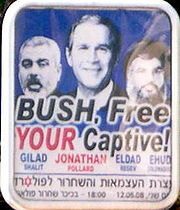
 In addition to the release requests by the Israeli government, there has been a long running public campaign to free Pollard. The organizers include the Pollard family, his ex-wife, Anne, and Jewish groups in the US and Israel. The campaign's main points claim that Pollard spied for an ally instead of an enemy, that his sentence was out of proportion when compared to similar crimes, and that the US failed to live up to its plea bargain. Some Israeli activists compared President Bush to Hamas and Hezbollah leaders who have taken Israeli soldiers prisoner.
 Pollard's supporters argue that his sentence was excessive. Although Pollard pleaded guilty as part of a plea bargain
for himself and his wife, he was shown no leniency and was given the maximum sentence with the exception of death, because he allegedly broke the terms of that plea agreement even before the sentence was handed down.
The issue of his imprisonment has sometimes arisen amidst Israeli domestic politics. Benjamin Netanyahu has been particularly vocal in lobbying for Pollard's release, visiting Pollard in prison in 2002. Netanyahu raised the issue with President Bill Clinton
during the Wye River peace talks
in 1998. In his autobiography, Clinton wrote that he was inclined to release Pollard, but the objections of U.S. intelligence officials was too strong:
Alan Dershowitz
has been among Pollard's high-profile supporters, both in the courtroom as a lawyer and in various print media. Characterizing the sentence as "excessive", Dershowitz writes in an article reprinted in his bestselling book Chutzpah!, "As an American, and as a Jew, I hereby express my outrage at Jonathan Pollard's sentence of life imprisonment for the crime to which he pleaded guilty." Dershowitz writes:
The Jerusalem City Council has also acted in support of Pollard, changing the name of a square near the official prime minister's residence from Paris Square to Freedom for Jonathan Pollard Square.
Pollard has at times claimed that he provided only information that, at the time, he believed was vital to Israeli security and that was being withheld by the Pentagon
, in violation of a 1983 Memorandum of Understanding between the two countries regarding the sharing of vital security intelligence. According to Pollard, this included data on Soviet arms shipments to Syria
, Iraq
i and Syrian chemical weapons, the Pakistan
i atomic bomb project, and Libya
n air defense systems.
was the first Israeli prime minister to ask for the release of Pollard, requesting US President Bill Clinton
to pardon him in 1995. Among the many requests for Pollard's release was one at the 1998 Wye River conference
, where Netanyahu recalls, "if we signed an agreement with Arafat
, I expected a pardon for Pollard". Of his meeting with Netanyahu during the Wye River talks, Bill Clinton writes, "Netanyahu was threatening to scuttle the whole deal unless I released Pollard. He said I had promised him I would do so at an earlier meeting the night before, and that's why he had agreed on the other issues. In fact, I had told the prime minister that if that's what it took to make peace, I was inclined to do it, but I would have to check with our people." Clinton states that Madeleine Albright
, Sandy Berger
, and George Tenet
were all "adamantly opposed" to letting Pollard out of prison.
Another Israeli request for Pollard's release was made in New York
on September 14, 2005 and was declined by President George W. Bush
. A request on Pollard's behalf that he be designated a Prisoner of Zion was rejected by the High Court of Justice of Israel
on January 16, 2006. Another appeal for intervention on Pollard's behalf was rejected by the High Court on June 8, 2006.
On January 10, 2008, the subject of Pollard's pardon was again brought up for discussion, this time by Prime Minister
Ehud Olmert
, during President George W. Bush's first visit to Israel as President. Subsequently, this request was turned down by President Bush. The next day, at a dinner attended by several ministers in the Israeli government (in addition to U.S. Secretary of State Condoleezza Rice
), the subject of Pollard's release was again discussed. This time however, Prime Minister Olmert commented that it was not the appropriate occasion to discuss the fate of the convicted Israeli spy.
As President Bush was about to leave office in 2009, Pollard himself requested clemency for the first time. In an interview to Newsweek former CIA director James Woolsey endorsed Pollard's release on two conditions: that he show contrition and decline any profits from books or other projects linked to the case
. Bush did not pardon him.
The New York Times reported on 21 September 2010 that the Israeli government (again under Netanyahu) informally proposed that Pollard be released as a reward to Israel for extending by three months a halt to new settlements in occupied territories.
In 2010 representatives Barney Frank
(D-Mass.), Edolphus Towns (D-N.Y.), Anthony Weiner (D-N.Y.) and Bill Pascrell (D-N.J.) wrote a letter which "notes the positive impact that a grant of clemency would have in Israel, as a strong indication of the goodwill of our nation towards Israel and the Israeli people", On November 18, 2010, 39 members of Congress submitted a Plea Of Clemency to the White House on behalf of Pollard, asking the president for his immediate release: "Such an exercise of the clemency power would not in any way imply doubt about his guilt, nor cast any aspersions on the process by which he was convicted".
On December 21, 2010, Israeli Prime Minister Benjamin Netanyahu
said he would formally and publicly call for Pollard's release. This was the first formal request made by Israel. On January 4, 2011 Netanyahu formally submitted a letter to President Obama requesting clemency. The White House issued a statement saying the letter would be reviewed.
Henry Kissinger
, former U.S. Secretary of State, wrote in a letter to Barack Obama, "I believe justice would be served by commuting."
Lawrence Korb
, former assistant secretary of defense under Ronald Reagan
, has called on the Obama Administration to grant clemency to Polard:
In August 2011 Barney Frank
sought permission from Congress to discuss the incarceration of Jonathan Pollard and called on Barack Obama to "answer the many calls for Pollard's immediate release." According to activists promoting the release of Pollard, Frank said Pollard has paid a price much higher than anyone else that spied on a friend of the United States and more than many who spied for its enemies.
, Benjamin Netanyahu
demanded Pollard's release, and President Clinton made a public statement about reviewing the case. This precipitated an "incredulous" reaction in the American intelligence community. Former Secretary of Defense Donald Rumsfeld
, as well as six other former U.S. Secretaries of Defense (Melvin R. Laird
, Frank C. Carlucci, Richard B. Cheney, Caspar W. Weinberger, James R. Schlesinger
and Elliot L. Richardson) spoke out in opposition to clemency for Jonathan Pollard. They were joined by several senior congressional leaders.
Four past directors of Naval Intelligence, William Studeman, Sumner Shapiro
, John L. Butts, and Thomas Brooks, authored a response to the talk of clemency and what they termed "the myths that have arisen from this clever public relations campaign... aimed at transforming Pollard from greedy, arrogant betrayer of the American national trust into Pollard, committed Israeli patriot". They asserted that Pollard passed information to three other countries before engaging in espionage activity on behalf of Israel, and that he had offered his services to a fourth country while he was spying for Israel.
Admiral
Shapiro, himself Jewish, stated that he was troubled by the support of Jewish organizations for Pollard: "We work so hard to establish ourselves and to get where we are, and to have somebody screw it up... and then to have Jewish organizations line up behind this guy and try to make him out a hero of the Jewish people, it bothers the hell out of me".
Eric Margolis
alleges that Pollard's spying may have led to the capture and execution of CIA spies in the Eastern Bloc
after Israel sold or bartered Pollard's information to the Soviet Union
. According to one theory, Israeli businessman and convicted Soviet spy Shabattai Kalmanovich
may have been made a scapegoat for information from Pollard that had been willingly shared by Israel with the Soviets in order to secure the release of certain Jewish scientists in the USSR. However, according to Lawrence Korb
, and as determined by CIA Director James Woolsey, Weinberg's original contention that information Pollard gave to Israel made its way to the Soviet Union is false. Korb argues the information the Soviets received during the 18 months Pollard spied for Israel came from Aldrich Ames
and Robert Hanssen
.
According to American intelligence expert John Loftus
, former US government prosecutor and army intelligence officer, Pollard could not have revealed the identities of American spies as Pollard lacked the security clearance to access this information. In the opinion of Loftus, "Pollard's continued incarceration is due to horrible stupidity."
Ron Olive, retired Naval Criminal Investigative Service
, led the Pollard investigation. In 2006 his book, Capturing Jonathan Pollard - How One of the Most Notorious Spies in American History Was Brought to Justice, was published. Olive wrote that Pollard did not serve Israel solely, and that Pollard confessed to passing secrets to South Africa
and to his financial advisers, shopping his access to Pakistan and recruiting others for money.
New Republic
editor (and vocal supporter of Israel) Martin Peretz
has argued against freeing Pollard, writing that "Jonathan Pollard is not a Jewish martyr
. He is a convicted espionage agent who spied on his country for both Israel and Pakistan
(!) — a spy, moreover, who got paid for his work. His professional career, then, reeks of infamy and is suffused with depravity." Peretz called Pollard's supporters "professional victims, mostly brutal themselves, who originate in the ultra-nationalist and religious right
. They are insatiable. And they want America to be Israel's patsy
."
Former FBI and Navy lawyer M.E. "Spike" Bowman, top legal adviser to navy intelligence at the time, and with intimate knowledge, of the Pollard case, has issued a detailed critique of the case for clemency, asserting "Because the case never went to trial, it is difficult for outside observers to understand the potential impact and complexity of the Pollard betrayal. There is no doubt that Pollard was devoted to Israel. However, the extent of the theft and the damage was far broader and more complex than evidenced by the single charge and sentence." Bowman wrote that Pollard "was neither a U.S. nor an Israeli patriot. He was a self-serving, gluttonous character seeking financial reward and personal gratification."
In September 2011, when asked by a group of rabbis whether the Obama administration was considering the release of Pollard, Vice President Joe Biden responded, “President Obama was considering clemency, but I told him, ‘Over my dead body are we going to let him out before his time. If it were up to me, he would stay in jail for life.'”
Republican presidential candidate Herman Cain
publicly disagreed with Biden's stance and said that he sympathizes with Pollard, but if elected he would still have to review the entire case before deciding to free him.
Pollard's story inspired the movie Les Patriotes
(The Patriots) by French director Éric Rochant
in which American actor Richard Masur
portrayed a character resembling Pollard.
The controversial legal building Beit Yonatan in East Jerusalem is named after him..
Intelligence (information gathering)
Intelligence assessment is the development of forecasts of behaviour or recommended courses of action to the leadership of an organization, based on a wide range of available information sources both overt and covert. Assessments are developed in response to requirements declared by the leadership...
analyst before being convicted of spy
SPY
SPY is a three-letter acronym that may refer to:* SPY , ticker symbol for Standard & Poor's Depositary Receipts* SPY , a satirical monthly, trademarked all-caps* SPY , airport code for San Pédro, Côte d'Ivoire...
ing for Israel
Israel
The State of Israel is a parliamentary republic located in the Middle East, along the eastern shore of the Mediterranean Sea...
. He received a life sentence in 1987.
Israel granted Pollard citizenship in 1995, while publicly denying, until 1998, that he was an Israeli spy. Israeli activist groups, as well as high-profile Israeli politicians, have lobbied for his release. Israeli Prime Minister Benjamin Netanyahu
Benjamin Netanyahu
Benjamin "Bibi" Netanyahu is the current Prime Minister of Israel. He serves also as the Chairman of the Likud Party, as a Knesset member, as the Health Minister of Israel, as the Pensioner Affairs Minister of Israel and as the Economic Strategy Minister of Israel.Netanyahu is the first and, to...
has voiced particularly strong support for Pollard, visiting the convicted spy in prison in 2002. His case was later linked to that of Ben-ami Kadish
Ben-ami Kadish
Ben-ami Kadish is a former U.S. Army mechanical engineer. He pleaded guilty in December 2008 to being an "unregistered agent for Israel", and admitted to disclosing classified U.S. documents to Israel in the 1980s. His unauthorized disclosure of classified U.S...
, another U.S. national who pleaded guilty to charges of passing classified information to Israel in the same period. He renounced his United States citizenship and is now solely an Israeli citizen, the country to which he will be deported in the event he is released from prison.
Early life
Jonathan Jay Pollard was born in 1954 to a Jewish family, the youngest of three siblings. In 1964 his family moved from Texas to South Bend, IndianaSouth Bend, Indiana
The city of South Bend is the county seat of St. Joseph County, Indiana, United States, on the St. Joseph River near its southernmost bend, from which it derives its name. As of the 2010 Census, the city had a total of 101,168 residents; its Metropolitan Statistical Area had a population of 316,663...
, where his father, an award-winning microbiologist
Microbiologist
A microbiologist is a scientist who works in the field of microbiology. Microbiologists study organisms called microbes. Microbes can take the form of bacteria, viruses, fungi, and protists...
, taught at Notre Dame
University of Notre Dame
The University of Notre Dame du Lac is a Catholic research university located in Notre Dame, an unincorporated community north of the city of South Bend, in St. Joseph County, Indiana, United States...
.
Pollard was an intelligent and sensitive child, who was frequently a victim of bullying. He grew up with what he describes as a "racial obligation" to Israel, and says of his troubled childhood, "I got beaten up, but at least I knew the Israelis would beat up a couple Arab countries and maybe I would feel better." Pollard made his first trip to Israel in 1970, as part of a science program visiting the Weizmann Institute of Science
Weizmann Institute of Science
The Weizmann Institute of Science , known as Machon Weizmann, is a university and research institute in Rehovot, Israel. It differs from other Israeli universities in that it offers only graduate and post-graduate studies in the sciences....
in Rehovot
Rehovot
Rehovot is a city in the Center District of Israel, about south of Tel Aviv. According to the Israel Central Bureau of Statistics , at the end of 2009 the city had a total population of 112,700. Rehovot's official website estimates the population at 114,000.Rehovot was built on the site of Doron,...
. While there, he was hospitalized after a fight with another student. One Weizmann scientist remembered Pollard as leaving behind "a reputation of being an unstable troublemaker, the worst case of this kind in the history of the summer camp."
After completing high school, Pollard attended Stanford University
Stanford University
The Leland Stanford Junior University, commonly referred to as Stanford University or Stanford, is a private research university on an campus located near Palo Alto, California. It is situated in the northwestern Santa Clara Valley on the San Francisco Peninsula, approximately northwest of San...
, where he completed a degree in political science
Political science
Political Science is a social science discipline concerned with the study of the state, government and politics. Aristotle defined it as the study of the state. It deals extensively with the theory and practice of politics, and the analysis of political systems and political behavior...
in 1976. While there, he is remembered by several of his acquaintances as boasting that he worked for the Mossad
Mossad
The Mossad , short for HaMossad leModi'in uleTafkidim Meyuchadim , is the national intelligence agency of Israel....
, and that he had attained the rank of Colonel in the Israeli Defense Forces
Israel Defense Forces ranks
Israel Defense Forces The Israel Defense Forces have a unique rank structure. Because the IDF is an integrated force, ranks are the same in all services The ranks are derived from those of the paramilitary Haganah developed in the Mandate period to protect the Yishuv...
, although neither claim was true. Later, Pollard enrolled in several graduate schools, but never completed a postgraduate degree. He met his future wife Anne Henderson in 1982, when both were living in Sacramento.
Early career
In 1979, after leaving graduate school, Pollard began applying for intelligence service jobs, first at the Central Intelligence AgencyCentral Intelligence Agency
The Central Intelligence Agency is a civilian intelligence agency of the United States government. It is an executive agency and reports directly to the Director of National Intelligence, responsible for providing national security intelligence assessment to senior United States policymakers...
(CIA) and then the navy. Pollard was turned down for the CIA job after taking a polygraph test in which he admitted to prolific illegal drug usage between 1974 and 1978. He fared better with the Navy and was hired by the Naval Fields Operational Intelligence Office (NFOIO) as an intelligence specialist working on Soviet
Soviet Union
The Soviet Union , officially the Union of Soviet Socialist Republics , was a constitutionally socialist state that existed in Eurasia between 1922 and 1991....
issues. A background check was required for the job as well as security clearances, but no polygraph test. In addition to a 'Top Secret' clearance, a more stringent 'Sensitive Compartmented Information' (SCI) clearance was required. The navy asked for but was denied information from the CIA regarding Pollard, including the results of their pre-employment polygraph test showing Pollard's excessive drug use
Recreational drug use
Recreational drug use is the use of a drug, usually psychoactive, with the intention of creating or enhancing recreational experience. Such use is controversial, however, often being considered to be also drug abuse, and it is often illegal...
. Pollard was given temporary security clearances pending completion of his background check, which was normal for new hires at the time.
Within two months after Pollard was hired, the technical director of the NFOIO, Richard Haver, requested that hebe terminated. This came after a conversation with the new hire in which Pollard offered to start a back-channel operation with the South African intelligence service
National Intelligence Service (South Africa)
The National Intelligence Service was an intelligence agency of the Republic of South Africa that took over from the older South African Bureau of State Security in 1980. Associated with the Apartheid Era in South Africa, it was replaced by the South African Secret Service and the National...
and lied about his father's involvement with the CIA. Instead of terminating Pollard, Haver's boss reassigned him to a human-gathered intelligence operation. This was apparently because Pollard had a friend from graduate school in the South African intelligence service. In the vetting process for this position, Pollard, it was later discovered, lied repeatedly: he denied illegal drug use, claimed his father had been a CIA operative, misrepresented his language abilities and his educational achievements, and claimed to have applied for a commission as officer in the Naval Reserve. A month later Pollard applied for and received a transfer to the Naval Investigative Service (NIS) Surface Ships Division while keeping his position with Task Force
Task force
A task force is a unit or formation established to work on a single defined task or activity. Originally introduced by the United States Navy, the term has now caught on for general usage and is a standard part of NATO terminology...
168 (TF-168).
While transferring to his new job at the NIS, Pollard again initiated a meeting with someone far up the chain of command, this time with Admiral Sumner Shapiro
Sumner Shapiro
Sumner Shapiro was a United States Navy Rear Admiral who served as Director of the Office of Naval Intelligence from 1978 to 1982.-Early life and education:...
, about an idea he had for TF-168 and South Africa. (The TF-168 group had passed on his ideas). After the meeting, Shapiro immediately ordered that Pollard's security clearances be revoked and that he be reassigned to a non-sensitive position. According to The Washington Post
The Washington Post
The Washington Post is Washington, D.C.'s largest newspaper and its oldest still-existing paper, founded in 1877. Located in the capital of the United States, The Post has a particular emphasis on national politics. D.C., Maryland, and Virginia editions are printed for daily circulation...
, Shapiro dismissed Pollard as a "kook", saying later, "I wish the hell I'd fired him."
Because of the job transfer, Shapiro's order to remove Pollard's security clearances slipped through the cracks. However, Shapiro's office followed up with a request to the TF-168 that Pollard's trustworthiness be investigated by the CIA. The CIA found Pollard to be a risk and recommended that he not be used in any intelligence collection operation. A subsequent polygraph test was inconclusive, although it did prompt Pollard to admit to making false statements to his superiors, prior drug use, and having unauthorized contacts with representatives of foreign governments. The special agent administering the test felt that Pollard, who at times "began shouting and shaking and making gagging sounds as if he were going to vomit," was feigning illness to invalidate the test, and recommended that he not be granted access to highly classified information. Pollard was also required to be evaluated by a psychiatrist
Psychiatrist
A psychiatrist is a physician who specializes in the diagnosis and treatment of mental disorders. All psychiatrists are trained in diagnostic evaluation and in psychotherapy...
.
Pollard's clearance was reduced to Secret. Pollard subsequently filed a grievance and threatened lawsuits to recover his SCI clearance, and subsequently began receiving excellent performance reviews. In 1982, after the psychiatrist concluded Pollard had no mental illness, Pollard's clearance was upgraded to SCI once again. In October 1984, after some reorganization of the navy's intelligence departments, Pollard applied for and was accepted into a position as an analyst for the Naval Intelligence Service.
Espionage
Aviem Sella
Aviem Sella is a former colonel in the Israeli Air Force. He is a combat veteran of the Six-Day War, commanded Operation Opera, the air strike against the Iraqi Osirak nuclear reactor in 1981, and was a commanding officer in Operation Mole Cricket 19 during the 1982 Lebanon War.While a graduate...
, an Israeli Air Force
Israeli Air Force
The Israeli Air Force is the air force of the State of Israel and the aerial arm of the Israel Defense Forces. It was founded on May 28, 1948, shortly after the Israeli Declaration of Independence...
combat veteran who was at the time a graduate student at New York University
New York University
New York University is a private, nonsectarian research university based in New York City. NYU's main campus is situated in the Greenwich Village section of Manhattan...
, on leave from his position as colonel
Colonel
Colonel , abbreviated Col or COL, is a military rank of a senior commissioned officer. It or a corresponding rank exists in most armies and in many air forces; the naval equivalent rank is generally "Captain". It is also used in some police forces and other paramilitary rank structures...
in order to gain a master's in computer science
Computer science
Computer science or computing science is the study of the theoretical foundations of information and computation and of practical techniques for their implementation and application in computer systems...
. Within a few days, in June 1984, Pollard started passing classified information to Sella and received, in exchange, $10,000 cash and a very expensive diamond
Diamond
In mineralogy, diamond is an allotrope of carbon, where the carbon atoms are arranged in a variation of the face-centered cubic crystal structure called a diamond lattice. Diamond is less stable than graphite, but the conversion rate from diamond to graphite is negligible at ambient conditions...
and sapphire
Sapphire
Sapphire is a gemstone variety of the mineral corundum, an aluminium oxide , when it is a color other than red or dark pink; in which case the gem would instead be called a ruby, considered to be a different gemstone. Trace amounts of other elements such as iron, titanium, or chromium can give...
ring, which Pollard later used to propose marriage to his girlfriend Anne. He also agreed to receive $1,500 per month for further espionage.
Naval Criminal Investigative Service
Naval Criminal Investigative Service
The United States Naval Criminal Investigative Service is the primary security, counter-intelligence, counter-terrorism, and law enforcement agency of the United States Department of the Navy...
(NCIS) investigator Ronald Olive has alleged that Pollard passed classified information to South Africa
South Africa
The Republic of South Africa is a country in southern Africa. Located at the southern tip of Africa, it is divided into nine provinces, with of coastline on the Atlantic and Indian oceans...
, and attempted, through a third party, to sell classified information to Pakistan
Pakistan
Pakistan , officially the Islamic Republic of Pakistan is a sovereign state in South Asia. It has a coastline along the Arabian Sea and the Gulf of Oman in the south and is bordered by Afghanistan and Iran in the west, India in the east and China in the far northeast. In the north, Tajikistan...
on multiple occasions. Pollard also stole classified documents related to the People's Republic of China
People's Republic of China
China , officially the People's Republic of China , is the most populous country in the world, with over 1.3 billion citizens. Located in East Asia, the country covers approximately 9.6 million square kilometres...
on behalf of his wife, who used the information to advance her personal business interests and kept them around the house, where they were discovered by investigating authorities when Pollard's espionage activity came to light.
During Pollard's trial, the government's memorandum in aid of sentencing challenges "defendant's claim that he was motivated by altruism rather than greed", asserting that Pollard had "disclosed classified information in anticipation of financial gain" in other instances:
The government's investigation has revealed that defendant provided to certain of his acquaintances U.S. classified documents which defendant obtained through U.S. Navy sources. The classified documents which defendant disclosed to two such acquaintances, both of whom are professional investment advisers, contained classified economic and political analyses which defendant believed would help his acquaintances render investment advice to their clients... Defendant acknowledged that, although he was not paid for his unauthorized disclosures of classified information to the above-mentioned acquaintances, he hoped to be rewarded ultimately through business opportunities that these individuals could arrange for defendant when he eventually left his position with the U.S. Navy. In fact, defendant was involved in an ongoing business venture with two of these acquaintances at the time he provided the classified information to them...
During the course of the Pollard trial, Australian authorities reported the disclosure of classified American documents by Pollard to one of their own agents, a Royal Australian Navy
Royal Australian Navy
The Royal Australian Navy is the naval branch of the Australian Defence Force. Following the Federation of Australia in 1901, the ships and resources of the separate colonial navies were integrated into a national force: the Commonwealth Naval Forces...
officer who had been engaged in a personnel-exchange liaison program between the U.S. and Australian Navies. The Australian officer, alarmed by Pollard's repeated disclosure of NOFORN data to him, reported the indiscretions to his chain of command which in turn recalled him from his position in the U.S., fearing that the disclosures might be part of a "CIA ruse." Confronted with this accusation after entering his plea, Pollard only admitted to passing a single classified document to the Australian; later, he changed his story, and claimed that his superiors ordered him to share information with the Australians.
The full extent of the information he gave to Israel has still not been officially revealed. Press reports cited a secret 46-page memorandum, which Pollard and his attorneys were allowed to view. They were provided to the judge by Secretary of Defense
United States Secretary of Defense
The Secretary of Defense is the head and chief executive officer of the Department of Defense of the United States of America. This position corresponds to what is generally known as a Defense Minister in other countries...
Caspar Weinberger
Caspar Weinberger
Caspar Willard "Cap" Weinberger , was an American politician, vice president and general counsel of Bechtel Corporation, and Secretary of Defense under President Ronald Reagan from January 21, 1981, until November 23, 1987, making him the third longest-serving defense secretary to date, after...
, who described Pollard's spying as including, among other things, obtaining and copying the latest version of Radio-Signal Notations (RASIN), a 10-volume manual comprehensively detailing America's global electronic surveillance network.
Capture
Caribbean
The Caribbean is a crescent-shaped group of islands more than 2,000 miles long separating the Gulf of Mexico and the Caribbean Sea, to the west and south, from the Atlantic Ocean, to the east and north...
, which is what the section focused on. Looking at more unrelated documents, the supervisor believed foreign intelligence may be involved, but was unable to determine which nation would be interested. Supervisors began investigating, and upon finding the enormous amount of material checked out by Pollard, and that it was outside of his area of responsibility, asked the FBI to begin an investigation.
Pollard was stopped and questioned about a week later while removing classified material from his work premises. He explained that he was taking it to another analyst at a different agency for a consultation. During the voluntary interview, his story was checked and found to be false. Pollard requested to make a phone call to his wife telling her where he was. As the interview was voluntary the investigators had no choice but to grant the request. During the call to Anne he used the code word 'cactus', meaning that he was in trouble and that she should remove all classified material from their home, which she attempted to do, enlisting the help of a neighbor.
After some time, Pollard agreed to a search of his home which turned up only a few documents Anne had missed. At this point, the FBI decided to drop the case and leave it as an administrative action for Pollard's supervisors, since there only seemed to be some mishandling of documents and at this point, was no proof that Pollard was passing classified documents. The case broke wide open a few days later when Pollard was asked to take a polygraph. Instead, he admitted to illegally passing on documents, without mentioning Israel. The FBI again became involved. A short time later Pollard's neighbor began calling around the military intelligence community (he was a naval officer) asking what to do with the 70 lb suitcase full of highly classified material that Pollard's wife, Anne, had given him. After being unable to contact Anne or Jonathan Pollard he became concerned about safeguarding the documents. He cooperated fully with the investigation and was not charged with any crime.
After his partial confession, Pollard was surveilled but not taken into custody. He and his wife then attempted to gain asylum at the Israeli embassy, only to be rebuffed by the Israeli guards and taken into custody by FBI agents who swarmed the perimeter as soon as Pollard set foot off embassy property. Until this point, investigators could not confirm that Pollard had been spying for Israel; their only lead having been the speculation of Pollard's superiors. Pollard was finally arrested on November 21, 1985, at the gates of the Israeli Embassy in Washington, D.C.
Investigation
When asked to return the stolen material, the Israelis reportedly only turned over a few dozen low-classified documents. At the time, the Americans knew that Pollard had passed tens of thousands of documents. When American investigators traveled to Israel they were treated with hostility from the moment they arrived in Israel to the moment they left. The Israelis created a schedule designed to wear them down, including many hours per day of commuting in blacked out buses on rough roads, and frequent switching of buses leaving them without adequate time to sleep and preventing them from sleeping on the commute. The identity of Pollard's original handler, Sella, was withheld. All questions had to be translated into HebrewHebrew language
Hebrew is a Semitic language of the Afroasiatic language family. Culturally, is it considered by Jews and other religious groups as the language of the Jewish people, though other Jewish languages had originated among diaspora Jews, and the Hebrew language is also used by non-Jewish groups, such...
and answered in Hebrew, and then translated back into English, even though all the parties spoke perfect English. The Commander Jerry Agee remembers that, even as he departed the airport, airport security made a point of informing him that "you will never be coming back here again"; Agee found various items had been stolen from his luggage, upon his return to the United States. The abuse came not only from the guards and officials, but also the Israeli media.
Aviem Sella
Aviem Sella
Aviem Sella is a former colonel in the Israeli Air Force. He is a combat veteran of the Six-Day War, commanded Operation Opera, the air strike against the Iraqi Osirak nuclear reactor in 1981, and was a commanding officer in Operation Mole Cricket 19 during the 1982 Lebanon War.While a graduate...
, Pollard's initial Israeli contact, was eventually indicted on three counts of espionage by an American court. Israel refused to allow him to be interviewed unless he was granted immunity. America refused because of Israel's previous failure to cooperate as promised. Israel then refused to extradite Sella, instead giving him command of a prestigious air force
Israeli Air Force
The Israeli Air Force is the air force of the State of Israel and the aerial arm of the Israel Defense Forces. It was founded on May 28, 1948, shortly after the Israeli Declaration of Independence...
base. The U.S. Congress responded by threatening to cut aid to Israel, at which point Sella stepped down.
Plea agreement and trial
Pollard's pleaPlea bargain
A plea bargain is an agreement in a criminal case whereby the prosecutor offers the defendant the opportunity to plead guilty, usually to a lesser charge or to the original criminal charge with a recommendation of a lighter than the maximum sentence.A plea bargain allows criminal defendants to...
discussions with the Government sought both to minimize his chances of receiving a life sentence and to enable Anne Pollard to plead as well, which the Government was otherwise unwilling to let her do. The government, however, was prepared to offer Anne Pollard a plea agreement only after Jonathan Pollard consented to assist the government in its damage assessment and submitted to polygraph
Polygraph
A polygraph measures and records several physiological indices such as blood pressure, pulse, respiration, and skin conductivity while the subject is asked and answers a series of questions...
examinations and interviews with FBI agents and Department of Justice
United States Department of Justice
The United States Department of Justice , is the United States federal executive department responsible for the enforcement of the law and administration of justice, equivalent to the justice or interior ministries of other countries.The Department is led by the Attorney General, who is nominated...
attorneys. Accordingly, over a period of several months, Pollard cooperated with the Government's investigation, and in late May 1986, the Government offered him a plea agreement, which he accepted. By the terms of that agreement, Pollard was bound to plead guilty to one count of conspiracy to deliver national defense information to a foreign government, which carried a maximum prison term of life, and to cooperate fully with the Government's ongoing investigation. He promised not to disseminate any information concerning his crimes or his case, or to speak publicly of any classified information, without first submitting to pre-clearance by the Director of Naval Intelligence. His agreement further provided that failure by Anne Pollard to adhere to the terms of her agreement entitled the Government to void his agreement, and her agreement contained a mirror-image provision. In return for Pollard's plea, the Government promised not to charge him with additional crimes.
Three weeks before Pollard's sentencing, Wolf Blitzer
Wolf Blitzer
Wolf Isaac Blitzer is an American journalist who has been a CNN reporter since 1990. Blitzer is currently the host of the newscast The Situation Room and was the host of the Sunday talk show Late Edition until it was discontinued on January 11, 2009...
, at the time a Jerusalem Post correspondent, conducted a jail-cell interview with Pollard and penned an article which also ran in The Washington Post
The Washington Post
The Washington Post is Washington, D.C.'s largest newspaper and its oldest still-existing paper, founded in 1877. Located in the capital of the United States, The Post has a particular emphasis on national politics. D.C., Maryland, and Virginia editions are printed for daily circulation...
headlined, "Pollard: Not A Bumbler, but Israel's Master Spy", published February 15, 1987. Pollard told Blitzer about some of the information he provided the Israelis: reconnaissance satellite photography of Palestine Liberation Organization
Palestine Liberation Organization
The Palestine Liberation Organization is a political and paramilitary organization which was created in 1964. It is recognized as the "sole legitimate representative of the Palestinian people" by the United Nations and over 100 states with which it holds diplomatic relations, and has enjoyed...
(PLO) headquarters in Tunisia
Tunisia
Tunisia , officially the Tunisian RepublicThe long name of Tunisia in other languages used in the country is: , is the northernmost country in Africa. It is a Maghreb country and is bordered by Algeria to the west, Libya to the southeast, and the Mediterranean Sea to the north and east. Its area...
, specific capabilities of Libya
Libya
Libya is an African country in the Maghreb region of North Africa bordered by the Mediterranean Sea to the north, Egypt to the east, Sudan to the southeast, Chad and Niger to the south, and Algeria and Tunisia to the west....
's air defenses, and "the pick of U.S. intelligence about Arab and Islamic conventional and unconventional military activity, from Morocco
Morocco
Morocco , officially the Kingdom of Morocco , is a country located in North Africa. It has a population of more than 32 million and an area of 710,850 km², and also primarily administers the disputed region of the Western Sahara...
to Pakistan
Pakistan
Pakistan , officially the Islamic Republic of Pakistan is a sovereign state in South Asia. It has a coastline along the Arabian Sea and the Gulf of Oman in the south and is bordered by Afghanistan and Iran in the west, India in the east and China in the far northeast. In the north, Tajikistan...
and every country in between. This included both 'friendly' and 'unfriendly' Arab countries." Some commentators identified this interview as a blatant violation of the plea agreement.
Prior to sentencing, Pollard and his wife Anne gave further defiant media interviews in which they defended their spying and attempted to rally Jewish Americans to their cause. In a 60 Minutes
60 Minutes
60 Minutes is an American television news magazine, which has run on CBS since 1968. The program was created by producer Don Hewitt who set it apart by using a unique style of reporter-centered investigation....
interview, Anne said, "I feel my husband and I did what we were expected to do, and what our moral obligation was as Jews, what our moral obligation was as human beings, and I have no regrets about that".
On June 4, 1986, Pollard pleaded guilty to one count of conspiracy to deliver national defense information to a foreign government. Prior to sentencing, speaking on his own behalf, Pollard stated that while his motives "may have been well meaning, they cannot, under any stretch of the imagination, excuse or justify the violation of the law, particularly one that involves the trust of government... I broke trust, ruined and brought disgrace to my family." He admitted and apologized for taking money from the Israeli government in exchange for classified information. Anne Pollard, in her own statement, stated that she did "what at the time I believed to be correct", in helping her husband and attempting to conceal stolen documents, adding "And I can't say that I would never not help him again. However, I would look for different routes or different ways."
The prosecution answered these statements by saying that the Pollards had continued to violate numerous nondisclosure agreements even as the trial was taking place. The prosecutor noted one in particular, which had been signed in June 1986, alluding to Pollard's interview with Wolf Blitzer. The prosecutor concluded:
[I]n combination with the breadth of this man's knowledge, the depth of his memory, and the complete lack of honor that he has demonstrated in these proceedings, I suggest to you, your honor, he is a very dangerous man.
Sentencing and incarceration
Pollard was sentenced to life in prison on one count of espionage on March 4, 1987. The prosecutor complied with the plea agreement and asked for "only a substantial number of years in prison;" Judge Aubrey Robinson, Jr., who was not obligated to follow the recommendation of the prosecutor, imposed a life sentence after hearing a "damage-assessment memorandum" from the Secretary of Defense.In 1987, Pollard began his life sentence. His wife, Anne, was sentenced to five years in prison but was paroled after three and a half years due to health problems. After her parole ended, she emigrated to Israel. Jonathan divorced Anne, stating he believed he was going to be jailed for the remainder of his life and did not want Anne to be bound to him.
At the time of Pollard's sentencing there was a rule that mandated parole after 30 years of imprisonment for certain prisoners who had maintained a clean record in prison. That parole date would be November 21, 2015. Pollard was also eligible to apply for parole after eight years and six months, although he has not done so to date.
His Federal Bureau of Prisons
Federal Bureau of Prisons
The Federal Bureau of Prisons is a federal law enforcement agency subdivision of the United States Department of Justice and is responsible for the administration of the federal prison system. The system also handles prisoners who committed acts considered felonies under the District of Columbia's...
ID is #09185-016. He is incarcerated in FCI Butner Medium at the Butner Federal Correction Complex in North Carolina
North Carolina
North Carolina is a state located in the southeastern United States. The state borders South Carolina and Georgia to the south, Tennessee to the west and Virginia to the north. North Carolina contains 100 counties. Its capital is Raleigh, and its largest city is Charlotte...
. The Bureau of Prisons (BOP) projects his release date as November 21, 2015.
Appeals
In United States of America v. Jonathan Jay Pollard 1990 U.S. Dist. LEXIS 11844, Pollard's attorney filed a motion to withdraw the plea, among other things. The motion was denied. Several parts of the plea agreement are mentioned in the appeal, United States of America v. Jonathan Jay Pollard 295 U.S. App. D.C. 7; 959 F.2d 1011; 1992 U.S. App. LEXIS 4695. The appeal was also denied. Several years later, with a different attorney, Pollard filed a habeas corpusHabeas corpus
is a writ, or legal action, through which a prisoner can be released from unlawful detention. The remedy can be sought by the prisoner or by another person coming to his aid. Habeas corpus originated in the English legal system, but it is now available in many nations...
petition. A panel of the U.S. Court of Appeals for the District of Columbia Circuit ruled two-to-one to deny Pollard's petition, primarily due to the failure of Pollard's original attorneys to file his appeal in a timely manner. The dissenting judge, Judge Stephen F. Williams
Stephen F. Williams
Stephen Fain Williams is a Senior Circuit Judge on the United States Court of Appeals for the District of Columbia Circuit. He was appointed to the court in June 1986 by President Ronald Reagan, and took senior status in September 2001....
, stated that "because the government's breach of the plea agreement was a fundamental miscarriage of justice requiring relief under 28 U.S.C. § 2255, I dissent."
In July 2005, the District of Columbia Circuit rejected Pollard's latest appeal. Pollard had sought a new trial on the grounds of ineffective assistance of counsel, and he sought to receive classified documents pertinent to his new lawyers' efforts in preparing a clemency petition. The Court of Appeals rejected both arguments, however, and Pollard remains imprisoned. On February 10, 2006, lawyers for Pollard filed a petition for certiorari
Certiorari
Certiorari is a type of writ seeking judicial review, recognized in U.S., Roman, English, Philippine, and other law. Certiorari is the present passive infinitive of the Latin certiorare...
with the United States Supreme Court to attempt to gain access to the classified documents. The brief was based on the notion that the separation of powers
Separation of powers
The separation of powers, often imprecisely used interchangeably with the trias politica principle, is a model for the governance of a state. The model was first developed in ancient Greece and came into widespread use by the Roman Republic as part of the unmodified Constitution of the Roman Republic...
doctrine is a flexible doctrine that does not dictate the complete separation of the three branches of Government from one another. The brief argued that the Court of Appeals violated this principle in asserting sua sponte
Sua sponte
In law, sua sponte describes an act of authority taken without formal prompting from another party. The term is usually applied to actions by a judge taken without a prior motion or request from the parties...
that the judiciary has no jurisdiction over the classified documents due to the fact that access was for the ultimate purpose of clemency, an executive function. In fact, the President's clemency power would be wholly unaffected by successor counsel's access to the classified documents, and the classified documents were sealed under protective order, a judicial tool. The Supreme Court denied the cert petition on March 20, 2006.
Israel and Pollard
Pollard applied for Israeli citizenship in 1995; his petition was granted on November 22, 1995. Until 1998 Israel publicly denied that Pollard was an Israeli spy. Their official position was that he worked for an unauthorized rogue operation. In 1997, Pollard initiated legal action with the High Court of Israel to force the government to admit he was one of its agents.On May 11, 1998, Benjamin Netanyahu
Benjamin Netanyahu
Benjamin "Bibi" Netanyahu is the current Prime Minister of Israel. He serves also as the Chairman of the Likud Party, as a Knesset member, as the Health Minister of Israel, as the Pensioner Affairs Minister of Israel and as the Economic Strategy Minister of Israel.Netanyahu is the first and, to...
admitted Pollard was a known and sanctioned agent, handled by high ranking officials of the Israeli Bureau for Scientific Relations (Lekem
Lekem
Lekem, an acronym for ha-Lishka le-Kishrei Mada , was an Israeli intelligence agency. It collected scientific and technical intelligence abroad from both open and covert sources. It was disbanded in 1986 following the arrest of Jonathan Pollard for espionage on behalf of Israel...
). The Israeli government has paid for at least two of Pollard's trial attorneys — Richard A. Hibey and Hamilton Philip Fox III — and continues to ask for his release. Netanyahu and Ehud Barak
Ehud Barak
Ehud Barak is an Israeli politician who served as Prime Minister from 1999 until 2001. He was leader of the Labor Party until January 2011 and holds the posts of Minister of Defense and Deputy Prime Minister in Binyamin Netanyahu's government....
, in 1999 in the context of the Israeli elections, exchanged barbs in the media over which of them had been more supportive of Pollard.
In 2002, Netanyahu visited Pollard
in prison, and, in 2007, claimed that if he were to be elected Prime Minister he would bring about Pollard's release.
In September 2009, Israeli State Comptroller Micha Lindenstrauss released a report that stated the Israeli government has made concerted efforts for years to gain Pollard's release, but the American government refused. The Pollards rejected the findings of the report, calling it a "whitewash" of the Israeli government. However, they did agree with another finding of the report that stated Pollard had been denied due legal process in the United States. Israeli officials at one point reportedly considered offering to exchange the American spy Yosef Amit
Yosef Amit
Yosef Amit is a former IDF military intelligence major who was convicted of espionage in 1987. Amit is thought to have spied for the United States, though this has never been confirmed by the Israeli government....
for Pollard, but rejected the idea.
In June 2011, 70 Israeli MK
Knesset
The Knesset is the unicameral legislature of Israel, located in Givat Ram, Jerusalem.-Role in Israeli Government :The legislative branch of the Israeli government, the Knesset passes all laws, elects the President and Prime Minister , approves the cabinet, and supervises the work of the government...
s lent their support to the Pollard family's request that President Obama allow Pollard to visit his ailing father, Morris. When his father died soon after, Israeli Prime Minister Benjamin Netanyahu
Benjamin Netanyahu
Benjamin "Bibi" Netanyahu is the current Prime Minister of Israel. He serves also as the Chairman of the Likud Party, as a Knesset member, as the Health Minister of Israel, as the Pensioner Affairs Minister of Israel and as the Economic Strategy Minister of Israel.Netanyahu is the first and, to...
announced Israel's official support for a new Pollard family request that would allow Jonathan Pollard to attend his father's funeral. These requests were both ultimately denied by the U.S. government.
Public campaigns
Pro-Pollard efforts
Plea bargain
A plea bargain is an agreement in a criminal case whereby the prosecutor offers the defendant the opportunity to plead guilty, usually to a lesser charge or to the original criminal charge with a recommendation of a lighter than the maximum sentence.A plea bargain allows criminal defendants to...
for himself and his wife, he was shown no leniency and was given the maximum sentence with the exception of death, because he allegedly broke the terms of that plea agreement even before the sentence was handed down.
The issue of his imprisonment has sometimes arisen amidst Israeli domestic politics. Benjamin Netanyahu has been particularly vocal in lobbying for Pollard's release, visiting Pollard in prison in 2002. Netanyahu raised the issue with President Bill Clinton
Bill Clinton
William Jefferson "Bill" Clinton is an American politician who served as the 42nd President of the United States from 1993 to 2001. Inaugurated at age 46, he was the third-youngest president. He took office at the end of the Cold War, and was the first president of the baby boomer generation...
during the Wye River peace talks
Wye River Memorandum
The Wye River Memorandum was an agreement negotiated between Israel and the Palestine Authority to implement the earlier Interim Agreement of 28 September, 1995...
in 1998. In his autobiography, Clinton wrote that he was inclined to release Pollard, but the objections of U.S. intelligence officials was too strong:
For all the sympathy Pollard generated in Israel, he was a hard case to push in America; he had sold our country's secrets for money, not conviction, and for years had not shown any remorse. When I talked to Sandy BergerSandy BergerSamuel Richard "Sandy" Berger was United States National Security Advisor, under President Bill Clinton from 1997 to 2001. In his position, he helped to formulate the foreign policy of the Clinton Administration...
and George TenetGeorge TenetGeorge John Tenet was the Director of Central Intelligence for the United States Central Intelligence Agency, and is Distinguished Professor in the Practice of Diplomacy at Georgetown University....
, they were adamantly opposed to letting Pollard go, as was Madeleine AlbrightMadeleine AlbrightMadeleine Korbelová Albright is the first woman to become a United States Secretary of State. She was appointed by U.S. President Bill Clinton on December 5, 1996, and was unanimously confirmed by a U.S. Senate vote of 99–0...
.
Alan Dershowitz
Alan Dershowitz
Alan Morton Dershowitz is an American lawyer, jurist, and political commentator. He has spent most of his career at Harvard Law School where in 1967, at the age of 28, he became the youngest full professor of law in its history...
has been among Pollard's high-profile supporters, both in the courtroom as a lawyer and in various print media. Characterizing the sentence as "excessive", Dershowitz writes in an article reprinted in his bestselling book Chutzpah!, "As an American, and as a Jew, I hereby express my outrage at Jonathan Pollard's sentence of life imprisonment for the crime to which he pleaded guilty." Dershowitz writes:
[E]veryone seems frightened to speak up on behalf of a convicted spy. This has been especially true of the Jewish leadership in America. The Pollards are Jewish... The Pollards are also Zionists, who--out of a sense of misguided "racial imperative" (to quote Jonathan Pollard)--seem to place their commitment to Israeli survival over the laws of their own country... American Jewish leaders, always sensitive to the canard of dual loyalty, are keeping a low profile in the Pollard matter. Many American Jews at the grass roots are outraged at what they perceive to be an overreaction to the Pollards' crimes and the unusually long sentence imposed on Jonathan Pollard.
The Jerusalem City Council has also acted in support of Pollard, changing the name of a square near the official prime minister's residence from Paris Square to Freedom for Jonathan Pollard Square.
Pollard has at times claimed that he provided only information that, at the time, he believed was vital to Israeli security and that was being withheld by the Pentagon
The Pentagon
The Pentagon is the headquarters of the United States Department of Defense, located in Arlington County, Virginia. As a symbol of the U.S. military, "the Pentagon" is often used metonymically to refer to the Department of Defense rather than the building itself.Designed by the American architect...
, in violation of a 1983 Memorandum of Understanding between the two countries regarding the sharing of vital security intelligence. According to Pollard, this included data on Soviet arms shipments to Syria
Syria
Syria , officially the Syrian Arab Republic , is a country in Western Asia, bordering Lebanon and the Mediterranean Sea to the West, Turkey to the north, Iraq to the east, Jordan to the south, and Israel to the southwest....
, Iraq
Iraq
Iraq ; officially the Republic of Iraq is a country in Western Asia spanning most of the northwestern end of the Zagros mountain range, the eastern part of the Syrian Desert and the northern part of the Arabian Desert....
i and Syrian chemical weapons, the Pakistan
Pakistan
Pakistan , officially the Islamic Republic of Pakistan is a sovereign state in South Asia. It has a coastline along the Arabian Sea and the Gulf of Oman in the south and is bordered by Afghanistan and Iran in the west, India in the east and China in the far northeast. In the north, Tajikistan...
i atomic bomb project, and Libya
Libya
Libya is an African country in the Maghreb region of North Africa bordered by the Mediterranean Sea to the north, Egypt to the east, Sudan to the southeast, Chad and Niger to the south, and Algeria and Tunisia to the west....
n air defense systems.
Official requests for clemency
Yitzhak RabinYitzhak Rabin
' was an Israeli politician, statesman and general. He was the fifth Prime Minister of Israel, serving two terms in office, 1974–77 and 1992 until his assassination in 1995....
was the first Israeli prime minister to ask for the release of Pollard, requesting US President Bill Clinton
Bill Clinton
William Jefferson "Bill" Clinton is an American politician who served as the 42nd President of the United States from 1993 to 2001. Inaugurated at age 46, he was the third-youngest president. He took office at the end of the Cold War, and was the first president of the baby boomer generation...
to pardon him in 1995. Among the many requests for Pollard's release was one at the 1998 Wye River conference
Wye River Memorandum
The Wye River Memorandum was an agreement negotiated between Israel and the Palestine Authority to implement the earlier Interim Agreement of 28 September, 1995...
, where Netanyahu recalls, "if we signed an agreement with Arafat
Yasser Arafat
Mohammed Yasser Abdel Rahman Abdel Raouf Arafat al-Qudwa al-Husseini , popularly known as Yasser Arafat or by his kunya Abu Ammar , was a Palestinian leader and a Laureate of the Nobel Prize. He was Chairman of the Palestine Liberation Organization , President of the Palestinian National Authority...
, I expected a pardon for Pollard". Of his meeting with Netanyahu during the Wye River talks, Bill Clinton writes, "Netanyahu was threatening to scuttle the whole deal unless I released Pollard. He said I had promised him I would do so at an earlier meeting the night before, and that's why he had agreed on the other issues. In fact, I had told the prime minister that if that's what it took to make peace, I was inclined to do it, but I would have to check with our people." Clinton states that Madeleine Albright
Madeleine Albright
Madeleine Korbelová Albright is the first woman to become a United States Secretary of State. She was appointed by U.S. President Bill Clinton on December 5, 1996, and was unanimously confirmed by a U.S. Senate vote of 99–0...
, Sandy Berger
Sandy Berger
Samuel Richard "Sandy" Berger was United States National Security Advisor, under President Bill Clinton from 1997 to 2001. In his position, he helped to formulate the foreign policy of the Clinton Administration...
, and George Tenet
George Tenet
George John Tenet was the Director of Central Intelligence for the United States Central Intelligence Agency, and is Distinguished Professor in the Practice of Diplomacy at Georgetown University....
were all "adamantly opposed" to letting Pollard out of prison.
Another Israeli request for Pollard's release was made in New York
New York City
New York is the most populous city in the United States and the center of the New York Metropolitan Area, one of the most populous metropolitan areas in the world. New York exerts a significant impact upon global commerce, finance, media, art, fashion, research, technology, education, and...
on September 14, 2005 and was declined by President George W. Bush
George W. Bush
George Walker Bush is an American politician who served as the 43rd President of the United States, from 2001 to 2009. Before that, he was the 46th Governor of Texas, having served from 1995 to 2000....
. A request on Pollard's behalf that he be designated a Prisoner of Zion was rejected by the High Court of Justice of Israel
Supreme Court of Israel
The Supreme Court is at the head of the court system and highest judicial instance in Israel. The Supreme Court sits in Jerusalem.The area of its jurisdiction is all of Israel and the Israeli-occupied territories. A ruling of the Supreme Court is binding upon every court, other than the Supreme...
on January 16, 2006. Another appeal for intervention on Pollard's behalf was rejected by the High Court on June 8, 2006.
On January 10, 2008, the subject of Pollard's pardon was again brought up for discussion, this time by Prime Minister
Prime Minister of Israel
The Prime Minister of Israel is the head of the Israeli government and the most powerful political figure in Israel . The prime minister is the country's chief executive. The official residence of the prime minister, Beit Rosh Hamemshala is in Jerusalem...
Ehud Olmert
Ehud Olmert
Ehud Olmert is an Israeli politician and lawyer. He served as Prime Minister of Israel from 2006 to 2009, as a Cabinet Minister from 1988 to 1992 and from 2003 to 2006, and as Mayor of Jerusalem from 1993 to 2003....
, during President George W. Bush's first visit to Israel as President. Subsequently, this request was turned down by President Bush. The next day, at a dinner attended by several ministers in the Israeli government (in addition to U.S. Secretary of State Condoleezza Rice
Condoleezza Rice
Condoleezza Rice is an American political scientist and diplomat. She served as the 66th United States Secretary of State, and was the second person to hold that office in the administration of President George W. Bush...
), the subject of Pollard's release was again discussed. This time however, Prime Minister Olmert commented that it was not the appropriate occasion to discuss the fate of the convicted Israeli spy.
As President Bush was about to leave office in 2009, Pollard himself requested clemency for the first time. In an interview to Newsweek former CIA director James Woolsey endorsed Pollard's release on two conditions: that he show contrition and decline any profits from books or other projects linked to the case
Son of Sam law
A Son of Sam Law is any American law designed to keep criminals from profiting from the publicity of their crimes, often by selling their stories to publishers. However, this is not in the same manner of asset forfeiture, which is intended to seize assets acquired directly as a result of criminal...
. Bush did not pardon him.
The New York Times reported on 21 September 2010 that the Israeli government (again under Netanyahu) informally proposed that Pollard be released as a reward to Israel for extending by three months a halt to new settlements in occupied territories.
In 2010 representatives Barney Frank
Barney Frank
Barney Frank is the U.S. Representative for . A member of the Democratic Party, he is the former chairman of the House Financial Services Committee and is considered the most prominent gay politician in the United States.Born and raised in New Jersey, Frank graduated from Harvard College and...
(D-Mass.), Edolphus Towns (D-N.Y.), Anthony Weiner (D-N.Y.) and Bill Pascrell (D-N.J.) wrote a letter which "notes the positive impact that a grant of clemency would have in Israel, as a strong indication of the goodwill of our nation towards Israel and the Israeli people", On November 18, 2010, 39 members of Congress submitted a Plea Of Clemency to the White House on behalf of Pollard, asking the president for his immediate release: "Such an exercise of the clemency power would not in any way imply doubt about his guilt, nor cast any aspersions on the process by which he was convicted".
On December 21, 2010, Israeli Prime Minister Benjamin Netanyahu
Benjamin Netanyahu
Benjamin "Bibi" Netanyahu is the current Prime Minister of Israel. He serves also as the Chairman of the Likud Party, as a Knesset member, as the Health Minister of Israel, as the Pensioner Affairs Minister of Israel and as the Economic Strategy Minister of Israel.Netanyahu is the first and, to...
said he would formally and publicly call for Pollard's release. This was the first formal request made by Israel. On January 4, 2011 Netanyahu formally submitted a letter to President Obama requesting clemency. The White House issued a statement saying the letter would be reviewed.
Henry Kissinger
Henry Kissinger
Heinz Alfred "Henry" Kissinger is a German-born American academic, political scientist, diplomat, and businessman. He is a recipient of the Nobel Peace Prize. He served as National Security Advisor and later concurrently as Secretary of State in the administrations of Presidents Richard Nixon and...
, former U.S. Secretary of State, wrote in a letter to Barack Obama, "I believe justice would be served by commuting."
Lawrence Korb
Lawrence Korb
Lawrence J. Korb , is a Senior Fellow at the Center for American Progress and a Senior Adviser to the Center for Defense Information...
, former assistant secretary of defense under Ronald Reagan
Ronald Reagan
Ronald Wilson Reagan was the 40th President of the United States , the 33rd Governor of California and, prior to that, a radio, film and television actor....
, has called on the Obama Administration to grant clemency to Polard:
Some now argue that Pollard should be released because it would improve US-Israeli relations and enhance the prospects of success of the Obama administration’s Middle East peace process. Although that may be true, it is not the reason I and many others have recently written to the president requesting that he grant Pollard clemency. The reason is that Pollard has already served far too long for the crime for which he was convicted, and by now, whatever facts he might know would have little effect on national security.
In August 2011 Barney Frank
Barney Frank
Barney Frank is the U.S. Representative for . A member of the Democratic Party, he is the former chairman of the House Financial Services Committee and is considered the most prominent gay politician in the United States.Born and raised in New Jersey, Frank graduated from Harvard College and...
sought permission from Congress to discuss the incarceration of Jonathan Pollard and called on Barack Obama to "answer the many calls for Pollard's immediate release." According to activists promoting the release of Pollard, Frank said Pollard has paid a price much higher than anyone else that spied on a friend of the United States and more than many who spied for its enemies.
Responses
At the 1998 Wye River ConferenceWye River Memorandum
The Wye River Memorandum was an agreement negotiated between Israel and the Palestine Authority to implement the earlier Interim Agreement of 28 September, 1995...
, Benjamin Netanyahu
Benjamin Netanyahu
Benjamin "Bibi" Netanyahu is the current Prime Minister of Israel. He serves also as the Chairman of the Likud Party, as a Knesset member, as the Health Minister of Israel, as the Pensioner Affairs Minister of Israel and as the Economic Strategy Minister of Israel.Netanyahu is the first and, to...
demanded Pollard's release, and President Clinton made a public statement about reviewing the case. This precipitated an "incredulous" reaction in the American intelligence community. Former Secretary of Defense Donald Rumsfeld
Donald Rumsfeld
Donald Henry Rumsfeld is an American politician and businessman. Rumsfeld served as the 13th Secretary of Defense from 1975 to 1977 under President Gerald Ford, and as the 21st Secretary of Defense from 2001 to 2006 under President George W. Bush. He is both the youngest and the oldest person to...
, as well as six other former U.S. Secretaries of Defense (Melvin R. Laird
Melvin R. Laird
Melvin Robert Laird is an American politician and writer. Laird was a Republican congressman who also served as Richard Nixon's Secretary of Defense from 1969 to 1973. Laird urged Nixon to maintain a policy of withdrawing US soldiers from Vietnam...
, Frank C. Carlucci, Richard B. Cheney, Caspar W. Weinberger, James R. Schlesinger
James R. Schlesinger
Dr. James Rodney Schlesinger is an American politician. He is best known for serving as Secretary of Defense from 1973 to 1975 under Presidents Richard Nixon and Gerald Ford...
and Elliot L. Richardson) spoke out in opposition to clemency for Jonathan Pollard. They were joined by several senior congressional leaders.
Four past directors of Naval Intelligence, William Studeman, Sumner Shapiro
Sumner Shapiro
Sumner Shapiro was a United States Navy Rear Admiral who served as Director of the Office of Naval Intelligence from 1978 to 1982.-Early life and education:...
, John L. Butts, and Thomas Brooks, authored a response to the talk of clemency and what they termed "the myths that have arisen from this clever public relations campaign... aimed at transforming Pollard from greedy, arrogant betrayer of the American national trust into Pollard, committed Israeli patriot". They asserted that Pollard passed information to three other countries before engaging in espionage activity on behalf of Israel, and that he had offered his services to a fourth country while he was spying for Israel.
Admiral
Rear admiral (United States)
Rear admiral is a naval commissioned officer rank above that of a commodore and captain, and below that of a vice admiral. The uniformed services of the United States are unique in having two grades of rear admirals.- Rear admiral :...
Shapiro, himself Jewish, stated that he was troubled by the support of Jewish organizations for Pollard: "We work so hard to establish ourselves and to get where we are, and to have somebody screw it up... and then to have Jewish organizations line up behind this guy and try to make him out a hero of the Jewish people, it bothers the hell out of me".
Eric Margolis
Eric Margolis
Eric S. Margolis is an American-born journalist and writer. For 27 years, ending in 2010, he was a contributing editor to the Toronto Sun chain of newspapers, writing mainly about the Middle East, South Asia and Islam. He contributes to the Huffington Post and appears frequently on Canadian...
alleges that Pollard's spying may have led to the capture and execution of CIA spies in the Eastern Bloc
Eastern bloc
The term Eastern Bloc or Communist Bloc refers to the former communist states of Eastern and Central Europe, generally the Soviet Union and the countries of the Warsaw Pact...
after Israel sold or bartered Pollard's information to the Soviet Union
Soviet Union
The Soviet Union , officially the Union of Soviet Socialist Republics , was a constitutionally socialist state that existed in Eurasia between 1922 and 1991....
. According to one theory, Israeli businessman and convicted Soviet spy Shabattai Kalmanovich
Shabattai Kalmanovich
Shabtai Kalmanovich , alternatively spelled Shabtai Kalmanovic, was a KGB spy, who later became known in Russia as a successful businessman, concert promoter and basketball sponsor.-Biography:...
may have been made a scapegoat for information from Pollard that had been willingly shared by Israel with the Soviets in order to secure the release of certain Jewish scientists in the USSR. However, according to Lawrence Korb
Lawrence Korb
Lawrence J. Korb , is a Senior Fellow at the Center for American Progress and a Senior Adviser to the Center for Defense Information...
, and as determined by CIA Director James Woolsey, Weinberg's original contention that information Pollard gave to Israel made its way to the Soviet Union is false. Korb argues the information the Soviets received during the 18 months Pollard spied for Israel came from Aldrich Ames
Aldrich Ames
Aldrich Hazen Ames is a former Central Intelligence Agency counter-intelligence officer and analyst, who, in 1994, was convicted of spying for the Soviet Union and Russia...
and Robert Hanssen
Robert Hanssen
Robert Philip Hanssen is a former American FBI agent who spied for Soviet and Russian intelligence services against the United States for 22 years from 1979 to 2001...
.
According to American intelligence expert John Loftus
John Loftus
John Joseph Loftus is an American author, former US government prosecutor and former Army intelligence officer. He is a president of The Intelligence Summit and, although he is not Jewish, a president of the Florida Holocaust Museum. Loftus also serves on the Board of Advisers to Public...
, former US government prosecutor and army intelligence officer, Pollard could not have revealed the identities of American spies as Pollard lacked the security clearance to access this information. In the opinion of Loftus, "Pollard's continued incarceration is due to horrible stupidity."
Ron Olive, retired Naval Criminal Investigative Service
Naval Criminal Investigative Service
The United States Naval Criminal Investigative Service is the primary security, counter-intelligence, counter-terrorism, and law enforcement agency of the United States Department of the Navy...
, led the Pollard investigation. In 2006 his book, Capturing Jonathan Pollard - How One of the Most Notorious Spies in American History Was Brought to Justice, was published. Olive wrote that Pollard did not serve Israel solely, and that Pollard confessed to passing secrets to South Africa
South Africa
The Republic of South Africa is a country in southern Africa. Located at the southern tip of Africa, it is divided into nine provinces, with of coastline on the Atlantic and Indian oceans...
and to his financial advisers, shopping his access to Pakistan and recruiting others for money.
New Republic
The New Republic
The magazine has also published two articles concerning income inequality, largely criticizing conservative economists for their attempts to deny the existence or negative effect increasing income inequality is having on the United States...
editor (and vocal supporter of Israel) Martin Peretz
Martin Peretz
Martin H. "Marty" Peretz , is an American publisher. Formerly an assistant professor at Harvard University, he purchased The New Republic in 1974 and took editorial control soon afterwards. He retained majority ownership until 2002, when he sold a two-thirds stake in the magazine to two financiers...
has argued against freeing Pollard, writing that "Jonathan Pollard is not a Jewish martyr
Martyr
A martyr is somebody who suffers persecution and death for refusing to renounce, or accept, a belief or cause, usually religious.-Meaning:...
. He is a convicted espionage agent who spied on his country for both Israel and Pakistan
Pakistan
Pakistan , officially the Islamic Republic of Pakistan is a sovereign state in South Asia. It has a coastline along the Arabian Sea and the Gulf of Oman in the south and is bordered by Afghanistan and Iran in the west, India in the east and China in the far northeast. In the north, Tajikistan...
(!) — a spy, moreover, who got paid for his work. His professional career, then, reeks of infamy and is suffused with depravity." Peretz called Pollard's supporters "professional victims, mostly brutal themselves, who originate in the ultra-nationalist and religious right
Religious right
The term religious right may refer to religiously motivated right wing movements such as:*Christian right*Hindu nationalism *Islamism*Jewish right*Theravada...
. They are insatiable. And they want America to be Israel's patsy
Patsy
Patsy is a given name often used as a diminutive of the feminine given name Patricia or sometimes the masculine name Patrick, or occasionally other names containing the syllable "Pat" or "Pet" .-Historical usage:...
."
Former FBI and Navy lawyer M.E. "Spike" Bowman, top legal adviser to navy intelligence at the time, and with intimate knowledge, of the Pollard case, has issued a detailed critique of the case for clemency, asserting "Because the case never went to trial, it is difficult for outside observers to understand the potential impact and complexity of the Pollard betrayal. There is no doubt that Pollard was devoted to Israel. However, the extent of the theft and the damage was far broader and more complex than evidenced by the single charge and sentence." Bowman wrote that Pollard "was neither a U.S. nor an Israeli patriot. He was a self-serving, gluttonous character seeking financial reward and personal gratification."
In September 2011, when asked by a group of rabbis whether the Obama administration was considering the release of Pollard, Vice President Joe Biden responded, “President Obama was considering clemency, but I told him, ‘Over my dead body are we going to let him out before his time. If it were up to me, he would stay in jail for life.'”
Republican presidential candidate Herman Cain
Herman Cain
Herman Cain is a candidate for the 2012 U.S. Republican Party presidential nomination.Cain has a background as a business executive, syndicated columnist, and radio host from Georgia. He served as chairman and CEO of Godfather's Pizza from 1986 to 1996...
publicly disagreed with Biden's stance and said that he sympathizes with Pollard, but if elected he would still have to review the entire case before deciding to free him.
Miscellaneous
Pollard divorced his first wife, Anne, after her release from prison. Following his divorce, Jonathan Pollard was reportedly remarried to an activist who had been working to free him. His second wife, Elaine "Esther" Pollard, is frequently active in the Israeli media, calling for his release or criticizing officials as she believes they have forgotten about Jonathan Pollard. In 1996, she embarked upon a public hunger strike, which she hoped would lead to the release of her husband. There have been some questions in the media as to whether the two are actually legally wed.Pollard's story inspired the movie Les Patriotes
Les patriotes (film)
The Patriots is a 1994 French film by director Éric Rochant starring Yvan Attal and Nancy Allen which focuses on certain activities carried out by the Mossad, as well as describing some of their operational tactics. It is a fictionalized account of two separate missions undertaken by the Israeli...
(The Patriots) by French director Éric Rochant
Éric Rochant
Éric Rochant, born February 24, 1961, is a French film director and a screenwriter.- Filmography :* 1984 - Comme les doigts de la main* 1985 - French Lovers* 1987 - Présence féminine* 1989 - Un monde sans pitié...
in which American actor Richard Masur
Richard Masur
Richard Masur is an American actor who has appeared in more than 80 movies during his career. From 1995-1999, he served two terms as president of the Screen Actors Guild . Masur sits on the Corporate Board of the Motion Picture & Television Fund.-Biography:Masur was born in New York City to a...
portrayed a character resembling Pollard.
The controversial legal building Beit Yonatan in East Jerusalem is named after him..
Works cited
- Shaw, Mark (2001), Miscarriage of Justice: The Jonathan Pollard Case, Paragon House Publishers. ISBN #1-55778-803-0
External links
- Key US v Jonathan J. Pollard trial documents obtained from the District Court of the District of Columbia
- Jonathan Pollard's Website
- American Security Perspective http://whatreallyhappened.com/WRHARTICLES/motherofallscandals.html?q=motherofallscandals.html
- Israel acknowledges spying on US. BBC News, 12 May 1998
- All about Jonathan Pollard
- Why Jonathan Pollard is Still in Prison by Edwin Black, published in The ForwardThe ForwardThe Forward , commonly known as The Jewish Daily Forward, is a Jewish-American newspaper published in New York City. The publication began in 1897 as a Yiddish-language daily issued by dissidents from the Socialist Labor Party of Daniel DeLeon...
and archived in the Internet ArchiveInternet ArchiveThe Internet Archive is a non-profit digital library with the stated mission of "universal access to all knowledge". It offers permanent storage and access to collections of digitized materials, including websites, music, moving images, and nearly 3 million public domain books. The Internet Archive...
. A shorter version of this article was published here in the The Jewish Journal of Greater Los AngelesThe Jewish Journal of Greater Los AngelesThe Jewish Journal of Greater Los Angeles is an independent, nonprofit community weekly newspaper serving the Jewish community of greater Los Angeles, published by TRIBE Media Corp. The Journal was established in 1985. As of 2010 it had a verified circulation of 60,000 and an estimated readership...
. - CRS Report for Congress RS20001 Jonathan Pollard: Background and Considerations for Presidential Clemency - Federation of American Scientists
- Time for a fresh start. Jerusalem Post Nov 22 2009 Jpost.com.