
All Topics  
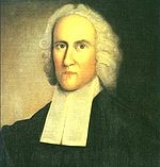
Jonathan Edwards

 
Jonathan Edwards

   Email Print
   Bookmark   Link


Jonathan Edwards


This article is about the theologian (b. 1703), for other uses of Jonathan Edwards see Jonathan Edwards
Jonathan Edwards

This article is about the theologian , for other uses of Jonathan Edwards see Jonathan Edwards.Jonathan Edwards was a Thirteen Colonies Congregational church preacher, theologian, and missionary to Native Americans in the United States....
.


Jonathan Edwards (October 5, 1703 – March 22, 1758) was a colonial American
Thirteen Colonies

The Thirteen Colonies were part of what became known as British America, a name that was used by Great Britain until the Treaty of Paris recognized the independence of the original thirteen United States of America in 1783....
 Congregational
Congregational church

Congregational churches are Protestantism Christianity churches practicing congregationalist church governance, in which each Wiktionary:congregation independently and autonomously runs its own affairs....
 preacher, theologian, and missionary
Missionary

A 'missionary' is a member of a religion who works to convert those who do not share the missionary's faith; someone who Proselytism. The word "mission" is derived from the Latin missioninimus...
 to Native Americans
Native Americans in the United States

Native Americans in the United States are the Indigenous peoples of the Americas from the regions of North America now encompassed by the continental United States United States, including parts of Alaska and the island state of Hawaii....
. Edwards "is widely acknowledged to be America's most important and original philosophical theologian". His work is very broad in scope, but he is often associated with his defense of Calvinist
Calvinism

Calvinism is a theology system and an approach to the Christian life that emphasizes the rule of God over all things. It was developed by several theologians, but it bears the name of the French Protestant Reformation John Calvin because of his prominent influence on it and because of his role in the confessional and ecclesiastical debates t...
 theology, the metaphysics
Metaphysics

Metaphysics investigates principles of reality transcending those of any particular science. cosmology and ontology are traditional branches of metaphysics....
 of theological determinism, and the Puritan
Puritan

A Puritan of 16th and 17th century England was an associate of any number of religious groups advocating for more "purity" of worship and doctrine, as well as personal and group pietism....
 heritage.


Discussion
Ask a question about 'Jonathan Edwards'
Start a new discussion about 'Jonathan Edwards'
Answer questions from other users
Full Discussion Forum


Recent Posts


Quotations


I assert that nothing ever comes to pass without a cause.

The Freedom of the Will (1754)

Intend to live in continual mortification, and never to expect or desire any worldly ease or pleasure.

Diary (1723)

Resolved, always to do that, which I shall wish I had done when I see others do it.

No. 69

Resolved, never to do anything out of revenge.

No. 14

Resolved, never to do anything which I should be afraid to do if it were the last hour of my life.

No. 7

Resolved, never to lose one moment of time; but improve it the most profitable way I possibly can.

No. 5


Encyclopedia


This article is about the theologian (b. 1703), for other uses of Jonathan Edwards see Jonathan Edwards
Jonathan Edwards

This article is about the theologian , for other uses of Jonathan Edwards see Jonathan Edwards.Jonathan Edwards was a Thirteen Colonies Congregational church preacher, theologian, and missionary to Native Americans in the United States....
.


Jonathan Edwards (October 5, 1703 – March 22, 1758) was a colonial American
Thirteen Colonies

The Thirteen Colonies were part of what became known as British America, a name that was used by Great Britain until the Treaty of Paris recognized the independence of the original thirteen United States of America in 1783....
 Congregational
Congregational church

Congregational churches are Protestantism Christianity churches practicing congregationalist church governance, in which each Wiktionary:congregation independently and autonomously runs its own affairs....
 preacher, theologian, and missionary
Missionary

A 'missionary' is a member of a religion who works to convert those who do not share the missionary's faith; someone who Proselytism. The word "mission" is derived from the Latin missioninimus...
 to Native Americans
Native Americans in the United States

Native Americans in the United States are the Indigenous peoples of the Americas from the regions of North America now encompassed by the continental United States United States, including parts of Alaska and the island state of Hawaii....
. Edwards "is widely acknowledged to be America's most important and original philosophical theologian". His work is very broad in scope, but he is often associated with his defense of Calvinist
Calvinism

Calvinism is a theology system and an approach to the Christian life that emphasizes the rule of God over all things. It was developed by several theologians, but it bears the name of the French Protestant Reformation John Calvin because of his prominent influence on it and because of his role in the confessional and ecclesiastical debates t...
 theology, the metaphysics
Metaphysics

Metaphysics investigates principles of reality transcending those of any particular science. cosmology and ontology are traditional branches of metaphysics....
 of theological determinism, and the Puritan
Puritan

A Puritan of 16th and 17th century England was an associate of any number of religious groups advocating for more "purity" of worship and doctrine, as well as personal and group pietism....
 heritage. His famous sermon "Sinners in the Hands of an Angry God
Sinners in the Hands of an Angry God

Most famously preached on July 8, 1741 in Enfield, Connecticut, Connecticut, "Sinners in the Hands of an Angry God", is Jonathan Edwards most recognizable sermon....
," emphasized the just wrath of God against sin and contrasted it with the provision of God for salvation; the intensity of his preaching sometimes resulted in members of the audience fainting, swooning, and other more obtrusive reactions. The swooning and other behaviors in his audience caught him up in a controversy over "bodily effects" of the Holy Spirit's presence.

Early life

Jonathan Edwards, born on October 5, 1703, was the son of Timothy Edwards (1668–1759), a minister at East Windsor, Connecticut
East Windsor, Connecticut

East Windsor is a town in Hartford County, Connecticut, Connecticut, United States. The population was 9,818 at the 2000 United States Census....
 (modern day South Windsor
South Windsor, Connecticut

South Windsor is a town in Hartford County, Connecticut, Connecticut, United States. The population was 24,412 at the 2000 United States Census....
) who eked out his salary by tutoring boys for college. His mother, Esther Stoddard, daughter of the Rev. Solomon Stoddard
Solomon Stoddard

Solomon Stoddard was the United States colonial minister who succeeded Rev. Eleazer Mather as pastor at Northampton, Massachusetts, where he died, after Mather?s death....
, of Northampton, Massachusetts
Northampton, Massachusetts

Northampton is a city in Hampshire County, Massachusetts, Massachusetts, United States. The population was 28,978 at the 2000 census. It is the county seat of Hampshire County....
, seems to have been a woman of unusual mental gifts and independence of character.

Jonathan, their only son, was the fifth of eleven children. He was trained for college by his father and by his elder sisters, all of whom received an excellent education. When ten years old, he wrote a semi-humorous tract on the immateriality of the soul. He was interested in natural history and, at the age of eleven, wrote a remarkable essay on the habits of the "flying spider."

He entered Yale College
Yale University

Yale University is a private university in New Haven, Connecticut. Founded in 1701 as the Collegiate School, Yale is the Colonial Colleges institution of higher education in the United States and is a member of the Ivy League....
 in 1716, at just under the age of thirteen. In the following year, he became acquainted with John Locke
John Locke

John Locke was an English philosopher. Locke is considered the first of the British Empiricism, but is equally important to social contract theory....
's Essay Concerning Human Understanding, which influenced him profoundly. During his college studies, he kept note books labelled "The Mind," "Natural Science" (containing a discussion of the atomic theory
Atomic theory

In chemistry and physics, atomic theory is a theory of the nature of matter, which states that matter is composed of discrete units called atoms, as opposed to the obsolete notion that matter could be divided into any arbitrarily small quantity....
), "The Scriptures" and "Miscellanies," had a grand plan for a work on natural and mental philosophy, and drew up for himself rules for its composition. Even before his graduation in September 1720, as valedictorian and head of his class, he seems to have had a well formulated philosophy. He spent two years after his graduation in New Haven
New Haven, Connecticut

New Haven is the third largest municipality in Connecticut, after Bridgeport, Connecticut and Hartford, with a core population of about 124,000 people....
 studying theology.

In 1722 to 1723, he was, for eight months, "stated supply" (a clergyman employed to supply a pulpit for a definite time, but not settled as a pastor) of a small Presbyterian Church in New York City
New York City

The City of New York is the List of United States cities by population in the United States, while the New York metropolitan area ranks among the List of urban areas by population....
. The church invited him to remain, but he declined the call. After spending two months in study at home, in 1724–1726, he was one of the two tutors at Yale, earning for himself the name of a "pillar tutor", from his steadfast loyalty to the college and its orthodox teaching, at the time when Yale's rector (Timothy Cutler
Timothy Cutler

Timothy Cutler was an American Episcopal Church in the United States of America clergyman and rector of Yale College....
) and one of her tutors had gone over to the Episcopal Church.

The years, 1720 to 1726, are partially recorded in his diary and in the resolutions for his own conduct which he drew up at this time. He had long been an eager seeker after salvation
Salvation

In religion, salvation is the concept that God saves humanity from death. As commonly conceived, He has both Will of God and omnipotence to realize human salvation....
 and was not fully satisfied as to his own conversion until an experience in his last year in college, when he lost his feeling that the election
Unconditional election

Unconditional election is the Calvinism teaching that before God created the world, he chose to salvation some people according to his own purposes and apart from any conditions related to those persons....
 of some to salvation and of others to eternal damnation was "a horrible doctrine," and reckoned it "exceedingly pleasant, bright and sweet." He now took a great and new joy in the beauties of nature, and delighted in the allegorical interpretation of the Song of Solomon
Song of Solomon

The Song of Songs , is a book of the Hebrew Bible—Tanakh or Old Testament—one of the five The Five Scrolls . It is also known as the Song of Solomon or as Canticles, the latter from the shortened and anglicized Vulgate title Canticum Canticorum, "Song of Songs" in Latin language....
. Balancing these mystic joys is the stern tone of his Resolutions, in which he is almost ascetic in his eagerness to live earnestly and soberly, to waste no time, to maintain the strictest temperance in eating and drinking.

On February 15, 1727, he was ordained minister at Northampton
Northampton, Massachusetts

Northampton is a city in Hampshire County, Massachusetts, Massachusetts, United States. The population was 28,978 at the 2000 census. It is the county seat of Hampshire County....
 and assistant to his grandfather, Solomon Stoddard. He was a scholar-pastor, not a visiting pastor, his rule being thirteen hours of study a day. In the same year, he married Sarah Pierpont. She was then aged seventeen and daughter of James Pierpont
James Pierpont (Yale founder)

James Pierpont was a Congregational church minister who is credited with the founding of Yale University in the United States. In 1701, Pierpont, a graduate of The Roxbury Latin School and Harvard University, secured the charter for The Collegiate School of Connecticut, which soon thereafter took the surname of its benefactor Elihu Yale....
 (1659–1714), a founder of Yale and, through her mother, great-granddaughter of Thomas Hooker
Thomas Hooker

Thomas Hooker was a prominent Puritan religious and colonial leader and the pre-eminent founder of the Colony of Connecticut. He was known as a great speaker and a leader of universal Christian suffrage....
. Of her piety and almost nun-like love of God and belief in His personal love for her, Edwards had known when she was only thirteen, and had written of it with spiritual enthusiasm. She was of a bright and cheerful disposition, a practical housekeeper, a model wife and the mother of his eleven children. Solomon Stoddard died on February 11, 1729, leaving to his grandson the difficult task of the sole ministerial charge of one of the largest and wealthiest congregations in the colony, and one proud of its morality, its culture and its reputation.

Great Awakening

On July 8, 1731, Edwards preached in Boston the "Public Lecture" afterwards published under the title "God Glorified — in Man's Dependence," which was his first public attack on Arminianism
Arminianism

Arminianism is a school of Soteriology thought within Protestant Christianity based on the Christian theology ideas of the Netherlands Dutch Reformed theologian Jacobus Arminius and his historic followers, the Remonstrants....
. The leading thought of the lecture was God's absolute sovereignty in the work of salvation
Salvation

In religion, salvation is the concept that God saves humanity from death. As commonly conceived, He has both Will of God and omnipotence to realize human salvation....
: that while it behooved God to create man pure and without sin
Sin

Sin is a term used mainly in a religion context to describe an act that violates a morality rule, or the state of having committed such a violation....
, it was of his "good pleasure" and "mere and arbitrary grace
Divine grace

In theology, grace may be described as 'enabling power sufficient for progression'. In Christianity, grace divine is an "unmerited favour" of God, indispensable gift from God for development, improvement, and character expansion, and without God's grace, there are certain limitations, weaknesses, flaws, impurities, and faults mankind cannot...
" for him to grant any person the faith necessary to incline him or her toward holiness; and that God might deny this grace without any disparagement to any of his character.

In 1733, a religious revival began in Northampton, and reached such intensity, in the winter of 1734 and the following spring, as to threaten the business of the town. In six months, nearly three hundred were admitted to the church. The revival gave Edwards an opportunity for studying the process of conversion in all its phases and varieties, and he recorded his observations with psychological minuteness and discrimination in A Faithful Narrative of the Surprising Work of God in the Conversion of Many Hundred Souls in Northampton (1737). A year later, he published Discourses on Various Important Subjects, the five sermons which had proved most effective in the revival, and of these, none, he tells us, was so immediately effective as that on the Justice of God in the Damnation of Sinners, from the text, "That every mouth may be stopped." Another sermon, published in 1734, on the Reality of Spiritual Light set forth what he regarded as the inner, moving principle of the revival, the doctrine of a special grace in the immediate, and supernatural divine illumination of the soul.

In the spring of 1735, the movement began to subside and a reaction set in. But the relapse was brief, and the Northampton revival, which had spread through the Connecticut valley and whose fame had reached England and Scotland, was followed in 1739–1740 by the Great Awakening
Great Awakening

The Great Awakenings were several periods of rapid and dramatic religious revival in Anglo-American religious history, generally recognized as beginning in the 1730s....
, distinctively under the leadership of Edwards. It was at this time that Edwards became acquainted with George Whitefield
George Whitefield

George Whitefield , also known as George Whitfield, , an Anglican itinerant minister who helped spread the Great Awakening in Great Britain and, especially, in the British North American colonies....
, and Edwards preached his most famous sermon, "Sinners in the Hands of an Angry God
Sinners in the Hands of an Angry God

Most famously preached on July 8, 1741 in Enfield, Connecticut, Connecticut, "Sinners in the Hands of an Angry God", is Jonathan Edwards most recognizable sermon....
" in Enfield, Connecticut
Enfield, Connecticut

Enfield is a New England town located in Hartford County, Connecticut, Connecticut, United States. The population was 45,212 at the 2000 United States Census....
 in 1741. This sermon has been widely reprinted as an example of "fire and brimstone" preaching in the colonial revivals.

The movement met with opposition from conservative Congregationalist ministers. In 1741, Edwards published in its defense The Distinguishing Marks of a Work of the Spirit of God, dealing particularly with the phenomena most criticized: the swoonings, outcries and convulsions. These "bodily effects," he insisted, were not distinguishing marks of the work of the Spirit of God one way or another; but so bitter was the feeling against the revival in the more strictly Puritan churches that, in 1742, he was forced to write a second apology, Thoughts on the Revival in New England, his main argument being the great moral improvement of the country. In the same pamphlet, he defends an appeal to the emotions, and advocates preaching terror when necessary, even to children, who in God's sight "are young vipers… if not Christ's." He considers "bodily effects" incidentals to the real work of God, but his own mystic devotion and the experiences of his wife during the Awakening (which he gives in detail) make him think that the divine visitation usually overpowers the body, a view in support of which he quotes Scripture. In reply to Edwards, Charles Chauncy
Charles Chauncy (1705-1787)

Charles Chauncy was an American Congregational clergyman in Boston. He was ordained as a minister of the First Church, Boston, in 1727 and remained in that pulpit for 60 years....
 wrote Seasonable Thoughts on the State of Religion in New England in 1743 and anonymously penned The Late Religious Commotions in New England Considered in the same year. In these works he urged conduct as the sole test of conversion; and the general convention of Congregational ministers in the Province of Massachusetts Bay protested "against disorders in practice which have of late obtained in various parts of the land."

In spite of Edwards's able pamphlet, the impression had become widespread that "bodily effects" were recognized by the promoters of the Great Awakening as the true tests of conversion. To offset this feeling, Edwards preached at Northampton, during the years 1742 and 1743, a series of sermons published under the title of Religious Affections (1746), a restatement in a more philosophical and general tone of his ideas as to "distinguishing marks." In 1747, he joined the movement started in Scotland called the "concert in prayer," and in the same year published An Humble Attempt to Promote Explicit Agreement and Visible Union of God's People in Extraordinary Prayer for the Revival of Religion and the Advancement of Christ's Kingdom on Earth. In 1749, he published a memoir of David Brainerd
David Brainerd

David Brainerd, was an United States missionary to the Native Americans in the United States.Brainerd was born in Haddam, Connecticut. He was orphaned at fourteen and had an experience that intensified his dedication to Christianity at age 21 in 1739....
 who had lived with his family for several months and had died at Northhampton in 1747. Brainerd had been constantly attended by Edwards's daughter Jerusha, to whom he was rumored to have been engaged to be married, though there is no surviving evidence for this. In the course of elaborating his theories of conversion Edwards used Brainerd and his ministry as a case study, making extensive notes of his conversions and confessions.

Science and aesthetics

Edwards was fascinated by the discoveries of Isaac Newton
Isaac Newton

Sir Isaac Newton, Fellow of the Royal Society was an English people physicist, mathematician, Astronomy, Natural philosophy, Alchemy, and Theology and one of the the 100 in human history....
 and other scientists
Science

In its broadest sense, science refers to any systematic knowledge or practice. In its more usual restricted sense, science refers to a system of acquiring knowledge based on scientific method, as well as to the organized body of knowledge gained through such research....
 of his age. Before he undertook full-time ministry work in Northampton, he wrote on various topics in natural philosophy, including "flying spider
Spider

Spiders are air-breathing chelicerate arthropods that have eight legs, and chelicerae modified into fangs that inject venom. In their bodies the usual arthropod segments are fused into two Tagma , the cephalothorax and abdomen, joined by a small, cylindrical pedicel....
s," light
Light

Light, or visible light, is electromagnetic radiation of a wavelength that is Visible spectrum to the human eye , or up to 380?750 nm. In the broader field of physics, light is sometimes used to refer to electromagnetic radiation of all wavelengths, whether visible or not....
, and optics
Optics

Optics is the study of the behavior and properties of light including its optical phenomena with matter and its imaging by optical instruments....
. While he was worried about the materialism
Materialism

The philosophy of materialism holds that the only thing that can be truly proven to existence is matter, and is considered a form of physicalism....
 and faith in reason alone of some of his contemporaries, he saw the laws of nature as derived from God and demonstrating his wisdom and care. Hence, scientific discoveries did not threaten his faith, and for him, there was no inherent conflict between the spiritual and material.

Edwards also wrote sermons and theological treatises that emphasized the beauty of God and the role of aesthetics
Aesthetics

Aesthetics or esthetics is commonly known as the study of senses or sensori-emotional values, sometimes called judgments of sentiment and taste ....
 in the spiritual life, in which he anticipates a twentieth-century current of theological aesthetics, represented by figures like Hans Urs von Balthasar
Hans Urs von Balthasar

Hans Urs von Balthasar was a Switzerland theologian and priest who was nominated to be a Cardinal of the Catholic Church....
.

Later years

In 1748, there had come a crisis in his relations with his congregation. The Half-Way Covenant
Half-Way Covenant

The Half-Way Covenant was a form of partial church membership created by New England Puritans in 1662. It was promoted in particular by the Reverend Solomon Stoddard, who felt that the people of the English colonies were drifting away from their original religious purpose....
, adopted by the synods of 1657 and 1662, had made baptism
Baptism

In Christianity, baptism is the ritual act, with the use of water, by which one is admitted as a full member of the Christian Church and, in the view of some, as a member of the particular Church in which the baptism is administered....
 alone the condition to the civil privileges of church membership, but not of participation in the sacrament
Sacrament

A sacrament, as defined in Hexam's Concise Dictionary of Religion is "a rite in which God is uniquely active." Augustine of Hippo defined a Christian sacrament as "a visible sign of an invisible reality." The Anglican Book of Common Prayer speaks of them as "an outward and visible sign of an inward and invisible Grace." Examples of sacram...
 of the Lord's Supper
Eucharist

The Eucharist, also called Holy Communion or Lord's Supper and other names, is a Christianity sacrament commemorating, by consecrating bread and wine, the Last Supper, the final meal that Jesus Christ shared with his disciples before his arrest, and eventual crucifixion, when he gave them bread saying, "This is my body", and wine...
. Edwards's grandfather and predecessor in the pastorate, Solomon Stoddard, had been even more liberal, holding that the Supper was a converting ordinance and that baptism was a sufficient title to all the privileges of the church. As early as 1744, Edwards, in his sermons on Religious Affections, had plainly intimated his dislike of this practice. In the same year, he had published in a church meeting the names of certain young people, members of the church, who were suspected of reading improper books, and also the names of those who were to be called as witnesses in the case. It has often been reported that the witnesses and accused were not distinguished on this list, and so, therefore, the entire congregation was in an uproar. However, Patricia Tracy's research has cast doubt on this version of the events, noting that in the list he read from, the names were definitely distinguished. Those involved were eventually disciplined for disrespect to the investigators rather than for the original incident. In any case, the incident further deteriorated the relationship between Edwards and the congregation. In a time of significant cultural foment, he was associated with the old guard.

Edwards's preaching became unpopular. For four years, no candidate presented himself for admission to the church, and when one did, in 1748, he was met with Edwards's formal but mild and gentle tests, as expressed in the Distinguishing Marks and later in Qualifications for Full Communion (1749). The candidate refused to submit to them, the church backed him, and the break between the church and Edwards was complete. Even permission to discuss his views in the pulpit was refused him. He was allowed to present his views on Thursday afternoons. His sermons were well attended by visitors, but not his own congregation. A council was convened to decide the communion matter between the minister and his people. The congregation chose half the council, and Edwards was allowed to select the other half of the council. His congregation, however, limited his selection to one county where the majority of the ministers were against him. The ecclesiastical council voted that the pastoral relation be dissolved. The church members, by a vote of more than 200 to 23, ratified the action of the council, and finally a town meeting voted that Edwards should not be allowed to occupy the Northampton pulpit, though he continued to live in the town and preach in the church by the request of the congregation until October 1751. He evinced no rancour or spite; his "Farewell Sermon" was dignified and temperate; he preached from 2 Cor. 1:14 and directed the thoughts of his people to that far future when the minister and his people would stand before God; nor is it to be ascribed to chagrin that in a letter to Scotland after his dismissal he expresses his preference for Presbyterian to Congregational church government. His position at the time was not unpopular throughout New England; his doctrine that the Lord's Supper is not a cause of regeneration and that communicants should be professing Christians has since (very largely through the efforts of his pupil Joseph Bellamy
Joseph Bellamy

Joseph Bellamy was an United States Congregationalist pastor and a leading preacher, author, educator and theologian in New England in the second half of the Eighteenth century....
) become a standard of New England Congregationalism.

Edwards, with his large family, was now thrown upon the world, but offers of aid quickly came to him. A parish in Scotland could have been procured, and he was called to a Virginia church. He declined both, to become, in 1750, pastor of the church in Stockbridge
Stockbridge

Stockbridge may refer to:...
 and a missionary to the Housatonic Indians. To the Indians, he preached through an interpreter, and their interests he boldly and successfully defended by attacking the whites who were using their official positions among them to increase their private fortunes. In Stockbridge
Stockbridge, Massachusetts

Stockbridge is a New England town in Berkshire County, Massachusetts in Western Massachusetts Massachusetts. It is part of the Pittsfield, Massachusetts, Massachusetts, Metropolitan Statistical Area....
, he wrote the Humble Relation, also called Reply to Williams (1752), which was an answer to Solomon Williams (1700–1776), a relative and a bitter opponent of Edwards as to the qualifications for full communion; and he there composed the treatises on which his reputation as a philosophical theologian chiefly rests, the essay on Original Sin
Original sin

Original sin is, according to a doctrine in Christian theology, humanity's state of sin resulting from the Fall of Man. While the Old Testament and the New Testament, which frequently speak of the sinfulness of humans, do not contain the terms "original sin" or "ancestral sin", the doctrine expressed by these terms is claimed to be based on t...
, the Dissertation Concerning the Nature of True Virtue, the Dissertation Concerning the End for which God created the World, and the great work on the Will, written in four months and a half, and published in 1754 under the title, An Inquiry into the Modern Prevailing Notions Respecting that Freedom of the Will which is supposed to be Essential to Moral Agency.

In 1757, on the death of the Reverend
The Reverend

Reverend or the Reverend is a Style used as a prefix to the names of many Christian clergy and Minister of religions. "The Reverend" is formally called a style but commonly and in dictionaries called a title, form of address, or title of respect....
 Aaron Burr
Aaron Burr, Sr.

The Reverend Aaron Burr was a notable divine and educator in colonial America. He was a founder of the College of New Jersey and the father of the third United States Vice President Aaron Burr ....
, who five years before had married Edwards's daughter Esther and was the father of future US vice-president Aaron Burr
Aaron Burr

Aaron Burr, Jr. was an United States politician, American Revolutionary War hero, and adventurer. He served as the List of Vice Presidents of the United States Vice President of the United States , under Thomas Jefferson....
, he reluctantly agreed to replace his late son-in-law as the president of the College of New Jersey (now Princeton University
Princeton University

Princeton University is a private university university located in Princeton, New Jersey, New Jersey, United States. The school is one of the eight universities of the Ivy League and has the largest per-student Financial endowment in the world....
), where he was installed on February 16, 1758.

Almost immediately after becoming president, he was inoculated for smallpox
Smallpox

Smallpox is an infectious disease unique to humans, caused by either of two virus variants, Variola major and Variola minor. The disease is also known by the Latin names Variola or Variola vera, which is a derivative of the Latin varius, meaning spotted, or varus, meaning "pimple"....
, which was raging in Princeton, New Jersey
Princeton, New Jersey

Princeton, New Jersey is located in Mercer County, New Jersey, New Jersey, United States. Princeton University has been sited in the town since 1756....
. Never in robust health, he died of the inoculation on March 22, 1758. He was buried in Princeton Cemetery
Princeton Cemetery

Princeton Cemetery is located in Borough of Princeton, New Jersey. It is owned by the Nassau Presbyterian Church. John F. Hageman in his 1878 history of Princeton, New Jersey refers to the cemetery as: "The Westminster Abbey of the United States." ...
. Edwards had three sons and eight daughters.

Legacy

The followers of Jonathan Edwards and his disciples came to be known as the New Light Calvinist ministers, as opposed to the traditional Old Light Calvinist ministers. Prominent disciples included Samuel Hopkins, Joseph Bellamy
Joseph Bellamy

Joseph Bellamy was an United States Congregationalist pastor and a leading preacher, author, educator and theologian in New England in the second half of the Eighteenth century....
, Jonathan Edwards's son Jonathan Edwards Jr.
Jonathan Edwards (the younger)

This article is about the theologian , for other uses of Jonathan Edwards see Jonathan Edwards.Jonathan Edwards was an United States theologian and linguistics....
 and Gideon Hawley
Gideon Hawley

Gideon Hawley was a missionary to the Iroquois Indigenous peoples of the Americas in Massachusetts and on the Susquehanna River in New York....
. Through a practice of apprentice ministers living in the homes of older ministers, they eventually filled a large number of pastorates in the New England
New England

New England is a region of the United States located in the northeastern corner of the country, bounded by the Atlantic Ocean, Canada and New York State, and consisting of the modern U.S....
 area. Many of Jonathan and Sarah Edwards's descendants became prominent citizens in the United States, including the Vice President Aaron Burr
Aaron Burr

Aaron Burr, Jr. was an United States politician, American Revolutionary War hero, and adventurer. He served as the List of Vice Presidents of the United States Vice President of the United States , under Thomas Jefferson....
 and the College Presidents Timothy Dwight
Timothy Dwight

Timothy Dwight may refer to:*Timothy Dwight College, a residential college at Yale University*Timothy Dwight IV , President of Yale University from 1795?1817...
, Jonathan Edwards Jr.
Jonathan Edwards (the younger)

This article is about the theologian , for other uses of Jonathan Edwards see Jonathan Edwards.Jonathan Edwards was an United States theologian and linguistics....
 and Merrill Edwards Gates
Merrill Edwards Gates

Merrill Edward Gates, LL.D. was the ninth President of Rutgers University serving from 1882 to 1890, and the sixth President of Amherst College, serving from 1890 to 1899....
. Jonathan and Sarah Edwards were also ancestors of the First Lady
First Lady of the United States

First Lady of the United States is the unofficial title of the hostess of the White House. Because this position is traditionally filled by the wife of the President of the United States, the title is sometimes taken to apply only to the wife of a sitting President....
 Edith Roosevelt
Edith Roosevelt

Edith Kermit Carow Roosevelt , second wife of Theodore Roosevelt, was First Lady of the United States from 1901 to 1909....
, the writer O. Henry
O. Henry

O. Henry was the pen name of United States writer William Sydney Porter . O. Henry short stories are known for wit, wordplay, warm characterization and clever twist endings....
, the publisher Frank Nelson Doubleday
Frank Nelson Doubleday

Frank Nelson Doubleday , known to friends and family as ?Effendi?, was a famous United States of America publisher. His most significant achievement was as founder of the eponymous Doubleday in 1897....
 and the writer Robert Lowell
Robert Lowell

Robert Traill Spence Lowell IV was an American poet, considered the founder of the confessional poetry movement. He was appointed the sixth Poet Laureate Consultant in Poetry to the Library of Congress in 1946....
.

Edwards's writings and beliefs continue to influence individuals and groups to this day. Early American Board of Commissioners for Foreign Missions
American Board of Commissioners for Foreign Missions

The American Board of Commissioners for Foreign Missions was the first United States of America Christian foreign mission agency. It was proposed in 1810 by recent graduates of Williams College and officially chartered in 1812....
 missionaries were influenced by Edwards' writings, as is evidenced in reports in the ABCFM's journal "The Missionary Herald," and beginning with Perry Miller
Perry Miller

Perry G. Miller was an United States intellectual historian and Harvard University professor. He was an authority on American Puritanism. Alfred Kazin referred to him as "the master of American intellectual history"....
's seminal work, Edwards enjoyed a renaissance among scholars after the end of the Second World War
World War II

World War II, or the Second World War , was a global military conflict which involved a Participants in World War II, including all of the great powers, organised into two opposing military alliances: the Allies of World War II and the Axis powers....
. The Banner of Truth Trust
Banner of Truth Trust

The Banner of Truth Trust is an Protestantism and Reformed Christian publishing house founded in London in 1957 by Iain Murray and Jack Cullum. Its offices are now in Edinburgh, Scotland with a key branch office and distribution point in Carlisle, Pennsylvania....
 and other publishers continue to reprint Edwards's works, and most of his major works are now available through the series published by Yale University Press
Yale University Press

Yale University Press is a book publisher 1908 in literature by George Parmly Day. It became an official Academic department of Yale University 1961 in literature, but remains financially and operationally autonomous....
, which has spanned three decades and supplies critical introductions by the editor of each volume. Yale has also established the Jonathan Edwards Project online. Author and teacher, Elisabeth Woodbridge Morris, memorialized him, her paternal ancestor (3rd great grandfather) in two books, The Jonathon Papers (1912), and More Jonathon Papers (1915). In 1933, he became the namesake of Jonathan Edwards College
Jonathan Edwards College

Jonathan Edwards College is a residential college at Yale University. Established in 1932, it is the oldest of Yale College and is generally called "J.E."...
, one of the first of the twelve residential colleges of Yale.

Edwards is commemorated as a teacher and missionary by the Evangelical Lutheran Church
Evangelical Lutheran Church

Evangelical Lutheran Church can refer to many different Lutheran churches in the world. Among them are the following:*Evangelical Lutheran Church in America...
 in America on March 22.

Works

Many of Edwards's works have been regularly reprinted. Some of the major works are:
  • , reprinted by Diggory Press ISBN 978-1846857225
  • , reprinted by Diggory Press ISBN 978-1846856334
  • , reprinted by Diggory Press ISBN 978-1846857461
  • , reprinted by Diggory Press ISBN 978-1846856242
  • , reprinted by Diggory Press ISBN 978-1846856372
  • , reprinted by Diggory Press ISBN 978-1846856198
  • , reprinted by Diggory Press ISBN 978-1846857607
  • , reprinted by Diggory Press ISBN 978-1846853791
  • , reprinted by Diggory Press ISBN 978-1846853814
  • , reprinted by Diggory Press ISBN 978-1846857591
  • , reprinted by Banner of Truth ISBN 978-0851513515
  • (1732), online text at


See also

  • Atonement (Governmental view)
    Atonement (governmental view)

    The governmental view of the atonement is a doctrine in Christian theology concerning the meaning and effect of the death of Jesus and has been traditionally taught in Arminianism circles that draw primarily from the works of Hugo Grotius....
  • Colonial America
    Colonial America

    The term colonial history of the United States refers to the history of the land that would become the United States from the start of European colonization of the Americas to the time of independence from Europe, and especially to the history of the thirteen colonies which declared themselves independent in 1776....
  • Congregational church
    Congregational church

    Congregational churches are Protestantism Christianity churches practicing congregationalist church governance, in which each Wiktionary:congregation independently and autonomously runs its own affairs....
  • Great Awakening
    First Great Awakening

    The First Great Awakening, was a period of heightened religious activity, primarily in the United Kingdom and its British America in the 1730s and 1740s.The First Great Awakening led to changes in colonial society....
  • Sinners in the Hands of an Angry God
    Sinners in the Hands of an Angry God

    Most famously preached on July 8, 1741 in Enfield, Connecticut, Connecticut, "Sinners in the Hands of an Angry God", is Jonathan Edwards most recognizable sermon....
  • Jonathan Edwards College
    Jonathan Edwards College

    Jonathan Edwards College is a residential college at Yale University. Established in 1932, it is the oldest of Yale College and is generally called "J.E."...
  • Argument from beauty
    Argument from beauty

    The argument from beauty is an argument for the existence of God as against materialism....


External links


Primary sources

  • in PDF
  • Audio recordings of Edwards' Works in MP3
    MP3

    MPEG-1 Audio Layer 3, more commonly referred to as MP3, is a digital audio Encoder format using a form of lossy data compression. It is a common audio format for consumer audio storage, as well as a de facto standard encoding for the transfer and playback of music on digital audio players....
     format: ,


Other

  • , a lecture by John Piper
  • , an article from conservative, Reformed perspective
  • , an Edwards bibliography


Further reading


ISBN 0-85151-397-2