
|
|
|
|
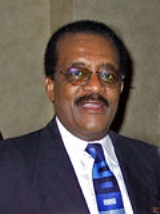
Johnnie Cochran
|
| |
|
| |
Johnnie L. Cochran, Jr. (October 2, 1937 March 29, 2005) was an American lawyer best known for his leadership role in the defense and criminal acquittal of O. J. Simpson for the murder of his former wife Nicole Simpson and her friend Ronald Goldman.
Cochran also represented Sean Combs (during his trial on gun and bribery charges), Michael Jackson, actor Todd Bridges, football player Jim Brown, rapper Snoop Dogg, former heavyweight Champion Riddick Bowe, and Reginald Oliver Denny, the trucker beaten by a mob during the 1992 Los Angeles riots.
He also defended athlete Marion Jones when she faced charges of doping during her high school track career.

Discussion
Ask a question about 'Johnnie Cochran'
Start a new discussion about 'Johnnie Cochran'
Answer questions from other users
|
Encyclopedia
Johnnie L. Cochran, Jr. (October 2, 1937 March 29, 2005) was an American lawyer best known for his leadership role in the defense and criminal acquittal of O. J. Simpson for the murder of his former wife Nicole Simpson and her friend Ronald Goldman.
Cochran also represented Sean Combs (during his trial on gun and bribery charges), Michael Jackson, actor Todd Bridges, football player Jim Brown, rapper Snoop Dogg, former heavyweight Champion Riddick Bowe, and Reginald Oliver Denny, the trucker beaten by a mob during the 1992 Los Angeles riots.
He also defended athlete Marion Jones when she faced charges of doping during her high school track career. Cochran was known for his skill in the courtroom and his prominence as an early advocate for victims of alleged police abuse.
Early life
Cochran completed his undergraduate degree at UCLA and earned his law degree at Loyola Marymount University School of Law (now Loyola Law School) in Los Angeles. He was a member of Kappa Alpha Psi Fraternity. The "L" in his middle name does not stand for anything.
Legal practice
Inspired by Thurgood Marshall and the legal victory he won in Brown v. Board of Education, Johnnie Cochran decided to dedicate his life to practicing law. Cochran felt his career was a calling, a double opportunity to work for what he considered to be right and to challenge what he considered wrong; he could make a difference by practicing law. In A Lawyer's Life, Cochran wrote:
- "I read everything that I could find about Thurgood Marshall and confirmed that a single dedicated man could use the law to change society."
Despite setbacks as a lawyer, Cochran vowed not to cease what he was doing, saying "I made this commitment and I must fulfill it."
Cochran took a job in Los Angeles as a Deputy City Attorney in the criminal division, after he passed the California bar in 1963. Two years later, he entered private practice and soon opened his own firm, Cochran, Atkins & Evans. In his first notable case, Cochran represented a widow who sued several police officers who had shot and killed her husband. Though Cochran lost the case for his client, Mrs. Leonard Deadwyler, it became a turning point in his career. Rather than seeing the case as a defeat, Cochran realized that the trial itself had awakened the African-American community. In reference to the loss, Cochran wrote, "Those were extremely difficult cases to win in those days. But what Deadwyler confirmed for me was that this issue of police abuse really galvanized the minority community. It taught me that these cases could really get attention" in The American Lawyer. By the late 1970s, Cochran had established his reputation in the black community. He was litigating a number of high-profile police brutality and criminal cases.
Los Angeles County District Attorney's office
In 1978 Cochran joined the Los Angeles County District Attorney's office as its first African-American Assistant District Attorney. Though he took a pay cut to do so, joining the government was his way of becoming "one of the good guys, one of the very top rung." He began to strengthen his ties with the political community, alter his image and work from within to change the system.
Five years later, Cochran returned to private practice, reinventing himself as "the best in the West" by opening the Johnnie L. Cochran, Jr. law firm. In contrast to his early loss in the Deadwyler case, Cochran won $760,000 for the family of Ron Settles, a black college football player who, his family claimed, was murdered by the police. In 1990 he joined a succeeding firm, Cochran, Mitchell & Jenna.
Even though Johnnie Cochran is no longer alive, he has twenty six offices located in fifteen states. Those states are of the following; Miami FL, Dothan AL, Tuskegee AL, Atlanta GA, Huntsville AL, Birmingham AL, Mobile AL, New Orleans LA (2), Metairie LA, Houston TX, Dallas TX, Memphis TN, St. Louis MO, Chicago IL, West Farmington Hills MI, Washington D.C., Philadelphia PA, New York NY, Las Vegas NV, Los Angeles CA, San Jose CA, Oakland CA, Sacramento CA, Shreveport LA, and Jackson MS.
Tort reform
Cochran opposed tort reform and in most of his cases represented plaintiffs in tort actions. He founded The Cochran Firm, a law firm that specializes in personal injury cases and has grown through mergers and partnerships to have offices in Alabama, California, Florida, Georgia, Illinois, Louisiana, Maryland, Missouri, Nevada, New York, Tennessee, Texas, Virginia and Washington, D.C. Because of his success as a lawyer, Cochran could encourage settlement simply by his presence on a case. According to Jesse Jackson, a call to Johnnie Cochran made "corporations and violators shake."
Johnnie Cochran's well-honed rhetoric and flamboyance in the courtroom has been described as theatrical. His practice as a lawyer earned him great wealth. He was said to have earned $40 million ($1 million a year) in trying cases. With his earnings, he bought and drove cars such as a Jaguar and a Rolls-Royce, and he wore expensive suits. Cochran owned homes in Los Angeles, two apartments in West Hollywood, and a condo in Manhattan. In 2001, Cochran's accountant estimated that within five years the attorney would be worth $25-50 million.
Clients
Cochran had achieved a reputation as the "go-to" lawyer for the rich and famous. It was the controversial and dramatic trial of O.J. Simpson, nevertheless, that made Cochran widely known, with opinions of him ranging widely.
Cochran often liked to say that he worked "not only for the OJs, but also the No Js". In other words, he enjoyed defending or suing in the name of those who did not have much in terms of fame or wealth. The most glorious moment as a lawyer, in Cochran's opinion, was when he won the freedom of Geronimo Pratt. Cochran considered the release "the happiest day" of his legal practice.
When Cochran died in 2005, family and friends proclaimed they "were most proud of the work he did on behalf of those in the community" rather than those with wealth and might. In the words of Harvard Law professor Charles Ogletree, Cochran "was willing to fight for the underdog." Reverend Jesse Jackson believed Cochran was the "people's lawyer." Magic Johnson proclaimed Cochran was known "...for representing O.J. [Simpson] and Michael [Jackson], but he was bigger and better than that." Cochran would have been pleased to know that he was even described as the Thurgood Marshall of his era.
Michael Jackson In 1993, Cochran represented singer Michael Jackson in a case of allegations of child molestation. No criminal charges were filed by the police. The father of the child making allegations filed a civil suit against Jackson. Jackson and the family settled out of court for an undisclosed sum.
O.J. Simpson During closing arguments in the Simpson trial, Cochran uttered the now famous phrase, "[I]f it doesn't fit, you must acquit." He used the phrase as a way to try to persuade the jury that O.J. Simpson could not have murdered Nicole Brown Simpson and Ronald Goldman, because the murderer's gloves did not fit him. Cochran did not represent Simpson in a civil trial for the same murders in which Simpson received a guilty verdict.
Johnnie Cochran was criticized by some for bringing up the issue of race. Cochran told the mainly black Simpson jury that police officers were trying to frame O.J. Simpson because of his race. Robert Shapiro, co-counsel on the Simpson defense team, accused Cochran of dealing the "race card" "from the bottom of the deck." In response, Cochran replied it was "not a case about race, it is a case about reasonable doubt...", noting "there are a lot of white people who are willing to accept this verdict." Cochran's effective representation of a man many believed to be guilty generated hostility toward the attorney.
At Cochran's funeral, O.J. Simpson expressed his belief that, without Cochran, he would not have been free.
Abner Louima Cochran successfully represented Abner Louima, a Haitian immigrant who was sodomized with a broomstick while in police custody. Louima was awarded a $8.75 million settlement, the largest police brutality settlement in New York City. Tension broke out between Louima's original lawyers, and the new team headed by Cochran. The former team felt that Cochran and his colleagues were trying to take control of the entire trial.
Sean Combs In 2001, Sean Combs was indicted on stolen weapons charges as well as bribery. Soon thereafter, Combs hired Cochran. Cochran effectively fought for Combs' freedom, with Combs winning an acquittal. At Johnnie Cochran's funeral, Combs said Cochran saved his life.
In 2002, Cochran promised Combs this would be Cochran's last criminal case. After that trial, he retired from criminal cases due to their exhausting nature. Though the trial lasted only five to seven weeks, it became too much for Cochran. After the trial, Cochran declined to represent R. Kelly and Allen Iverson in criminal cases where they asked for his defense.
Popular culture
As a result of Cochran's record in high-profile trials, popular culture has enshrined him as representative of a successful lawyer. Chris Rock's character, Detective Butters, advised a suspect in Lethal Weapon 4 that he had the right to an attorney, but "If you get Johnnie Cochran, I’ll kill you!". Individuals from Bernie Mac in Charlie's Angels: Full Throttle, to Good Charlotte's "Lifestyles of the Rich and Famous", to 1997's Jackie Brown, and Tommy Davidson in the film Woo have all touted Cochran as their solution in a jam. Wyclef Jean in his song "Thug Angels" and Too Short in his song "Gettin' It" have mentioned Cochran as a lawyer of choice.
In the episode "Chef Aid" of TV Show South Park, Johnnie Cochran is hired by a record company who sues the character Chef for harassment. In his closing argument he employs the Chewbacca defense, a parody of his closing statement in the Simpson trial; "If it doesn't fit ("it" being the fact that Chewbacca, an 8' tall Wookiee, lives on Endor, which is populated by tiny Ewoks), you must acquit! The defense rests"
In the TV show Angel, the evil law firm, Wolfram and Hart, is mostly composed of demons and daemonic familiars, and is "the law firm that Johnnie Cochran is too ethical to join". Actor Denzel Washington interviewed Cochran as part of his research for the movie Philadelphia. Augustus Gibbons uses Jon E. Cochran as a false identity when visiting Ice Cube's character in military prison, in XXX: State of the Union.
A Johnnie Cochran parody appeared in the revamp of Batman: The Animated series, The New Batman Adventures, appearing in "Joker's Millions" as Joker's lawyer, stating 'If the Defendant is filled with glee, he must go free' and in "Over the Edge" as the lawyer of Harley Quinn, The Mad Hatter, The Riddler and Arnold Wesker, stating that 'If the victims are on a spree, Wayne must pay the fee'. In a DVD commentary of the episode, the Batman: The Animated Series writers and creators expressed regret with the parody, stating, "Don't add pop culture references to your work, because you will immediately date yourself."
The Justice League animated series episode In Blackest Night also pays tribute to Cochran. As the Flash is portraying Green Lantern's lawyer he states "If the ring wasn't lit, you must acquit."
Cochran was also parodied in the form of attorney Jackie Chiles on Seinfeld.
In the "That's So Raven" episode "Driving Miss Lazy", Raven, disguised as a criminal attorney, parodies Cochran in a makeshift trial, saying "If the dress does not fit, you must acquit." and also "If the dress is the wrong size, you must apologise."
Cochran himself took these parodies in stride, discussing them in his autobiography, A Lawyer’s Life. Furthermore, he appeared in The Hughleys, Family Matters, The Howard Stern Show, Arli$$, CHiPs '99, Bamboozled, Showtime and JAG.
After the Simpson trial, Cochran himself was a frequent commentator on law-related television shows. In addition to being featured on television shows, he hosted his own show, Johnnie Cochran Tonight, on CourtTV. With the Simpson fame also came movie deals.
A mixed beer combination of half Guinness and half Newcastle Brown Ale named a "Johnnie Cochran" is popular in Madison, WI
Death
Johnnie Cochran died at his home in Los Angeles on Tuesday, March 29, 2005 from a brain tumor. In April 2004, Cochran underwent surgery, which led to him staying away from the media. Shortly thereafter, he told the New York Post he was feeling well, and that he was in good health.
Public viewing of his casket was conducted on April 4 and April 5 and a memorial service was held at Little Union Baptist Church on April 8, 2005 in Shreveport. His remains were interred in the Inglewood Park Cemetery in Inglewood, California. The funeral was attended by numerous former clients and friends. Among them were Michael Jackson, Reverend Jesse Jackson, Reverend Al Sharpton, Sean "Diddy" Combs, O.J. Simpson, Stevie Wonder, Magic Johnson, actress Angela Bassett, Gloria Allred, former San Francisco Mayor Willie Brown, Abner Louima, and others.
On May 31, 2005, about two months after Cochran's death, the U.S. Supreme Court delivered its opinion on Tory v. Cochran. It found that due to Cochran's death, a restriction on Ulysses Tory's defamatory speech regarding Cochran was no longer required. Lower courts, before Cochran died, held that Tory could not make any public comments about Johnnie Cochran in any way.
In honor of Cochran, on January 24, 2006, Los Angeles Unified School District officials unanimously approved the renaming of Mount Vernon Middle School, Cochran's boyhood middle school, to Johnnie L. Cochran, Jr. Middle School, saying he was an "extraordinary, superb lawyer with movie-star celebrity status." There have been mixed reactions about the board of education's decision, primarily because of Cochran's work as a lawyer. For instance, the sister of Nicole Brown Simpson has expressed her disappointment with the decision, although she called Cochran "a great defense attorney." Since the school was renamed, others have voiced their ideas of naming a street after Cochran. City Councilman Herb J. Wesson Jr. wants the city to rename a section of 17th Street, because he feels Cochran was "a great attorney and a great role model who contributed to this community."
External links
|
| |
|
|