

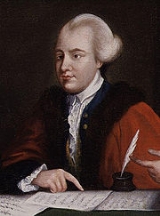
John Wilkes

Encyclopedia
England
England is a country that is part of the United Kingdom. It shares land borders with Scotland to the north and Wales to the west; the Irish Sea is to the north west, the Celtic Sea to the south west, with the North Sea to the east and the English Channel to the south separating it from continental...
radical
Radicalism (historical)
The term Radical was used during the late 18th century for proponents of the Radical Movement. It later became a general pejorative term for those favoring or seeking political reforms which include dramatic changes to the social order...
, journalist
Journalist
A journalist collects and distributes news and other information. A journalist's work is referred to as journalism.A reporter is a type of journalist who researchs, writes, and reports on information to be presented in mass media, including print media , electronic media , and digital media A...
and politician
Politician
A politician, political leader, or political figure is an individual who is involved in influencing public policy and decision making...
.
He was first elected Member of Parliament in 1757. In the Middlesex
Middlesex
Middlesex is one of the historic counties of England and the second smallest by area. The low-lying county contained the wealthy and politically independent City of London on its southern boundary and was dominated by it from a very early time...
election dispute, he fought for the right of voters—rather than the House of Commons
British House of Commons
The House of Commons is the lower house of the Parliament of the United Kingdom, which also comprises the Sovereign and the House of Lords . Both Commons and Lords meet in the Palace of Westminster. The Commons is a democratically elected body, consisting of 650 members , who are known as Members...
—to determine their representatives. In 1771 he was instrumental in obliging the government to concede the right of printers to publish verbatim accounts of parliamentary debates. In 1776 he introduced the first Bill for parliamentary reform in the British Parliament
Parliament of Great Britain
The Parliament of Great Britain was formed in 1707 following the ratification of the Acts of Union by both the Parliament of England and Parliament of Scotland...
. During the American War of Independence he was a supporter of the American rebels
Patriot (American Revolution)
Patriots is a name often used to describe the colonists of the British Thirteen United Colonies who rebelled against British control during the American Revolution. It was their leading figures who, in July 1776, declared the United States of America an independent nation...
adding further to his popularity with American Whigs. In 1780, however, he commanded militia
Militia
The term militia is commonly used today to refer to a military force composed of ordinary citizens to provide defense, emergency law enforcement, or paramilitary service, in times of emergency without being paid a regular salary or committed to a fixed term of service. It is a polyseme with...
forces which helped put down the Gordon Riots
Gordon Riots
The Gordon Riots of 1780 were an anti-Catholic protest against the Papists Act 1778.The Popery Act 1698 had imposed a number of penalties and disabilities on Roman Catholics in England; the 1778 act eliminated some of these. An initial peaceful protest led on to widespread rioting and looting and...
damaging his popularity with many radicals.
Wilkes's increasing conservatism
Conservatism
Conservatism is a political and social philosophy that promotes the maintenance of traditional institutions and supports, at the most, minimal and gradual change in society. Some conservatives seek to preserve things as they are, emphasizing stability and continuity, while others oppose modernism...
as he grew older caused dissatisfaction among radicals and was instrumental in the loss of his Middlesex seat at the 1790 general election
British general election, 1790
The British general election, 1790 returned members to serve in the House of Commons of the 17th Parliament of Great Britain to be held, after the merger of the Parliament of England and the Parliament of Scotland in 1707.-Political Situation:...
. At the age of 65, Wilkes retired from politics and took no part in the growth of radicalism in the 1790s following the French Revolution
French Revolution
The French Revolution , sometimes distinguished as the 'Great French Revolution' , was a period of radical social and political upheaval in France and Europe. The absolute monarchy that had ruled France for centuries collapsed in three years...
. During his life he earned a reputation as a libertine
Libertine
A libertine is one devoid of most moral restraints, which are seen as unnecessary or undesirable, especially one who ignores or even spurns accepted morals and forms of behavior sanctified by the larger society. Libertines, also known as rakes, placed value on physical pleasures, meaning those...
.
Early life and character
Born in ClerkenwellClerkenwell
Clerkenwell is an area of central London in the London Borough of Islington. From 1900 to 1965 it was part of the Metropolitan Borough of Finsbury. The well after which it was named was rediscovered in 1924. The watchmaking and watch repairing trades were once of great importance...
in London
London
London is the capital city of :England and the :United Kingdom, the largest metropolitan area in the United Kingdom, and the largest urban zone in the European Union by most measures. Located on the River Thames, London has been a major settlement for two millennia, its history going back to its...
, Wilkes was the second son of the distiller Israel Wilkes and his wife Sarah (born Heaton), who had six children. John Wilkes was educated initially at an academy in Hertford
Hertford
Hertford is the county town of Hertfordshire, England, and is also a civil parish in the East Hertfordshire district of the county. Forming a civil parish, the 2001 census put the population of Hertford at about 24,180. Recent estimates are that it is now around 28,000...
; this was followed by private tutoring and finally a stint at the University of Leiden in the Dutch Republic
Dutch Republic
The Dutch Republic — officially known as the Republic of the Seven United Netherlands , the Republic of the United Netherlands, or the Republic of the Seven United Provinces — was a republic in Europe existing from 1581 to 1795, preceding the Batavian Republic and ultimately...
. There he met Andrew Baxter
Andrew Baxter
Andrew Baxter was a Scottish metaphysician.Baxter was educated at King's College, University of Aberdeen. He maintained himself by acting as tutor to noblemen's sons. From 1741 to 1747 he lived with Lord Blantyre and Mr Hay of Drummelzier at Utrecht, and made excursions in Flanders, France and...
, a Presbyterian clergyman who greatly influenced Wilkes' views on religion. Although Wilkes would remain in the Church of England
Church of England
The Church of England is the officially established Christian church in England and the Mother Church of the worldwide Anglican Communion. The church considers itself within the tradition of Western Christianity and dates its formal establishment principally to the mission to England by St...
for the rest of his life, he had a deep sympathy for non-conformist Protestants, and was an advocate of religious tolerance from an early age. Wilkes was also beginning to develop a deep patriotism
Patriotism
Patriotism is a devotion to one's country, excluding differences caused by the dependencies of the term's meaning upon context, geography and philosophy...
for his country. During the Jacobite rebellion
Jacobite Rising of 1745
The Jacobite rising of 1745, often referred to as "The 'Forty-Five," was the attempt by Charles Edward Stuart to regain the British throne for the exiled House of Stuart. The rising occurred during the War of the Austrian Succession when most of the British Army was on the European continent...
of 1745 he rushed home to London to join a Loyal Association - and readied to defend the capital. Once the rebellion had ended after the Battle of Culloden
Battle of Culloden
The Battle of Culloden was the final confrontation of the 1745 Jacobite Rising. Taking place on 16 April 1746, the battle pitted the Jacobite forces of Charles Edward Stuart against an army commanded by William Augustus, Duke of Cumberland, loyal to the British government...
, Wilkes returned to the Netherlands to complete his studies.
In 1747 he married Mary Meade and came into possession of an estate and income in Buckinghamshire
Buckinghamshire
Buckinghamshire is a ceremonial and non-metropolitan home county in South East England. The county town is Aylesbury, the largest town in the ceremonial county is Milton Keynes and largest town in the non-metropolitan county is High Wycombe....
. They had one child Mary (known as Polly), to whom John was utterly devoted for the rest of his life. Wilkes and Mary, however, separated in 1756, a separation that became permanent. Wilkes never married again, but he gained a reputation as a rake
Rake (character)
A rake, short for rakehell, is a historic term applied to a man who is habituated to immoral conduct, frequently a heartless womanizer. Often a rake was a man who wasted his fortune on gambling, wine, women and song, incurring lavish debts in the process...
. He was known to have fathered at least five other children.
He was elected a Fellow of the Royal Society in 1749 and appointed High Sheriff of Buckinghamshire
High Sheriff of Buckinghamshire
The High Sheriff of Buckinghamshire, in common with other counties, was originally the King's representative on taxation upholding the law in Saxon times...
in 1754. He was an unsuccessful candidate for Berwick in the 1754 parliamentary elections but was elected for Aylesbury
Aylesbury (UK Parliament constituency)
Aylesbury is a parliamentary constituency represented in the House of Commons of the United Kingdom. The Conservative Party has held the seat since 1924, and held it at the 2010 general election with a 52.2% share of the vote.-Boundaries:...
in 1757 and again in 1761.
He was a member of the Knights of St. Francis of Wycombe, also known as the Hellfire Club
Hellfire Club
The Hellfire Club was a name for several exclusive clubs for high society rakes established in Britain and Ireland in the 18th century, and was more formally or cautiously known as the "Order of the Friars of St. Francis of Wycombe"...
or the Medmenham Monks, and was the instigator of a prank that may have hastened its dissolution. The Club had many distinguished members, including the Earl of Sandwich
John Montagu, 4th Earl of Sandwich
John Montagu, 4th Earl of Sandwich, PC, FRS was a British statesman who succeeded his grandfather, Edward Montagu, 3rd Earl of Sandwich, as the Earl of Sandwich in 1729, at the age of ten...
and Sir Francis Dashwood. Wilkes reportedly brought a baboon
Baboon
Baboons are African and Arabian Old World monkeys belonging to the genus Papio, part of the subfamily Cercopithecinae. There are five species, which are some of the largest non-hominoid members of the primate order; only the mandrill and the drill are larger...
dressed in a cape and horns into the rituals performed at the club, producing considerable mayhem among the inebriated initiates.
Wilkes was notoriously ugly, being called the ugliest man in England at the time. He possessed an unsightly squint and protruding jaw, but had a charm that carried all before it. He boasted that it "took him only half an hour to talk away his face", though the duration required changed on the several occasions Wilkes repeated the claim. He also declared that "a month's start of his rival on account of his face" would secure him the conquest in any love affair.
He was well known for his verbal wit and his snappy responses to insults. For instance, when told by a constituent
Electoral district
An electoral district is a distinct territorial subdivision for holding a separate election for one or more seats in a legislative body...
that he would rather vote for the devil, Wilkes responded: "Naturally." He then added: "And if your friend decides against standing, can I count on your vote?"
In a famous exchange with John Montagu, 4th Earl of Sandwich
John Montagu, 4th Earl of Sandwich
John Montagu, 4th Earl of Sandwich, PC, FRS was a British statesman who succeeded his grandfather, Edward Montagu, 3rd Earl of Sandwich, as the Earl of Sandwich in 1729, at the age of ten...
, where the latter exclaimed: "Sir, I do not know whether you will die on the gallows or of the pox"; Wilkes is reported to have replied: "That depends, my lord, on whether I embrace your lordship's principles or your mistress". Fred R. Shapiro, in The Yale Book of Quotations
The Yale Book of Quotations
The Yale Book of Quotations is a quotations collection that focuses on modern and American quotations and claims a high level of scholarship and reliability. Edited by Fred R. Shapiro, it was published by Yale University Press in 2006 with a foreword by Joseph Epstein, ISBN 978-0-300-10798-2...
(2006), disputes the attribution based on a claim that it first appeared in a book published in 1935, but it is ascribed to Wilkes in Henry Brougham's Historical Sketches (1844), related from Bernard Howard, 12th Duke of Norfolk
Bernard Howard, 12th Duke of Norfolk
Bernard Edward Howard, 12th Duke of Norfolk, KG, Earl Marshal was the son of Henry Howard , and Juliana Molyneux ....
, who claims to have been present, as well as in Charles Marsh
Charles Marsh
Charles Marsh was a Vermont politician who served in the United States House of Representatives.He was born in Lebanon, Connecticut. A graduate of Dartmouth College, he was appointed by George Washington to be U.S...
's Clubs of London (1828). Brougham notes the exchange had in France previously been ascribed to Honoré Gabriel Riqueti, comte de Mirabeau
Honoré Gabriel Riqueti, comte de Mirabeau
Honoré Gabriel Riqueti, comte de Mirabeau was a French revolutionary, as well as a writer, diplomat, freemason, journalist and French politician at the same time. He was a popular orator and statesman. During the French Revolution, he was a moderate, favoring a constitutional monarchy built on...
and Cardinal Jean-Sifrein Maury
Jean-Sifrein Maury
Jean-Sifrein Maury was a French cardinal and Archbishop of Paris.-Biography:The son of a poor cobbler, he was born on at Valréas in the Comtat-Venaissin, the enclave within France that belonged to the pope. His acuteness was observed by the priests of the seminary at Avignon, where he was educated...
.
Radical journalism
William Pitt, 1st Earl of Chatham
William Pitt, 1st Earl of Chatham PC was a British Whig statesman who led Britain during the Seven Years' War...
and was an enthusiastic supporter of Britain's involvement in the Seven Years War
Great Britain in the Seven Years War
The Kingdom of Great Britain was one of the major participants in the Seven Years' War which lasted between 1756 and 1763. Britain emerged from the war as the world's leading colonial power having gained a number of new territories at the Treaty of Paris in 1763 and established itself as the...
. When the Scottish John Stuart, 3rd Earl of Bute
John Stuart, 3rd Earl of Bute
John Stuart, 3rd Earl of Bute KG, PC , styled Lord Mount Stuart before 1723, was a Scottish nobleman who served as Prime Minister of Great Britain under George III, and was arguably the last important favourite in British politics...
, came to head the government in 1762, Wilkes started a radical
Radicalism (historical)
The term Radical was used during the late 18th century for proponents of the Radical Movement. It later became a general pejorative term for those favoring or seeking political reforms which include dramatic changes to the social order...
weekly publication, The North Briton
The North Briton
The North Briton was a radical newspaper published in 18th century London. The North Briton also served as the pseudonym of the newspaper's author, used in advertisements, letters to other publications, and handbills....
, to attack him, using an anti-Scots tone. Typical of Wilkes, the title was a satirical take on the Earl's newspaper, The Briton, with North Briton referring to Scotland
Scotland
Scotland is a country that is part of the United Kingdom. Occupying the northern third of the island of Great Britain, it shares a border with England to the south and is bounded by the North Sea to the east, the Atlantic Ocean to the north and west, and the North Channel and Irish Sea to the...
. He was particularly incensed by what he regarded as Bute's betrayal in agreeing to overly generous peace terms with France to end the war.
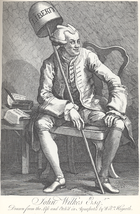
Wilkes was charged with seditious libel
Seditious libel
Seditious libel was a criminal offence under English common law. Sedition is the offence of speaking seditious words with seditious intent: if the statement is in writing or some other permanent form it is seditious libel...
over attacks on George III
George III of the United Kingdom
George III was King of Great Britain and King of Ireland from 25 October 1760 until the union of these two countries on 1 January 1801, after which he was King of the United Kingdom of Great Britain and Ireland until his death...
's speech endorsing the Paris Peace Treaty
Treaty of Paris (1763)
The Treaty of Paris, often called the Peace of Paris, or the Treaty of 1763, was signed on 10 February 1763, by the kingdoms of Great Britain, France and Spain, with Portugal in agreement. It ended the French and Indian War/Seven Years' War...
of 1763 at the opening of Parliament on 23 April 1763. Wilkes was highly critical of the King's speech, which was recognized as having been written by Bute. He attacked it in an article of issue 45 of The North Briton. The issue number in which Wilkes published his critical editorial was appropriate because the number 45 was synonymous with the Jacobite Rising of 1745
Jacobite Rising of 1745
The Jacobite rising of 1745, often referred to as "The 'Forty-Five," was the attempt by Charles Edward Stuart to regain the British throne for the exiled House of Stuart. The rising occurred during the War of the Austrian Succession when most of the British Army was on the European continent...
, commonly known as "The '45". Bute, Scottish and politically controversial as an adviser to the King, was associated popularly with Jacobitism, a perception which Wilkes played on.
The King felt personally insulted and ordered general warrants to be issued for the arrest of Wilkes and the publishers on 30 April 1763. Forty-nine people, including Wilkes, were arrested under the warrants. Wilkes, however, gained considerable popular support as he asserted the unconstitutionality of general warrants. At his court hearing the Lord Chief Justice ruled that as an MP, Wilkes was protected by privilege from arrest on a charge of libel. He was soon restored to his seat, as he cited parliamentary privilege
Parliamentary privilege
Parliamentary privilege is a legal immunity enjoyed by members of certain legislatures, in which legislators are granted protection against civil or criminal liability for actions done or statements made related to one's duties as a legislator. It is common in countries whose constitutions are...
for his editorial. Wilkes sued his arresters for trespass. As a result of this episode, people were chanting, "Wilkes, Liberty and Number 45", referring to the newspaper.
Bute had by now resigned, but Wilkes was equally opposed to his successor, George Grenville
George Grenville
George Grenville was a British Whig statesman who rose to the position of Prime Minister of Great Britain. Grenville was born into an influential political family and first entered Parliament in 1741 as an MP for Buckingham...
. Wilkes resumed attacking the King when on 16 November 1763, Samuel Martin
Samuel Martin (Secretary to the Treasury)
Samuel Martin was a British politician and administrator.-Family:He was the son of Samuel Martin, the leading plantation owner on the West Indies island of Antigua, where he was born, and eldest half-brother of Sir Henry Martin, 1st Baronet , for many years naval commissioner at Portsmouth and...
, a supporter of George III, challenged Wilkes to a duel. Wilkes was shot and wounded in the stomach. Parliament was quick to vote on a measure that did not protect MP's from arrest for the writing and publishing of seditious libel.
Outlaw
Wilkes and Thomas Potter wrote a pornographic poem entitled "An Essay on Woman" as a parody of Alexander PopeAlexander Pope
Alexander Pope was an 18th-century English poet, best known for his satirical verse and for his translation of Homer. He is the third-most frequently quoted writer in The Oxford Dictionary of Quotations, after Shakespeare and Tennyson...
's "An Essay on Man
An Essay on Man
An Essay on Man is a poem published by Alexander Pope in 1734. It is a rationalistic effort to use philosophy in order to "vindicate the ways of God to man" , a variation of John Milton's claim in the opening lines of Paradise Lost, that he will "justify the ways of God to man" . It is concerned...
". Wilkes's political enemies obtained this, foremost among them John Montagu, 4th Earl of Sandwich
John Montagu, 4th Earl of Sandwich
John Montagu, 4th Earl of Sandwich, PC, FRS was a British statesman who succeeded his grandfather, Edward Montagu, 3rd Earl of Sandwich, as the Earl of Sandwich in 1729, at the age of ten...
, who was also a member of the Hellfire Club
Hellfire Club
The Hellfire Club was a name for several exclusive clubs for high society rakes established in Britain and Ireland in the 18th century, and was more formally or cautiously known as the "Order of the Friars of St. Francis of Wycombe"...
, who introduced it in the House of Lords
House of Lords
The House of Lords is the upper house of the Parliament of the United Kingdom. Like the House of Commons, it meets in the Palace of Westminster....
. Sandwich had a personal vendetta
Feud
A feud , referred to in more extreme cases as a blood feud, vendetta, faida, or private war, is a long-running argument or fight between parties—often groups of people, especially families or clans. Feuds begin because one party perceives itself to have been attacked, insulted or wronged by another...
against Wilkes that stemmed in large part from embarrassment caused by a prank of Wilkes involving the Earl at one of the Hellfire Club's meetings; he was delighted at the chance for revenge. Sandwich read the poem to the House of Lords in an effort to denounce Wilkes's moral behavior, despite the hypocrisy of his action. The Lords declared the poem obscene and blasphemous, and it caused a great scandal. The House of Lords moved to expel Wilkes again; he fled to Paris
Paris
Paris is the capital and largest city in France, situated on the river Seine, in northern France, at the heart of the Île-de-France region...
before any expulsion or trial. He was tried and found guilty in absentia of obscene libel and seditious libel, and was declared an outlaw
Outlaw
In historical legal systems, an outlaw is declared as outside the protection of the law. In pre-modern societies, this takes the burden of active prosecution of a criminal from the authorities. Instead, the criminal is withdrawn all legal protection, so that anyone is legally empowered to persecute...
on 19 January 1764.
Wilkes hoped for a change in power to remove the charges, but this did not come to pass. As his French creditors began to pressure him, in 1768 he had little choice but to return to England. He returned intending to stand as a Member of Parliament
Member of Parliament
A Member of Parliament is a representative of the voters to a :parliament. In many countries with bicameral parliaments, the term applies specifically to members of the lower house, as upper houses often have a different title, such as senate, and thus also have different titles for its members,...
on an anti-government ticket; the government did not issue warrants for his immediate arrest as it did not want to inflame popular support.
Wilkes stood in London and came in bottom of the poll of seven candidates, possibly due to his late entry into the race for the position. He was quickly elected MP for Middlesex
Middlesex (UK Parliament constituency)
Middlesex is a former United Kingdom Parliamentary constituency. It was a constituency of the House of Commons of the Parliament of England then of the Parliament of Great Britain from 1707 to 1800 and of the Parliament of the United Kingdom from 1801 to 1885....
, where most of his support was located. He surrendered to the King's Bench
King's Bench
The Queen's Bench is the superior court in a number of jurisdictions within some of the Commonwealth realms...
in April. On waiving his parliamentary privilege
Parliamentary privilege
Parliamentary privilege is a legal immunity enjoyed by members of certain legislatures, in which legislators are granted protection against civil or criminal liability for actions done or statements made related to one's duties as a legislator. It is common in countries whose constitutions are...
to immunity, he was sentenced to two years and fined £1,000. The sentence of outlawry was overturned.
When Wilkes was imprisoned in the King's Bench Prison
King's Bench Prison
The King's Bench Prison was a prison in Southwark, south London, from medieval times until it closed in 1880. It took its name from the King's Bench court of law in which cases of defamation, bankruptcy and other misdemeanours were heard; as such, the prison was often used as a debtor's prison...
on 10 May 1768, his supporters appeared before King's Bench
King's Bench
The Queen's Bench is the superior court in a number of jurisdictions within some of the Commonwealth realms...
, London
London
London is the capital city of :England and the :United Kingdom, the largest metropolitan area in the United Kingdom, and the largest urban zone in the European Union by most measures. Located on the River Thames, London has been a major settlement for two millennia, its history going back to its...
, chanting "No justice, no peace." Troops opened fire on the unarmed men, killing seven and wounding 15, an incident that came to be known as the St George's Fields Massacre. The Irish playwright Hugh Kelly a prominent supporter of the government, defended the right of the army to use force against riotors. This drew the anger of Wilkes' supporters against Kelly and they began a riot at the Drury Lane Theatre during the performance of Kelly's new play A Word to the Wise
A Word to the Wise
A Word to the Wise is a 1770 comedy play by the Irish writer Hugh Kelly. It was his second work after the 1767 hit False Delicacy. Kelly was known as a supporter of the government, and an opponent of the radical John Wilkes, and during the second performance of the play at a riot broke out amongst...
forcing it to be abandoned.
Middlesex election dispute
Wilkes was expelled from Parliament in February 1769, on the grounds that he was an outlaw when he was returned. He was re-elected by his Middlesex constituents in the same month, only to be expelled and re-elected in March. In April, after his expulsion and another re-election, Parliament declared his opponent, Henry LuttrellHenry Luttrell, 2nd Earl of Carhampton
General Henry Lawes Luttrell, 2nd Earl of Carhampton PC was a politician and soldier.-Military career:Educated at Westminster School and Christ Church, Oxford, Luttrell was commissioned into the 48th Regiment of Foot in 1757. In 1762, during the Seven Years' War, he became Deputy Adjutant-General...
, to be the winner.
In defiance Wilkes was elected an alderman
Alderman
An alderman is a member of a municipal assembly or council in many jurisdictions founded upon English law. The term may be titular, denoting a high-ranking member of a borough or county council, a council member chosen by the elected members themselves rather than by popular vote, or a council...
of London in 1769, using his supporters' group, the Society for the Supporters of the Bill of Rights, for his campaign. Wilkes eventually succeeded in convincing Parliament to expunge the resolution barring him from sitting. While in Parliament, he condemned the government's policy towards the American colonies during the American Revolution
American Revolutionary War
The American Revolutionary War , the American War of Independence, or simply the Revolutionary War, began as a war between the Kingdom of Great Britain and thirteen British colonies in North America, and ended in a global war between several European great powers.The war was the result of the...
. In addition, he introduced one of the earliest radical Bills to Parliament, although it failed to gain passage. On his release from prison in March 1770, Wilkes was appointed a sheriff
Sheriffs of the City of London
There are two Sheriffs of the City of London. The sheriffs are elected annually by the Liverymen of the Livery Companies, and it is a requirement for a Lord Mayor of the City of London to previously have served as a Sheriff. Sheriffs have only nominal duties now, but previously had large judicial...
in London.
Later life
Freedom of the press
Freedom of the press or freedom of the media is the freedom of communication and expression through vehicles including various electronic media and published materials...
by gaining passage of a bill to remove the power of general warrants and to end Parliament's ability to punish political reports of debates.
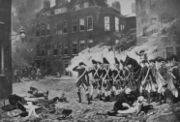
After 1780, his popularity declined as he was popularly perceived as less radical. During the uprising known as the Gordon Riots
Gordon Riots
The Gordon Riots of 1780 were an anti-Catholic protest against the Papists Act 1778.The Popery Act 1698 had imposed a number of penalties and disabilities on Roman Catholics in England; the 1778 act eliminated some of these. An initial peaceful protest led on to widespread rioting and looting and...
, Wilkes was in charge of the soldiers defending the Bank of England
Bank of England
The Bank of England is the central bank of the United Kingdom and the model on which most modern central banks have been based. Established in 1694, it is the second oldest central bank in the world...
from the attacking mobs. It was under his orders that troops fired into the crowds of rioters. The working classes who had previously seen Wilkes as a "man of the people", then criticized him as a hypocrite; his middle class support was scared off by the violent action. The Gordon Riots nearly extinguished his popularity.
While he was returned for the county seat of Middlesex in 1784, he found so little support that by 1790, he withdrew early in the election. The French Revolution
French Revolution
The French Revolution , sometimes distinguished as the 'Great French Revolution' , was a period of radical social and political upheaval in France and Europe. The absolute monarchy that had ruled France for centuries collapsed in three years...
of 1789 had proved extremely divisive in England, and Wilkes had been against it due to the violent murders in France. His position was different from that of many radicals of the time and was a view more associated with conservative figures. Edmund Burke
Edmund Burke
Edmund Burke PC was an Irish statesman, author, orator, political theorist and philosopher who, after moving to England, served for many years in the House of Commons of Great Britain as a member of the Whig party....
, who had also supported American Independence, made a similar switch.
Wilkes worked in his final years as a magistrate campaigning for more moderate punishment for disobedient household servants.
Between 1788-1797 he occupied a property named "Villakin" in Sandown, Isle of Wight. The site is marked by a blue plaque.
He was a member of the Oddfellows
Oddfellows
The name Oddfellows refers to a number of friendly societies and fraternal organisations operating in the United Kingdom. It also refers to a number of Lodges with histories dating back to the 18th century. These various organisations were set up to protect and care for their members and...
.
Influence
Charles Lucas (politician)
Charles Lucas was an Irish apothecary, physician and politician. He sat as Member of Parliament for Dublin City and was known as the "Irish Wilkes" because of his radical views.-Early life:...
, who sat for Dublin City
Dublin City (Parliament of Ireland constituency)
Dublin City was a constituency represented in the Irish House of Commons to 1801.-History:In the Patriot Parliament of 1689 summoned by King James II, Dublin City was represented with two members. In the 1760s the radical politician Charles Lucas used the seat as his political base.-1689–1801:...
in the Irish Parliament, was known as the "Irish Wilkes". The Dutch politician Joan van der Capellen tot den Pol
Joan van der Capellen tot den Pol
Joan Derk, Baron van der Capellen tot den Pol was a Dutch nobleman who played a prominent role in the formation of the Batavian Republic and the revolutionary events that preceded its formation...
(1741–1784), who advocated American independence
American Revolution
The American Revolution was the political upheaval during the last half of the 18th century in which thirteen colonies in North America joined together to break free from the British Empire, combining to become the United States of America...
and criticized the Stadtholder
Stadtholder
A Stadtholder A Stadtholder A Stadtholder (Dutch: stadhouder [], "steward" or "lieutenant", literally place holder, holding someones place, possibly a calque of German Statthalter, French lieutenant, or Middle Latin locum tenens...
regime
Regime
The word regime refers to a set of conditions, most often of a political nature.-Politics:...
, was inspired by Wilkes.
British subjects in the American colonies closely followed Wilkes's career. His struggles convinced many colonists that the British constitution was being subverted by a corrupt ministry, an idea that contributed to the coming of the American Revolution
American Revolution
The American Revolution was the political upheaval during the last half of the 18th century in which thirteen colonies in North America joined together to break free from the British Empire, combining to become the United States of America...
. In reaction, after the Revolution, representatives included provisions in the new American constitution
United States Constitution
The Constitution of the United States is the supreme law of the United States of America. It is the framework for the organization of the United States government and for the relationship of the federal government with the states, citizens, and all people within the United States.The first three...
to prevent Congress from rejecting any legally elected member and to proscribe general warrants for arrest.
John Wilkes's brother was the grandfather of U.S. Naval Admiral Charles Wilkes
Charles Wilkes
Charles Wilkes was an American naval officer and explorer. He led the United States Exploring Expedition, 1838-1842 and commanded the ship in the Trent Affair during the American Civil War...
.
Eponyms
- The city of Wilkes-Barre, PennsylvaniaWilkes-Barre, PennsylvaniaWilkes-Barre is a city in the U.S. state of Pennsylvania, the county seat of Luzerne County. It is at the center of the Wyoming Valley area and is one of the principal cities in the Scranton/Wilkes-Barre metropolitan area, which had a population of 563,631 as of the 2010 Census...
was named for John Wilkes and Isaac BarréIsaac BarréIsaac Barré was an Irish soldier and politician. He earned distinction serving with the British army during the Seven Years' War, and later became a prominent Member of Parliament where he became a vocal supporter of William Pitt. He is known for coining the term "Sons of Liberty" in reference to...
. - Wilkes UniversityWilkes UniversityWilkes University is a private, non-denominational American university located in Wilkes-Barre, Pennsylvania. It has over 2,200 undergraduates and over 2,200 graduate students...
, a four-year, independent, non-sectarian college in Wilkes-Barre is named for John Wilkes. - Wilkes County, GeorgiaWilkes County, GeorgiaWilkes County is a county located in the U.S. state of Georgia. As of 2000, the population was 10,687. The 2007 Census estimate shows a population of 10,262. The county seat is the city of Washington. Referred to as "Washington-Wilkes", the county seat and county are commonly treated as a...
and Wilkes County, North CarolinaWilkes County, North CarolinaWilkes County is a county located in the U.S. state of North Carolina. The 2000 U.S. Census listed the county's population at 65,632; the 2010 U.S. Census listed the population at 69,340...
were named in his honor. - Wilkes Street in Alexandria, VirginiaAlexandria, VirginiaAlexandria is an independent city in the Commonwealth of Virginia. As of 2009, the city had a total population of 139,966. Located along the Western bank of the Potomac River, Alexandria is approximately six miles south of downtown Washington, D.C.Like the rest of northern Virginia, as well as...
, USA, is named for John Wilkes. - Fox & Wilkes Books, the publishing arm of Laissez Faire BooksLaissez Faire BooksLaissez Faire Books is an online bookseller that was originally based in New York City when it first opened in 1972. The bookstore's ownership was transferred to the International Society for Individual Liberty in November 2007...
, is named for John Wilkes. - American actor and assassin John Wilkes BoothJohn Wilkes BoothJohn Wilkes Booth was an American stage actor who assassinated President Abraham Lincoln at Ford's Theatre, in Washington, D.C., on April 14, 1865. Booth was a member of the prominent 19th century Booth theatrical family from Maryland and, by the 1860s, was a well-known actor...
, a distant relative, was named after John Wilkes.
Further reading
External Links
- John Wilkes papers. William L. Clements Library.