

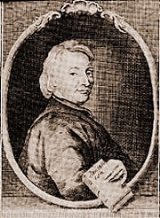
John Toland

Encyclopedia
John Toland was a rationalist philosopher and freethinker
, and occasional satirist, who wrote numerous books and pamphlets on political philosophy
and philosophy of religion
, which are early expressions of the philosophy of the Age of Enlightenment
. Born in Ireland, he was educated at the universities of Glasgow
, Edinburgh
, Leiden and Oxford
and was influenced by the philosophy of John Locke
.
on the Inishowen Peninsula
, a predominantly Catholic
and Irish
-speaking region in northwestern Ireland. His parents are unknown. He would later write that he had been baptized Janus Junius, a play on his name that recalled both the Roman two-faced god Janus
and Junius Brutus, reputed founder of the Roman republic
. According to his biographer Pierre des Maizeaux
, he adopted the name John as a schoolboy with the encouragement of his school teacher.
Having formally converted from Catholicism to Protestantism at the age of 16, Toland got a scholarship to study theology at the University of Glasgow
. In 1690, at age 19, the University of Edinburgh
conferred a master's degree on him. He then got a scholarship to spend two years studying at University of Leiden in Holland, and subsequently nearly two years at Oxford in England (1694–95). The Leiden scholarship had been provided by wealthy English Dissenters
, who hoped Toland would go on to become a minister for Dissenters. In Toland's first book Christianity Not Mysterious (1696), he argued that the divine revelation of the Bible contains no true mysteries; rather, all the dogmas of the faith can be understood and demonstrated by properly trained reason from natural principles. For this argument he was prosecuted by a grand jury in London, and the book was also burnt by the public hangman in Dublin, because it was contrary to the core doctrine of faith. After his departure from Oxford Toland resided in London for most of the rest of his life, but was also a somewhat frequent visitor to the European continent, particularly Germany and the Netherlands. He lived on the Continent from 1707 to 1710. Toland died in Putney on 10 March 1722. The 1911 Encyclopedia Britannica says of him that at his death in London at age 51 "he died... as he had lived, in great poverty, in the midst of his books, with his pen in his hand." Just before he died, he composed his own epitaph: "He was an assertor of liberty, a lover of all sorts of learning ... but no man’s follower or dependent. Nor could frowns or fortune bend him to decline from the ways he had chosen."
Very shortly after his death a lengthy biography of Toland was written by Pierre des Maizeaux
.
(by Bishop Berkeley
) and went on to write over a hundred books in various domains but mostly dedicated to criticizing ecclesiastical institutions. A great deal of his intellectual activity was dedicated to writing political tracts in support of the Whig
cause. Many scholars know him for his role as either the biographer or editor of notable republicans from the mid-17th century such as James Harrington
, Algernon Sidney and John Milton
. His works "Anglia Libera" and "State Anatomy" are prosaic expressions of an English republicanism which reconciles itself with constitutional monarchy.
After Christianity Not Mysterious, Toland's views became gradually more radical. His opposition to hierarchy in the church also led to opposition to hierarchy in the state; bishops and kings, in other words, were as bad as each other, and monarchy had no God-given sanction as a form of government. In his 1704 Letters to Serena - in which he coins the expression 'pantheism
' - he carefully analyses the manner by which truth is arrived at, and why people are prone to forms of 'false consciousness.'
In politics his most radical proposition was that liberty
was a defining characteristic of what it means to be human. Political institutions should be designed to guarantee freedom, not simply to establish order. For Toland, reason and tolerance were the twin pillars of the good society. This was Whiggism
at its most intellectually refined, the very antithesis of the Tory
belief in sacred authority in both church
and state
. Toland's belief in the need for perfect equality among free-born citizens was extended to the Jewish community, tolerated, but still outsiders in early eighteenth century England. In his 1714 Reasons for Naturalising the Jews he was the first to advocate full citizenship and equal rights for Jewish people.
Toland's world was not all detached intellectual speculation, though. There was also an incendiary element to his political pamphleteering, and he was not beyond whipping up some of the baser anti-Catholic sentiments of the day in his attacks on the Jacobites
.
, Judaism
and Islam
are all condemned as the three great political frauds. The Treatise of the Three Imposters was rumored to exist in manuscript form since the Middle Ages and excoriated throughout all of Europe. It is now thought that the work did not exist.
Toland claimed to have a personal copy of the manuscript which he passed to the circle of Jean Rousset
in France. Rumours that it was then translated into French were taken seriously by some: however, not by Voltaire
who issued a satirical reply.
sympathies were also evidenced by his editing of the writings of some of the great radicals of the 1650s, including James Harrington
, Algernon Sydney
, Edmund Ludlow
and John Milton
. In his support for the Hanoverian monarchy he somewhat moderated his republican sentiments; though his ideal kingship was one that would work towards achieving civic virtue and social harmony, a 'just liberty' and the 'preservation and improvement of our reason.' But George I and the oligarchy behind Walpole were about as far from Toland's ideal as it is possible to get. In many ways he was thus a man born both too late and too early.
's ideas about physical motion. In his Letters to Serena, Toland claimed that rest, or absence of motion, is not merely relative. Actually, for Toland, rest is a special case of motion. When there is a conflict of forces, the body that is apparently at rest is influenced by as much activity and passivity as it would be if it were moving.
, but at the time when he wrote Christianity not Mysterious he was careful to distinguish himself from both skeptical atheists and orthodox theologians. After having formulated a stricter version of Locke
's epistemological rationalism, Toland then goes on to show that there are no facts or doctrines from the Bible which are not perfectly plain, intelligible and reasonable, being neither contrary to reason nor incomprehensible to it. All revelation is human revelation; that which is not rendered understandable is to be rejected as gibberish.
However, David Berman has argued for an atheistic reading of Toland, demonstrating contradictions between Christianity not Mysterious and Toland's Two Essays (London, 1695). Berman's reading of Toland and Charles Blount attempts to show that Toland deliberately obscured his real atheism so as to avoid prosecution whilst attempting to subliminally influence unknowing readers, specifically by creating contradictions in his work which can only be resolved by reducing Toland's God to a pantheistic one, and realising that such a non-providential God is, for Blount, Toland and Colins, "...no God, or as good as no God...In short, the God of theism is blictri for Toland; only the determined material God of pantheism exists, and he (or it) is really no God."
After his Christianity not Mysterious, Toland's "Letters to Serena" constitute his major contribution to philosophy. In the first three letters, he develops a historical account of the rise of superstition arguing that human reason cannot ever fully liberate itself from prejudices. In the last two letters, he founds a metaphysical materialism
grounded in a critique of monist substantialism. Later on, we find Toland continuing his critique of church government in Nazarenus which was first more fully developed in his "Primitive Constitution of the Christian Church", a clandestine writing in circulation by 1705. The first book of "Nazarenus" calls attention to the right of the Ebionites
to a place in the early church. The thrust of his argument was to push to the very limits the applicability of canonical scripture to establish institutionalized religion. Later works of special importance include Tetradymus wherein can be found Clidophorus, a historical study of the distinction between esoteric and exoteric philosophies.
His Pantheisticon, sive formula celebrandae sodalitatis socraticae (Pantheisticon, or the Form of Celebrating the Socratic Society), of which he printed a few copies for private circulation only, gave great offence as a sort of liturgic service made up of passages from heathen authors, in imitation of the Church of England
liturgy. The title also was in those days alarming, and still more so the mystery which the author threw around the question how far such societies of pantheists actually existed. The term "pantheism
" was coined by Toland to describe the philosophy
of Spinoza.
Toland was famous for distinguishing exoteric philosophy—what one says publicly about religion—from esoteric philosophy—what one confides to trusted friends. In a recent book on Toland, Fouke analyses Toland's 'exoteric strategy' of speaking as others speak, but with a different meaning. He argues that Toland's philosophy and theology had little to do with positive expression of beliefs, and that his philosophical aim was not to develop an epistemology, a true metaphysical system, an ideal form of governance, or the basis of ethical obligation, but to find ways to participate in the discourses of others while undermining those discourses from within. Fouke traces Toland's practices to Shaftesbury's conception of a comic or 'derisory' mode of philosophising aimed at exposing pedantry, imposture, dogmatism, and folly.
, governed by cynicism and self-interest. His intellectual reputation, moreover, was subsequently eclipsed by the likes of John Locke
and David Hume
, and still more by Montesquieu and the French radical thinkers. Edmund Burke
in his "Reflections on the Revolution in France
" wrote dismissively of Toland and his fellows: "Who, born within the last 40 years, has read one word of Collins
, and Toland, and Tindal
, and Chubb
, and Morgan
, and that whole race who called themselves Freethinkers?"
Still, in Christianity not Mysterious, the book for which he is best known, Toland laid down a challenge not just to the authority of the established church, but to all inherited and unquestioned authority. It was thus as radical politically and philosophically, as it was theologically.
Of his influence, humanities professor Robert Pattison wrote: "Two centuries earlier the establishment would have burned him as a heretic; two centuries later it would have made him a professor of comparative religion in a California university. In the rational Protestant climate of early eighteenth-century Britain, he was merely ignored to death."
Note: Many of the above writings are freely downloadable at The Works by John Toland at Archive.org.
Freethought
Freethought is a philosophical viewpoint that holds that opinions should be formed on the basis of science, logic, and reason, and should not be influenced by authority, tradition, or other dogmas...
, and occasional satirist, who wrote numerous books and pamphlets on political philosophy
Political philosophy
Political philosophy is the study of such topics as liberty, justice, property, rights, law, and the enforcement of a legal code by authority: what they are, why they are needed, what, if anything, makes a government legitimate, what rights and freedoms it should protect and why, what form it...
and philosophy of religion
Philosophy of religion
Philosophy of religion is a branch of philosophy concerned with questions regarding religion, including the nature and existence of God, the examination of religious experience, analysis of religious language and texts, and the relationship of religion and science...
, which are early expressions of the philosophy of the Age of Enlightenment
Age of Enlightenment
The Age of Enlightenment was an elite cultural movement of intellectuals in 18th century Europe that sought to mobilize the power of reason in order to reform society and advance knowledge. It promoted intellectual interchange and opposed intolerance and abuses in church and state...
. Born in Ireland, he was educated at the universities of Glasgow
University of Glasgow
The University of Glasgow is the fourth-oldest university in the English-speaking world and one of Scotland's four ancient universities. Located in Glasgow, the university was founded in 1451 and is presently one of seventeen British higher education institutions ranked amongst the top 100 of the...
, Edinburgh
University of Edinburgh
The University of Edinburgh, founded in 1583, is a public research university located in Edinburgh, the capital of Scotland, and a UNESCO World Heritage Site. The university is deeply embedded in the fabric of the city, with many of the buildings in the historic Old Town belonging to the university...
, Leiden and Oxford
University of Oxford
The University of Oxford is a university located in Oxford, United Kingdom. It is the second-oldest surviving university in the world and the oldest in the English-speaking world. Although its exact date of foundation is unclear, there is evidence of teaching as far back as 1096...
and was influenced by the philosophy of John Locke
John Locke
John Locke FRS , widely known as the Father of Liberalism, was an English philosopher and physician regarded as one of the most influential of Enlightenment thinkers. Considered one of the first of the British empiricists, following the tradition of Francis Bacon, he is equally important to social...
.
Biography
Very little is known of Toland's early life. He was born in ArdaghArdagh, Donegal
Ardagh, Donegal is a townland on the Inishowen peninsula near Ballyliffin in County Donegal, Ireland. It was the birth place of the philosopher John Toland , a pantheist and anti-Catholic polemicist.-See also:...
on the Inishowen Peninsula
Inishowen
Inishowen is a peninsula in County Donegal, part of the Province of Ulster in the north of Ireland. It is also the largest peninsula in all of Ireland. Inishowen is a picturesque location with a rich history...
, a predominantly Catholic
Roman Catholic Church
The Catholic Church, also known as the Roman Catholic Church, is the world's largest Christian church, with over a billion members. Led by the Pope, it defines its mission as spreading the gospel of Jesus Christ, administering the sacraments and exercising charity...
and Irish
Irish language
Irish , also known as Irish Gaelic, is a Goidelic language of the Indo-European language family, originating in Ireland and historically spoken by the Irish people. Irish is now spoken as a first language by a minority of Irish people, as well as being a second language of a larger proportion of...
-speaking region in northwestern Ireland. His parents are unknown. He would later write that he had been baptized Janus Junius, a play on his name that recalled both the Roman two-faced god Janus
Janus
-General:*Janus , the two-faced Roman god of gates, doors, doorways, beginnings, and endings*Janus , a moon of Saturn*Janus Patera, a shallow volcanic crater on Io, a moon of Jupiter...
and Junius Brutus, reputed founder of the Roman republic
Roman Republic
The Roman Republic was the period of the ancient Roman civilization where the government operated as a republic. It began with the overthrow of the Roman monarchy, traditionally dated around 508 BC, and its replacement by a government headed by two consuls, elected annually by the citizens and...
. According to his biographer Pierre des Maizeaux
Pierre des Maizeaux
Pierre des Maizeaux, also spelled Desmaizeaux was a French Huguenot writer exiled in London, best known as the translator and biographer of Pierre Bayle....
, he adopted the name John as a schoolboy with the encouragement of his school teacher.
Having formally converted from Catholicism to Protestantism at the age of 16, Toland got a scholarship to study theology at the University of Glasgow
University of Glasgow
The University of Glasgow is the fourth-oldest university in the English-speaking world and one of Scotland's four ancient universities. Located in Glasgow, the university was founded in 1451 and is presently one of seventeen British higher education institutions ranked amongst the top 100 of the...
. In 1690, at age 19, the University of Edinburgh
University of Edinburgh
The University of Edinburgh, founded in 1583, is a public research university located in Edinburgh, the capital of Scotland, and a UNESCO World Heritage Site. The university is deeply embedded in the fabric of the city, with many of the buildings in the historic Old Town belonging to the university...
conferred a master's degree on him. He then got a scholarship to spend two years studying at University of Leiden in Holland, and subsequently nearly two years at Oxford in England (1694–95). The Leiden scholarship had been provided by wealthy English Dissenters
English Dissenters
English Dissenters were Christians who separated from the Church of England in the 16th, 17th and 18th centuries.They originally agitated for a wide reaching Protestant Reformation of the Established Church, and triumphed briefly under Oliver Cromwell....
, who hoped Toland would go on to become a minister for Dissenters. In Toland's first book Christianity Not Mysterious (1696), he argued that the divine revelation of the Bible contains no true mysteries; rather, all the dogmas of the faith can be understood and demonstrated by properly trained reason from natural principles. For this argument he was prosecuted by a grand jury in London, and the book was also burnt by the public hangman in Dublin, because it was contrary to the core doctrine of faith. After his departure from Oxford Toland resided in London for most of the rest of his life, but was also a somewhat frequent visitor to the European continent, particularly Germany and the Netherlands. He lived on the Continent from 1707 to 1710. Toland died in Putney on 10 March 1722. The 1911 Encyclopedia Britannica says of him that at his death in London at age 51 "he died... as he had lived, in great poverty, in the midst of his books, with his pen in his hand." Just before he died, he composed his own epitaph: "He was an assertor of liberty, a lover of all sorts of learning ... but no man’s follower or dependent. Nor could frowns or fortune bend him to decline from the ways he had chosen."
Very shortly after his death a lengthy biography of Toland was written by Pierre des Maizeaux
Pierre des Maizeaux
Pierre des Maizeaux, also spelled Desmaizeaux was a French Huguenot writer exiled in London, best known as the translator and biographer of Pierre Bayle....
.
Political thought
John Toland was the first person called a freethinkerFreethought
Freethought is a philosophical viewpoint that holds that opinions should be formed on the basis of science, logic, and reason, and should not be influenced by authority, tradition, or other dogmas...
(by Bishop Berkeley
George Berkeley
George Berkeley , also known as Bishop Berkeley , was an Irish philosopher whose primary achievement was the advancement of a theory he called "immaterialism"...
) and went on to write over a hundred books in various domains but mostly dedicated to criticizing ecclesiastical institutions. A great deal of his intellectual activity was dedicated to writing political tracts in support of the Whig
British Whig Party
The Whigs were a party in the Parliament of England, Parliament of Great Britain, and Parliament of the United Kingdom, who contested power with the rival Tories from the 1680s to the 1850s. The Whigs' origin lay in constitutional monarchism and opposition to absolute rule...
cause. Many scholars know him for his role as either the biographer or editor of notable republicans from the mid-17th century such as James Harrington
James Harrington
James Harrington was an English political theorist of classical republicanism, best known for his controversial work, The Commonwealth of Oceana .-Early life:...
, Algernon Sidney and John Milton
John Milton
John Milton was an English poet, polemicist, a scholarly man of letters, and a civil servant for the Commonwealth of England under Oliver Cromwell...
. His works "Anglia Libera" and "State Anatomy" are prosaic expressions of an English republicanism which reconciles itself with constitutional monarchy.
After Christianity Not Mysterious, Toland's views became gradually more radical. His opposition to hierarchy in the church also led to opposition to hierarchy in the state; bishops and kings, in other words, were as bad as each other, and monarchy had no God-given sanction as a form of government. In his 1704 Letters to Serena - in which he coins the expression 'pantheism
Pantheism
Pantheism is the view that the Universe and God are identical. Pantheists thus do not believe in a personal, anthropomorphic or creator god. The word derives from the Greek meaning "all" and the Greek meaning "God". As such, Pantheism denotes the idea that "God" is best seen as a process of...
' - he carefully analyses the manner by which truth is arrived at, and why people are prone to forms of 'false consciousness.'
In politics his most radical proposition was that liberty
Liberty
Liberty is a moral and political principle, or Right, that identifies the condition in which human beings are able to govern themselves, to behave according to their own free will, and take responsibility for their actions...
was a defining characteristic of what it means to be human. Political institutions should be designed to guarantee freedom, not simply to establish order. For Toland, reason and tolerance were the twin pillars of the good society. This was Whiggism
Whiggism
Whiggism, sometimes spelled Whigism, is a historical political philosophy that grew out of the Parliamentarian faction in the Wars of the Three Kingdoms. The whigs' key policy positions were the supremacy of Parliament , toleration for Protestant dissenters, and opposition to a Catholic on the...
at its most intellectually refined, the very antithesis of the Tory
Tory
Toryism is a traditionalist and conservative political philosophy which grew out of the Cavalier faction in the Wars of the Three Kingdoms. It is a prominent ideology in the politics of the United Kingdom, but also features in parts of The Commonwealth, particularly in Canada...
belief in sacred authority in both church
Church of England
The Church of England is the officially established Christian church in England and the Mother Church of the worldwide Anglican Communion. The church considers itself within the tradition of Western Christianity and dates its formal establishment principally to the mission to England by St...
and state
Kingdom of England
The Kingdom of England was, from 927 to 1707, a sovereign state to the northwest of continental Europe. At its height, the Kingdom of England spanned the southern two-thirds of the island of Great Britain and several smaller outlying islands; what today comprises the legal jurisdiction of England...
. Toland's belief in the need for perfect equality among free-born citizens was extended to the Jewish community, tolerated, but still outsiders in early eighteenth century England. In his 1714 Reasons for Naturalising the Jews he was the first to advocate full citizenship and equal rights for Jewish people.
Toland's world was not all detached intellectual speculation, though. There was also an incendiary element to his political pamphleteering, and he was not beyond whipping up some of the baser anti-Catholic sentiments of the day in his attacks on the Jacobites
Jacobitism
Jacobitism was the political movement in Britain dedicated to the restoration of the Stuart kings to the thrones of England, Scotland, later the Kingdom of Great Britain, and the Kingdom of Ireland...
.
Literary hoax "The Treatise of the Three Imposters"
He also produced some highly controversial polemics, including the Treatise of the Three Impostors, in which ChristianityChristianity
Christianity is a monotheistic religion based on the life and teachings of Jesus as presented in canonical gospels and other New Testament writings...
, Judaism
Judaism
Judaism ) is the "religion, philosophy, and way of life" of the Jewish people...
and Islam
Islam
Islam . The most common are and . : Arabic pronunciation varies regionally. The first vowel ranges from ~~. The second vowel ranges from ~~~...
are all condemned as the three great political frauds. The Treatise of the Three Imposters was rumored to exist in manuscript form since the Middle Ages and excoriated throughout all of Europe. It is now thought that the work did not exist.
Toland claimed to have a personal copy of the manuscript which he passed to the circle of Jean Rousset
Jean Rousset
Jean Rousset was a Swiss literary critic who worked on French literature, and in particular on Baroque literature of the late Renaissance and early seventeenth century. He is sometimes grouped with the Geneva School and with early Structuralism.-Biography:Jean Rousset began his studies in law,...
in France. Rumours that it was then translated into French were taken seriously by some: however, not by Voltaire
Voltaire
François-Marie Arouet , better known by the pen name Voltaire , was a French Enlightenment writer, historian and philosopher famous for his wit and for his advocacy of civil liberties, including freedom of religion, free trade and separation of church and state...
who issued a satirical reply.
Editions of republican radicals of the 1650s
His republicanRepublicanism
Republicanism is the ideology of governing a nation as a republic, where the head of state is appointed by means other than heredity, often elections. The exact meaning of republicanism varies depending on the cultural and historical context...
sympathies were also evidenced by his editing of the writings of some of the great radicals of the 1650s, including James Harrington
James Harrington
James Harrington was an English political theorist of classical republicanism, best known for his controversial work, The Commonwealth of Oceana .-Early life:...
, Algernon Sydney
Algernon Sydney
Algernon Sidney or Sydney was an English politician, republican political theorist, colonel, and opponent of King Charles II of England, who became involved in a plot against the King and was executed for treason.-Early life:Sidney's father was Robert Sidney, 2nd Earl of Leicester, a direct...
, Edmund Ludlow
Edmund Ludlow
Edmund Ludlow was an English parliamentarian, best known for his involvement in the execution of Charles I, and for his Memoirs, which were published posthumously in a rewritten form and which have become a major source for historians of the Wars of the Three Kingdoms. After service in the English...
and John Milton
John Milton
John Milton was an English poet, polemicist, a scholarly man of letters, and a civil servant for the Commonwealth of England under Oliver Cromwell...
. In his support for the Hanoverian monarchy he somewhat moderated his republican sentiments; though his ideal kingship was one that would work towards achieving civic virtue and social harmony, a 'just liberty' and the 'preservation and improvement of our reason.' But George I and the oligarchy behind Walpole were about as far from Toland's ideal as it is possible to get. In many ways he was thus a man born both too late and too early.
Contributions to natural philosophy
Toland influenced Baron d'HolbachBaron d'Holbach
Paul-Henri Thiry, Baron d'Holbach was a French-German author, philosopher, encyclopedist and a prominent figure in the French Enlightenment. He was born Paul Heinrich Dietrich in Edesheim, near Landau in the Rhenish Palatinate, but lived and worked mainly in Paris, where he kept a salon...
's ideas about physical motion. In his Letters to Serena, Toland claimed that rest, or absence of motion, is not merely relative. Actually, for Toland, rest is a special case of motion. When there is a conflict of forces, the body that is apparently at rest is influenced by as much activity and passivity as it would be if it were moving.
Religious thought
Toland is generally classed with the deistsDeism
Deism in religious philosophy is the belief that reason and observation of the natural world, without the need for organized religion, can determine that the universe is the product of an all-powerful creator. According to deists, the creator does not intervene in human affairs or suspend the...
, but at the time when he wrote Christianity not Mysterious he was careful to distinguish himself from both skeptical atheists and orthodox theologians. After having formulated a stricter version of Locke
John Locke
John Locke FRS , widely known as the Father of Liberalism, was an English philosopher and physician regarded as one of the most influential of Enlightenment thinkers. Considered one of the first of the British empiricists, following the tradition of Francis Bacon, he is equally important to social...
's epistemological rationalism, Toland then goes on to show that there are no facts or doctrines from the Bible which are not perfectly plain, intelligible and reasonable, being neither contrary to reason nor incomprehensible to it. All revelation is human revelation; that which is not rendered understandable is to be rejected as gibberish.
However, David Berman has argued for an atheistic reading of Toland, demonstrating contradictions between Christianity not Mysterious and Toland's Two Essays (London, 1695). Berman's reading of Toland and Charles Blount attempts to show that Toland deliberately obscured his real atheism so as to avoid prosecution whilst attempting to subliminally influence unknowing readers, specifically by creating contradictions in his work which can only be resolved by reducing Toland's God to a pantheistic one, and realising that such a non-providential God is, for Blount, Toland and Colins, "...no God, or as good as no God...In short, the God of theism is blictri for Toland; only the determined material God of pantheism exists, and he (or it) is really no God."
After his Christianity not Mysterious, Toland's "Letters to Serena" constitute his major contribution to philosophy. In the first three letters, he develops a historical account of the rise of superstition arguing that human reason cannot ever fully liberate itself from prejudices. In the last two letters, he founds a metaphysical materialism
Materialism
In philosophy, the theory of materialism holds that the only thing that exists is matter; that all things are composed of material and all phenomena are the result of material interactions. In other words, matter is the only substance...
grounded in a critique of monist substantialism. Later on, we find Toland continuing his critique of church government in Nazarenus which was first more fully developed in his "Primitive Constitution of the Christian Church", a clandestine writing in circulation by 1705. The first book of "Nazarenus" calls attention to the right of the Ebionites
Ebionites
Ebionites, or Ebionaioi, , is a patristic term referring to a Jewish Christian sect or sects that existed during the first centuries of the Christian Era. They regarded Jesus as the Messiah and insisted on the necessity of following Jewish religious law and rites...
to a place in the early church. The thrust of his argument was to push to the very limits the applicability of canonical scripture to establish institutionalized religion. Later works of special importance include Tetradymus wherein can be found Clidophorus, a historical study of the distinction between esoteric and exoteric philosophies.
His Pantheisticon, sive formula celebrandae sodalitatis socraticae (Pantheisticon, or the Form of Celebrating the Socratic Society), of which he printed a few copies for private circulation only, gave great offence as a sort of liturgic service made up of passages from heathen authors, in imitation of the Church of England
Church of England
The Church of England is the officially established Christian church in England and the Mother Church of the worldwide Anglican Communion. The church considers itself within the tradition of Western Christianity and dates its formal establishment principally to the mission to England by St...
liturgy. The title also was in those days alarming, and still more so the mystery which the author threw around the question how far such societies of pantheists actually existed. The term "pantheism
Pantheism
Pantheism is the view that the Universe and God are identical. Pantheists thus do not believe in a personal, anthropomorphic or creator god. The word derives from the Greek meaning "all" and the Greek meaning "God". As such, Pantheism denotes the idea that "God" is best seen as a process of...
" was coined by Toland to describe the philosophy
Philosophy
Philosophy is the study of general and fundamental problems, such as those connected with existence, knowledge, values, reason, mind, and language. Philosophy is distinguished from other ways of addressing such problems by its critical, generally systematic approach and its reliance on rational...
of Spinoza.
Toland was famous for distinguishing exoteric philosophy—what one says publicly about religion—from esoteric philosophy—what one confides to trusted friends. In a recent book on Toland, Fouke analyses Toland's 'exoteric strategy' of speaking as others speak, but with a different meaning. He argues that Toland's philosophy and theology had little to do with positive expression of beliefs, and that his philosophical aim was not to develop an epistemology, a true metaphysical system, an ideal form of governance, or the basis of ethical obligation, but to find ways to participate in the discourses of others while undermining those discourses from within. Fouke traces Toland's practices to Shaftesbury's conception of a comic or 'derisory' mode of philosophising aimed at exposing pedantry, imposture, dogmatism, and folly.
Influence and legacy
Toland was a man not of his time; one who advocated principles of virtue in duty, principles that had little place in the England of Robert WalpoleRobert Walpole
Robert Walpole, 1st Earl of Orford, KG, KB, PC , known before 1742 as Sir Robert Walpole, was a British statesman who is generally regarded as having been the first Prime Minister of Great Britain....
, governed by cynicism and self-interest. His intellectual reputation, moreover, was subsequently eclipsed by the likes of John Locke
John Locke
John Locke FRS , widely known as the Father of Liberalism, was an English philosopher and physician regarded as one of the most influential of Enlightenment thinkers. Considered one of the first of the British empiricists, following the tradition of Francis Bacon, he is equally important to social...
and David Hume
David Hume
David Hume was a Scottish philosopher, historian, economist, and essayist, known especially for his philosophical empiricism and skepticism. He was one of the most important figures in the history of Western philosophy and the Scottish Enlightenment...
, and still more by Montesquieu and the French radical thinkers. Edmund Burke
Edmund Burke
Edmund Burke PC was an Irish statesman, author, orator, political theorist and philosopher who, after moving to England, served for many years in the House of Commons of Great Britain as a member of the Whig party....
in his "Reflections on the Revolution in France
Reflections on the Revolution in France
Reflections on the Revolution in France , by Edmund Burke, is one of the best-known intellectual attacks against the French Revolution...
" wrote dismissively of Toland and his fellows: "Who, born within the last 40 years, has read one word of Collins
Anthony Collins
Anthony Collins , was an English philosopher, and a proponent of deism.-Life and Writings:...
, and Toland, and Tindal
Matthew Tindal
Matthew Tindal was an eminent English deist author. His works, highly influential at the dawn of the Enlightenment, caused great controversy and challenged the Christian consensus of his time.-Life:...
, and Chubb
Thomas Chubb
Thomas Chubb was an English lay Deist writer, born near Salisbury.Chubb regarded Christ as a divine teacher, but held reason to be sovereign in matters of religion, questioned religions' morality, yet was on rational grounds a defender of Christianity...
, and Morgan
Thomas Morgan (deist)
-Biography:Morgan was first a dissenter preacher, then a practicer of healing among the Quakers, and finally a writer.He was the author of a large three-volume work entitled The Moral Philosopher. It is a dialogue between a Christian Jew, Theophanus, and a Christian deist, Philalethes...
, and that whole race who called themselves Freethinkers?"
Still, in Christianity not Mysterious, the book for which he is best known, Toland laid down a challenge not just to the authority of the established church, but to all inherited and unquestioned authority. It was thus as radical politically and philosophically, as it was theologically.
Of his influence, humanities professor Robert Pattison wrote: "Two centuries earlier the establishment would have burned him as a heretic; two centuries later it would have made him a professor of comparative religion in a California university. In the rational Protestant climate of early eighteenth-century Britain, he was merely ignored to death."
Further reading
- Works by John Toland at Archive.org
- Pierre des MaizeauxPierre des MaizeauxPierre des Maizeaux, also spelled Desmaizeaux was a French Huguenot writer exiled in London, best known as the translator and biographer of Pierre Bayle....
, "Memoirs of the Life and Writings of Mr John Toland" (year 1722), prefixed to The Miscellaneous Works of Mr John Toland (London, 1726); - John LelandJohn Leland (Presbyterian)John Leland was an English Presbyterian minister and author of theological works.Leland was born in Wigan, Lancashire on October 18, 1691. He was educated in Dublin, Ireland , and went into the ministry there. He received his Doctor of Divinity degree from the University of Aberdeen in 1739. His...
, View of the Principal Deistical Writers (last ed. 1837); - G. V. Lechler, Geschichte des englischen Deismus (1841);
- Isaac Disraeli, Calamities of Authors (new ed., 1881);
- article on "The English Freethinkers" in Theological Review, No. 5 (November, 1864);
- J. Hunt, in Contemporary Review, No. 6.
- Margaret Jacob, The Newtonians and the English Revolution (Ithaca, NY, Cornell University Press, 1976);
- Daniel C. Fouke, Philosophy and Theology in a Burlesque Mode: John Toland and the Way of Paradox (New York: Prometheus Books, 2008).
Writings by John Toland
This is not an exhaustive list (and it does not clearly distinguish pamphlets from books):- Christianity Not Mysterious: A Treatise Shewing, That there is nothing in the Gospel Contrary to Reason, Nor Above It: And that no Christian Doctrine can be properly called A Mystery (1696) [book]
- A Discourse on Coins, by Seignor Bernardo Davanzati, anno 1588, translated out of Italian by John Toland (1696). (Note: Coinage and particularly coin clippingCoin clippingCoin debasement is the act of decreasing the amount of precious metal in a coin, while continuing to circulate it at face value. This was frequently done by governments in order to inflate the amount of currency in circulation; typically, some of the precious metal was replaced by a cheaper metal...
was a hot topic of public concern around 1696). - An Apology for Mr. Toland (1697) (concerning Toland's earlier Christianity Not Mysterious).
- The Militia Reformed: An easy scheme of furnishing England with a constant land force, capable to prevent or to subdue any foreign power, and to maintain perpetual quite at home, without endangering the public liberty. (1698). (Note: The militia question was a hot topic with the British pamphlet-buying public around 1698).
- The Life of John Milton, containing, besides the history of his works, several extraordinary characters of men, of books, sects, parties and opinions. (1698) [book]
- Amyntor, or a Defence of Milton's Life [meaning Toland's earlier book] Containing (I) a general apology for all writings of that kind, (II) a catalogue of books attributed in the primitive times to Jesus Christ, his apostles and other eminent persons, with several important remarks relating to the canon of Scripture, (III) a complete history of the book Eikon Basilike proving Dr Gauden and not King Charles I to be the author of it. (1699).
- Edited James Harrington's Oceana and other Works (1700)
- The Art of Governing by Parties, particularly in Religion, Politics, Parliament, the Bench, and the Ministry; with the ill effects of Parties. (1701).[book]
- Anglia Libera; or the limitation and succession of the crown of England explained and asserted. (1701).[pamphlet]
- Limitations for the next Foreign Successor, or A New Saxon Race: Debated in a Conference betwixt Two Gentlemen; Sent in a Letter to a Member of Parliament (1701)[pamphlet]
- Propositions for Uniting the Two East India Companies (1701)
- Paradoxes of State, relating to the present juncture of affairs in England and the rest of Europe, chiefly grounded on his Majesty's princely, pious and most gracious speech [referring to a recent keynote speech by the king of England]. (1702).[pamphlet]
- Reasons for inviting the Hanover royals into England.... Together with arguments for making a vigorous war against France. (1702). [pamphlet]
- Vindicius Liberius. (1702). (This pamphlet was another defence of Christianity Not Mysterious, this time against one specific attack.)
- Letters to Serena (1704) [book]
- Hypatia or the History of a most beautiful, most virtuous, most learned and in every way accomplished lady, who was torn to pieces by the clergy of Alexandria to gratify the pride, emulation and cruelty of the archbishop commonly but undeservedly titled St Cyril (1720)
- The Primitive Constitution of the Christian Church (c.1705; posthume, 1726)
- The Account of the Courts of Prussia and Hanover (1705)
- Socinianism Truly Stated (by "A Pantheist") (1705)
- Translated Matthäus SchinerMatthäus SchinerMatthäus Schiner was a Swiss bishop of Sion, Cardinal, and diplomat. He was a military commander in several battles in northern Italy....
's A Philippick Oration to Incite the English Against the French (1707) - Adeisidaemon - or the "Man Without Superstition" (1709)
- Origines Judaicae (1709)
- The Art of Restoring (1710)
- The Jacobitism, Perjury, and Popery of High-Church Priests (1710) [pamphlet]
- An Appeal to Honest People against Wicked Priests (1713)
- Dunkirk or Dover (1713)
- The Art of Restoring (1714) (against Robert Harley, 1st Earl of Oxford and Mortimer|Robert Harley)
- Reasons for Naturalising the Jews in Great Britain and Ireland on the same foot with all Other Nations (1714) [77 pages]
- State Anatomy of Great Britain (1717)
- The Second Part of the State Anatomy (1717)
- Nazarenus: or Jewish, Gentile and Mahometan Christianity, containing the history of the ancient gospel of Barnabas... Also the Original Plan of Christianity explained in the history of the Nazarens.... with... a summary of ancient Irish Christianity... (1718)[book]
- The Probability of the Speedy and Final Destruction of the Pope (1718)
- Tetradymus (1720) (Written in Latin. An English translation was published in 1751)
- Pantheisticon (1720) (Written in Latin. An English translation was published in 1751)
- History of the Celtic Religion and Learning Containing an Account of the Druids (1726)
- A Collection of Several Pieces of Mr John Toland, ed. P. Des Maizeaux, 2 vols. (1726)
Note: Many of the above writings are freely downloadable at The Works by John Toland at Archive.org.