


John Severin

Encyclopedia
John Powers Severin is an American
comic book
artist noted for his distinctive work with EC Comics
, primarily on the war comics
Two-Fisted Tales
and Frontline Combat
; for Marvel Comics
, primarily on its war and Western comics
; and for the satiric
magazine Cracked. He was one of the founding cartoonists of Mad
in 1952.
Severin was inducted into the Will Eisner Award Hall of Fame in 2003.
, together with future EC Comics
and Mad
magazine artists Harvey Kurtzman
, Will Elder
, Al Jaffee
, and Al Feldstein
. After high school, he worked as an apprentice machinist and then enlisted in the Army during World War II.
In a 1980 interview, Severin recalled his start as a professional artist:
Inspired by the quick money Kurtzman would make in-between advertising assignments with one-page "Hey Look!" gags for editor Stan Lee
at Timely Comics
, Severin worked up comics samples inked by Elder. In late 1947, he recalled, the writer-artist-editor team of Joe Simon
& Jack Kirby
at Crestwood Publications
"gave us our first job."
Since it was not standard practice to credit comics creators during this era, a comprehensive list of his early work is difficult to ascertain. Author and historian Jim Vadeboncoeur Jr., based on Severin's description of "a crime story about a boy and a girl who killed somebody ... I think it was their stepfather. They lived on a farm, or out in the suburbs," believes that first Severin/Elder story was the eight-page "The Clue of the Horoscope" in Headline Comics #32 (cover-dated Nov. 1948), from the Crestwood-affiliated Prize Comics. The standard reference Grand Comics Database has no credits for that story, and lists Severin's first confirmed work in comics as two stories published the same month: the 10-page Boy Commandos
adventure "The Triumph of William Tell" in DC Comics
' Boy Commandos #30; and the eight-page Western
story "Grinning Hole In the Wall" in Prize Comics' Prize Comics Western vol. 7, #5 (each Dec. 1948), both of which he penciled and the latter of which he also inked
.
Through 1955, Severin drew a large number of stories for the latter title and other Western series from Prize, and as penciler, he co-created with an unknown writer the long-running Native American
feature "American Eagle" in Prize Comics Western vol. 9, #6 (Jan. 1951), inked by his high-school classmate turned fellow pro Will Edler.
Around this time, Severin did his first confirmed work for two publishers with whom he would long be associated. For the future Marvel Comics
, he penciled the seven-page romance comic
story "My Heart Had No Faith" in Timely Comics
' Actual Romances #1 (Oct. 1949). For EC Comics
, he broke in with the seven-page "War Story" in Two-Fisted Tales
#19 (Feb. 1951), continuing to work in tandem with his friend Elder as his inker.
, Severin — who continued to draw stories for Two-Fisted Tales as well as for Frontline Combat
— became with Elder one of the five original artists who launched editor Harvey Kurtzman
's landark satiric
comic book Mad
, along with Kurtzman himself, Wally Wood
, and Jack Davis
. Severin drew nine features for Mad between 1952 and 1954.
 Following the cancellation of EC's comic book line in the wake of the Comics Code in the mid-1950s, Severin began working for Atlas Comics
, the 1950s forerunner of Marvel Comics
. Artist and colorist Stan Goldberg
, a company colleague recalled in 2005,
After Atlas transitioned to become Marvel Comics in the 1960s, Severin did extensive work as penciler, inker
or both on such series as The Incredible Hulk, The 'Nam, Conan the Barbarian
, Captain Savage, What The?! and Semper Fi. Herb Trimpe
, the primary Hulk penciler during this period comics fans and historians call the Silver Age of comic books
, said in 2009, "I was kind of thrilled when John Severin inked me, because I liked his work for EC comics, and he was one of my idols." As inker, Severin teamed with penciler Dick Ayers
on an acclaimed run of the World War II
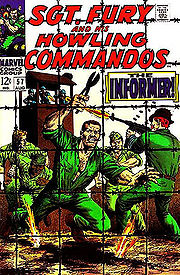
series Sgt. Fury and his Howling Commandos
, beginning with #44 (July 1967). In the 1970s, he collaborated with his sister, artist Marie Severin
, on Marvel's sword and sorcery
series, King Kull
.
During this time he was a major contributor to the satiric
Cracked magazine, drawing television parodies and other features. For Warren Publishing
in the 1970s, he drew for the black-and-white comics magazines Blazing Combat
and Creepy
. Severin also contributed to Topps
' line of bubble gum trading cards.
Circa 2000, writer Jeff Mariotte recalled in 2002, Severin phoned Scott Dunbier, a group editor at DC Comics
' WildStorm
imprint, "and said he was looking to do comics again" after working primarily for Cracked at the time. "I happened to pass by Scott's office as he hung up the phone, and he sounded kind of awestruck as he told me that John Severin wanted to do something with us. I said something like, 'Gee, a Desperadoes story by Severin would be great,'" referring to Mariotte's Western
miniseries for DC. "Scott agreed. We needed to hurry, before he was snapped up by someone else, so I went home and worked up a proposal overnight. We had sent him, right after that first call, copies of the original Desperadoes books. That was followed up by the proposal, the next day. He liked what he saw and wanted to play along." This led to Severin drawing the sequel miniseries Desperadoes: Quiet of The Grave.
He went on to illustrate the controversial 2003 Marvel limited series
The Rawhide Kid, a lighthearted parallel universe
Western
that reimagined the outlaw hero as a kitschy though still formidably gunslinging gay
man. Severin, who had drawn the character for Atlas in the 1950s, refuted rumors that he had not known of the subject matter, saying at the time of the premiere issue's release, "The Rawhide Kid is rather effeminate in this story. It may be quite a blow to some of the old fans of Rawhide Kid. But it's a lot of fun, and he's still a tough hombre." Also in the 2000s, Severin contributed to Marvel's The Punisher
; DC Comics
' Suicide Squad
, American Century
, Caper, and Bat Lash
; and Dark Horse Comics
' Conan, B.P.R.D. and Witchfinder.
, a comic book artist; his son John Severin, Jr., the head of Bubblehead Publishing; his daughter, Ruth Larenas, a producer for that company; and his grandson, John Severin III, a music producer and recording engineer.
With writer Gary Friedrich
and penciler Dick Ayers
, Severin's inking contributed to Sgt. Fury and his Howling Commandos
winning the Alley Award
for Best War Title of 1967 and 1968.
Severin was nominated for a Shazam Award in 1973, for Best Inker (Humor Division).
He was among the winners of the Cartoon Art Museum
's 2001 Sparky Award.
His artwork was exhibited three times at the Words & Pictures Museum in Northampton, Massachusetts
— in the grand-opening group show (October 9, 1992 - January 5, 1993), in the group exhibit "War No More" (May 18-August 8, 1993) and in the group show "Classic Comics: A Selection of Stories from EC Comics" (December 7-February 11, 1996).
United States
The United States of America is a federal constitutional republic comprising fifty states and a federal district...
comic book
Comic book
A comic book or comicbook is a magazine made up of comics, narrative artwork in the form of separate panels that represent individual scenes, often accompanied by dialog as well as including...
artist noted for his distinctive work with EC Comics
EC Comics
Entertaining Comics, more commonly known as EC Comics, was an American publisher of comic books specializing in horror fiction, crime fiction, satire, military fiction and science fiction from the 1940s through the mid-1950s, notably the Tales from the Crypt series...
, primarily on the war comics
War comics
War comics is a genre of comic books that gained popularity in English-speaking countries following World War II.-American war comics:Shortly after the birth of the modern comic book in the mid- to late 1930s, comics publishers began including stories of wartime adventures in the multi-genre...
Two-Fisted Tales
Two-Fisted Tales
Two-Fisted Tales was a bimonthly, anthology war comic published by EC Comics in the early 1950s. The title originated in 1950 when Harvey Kurtzman suggested to William Gaines that they publish an adventure comic. Kurtzman became the editor of Two-Fisted Tales, and with the advent of the Korean War,...
and Frontline Combat
Frontline Combat
Frontline Combat was a bi-monthly, anthology war comic edited by Harvey Kurtzman and published by EC Comics. The first issue was cover dated July/August, 1951. Over a three-year span, the title ran for 15 issues, ending with the January, 1954 issue...
; for Marvel Comics
Marvel Comics
Marvel Worldwide, Inc., commonly referred to as Marvel Comics and formerly Marvel Publishing, Inc. and Marvel Comics Group, is an American company that publishes comic books and related media...
, primarily on its war and Western comics
Western comics
Western comics is a comics genre usually depicting the American Old West frontier and typically set during the late nineteenth century...
; and for the satiric
Satire
Satire is primarily a literary genre or form, although in practice it can also be found in the graphic and performing arts. In satire, vices, follies, abuses, and shortcomings are held up to ridicule, ideally with the intent of shaming individuals, and society itself, into improvement...
magazine Cracked. He was one of the founding cartoonists of Mad
Mad (magazine)
Mad is an American humor magazine founded by editor Harvey Kurtzman and publisher William Gaines in 1952. Launched as a comic book before it became a magazine, it was widely imitated and influential, impacting not only satirical media but the entire cultural landscape of the 20th century.The last...
in 1952.
Severin was inducted into the Will Eisner Award Hall of Fame in 2003.
Early life and career
John Severin began drawing professionally at age 10 when he contributed cartoons to The Hobo News. He attended The High School of Music and Art in New York CityNew York City
New York is the most populous city in the United States and the center of the New York Metropolitan Area, one of the most populous metropolitan areas in the world. New York exerts a significant impact upon global commerce, finance, media, art, fashion, research, technology, education, and...
, together with future EC Comics
EC Comics
Entertaining Comics, more commonly known as EC Comics, was an American publisher of comic books specializing in horror fiction, crime fiction, satire, military fiction and science fiction from the 1940s through the mid-1950s, notably the Tales from the Crypt series...
and Mad
Mad (magazine)
Mad is an American humor magazine founded by editor Harvey Kurtzman and publisher William Gaines in 1952. Launched as a comic book before it became a magazine, it was widely imitated and influential, impacting not only satirical media but the entire cultural landscape of the 20th century.The last...
magazine artists Harvey Kurtzman
Harvey Kurtzman
Harvey Kurtzman was an American cartoonist and the editor of several comic books and magazines. Kurtzman often signed his name H. Kurtz, followed by a stick figure Harvey Kurtzman (October 3, 1924, Brooklyn, New York – February 21, 1993) was an American cartoonist and the editor of several comic...
, Will Elder
Will Elder
William Elder was an American illustrator and comic book artist who worked in numerous areas of commercial art, but is best known for a zany cartoon style that helped launch Harvey Kurtzman's Mad comic book in 1952....
, Al Jaffee
Al Jaffee
Abraham Jaffee , known as Al Jaffee, is an American cartoonist. He is notable for his work in the satirical magazine Mad, including his trademark feature, the Mad Fold-in. As of 2010, Jaffee remains a regular in the magazine after 55 years and is its longest-running contributor...
, and Al Feldstein
Al Feldstein
Albert B. Feldstein is an American writer, editor, and artist, best known for his work at EC Comics and, from 1956 to 1985, as the editor of the satirical magazine Mad. Since retiring from Mad, Feldstein has concentrated on American paintings of Western wildlife...
. After high school, he worked as an apprentice machinist and then enlisted in the Army during World War II.
In a 1980 interview, Severin recalled his start as a professional artist:
Inspired by the quick money Kurtzman would make in-between advertising assignments with one-page "Hey Look!" gags for editor Stan Lee
Stan Lee
Stan Lee is an American comic book writer, editor, actor, producer, publisher, television personality, and the former president and chairman of Marvel Comics....
at Timely Comics
Timely Comics
Timely Comics, an imprint of Timely Publications, was the earliest comic book arm of American publisher Martin Goodman, and the entity that would evolve by the 1960s to become Marvel Comics....
, Severin worked up comics samples inked by Elder. In late 1947, he recalled, the writer-artist-editor team of Joe Simon
Joe Simon
Joseph Henry "Joe" Simon is an American comic book writer, artist, editor, and publisher. Simon created or co-created many important characters in the 1930s-1940s Golden Age of Comic Books and served as the first editor of Timely Comics, the company that would evolve into Marvel Comics.With his...
& Jack Kirby
Jack Kirby
Jack Kirby , born Jacob Kurtzberg, was an American comic book artist, writer and editor regarded by historians and fans as one of the major innovators and most influential creators in the comic book medium....
at Crestwood Publications
Crestwood Publications
Crestwood Publications, also known as Feature Publications, was a magazine publisher that also published comic books from the 1940s through the 1960s. Its title Prize Comics contained what is considered the first ongoing horror comic-book feature, Dick Briefer's "Frankenstein"...
"gave us our first job."
Since it was not standard practice to credit comics creators during this era, a comprehensive list of his early work is difficult to ascertain. Author and historian Jim Vadeboncoeur Jr., based on Severin's description of "a crime story about a boy and a girl who killed somebody ... I think it was their stepfather. They lived on a farm, or out in the suburbs," believes that first Severin/Elder story was the eight-page "The Clue of the Horoscope" in Headline Comics #32 (cover-dated Nov. 1948), from the Crestwood-affiliated Prize Comics. The standard reference Grand Comics Database has no credits for that story, and lists Severin's first confirmed work in comics as two stories published the same month: the 10-page Boy Commandos
Boy Commandos
Boy Commandos was a 1940s comic book series created by Joe Simon and Jack Kirby for DC Comics. A combination of "kid gang" comics and war comics, the title starred an international cast of little tough guys fighting the Nazis — or in their own parlance, "the Ratzies".-Creation:Simon & Kirby, hired...
adventure "The Triumph of William Tell" in DC Comics
DC Comics
DC Comics, Inc. is one of the largest and most successful companies operating in the market for American comic books and related media. It is the publishing unit of DC Entertainment a company of Warner Bros. Entertainment, which itself is owned by Time Warner...
' Boy Commandos #30; and the eight-page Western
Western comics
Western comics is a comics genre usually depicting the American Old West frontier and typically set during the late nineteenth century...
story "Grinning Hole In the Wall" in Prize Comics' Prize Comics Western vol. 7, #5 (each Dec. 1948), both of which he penciled and the latter of which he also inked
Inker
The inker is one of the two line artists in a traditional comic book or graphic novel. After a pencilled drawing is given to the inker, the inker uses black ink to produce refined outlines over the pencil lines...
.
Through 1955, Severin drew a large number of stories for the latter title and other Western series from Prize, and as penciler, he co-created with an unknown writer the long-running Native American
Indigenous peoples of the Americas
The indigenous peoples of the Americas are the pre-Columbian inhabitants of North and South America, their descendants and other ethnic groups who are identified with those peoples. Indigenous peoples are known in Canada as Aboriginal peoples, and in the United States as Native Americans...
feature "American Eagle" in Prize Comics Western vol. 9, #6 (Jan. 1951), inked by his high-school classmate turned fellow pro Will Edler.
Around this time, Severin did his first confirmed work for two publishers with whom he would long be associated. For the future Marvel Comics
Marvel Comics
Marvel Worldwide, Inc., commonly referred to as Marvel Comics and formerly Marvel Publishing, Inc. and Marvel Comics Group, is an American company that publishes comic books and related media...
, he penciled the seven-page romance comic
Romance comics
Romance comics is a comics genre depicting romantic love and its attendant complications such as jealousy, marriage, divorce, betrayal, and heartache. The term is generally associated with an American comic books genre published through the first three decades of the Cold War...
story "My Heart Had No Faith" in Timely Comics
Timely Comics
Timely Comics, an imprint of Timely Publications, was the earliest comic book arm of American publisher Martin Goodman, and the entity that would evolve by the 1960s to become Marvel Comics....
' Actual Romances #1 (Oct. 1949). For EC Comics
EC Comics
Entertaining Comics, more commonly known as EC Comics, was an American publisher of comic books specializing in horror fiction, crime fiction, satire, military fiction and science fiction from the 1940s through the mid-1950s, notably the Tales from the Crypt series...
, he broke in with the seven-page "War Story" in Two-Fisted Tales
Two-Fisted Tales
Two-Fisted Tales was a bimonthly, anthology war comic published by EC Comics in the early 1950s. The title originated in 1950 when Harvey Kurtzman suggested to William Gaines that they publish an adventure comic. Kurtzman became the editor of Two-Fisted Tales, and with the advent of the Korean War,...
#19 (Feb. 1951), continuing to work in tandem with his friend Elder as his inker.
EC Comics
Also at ECEC Comics
Entertaining Comics, more commonly known as EC Comics, was an American publisher of comic books specializing in horror fiction, crime fiction, satire, military fiction and science fiction from the 1940s through the mid-1950s, notably the Tales from the Crypt series...
, Severin — who continued to draw stories for Two-Fisted Tales as well as for Frontline Combat
Frontline Combat
Frontline Combat was a bi-monthly, anthology war comic edited by Harvey Kurtzman and published by EC Comics. The first issue was cover dated July/August, 1951. Over a three-year span, the title ran for 15 issues, ending with the January, 1954 issue...
— became with Elder one of the five original artists who launched editor Harvey Kurtzman
Harvey Kurtzman
Harvey Kurtzman was an American cartoonist and the editor of several comic books and magazines. Kurtzman often signed his name H. Kurtz, followed by a stick figure Harvey Kurtzman (October 3, 1924, Brooklyn, New York – February 21, 1993) was an American cartoonist and the editor of several comic...
's landark satiric
Satire
Satire is primarily a literary genre or form, although in practice it can also be found in the graphic and performing arts. In satire, vices, follies, abuses, and shortcomings are held up to ridicule, ideally with the intent of shaming individuals, and society itself, into improvement...
comic book Mad
Mad (magazine)
Mad is an American humor magazine founded by editor Harvey Kurtzman and publisher William Gaines in 1952. Launched as a comic book before it became a magazine, it was widely imitated and influential, impacting not only satirical media but the entire cultural landscape of the 20th century.The last...
, along with Kurtzman himself, Wally Wood
Wally Wood
Wallace Allan Wood was an American comic book writer, artist and independent publisher, best known for his work in EC Comics and Mad. He was one of Mads founding cartoonists in 1952. Although much of his early professional artwork is signed Wallace Wood, he became known as Wally Wood, a name he...
, and Jack Davis
Jack Davis (cartoonist)
Jack Davis is an American cartoonist and illustrator, known for his advertising art, magazine covers, film posters, record album art and numerous comic book stories...
. Severin drew nine features for Mad between 1952 and 1954.
Marvel Comics and other publishers
Atlas Comics (1950s)
Atlas Comics is the term used to describe the 1950s comic book publishing company that would evolve into Marvel Comics. Magazine and paperback novel publisher Martin Goodman, whose business strategy involved having a multitude of corporate entities, used Atlas as the umbrella name for his comic...
, the 1950s forerunner of Marvel Comics
Marvel Comics
Marvel Worldwide, Inc., commonly referred to as Marvel Comics and formerly Marvel Publishing, Inc. and Marvel Comics Group, is an American company that publishes comic books and related media...
. Artist and colorist Stan Goldberg
Stan Goldberg
Stan Goldberg is an American comic book artist best known for his work as a flagship artist of Archie Comics and as a Marvel Comics' 1960s colorist, who helped design the original color schemes of Spider-Man, the Fantastic Four and other major characters.-Career:Stan Goldberg began work in the...
, a company colleague recalled in 2005,
After Atlas transitioned to become Marvel Comics in the 1960s, Severin did extensive work as penciler, inker
Inker
The inker is one of the two line artists in a traditional comic book or graphic novel. After a pencilled drawing is given to the inker, the inker uses black ink to produce refined outlines over the pencil lines...
or both on such series as The Incredible Hulk, The 'Nam, Conan the Barbarian
Conan the Barbarian
Conan the Barbarian is a fictional sword and sorcery hero that originated in pulp fiction magazines and has since been adapted to books, comics, several films , television programs, video games, roleplaying games and other media...
, Captain Savage, What The?! and Semper Fi. Herb Trimpe
Herb Trimpe
Herbert W. "Herb" Trimpe Herbert W. "Herb" Trimpe Herbert W. "Herb" Trimpe (b. May 26, 1939, is an American comic book artist and occasional writer, best known for his work on The Incredible Hulk and as the first artist to draw for publication the character Wolverine, who later became a breakout...
, the primary Hulk penciler during this period comics fans and historians call the Silver Age of comic books
Silver Age of Comic Books
The Silver Age of Comic Books was a period of artistic advancement and commercial success in mainstream American comic books, predominantly those in the superhero genre. Following the Golden Age of Comic Books and an interregnum in the early to mid-1950s, the Silver Age is considered to cover the...
, said in 2009, "I was kind of thrilled when John Severin inked me, because I liked his work for EC comics, and he was one of my idols." As inker, Severin teamed with penciler Dick Ayers
Dick Ayers
Richard "Dick" Ayers is an American comic book artist and cartoonist best known for his work as one of Jack Kirby's inkers during the late-1950s and 1960s period known as the Silver Age of Comics, including on some of the earliest issues of Marvel Comics' The Fantastic Four, and as the signature...
on an acclaimed run of the World War II
World War II
World War II, or the Second World War , was a global conflict lasting from 1939 to 1945, involving most of the world's nations—including all of the great powers—eventually forming two opposing military alliances: the Allies and the Axis...
series Sgt. Fury and his Howling Commandos
Sgt. Fury and his Howling Commandos
Sgt. Fury and his Howling Commandos are a fictional World War II unit in comic books published by Marvel Comics. Created by Stan Lee and Jack Kirby, they first appeared in Sgt. Fury and his Howling Commandos #1 . The main character, Sgt...
, beginning with #44 (July 1967). In the 1970s, he collaborated with his sister, artist Marie Severin
Marie Severin
Marie Severin is an American comic book artist and colorist best known for her work for Marvel Comics and the 1950s' EC Comics....
, on Marvel's sword and sorcery
Sword and sorcery
Sword and sorcery is a sub-genre of fantasy and historical fantasy, generally characterized by sword-wielding heroes engaged in exciting and violent conflicts. An element of romance is often present, as is an element of magic and the supernatural...
series, King Kull
Kull
Kull of Atlantis or Kull the Conqueror is a fictional character created by American writer Robert E. Howard, also creator of Conan the Barbarian, Solomon Kane, and Bran Mak Morn...
.
During this time he was a major contributor to the satiric
Satire
Satire is primarily a literary genre or form, although in practice it can also be found in the graphic and performing arts. In satire, vices, follies, abuses, and shortcomings are held up to ridicule, ideally with the intent of shaming individuals, and society itself, into improvement...
Cracked magazine, drawing television parodies and other features. For Warren Publishing
Warren Publishing
Warren Publishing was an American magazine company founded by James Warren, who published his first magazines in 1957 and continued in the business for decades...
in the 1970s, he drew for the black-and-white comics magazines Blazing Combat
Blazing Combat
Blazing Combat was an American war-comics magazine published by Warren Publishing from 1965 to 1966. Written and edited by Archie Goodwin, with artwork by such industry notables as Gene Colan, Frank Frazetta, John Severin, Alex Toth, and Wally Wood, it featured war stories in both contemporary and...
and Creepy
Creepy
Creepy was an American horror-comics magazine launched by Warren Publishing in 1964. Like Mad, it was a black-and-white newsstand publication in a magazine format and thus did not require the approval or seal of the Comics Code Authority. The anthology magazine was initially published quarterly but...
. Severin also contributed to Topps
Topps
The Topps Company, Inc., manufactures chewing gum, candy and collectibles. Based in New York, New York, Topps is best known as a leading producer of baseball cards, football cards, basketball cards, hockey cards and other sports and non-sports themed trading cards.-Company history:Topps itself was...
' line of bubble gum trading cards.
Circa 2000, writer Jeff Mariotte recalled in 2002, Severin phoned Scott Dunbier, a group editor at DC Comics
DC Comics
DC Comics, Inc. is one of the largest and most successful companies operating in the market for American comic books and related media. It is the publishing unit of DC Entertainment a company of Warner Bros. Entertainment, which itself is owned by Time Warner...
' WildStorm
WildStorm
WildStorm Productions, or simply WildStorm, published American comic books. Originally an independent company established by Jim Lee and further expanded upon in subsequent years by other creators, WildStorm became a publishing imprint of DC Comics in 1999...
imprint, "and said he was looking to do comics again" after working primarily for Cracked at the time. "I happened to pass by Scott's office as he hung up the phone, and he sounded kind of awestruck as he told me that John Severin wanted to do something with us. I said something like, 'Gee, a Desperadoes story by Severin would be great,'" referring to Mariotte's Western
Western comics
Western comics is a comics genre usually depicting the American Old West frontier and typically set during the late nineteenth century...
miniseries for DC. "Scott agreed. We needed to hurry, before he was snapped up by someone else, so I went home and worked up a proposal overnight. We had sent him, right after that first call, copies of the original Desperadoes books. That was followed up by the proposal, the next day. He liked what he saw and wanted to play along." This led to Severin drawing the sequel miniseries Desperadoes: Quiet of The Grave.
He went on to illustrate the controversial 2003 Marvel limited series
Limited series
A limited series is a comic book series with a set number of installments. A limited series differs from an ongoing series in that the number of issues is determined before production and it differs from a one shot in that it is composed of multiple issues....
The Rawhide Kid, a lighthearted parallel universe
Parallel universe (fiction)
A parallel universe or alternative reality is a hypothetical self-contained separate reality coexisting with one's own. A specific group of parallel universes is called a "multiverse", although this term can also be used to describe the possible parallel universes that constitute reality...
Western
Western comics
Western comics is a comics genre usually depicting the American Old West frontier and typically set during the late nineteenth century...
that reimagined the outlaw hero as a kitschy though still formidably gunslinging gay
Gay
Gay is a word that refers to a homosexual person, especially a homosexual male. For homosexual women the specific term is "lesbian"....
man. Severin, who had drawn the character for Atlas in the 1950s, refuted rumors that he had not known of the subject matter, saying at the time of the premiere issue's release, "The Rawhide Kid is rather effeminate in this story. It may be quite a blow to some of the old fans of Rawhide Kid. But it's a lot of fun, and he's still a tough hombre." Also in the 2000s, Severin contributed to Marvel's The Punisher
Punisher
The Punisher is a fictional character, an anti-hero appearing in comic books based in the . Created by writer Gerry Conway and artists John Romita, Sr., and Ross Andru, the character made its first appearance in The Amazing Spider-Man #129 .The Punisher is a vigilante who employs murder,...
; DC Comics
DC Comics
DC Comics, Inc. is one of the largest and most successful companies operating in the market for American comic books and related media. It is the publishing unit of DC Entertainment a company of Warner Bros. Entertainment, which itself is owned by Time Warner...
' Suicide Squad
Suicide Squad
The Suicide Squad, also known as Task Force X , is a name for two fictional organizations in the DC Comics Universe. The first version debuted in The Brave and the Bold #25 , and the second in Legends #3...
, American Century
American Century (comics)
American Century was a comic book series published by DC Comics as a part of the Vertigo imprint starting in early 2001. It was co-written by Howard Chaykin and David Tischman....
, Caper, and Bat Lash
Bat Lash
Bartholomew "Bat" Alouysius Lash is a fictional Western character in the DC Universe. A self-professed pacifist, ladies' man, and gambler, Bat Lash's adventures have been published by DC Comics since 1968.-Character origin:...
; and Dark Horse Comics
Dark Horse Comics
Dark Horse Comics is the largest independent American comic book and manga publisher.Dark Horse Comics was founded in 1986 by Mike Richardson in Milwaukie, Oregon, with the concept of establishing an ideal atmosphere for creative professionals. Richardson started out by opening his first comic book...
' Conan, B.P.R.D. and Witchfinder.
Family
Severin's family members working in the publishing and entertainment fields include his sister Marie SeverinMarie Severin
Marie Severin is an American comic book artist and colorist best known for her work for Marvel Comics and the 1950s' EC Comics....
, a comic book artist; his son John Severin, Jr., the head of Bubblehead Publishing; his daughter, Ruth Larenas, a producer for that company; and his grandson, John Severin III, a music producer and recording engineer.
Awards and honors
Severin was inducted into the Will Eisner Award Hall of Fame in 2003.With writer Gary Friedrich
Gary Friedrich
Gary Friedrich . is an American comic book writer best known for his Silver Age stories for Marvel Comics' Sgt...
and penciler Dick Ayers
Dick Ayers
Richard "Dick" Ayers is an American comic book artist and cartoonist best known for his work as one of Jack Kirby's inkers during the late-1950s and 1960s period known as the Silver Age of Comics, including on some of the earliest issues of Marvel Comics' The Fantastic Four, and as the signature...
, Severin's inking contributed to Sgt. Fury and his Howling Commandos
Sgt. Fury and his Howling Commandos
Sgt. Fury and his Howling Commandos are a fictional World War II unit in comic books published by Marvel Comics. Created by Stan Lee and Jack Kirby, they first appeared in Sgt. Fury and his Howling Commandos #1 . The main character, Sgt...
winning the Alley Award
Alley Award
The Alley Award was an American series of comic book fan awards, first presented in 1962 for comics published in 1961. Officially organized under the aegis of the Academy of Comic Book Arts and Sciences, under executive secretary Jerry Bails, and later Paul Gambaccini and David Kaler, the award...
for Best War Title of 1967 and 1968.
Severin was nominated for a Shazam Award in 1973, for Best Inker (Humor Division).
He was among the winners of the Cartoon Art Museum
Cartoon Art Museum
The Cartoon Art Museum is a California art museum that specializes in the art of comics and cartoons. It is the only museum in the Western United States dedicated to the preservation and exhibition of all forms of cartoon art...
's 2001 Sparky Award.
His artwork was exhibited three times at the Words & Pictures Museum in Northampton, Massachusetts
Northampton, Massachusetts
The city of Northampton is the county seat of Hampshire County, Massachusetts, United States. As of the 2010 census, the population of Northampton's central neighborhoods, was 28,549...
— in the grand-opening group show (October 9, 1992 - January 5, 1993), in the group exhibit "War No More" (May 18-August 8, 1993) and in the group show "Classic Comics: A Selection of Stories from EC Comics" (December 7-February 11, 1996).
Further reading
- John Severin interview, Graphic Story MagazineGraphic Story MagazineGraphic Story Magazine was an American magazine edited and published by Bill Spicer in the late 1960s and early 1970s.As writer and historian Steve Grant describes the magazine's roots,-Artists and writers:...
#13, Spring 1971 - John Severin interview, REH: Lone Star Fictioneer #4, Spring 1976
- John Severin interview, The Comics JournalThe Comics JournalThe Comics Journal, often abbreviated TCJ, is an American magazine of news and criticism pertaining to comic books, comic strips and graphic novels...
#215, August 1999, pp. 46–93; and #216, pp. 121–152, Fantagraphics - John Severin interview, Jack Kirby Collector #25, August 1999, TwoMorrows PublishingTwoMorrows PublishingTwoMorrows Publishing is a publisher of magazines about comic books, founded in 1994 by John and Pam Morrow out of their small advertising agency in Raleigh, North Carolina...
External links
- Archive of "Trimmings: John Severin": Excerpts/additional material from interview in The Comics JournalThe Comics JournalThe Comics Journal, often abbreviated TCJ, is an American magazine of news and criticism pertaining to comic books, comic strips and graphic novels...
#215, August 1999. WebCitation archive. Original page. - Archive of Shaw, ScottScott Shaw (artist)Scott Shaw is a United States cartoonist and animator, and is also an esteemed conductor of the concert band at Mary Institute and Country Day School...
, "The Story Of Checks"[ inked by John Severin], "Oddball Comics" (column) #1097, December 2, 2005.