
|
|
|
|
John Roberts
|
| |
|
| |
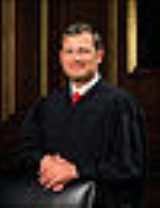
John Glover Roberts, Jr. (born January 27, 1955) is the seventeenth and current Chief Justice of the United States. Appointed by President George W. Bush in 2005, Roberts generally votes with the conservative wing of the Supreme Court. Before joining the Court, he was a judge on the D.C. Circuit for two years, having previously spent fourteen years in private law practice and serving in the Department of Justice and Office of the White House Counsel during the administrations of Presidents Ronald Reagan and George H.W. Bush.
rts was born in Buffalo, New York, on January 27, 1955, the son of John Glover (Jack) Roberts, Sr.

Discussion
Ask a question about 'John Roberts'
Start a new discussion about 'John Roberts'
Answer questions from other users
|
Recent Posts

Encyclopedia
John Glover Roberts, Jr. (born January 27, 1955) is the seventeenth and current Chief Justice of the United States. Appointed by President George W. Bush in 2005, Roberts generally votes with the conservative wing of the Supreme Court. Before joining the Court, he was a judge on the D.C. Circuit for two years, having previously spent fourteen years in private law practice and serving in the Department of Justice and Office of the White House Counsel during the administrations of Presidents Ronald Reagan and George H.W. Bush.
Early years
Roberts was born in Buffalo, New York, on January 27, 1955, the son of John Glover (Jack) Roberts, Sr. (1928-2008) and Rosemary, née Podrasky. All of his maternal great-grandparents were from Czechoslovakia. His father was a plant manager with Bethlehem Steel. When Roberts was in second grade, his family moved to the beachside town of Long Beach, Indiana. He grew up with three sisters: Kathy, Peggy, and Barbara.
Roberts attended Notre Dame Elementary School, a Catholic grade school in Long Beach, and then La Lumiere School, a Catholic boarding school in LaPorte, Indiana and was an excellent student and athlete. He studied five years of Latin (in his four years) and some French, and was known for his devotion to his studies. He was captain of his football team (he later described himself as a "slow-footed linebacker"), and was a Regional Champion in wrestling. He participated in choir and drama, co-edited the school newspaper, and served on the athletic council and the Executive Committee of the Student Council.
He attended Sacred Heart University and transferred to Harvard College for his sophomore year, eventually graduating with an A.B. in history summa cum laude in three years, before attending Harvard Law School, was the managing editor of the Harvard Law Review, and graduated with his J.D. magna cum laude.
Early legal career
After graduating from law school, Roberts served as a law clerk for Judge Henry Friendly on the Second Circuit Court of Appeals for one year. From 1980 to 1981, he clerked for then-Associate Justice William Rehnquist on the United States Supreme Court. From 1981 to 1982, he served in the Reagan administration as a Special Assistant to U.S. Attorney General William French Smith. From 1982 to 1986, Roberts served as Associate Counsel to the President under White House Counsel Fred Fielding.
Roberts entered private law practice in 1986 as an associate at the Washington, D.C.-based law firm of Hogan & Hartson, but left to serve in the George H. W. Bush administration as Principal Deputy Solicitor General from 1989 to 1993. During this time, Roberts argued 39 cases for the government before the Supreme Court, prevailing in 25 of them. He represented 18 states in United States v. Microsoft.
In 1992, George H. W. Bush nominated Roberts to the U.S. Court of Appeals for the District of Columbia Circuit, but no Senate vote was held, and Roberts' nomination expired when Bush left office after losing the 1992 presidential election. Roberts returned to Hogan & Hartson as a partner and became the head of the firm's appellate practice, in addition to serving as an adjunct faculty member at the Georgetown University Law Center. In his capacity as head of Hogan & Hartson's appellate practice, Roberts argued a total of 39 cases before the Supreme Court, including:
| Case | Argued | Decided | Represented |
|---|
| First Options v. Kaplan, | March 22, 1995 | May 22, 1995 | Respondent | | Adams v. Robertson, | January 14, 1997 | March 3, 1997 | Respondent | | Alaska v. Native Village of Venetie Tribal Government, | December 10, 1997 | February 25, 1998 | Petitioner | | Feltner v. Columbia Pictures Television, Inc., | January 21, 1998 | March 31, 1998 | Petitioner | | National Collegiate Athletic Association v. Smith, | January 20, 1999 | February 23, 1999 | Petitioner | | Rice v. Cayetano, | October 6, 1999 | February 23, 2000 | Respondent | | Eastern Associated Coal Corp. v. Mine Workers, | October 2, 2000 | November 28, 2000 | Petitioner | | TrafFix Devices, Inc. v. Marketing Displays, Inc., | November 29, 2000 | March 20, 2001 | Petitioner | | Toyota Motor Manufacturing v. Williams, | November 7, 2001 | January 8, 2002 | Petitioner | | Tahoe-Sierra Preservation Council, Inc. v. Tahoe Regional Planning Agency, | January 7, 2002 | April 23, 2002 | Respondent | | Rush Prudential HMO, Inc. v. Moran, | January 16, 2002 | June 20, 2002 | Petitioner | | Gonzaga University v. Doe, | April 24, 2002 | June 20, 2002 | Petitioner | | Barnhart v. Peabody Coal Co., | October 8, 2002 | January 15, 2003 | Respondent | | Smith v. Doe, | November 13, 2002 | March 5, 2003 | Petitioner |
During the late 1990s, while working for Hogan & Hartson, Roberts served as a member of the steering committee of the Washington, D.C. chapter of the Federalist Society.
In 2000, Roberts traveled to Tallahassee, Florida to advise Jeb Bush, then the Governor of Florida, concerning the latter's actions in the Florida election recount during the presidential election.
On the D.C. Circuit
On May 10, 2001, President George W. Bush nominated Roberts for a different seat on the D.C. Circuit, which had been vacated by James L. Buckley. The Senate at the time, however, was controlled by the Democrats, who were in conflict with Bush over his judicial nominees. Senate Judiciary Committee Chairman Patrick Leahy, D-VT, refused to give Roberts a hearing in the 107th Congress. The GOP regained control of the Senate on January 7, 2003, and Bush resubmitted Roberts' nomination that day. Roberts was confirmed on May 8, 2003, and received his commission on June 2, 2003. During his two year tenure on the D.C. Circuit, Roberts authored 49 opinions, eliciting only two dissents from other judges, and authoring only three dissents of his own.
During his confirmation hearings for Chief Justice, Roberts claimed not to have a set jurisprudential approach, stating that he did "not think beginning with an all-encompassing approach to constitutional interpretation is the best way to faithfully construe the document." Cass Sunstein had earlier argued at the time of his nomination as an Associate Justice that, in general, Roberts appeared to be a judicial minimalist, emphasizing precedent, as opposed to an originalism-oriented or rights-focused jurist:
Notable decisions on the D.C. Circuit include the following:
Fourth and Fifth Amendments
Hedgepeth v. Washington Metropolitan Area Transit Authority, 386 F.3d 1148, involved a 12-year-old girl who was, according to the Washington Post, asked if she had any drugs in her possession, searched for drugs, taken into custody, handcuffed, driven to police headquarters, booked and fingerprinted after she violated a publicly-advertised zero tolerance "no eating" policy in a Washington Metro station by eating a single french fry. She sued; the D.C. Circuit unanimously affirmed the district court's dismissal of the case, which was predicated on the Fourth and Fifth Amendments, and which claimed that an adult would have only received a citation for the same offense, while children must be detained until parents are notified.
"No one is very happy about the events that led to this litigation," Roberts wrote, and noted that the policies under which the girl was apprehended had since been changed. Because age discrimination is evaluated using a rational basis test, however, only weak state interests were required to justify the policy, and the panel concluded they were present. "Because parents and guardians play an essential role in that rehabilitative process, it is reasonable for the District to seek to ensure their participation, and the method chosen — detention until the parent is notified and retrieves the child — certainly does that, in a way issuing a citation might not." The court concluded that the policy and detention were constitutional, noting that "the question before us... is not whether these policies were a bad idea, but whether they violated the Fourth and Fifth Amendments to the Constitution," language reminiscent of Justice Potter Stewart's dissent in Griswold v. Connecticut. "We are not asked in this case to say whether we think this law is unwise, or even asinine," Stewart had written; "[w]e are asked to hold that it violates the United States Constitution. And that, I cannot do."
Military tribunals
In Hamdan v. Rumsfeld, Roberts was part of a unanimous Circuit panel overturning the district court ruling and upholding military tribunals set up by the Bush administration for trying terrorism suspects known as enemy combatants. Circuit Judge A. Raymond Randolph, writing for the court, ruled that Salim Ahmed Hamdan, a driver for al-Qaeda leader Osama bin Laden, could be tried by a military court because:
- the military commission had the approval of the United States Congress;
- the Third Geneva Convention is a treaty between nations and as such it does not confer individual rights and remedies enforceable in U.S. courts;
- even if the Convention could be enforced in U.S. courts, it would not be of assistance to Hamdan at the time because, for a conflict such as the war against Al-Qaeda (considered by the court as a separate war from that against Afghanistan itself) that is not between two countries, it guarantees only a certain standard of judicial procedure without speaking to the jurisdiction in which the prisoner must be tried.
The court held open the possibility of judicial review of the results of the military commission after the current proceedings have ended. This decision was overturned on June 29, 2006 by the Supreme Court in a 5-3 decision, with Roberts not participating due to his prior ruling as a circuit judge.
Environmental regulation
On the U.S. Court of Appeals, Roberts wrote a dissenting opinion regarding Rancho Viejo, LLC v. Norton, , a case involving the protection of a rare California toad under the Endangered Species Act. When the court denied a rehearing en banc, (D.C. Cir. 2003), Roberts dissented, arguing that the original opinion was wrongly decided because he found it inconsistent with United States v. Lopez and United States v. Morrison in that it focused on the effects of the regulation, rather than the taking of the toads themselves, on interstate commerce. In Roberts's view, the Commerce Clause of the Constitution did not permit the government to regulate activity affecting what he called "a hapless toad" that "for reasons of its own, lives its entire life in California." He said that reviewing the case could allow the court "alternative grounds for sustaining application of the Act that may be more consistent with Supreme Court precedent."
Jurisprudence
During Judiciary Committee hearings on his nomination to the circuit court, Roberts testified about his views on jurisprudence.
Commerce Clause
- "Starting with McCulloch v. Maryland, Chief Justice John Marshall gave a very broad and expansive reading to the powers of the Federal Government and explained generally that if the ends be legitimate, then any means chosen to achieve them are within the power of the Federal Government, and cases interpreting that, throughout the years, have come down. Certainly, by the time Lopez was decided, many of us had learned in law school that it was just sort of a formality to say that interstate commerce was affected and that cases weren't going to be thrown out that way. Lopez certainly breathed new life into the Commerce Clause.
- "I think it remains to be seen, in subsequent decisions, how rigorous a showing, and in many cases, it is just a showing. It's not a question of an abstract fact, does this affect interstate commerce or not, but has this body, the Congress, demonstrated the impact on interstate commerce that drove them to legislate? That's a very important factor. It wasn't present in Lopez at all. I think the members of Congress had heard the same thing I had heard in law school, that this is unimportant — and they hadn't gone through the process of establishing a record in that case."
Federalism
- "Simply because you have a problem that needs addressing, it's not necessarily the case that Federal legislation is the best way to address it.... The constitutional limitation doesn't turn on whether it's a good idea. There is not a 'good idea' clause in the Constitution. It can be a bad idea, but certainly still satisfy the constitutional requirements."
Applying precedent
- "The Supreme Court has, throughout its history, on many occasions described the deference that is due to legislative judgments. Justice Holmes described assessing the constitutionality of an act of Congress as the gravest duty that the Supreme Court is called upon to perform.... It's a principle that is easily stated and needs to be observed in practice, as well as in theory.
- "Now, the Court, of course, has the obligation, and has been recognized since Marbury v. Madison, to assess the constitutionality of acts of Congress, and when those acts are challenged, it is the obligation of the Court to say what the law is. The determination of when deference to legislative policy judgments goes too far and becomes abdication of the judicial responsibility, and when scrutiny of those judgments goes too far on the part of the judges and becomes what I think is properly called judicial activism, that is certainly the central dilemma of having an unelected, as you describe it correctly, undemocratic judiciary in a democratic republic."
In referring to Brown v. Board that overturned school segregation: "the Court in that case, of course, overruled a prior decision. I don't think that constitutes judicial activism because obviously if the decision is wrong, it should be overruled. That's not activism. That's applying the law correctly."
Roe v. Wade
While working as a lawyer for the Reagan administration, Roberts wrote legal memos forcefully defending Reagan's policies on abortion. At his nomination hearing Roberts testified that the legal memos represented the views of the administration he was representing at the time and not necessarily his own. "Senator, I was a staff lawyer; I didn't have a position," Roberts said. As a lawyer in the George H. W. Bush administration, Roberts signed a legal brief urging the court to overturn Roe v. Wade.
In private meetings with senators before his confirmation, Roberts testified that Roe was settled law, but he added that it was subject to the legal principle of stare decisis. This told senators little - Roberts was saying only that Roe is settled law so long as the Supreme Court says so.
In his Senate testimony, Roberts acknowledged that, while sitting on the Appellate Court, he would have an obligation to respect precedents established by the Supreme Court, including the controversial decision invalidating many restrictions on the right to an abortion. He stated: "Roe v. Wade is the settled law of the land. [...] There is nothing in my personal views that would prevent me from fully and faithfully applying that precedent, as well as Casey." Following the traditional reticence of nominees to indicate which way they might vote on an issue likely to come before the high court, he did not explicitly say whether he would vote to overturn either.
- See John Roberts Supreme Court nomination and hearings for speculation about Roberts's current views, concerns about these views raised in the hearings, and the potential impact they might have on his actions in the Supreme Court.
Free speech
Roberts authored the 2007 student free speech case Morse v. Frederick, ruling that a student in a public school-sponsored activity does not have the right to advocate drug use on the basis that the right to free speech does not invariably prevent the exercise of school discipline.
U.S. Supreme Court
Nomination and confirmation
On July 19, 2005, President Bush nominated Roberts to the U.S. Supreme Court to fill a vacancy that would be left by the announced retirement of Associate Justice Sandra Day O'Connor. Roberts was the first Supreme Court nominee since Stephen Breyer in 1994. Bush announced Roberts' nomination in a live, nationwide television broadcast from the East Room of the White House at 9 p.m. Eastern Time.
Chief Justice William H. Rehnquist died on September 3, 2005 while Roberts' confirmation was still pending before the Senate. Shortly thereafter, on September 6, Bush withdrew Roberts's nomination as O'Connor's successor and announced Roberts' new nomination to the position of Chief Justice. Bush asked the Senate to expedite Roberts' confirmation hearings in order to fill the vacancy by the beginning of the Supreme Court's session in early October.
On September 22 the Senate Judiciary Committee approved Roberts' nomination by a vote of 13-5, with Senators Ted Kennedy, Richard Durbin, Charles Schumer, Joe Biden and Dianne Feinstein casting the dissenting votes. Roberts was confirmed by the full Senate on September 29, passing by a margin of 78-22. All Republicans and the lone Independent voted for Roberts; the Democrats split evenly, 22 for and 22 against. Roberts was confirmed by what was, historically, a narrow margin for a Supreme Court Justice. While this margin was greater than the 1986 65-33 vote confirming Roberts' predecessor, William Rehnquist, as Chief Justice, and far greater than the 52-48 vote confirming Clarence Thomas as Associate Justice in 1991, it was far narrower than all other recent appointments: Stephen Breyer (87 to 9), David Souter (90 to 9), Ruth Bader Ginsburg (96 to 3), Anthony Kennedy (97 to 0), John Paul Stevens (98 to 0), Antonin Scalia (98 to 0), and Sandra Day O'Connor (99 to 0).
The Roberts Court
Roberts took the Constitutional oath of office, administered by senior Associate Justice John Paul Stevens at the White House, on September 29. On October 3, he took the judicial oath provided for by the Judiciary Act of 1789 at the United States Supreme Court building, prior to the first oral arguments of the 2005 term. Ending weeks of speculation, Roberts wore a plain black robe, dispensing with the gold sleeve-bars added to the Chief Justice's robes by his predecessor. Then 50, Roberts became the youngest member of the Court, and the third-youngest person to have ever become Chief Justice (John Jay was appointed at age 44 in 1789 while John Marshall was appointed at age 45 in 1801). However, many Associate Justices, such as Clarence Thomas (appointed at age 43) and William O. Douglas (appointed at age 41 in 1939), have joined the Court at a younger age than Roberts.
Since joining the court, Justice Antonin Scalia has said that Roberts "pretty much run[s] the show the same way" as Rehnquist, albeit "let[ting] people go on a little longer at conference ... but [he'll] get over that."
Early decisions
On January 17, 2006, Roberts dissented along with Antonin Scalia and Clarence Thomas in Gonzales v. Oregon, which held that the Controlled Substances Act does not allow the United States Attorney General to prohibit physicians from prescribing drugs for the assisted suicide of the terminally ill as permitted by an Oregon law. However, the point of contention in this case was largely one of statutory interpretation, not federalism.
On March 6, 2006, Roberts wrote the unanimous decision in Rumsfeld v. Forum for Academic and Institutional Rights that colleges accepting federal money must allow military recruiters on campus, despite university objections to the Clinton administration-initiated "Don't ask, don't tell" policy on gays in the military.
Fourth Amendment
Roberts wrote his first dissent in the case Georgia v. Randolph, decided March 22, 2006. The majority's decision prohibited police from searching a home if, as in this case, both occupants are present but one occupant objected while another consented. Roberts' dissent criticized the majority opinion as inconsistent with prior case law and for basing its reasoning in part on its perception of social custom.
Notice and opportunity to be heard
Although Roberts has often sided with Scalia and Thomas, Roberts provided a crucial vote against their position in Jones v. Flowers. In Jones, Roberts sided with the liberal bloc of the court in ruling that, before a home is seized and sold in a tax-forfeiture sale, due diligence must be demonstrated and proper notification needs to be sent to the owners. Dissenting were Anthony Kennedy along with Antonin Scalia and Clarence Thomas. Samuel Alito did not participate, while Roberts's ruling was joined by David Souter, Stephen Breyer, John Paul Stevens, and Ruth Bader Ginsburg.
Abortion
On the Supreme Court, Roberts has indicated he supports some abortion restrictions, but has not committed to overturn Roe v. Wade. In Gonzales v. Carhart (2007), the only significant abortion case the court has decided since Roberts joined, he voted with the majority to uphold the constitutionality of the Partial-Birth Abortion Ban Act. Justice Anthony Kennedy, writing for a five-justice majority, distinguished Stenberg v. Carhart, and concluded that the court's previous decision in Planned Parenthood v. Casey did not prevent Congress from banning the procedure. The decision left the door open for future as-applied challenges, and did not address the broader question of whether Congress had the authority to pass the law. Justice Clarence Thomas filed a concurring opinion, contending that the Court's prior decisions in Roe v. Wade and Casey should be reversed; Roberts declined to join that opinion.
Equal protection clause
Roberts opposes the use of race in assigning students to particular schools, even for benign purposes such as maintaining integrated schools. He sees plans such as these as discrimination in violation of the constitution's equal protection clause and the ruling in Brown v. Board of Education. In Parents Involved in Community Schools v. Seattle School District No. 1, the court considered two voluntarily-adopted school district plans that relied on race to determine which schools certain children may attend. Prior to Roberts' arrival, the court had held in Brown that "racial discrimination in public education is unconstitutional," and later, that "racial classifications, imposed by whatever federal, state, or local governmental actor, ... are constitutional only if they are narrowly tailored measures that further compelling governmental interests," and that this "[n]arrow tailoring ... require[s] serious, good faith consideration of workable race-neutral alternatives." Roberts pointed to these cases in writing for the Parents Involved majority, concluding that the school districts had "failed to show that they considered methods other than explicit racial classifications to achieve their stated goals." In a section of the opinion joined by only four Justices, Roberts added that "[t]he way to stop discrimination on the basis of race is to stop discriminating on the basis of race."
Administering Presidential Oath of Office
As Chief Justice, Roberts administered his first oath of office of the President of the United States at the inauguration of Barack Obama on January 20, 2009. Obama had previously voted against Roberts' confirmation to the Supreme Court, making this the first time a Supreme Court justice has sworn in a president who voted against his confirmation.
During the ceremony, Roberts paused momentarily after prompting Obama with "I, Barack Hussein Obama", and the new president began repeating these words at the same time the justice continued with the next phrase. Roberts then misplaced the word "faithfully" in the text of the oath and erroneously replaced the phrase "President of the United States" with "President to the United States" before restating the phrase correctly. When the oath itself was completed, Roberts did not conclude his prompts in the first person, as is recent tradition. He instead concluded by asking Obama, "So help you God?" which the president answered with the traditional, "So help me God." The Associated Press has reported that "[l]ater, as the two men shook hands in the Capitol, Roberts appeared to say the mistake was his fault." The following evening, in the White House Map Room with reporters present, Roberts and Obama repeated the oath correctly. This was, according to the White House, to ensure with "an abundance of caution" that the Constitutional requirement had been met.
Personal life
Roberts is one of twelve Roman Catholic justices — out of 110 justices total — in the history of the Supreme Court. He married Jane Sullivan in Washington in 1996. She is a fellow attorney, a Roman Catholic, and a trustee (along with Clarence Thomas) at her alma mater, the College of the Holy Cross in Worcester, Massachusetts. The Robertses adopted two children, John and Josephine.
Health
Chief Justice Roberts suffered a seizure on July 30, 2007, while at his vacation home on Hupper Island off the village of Port Clyde in St. George, Maine. As a result of the seizure he fell five to ten feet on a dock near his house but suffered only minor scrapes. He was taken by private boat to the mainland (which is several hundred yards from the island) and was then taken by ambulance to Penobscot Bay Medical Center in Rockport, where he stayed overnight, according to Supreme Court spokesperson Kathy Arberg. Doctors called the incident a benign idiopathic seizure, which means there was no obvious physiological cause.
Roberts had suffered a similar seizure in 1993. After this first seizure, Roberts temporarily limited some of his activities, such as driving. According to Senator Arlen Specter, who chaired the Senate Judiciary Committee during Roberts' nomination to be Chief Justice in 2005, senators were aware of this seizure when they were considering his nomination, but the committee did not think it was significant enough to bring up during his confirmation hearings. Federal judges are not required by law to release information about their health.
According to neurologist Dr. Marc Schlosberg of Washington Hospital Center, who has no direct connection to the Roberts case, someone who has had more than one seizure without any other cause is by definition determined to have epilepsy. After two seizures, the likelihood of another at some point is greater than 60 percent. Dr. Steven Garner of New York Methodist Hospital, who is also uninvolved with the case, said that Roberts' previous history of seizures means that the second incident may be less serious than if this were a newly-emerging problem.
The Supreme Court said in a statement Roberts has "fully recovered from the incident," and a neurological evaluation "revealed no cause for concern." Sanjay Gupta, a CNN contributor and a neurosurgeon not directly involved in Roberts' case, said when an otherwise healthy person has a seizure, his doctor would investigate whether the patient had started any new medications and had normal electrolyte levels. If those two things were normal, then a brain scan would be performed. If Roberts does not have another seizure within a relatively short time period, Gupta said he was unsure if Roberts would be given the diagnosis of epilepsy. He said the Chief Justice may need to take an anti-seizure medication.
Personal finances
According to a 16-page financial disclosure form Roberts submitted to the Senate Judiciary Committee prior to his Supreme Court confirmation hearings, his net worth was more than $6 million, including $1.6 million in stock holdings. At the time Roberts left private practice to join the D.C. Circuit Court of Appeals in 2003, he took a pay cut from $1 million a year to $171,800; as Chief Justice his salary is $217,400. Roberts also holds a one-eighth interest in a cottage in Knocklong, an Irish village in County Limerick, where his wife's family roots lie.
Bibliography of articles by John G. Roberts Jr.
The University of Michigan Law Library (External Links, below) has compiled fulltext links to these articles and a number of briefs and arguments.
- Developments in the Law — Zoning, "The Takings Clause," 91 Harv. L. Rev. 1462 (1978). (Section III of a longer article beginning on p. 1427)
- Comment, "Contract Clause — Legislative Alteration of Private Pension Agreements: Allied Structural Steel Co. v. Spannaus," 92 Harv. L. Rev. 86 (1978). (Subsection C of a longer article beginning on p. 57)
- New Rules and Old Pose Stumbling Blocks in High Court Cases, Legal Times, February 26, 1990, co-authored with E. Barrett Prettyman, Jr.*Riding the Coattails of the Solicitor General, Legal Times, March 29, 1993.
- The New Solicitor General and the Power of the Amicus, The Wall Street Journal, May 5, 1993.*Forfeitures: Does Innocence Matter?, New Jersey Law Journal, October 9, 1995.
- Thoughts on Presenting an Effective Oral Argument, School Law in Review (1997).
- The Bush Panel, 2003 BYU L. Rev. 62 (2003). (Part of a tribute to Rex. E. Lee beginning on p. 1. "The Bush Panel" contains a speech by Roberts.)*
See also
Further reading
News articles
- "Roberts Listed in Federalist Society '97-98 Directory". Washington Post. July 25, 2005.
- "Appellate judge Roberts is Bush high-court pick." MSNBC. July 19, 2005.
- Argetsinger, Amy, and Jo Becker. "The nominee as a young pragmatist: under Reagan, Roberts tackled tough issues." Washington Post. July 22, 2005.
- Barbash, Fred, et al.: "Bush to nominate Judge John G. Roberts Jr." Washington Post. July 19, 2005.
- Becker, Jo, and R. Jeffrey Smith. "Record of accomplishment — and some contradictions." Washington Post. July 20, 2005.
- Bumuller, Elisabeth, and David Stout: "President chooses conservative judge as nominee to court." New York Times. July 19, 2005.
- "Bush: Meeting with Roberts during recount wasn't political." Associated Press. July 23, 2005.
- Entous, Adam. "Bush picks conservative Roberts for Supreme Court." Reuters. July 19, 2005.
- Kallestad, Brent. "Roberts helped counsel Jeb Bush." Associated Press. July 21, 2005.
- Lane, Charles. "Federalist affiliation misstated: Roberts does not belong to group." Washington Post. July 21, 2005.
- Lane, Charles. "Short record as judge is under a microscope." Washington Post. July 21, 2005.
- Groppe, Maureen, and John Tuohy. "If you ask John where he's from, he says Indiana." Indianapolis Star. July 20, 2005.
- McFeatters, Ann. "John G. Roberts Jr. is Bush choice for Supreme Court." Pittsburgh Post-Gazette. July 19, 2005.
- Riechmann, Deb. "Federal judge Roberts is Bush's choice." Associated Press. July 20, 2005.
- "Roberts: A smart, self-effacing 'Eagle Scout'." Associated Press. July 20, 2005.
- "Who Is John G. Roberts Jr.?" ABC News. July 19, 2005.
Government/official biographies
- "President announces Judge John Roberts as Supreme Court nominee." Office of the Press Secretary, Executive Office of the President.
- "Roberts, John G., Jr." Federal Judicial Center.
- "John G. Roberts biography." Office of Legal Policy, U.S. Department of Justice.
- "Biographical Sketches of the Judges of the U.S. Court of Appeals for the DC Circuit." United States Court of Appeals for the District of Columbia Circuit.
- John G. Roberts Questionnaire for Appeals Court Confirmation Hearing (p. 297–339) and responses to Questions from Various Senators (p. 443–461)
Other
- Coffin, Shannen W. "Meet John Roberts: The President Makes the Best Choice." National Review Online. July 19, 2005.
- "Former Hogan & Hartson partner nominated for the U.S. Supreme Court." Hogan & Hartson, LLP. July 20, 2005.
- Goldman, Jerry. "John G. Roberts, Jr." Oyez.
- "John G. Roberts, Jr. Fact Sheet" La Lumiere School.
- "John G. Roberts federal campaign contributions." Newsmeat.com. July 19, 2005.
- "Progress for America: Support for the Confirmation of John G. Roberts"
- "Report of the Alliance for Justice: Opposition to the Confirmation of John G. Roberts to the U.S. Court of Appeals for the D.C. Circuit." Alliance for Justice.
External links
|
| |
|
|