

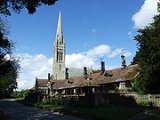
John Loughborough Pearson

Encyclopedia
John Loughborough Pearson (15 July 1817 – 11 December 1897) was a Gothic Revival architect
renowned for his work on churches and cathedral
s. Pearson revived and practised largely the art of vaulting, and acquired in it a proficiency unrivalled in his generation.
, Belgium on 5 July 1817. He was the son of William Pearson, etcher, of Durham
, and was brought up there. At the age of fourteen he was articled to Ignatius Bonomi
, architect, of Durham, whose clergy clientele helped stimulate Pearson's long association with religious architecture, particularly of the Gothic
style.
He soon moved to London
, where he became was a pupil of Philip Hardwick
(1792–1870), architect of the Euston Arch
and Lincoln's Inn
. Pearson lived in central London at 13 Mansfield Street (where a blue plaque
commemorates him), and was awarded the RIBA
Royal Gold Medal
in 1880.
, in Yorkshire
, in 1843, to that of St Peter's, Vauxhall
, in 1864, his buildings are geometrical in manner and exhibit a close adherence to precedent, but elegance of proportion and refinement of detail lift them out of the commonplace of mere imitation. Holy Trinity, Westminster
(1848), and St Mary's, Dalton Holme
(1858), are notable examples of this phase.
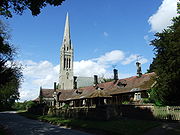 St Peter's, Vauxhall (1864), was his first groined church, and the first of a series of buildings which brought Pearson to the forefront among his contemporaries. In these he applied the Early English style to modern needs and modern economy with unrivalled success. St. Augustine's, Kilburn
(1871), St John's, Red Lion Square
, London (1874), St Alban's, Conybere Street, Birmingham
(1880), St Michael's, Croydon
(1880), St John's, Norwood
(1881), St Stephen's
, Bournemouth
(1889), and All Saints Church
, Hove
(1889), are characteristic examples of his mature work.
 He is best known for Truro
Cathedral (1880), which has a special interest in its apt incorporation of the south aisle of the ancient church. Pearson's conservative spirit fitted him for the repair of ancient buildings, and among cathedrals and other historic buildings placed under his care were Lincoln
, Chichester
, Peterborough
, Bristol
and Exeter
Cathedrals, St George's Chapel, Windsor
, Westminster Hall, and Westminster Abbey
, in the surveyorship of which he succeeded Sir George Gilbert Scott
. He re-faced the north transept of Westminster Abbey, except for the porches (which are the work of Scott), and also designed the vigorous organ cases. In his handling of ancient buildings he was repeatedly opposed by the anti-restorers of the Society for the Protection of Ancient Buildings
(as in the case of the west front of Peterborough Cathedral
in 1896), but he generally proved the soundness of his judgment by his executed work.
Pearson's practice was not confined to church building. Treberfydd
(1850), Quar Wood (1858), Lechlade Manor, an Elizabethan house (1873), Westwood House, Sydenham
, in the French Renaissance
style (1880), the Astor
estate offices (1892) upon the Victoria Embankment
, London, the remodelling of the interiors of Cliveden
House (1893) and No. 18 Carlton House Terrace
(1894), with many parsonages, show his aptitude for domestic architecture. In general design he first aimed at form, embracing both proportion and contour; and his work may be recognized by accurate scholarship coupled with harmonious detail. Its keynotes are cautiousness and refinement rather than boldness.
He is buried in the nave of Westminster Abbey, where his grave is marked by the appropriate motto Sustinuit et abstinuit. He was elected an Associate of the Royal Academy
in 1874, becoming a full member in 1880. He was also a fellow of the Society of Antiquaries
, and a fellow and member of the Council of the Royal Institute of British Architects.
In 1862 Pearson married Jemima Christian, a cousin of his friend Ewan Christian
, a Manxman and architect to the Ecclesiastical Commissioners. Their son Frank Loughborough Pearson was born in 1864, but to Pearson's great sorrow Jemima died the following year of typhoid fever. Frank followed in his father's footsteps completing much of his work before embarking on his own original designs.
Gothic Revival architecture
The Gothic Revival is an architectural movement that began in the 1740s in England...
renowned for his work on churches and cathedral
Cathedral
A cathedral is a Christian church that contains the seat of a bishop...
s. Pearson revived and practised largely the art of vaulting, and acquired in it a proficiency unrivalled in his generation.
Early life and education
Pearson was born in BrusselsBrussels
Brussels , officially the Brussels Region or Brussels-Capital Region , is the capital of Belgium and the de facto capital of the European Union...
, Belgium on 5 July 1817. He was the son of William Pearson, etcher, of Durham
Durham
Durham is a city in north east England. It is within the County Durham local government district, and is the county town of the larger ceremonial county...
, and was brought up there. At the age of fourteen he was articled to Ignatius Bonomi
Ignatius Bonomi
Ignatius Bonomi was an English architect and surveyor, with Italian origins by his father, strongly associated with Durham in north-east England....
, architect, of Durham, whose clergy clientele helped stimulate Pearson's long association with religious architecture, particularly of the Gothic
Gothic architecture
Gothic architecture is a style of architecture that flourished during the high and late medieval period. It evolved from Romanesque architecture and was succeeded by Renaissance architecture....
style.
He soon moved to London
London
London is the capital city of :England and the :United Kingdom, the largest metropolitan area in the United Kingdom, and the largest urban zone in the European Union by most measures. Located on the River Thames, London has been a major settlement for two millennia, its history going back to its...
, where he became was a pupil of Philip Hardwick
Philip Hardwick
Philip Hardwick was an eminent English architect, particularly associated with railway stations and warehouses in London and elsewhere...
(1792–1870), architect of the Euston Arch
Euston Arch
The Euston Arch, built in 1837, was the original entrance to Euston station, facing onto Drummond Street, London. The Arch was demolished when the station was rebuilt in the 1960s, but much of the original stone was later located—principally used as fill in the Prescott Channel—and proposals have...
and Lincoln's Inn
Lincoln's Inn
The Honourable Society of Lincoln's Inn is one of four Inns of Court in London to which barristers of England and Wales belong and where they are called to the Bar. The other three are Middle Temple, Inner Temple and Gray's Inn. Although Lincoln's Inn is able to trace its official records beyond...
. Pearson lived in central London at 13 Mansfield Street (where a blue plaque
Blue plaque
A blue plaque is a permanent sign installed in a public place to commemorate a link between that location and a famous person or event, serving as a historical marker....
commemorates him), and was awarded the RIBA
Royal Institute of British Architects
The Royal Institute of British Architects is a professional body for architects primarily in the United Kingdom, but also internationally.-History:...
Royal Gold Medal
Royal Gold Medal
The Royal Gold Medal for architecture is awarded annually by the Royal Institute of British Architects on behalf of the British monarch, in recognition of an individual's or group's substantial contribution to international architecture....
in 1880.
Career
From the erection of his first church at EllerkerEllerker
Ellerker is a village and civil parish in the East Riding of Yorkshire, England. It is situated approximately west of Hull city centre and east of the market town of Howden...
, in Yorkshire
Yorkshire
Yorkshire is a historic county of northern England and the largest in the United Kingdom. Because of its great size in comparison to other English counties, functions have been increasingly undertaken over time by its subdivisions, which have also been subject to periodic reform...
, in 1843, to that of St Peter's, Vauxhall
Vauxhall
-Demography:Many Vauxhall residents live in social housing. There are several gentrified areas, and areas of terraced townhouses on streets such as Fentiman Road and Heyford Avenue have higher property values in the private market, however by far the most common type of housing stock within...
, in 1864, his buildings are geometrical in manner and exhibit a close adherence to precedent, but elegance of proportion and refinement of detail lift them out of the commonplace of mere imitation. Holy Trinity, Westminster
Westminster
Westminster is an area of central London, within the City of Westminster, England. It lies on the north bank of the River Thames, southwest of the City of London and southwest of Charing Cross...
(1848), and St Mary's, Dalton Holme
Dalton Holme
Dalton Holme a civil parish in the East Riding of Yorkshire in England. It is situated to the north west of the market town of Beverley and covering an area of ....
(1858), are notable examples of this phase.
St. Augustine's, Kilburn
Saint Augustine's, Kilburn is an Anglican Church in the area of Kilburn, in North London, United Kingdom. Because of its large scale and ornate architecture, it is sometimes affectionately referred to as "the Cathedral of North London", although the church is not a cathedral in any official...
(1871), St John's, Red Lion Square
Red Lion Square
Red Lion Square is a small square on the boundary of Bloomsbury and Holborn in London. The square was laid out in 1698 by Nicholas Barbon, taking its name from the Red Lion Inn. According to some sources the bodies of three regicides - Oliver Cromwell, John Bradshaw and Henry Ireton - were placed...
, London (1874), St Alban's, Conybere Street, Birmingham
Birmingham
Birmingham is a city and metropolitan borough in the West Midlands of England. It is the most populous British city outside the capital London, with a population of 1,036,900 , and lies at the heart of the West Midlands conurbation, the second most populous urban area in the United Kingdom with a...
(1880), St Michael's, Croydon
Croydon
Croydon is a town in South London, England, located within the London Borough of Croydon to which it gives its name. It is situated south of Charing Cross...
(1880), St John's, Norwood
Norwood, North Yorkshire
Norwood is a civil parish in the Harrogate district of North Yorkshire, England. According to the 2001 UK census, Norwood parish had a population of 200....
(1881), St Stephen's
St Stephen's Church, Bournemouth
St Stephen's Church is an Anglican church in Bournemouth, Dorset . The liturgical life of the Church is deeply rooted in a rich Anglo-Catholic tradition; the Church boasting a magnificent Lady Chapel, celebrating Marian masses, benediction and recitation of the Rosary for The Society of Mary...
, Bournemouth
Bournemouth
Bournemouth is a large coastal resort town in the ceremonial county of Dorset, England. According to the 2001 Census the town has a population of 163,444, making it the largest settlement in Dorset. It is also the largest settlement between Southampton and Plymouth...
(1889), and All Saints Church
All Saints Church, Hove
All Saints Church is an Anglican church in Hove, part of the English city of Brighton and Hove. It has served as the parish church for the whole of Hove since 1892, and stands in a prominent location at a major crossroads in central Hove.-History:...
, Hove
Hove
Hove is a town on the south coast of England, immediately to the west of its larger neighbour Brighton, with which it forms the unitary authority Brighton and Hove. It forms a single conurbation together with Brighton and some smaller towns and villages running along the coast...
(1889), are characteristic examples of his mature work.
Truro
Truro is a city and civil parish in Cornwall, England, United Kingdom. The city is the centre for administration, leisure and retail in Cornwall, with a population recorded in the 2001 census of 17,431. Truro urban statistical area, which includes parts of surrounding parishes, has a 2001 census...
Cathedral (1880), which has a special interest in its apt incorporation of the south aisle of the ancient church. Pearson's conservative spirit fitted him for the repair of ancient buildings, and among cathedrals and other historic buildings placed under his care were Lincoln
Lincoln Cathedral
Lincoln Cathedral is a historic Anglican cathedral in Lincoln in England and seat of the Bishop of Lincoln in the Church of England. It was reputedly the tallest building in the world for 249 years . The central spire collapsed in 1549 and was not rebuilt...
, Chichester
Chichester Cathedral
The Cathedral Church of the Holy Trinity, otherwise called Chichester Cathedral, is the seat of the Anglican Bishop of Chichester. It is located in Chichester, in Sussex, England...
, Peterborough
Peterborough Cathedral
Peterborough Cathedral, properly the Cathedral Church of St Peter, St Paul and St Andrew – also known as Saint Peter's Cathedral in the United Kingdom – is the seat of the Bishop of Peterborough, dedicated to Saint Peter, Saint Paul and Saint Andrew, whose statues look down from the...
, Bristol
Bristol Cathedral
The Cathedral Church of the Holy and Undivided Trinity is the Church of England cathedral in the city of Bristol, England, and is commonly known as Bristol Cathedral...
and Exeter
Exeter Cathedral
Exeter Cathedral, the Cathedral Church of Saint Peter at Exeter, is an Anglican cathedral, and the seat of the Bishop of Exeter, in the city of Exeter, Devon in South West England....
Cathedrals, St George's Chapel, Windsor
Windsor Castle
Windsor Castle is a medieval castle and royal residence in Windsor in the English county of Berkshire, notable for its long association with the British royal family and its architecture. The original castle was built after the Norman invasion by William the Conqueror. Since the time of Henry I it...
, Westminster Hall, and Westminster Abbey
Westminster Abbey
The Collegiate Church of St Peter at Westminster, popularly known as Westminster Abbey, is a large, mainly Gothic church, in the City of Westminster, London, United Kingdom, located just to the west of the Palace of Westminster. It is the traditional place of coronation and burial site for English,...
, in the surveyorship of which he succeeded Sir George Gilbert Scott
George Gilbert Scott
Sir George Gilbert Scott was an English architect of the Victorian Age, chiefly associated with the design, building and renovation of churches, cathedrals and workhouses...
. He re-faced the north transept of Westminster Abbey, except for the porches (which are the work of Scott), and also designed the vigorous organ cases. In his handling of ancient buildings he was repeatedly opposed by the anti-restorers of the Society for the Protection of Ancient Buildings
Society for the Protection of Ancient Buildings
The Society for the Protection of Ancient Buildings was founded by William Morris, Philip Webb and J.J.Stevenson, and other notable members of the Pre Raphaelite brotherhood, in 1877, to oppose what they saw as the insensitive renovation of ancient buildings then occurring in Victorian...
(as in the case of the west front of Peterborough Cathedral
Peterborough Cathedral
Peterborough Cathedral, properly the Cathedral Church of St Peter, St Paul and St Andrew – also known as Saint Peter's Cathedral in the United Kingdom – is the seat of the Bishop of Peterborough, dedicated to Saint Peter, Saint Paul and Saint Andrew, whose statues look down from the...
in 1896), but he generally proved the soundness of his judgment by his executed work.
Pearson's practice was not confined to church building. Treberfydd
Treberfydd
Treberfydd is a Victorian country house built in Gothic Revival style in 1847-50, just south of Llangorse Lake in the Brecon Beacons National Park in Wales.It is surrounded by of landscaped gardens and is open to the public during August....
(1850), Quar Wood (1858), Lechlade Manor, an Elizabethan house (1873), Westwood House, Sydenham
Sydenham
Sydenham is an area and electoral ward in the London Borough of Lewisham; although some streets towards Crystal Palace Park, Forest Hill and Penge are outside the ward and in the London Borough of Bromley, and some streets off Sydenham Hill are in the London Borough of Southwark. Sydenham was in...
, in the French Renaissance
French Renaissance
French Renaissance is a recent term used to describe a cultural and artistic movement in France from the late 15th century to the early 17th century. It is associated with the pan-European Renaissance that many cultural historians believe originated in northern Italy in the fourteenth century...
style (1880), the Astor
Astor family
The Astor family is a Anglo-American business family of German descent notable for their prominence in business, society, and politics.-Founding family members:...
estate offices (1892) upon the Victoria Embankment
Victoria Embankment
The Victoria Embankment is part of the Thames Embankment, a road and river walk along the north bank of the River Thames in London. Victoria Embankment extends from the City of Westminster into the City of London.-Construction:...
, London, the remodelling of the interiors of Cliveden
Cliveden
Cliveden is an Italianate mansion and estate at Taplow, Buckinghamshire, England. Set on banks above the River Thames, its grounds slope down to the river. The site has been home to an Earl, two Dukes, a Prince of Wales and the Viscounts Astor....
House (1893) and No. 18 Carlton House Terrace
Carlton House Terrace
Carlton House Terrace refers to a street in the St. James's district of the City of Westminster in London, England, and in particular to two terraces of white stucco-faced houses on the south side of the street overlooking St. James's Park. These terraces were built in 1827–32 to overall designs by...
(1894), with many parsonages, show his aptitude for domestic architecture. In general design he first aimed at form, embracing both proportion and contour; and his work may be recognized by accurate scholarship coupled with harmonious detail. Its keynotes are cautiousness and refinement rather than boldness.
He is buried in the nave of Westminster Abbey, where his grave is marked by the appropriate motto Sustinuit et abstinuit. He was elected an Associate of the Royal Academy
Royal Academy
The Royal Academy of Arts is an art institution based in Burlington House on Piccadilly, London. The Royal Academy of Arts has a unique position in being an independent, privately funded institution led by eminent artists and architects whose purpose is to promote the creation, enjoyment and...
in 1874, becoming a full member in 1880. He was also a fellow of the Society of Antiquaries
Society of Antiquaries of London
The Society of Antiquaries of London is a learned society "charged by its Royal Charter of 1751 with 'the encouragement, advancement and furtherance of the study and knowledge of the antiquities and history of this and other countries'." It is based at Burlington House, Piccadilly, London , and is...
, and a fellow and member of the Council of the Royal Institute of British Architects.
In 1862 Pearson married Jemima Christian, a cousin of his friend Ewan Christian
Ewan Christian
Ewan Christian was a British architect. He is most notable for the restoration of Carlisle Cathedral, the alterations to Christ Church, Spitalfields in 1866, and the extension to the National Gallery that created the National Portrait Gallery. He was architect to the Ecclesiastical Commissioners...
, a Manxman and architect to the Ecclesiastical Commissioners. Their son Frank Loughborough Pearson was born in 1864, but to Pearson's great sorrow Jemima died the following year of typhoid fever. Frank followed in his father's footsteps completing much of his work before embarking on his own original designs.
Notable buildings
- St Augustine's, Kilburn (1871–1880) the tower and spire completed (1897–98)
- Truro CathedralTruro CathedralThe Cathedral of the Blessed Virgin Mary, Truro is an Anglican cathedral located in the city of Truro, Cornwall, in the United Kingdom. It was built in the Gothic Revival architectural style fashionable during much of the nineteenth century, and is one of only three cathedrals in the United Kingdom...
(1879–1910) - St Agnes and St Pancras churchSt Agnes and St Pancras churchThe Church of St. Agnes and St. Pancras, Toxteth Park is in Ullet Road, Toxteth Park, Liverpool, Merseyside, England . It is a Grade I listed building and is an active Anglican church in the diocese of Liverpool, the archdeaconry of Liverpool and the deanery of Toxteth and Wavertree...
- St. Margaret's, WestminsterSt. Margaret's, WestminsterThe Anglican church of St. Margaret, Westminster Abbey is situated in the grounds of Westminster Abbey on Parliament Square, and is the parish church of the House of Commons of the United Kingdom in London...
(existing building, Pearson added eastern and western porches) - Christ Church, Appleton-le-MoorsAppleton-le-MoorsAppleton-le-Moors is a village and civil parish in the Ryedale district of North Yorkshire, England. According to the 2001 census it had a population of 183. The village is in the North York Moors National Park, and is near to Pickering and Kirkby Moorside....
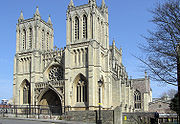
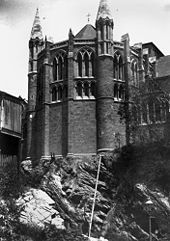
, Yorkshire - Bristol CathedralBristol CathedralThe Cathedral Church of the Holy and Undivided Trinity is the Church of England cathedral in the city of Bristol, England, and is commonly known as Bristol Cathedral...
, existing building, Pearson added the twin towers of the west front - Wakefield CathedralWakefield CathedralWakefield Cathedral, formally the Cathedral Church of All Saints Wakefield is the cathedral for the Church of England's Diocese of Wakefield and is the seat of the Bishop of Wakefield. The cathedral has Anglo Saxon origins and the tallest cathedral spire in Yorkshire...
, Pearson added a new east end after the church was raised to cathedral status (completed 1903-05 by his son Frank).
Some of Pearson's other important works
- FerribyFerribyFerriby is the name of two places, on opposite sides of the Humber Estuary*North Ferriby, in the East Riding of Yorkshire*South Ferriby, in North LincolnshireThe two were historically linked by a ferry....
church (1846) - Stow, LincolnshireStow, LincolnshireStow is a small village and civil parish within the West Lindsey district of Lincolnshire, England. It is eleven miles northwest of the city of Lincoln and six miles southeast of Gainsborough, and has a total resident population of 355.Stow dates back to Roman times and in the...
, St Mary's Minster, (restoration, 1850) - WeybridgeWeybridgeWeybridge is a town in the Elmbridge district of Surrey in South East England. It is bounded to the north by the River Thames at the mouth of the River Wey, from which it gets its name...
, St James's (1853) - Freeland, OxfordshireFreeland, OxfordshireFreeland is a village and civil parish about northeast of Witney in Oxfordshire.-History:Freeland village began as part of the parish of Eynsham. Its toponym is derived from the common Old English word fyrth, meaning a wood. In 1150 the Abbot of Eynsham granted land called terra de Frithe to one...
, St Mary's parish church, parsonage and schools (1869–71) - Kilburn, St Peter's Home (1868)
- WentworthWentworth-People:* Baron Wentworth , the Wentworth peerage, several men and women.* D'Arcy Wentworth , surgeon in the early days of Sydney, Australia, and father of William Charles Wentworth I....
church (1872) - Kirk BraddanBraddanBraddan is an elongated parish in the sheading of Middle in the Isle of Man, stretching from the parishes of Michael and Lezayre in the north, bordering on the parishes of German, Marown and Onchan in the middle and bordering on Santon in the south....
new church, Isle of Man (1873) - HorsforthHorsforthHorsforth is a town and civil parish within the metropolitan borough of the City of Leeds, in West Yorkshire, England, lying to the north west of Leeds. It has a population of 18,928....
church (1874) - CullercoatsCullercoatsCullercoats is an urban area of north east England, with a population 9,407 in 2004. It has now been absorbed into the North Tyneside conurbation, sitting between Tynemouth and Whitley Bay. There is a semi-circular sandy beach with cliffs and caves, and the village is a popular destination for...
, St. George'sSt George's CullercoatsSt. George's, Cullercoats, North Tyneside, England was built in the 19th century French Gothic style.-Background:Looking over the North Sea, beacon-like, it was designed by the church architect John Loughborough Pearson and built in 1884 by the 6th Duke of Northumberland...
(1882) - ChiswickChiswickChiswick is a large suburb of west London, England and part of the London Borough of Hounslow. It is located on a meander of the River Thames, west of Charing Cross and is one of 35 major centres identified in the London Plan. It was historically an ancient parish in the county of Middlesex, with...
, St Michael's (restoration, 1882) - HoveHoveHove is a town on the south coast of England, immediately to the west of its larger neighbour Brighton, with which it forms the unitary authority Brighton and Hove. It forms a single conurbation together with Brighton and some smaller towns and villages running along the coast...
, St. Barnabas' parish churchSt Barnabas Church, HoveSt Barnabas Church is an Anglican church in Hove, part of the English city of Brighton and Hove. It was built between 1882 and 1883 to serve residents of the newly developed streets to the south and west of Hove railway station, which had opened in 1865 and had stimulated growth in the previously...
(1882–1883) - Great YarmouthGreat YarmouthGreat Yarmouth, often known to locals as Yarmouth, is a coastal town in Norfolk, England. It is at the mouth of the River Yare, east of Norwich.It has been a seaside resort since 1760, and is the gateway from the Norfolk Broads to the sea...
church (restoration, 1883) - LiverpoolLiverpoolLiverpool is a city and metropolitan borough of Merseyside, England, along the eastern side of the Mersey Estuary. It was founded as a borough in 1207 and was granted city status in 1880...
, St. Agnes' (1883) - LastinghamLastinghamLastingham is a village and civil parish which lies in the Ryedale district of North Yorkshire, England. It is on the southern fringe of the North York Moors, five miles north east of Kirkbymoorside, one and a half miles to the east of Hutton-le-Hole. It was home to the early missionaries to the...
, St Mary’s Church - Silverhill, East Sussex, St. Matthew's ChurchSt Matthew's Church, SilverhillSt Matthew's Church is an Anglican church in the Silverhill suburb of Hastings, a town and borough in the English county of East Sussex. The present building, a large brick structure of 1884 by ecclesiastical architect John Loughborough Pearson, replaced a much smaller church founded in 1860 when...
(1884) - WokingWokingWoking is a large town and civil parish that shares its name with the surrounding local government district, located in the west of Surrey, UK. It is part of the Greater London Urban Area and the London commuter belt, with frequent trains and a journey time of 24 minutes to Waterloo station....
Convalescent Home (1884) - HeadingleyHeadingleyHeadingley is a suburb of Leeds in West Yorkshire, England. It is approximately two miles out of the city centre, to the north west along the A660 road...
, St Michael's churchSt Michael and All Angels Church, HeadingleyHeadingley Parish Church or the Parish Church of St Michael and All Angels in Headingley, a suburban area of the city of Leeds, West Yorkshire, England is a large Victorian Church of England parish church in the centre of the parish on Otley Road...
(1884) - TorquayTorquayTorquay is a town in the unitary authority area of Torbay and ceremonial county of Devon, England. It lies south of Exeter along the A380 on the north of Torbay, north-east of Plymouth and adjoins the neighbouring town of Paignton on the west of the bay. Torquay’s population of 63,998 during the...
, All Saints' church (1884) - MaidstoneMaidstoneMaidstone is the county town of Kent, England, south-east of London. The River Medway runs through the centre of the town linking Maidstone to Rochester and the Thames Estuary. Historically, the river was a source and route for much of the town's trade. Maidstone was the centre of the agricultural...
, All Saints' church (restoration, 1885) - Shrewsbury AbbeyShrewsbury AbbeyThe Abbey of Saint Peter and Saint Paul, commonly known as Shrewsbury Abbey, was a Benedictine monastery founded in 1083 by the Norman Earl of Shrewsbury, Roger de Montgomery, in Shrewsbury, the county town of Shropshire, England.-Background:...
(1886) - AyrAyrAyr is a town and port situated on the Firth of Clyde in south-west Scotland. With a population of around 46,000, Ayr is the largest settlement in Ayrshire, of which it is the county town, and has held royal burgh status since 1205...
, Holy Trinity (1886) - ThurstastonThurstastonThurstaston is a village on the Wirral Peninsula, England. It is part of the West Kirby & Thurstaston Ward of the Metropolitan Borough of Wirral...
, St Bartholomew's (1886) - HytheHytheHythe may refer to a landing-place, port or haven, or to:Placenames in Canada*Hythe, Alberta Placenames in England*Hythe, Essex *Hythe, Hampshire...
, Kent, St Leonard's Church (restoration, 1887) - OxfordOxfordThe city of Oxford is the county town of Oxfordshire, England. The city, made prominent by its medieval university, has a population of just under 165,000, with 153,900 living within the district boundary. It lies about 50 miles north-west of London. The rivers Cherwell and Thames run through...
, New CollegeNew College, OxfordNew College is one of the constituent colleges of the University of Oxford in the United Kingdom.- Overview :The College's official name, College of St Mary, is the same as that of the older Oriel College; hence, it has been referred to as the "New College of St Mary", and is now almost always...
, reredos (completion, 1889) - CambridgeCambridgeThe city of Cambridge is a university town and the administrative centre of the county of Cambridgeshire, England. It lies in East Anglia about north of London. Cambridge is at the heart of the high-technology centre known as Silicon Fen – a play on Silicon Valley and the fens surrounding the...
, Old SchoolsOld SchoolsThe Old Schools are part of the University of Cambridge, in the centre of Cambridge, England. The Old Schools house the Cambridge University Offices, which form the main administration for the University....
, University Library (additions, 1889) - Cheswardine, Shropshire, (St Swithun's) (rebuilding 1889)
- St John, Friern BarnetSt John, Friern BarnetSt John the Evangelist is an Anglican church on Friern Barnet Road in north London. It is a late example of the Gothic Revival Style by Victorian architect John Loughborough Pearson, begun in 1890-91 and completed after his death by his son Frank Loughborough Pearson.Originating in 1883 as a...
, (1890) - Cambridge, Sidney Sussex College (additions, 1890)
- Middlesex HospitalMiddlesex HospitalThe Middlesex Hospital was a teaching hospital located in the Fitzrovia area of London, United Kingdom. First opened in 1745 on Windmill Street, it was moved in 1757 to Mortimer Street where it remained until it was finally closed in 2005. Its staff and services were transferred to various sites...
chapel (1890) - BishopsgateBishopsgateBishopsgate is a road and ward in the northeast part of the City of London, extending north from Gracechurch Street to Norton Folgate. It is named after one of the original seven gates in London Wall...
, St Helen's parish church (restoration, 1891) - Maida HillMaida ValeMaida Vale is a residential district in West London between St John's Wood and Kilburn. It is part of the City of Westminster. The area is mostly residential, and mainly affluent, consisting of many large late Victorian and Edwardian blocks of mansion flats...
(Irvingite) church (1891) - BarkingBarkingBarking is a suburban town in the London Borough of Barking and Dagenham, in East London, England. A retail and commercial centre situated in the west of the borough, it lies east of Charing Cross. Barking was in the historic county of Essex until it was absorbed by Greater London. The area is...
, All Hallows church (restoration, 1893) - Cambridge, Emmanuel CollegeEmmanuel College, CambridgeEmmanuel College is a constituent college of the University of Cambridge.The college was founded in 1584 by Sir Walter Mildmay on the site of a Dominican friary...
(additions, 1893) - LedburyLedburyLedbury is a town in Herefordshire, England, lying east of Hereford, and south of the Malvern Hills.Today, Ledbury is a thriving market town in rural England. The town has a large number of timber framed buildings, in particular along Church Lane and High Street. One of Ledbury's most outstanding...
, St Michael's church (restoration, 1894) - MaltaMaltaMalta , officially known as the Republic of Malta , is a Southern European country consisting of an archipelago situated in the centre of the Mediterranean, south of Sicily, east of Tunisia and north of Libya, with Gibraltar to the west and Alexandria to the east.Malta covers just over in...
, Memorial church (1894) - Two Temple PlaceTwo Temple PlaceTwo Temple Place, known for many years as “Astor House”, is a building situated near Victoria Embankment . It is both an architectural gem and a veritable treasure house of exquisite works by the likes of William Silver Frith,, Sir George Frampton RA, Nathaniel Hitch and Thomas Nicholls . On 28...
, London (1895) - Port TalbotPort TalbotPort Talbot is a town in Neath Port Talbot, Wales. It had a population of 35,633 in 2001.-History:Port Talbot grew out of the original small port and market town of Aberafan , which belonged to the medieval Lords of Afan. The area of the parish of Margam lying on the west bank of the lower Afan...
, St Theodore's church (1895) - Merthyr TydfilMerthyr TydfilMerthyr Tydfil is a town in Wales, with a population of about 30,000. Although once the largest town in Wales, it is now ranked as the 15th largest urban area in Wales. It also gives its name to a county borough, which has a population of around 55,000. It is located in the historic county of...
, St Tydfil's church (1895) - St Paul's Church, Daybrook (1896)
- St John's Cathedral, BrisbaneSt John's Cathedral, BrisbaneSt John's Cathedral is the Anglican cathedral of Brisbane and the metropolitan cathedral of the ecclesiastical province of Queensland, Australia...
, near replica of Truro Cathedral (1906–1910) - St Bartholomew's Church, Nottingham 1899-1902 (completed by his son)