


John Law (economist)

Encyclopedia
John Law was a Scottish
economist who believed that money was only a means of exchange
that did not constitute wealth
in itself and that national wealth depended on trade. He was appointed Controller General of Finances of France under King Louis XV.
In 1716 Law established the Banque Générale in France, a private bank, but three-quarters of the capital consisted of government bills and government-accepted notes, effectively making it the first central bank
of the nation. He was responsible for the Mississippi Bubble and a chaotic economic collapse in France.
Law was a gambler and a brilliant mental calculator. He was known to win card games by mentally calculating the odds
. He originated economic ideas such as "The Scarcity Theory of Value" and the "Real bills doctrine
".
; his father had purchased a landed estate
at Cramond
on the Firth of Forth
and was known as Law of Lauriston
. Law joined the family business at age fourteen and studied the banking business until his father died in 1688. Law subsequently neglected the firm in favour of more extravagant pursuits and travelled to London, where he lost large sums of money in gambling.
On 9 April 1694, John Law fought a duel with Edward Wilson. Wilson had challenged Law over the affections of Elizabeth Villiers. After Law killed Wilson, he was tried and found guilty of murder and sentenced to death. His sentence was commuted to a fine, upon the ground that the offence only amounted to manslaughter
. Wilson's brother appealed and had Law imprisoned, but he managed to escape to Amsterdam
.
Law urged the establishment of a national bank
to create and increase instruments of credit
and the issue of banknotes backed by land, gold, or silver. The first manifestation of Law's system came when he had returned to Scotland and contributed to the debates leading to the Treaty of Union 1707. He published a text entitled Money and Trade Consider'd with a Proposal for Supplying the Nation with Money (1705). Law's propositions of creating a national bank in Scotland
were ultimately rejected, and he left to pursue his ambitions abroad.
He spent ten years moving between France and the Netherlands
, dealing in financial speculations
. Problems with the French economy presented the opportunity to put his system into practice.
He had the idea of abolishing minor monopolies
and private farming of taxes. He would create a bank for national finance and a state company for commerce, ultimately to exclude all private revenue. This would create a huge monopoly of finance and trade run by the state, and its profits would pay off the national debt. The council called to consider Law's proposal, including financiars such as Samuel Bernard
, rejected the proposition on 24 October 1715.
The wars waged by Louis XIV left the country completely wasted, both economically and financially. The resultant shortage of precious metals led to a shortage of coins in circulation, which in turn limited the production of new coins. It was in this context that the regent, Philippe d'Orléans, appointed John Law as Controller General of Finances.
As Controller General, Law instituted many beneficial reforms (some of which had lasting effect, others of which were soon abolished). He tried to break up large land-holdings to benefit the peasants; he abolished internal road and canal tolls; he encouraged the building of new roads, the starting of new industries (even importing artisans but mostly by offering low-interest loans), and the revival of overseas commerce—and indeed industry increased 60% in two years, and the number of French ships engaged in export went from sixteen to three hundred.
Since, following the devastating War of the Spanish Succession
, France's economy was stagnant and her national debt was crippling, Law proposed to stimulate industry by replacing gold with paper credit and then increasing the supply of credit, and to reduce the national debt by replacing it with shares in economic ventures. Though they failed, his theories ironically live on 300 years later and "captured many key conceptual points which are very much a part of modern monetary theorizing".
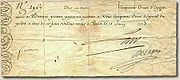
.png)
; an event that would begin with the consolidation of the trading companies of Louisiana
into a single monopoly (The Mississippi Company), and ended with the collapse of the Banque Generale and subsequent devaluing of The Mississippi Company's shares. The company's shares were ultimately rendered worthless, and initially inflated speculation about their worth led to widespread financial stress, which saw Law dismissed from his post as Chief Director of the Banque Generale. Law ultimately fled the country disguised as a woman for his own safety.
in impoverished circumstances. He spent the next few years gambling in Rome, Copenhagen
and Venice
but never regained his former prosperity. Law realised he would never return to France when Orléans died suddenly in 1723 and was granted permission to return to London having received a pardon in 1719. He lived in London for four years and then moved to Venice where he contracted pneumonia
and died a poor man in 1729.
's 1978 National Film Board of Canada
(NFB) animated short John Law and the Mississippi Bubble is a humorous interpretation. The film was a collaboration between Condie and his sister, Sharon Condie, who had been inspired to make a film on the Mississippi Bubble after reading Extraordinary Popular Delusions and the Madness of Crowds. The film was produced by the NFB at its newly opened Winnipeg
studio. It opened in Canadian cinemas starting in September 1979 and was sold to international broadcasters. The film received an award at the Tampere Film Festival
.
}
}}
Scotland
Scotland is a country that is part of the United Kingdom. Occupying the northern third of the island of Great Britain, it shares a border with England to the south and is bounded by the North Sea to the east, the Atlantic Ocean to the north and west, and the North Channel and Irish Sea to the...
economist who believed that money was only a means of exchange
Financial transaction
A financial transaction is an event or condition under the contract between a buyer and a seller to exchange an asset for payment. It involves a change in the status of the finances of two or more businesses or individuals.-History:...
that did not constitute wealth
Wealth
Wealth is the abundance of valuable resources or material possessions. The word wealth is derived from the old English wela, which is from an Indo-European word stem...
in itself and that national wealth depended on trade. He was appointed Controller General of Finances of France under King Louis XV.
In 1716 Law established the Banque Générale in France, a private bank, but three-quarters of the capital consisted of government bills and government-accepted notes, effectively making it the first central bank
Central bank
A central bank, reserve bank, or monetary authority is a public institution that usually issues the currency, regulates the money supply, and controls the interest rates in a country. Central banks often also oversee the commercial banking system of their respective countries...
of the nation. He was responsible for the Mississippi Bubble and a chaotic economic collapse in France.
Law was a gambler and a brilliant mental calculator. He was known to win card games by mentally calculating the odds
Odds
The odds in favor of an event or a proposition are expressed as the ratio of a pair of integers, which is the ratio of the probability that an event will happen to the probability that it will not happen...
. He originated economic ideas such as "The Scarcity Theory of Value" and the "Real bills doctrine
Real bills doctrine
The real bills doctrine holds that issuing money in exchange for real bills is not inflationary. It is best known as "the decried doctrine of the old Bank Directors of 1810: that so long as a bank issues its notes only in the discount of good bills, at not more than sixty days’ date, it cannot go...
".
Biography
Law was born into a family of bankers and goldsmiths from FifeFife
Fife is a council area and former county of Scotland. It is situated between the Firth of Tay and the Firth of Forth, with inland boundaries to Perth and Kinross and Clackmannanshire...
; his father had purchased a landed estate
Lauriston Castle
Lauriston Castle is a 16th century tower house with 19th century extensions overlooking the Firth of Forth, in Edinburgh, Scotland.-History:...
at Cramond
Cramond
Cramond is a seaside village now part of suburban Edinburgh, Scotland, located in the north-west corner of the city at the mouth of the River Almond where it enters the Firth of Forth....
on the Firth of Forth
Firth of Forth
The Firth of Forth is the estuary or firth of Scotland's River Forth, where it flows into the North Sea, between Fife to the north, and West Lothian, the City of Edinburgh and East Lothian to the south...
and was known as Law of Lauriston
Lauriston Castle
Lauriston Castle is a 16th century tower house with 19th century extensions overlooking the Firth of Forth, in Edinburgh, Scotland.-History:...
. Law joined the family business at age fourteen and studied the banking business until his father died in 1688. Law subsequently neglected the firm in favour of more extravagant pursuits and travelled to London, where he lost large sums of money in gambling.
On 9 April 1694, John Law fought a duel with Edward Wilson. Wilson had challenged Law over the affections of Elizabeth Villiers. After Law killed Wilson, he was tried and found guilty of murder and sentenced to death. His sentence was commuted to a fine, upon the ground that the offence only amounted to manslaughter
Manslaughter
Manslaughter is a legal term for the killing of a human being, in a manner considered by law as less culpable than murder. The distinction between murder and manslaughter is said to have first been made by the Ancient Athenian lawmaker Dracon in the 7th century BC.The law generally differentiates...
. Wilson's brother appealed and had Law imprisoned, but he managed to escape to Amsterdam
Amsterdam
Amsterdam is the largest city and the capital of the Netherlands. The current position of Amsterdam as capital city of the Kingdom of the Netherlands is governed by the constitution of August 24, 1815 and its successors. Amsterdam has a population of 783,364 within city limits, an urban population...
.
Law urged the establishment of a national bank
National bank
In banking, the term national bank carries several meanings:* especially in developing countries, a bank owned by the state* an ordinary private bank which operates nationally...
to create and increase instruments of credit
Credit (finance)
Credit is the trust which allows one party to provide resources to another party where that second party does not reimburse the first party immediately , but instead arranges either to repay or return those resources at a later date. The resources provided may be financial Credit is the trust...
and the issue of banknotes backed by land, gold, or silver. The first manifestation of Law's system came when he had returned to Scotland and contributed to the debates leading to the Treaty of Union 1707. He published a text entitled Money and Trade Consider'd with a Proposal for Supplying the Nation with Money (1705). Law's propositions of creating a national bank in Scotland
Scotland
Scotland is a country that is part of the United Kingdom. Occupying the northern third of the island of Great Britain, it shares a border with England to the south and is bounded by the North Sea to the east, the Atlantic Ocean to the north and west, and the North Channel and Irish Sea to the...
were ultimately rejected, and he left to pursue his ambitions abroad.
He spent ten years moving between France and the Netherlands
Dutch Republic
The Dutch Republic — officially known as the Republic of the Seven United Netherlands , the Republic of the United Netherlands, or the Republic of the Seven United Provinces — was a republic in Europe existing from 1581 to 1795, preceding the Batavian Republic and ultimately...
, dealing in financial speculations
Speculations
Speculations was a resource for writers within the science fiction, fantasy, and other speculative fiction subgenres. Started in 1994 as a print magazine, Speculations moved online in 1999, then ceased operations in 2008. Speculations was a Hugo Award for Best Semiprozine nominee seven times...
. Problems with the French economy presented the opportunity to put his system into practice.
He had the idea of abolishing minor monopolies
Monopoly
A monopoly exists when a specific person or enterprise is the only supplier of a particular commodity...
and private farming of taxes. He would create a bank for national finance and a state company for commerce, ultimately to exclude all private revenue. This would create a huge monopoly of finance and trade run by the state, and its profits would pay off the national debt. The council called to consider Law's proposal, including financiars such as Samuel Bernard
Samuel Bernard
Samuel Bernard , Count of Coubert , was a French financier.-Life:Of Dutch origin, Samuel Bernard was the son of the painter and engraver Samuel-Jacques Bernard...
, rejected the proposition on 24 October 1715.
The wars waged by Louis XIV left the country completely wasted, both economically and financially. The resultant shortage of precious metals led to a shortage of coins in circulation, which in turn limited the production of new coins. It was in this context that the regent, Philippe d'Orléans, appointed John Law as Controller General of Finances.
As Controller General, Law instituted many beneficial reforms (some of which had lasting effect, others of which were soon abolished). He tried to break up large land-holdings to benefit the peasants; he abolished internal road and canal tolls; he encouraged the building of new roads, the starting of new industries (even importing artisans but mostly by offering low-interest loans), and the revival of overseas commerce—and indeed industry increased 60% in two years, and the number of French ships engaged in export went from sixteen to three hundred.
Since, following the devastating War of the Spanish Succession
War of the Spanish Succession
The War of the Spanish Succession was fought among several European powers, including a divided Spain, over the possible unification of the Kingdoms of Spain and France under one Bourbon monarch. As France and Spain were among the most powerful states of Europe, such a unification would have...
, France's economy was stagnant and her national debt was crippling, Law proposed to stimulate industry by replacing gold with paper credit and then increasing the supply of credit, and to reduce the national debt by replacing it with shares in economic ventures. Though they failed, his theories ironically live on 300 years later and "captured many key conceptual points which are very much a part of modern monetary theorizing".
Mississippi Company
Law would become the architect of what would later be known as "The Mississippi Bubble"Mississippi Company
The "Mississippi Company" became the "Company of the West" and expanded as the "Company of the Indies" .-The Banque Royale:...
; an event that would begin with the consolidation of the trading companies of Louisiana
Louisiana
Louisiana is a state located in the southern region of the United States of America. Its capital is Baton Rouge and largest city is New Orleans. Louisiana is the only state in the U.S. with political subdivisions termed parishes, which are local governments equivalent to counties...
into a single monopoly (The Mississippi Company), and ended with the collapse of the Banque Generale and subsequent devaluing of The Mississippi Company's shares. The company's shares were ultimately rendered worthless, and initially inflated speculation about their worth led to widespread financial stress, which saw Law dismissed from his post as Chief Director of the Banque Generale. Law ultimately fled the country disguised as a woman for his own safety.
Later years
Law initially moved to BrusselsBrussels
Brussels , officially the Brussels Region or Brussels-Capital Region , is the capital of Belgium and the de facto capital of the European Union...
in impoverished circumstances. He spent the next few years gambling in Rome, Copenhagen
Copenhagen
Copenhagen is the capital and largest city of Denmark, with an urban population of 1,199,224 and a metropolitan population of 1,930,260 . With the completion of the transnational Øresund Bridge in 2000, Copenhagen has become the centre of the increasingly integrating Øresund Region...
and Venice
Venice
Venice is a city in northern Italy which is renowned for the beauty of its setting, its architecture and its artworks. It is the capital of the Veneto region...
but never regained his former prosperity. Law realised he would never return to France when Orléans died suddenly in 1723 and was granted permission to return to London having received a pardon in 1719. He lived in London for four years and then moved to Venice where he contracted pneumonia
Pneumonia
Pneumonia is an inflammatory condition of the lung—especially affecting the microscopic air sacs —associated with fever, chest symptoms, and a lack of air space on a chest X-ray. Pneumonia is typically caused by an infection but there are a number of other causes...
and died a poor man in 1729.
Books
- John Law: Economic Theorist and Policy-Maker by Antoin E. Murphy (Oxford University Press, 1997) is the most extensive account of Law's writings. It is given credit for completing the transformation of opinion about Law from a con man (see Mackay below) to an important economic theorist and successful financial leader.
- Millionaire: The Philanderer, Gambler, and Duelist Who Invented Modern Finance by Janet Gleeson (2000). (ISBN 0-684-87295-1) is a straightforward biography.
- The Poker Face of Wall Street by Aaron BrownAaron C. BrownAaron C. Brown is an American finance professor, author and quant. He wrote Red-Blooded Risk: The Secret History of Wall Street, The Poker Face of Wall Street and A World of Chance...
(John Wiley & Sons, 2006) credits Law for the inspiration of the modern futures exchange and also the game of Poker. - John Law – The History of an Honest Adventurer by H. Montgomery Hyde (W. H. Allen, 1969) is one of the earliest favorable accounts of Law's ideas.
- John Law, the father of paper money by Robert Minton (Association Press, 1975) treats Law's financial innovations that led to modern paper money.
- Crime, Cash, Credit and Chaos by Colin McCall (Solcol, 2007) examines the events and circumstances that became Law's dramatic and tragic life.
- Extraordinary Popular Delusions and the Madness of CrowdsExtraordinary Popular Delusions and the Madness of CrowdsExtraordinary Popular Delusions and the Madness of Crowds is a history of popular folly by Scottish journalist Charles Mackay, first published in 1841. The book chronicles its subjects in three parts: "National Delusions", "Peculiar Follies", and "Philosophical Delusions"...
by Charles MackayCharles MackayCharles Mackay was a Scottish poet, journalist, and song writer.-Life:Charles Mackay was born in Perth, Scotland. His father was by turns a naval officer and a foot soldier; his mother died shortly after his birth. Charles was educated at the Caledonian Asylum, London, and at Brussels, but spent...
, published 1841, contains a colorful negative account of Law's financial activities in France. Available as a reprint and online, including as a free Kindle text.
Films
Richard CondieRichard Condie
Richard Condie, RCA is a Canadian animator, film maker and musician living and working in Winnipeg, Manitoba.-Education and career:...
's 1978 National Film Board of Canada
National Film Board of Canada
The National Film Board of Canada is Canada's twelve-time Academy Award-winning public film producer and distributor. An agency of the Government of Canada, the NFB produces and distributes documentary, animation, alternative drama and digital media productions...
(NFB) animated short John Law and the Mississippi Bubble is a humorous interpretation. The film was a collaboration between Condie and his sister, Sharon Condie, who had been inspired to make a film on the Mississippi Bubble after reading Extraordinary Popular Delusions and the Madness of Crowds. The film was produced by the NFB at its newly opened Winnipeg
Winnipeg
Winnipeg is the capital and largest city of Manitoba, Canada, and is the primary municipality of the Winnipeg Capital Region, with more than half of Manitoba's population. It is located near the longitudinal centre of North America, at the confluence of the Red and Assiniboine Rivers .The name...
studio. It opened in Canadian cinemas starting in September 1979 and was sold to international broadcasters. The film received an award at the Tampere Film Festival
Tampere Film Festival
The Tampere Film Festival is a short film festival held every March in the Finnish town of Tampere. It is accredited by the film producers' society FIAPF, and together with the short film festivals in Oberhausen and Clermont-Ferrand, it is among the most important European short film festivals.The...
.
External links
}
}}