

John Hancock Tower

Encyclopedia
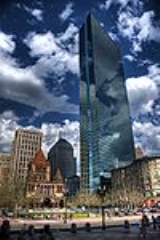
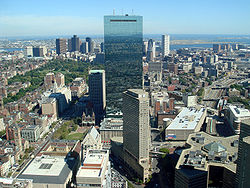
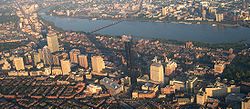
The John Hancock Tower, officially named Hancock Place and colloquially known as The Hancock, is a 60-story, 790-foot (241 m) skyscraper
in Boston
. The tower was designed by Henry N. Cobb
of the firm I. M. Pei & Partners (now known as Pei Cobb Freed & Partners
) and was completed in 1976. In 1977, the American Institute of Architects
presented the firm with a National Honor Award for the building and in 2011 conferred on it the AIA Twenty-five Year Award. It has been the tallest building in Boston for more than 30 years, and is the tallest building in New England
.
Its street address is 200 Clarendon Street. The company uses both "Hancock Place" and "200 Clarendon Street" as mailing addresses for offices in the building. John Hancock Insurance
was originally the main tenant of the building, but the insurance company announced in 2004 that some offices will relocate to a new building at 601 Congress Street, in Fort Point, Boston
.
proposed a glass skyscraper for Berlin
. Such buildings as Gordon Bunshaft
's Lever House
and Mies's Seagram Building
in New York City
, and Frank Lloyd Wright
's Johnson Wax Headquarters
attempted this goal, but many of these designs retained structural artifacts that prevented a consistent, monolithic look.
In 1972, Cobb's design of the Hancock Tower took the glass monolith
skyscraper concept to new heights. The tower is an achievement in minimalist, modernist
skyscraper design.
 Minimalism was the design principle behind the tower. The largest panes of glass possible were used. There are no spandrel
panels, and the mullion
s are minimal. Cobb added a geometric modernist twist by using a parallelogram
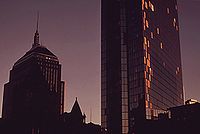
shape for the tower floor plan. From the most common views, this design makes the corners of the tower appear very sharp. The highly reflective window glass is tinted slightly blue, which results in the tower having only a slight contrast with the sky on a clear day. As a final modernist touch, the short sides of the parallelogram are marked with a deep vertical notch, breaking up the tower's mass and emphasizing its verticality. In late evening, the vertical notch to the northwest catches the last light of the sky, while the larger portions of glass reflect the darkening.
A major concern of the architects while designing the tower was its proximity to Boston's Trinity Church
, a prominent National Historic Landmark. Their concern led them to redesign the tower's plans, as there was a public outcry when it was revealed that the Hancock Tower would cast its shadow on the church.
 The building was a much-anticipated landmark from the country's most respected design firm, but has been more notorious for its engineering
flaws than for its architectural
achievement. Its opening was delayed from 1971 to 1976, and the total cost is rumored to have rocketed from $75M to $175M. It was an embarrassment for the firm, modernist architects, and the architecture industry.
s were erected to create a void on which to build. The walls warped, giving way to the clay and mud fill of the Back Bay which they were supposed to hold back. The inward bend of the retaining walls damaged utility lines, the sidewalk pavement, and nearby buildings—including the historic Trinity Church
across the street. Hancock ultimately paid for all the repairs.
 Inventing a way to use the blue mirror glass in a steel tower came at a high price. The building's most dangerous and conspicuous flaw was faulty glass windows. Entire 4' x 11', 500-lb (1.2 x 3.4 m, 227 kg) windowpanes detached from the building and crashed to the sidewalk hundreds of feet below. Police had to close off surrounding streets whenever winds reached 45 mph (72 km/h). According to the Boston Globe, a scale model of the entire Back Bay was built in MIT's Wright Brothers Wind Tunnel
to identify the problem. The research raised questions about the structural integrity of the entire building (due to unanticipated twisting of the structure), but it did not account for the loss of the glass panels. An independent laboratory eventually confirmed that the failure of the glass was due to oscillations and repeated thermal stresses caused by the expansion and contraction of the air between the inner and outer glass panels which formed each window; the bonding between the inner glass, reflective material, and outer glass was so stiff that it was transmitting the force to the outer glass (instead of absorbing it), causing the glass to fail.
In October 1973, I.M. Pei & Partners announced that all 10,344 window panes would be replaced by a single pane, heat-treated variety, costing between $5 million and $7 million. During the repairs, sheets of plywood
replaced empty windows of the building, earning it the nicknames "Plywood Palace" and "Plywood Ranch" (the same name as a suburban lumber-yard chain at the time). The joke was that the Hancock Tower was "the world's tallest plywood building".
when the building swayed in the wind. To stabilize the movement, contractors installed a device called a tuned mass damper
on the 58th floor. As described by Robert Campbell, architecture critic for the Boston Globe:
 According to Robert Campbell, it was discovered that—despite the mass damper—the building could have fallen over under a certain kind of wind loading. It was assessed as more unstable on its narrow sides than on the big flat sides. Some 1,500 tons of diagonal steel bracing, costing $5 million, were added to prevent such an event.
.
The building's owners cite security as the reason for the continued closure. They have rented the deck for private functions and have expressed intent to replace it with more office space. Boston city officials contend that security concerns are moot, since most similar attractions have long since reopened. In addition, they note that a public observation deck was a requirement for the original building permits to gain public benefit from the high tower. However, they have not been able to locate the documentation of this requirement.
. On March 30, 2009, Hancock Place was sold at auction
for $660 million ($20 million was new equity and the $640 million of in-place debt was assumed by the buyer) to a consortium
of "Normandy Real Estate Partners" and "Five Mile Capital Partners". The companies had been slowly increasing their investment over the previous months. In October 2010, Boston Properties acquired the John Hancock Tower for $930 million.
The company that built the Hancock Tower and two earlier, similarly named buildings is known loosely as "John Hancock Insurance
," or simply "John Hancock." It was known as "The John Hancock Life Insurance Company" in the 1930s and "The John Hancock Mutual Life Insurance Company" in the 1940s. As of 2000, the company owning the buildings was "John Hancock Financial Services, Inc." with various subsidiaries such as "The John Hancock Variable Life Insurance Company" and "Signator Investors, Inc." In 2003, the company was acquired by the Canadian Manulife Financial Corporation
, but it still uses the name "John Hancock Financial Services, Inc." and those of various subsidiaries.
Skyscraper
A skyscraper is a tall, continuously habitable building of many stories, often designed for office and commercial use. There is no official definition or height above which a building may be classified as a skyscraper...
in Boston
Boston
Boston is the capital of and largest city in Massachusetts, and is one of the oldest cities in the United States. The largest city in New England, Boston is regarded as the unofficial "Capital of New England" for its economic and cultural impact on the entire New England region. The city proper had...
. The tower was designed by Henry N. Cobb
Henry N. Cobb
Henry N. Cobb is an American architect and founding partner with I.M. Pei of Pei Cobb Freed & Partners, an international architectural firm based in New York City....
of the firm I. M. Pei & Partners (now known as Pei Cobb Freed & Partners
Pei Cobb Freed & Partners
Pei Cobb Freed & Partners is an architectural firm that was founded in 1955 by I. M. Pei as I. M. Pei & Associates, in 1966 called I. M. Pei & Partners, and received its current name and organization in 1989. The founders were I. M. Pei, Henry N. Cobb, and Eason H. Leonard. Pei and Leonard retired...
) and was completed in 1976. In 1977, the American Institute of Architects
American Institute of Architects
The American Institute of Architects is a professional organization for architects in the United States. Headquartered in Washington, D.C., the AIA offers education, government advocacy, community redevelopment, and public outreach to support the architecture profession and improve its public image...
presented the firm with a National Honor Award for the building and in 2011 conferred on it the AIA Twenty-five Year Award. It has been the tallest building in Boston for more than 30 years, and is the tallest building in New England
New England
New England is a region in the northeastern corner of the United States consisting of the six states of Maine, New Hampshire, Vermont, Massachusetts, Rhode Island, and Connecticut...
.
Its street address is 200 Clarendon Street. The company uses both "Hancock Place" and "200 Clarendon Street" as mailing addresses for offices in the building. John Hancock Insurance
John Hancock Insurance
John Hancock Financial is a loose term for a United States insurance company which existed, in various forms, from its founding on April 21, 1862, until its acquisition in 2004 by the Canadian insurance company Manulife Financial. It was named in honor of John Hancock, a prominent patriot...
was originally the main tenant of the building, but the insurance company announced in 2004 that some offices will relocate to a new building at 601 Congress Street, in Fort Point, Boston
Fort Point, Boston
Fort Point is a neighborhood or district of Boston, Massachusetts, which is named after the location of a fort which guarded the city in colonial times....
.
Design
Tall, skinny glass structures were a goal of modernist architecture since Mies Van Der RoheLudwig Mies van der Rohe
Ludwig Mies van der Rohe was a German architect. He is commonly referred to and addressed as Mies, his surname....
proposed a glass skyscraper for Berlin
Berlin
Berlin is the capital city of Germany and is one of the 16 states of Germany. With a population of 3.45 million people, Berlin is Germany's largest city. It is the second most populous city proper and the seventh most populous urban area in the European Union...
. Such buildings as Gordon Bunshaft
Gordon Bunshaft
Gordon Bunshaft was an architect educated at the Massachusetts Institute of Technology. In 1988, Gordon Bunshaft nominated himself for the Pritzker Prize and eventually won it.-Career:...
's Lever House
Lever House
Lever House, designed by Gordon Bunshaft of Skidmore, Owings and Merrill and located at 390 Park Avenue in New York City, is the quintessential and seminal glass-box skyscraper built in the International style according to the design principles of Ludwig Mies van der Rohe. Completed in 1952, it was...
and Mies's Seagram Building
Seagram Building
The Seagram Building is a skyscraper, located at 375 Park Avenue, between 52nd Street and 53rd Street in Midtown Manhattan, New York City. It was designed by Ludwig Mies van der Rohe, in collaboration with Philip Johnson. Severud Associates were the structural engineering consultants. The building...
in New York City
New York City
New York is the most populous city in the United States and the center of the New York Metropolitan Area, one of the most populous metropolitan areas in the world. New York exerts a significant impact upon global commerce, finance, media, art, fashion, research, technology, education, and...
, and Frank Lloyd Wright
Frank Lloyd Wright
Frank Lloyd Wright was an American architect, interior designer, writer and educator, who designed more than 1,000 structures and completed 500 works. Wright believed in designing structures which were in harmony with humanity and its environment, a philosophy he called organic architecture...
's Johnson Wax Headquarters
Johnson Wax Headquarters
Johnson Wax Headquarters is the world headquarters and administration building of S. C. Johnson & Son in Racine, Wisconsin. Designed by American architect Frank Lloyd Wright for the company's president, Herbert F. "Hib" Johnson, the building was constructed from 1936 to 1939...
attempted this goal, but many of these designs retained structural artifacts that prevented a consistent, monolithic look.
In 1972, Cobb's design of the Hancock Tower took the glass monolith
Monolith
A monolith is a geological feature such as a mountain, consisting of a single massive stone or rock, or a single piece of rock placed as, or within, a monument...
skyscraper concept to new heights. The tower is an achievement in minimalist, modernist
Modernism
Modernism, in its broadest definition, is modern thought, character, or practice. More specifically, the term describes the modernist movement, its set of cultural tendencies and array of associated cultural movements, originally arising from wide-scale and far-reaching changes to Western society...
skyscraper design.
Spandrel
A spandrel, less often spandril or splaundrel, is the space between two arches or between an arch and a rectangular enclosure....
panels, and the mullion
Mullion
A mullion is a vertical structural element which divides adjacent window units. The primary purpose of the mullion is as a structural support to an arch or lintel above the window opening. Its secondary purpose may be as a rigid support to the glazing of the window...
s are minimal. Cobb added a geometric modernist twist by using a parallelogram
Parallelogram
In Euclidean geometry, a parallelogram is a convex quadrilateral with two pairs of parallel sides. The opposite or facing sides of a parallelogram are of equal length and the opposite angles of a parallelogram are of equal measure...
shape for the tower floor plan. From the most common views, this design makes the corners of the tower appear very sharp. The highly reflective window glass is tinted slightly blue, which results in the tower having only a slight contrast with the sky on a clear day. As a final modernist touch, the short sides of the parallelogram are marked with a deep vertical notch, breaking up the tower's mass and emphasizing its verticality. In late evening, the vertical notch to the northwest catches the last light of the sky, while the larger portions of glass reflect the darkening.
A major concern of the architects while designing the tower was its proximity to Boston's Trinity Church
Trinity Church, Boston
Trinity Church in the City of Boston, located in the Back Bay of Boston, Massachusetts, is a parish of the Episcopal Diocese of Massachusetts. The congregation, currently standing at approximately 3,000 households, was founded in 1733. The current rector is The Reverend Anne Bonnyman...
, a prominent National Historic Landmark. Their concern led them to redesign the tower's plans, as there was a public outcry when it was revealed that the Hancock Tower would cast its shadow on the church.
Problems with the building
Engineering
Engineering is the discipline, art, skill and profession of acquiring and applying scientific, mathematical, economic, social, and practical knowledge, in order to design and build structures, machines, devices, systems, materials and processes that safely realize improvements to the lives of...
flaws than for its architectural
Architecture
Architecture is both the process and product of planning, designing and construction. Architectural works, in the material form of buildings, are often perceived as cultural and political symbols and as works of art...
achievement. Its opening was delayed from 1971 to 1976, and the total cost is rumored to have rocketed from $75M to $175M. It was an embarrassment for the firm, modernist architects, and the architecture industry.
Foundation
Hancock Tower was plagued with problems before construction started. During the excavation of the tower's foundation, temporary steel retaining wallRetaining wall
Retaining walls are built in order to hold back earth which would otherwise move downwards. Their purpose is to stabilize slopes and provide useful areas at different elevations, e.g...
s were erected to create a void on which to build. The walls warped, giving way to the clay and mud fill of the Back Bay which they were supposed to hold back. The inward bend of the retaining walls damaged utility lines, the sidewalk pavement, and nearby buildings—including the historic Trinity Church
Trinity Church, Boston
Trinity Church in the City of Boston, located in the Back Bay of Boston, Massachusetts, is a parish of the Episcopal Diocese of Massachusetts. The congregation, currently standing at approximately 3,000 households, was founded in 1733. The current rector is The Reverend Anne Bonnyman...
across the street. Hancock ultimately paid for all the repairs.
Falling glass panes
Wind tunnel
A wind tunnel is a research tool used in aerodynamic research to study the effects of air moving past solid objects.-Theory of operation:Wind tunnels were first proposed as a means of studying vehicles in free flight...
to identify the problem. The research raised questions about the structural integrity of the entire building (due to unanticipated twisting of the structure), but it did not account for the loss of the glass panels. An independent laboratory eventually confirmed that the failure of the glass was due to oscillations and repeated thermal stresses caused by the expansion and contraction of the air between the inner and outer glass panels which formed each window; the bonding between the inner glass, reflective material, and outer glass was so stiff that it was transmitting the force to the outer glass (instead of absorbing it), causing the glass to fail.
In October 1973, I.M. Pei & Partners announced that all 10,344 window panes would be replaced by a single pane, heat-treated variety, costing between $5 million and $7 million. During the repairs, sheets of plywood
Plywood
Plywood is a type of manufactured timber made from thin sheets of wood veneer. It is one of the most widely used wood products. It is flexible, inexpensive, workable, re-usable, and can usually be locally manufactured...
replaced empty windows of the building, earning it the nicknames "Plywood Palace" and "Plywood Ranch" (the same name as a suburban lumber-yard chain at the time). The joke was that the Hancock Tower was "the world's tallest plywood building".
Nauseating sway
The building's upper-floor occupants suffered from motion sicknessMotion sickness
Motion sickness or kinetosis, also known as travel sickness, is a condition in which a disagreement exists between visually perceived movement and the vestibular system's sense of movement...
when the building swayed in the wind. To stabilize the movement, contractors installed a device called a tuned mass damper
Tuned mass damper
A tuned mass damper, also known as an active mass damper or harmonic absorber, is a device mounted in structures to reduce the amplitude of mechanical vibrations. Their application can prevent discomfort, damage, or outright structural failure...
on the 58th floor. As described by Robert Campbell, architecture critic for the Boston Globe:
- Two 300-ton weights sit at opposite ends of the 58th floor of the Hancock. Each weight is a box of steel, filled with lead, 17 feet (5.2 m) square by 3 feet (0.9 m) high. Each weight rests on a steel plate. The plate is covered with lubricant so the weight is free to slide. But the weight is attached to the steel frame of the building by means of springs and shock absorbers. When the Hancock sways, the weight tends to remain still, allowing the floor to slide underneath it. Then, as the springs and shocks take hold, they begin to tug the building back. The effect is like that of a gyroscope, stabilizing the tower. The reason there are two weights, instead of one, is so they can tug in opposite directions when the building twists. The cost of the damper was $3 million. The dampers are free to move a few feet relative to the floor.
Closure of the observation deck
An observation deck with spectacular views of Boston was a popular attraction. However, it was closed after the September 11, 2001, terrorist attacks.. Because of the closure of the John Hancock Tower's observation deck, the highest observation deck open to the public in Boston is in the Prudential TowerPrudential Tower
The Prudential Tower, also known as the Prudential Building or, colloquially, The Pru, is a skyscraper in Boston, Massachusetts. The building, a part of the Prudential Center complex, currently stands as the 2nd-tallest building in Boston, behind the John Hancock Tower. The Prudential Tower was...
.
The building's owners cite security as the reason for the continued closure. They have rented the deck for private functions and have expressed intent to replace it with more office space. Boston city officials contend that security concerns are moot, since most similar attractions have long since reopened. In addition, they note that a public observation deck was a requirement for the original building permits to gain public benefit from the high tower. However, they have not been able to locate the documentation of this requirement.
2006-10 ownership changes
In 2006, Broadway Partners acquired Hancock Place for $1.3 billion. By 2009, they had defaulted on the loans they used to buy the building, and it fell into foreclosureForeclosure
Foreclosure is the legal process by which a mortgage lender , or other lien holder, obtains a termination of a mortgage borrower 's equitable right of redemption, either by court order or by operation of law...
. On March 30, 2009, Hancock Place was sold at auction
Auction
An auction is a process of buying and selling goods or services by offering them up for bid, taking bids, and then selling the item to the highest bidder...
for $660 million ($20 million was new equity and the $640 million of in-place debt was assumed by the buyer) to a consortium
Consortium
A consortium is an association of two or more individuals, companies, organizations or governments with the objective of participating in a common activity or pooling their resources for achieving a common goal....
of "Normandy Real Estate Partners" and "Five Mile Capital Partners". The companies had been slowly increasing their investment over the previous months. In October 2010, Boston Properties acquired the John Hancock Tower for $930 million.
Note on company name
The company that built the Hancock Tower and two earlier, similarly named buildings is known loosely as "John Hancock Insurance
John Hancock Insurance
John Hancock Financial is a loose term for a United States insurance company which existed, in various forms, from its founding on April 21, 1862, until its acquisition in 2004 by the Canadian insurance company Manulife Financial. It was named in honor of John Hancock, a prominent patriot...
," or simply "John Hancock." It was known as "The John Hancock Life Insurance Company" in the 1930s and "The John Hancock Mutual Life Insurance Company" in the 1940s. As of 2000, the company owning the buildings was "John Hancock Financial Services, Inc." with various subsidiaries such as "The John Hancock Variable Life Insurance Company" and "Signator Investors, Inc." In 2003, the company was acquired by the Canadian Manulife Financial Corporation
Manulife Financial
Manulife Financial Corporation , is a Canadian insurance company and financial services provider. Manulife Financial's global head office is located in Toronto, Canada and the Company has operations in 21 countries and territories worldwide.The Company operates in Canada and Asia through the brand...
, but it still uses the name "John Hancock Financial Services, Inc." and those of various subsidiaries.
See also
- John HancockJohn HancockJohn Hancock was a merchant, statesman, and prominent Patriot of the American Revolution. He served as president of the Second Continental Congress and was the first and third Governor of the Commonwealth of Massachusetts...
, for whom John Hancock Insurance was named - Prudential TowerPrudential TowerThe Prudential Tower, also known as the Prudential Building or, colloquially, The Pru, is a skyscraper in Boston, Massachusetts. The building, a part of the Prudential Center complex, currently stands as the 2nd-tallest building in Boston, behind the John Hancock Tower. The Prudential Tower was...
for an image of the Boston skyline from Cambridge in 1963, with the old 26-story Hancock building a conspicuous landmark. - List of tallest buildings by U.S. state
- List of tallest buildings in Boston
External links
- library-towers John Hancock Tower
- Architecture Week When Bad Things Happen to Good Buildings
- The Perfect Skyscraper The Perfect Skyscraper
- Special Report on the Boston Globe; "The Hancock at 30" includes 4 audio slideshows
- Globe Critic, Robert Campbell, on the problems of the John Hancock Tower