
Home      Discussion      Topics      Dictionary      Almanac
Signup       Login
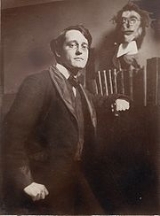
John French Sloan

John French Sloan

Overview
John French Sloan was an American artist. As a member of The Eight
The Eight
The Eight may refer to:*Ashcan School, an American school of painters*The Eight , a Hungarian art movement*The Eight ...

, he became a leading figure in the Ashcan School
Ashcan School
The Ashcan School, also called the Ash Can School, is defined as a realist artistic movement that came into prominence in the United States during the early twentieth century, best known for works portraying scenes of daily life in New York's poorer neighborhoods. The movement grew out of a group...

 of realist
Realism (visual arts)
Realism in the visual arts is a style that depicts the actuality of what the eyes can see. The term is used in different senses in art history; it may mean the same as illusionism, the representation of subjects with visual mimesis or verisimilitude, or may mean an emphasis on the actuality of...

 artists. He was known for his urban genre painting and ability to capture the essence of neighborhood life in New York City
New York City
New York is the most populous city in the United States and the center of the New York Metropolitan Area, one of the most populous metropolitan areas in the world. New York exerts a significant impact upon global commerce, finance, media, art, fashion, research, technology, education, and...

, often through his window. Sloan has been called "the premier artist of the Ashcan School who painted the inexhaustible energy and life of New York City during the first decades of the twentieth century", and an "early twentieth-century realist painter who embraced the principles of socialism and placed his artistic talents at the service of those beliefs."
Discussion
Ask a question about 'John French Sloan'
Start a new discussion about 'John French Sloan'
Answer questions from other users
Full Discussion Forum
 
Recent Discussions
Encyclopedia
John French Sloan was an American artist. As a member of The Eight
The Eight
The Eight may refer to:*Ashcan School, an American school of painters*The Eight , a Hungarian art movement*The Eight ...

, he became a leading figure in the Ashcan School
Ashcan School
The Ashcan School, also called the Ash Can School, is defined as a realist artistic movement that came into prominence in the United States during the early twentieth century, best known for works portraying scenes of daily life in New York's poorer neighborhoods. The movement grew out of a group...

 of realist
Realism (visual arts)
Realism in the visual arts is a style that depicts the actuality of what the eyes can see. The term is used in different senses in art history; it may mean the same as illusionism, the representation of subjects with visual mimesis or verisimilitude, or may mean an emphasis on the actuality of...

 artists. He was known for his urban genre painting and ability to capture the essence of neighborhood life in New York City
New York City
New York is the most populous city in the United States and the center of the New York Metropolitan Area, one of the most populous metropolitan areas in the world. New York exerts a significant impact upon global commerce, finance, media, art, fashion, research, technology, education, and...

, often through his window. Sloan has been called "the premier artist of the Ashcan School who painted the inexhaustible energy and life of New York City during the first decades of the twentieth century", and an "early twentieth-century realist painter who embraced the principles of socialism and placed his artistic talents at the service of those beliefs."

Biography


John Sloan was born in Lock Haven, Pennsylvania
Lock Haven, Pennsylvania
The city of Lock Haven is the county seat of Clinton County, in the U.S. state of Pennsylvania. Located near the confluence of the West Branch Susquehanna River and Bald Eagle Creek, it is the principal city of the Lock Haven, Pennsylvania, micropolitan statistical area, itself part of the...

, on August 2, 1871, to James Dixon, a man with artistic leanings who made an unsteady income in a succession of jobs, and Henrietta Sloan, a schoolteacher from an affluent family. Sloan grew up in Philadelphia, Pennsylvania
Philadelphia, Pennsylvania
Philadelphia is the largest city in the Commonwealth of Pennsylvania and the county seat of Philadelphia County, with which it is coterminous. The city is located in the Northeastern United States along the Delaware and Schuylkill rivers. It is the fifth-most-populous city in the United States,...

, where he lived and worked until 1904, when he moved to New York City
New York City
New York is the most populous city in the United States and the center of the New York Metropolitan Area, one of the most populous metropolitan areas in the world. New York exerts a significant impact upon global commerce, finance, media, art, fashion, research, technology, education, and...

. He and his two sisters were encouraged to draw and paint from an early age. In the fall of 1884 he started high school at Central High School in Philadelphia, where his classmates included William Glackens
William Glackens
William James Glackens was an American realist painter.Glackens studied at the Pennsylvania Academy of the Fine Arts and later moved to New York City, where he co-founded what came to be called the Ashcan School art movement...

 and Albert C. Barnes
Albert C. Barnes
Albert Coombs Barnes was an American chemist and art collector. With the fortune made from the development of the antiseptic, anti-blindness drug Argyrol, he founded the Barnes Foundation, an educational institution based on his private collection of art...

.

In the spring of 1888, his father experienced a mental breakdown that left him unable to work, and Sloan became responsible, at the age of 16, for the support of his parents and sisters. He dropped out of school in order to work full-time as an assistant cashier at Porter and Coates, a bookstore and seller of fine prints. His duties were light, allowing him many hours to read the books and examine the works in the store's print department. It was there that Sloan created his earliest surviving works, among which are pen and ink copies after Dürer
Albrecht Dürer
Albrecht Dürer was a German painter, printmaker, engraver, mathematician, and theorist from Nuremberg. His prints established his reputation across Europe when he was still in his twenties, and he has been conventionally regarded as the greatest artist of the Northern Renaissance ever since...

 and Rembrandt. He also began making etching
Etching
Etching is the process of using strong acid or mordant to cut into the unprotected parts of a metal surface to create a design in intaglio in the metal...

s, which were sold in the store for a modest sum. In 1890, the offer of a higher salary persuaded Sloan to leave his position to work for A. Edward Newton
A. Edward Newton
Alfred Edward Newton was an American author, publisher, and avid book collector. He is best known for his book Amenities of Book Collecting which sold over 25,000 copies...

, a former clerk for Porter and Coates who had opened his own stationery store. At Newton's, Sloan designed greeting cards and calendars, and continued with his etchings. In that same year he also attended a night drawing class at the Spring Garden Institute
Spring Garden College
Spring Garden College, established as the Spring Garden Institute in 1851, was a private technical college founded in Spring Garden, Pennsylvania . Its building at 523-25 North Broad Street was designed by architect Stephen Decatur Button.The college closed in the 1990s...

, which provided him his first formal art training.

He soon left Newton's business in quest of greater freedom as a freelance commercial artist, but this venture produced little income. In 1892, he began working as an illustrator in the art department of The Philadelphia Inquirer
The Philadelphia Inquirer
The Philadelphia Inquirer is a morning daily newspaper that serves the Philadelphia, Pennsylvania, metropolitan area of the United States. The newspaper was founded by John R. Walker and John Norvell in June 1829 as The Pennsylvania Inquirer and is the third-oldest surviving daily newspaper in the...

. Later that same year, Sloan began taking evening classes at the Pennsylvania Academy of the Fine Arts
Pennsylvania Academy of the Fine Arts
The Pennsylvania Academy of the Fine Arts is a museum and art school in Philadelphia, Pennsylvania. It was founded in 1805 and is the oldest art museum and school in the United States. The academy's museum is internationally known for its collections of 19th and 20th century American paintings,...

 under the guidance of Thomas Pollock Anshutz
Thomas Pollock Anshutz
Thomas Pollock Anshutz was an American painter and teacher. Co-founder of The Darby School and leader at the Pennsylvania Academy of Fine Arts, Anshutz was known for his award winning portraiture work and working friendship with Thomas Eakins.-Personal life and education:Thomas Anshutz was born in...

. Among his fellow students was his old schoolmate William Glackens.

At a Christmas party in 1892, Sloan met Robert Henri
Robert Henri
Robert Henri was an American painter and teacher. He was a leading figure of the Ashcan School in art.- Early life :...

, a charismatic advocate of artistic independence who became a mentor to him. Henri encouraged Sloan and eventually convinced him to turn to painting. They were lifelong friends, shared a common artistic outlook, and together promoted a new form of realism that helped to redefine American Art. In 1893, Sloan and Henri founded the Charcoal Club together, which would also include Glackens, George Luks
George Luks
George Benjamin Luks, was an American realist artist and illustrator. His vigorously painted genre paintings of urban subjects are examples of the Ashcan school in American art.-Early life:...

, and Everett Shinn
Everett Shinn
Everett Shinn was an American realist painter and member of the Ashcan School, also known as 'the Eight.' He was the youngest member of the group of modernist painters who explored the depiction of real life...

.

Towards the end of 1895, Sloan decided to leave The Philadelphia Inquirer to work in the art department of The Philadelphia Press
Philadelphia Press
The Philadelphia Press is a defunct newspaper that was published from August 1, 1857 to October 1, 1920.The paper was founded by John W. Forney. Charles Emory Smith was editor and owned a stake in the paper from 1880 until his death in 1908...

. His schedule was now less rigid, allowing him more time to paint. Henri offered encouragement, and often sent Sloan reproductions of European artists, such as Manet
Édouard Manet
Édouard Manet was a French painter. One of the first 19th-century artists to approach modern-life subjects, he was a pivotal figure in the transition from Realism to Impressionism....

, Hals
Frans Hals
Frans Hals was a Dutch Golden Age painter. He is notable for his loose painterly brushwork, and helped introduce this lively style of painting into Dutch art. Hals was also instrumental in the evolution of 17th century group portraiture.-Biography:Hals was born in 1580 or 1581, in Antwerp...

, Goya
Francisco Goya
Francisco José de Goya y Lucientes was a Spanish romantic painter and printmaker regarded both as the last of the Old Masters and the first of the moderns. Goya was a court painter to the Spanish Crown, and through his works was both a commentator on and chronicler of his era...

 and Velázquez
Diego Velázquez
Diego Rodríguez de Silva y Velázquez was a Spanish painter who was the leading artist in the court of King Philip IV. He was an individualistic artist of the contemporary Baroque period, important as a portrait artist...

.

In 1898, the socially awkward Sloan was introduced to Anna Maria (Dolly) Wall (born July 28, 1876), and the two fell immediately in love. In entering into a relationship with her, Sloan accepted the challenges posed by her alcoholism
Alcoholism
Alcoholism is a broad term for problems with alcohol, and is generally used to mean compulsive and uncontrolled consumption of alcoholic beverages, usually to the detriment of the drinker's health, personal relationships, and social standing...

 and her sexual history, which included prostitution
Prostitution
Prostitution is the act or practice of providing sexual services to another person in return for payment. The person who receives payment for sexual services is called a prostitute and the person who receives such services is known by a multitude of terms, including a "john". Prostitution is one of...

; although Dolly worked in a department store by day, Sloan met her in a brothel. The two were married on August 5, 1901, providing Sloan with an affectionate partner who believed in him absolutely, but whose lapses and mental instability led to frequent crises.

By 1903 he had produced about sixty oil paintings in total. In April 1904, Sloan moved to New York City
New York City
New York is the most populous city in the United States and the center of the New York Metropolitan Area, one of the most populous metropolitan areas in the world. New York exerts a significant impact upon global commerce, finance, media, art, fashion, research, technology, education, and...

, and soon found quarters in Greenwich Village
Greenwich Village
Greenwich Village, , , , .in New York often simply called "the Village", is a largely residential neighborhood on the west side of Lower Manhattan in New York City. A large majority of the district is home to upper middle class families...

 where he painted some of his best-known works, including McSorley's Bar, Sixth Avenue Elevated
IRT Sixth Avenue Line
The IRT Sixth Avenue Line, often called the Sixth Avenue Elevated or Sixth Avenue El, was the second elevated railway in Manhattan in New York City, following the Ninth Avenue Elevated. In addition to its transportation role, it also captured the imagination of artists and poets.The line ran south...

 at Third Street
, and Wake of the Ferry. His time in New York was his most prolific period, but he sold little, and he continued to rely on his earnings as a freelancer for The Philadelphia Press, for which he continued to draw weekly puzzles until 1910. By 1905 he was supplementing this income by drawing illustrations for books (including The Moonstone
The Moonstone
The Moonstone by Wilkie Collins is a 19th-century British epistolary novel, generally considered the first detective novel in the English language. The story was originally serialized in Charles Dickens' magazine All the Year Round. The Moonstone and The Woman in White are considered Wilkie...

) and for such journals as Collier's Weekly
Collier's Weekly
Collier's Weekly was an American magazine founded by Peter Fenelon Collier and published from 1888 to 1957. With the passage of decades, the title was shortened to Collier's....

, Good Housekeeping
Good Housekeeping
Good Housekeeping is a women's magazine owned by the Hearst Corporation, featuring articles about women's interests, product testing by The Good Housekeeping Institute, recipes, diet, health as well as literary articles. It is well known for the "Good Housekeeping Seal," popularly known as the...

, Harper's Weekly
Harper's Weekly
Harper's Weekly was an American political magazine based in New York City. Published by Harper & Brothers from 1857 until 1916, it featured foreign and domestic news, fiction, essays on many subjects, and humor...

, The Saturday Evening Post
The Saturday Evening Post
The Saturday Evening Post is a bimonthly American magazine. It was published weekly under this title from 1897 until 1969, and quarterly and then bimonthly from 1971.-History:...

, and Scribner's
Scribner's Magazine
Scribner's Magazine was an American periodical published by the publishing house of Charles Scribner's Sons from January 1887 to May 1939. Scribner's Magazine was the second magazine out of the "Scribner's" firm, after the publication of Scribner's Monthly...

. Sloan participated in the 1908 exhibition at the Macbeth Galleries of a group that included the five artists from the Philadelphia Charcoal Club as well as Maurice Prendergast
Maurice Prendergast
Maurice Brazil Prendergast was an American Post-Impressionist artist who worked in oil, watercolor, and monotype...

, Ernest Lawson
Ernest Lawson
Ernest Lawson was a Canadian-American painter and a member of The Eight, a group of artists which included the group's leaders Robert Henri, Everett Shinn, John Sloan, Arthur B. Davies, Maurice Prendergast, George Luks, and William J. Glackens...

, and Arthur B. Davies
Arthur B. Davies
Arthur Bowen Davies was an avant-garde American artist and patron.-Biography:He was born in Utica, New York and studied at the Chicago Academy of Design from 1879 to 1882...

, who were afterward collectively known as "The Eight
The Eight
The Eight may refer to:*Ashcan School, an American school of painters*The Eight , a Hungarian art movement*The Eight ...

".


A doctor who was consulted in an effort to help Dolly overcome her drinking problem suggested a scheme to Sloan: he was to start a diary in which he would include his fondest thoughts of her, with the expectation that she would surreptitiously read it and be freed of her disabling fear that Sloan would leave her. Spanning the period from 1906 to early 1913, the diary soon grew beyond its initial purpose, and its publication in 1965 supplied researchers with a detailed chronicle of Sloan's activities and interests.

Sloan's growing discontent with what he called "the Plutocracy's government" led him to join the Socialist
Socialism
Socialism is an economic system characterized by social ownership of the means of production and cooperative management of the economy; or a political philosophy advocating such a system. "Social ownership" may refer to any one of, or a combination of, the following: cooperative enterprises,...

 party in 1910. He became the art editor of The Masses
The Masses
The Masses was a graphically innovative magazine of socialist politics published monthly in the U.S. from 1911 until 1917, when Federal prosecutors brought charges against its editors for conspiring to obstruct conscription. It was succeeded by The Liberator and then later The New Masses...

with the December 1912 issue, and contributed drawings to other socialist publications such as the Call and Coming Nation. As Sloan disliked propaganda, his work for these magazines often lacked overt political content. This was unacceptable to a faction of his fellow editors at The Masses, causing him to resign his position with the journal in 1916. He later became disenchanted with the Communist Party
Communist Party USA
The Communist Party USA is a Marxist political party in the United States, established in 1919. It has a long, complex history that is closely related to the histories of similar communist parties worldwide and the U.S. labor movement....

 in America, although he remained hopeful that the Soviet Union
Soviet Union
The Soviet Union , officially the Union of Soviet Socialist Republics , was a constitutionally socialist state that existed in Eurasia between 1922 and 1991....

 would succeed in creating an egalitarian society.

In 1913, Sloan painted a huge backdrop for the Paterson Strike Pageant. The play, a benefit performance for the striking silk mill workers, took place in Madison Square Garden
Madison Square Garden
Madison Square Garden, often abbreviated as MSG and known colloquially as The Garden, is a multi-purpose indoor arena in the New York City borough of Manhattan and located at 8th Avenue, between 31st and 33rd Streets, situated on top of Pennsylvania Station.Opened on February 11, 1968, it is the...

, and incorporated over 1,000 actors.

In February 1913, Sloan participated in the Armory Show
Armory Show
Many exhibitions have been held in the vast spaces of U.S. National Guard armories, but the Armory Show refers to the 1913 International Exhibition of Modern Art that was organized by the Association of American Painters and Sculptors...

. He served as a member of the committee that organized it, and also exhibited two paintings and five etchings. In that same year, the important collector Albert C. Barnes
Albert C. Barnes
Albert Coombs Barnes was an American chemist and art collector. With the fortune made from the development of the antiseptic, anti-blindness drug Argyrol, he founded the Barnes Foundation, an educational institution based on his private collection of art...

 purchased one of Sloan's paintings; this was only the fourth sale of a painting for Sloan (although it has often erroneously been counted as his first). For Sloan, exposure to the European modernist
Modernism
Modernism, in its broadest definition, is modern thought, character, or practice. More specifically, the term describes the modernist movement, its set of cultural tendencies and array of associated cultural movements, originally arising from wide-scale and far-reaching changes to Western society...

 works on view in the Armory Show initiated a gradual move away from the urban themes he had been painting for the previous ten years. In 1914–15, during summers spent in Gloucester, Massachusetts
Gloucester, Massachusetts
Gloucester is a city on Cape Ann in Essex County, Massachusetts, in the United States. It is part of Massachusetts' North Shore. The population was 28,789 at the 2010 U.S. Census...

, he painted landscapes outdoors in a new, more colorful style influenced by Van Gogh
Vincent van Gogh
Vincent Willem van Gogh , and used Brabant dialect in his writing; it is therefore likely that he himself pronounced his name with a Brabant accent: , with a voiced V and palatalized G and gh. In France, where much of his work was produced, it is...

 and the Fauves
Fauvism
Fauvism is the style of les Fauves , a short-lived and loose group of early twentieth-century Modern artists whose works emphasized painterly qualities and strong colour over the representational or realistic values retained by Impressionism...

.

Beginning in 1914, Sloan taught at the Art Students League
Art Students League of New York
The Art Students League of New York is an art school located on West 57th Street in New York City. The League has historically been known for its broad appeal to both amateurs and professional artists, and has maintained for over 130 years a tradition of offering reasonably priced classes on a...

, continuing for about ten years. Sloan also taught briefly at the George Luks Art School. His students respected him for his practical knowledge and integrity, but feared his caustic tongue; as a well-known painter who had nonetheless sold very few paintings, he advised his students, "I have nothing to teach you that will help you to make a living".

The summer of 1918 was the last he spent in Gloucester. For the next 30 years, he spent four months each summer in Santa Fe, New Mexico
Santa Fe, New Mexico
Santa Fe is the capital of the U.S. state of New Mexico. It is the fourth-largest city in the state and is the seat of . Santa Fe had a population of 67,947 in the 2010 census...

, where the desert landscape inspired a new concentration on the rendering of form. Still, the majority of his works were completed in New York. He developed a strong interest in Native American
Native Americans in the United States
Native Americans in the United States are the indigenous peoples in North America within the boundaries of the present-day continental United States, parts of Alaska, and the island state of Hawaii. They are composed of numerous, distinct tribes, states, and ethnic groups, many of which survive as...

 arts and ceremonies, and became an advocate of Indian artists. He also championed the work of Diego Rivera
Diego Rivera
Diego María de la Concepción Juan Nepomuceno Estanislao de la Rivera y Barrientos Acosta y Rodríguez was a prominent Mexican painter born in Guanajuato, Guanajuato, an active communist, and husband of Frida Kahlo . His large wall works in fresco helped establish the Mexican Mural Movement in...

, who he called "the one artist on this continent who is in the class of the old masters." The Society of Independent Artists
Society of Independent Artists
Society of Independent Artists was an association of American artists founded in 1916 and based in New York.Based on the French Société des Artistes Indépendants, the goal of the society was to hold annual exhibitions by avant-garde artists. Exhibitions were to be open to anyone who wanted to...

, which Sloan had co-founded in 1916, gave Rivera and José Clemente Orozco
José Clemente Orozco
José Clemente Orozco was a Mexican social realist painter, who specialized in bold murals that established the Mexican Mural Renaissance together with murals by Diego Rivera, David Alfaro Siqueiros, and others...

 their first showing in the United States in 1920.

In 1943, his wife, Dolly, died of coronary heart disease. The next year, Sloan married Helen Farr, who is responsible for most of the preservation of his works. On September 7, 1951 John Sloan died of cancer in Hanover, New Hampshire
Hanover, New Hampshire
Hanover is a town along the Connecticut River in Grafton County, New Hampshire, United States. The population was 11,260 at the 2010 census. CNN and Money magazine rated Hanover the sixth best place to live in America in 2011, and the second best in 2007....

.

Career


Training


John Sloan's training consisted of his study and reproduction of works by painters such as Rembrandt, a few classes at various institutions, mentorship by Robert Henri
Robert Henri
Robert Henri was an American painter and teacher. He was a leading figure of the Ashcan School in art.- Early life :...

, and his work experience as an etcher and draughtsman. It is recorded that the high school that Sloan attended had a good art department, but it is not known whether he gained any training there. Sloan worked several jobs in draughtsmanship, etching, and making commercial artwork before he attended The Pennsylvania Academy of the Fine Arts
Pennsylvania Academy of the Fine Arts
The Pennsylvania Academy of the Fine Arts is a museum and art school in Philadelphia, Pennsylvania. It was founded in 1805 and is the oldest art museum and school in the United States. The academy's museum is internationally known for its collections of 19th and 20th century American paintings,...

, where he studied under Thomas Pollock Anshutz
Thomas Pollock Anshutz
Thomas Pollock Anshutz was an American painter and teacher. Co-founder of The Darby School and leader at the Pennsylvania Academy of Fine Arts, Anshutz was known for his award winning portraiture work and working friendship with Thomas Eakins.-Personal life and education:Thomas Anshutz was born in...

. The experience Sloan gathered from his various press jobs provided him with a certain amount of knowledge and allowed room for him to explore and expand in his free time. Henri's mentorship was significant in Sloan's training because he encouraged him to paint more, and introduced him to the work of various artists, whose techniques, composition, and style Sloan studied. He sought additional guidance from Ruskin
John Ruskin
John Ruskin was the leading English art critic of the Victorian era, also an art patron, draughtsman, watercolourist, a prominent social thinker and philanthropist. He wrote on subjects ranging from geology to architecture, myth to ornithology, literature to education, and botany to political...

's The Elements of Drawing and John Collier's A Manual of Oil Painting. Sloan believed his study and mentorship at The Pennsylvania Academy of the Fine Arts, as well as his early Philadelphia experiences, to be his "college education."

Early influences


At a young age Sloan had been exposed to numerous books and reproductions through his uncle, Alexander Priestley, who held an extensive collection in his library. One major influence that he discovered was John Leech
John Leech
John Leech was an English caricaturist and illustrator.-Early life:John Leech was born in London...

, an English caricaturist
Caricature
A caricature is a portrait that exaggerates or distorts the essence of a person or thing to create an easily identifiable visual likeness. In literature, a caricature is a description of a person using exaggeration of some characteristics and oversimplification of others.Caricatures can be...

. When Sloan entered his position at The Philadelphia Press his newspaper drawings reflected the style of Leech, Charles Keene, and George du Maurier
George du Maurier
George Louis Palmella Busson du Maurier was a French-born British cartoonist and author, known for his cartoons in Punch and also for his novel Trilby. He was the father of actor Gerald du Maurier and grandfather of the writers Angela du Maurier and Dame Daphne du Maurier...

. But in 1894 he had begun attracting attention with decorative illustrations in a new style related to the poster
Poster
A poster is any piece of printed paper designed to be attached to a wall or vertical surface. Typically posters include both textual and graphic elements, although a poster may be either wholly graphical or wholly text. Posters are designed to be both eye-catching and informative. Posters may be...

 movement; these works combine the influences of European artists of the late 19th and early 20th century, including Walter Crane
Walter Crane
Walter Crane was an English artist and book illustrator. He is considered to be the most prolific and influential children’s book creator of his generation and, along with Randolph Caldecott and Kate Greenaway, one of the strongest contributors to the child's nursery motif that the genre of...

, and reveal Sloan's study of Botticelli
Sandro Botticelli
Alessandro di Mariano di Vanni Filipepi, better known as Sandro Botticelli was an Italian painter of the Early Renaissance...

 and Japanese prints.

Sloan's early paintings may have been influenced by Thomas Eakins
Thomas Eakins
Thomas Cowperthwait Eakins was an American realist painter, photographer, sculptor, and fine arts educator...

 as a result of his time studying under Anshutz
Thomas Pollock Anshutz
Thomas Pollock Anshutz was an American painter and teacher. Co-founder of The Darby School and leader at the Pennsylvania Academy of Fine Arts, Anshutz was known for his award winning portraiture work and working friendship with Thomas Eakins.-Personal life and education:Thomas Anshutz was born in...

 at The Pennsylvania Academy of the Fine Arts. In 1893, Sloan and Glackens became regulars at a weekly "open house" at Henri's studio, where he led discussions of such books as George Moore
George Moore (novelist)
George Augustus Moore was an Irish novelist, short-story writer, poet, art critic, memoirist and dramatist. Moore came from a Roman Catholic landed family who lived at Moore Hall in Carra, County Mayo. He originally wanted to be a painter, and studied art in Paris during the 1870s...

's Modern Painting and William Morris Hunt
William Morris Hunt
William Morris Hunt , American painter, was born at Brattleboro, Vermont to Jane Maria Hunt and Hon. Jonathan Hunt, who raised one of the preeminent families in American art...

's Talks on Art. "Both Eakins and Moore emphasized the importance of life in art, one of the ideas Henri is credited with having passed on to the young newspaper artists."

Style and the Ashcan School


He was a member of The Eight
Ashcan School
The Ashcan School, also called the Ash Can School, is defined as a realist artistic movement that came into prominence in the United States during the early twentieth century, best known for works portraying scenes of daily life in New York's poorer neighborhoods. The movement grew out of a group...

, a group of realist
American realism
300px|thumb|[[Ashcan School]] artists & friends at [[John French Sloan]]'s Philadelphia Studio, 1898American realism was an early 20th century idea in art, music and literature that showed through these different types of work, reflections of the time period...

 artists that included Robert Henri
Robert Henri
Robert Henri was an American painter and teacher. He was a leading figure of the Ashcan School in art.- Early life :...

, Everett Shinn
Everett Shinn
Everett Shinn was an American realist painter and member of the Ashcan School, also known as 'the Eight.' He was the youngest member of the group of modernist painters who explored the depiction of real life...

, Arthur B. Davies
Arthur B. Davies
Arthur Bowen Davies was an avant-garde American artist and patron.-Biography:He was born in Utica, New York and studied at the Chicago Academy of Design from 1879 to 1882...

, Ernest Lawson
Ernest Lawson
Ernest Lawson was a Canadian-American painter and a member of The Eight, a group of artists which included the group's leaders Robert Henri, Everett Shinn, John Sloan, Arthur B. Davies, Maurice Prendergast, George Luks, and William J. Glackens...

, Maurice Prendergast
Maurice Prendergast
Maurice Brazil Prendergast was an American Post-Impressionist artist who worked in oil, watercolor, and monotype...

, George Luks
George Luks
George Benjamin Luks, was an American realist artist and illustrator. His vigorously painted genre paintings of urban subjects are examples of the Ashcan school in American art.-Early life:...

, and William Glackens
William Glackens
William James Glackens was an American realist painter.Glackens studied at the Pennsylvania Academy of the Fine Arts and later moved to New York City, where he co-founded what came to be called the Ashcan School art movement...

. The Eight are closely identified with the Ashcan School
Ashcan School
The Ashcan School, also called the Ash Can School, is defined as a realist artistic movement that came into prominence in the United States during the early twentieth century, best known for works portraying scenes of daily life in New York's poorer neighborhoods. The movement grew out of a group...

, although Sloan despised this term. Unlike Henri, Sloan was not a facile painter, and labored over his work—leading Henri to remark that "Sloan" was "the past participle of 'slow'". When Glackens and Sloan were at The Philadelphia Inquirer
The Philadelphia Inquirer
The Philadelphia Inquirer is a morning daily newspaper that serves the Philadelphia, Pennsylvania, metropolitan area of the United States. The newspaper was founded by John R. Walker and John Norvell in June 1829 as The Pennsylvania Inquirer and is the third-oldest surviving daily newspaper in the...

, Glackens usually got the reportorial assignments because he was more adept than Sloan in making quick sketches. His slow and methodical approach towards sketching carried over to his painting. "Sloan's approach to making urban realist art was based on images seen and remembered (and sometimes written down) rather than sketched in the street, even though his autographic handling of paint and print media conveys the look of a rapid drawing. The effect is conceptual rather than perceptual, which Sloan denigrated as "eyesight" painting." This was a major characteristic of his style, consistent with the Ashcan School's goal of presenting a subject to the viewer with all the immediacy of a snapshot.

Sloan tended to observe city life and dwellers interacting in an intimate setting as they interact. He "concerned himself with what we call genre: street scenes, restaurant life, paintings of saloons, ferry boats, roof tops, back yards, and so on through a whole catalogue of commonplace subjects." Like Edward Hopper
Edward Hopper
Edward Hopper was a prominent American realist painter and printmaker. While most popularly known for his oil paintings, he was equally proficient as a watercolorist and printmaker in etching...

, Sloan often used the perspective of the window in his painting, in order to focus closely, but also in order to observe the subject undetected. He wrote in his diary, in 1911 ; "I am in the habit of watching every bit of human life I can see about my windows, but I do it so that I am not observed at it ... No insult to the people you are watching to do so unseen." Sloan's attention to isolated incidents within the urban environment recalls the narrative techniques used in the realist fiction and Hollywood film
Film
A film, also called a movie or motion picture, is a series of still or moving images. It is produced by recording photographic images with cameras, or by creating images using animation techniques or visual effects...

s he enjoyed.

Whenever Sloan was asked about the social context of his paintings or about his association with Socialism
Socialism
Socialism is an economic system characterized by social ownership of the means of production and cooperative management of the economy; or a political philosophy advocating such a system. "Social ownership" may refer to any one of, or a combination of, the following: cooperative enterprises,...

, he said that they were done with "sympathy, but no social consciousness." "I was never interested in putting propaganda into my paintings, so it annoys me when art historians try to interpret my city life pictures as 'socially conscious.' I saw the everyday life of the people, and on the whole I picked out bits of joy in human life for my subject matter." In the late 1920s, Sloan changed his technique, and abandoned his characteristic urban subject matter in favor of nudes and portraits. Rejecting as superficial the spontaneous, painterly technique of such artists as Manet
Édouard Manet
Édouard Manet was a French painter. One of the first 19th-century artists to approach modern-life subjects, he was a pivotal figure in the transition from Realism to Impressionism....

 and Hals
Frans Hals
Frans Hals was a Dutch Golden Age painter. He is notable for his loose painterly brushwork, and helped introduce this lively style of painting into Dutch art. Hals was also instrumental in the evolution of 17th century group portraiture.-Biography:Hals was born in 1580 or 1581, in Antwerp...

—and also of Henri and his followers among The Eight—he turned instead to the underpainting
Underpainting
In art, an underpainting is an initial layer of paint applied to a ground, which serves as a base for subsequent layers of paint. Underpaintings are often monochromatic and help to define colour values for later painting...

 and glazing
Glaze (painting technique)
Glazes can change the chroma, value, hue and texture of a surface. Drying time will depend on the amount and type of paint medium used in the glaze. The medium, base, or vehicle is the mixture to which the dry pigment is added...

 method used by old masters such as Andrea Mantegna
Andrea Mantegna
Andrea Mantegna was an Italian painter, a student of Roman archeology, and son in law of Jacopo Bellini. Like other artists of the time, Mantegna experimented with perspective, e.g., by lowering the horizon in order to create a sense of greater monumentality...

. The resulting paintings, which often made unconventional use of superimposed hatching
Hatching
Hatching is an artistic technique used to create tonal or shading effects by drawing closely spaced parallel lines...

s to define the forms, have never attained the popularity of his early Ashcan works.

Legacy


Among John Sloan's best-known paintings are Hairdresser's Window (1907), in the Wadsworth Atheneum
Wadsworth Atheneum
The Wadsworth Atheneum is the oldest public art museum in the United States, with significant holdings of French and American Impressionist paintings, Hudson River School landscapes, modernist masterpieces and contemporary works, as well as extensive holdings in early American furniture and...

, The Picnic Ground (1907), in the Whitney Museum of American Art
Whitney Museum of American Art
The Whitney Museum of American Art, often referred to simply as "the Whitney", is an art museum with a focus on 20th- and 21st-century American art. Located at 945 Madison Avenue at 75th Street in New York City, the Whitney's permanent collection contains more than 18,000 works in a wide variety of...

, The Haymarket (1907), in The Brooklyn Museum
Brooklyn Museum
The Brooklyn Museum is an encyclopedia art museum located in the New York City borough of Brooklyn. At 560,000 square feet, the museum holds New York City's second largest art collection with roughly 1.5 million works....

, and McSorley's Bar (1912). In 1971, his painting Wake of the Ferry (1907, in The Phillips Collection, Washington, D.C.
Washington, D.C.
Washington, D.C., formally the District of Columbia and commonly referred to as Washington, "the District", or simply D.C., is the capital of the United States. On July 16, 1790, the United States Congress approved the creation of a permanent national capital as permitted by the U.S. Constitution....

) was reproduced on a US postage stamp
Postage stamp
A postage stamp is a small piece of paper that is purchased and displayed on an item of mail as evidence of payment of postage. Typically, stamps are made from special paper, with a national designation and denomination on the face, and a gum adhesive on the reverse side...

 honoring Sloan.

His students included Alexander Calder
Alexander Calder
Alexander Calder was an American sculptor and artist most famous for inventing mobile sculptures. In addition to mobile and stable sculpture, Alexander Calder also created paintings, lithographs, toys, tapestry, jewelry and household objects.-Childhood:Alexander "Sandy" Calder was born in Lawnton,...

, Reginald Marsh
Reginald Marsh
Reginald Marsh may refer to:* Reginald Marsh , American painter most notable for his detailed depictions of life in New York City in the 1920s* Reginald Marsh , actor in many British sitcoms...

, Peggy Bacon
Peggy Bacon
Margaret Frances "Peggy" Bacon was an American printmaker, illustrator, painter and writer.-Biography:Bacon was born May 2, 1895 in Ridgefield, Connecticut to artists Charles Roswell Bacon and Elizabeth . The eldest of three children, Bacon's two younger brothers died in infancy leaving her an...

, Aaron Bohrod
Aaron Bohrod
Aaron Bohrod was an American artist best known for his trompe-l'oeil still-life paintings.Bohrad was born in Chicago, Illinois in 1907, the son of an emigree Russian grocer. Bohrod studied at the School of the Art Institute of Chicago and the Art Students League of New York between 1926 and 1930...

, Barnett Newman
Barnett Newman
Barnett Newman was an American artist. He is seen as one of the major figures in abstract expressionism and one of the foremost of the color field painters.-Early life:...

, and Norman Raeben
Norman Raeben
Norman Raeben was an American painter.He was born in Eastern Ukraine , the youngest of the six children of Yiddish author Sholom Aleichem, whose most famous character Tevye the Milkman gave the blueprint for the musical Fiddler on the Roof...

. In 1939 he published a book of his teachings, Gist of Art.

In American Visions the critic Robert Hughes
Robert Hughes (critic)
Robert Studley Forrest Hughes, AO is an Australian-born art critic, writer and television documentary maker who has resided in New York since 1970.-Early life:...

 praised the influence of "the most lyrical, and politically acerbic of the Ashcan artists, 'a spectator of life', as he called himself. Sloan's work had an honest humane-ness, a frank sympathy, he refused to flatten lower-class New Yorkers into stereotypes of misery, and his strong sense of the moments in which ordinary people are seen unawares, or isolated, was to deeply affect the leading artist of the next generation, Edward Hopper
Edward Hopper
Edward Hopper was a prominent American realist painter and printmaker. While most popularly known for his oil paintings, he was equally proficient as a watercolorist and printmaker in etching...

."

The lobby of the United States Post Office
United States Post Office (Bronxville, New York)
US Post Office-Bronxville is a historic post office building located at Bronxville in Westchester County, New York, United States. It was built in 1937 and designed by consulting architect Eric Kebbon for the Office of the Supervising Architect. It is a -story building faced with brick and...

 in Bronxville
Bronxville, New York
Bronxville is an affluent village within the town of Eastchester, New York, in the United States. It is a suburb of New York City, located approximately north of midtown Manhattan in southern Westchester County. At the 2010 census, Bronxville had a population of 6,323...

, New York, features a mural by Sloan painted in 1939 and titled The Arrival of the First Mail in Bronxville in 1846. The post office and mural were listed on the National Register of Historic Places
National Register of Historic Places
The National Register of Historic Places is the United States government's official list of districts, sites, buildings, structures, and objects deemed worthy of preservation...

 in 1988.

Further reading

  • John Sloan's New York Scene;: From the Diaries, Notes, and Correspondence, 1906–1913 Harper & Row, (1965)
  • Coco, Janice M. (2004), John Sloan's Women: A Psychoanalysis of Vision ISBN 0-87413-866-3
  • Revolutionaries of Realism – The Letters of John Sloan and Robert Henri. Edited by Bernard B. Perlman, Introduction by Mrs. John Sloan. Princeton, New Jersey: Princeton University Press. ISBN 0-691-04413-9
  • Leeds, Valerie Ann. The World of John Sloan. Orlando, Florida: Mennello Museum of American Art, 2009. ISBN 978-0-9668799-2-6

External links