

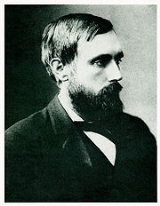
John Dillon

Encyclopedia
John Dillon was an Irish
land reform agitator from Dublin, an Irish Home Rule activist, a nationalist
politician, a Member of Parliament (MP) for over 35 years, and the last leader of the Irish Parliamentary Party
.
(1814–1866). He was educated at Catholic University School
, at Trinity College, Dublin
and at the Catholic University of Louvain
in Belgium
. He afterwards studied medicine
at the Royal College of Surgeons
in Dublin, then ceased active involvement in medicine after he joined Isaac Butt
’s Home Rule League
in 1873, winning notice in 1879 when he attacked Butt’s weak parliamentary handling of Irish Home Rule. His family financial means enabled him to turn and devote all his energies to political life.
He became a leading land reform agitator as member of the original committee of the Irish National Land League
, spearheading the policy of ”boycotting”
advocated by Michael Davitt
with whom he was allied in close friendship. He entered the Parliament of the United Kingdom
in 1880 as member for County Tipperary
, and was at first an ardent supporter of Charles Stewart Parnell
. He travelled to the United States
with Parnell on a fund-raising mission for the Land League. On his return he denounced William Ewart Gladstone
’s Land Act of 1881
as achieving nothing for small farmers. His views on agrarian reform and on Home Rule led him being branded an extremist, which resulted in his arrest from May until August 1881 under the Irish Coercion Act
.
, he signed the No rent Manifesto in solidarity although not fully in agreement with it. Parnell sought to end the Land War
by agreeing the Kilmainham treaty after which they were released from prison in May 1882. Shortly afterwards they received the freedom of the city of Dublin. Unhappy with Parnell’s "New Departure
" and because his health had suffered, he resigned his seat in Parliament
on 6 March 1883, and retired from politics to Colorado
in America where his brother lived. Returning in 1885, Parnell nominated him as the Irish Parliamentary Party candidate for East Mayo in the general election in November 1885
, where he was returned unopposed. He represented the constituency without a break until 1918.
He was one of the prime movers in the Irish Land League's famous Plan of Campaign
instigated by Timothy Healy
and organised by Timothy Harrington, which provided, that in the case of excessive rents the tenant should pay his rent to the Land League instead of the landlord, and in case of eviction be supported by the general fund. Dillon was compelled by the Court of Queens Bench in December 1886 to find securities for good behaviour, but two days later he was arrested while receiving rents on Lord Claricarde’s estate at Portumna
, County Galway
. In this instance the jury disagreed, but in April 1887 he was again imprisoned under Coercion and upon release he resumed agrarian agitation with a speech during a demonstration in September where O’Brien was on trial in Mitchelstown
during which the crowd threw stones at the police who then shot three civilians, known as the "Mitchelstown massacre". When in 1888 he defended Munster farmers he was again imprisoned for six months under the provisions of the new Criminal Law Procedure Bill, or Coercion Act. In all he was imprisoned six times.
and New Zealand
, where he collected funds for the Nationalist party. On his return to Ireland he was again arrested, but, being allowed bail, sailed to America, and failed to appear at the trial. He returned to Ireland by way of Boulogne
, where he and William O'Brien held long and indecisive discussions with Parnell after his divorce crisis over his continued leadership of the Irish Parliamentary Party. When these broke down they surrendered to the police in February, and were interred in Galway gaol from where they were released in July 1890.
Both he and O’Brien had become increasingly perturbed with the tenor of Irish politics as epitomised by Timothy Healy
. After Parnell’s divorce case the leader refused to step down and the party split. Dillon was one of his strongest opponents and joined the majority anti-Parnellite block, the Irish National Federation
(INF), with Justin McCarthy
becoming its leader. John Redmond
led the minority pro-Parnellite Irish National League (INL) after Parnell’s death later in 1891. When the Liberals
reclaimed office in 1892 Dillon took part in the negotiations on the second Home Rule Bill, the Irish Government Bill 1893
, which was rejected by the House of Lords
. Although he never lost sight of home rule or the land question, particularly the evicted tenants, he now concentrated on the day-to-day running of the INF as deputy-chairman.
returned to power in 1895, Dillon took the opportunity to expel Healy from his influence in the party. He also opposed Horace Plunkett in his attempts to bring Unionists
and Nationalists together, and his efforts to help small farmers through his co-operative movement. In November Dillon married Elizabeth Mathew in Brompton Oratory who bore him six children. In February 1896 he took over as chairman of the INF on McCarthy’s resignation. That autumn he arranged a convention of the Irish race, which included 2,000 delegates from various parts of the world. In 1897 Dillon opposed in the House of Commons the Address to Queen Victoria
on the occasion of the Diamond Jubilee, on the ground that her reign had not been a blessing to Ireland, and he showed the same uncompromising attitude in 1901 when a grant to Lord Roberts
was under discussion, accusing him of systematized inhumanity. He was suspended on the 20 March for violent language addressed to Joseph Chamberlain
.
Dillon was present in January 1898 when William O'Brien
launched his "United Ireland League" (UIL) from an agrarian platform in Ballina
, County Mayo
. Though helping to establish its constitution Dillon was very ambivalent about this new association, marking the first strains in the O'Brien-Dillon relationship. The year was also eventful with the attainment of the Local Government (Ireland) Act 1898
which put the administration of local affairs into Irish hands, not at all favoured by Dillon before attaining full Home Rule. O'Brien's UIL spread rapidly, forcing the divided factions, the INL and the INF, of the Irish Parliamentary Party to reunite under Redmond in 1900, with Dillon as deputy Party leader. He faithfully supported Redmond in the following years.
and after O'Brien won the subsequent Wyndham
Land Purchase Act (1903). O'Brien was viciously attacked by Dillon, who bore an instinctive dislike of negotiations with landlords, unwilling to accommodate the landlord class
, he never shedded his mistrust of dialogue with Unionists. His theory was that agrarian unrest better favoured achieving Home Rule by putting relentless pressure on landlords and the government. His attacks and those of the party's Freeman's Journal
alienated O'Brien who left the Party in November 1903. O'Brien's engagement during 1904-5 with the Irish Reform Association
was equally condemned by Dillon who despised all dealings with the "hereditary enemy". The ensuing breach never healed. Dillon subsequently gained control of the UIL through his protégé, its new secretary Joseph Devlin
, MP for Belfast West
, with whom Dillon always maintained a close alliance.
With the UIL and the IPP practically fused into a single body, Dillon later had members associated with O’Brien’s policy of conciliation expelled as “factionists” from the party. The Home Rule Movement, influenced very greatly by Dillon, reverted to a narrow traditional stand, which opposed any chance of an inclusive nationalism and failed to include new interests within Catholic society. His Home Rule Movement was largely a confessional ethnic body, sustained largely by the Ancient Order of Hibernians
, an exclusively Catholic and secret fraternity, largely under control of his close associate Joe Devlin. Dillion's Home Rule Movement was characterised by permanent class war and did not facilitate the working of the Wyndham Land Act. Dillon and his followers wanted conflict above victory.
Dillon suffered occasional health incapacities causing irregular attendance at Westminster
, particularly when his wife died in 1907 though after the Liberals returned to power in 1906
, he was more often consulted. Between 1910 and 1914 the Irish Home Rule question re-emerged, introduced by Prime Minister Herbert Asquith. Dillon, in his approach to Irish self-government under Home Rule took a more uncompromising stand to Redmond's, who during the Ulster
crisis of 1913 was prepared to concede a large measure of local autonomy to Ulster. This was unthinkable for Dillon, who put the integrity of Ireland foremost, and poured scorn on Edward Carson's Ulster Unionist Party
and their Ulster Volunteers’ threat of civil war as being a gigantic bluff.
He likewise condemned O’Brien’s new All-for-Ireland League
’s proposals for concessions to Ulster as encouraging their demands. He remained inflexible at various meetings, including the Buckingham Palace
Conference’s endeavour to settle the problem of Ulster. He agreed only reluctantly to Redmond conceding to six counties temporarily opting out of the Home Rule Act 1914
, which in September received Royal Assent
but was suspended for the duration of World War I
.
, but he abstained from recruiting for the Irish divisions. The 1916 Rising
took the Irish Party by surprise. He intervened with David Lloyd George
to halt the 90 sentences of execution pronounced by "field court-martial" (in camera without defence or jury) under martial law
by General Maxwell
after he declared the rebellion “treason in time of war”.
Dillon insisted that if they went ahead they would "fill the whole country" with the same type of radicals, as opposed to imprisonment. This, he said would leave the radicals with as many supporters as could "fit in a single gaol cell". He attacked the Government in the House of Commons and declared that the rebels were "wrong", but had fought "a clean fight". His intervention resulted in a halt to the executions after the fifteenth, though it was apparent how unbridgeable the chasm in Anglo-Irish relations had become following the Rising. The secret manner of the trials and executions had changed public opinion into sympathy for the rebels.
He was involved in May 1916 with Lloyd George’s futile attempt to implement Home Rule after the Rising, which failed in July on the issue of the exclusion or not of Ulster. He declined a nomination to the Irish Convention
on Home Rule in 1917. After Redmond's death on 6 March 1918, Dillon followed him as leader of the Irish Parliamentary Party. When the allied armies on the Western Front collapsed in the wake of the German Spring Offensive
and decimated the 10th and 16th Irish divisions, the Government attempted a month later in desperation to extend conscription to Ireland, which Dillon opposed with tenacity and in protest withdrew all Irish Members from the House of Commons. The attempt to impose conscription jointly linked with implementing Home Rule disgusted the wider Irish public and resulted in an immediate swing of support to Sinn Féin
which precipitated their election landslide after the war.
Dillon attempted to persuade the Government in July 1918 to implement Irish self-government by introducing a motion for self-determination in the Commons. He made clear in September that the goal of Home Rule could only be "the establishment of national self-government, including full and complete executive, legislative and fiscal power", and that national solidarity was essential. But he completely underestimated the need to offer provisions for Ulster concerns, a fatal misjudgement shared by most Nationalists and Republicans alike.
It was left to Dillon to fight a last campaign in the general election of December 1918
. After a failure to reach a pact with Sinn Féin,his party was swept into oblivion. He was defeated in East Mayo by Éamon de Valera
‘s 8975 votes to his 4514. Retiring from politics, Dillon was not spared witnessing the violent epoch of the Anglo-Irish War, the implementation of Home Rule in Northern Ireland
, the ensuing Partition of Ireland
endorsed by the Irish Free State
and the resulting Irish Civil War
.
, Dublin.
One of his six children was James Mathew Dillon (1902–1986), a prominent Irish politician and leader of the Irish Centre Party and of Fine Gael
(1957–1966) also Minister for Agriculture (he raised hackles and even death threats in Ireland when he suggested that Ireland actively support the Allies
in World War II
).
of D. D. Sheehan
, a considerable opponent.
Ireland
Ireland is an island to the northwest of continental Europe. It is the third-largest island in Europe and the twentieth-largest island on Earth...
land reform agitator from Dublin, an Irish Home Rule activist, a nationalist
Irish nationalism
Irish nationalism manifests itself in political and social movements and in sentiment inspired by a love for Irish culture, language and history, and as a sense of pride in Ireland and in the Irish people...
politician, a Member of Parliament (MP) for over 35 years, and the last leader of the Irish Parliamentary Party
Irish Parliamentary Party
The Irish Parliamentary Party was formed in 1882 by Charles Stewart Parnell, the leader of the Nationalist Party, replacing the Home Rule League, as official parliamentary party for Irish nationalist Members of Parliament elected to the House of Commons at...
.
Early life
John Dillon was born in Blackrock, Dublin, a son of the former "Young Irelander" John Blake DillonJohn Blake Dillon
John Blake Dillon was an Irish writer and Politician who was one of the founding members of the Young Ireland movement....
(1814–1866). He was educated at Catholic University School
Catholic University School
Catholic University School is a Roman Catholic secondary school for boys located on the southside of central Dublin, Ireland. It is run by the Marist Fathers.-Origins:...
, at Trinity College, Dublin
Trinity College, Dublin
Trinity College, Dublin , formally known as the College of the Holy and Undivided Trinity of Queen Elizabeth near Dublin, was founded in 1592 by letters patent from Queen Elizabeth I as the "mother of a university", Extracts from Letters Patent of Elizabeth I, 1592: "...we...found and...
and at the Catholic University of Louvain
Université catholique de Louvain
The Université catholique de Louvain, sometimes known, especially in Belgium, as UCL, is Belgium's largest French-speaking university. It is located in Louvain-la-Neuve and in Brussels...
in Belgium
Belgium
Belgium , officially the Kingdom of Belgium, is a federal state in Western Europe. It is a founding member of the European Union and hosts the EU's headquarters, and those of several other major international organisations such as NATO.Belgium is also a member of, or affiliated to, many...
. He afterwards studied medicine
Medicine
Medicine is the science and art of healing. It encompasses a variety of health care practices evolved to maintain and restore health by the prevention and treatment of illness....
at the Royal College of Surgeons
Royal College of Surgeons in Ireland
The Royal College of Surgeons in Ireland , is a Dublin-based medical institution, situated on St. Stephen's Green. The college is one of the five Recognised Colleges of the National University of Ireland...
in Dublin, then ceased active involvement in medicine after he joined Isaac Butt
Isaac Butt
Isaac Butt Q.C. M.P. was an Irish barrister, politician, Member of Parliament , and the founder and first leader of a number of Irish nationalist parties and organisations, including the Irish Metropolitan Conservative Society in 1836, the Home Government Association in 1870 and in 1873 the Home...
’s Home Rule League
Home Rule League
The Home Rule League, sometimes called the Home Rule Party, was a political party which campaigned for home rule for the country of Ireland from 1873 to 1882, when it was replaced by the Irish Parliamentary Party.-Origins:...
in 1873, winning notice in 1879 when he attacked Butt’s weak parliamentary handling of Irish Home Rule. His family financial means enabled him to turn and devote all his energies to political life.
He became a leading land reform agitator as member of the original committee of the Irish National Land League
Irish National Land League
The Irish Land League was an Irish political organization of the late 19th century which sought to help poor tenant farmers. Its primary aim was to abolish landlordism in Ireland and enable tenant farmers to own the land they worked on...
, spearheading the policy of ”boycotting”
Boycott
A boycott is an act of voluntarily abstaining from using, buying, or dealing with a person, organization, or country as an expression of protest, usually for political reasons...
advocated by Michael Davitt
Michael Davitt
Michael Davitt was an Irish republican and nationalist agrarian agitator, a social campaigner, labour leader, journalist, Home Rule constitutional politician and Member of Parliament , who founded the Irish National Land League.- Early years :Michael Davitt was born in Straide, County Mayo,...
with whom he was allied in close friendship. He entered the Parliament of the United Kingdom
Parliament of the United Kingdom
The Parliament of the United Kingdom of Great Britain and Northern Ireland is the supreme legislative body in the United Kingdom, British Crown dependencies and British overseas territories, located in London...
in 1880 as member for County Tipperary
Tipperary (UK Parliament constituency)
Tipperary, also known as Tipperary County, was a parliamentary constituency in Ireland, which from 1801 to 1885 returned two Members of Parliament to the House of Commons of the United Kingdom.-Boundaries:...
, and was at first an ardent supporter of Charles Stewart Parnell
Charles Stewart Parnell
Charles Stewart Parnell was an Irish landowner, nationalist political leader, land reform agitator, and the founder and leader of the Irish Parliamentary Party...
. He travelled to the United States
United States
The United States of America is a federal constitutional republic comprising fifty states and a federal district...
with Parnell on a fund-raising mission for the Land League. On his return he denounced William Ewart Gladstone
William Ewart Gladstone
William Ewart Gladstone FRS FSS was a British Liberal statesman. In a career lasting over sixty years, he served as Prime Minister four separate times , more than any other person. Gladstone was also Britain's oldest Prime Minister, 84 years old when he resigned for the last time...
’s Land Act of 1881
Irish Land Acts
The Land Acts were a series of measures to deal with the question of peasant proprietorship of land in Ireland in the nineteenth and twentieth centuries. Five such acts were introduced by the government of the United Kingdom between 1870 and 1909...
as achieving nothing for small farmers. His views on agrarian reform and on Home Rule led him being branded an extremist, which resulted in his arrest from May until August 1881 under the Irish Coercion Act
Irish Coercion Act
The Protection of Person and Property Act 1881 was one of more than 100 Coercion Acts passed by the Parliament of United Kingdom of Great Britain and Ireland between 1801 and 1922, in an attempt to establish law and order in Ireland. The 1881 Act was passed by parliament and introduced by...
.
Radical reformer
Again imprisoned for agitation in October 1881 together with Parnell, William O’Brien and others in Kilmainham GaolKilmainham Gaol
Kilmainham Gaol is a former prison, located in Kilmainham in Dublin, which is now a museum. It has been run since the mid-1980s by the Office of Public Works , an Irish Government agency...
, he signed the No rent Manifesto in solidarity although not fully in agreement with it. Parnell sought to end the Land War
Land War
The Land War in Irish history was a period of agrarian agitation in rural Ireland in the 1870s, 1880s and 1890s. The agitation was led by the Irish National Land League and was dedicated to bettering the position of tenant farmers and ultimately to a redistribution of land to tenants from...
by agreeing the Kilmainham treaty after which they were released from prison in May 1882. Shortly afterwards they received the freedom of the city of Dublin. Unhappy with Parnell’s "New Departure
New Departure (Ireland)
The term New Departure has been used to describe several initiatives in the late 19th century where Irish republicans, who were committed to independence from Britain through use of physical force, attempted to find a common ground for cooperation with groups committed to Irish Home Rule through...
" and because his health had suffered, he resigned his seat in Parliament
Resignation from the British House of Commons
Members of Parliament sitting in the House of Commons in the United Kingdom are technically forbidden to resign. To circumvent this prohibition, a legal fiction is used...
on 6 March 1883, and retired from politics to Colorado
Colorado
Colorado is a U.S. state that encompasses much of the Rocky Mountains as well as the northeastern portion of the Colorado Plateau and the western edge of the Great Plains...
in America where his brother lived. Returning in 1885, Parnell nominated him as the Irish Parliamentary Party candidate for East Mayo in the general election in November 1885
United Kingdom general election, 1885
-Seats summary:-See also:*List of MPs elected in the United Kingdom general election, 1885*Parliamentary Franchise in the United Kingdom 1885–1918*Representation of the People Act 1884*Redistribution of Seats Act 1885-References:...
, where he was returned unopposed. He represented the constituency without a break until 1918.
He was one of the prime movers in the Irish Land League's famous Plan of Campaign
Plan of Campaign
The Plan of Campaign was a stratagem adopted in Ireland between 1886 and 1891, co-ordinated by Irish politicians for the benefit of tenant farmers, against mainly absentee and rack-rent landlords. It was launched to counter agricultural distress caused by the continual depression in prices of dairy...
instigated by Timothy Healy
Timothy Michael Healy
Timothy Michael Healy, KC , also known as Tim Healy, was an Irish nationalist politician, journalist, author, barrister and one of the most controversial Irish Members of Parliament in the House of Commons of the United Kingdom of Great Britain and Ireland...
and organised by Timothy Harrington, which provided, that in the case of excessive rents the tenant should pay his rent to the Land League instead of the landlord, and in case of eviction be supported by the general fund. Dillon was compelled by the Court of Queens Bench in December 1886 to find securities for good behaviour, but two days later he was arrested while receiving rents on Lord Claricarde’s estate at Portumna
Portumna
Portumna is a market town in the south-east of County Galway, Ireland, on the border with County Tipperary. The town is located to the west of the point where the River Shannon enters Lough Derg. This historic crossing point over the River Shannon between counties Tipperary and Galway has a long...
, County Galway
County Galway
County Galway is a county in Ireland. It is located in the West Region and is also part of the province of Connacht. It is named after the city of Galway. Galway County Council is the local authority for the county. There are several strongly Irish-speaking areas in the west of the county...
. In this instance the jury disagreed, but in April 1887 he was again imprisoned under Coercion and upon release he resumed agrarian agitation with a speech during a demonstration in September where O’Brien was on trial in Mitchelstown
Mitchelstown
Mitchelstown is a town in County Cork, Ireland with a population of approximately 3300. Mitchelstown is situated in the valley to the south of the Galtee Mountains close to the Mitchelstown Caves and is 28 km from Cahir, 50 km from Cork and 59 km from Limerick...
during which the crowd threw stones at the police who then shot three civilians, known as the "Mitchelstown massacre". When in 1888 he defended Munster farmers he was again imprisoned for six months under the provisions of the new Criminal Law Procedure Bill, or Coercion Act. In all he was imprisoned six times.
Anti-Parnellite course
He was released in September, and in the spring of 1889 sailed for AustraliaAustralia
Australia , officially the Commonwealth of Australia, is a country in the Southern Hemisphere comprising the mainland of the Australian continent, the island of Tasmania, and numerous smaller islands in the Indian and Pacific Oceans. It is the world's sixth-largest country by total area...
and New Zealand
New Zealand
New Zealand is an island country in the south-western Pacific Ocean comprising two main landmasses and numerous smaller islands. The country is situated some east of Australia across the Tasman Sea, and roughly south of the Pacific island nations of New Caledonia, Fiji, and Tonga...
, where he collected funds for the Nationalist party. On his return to Ireland he was again arrested, but, being allowed bail, sailed to America, and failed to appear at the trial. He returned to Ireland by way of Boulogne
Boulogne-sur-Mer
-Road:* Metropolitan bus services are operated by the TCRB* Coach services to Calais and Dunkerque* A16 motorway-Rail:* The main railway station is Gare de Boulogne-Ville and located in the south of the city....
, where he and William O'Brien held long and indecisive discussions with Parnell after his divorce crisis over his continued leadership of the Irish Parliamentary Party. When these broke down they surrendered to the police in February, and were interred in Galway gaol from where they were released in July 1890.
Both he and O’Brien had become increasingly perturbed with the tenor of Irish politics as epitomised by Timothy Healy
Timothy Healy
Timothy Healy may refer to:* Timothy Michael Healy , Irish parliamentary politician, later Governor-General of the Irish Free State* Timothy S. Healy , president of Georgetown University* Tim Healy , British actor...
. After Parnell’s divorce case the leader refused to step down and the party split. Dillon was one of his strongest opponents and joined the majority anti-Parnellite block, the Irish National Federation
Irish National Federation
The Irish National Federation was a nationalist political party in Ireland. It was founded in March 1891 by former members of the Irish National League who had left the Irish Parliamentary Party in protest when Charles Stewart Parnell refused to resign the party leadership as a result of his...
(INF), with Justin McCarthy
Justin McCarthy
Justin McCarthy was an Irish nationalist and Liberal historian, novelist and politician. He was a Member of Parliament from 1879 to 1900, taking his seat in the House of Commons of the United Kingdom of Great Britain and Ireland- Early life :He was born in Cork, and was educated at a school there...
becoming its leader. John Redmond
John Redmond
John Edward Redmond was an Irish nationalist politician, barrister, MP in the House of Commons of the United Kingdom of Great Britain and Ireland and leader of the Irish Parliamentary Party from 1900 to 1918...
led the minority pro-Parnellite Irish National League (INL) after Parnell’s death later in 1891. When the Liberals
Liberal Party (UK)
The Liberal Party was one of the two major political parties of the United Kingdom during the 19th and early 20th centuries. It was a third party of negligible importance throughout the latter half of the 20th Century, before merging with the Social Democratic Party in 1988 to form the present day...
reclaimed office in 1892 Dillon took part in the negotiations on the second Home Rule Bill, the Irish Government Bill 1893
Irish Government Bill 1893
The Government of Ireland Bill 1893 was the second attempt made by William Ewart Gladstone, as Prime Minister of the United Kingdom, to enact a system of home rule for Ireland...
, which was rejected by the House of Lords
House of Lords
The House of Lords is the upper house of the Parliament of the United Kingdom. Like the House of Commons, it meets in the Palace of Westminster....
. Although he never lost sight of home rule or the land question, particularly the evicted tenants, he now concentrated on the day-to-day running of the INF as deputy-chairman.
Party manoeuvrings
When home rule became postponed after the Conservative PartyConservative Party (UK)
The Conservative Party, formally the Conservative and Unionist Party, is a centre-right political party in the United Kingdom that adheres to the philosophies of conservatism and British unionism. It is the largest political party in the UK, and is currently the largest single party in the House...
returned to power in 1895, Dillon took the opportunity to expel Healy from his influence in the party. He also opposed Horace Plunkett in his attempts to bring Unionists
Unionism in Ireland
Unionism in Ireland is an ideology that favours the continuation of some form of political union between the islands of Ireland and Great Britain...
and Nationalists together, and his efforts to help small farmers through his co-operative movement. In November Dillon married Elizabeth Mathew in Brompton Oratory who bore him six children. In February 1896 he took over as chairman of the INF on McCarthy’s resignation. That autumn he arranged a convention of the Irish race, which included 2,000 delegates from various parts of the world. In 1897 Dillon opposed in the House of Commons the Address to Queen Victoria
Victoria of the United Kingdom
Victoria was the monarch of the United Kingdom of Great Britain and Ireland from 20 June 1837 until her death. From 1 May 1876, she used the additional title of Empress of India....
on the occasion of the Diamond Jubilee, on the ground that her reign had not been a blessing to Ireland, and he showed the same uncompromising attitude in 1901 when a grant to Lord Roberts
Lord Roberts
Lord Roberts may refer to:*John Roberts, 2nd Baron Roberts , was an English politician and soldier during the English Civil War English and English Restoration...
was under discussion, accusing him of systematized inhumanity. He was suspended on the 20 March for violent language addressed to Joseph Chamberlain
Joseph Chamberlain
Joseph Chamberlain was an influential British politician and statesman. Unlike most major politicians of the time, he was a self-made businessman and had not attended Oxford or Cambridge University....
.
Dillon was present in January 1898 when William O'Brien
William O'Brien
William O'Brien was an Irish nationalist, journalist, agrarian agitator, social revolutionary, politician, party leader, newspaper publisher, author and Member of Parliament in the House of Commons of the United Kingdom of Great Britain and Ireland...
launched his "United Ireland League" (UIL) from an agrarian platform in Ballina
Ballina, County Mayo
Ballina is a large town in north County Mayo in Ireland. It lies at the mouth of the River Moy near Killala Bay, in the Moy valley and Parish of Kilmoremoy, with the Ox Mountain range to the east and the Nephin Beg mountains to the west...
, County Mayo
County Mayo
County Mayo is a county in Ireland. It is located in the West Region and is also part of the province of Connacht. It is named after the village of Mayo, which is now generally known as Mayo Abbey. Mayo County Council is the local authority for the county. The population of the county is 130,552...
. Though helping to establish its constitution Dillon was very ambivalent about this new association, marking the first strains in the O'Brien-Dillon relationship. The year was also eventful with the attainment of the Local Government (Ireland) Act 1898
Local Government (Ireland) Act 1898
The Local Government Act 1898 was an Act of the Parliament of the United Kingdom that established a system of local government in Ireland similar to that already created for England, Wales and Scotland by legislation in 1888 and 1889...
which put the administration of local affairs into Irish hands, not at all favoured by Dillon before attaining full Home Rule. O'Brien's UIL spread rapidly, forcing the divided factions, the INL and the INF, of the Irish Parliamentary Party to reunite under Redmond in 1900, with Dillon as deputy Party leader. He faithfully supported Redmond in the following years.
Conciliation unthinkable
Dillon played a decisive role in opposing O'Brien's “doctrine of conciliation” in Irish politics, especially during the 1902 Land ConferenceLand Conference
The Land Conference was a successful conciliatory negotiation held in the Mansion House in Dublin, Ireland between 20 December 1902 and 4 January 1903. In a short period it produced a unanimously agreed report recommending an amiable solution to the long waged land war between tenant farmers and...
and after O'Brien won the subsequent Wyndham
George Wyndham
George Wyndham PC was a British Conservative politician, man of letters, noted for his elegance, and one of The Souls.-Background and education:...
Land Purchase Act (1903). O'Brien was viciously attacked by Dillon, who bore an instinctive dislike of negotiations with landlords, unwilling to accommodate the landlord class
Protestant Ascendancy
The Protestant Ascendancy, usually known in Ireland simply as the Ascendancy, is a phrase used when referring to the political, economic, and social domination of Ireland by a minority of great landowners, Protestant clergy, and professionals, all members of the Established Church during the 17th...
, he never shedded his mistrust of dialogue with Unionists. His theory was that agrarian unrest better favoured achieving Home Rule by putting relentless pressure on landlords and the government. His attacks and those of the party's Freeman's Journal
Freeman's Journal
The Freeman's Journal was the oldest nationalist newspaper in Ireland. It was founded in 1763 by Charles Lucas and was identified with radical 18th century Protestant patriot politicians Henry Grattan and Henry Flood...
alienated O'Brien who left the Party in November 1903. O'Brien's engagement during 1904-5 with the Irish Reform Association
Irish Reform Association
The Irish Reform Association was an attempt to introduce limited devolved self-government to Ireland by a group of reform oriented Irish unionist land owners who proposed to initially adopt something less than full Home Rule...
was equally condemned by Dillon who despised all dealings with the "hereditary enemy". The ensuing breach never healed. Dillon subsequently gained control of the UIL through his protégé, its new secretary Joseph Devlin
Joseph Devlin
Joseph Devlin, also known as Joe Devlin, was an Irish journalist and influential nationalist politician...
, MP for Belfast West
Belfast West (UK Parliament constituency)
Belfast West is a parliamentary constituency in the House of Commons of the United Kingdom.-Boundaries:The seat was restored in 1922 when as part of the establishment of the devolved Stormont Parliament for Northern Ireland, the number of MPs in the Westminster Parliament was drastically cut...
, with whom Dillon always maintained a close alliance.
With the UIL and the IPP practically fused into a single body, Dillon later had members associated with O’Brien’s policy of conciliation expelled as “factionists” from the party. The Home Rule Movement, influenced very greatly by Dillon, reverted to a narrow traditional stand, which opposed any chance of an inclusive nationalism and failed to include new interests within Catholic society. His Home Rule Movement was largely a confessional ethnic body, sustained largely by the Ancient Order of Hibernians
Ancient Order of Hibernians
The Ancient Order of Hibernians is an Irish Catholic fraternal organization. Members must be Catholic and either Irish born or of Irish descent. Its largest membership is now in the United States, where it was founded in New York City in 1836...
, an exclusively Catholic and secret fraternity, largely under control of his close associate Joe Devlin. Dillion's Home Rule Movement was characterised by permanent class war and did not facilitate the working of the Wyndham Land Act. Dillon and his followers wanted conflict above victory.
Dillon suffered occasional health incapacities causing irregular attendance at Westminster
Parliament of the United Kingdom
The Parliament of the United Kingdom of Great Britain and Northern Ireland is the supreme legislative body in the United Kingdom, British Crown dependencies and British overseas territories, located in London...
, particularly when his wife died in 1907 though after the Liberals returned to power in 1906
United Kingdom general election, 1906
-Seats summary:-See also:*MPs elected in the United Kingdom general election, 1906*The Parliamentary Franchise in the United Kingdom 1885-1918-External links:***-References:*F. W. S. Craig, British Electoral Facts: 1832-1987**...
, he was more often consulted. Between 1910 and 1914 the Irish Home Rule question re-emerged, introduced by Prime Minister Herbert Asquith. Dillon, in his approach to Irish self-government under Home Rule took a more uncompromising stand to Redmond's, who during the Ulster
Ulster
Ulster is one of the four provinces of Ireland, located in the north of the island. In ancient Ireland, it was one of the fifths ruled by a "king of over-kings" . Following the Norman invasion of Ireland, the ancient kingdoms were shired into a number of counties for administrative and judicial...
crisis of 1913 was prepared to concede a large measure of local autonomy to Ulster. This was unthinkable for Dillon, who put the integrity of Ireland foremost, and poured scorn on Edward Carson's Ulster Unionist Party
Ulster Unionist Party
The Ulster Unionist Party – sometimes referred to as the Official Unionist Party or, in a historic sense, simply the Unionist Party – is the more moderate of the two main unionist political parties in Northern Ireland...
and their Ulster Volunteers’ threat of civil war as being a gigantic bluff.
He likewise condemned O’Brien’s new All-for-Ireland League
All-for-Ireland League
The All-for-Ireland League , was an Irish, Munster-based political party . Founded by William O'Brien MP, it generated a new national movement to achieve agreement between the different parties concerned on the historically difficult aim of Home Rule for the whole of Ireland...
’s proposals for concessions to Ulster as encouraging their demands. He remained inflexible at various meetings, including the Buckingham Palace
Buckingham Palace
Buckingham Palace, in London, is the principal residence and office of the British monarch. Located in the City of Westminster, the palace is a setting for state occasions and royal hospitality...
Conference’s endeavour to settle the problem of Ulster. He agreed only reluctantly to Redmond conceding to six counties temporarily opting out of the Home Rule Act 1914
Home Rule Act 1914
The Government of Ireland Act 1914 , also known as the Third Home Rule Bill, was an Act passed by the Parliament of the United Kingdom intended to provide self-government for Ireland within the United Kingdom of Great Britain and Ireland.The Act was the first law ever passed by the Parliament of...
, which in September received Royal Assent
Royal Assent
The granting of royal assent refers to the method by which any constitutional monarch formally approves and promulgates an act of his or her nation's parliament, thus making it a law...
but was suspended for the duration of World War I
World War I
World War I , which was predominantly called the World War or the Great War from its occurrence until 1939, and the First World War or World War I thereafter, was a major war centred in Europe that began on 28 July 1914 and lasted until 11 November 1918...
.
Uncompromising stand
With the outbreak of the Great War in August 1914 Dillon accepted Redmond’s decision to follow Britain’s support of the Allied war effortAllies of World War I
The Entente Powers were the countries at war with the Central Powers during World War I. The members of the Triple Entente were the United Kingdom, France, and the Russian Empire; Italy entered the war on their side in 1915...
, but he abstained from recruiting for the Irish divisions. The 1916 Rising
Easter Rising
The Easter Rising was an insurrection staged in Ireland during Easter Week, 1916. The Rising was mounted by Irish republicans with the aims of ending British rule in Ireland and establishing the Irish Republic at a time when the British Empire was heavily engaged in the First World War...
took the Irish Party by surprise. He intervened with David Lloyd George
David Lloyd George
David Lloyd George, 1st Earl Lloyd-George of Dwyfor OM, PC was a British Liberal politician and statesman...
to halt the 90 sentences of execution pronounced by "field court-martial" (in camera without defence or jury) under martial law
Martial law
Martial law is the imposition of military rule by military authorities over designated regions on an emergency basis— only temporary—when the civilian government or civilian authorities fail to function effectively , when there are extensive riots and protests, or when the disobedience of the law...
by General Maxwell
John Maxwell (British Army officer)
General Sir John Grenfell Maxwell GCB, KCMG, CVO, DSO, PC was a British Army officer and colonial governor. He served in the Mahdist War in the Sudan, the Boer War, and in the First World War, but he is best known for his role in the suppression of the 1916 Easter Rising in Ireland and subsequent...
after he declared the rebellion “treason in time of war”.
Dillon insisted that if they went ahead they would "fill the whole country" with the same type of radicals, as opposed to imprisonment. This, he said would leave the radicals with as many supporters as could "fit in a single gaol cell". He attacked the Government in the House of Commons and declared that the rebels were "wrong", but had fought "a clean fight". His intervention resulted in a halt to the executions after the fifteenth, though it was apparent how unbridgeable the chasm in Anglo-Irish relations had become following the Rising. The secret manner of the trials and executions had changed public opinion into sympathy for the rebels.
He was involved in May 1916 with Lloyd George’s futile attempt to implement Home Rule after the Rising, which failed in July on the issue of the exclusion or not of Ulster. He declined a nomination to the Irish Convention
Irish Convention
The Irish Convention was an assembly which sat in Dublin, Ireland from July 1917 until March 1918 to address the Irish Question and other constitutional problems relating to an early enactment of self-government for Ireland, to debate its wider future, discuss and come to an understanding on...
on Home Rule in 1917. After Redmond's death on 6 March 1918, Dillon followed him as leader of the Irish Parliamentary Party. When the allied armies on the Western Front collapsed in the wake of the German Spring Offensive
Spring Offensive
The 1918 Spring Offensive or Kaiserschlacht , also known as the Ludendorff Offensive, was a series of German attacks along the Western Front during World War I, beginning on 21 March 1918, which marked the deepest advances by either side since 1914...
and decimated the 10th and 16th Irish divisions, the Government attempted a month later in desperation to extend conscription to Ireland, which Dillon opposed with tenacity and in protest withdrew all Irish Members from the House of Commons. The attempt to impose conscription jointly linked with implementing Home Rule disgusted the wider Irish public and resulted in an immediate swing of support to Sinn Féin
Sinn Féin
Sinn Féin is a left wing, Irish republican political party in Ireland. The name is Irish for "ourselves" or "we ourselves", although it is frequently mistranslated as "ourselves alone". Originating in the Sinn Féin organisation founded in 1905 by Arthur Griffith, it took its current form in 1970...
which precipitated their election landslide after the war.
Dillon attempted to persuade the Government in July 1918 to implement Irish self-government by introducing a motion for self-determination in the Commons. He made clear in September that the goal of Home Rule could only be "the establishment of national self-government, including full and complete executive, legislative and fiscal power", and that national solidarity was essential. But he completely underestimated the need to offer provisions for Ulster concerns, a fatal misjudgement shared by most Nationalists and Republicans alike.
It was left to Dillon to fight a last campaign in the general election of December 1918
Irish (UK) general election, 1918
The Irish general election of 1918 was that part of the 1918 United Kingdom general election that took place in Ireland. It is seen as a key moment in modern Irish history...
. After a failure to reach a pact with Sinn Féin,his party was swept into oblivion. He was defeated in East Mayo by Éamon de Valera
Éamon de Valera
Éamon de Valera was one of the dominant political figures in twentieth century Ireland, serving as head of government of the Irish Free State and head of government and head of state of Ireland...
‘s 8975 votes to his 4514. Retiring from politics, Dillon was not spared witnessing the violent epoch of the Anglo-Irish War, the implementation of Home Rule in Northern Ireland
Northern Ireland
Northern Ireland is one of the four countries of the United Kingdom. Situated in the north-east of the island of Ireland, it shares a border with the Republic of Ireland to the south and west...
, the ensuing Partition of Ireland
Partition of Ireland
The partition of Ireland was the division of the island of Ireland into two distinct territories, now Northern Ireland and the Republic of Ireland . Partition occurred when the British Parliament passed the Government of Ireland Act 1920...
endorsed by the Irish Free State
Irish Free State
The Irish Free State was the state established as a Dominion on 6 December 1922 under the Anglo-Irish Treaty, signed by the British government and Irish representatives exactly twelve months beforehand...
and the resulting Irish Civil War
Irish Civil War
The Irish Civil War was a conflict that accompanied the establishment of the Irish Free State as an entity independent from the United Kingdom within the British Empire....
.
Family background
He married in 1895 to Elizabeth (1865–1907), daughter of Lord Justice J. C. Mathew, who bore him six children. Tall and slim he cut an imposing figure, his personal reputation hampered at times by a pessimistic and gloomy nature as well as conservative views on labour and women. He died in a London nursing home at the age of 76, on the 4 August 1927, and was buried four days later in Glasnevin cemeteryGlasnevin Cemetery
Glasnevin Cemetery , officially known as Prospect Cemetery, is the largest non-denominational cemetery in Ireland with an estimated 1.5 million burials...
, Dublin.
One of his six children was James Mathew Dillon (1902–1986), a prominent Irish politician and leader of the Irish Centre Party and of Fine Gael
Fine Gael
Fine Gael is a centre-right to centrist political party in the Republic of Ireland. It is the single largest party in Ireland in the Oireachtas, in local government, and in terms of Members of the European Parliament. The party has a membership of over 35,000...
(1957–1966) also Minister for Agriculture (he raised hackles and even death threats in Ireland when he suggested that Ireland actively support the Allies
Allies of World War II
The Allies of World War II were the countries that opposed the Axis powers during the Second World War . Former Axis states contributing to the Allied victory are not considered Allied states...
in World War II
World War II
World War II, or the Second World War , was a global conflict lasting from 1939 to 1945, involving most of the world's nations—including all of the great powers—eventually forming two opposing military alliances: the Allies and the Axis...
).
Sources
- Lyons, F. S. L.F. S. L. LyonsFrancis Stewart Leland Lyons was one of Ireland's premier historians.-Biography:Lyons was born in Derry, Northern Ireland, in 1923, but soon moved to Boyle in County Roscommon where his father was a bank official...
John Dillon: A biography Routledge & Kegan Paul, London (1968) ISBN 0-7100-2887-3 - Maume, Patrick: Who's Who in The long gestation (1999) p. 226, Gill & Macmillan (1999) ISBN 0-7171-2744-3
- Hickey, D.J. & Doherty , J.E., A new Dictionary of Irish History from 1800, Gill & MacMillan (2003) ISBN 0-7171-2520-3D.
- Oxford Dictionary of National Biography, Oxford University Press, (2004)
- Callanan, Frank: John Dillon in McGuire, James and Quinn, James (eds): Dictionary of Irish Biography: From the Earliest Times to the Year 2002; Royal Irish Academy, Vol.3 pp. 296–302, Cambridge University Press (2009) ISBN 978-0-521-19976-6
of D. D. Sheehan
D. D. Sheehan
Daniel Desmond Sheehan, usually known as D. D. Sheehan was an Irish nationalist, politician, labour leader, journalist, barrister and author...
, a considerable opponent.