

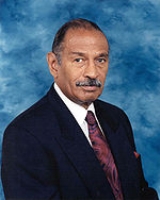
John Conyers

Encyclopedia
John Conyers, Jr. is the U.S. Representative
for , serving since 1965 (the district was numbered as the 1st District until 1993). He is a member of the Democratic Party. He is currently the second longest-serving incumbent member of the House (after fellow Democrat from Michigan, John Dingell
) and the third-longest incumbent member of the entire Congress by length of service (after Dingell and Daniel Inouye
). The district includes most of northwestern Detroit, as well as Highland Park
, Hamtramck and part of Dearborn
.
in Detroit, Conyers served in the Michigan National Guard 1948–50; US Army 1950–54; and the US Army Reserves 1954–57. Conyers served for a year in Korea as an officer in the U.S. Army Corps of Engineers and was awarded combat and merit citations. Conyers grew up in Detroit, and received both his B.A.
and his J.D.
from Wayne State University
.
Conyers was present in Selma, Alabama
on October 7, 1963, for the civil rights movement
voter registration drive known as Freedom Day. He served as an assistant to U.S. Congressman John Dingell, Jr. prior to his election to Congress.
and again in 1993.
was a clear front runner from the beginning. He was a 51-year-old former State Supreme Court Justice
who raised over $1.6 million. He won the September primary with 54% of the vote. Conyers placed in fourth place. Archer won the November election.
thirteen times, all with even larger margins. After the 1990 United States Census, Michigan lost a congressional district and Conyer's district was renumbered to the 14th district
. In 1992, he won re-election to his 15th term in his new district with 82% of the vote against Republican nominee John Gordon. He won re-election another nine times after that. His worst re-election performance was in 2010
, when he got 77% of the vote against Republican nominee Don Ukrainec.
In total, he has won re-election twenty-three times and has served twenty-four terms. He is the second longest-serving current member of the House, as well as the second longest-serving member of either house of Congress in Michigan's history. Only Dingell outranks him on both lists. He is the last surviving member of the Democrats' large freshman class of 1965. By one measure, Conyers was found the sixth most Progressive member of Congress after World War II.
, and is considered the Dean of that group. Formed in 1969, the CBC was founded to strengthen African-American lawmakers' ability to address the legislative concerns of Black and minority citizens. He has served longer in Congress than any other African-American. In 1971, he was one of the original members of Nixon's Enemies List
.
In 1965, John Conyers won a seat as a freshman on the influential Judiciary Committee, which was then under the leadership of liberal Democrat Emanuel Celler of New York. At the time, the assignment was an elite one, as Judiciary ranked behind only Ways and Means and Appropriations in terms of the number of Members who sought assignment there.
According to the National Journal
, Conyers has been considered, with Pete Stark
, John Lewis
, Jim McDermott
, and Barbara Lee
, to be one of the most liberal
members of Congress for many years. Civil rights icon Rosa Parks
served on Conyers' staff between 1965 and 1988.
Conyers is known as one of the supporters of the drive to regulate online gambling. He has likened the Unlawful Internet Gambling Enforcement Act of 2006, hidden within the SAFE Port Act
, to Prohibition.
After Martin Luther King Jr.'s assassination in 1968, Conyers introduced the first bill in Congress to make King's birthday a national holiday.
Nixon and Watergate
Conyers was critical of Richard Nixon
during his tenure, and as a result was number 13 on President
Richard Nixon
's enemies list
during Nixon's 1969–74 presidential tenure. The president's Chief Counsel described him as "coming on fast", and that he was "emerging" as a "black anti-Nixon spokesman"
Conyers voted on the Articles of Impeachment
against Nixon in July 1974. He is the last remaining member of the House Judiciary Committee who did so, though one other fellow Committee member is still in Congress (Charles Rangel, Democrat of New York).
National Health Care Act
The U.S. National Health Care Act (Expanded and Improved Medicare for All Act) (HR 676), is a bill submitted to the United States House of Representatives by Conyers which, as of September 29, 2008, has 93 cosponsors. It was first introduced, with 25 cosponsors, in 2003, and reintroduced each session since then. The act calls for the creation of a universal single-payer health care
system in the United States, in which the government would provide every resident health care free of charge. In order to eliminate disparate treatment between richer and poorer Americans, the Act would also prohibit private insurers from covering any treatment or procedure already covered by the Act. The bill is currently in the House Energy and Commerce's Subcommittee on Health.
Downing Street memo
On May 5, 2005, Conyers and 88 other members of Congress wrote an open letter to the White House inquiring about the Downing Street memo
, a leaked memorandum that revealed an apparent secret agreement between the U.S. and the United Kingdom
to attack Iraq
in 2002. The Times
reported that newly discovered documents reveal British and U.S. intentions to invade Iraq and leaders of the two countries had "discussed creating pretextual justifications for doing so". The documents go on to say that Tony Blair
decided the U.S. would need to "create" conditions to justify the war.
The memo story broke in the United Kingdom
, but did not receive much coverage in the United States, prompting Conyers to lament: "This should not be allowed to fall down the memory hole during wall-to-wall coverage of the Michael Jackson trial
and a runaway bride
." Conyers and others reportedly considered sending a congressional investigation delegation to London.
What Went Wrong In Ohio
In May, 2005, Conyers released What Went Wrong In Ohio: The Conyers Report On The 2004 Presidential Election, which discusses the voting irregularities
in the state of Ohio
during the 2004 U.S. Presidential Election. The evidence offered consists of statistical abnormalities in the differences between exit poll
results and actual votes registered at those locations. The book also discusses reports of faulty electronic voting
machines and the lack of credibility of those machines used to tally votes.
He was one of 31 members of the House who voted not to count the electoral votes from Ohio
in the United States presidential election, 2004
.
The Constitution in Crisis
On August 4, 2006, Conyers released his report, The Constitution in Crisis: The Downing Street Minutes and Deception, Manipulation, Torture, Retributions and Cover-ups in the Iraq War, an edited collection of information intended to serve as evidence that the Bush Administration
altered intelligence
to justify the 2003 invasion of Iraq
.
The Constitution in Crisis examines much of the evidence presented by the Bush Administration prior to the invasion and questions the credibility of their sources of intelligence. In addition, the document investigates the conditions that led to the torture scandal
at Abu Ghraib prison
in Iraq, as well as further evidence of torture
having been committed but not made known to the public. Finally, the document reports on a series of "smear tactics" purportedly used by the administration in dealing with its political adversaries.
The document calls for the censure
of President George W. Bush
and Vice President Dick Cheney
. Notably, however, Conyers refuses to back impeachment
proceedings.
On anti-Muslim intolerance
Conyers has proposed House Resolution 288, which condemns “religious intolerance” but emphasizes Islam
as needing special protection from acts of violence and intolerance. It states that “it should never be official policy of the United States Government to disparage the Quran, Islam, or any religion in any way, shape, or form,” and “calls upon local, State, and Federal authorities to work to prevent bias-motivated crimes and acts against all individuals, including those of the Islamic faith.” The bill was referred to the House subcommittee on the Constitution in June 2005.
Conyers v. Bush
See also Conyers v. Bush
In April 2006 Conyers, together with ten other senior congressmen, filed an action in the U.S. District Court in the Eastern District of Michigan, Southern Division
, challenging the constitutionality of the Deficit Reduction Act of 2005
. The complaint alleged the bill
was not afforded due consideration by the United States Congress
before being signed by the President. The action was subsequently dismissed on grounds of lack of standing.
Ethics controversy
In letters sent separately to the House Ethics Committee
, the FBI
, and the US Attorney's office by two former aides of Conyers, they alleged that Conyers used his staff to work on several local and state campaigns, and forced them to baby-sit and chauffeur his children. In late December 2006, Conyers "accepted responsibility" for possibly violating House rules. A statement issued December 29, 2006, by the House Ethics Committee Chairman Doc Hastings
(R-Wash.) and Ranking Minority Member Howard Berman
(D-Calif.), said that Conyers acknowledged what he characterized as a "lack of clarity" in his communications with staff members regarding their official duties and responsibilities, and accepted responsibility for his actions. In deciding to drop the matter, Hastings and Berman stated:
Also, in 1992, he was implicated in the House banking scandal
.
Copyright controversy
Conyers has come under fire from scientific and taxpayers' advocacy groups for repeatedly introducing a bill that would overturn NIH Public Access Policy, and forbid the government from mandating that federally funded research be made freely available to the public. Critics assert that Conyers has been influenced by publishing houses who have contributed significant money to Conyers.
House Report on George W. Bush presidency and proposed inquiry
On January 13, 2009, the House Committee on the Judiciary, led by Conyers, released "Reining in the Imperial Presidency: Lessons and Recommendations Relating to the Presidency of George W. Bush", a 486-page report detailing alleged abuses of power that occurred during the Bush administration
, and a comprehensive set of recommendations to prevent recurrence. Conyers has introduced a bill to set up a "truth commission" panel to investigate alleged policy abuses of the Bush administration.
Bill reading controversy
In late July 2009, Conyers, commenting on the healthcare debate
in the House, stated that “I love these members, they get up and say, ‘Read the bill'... What good is reading the bill if it’s a thousand pages and you don’t have two days and two lawyers to find out what it means after you read the bill?” His remark brought criticism from government transparency advocates such as the Sunlight Foundation
, which referred to readthebill.org in response. In the House, 93 representatives signed a pledge, started by Mike Pence
of Indiana
, to read a health care bill before voting on it.
Bribery conviction of wife, Monica Conyers
Conyers' wife, Monica, a former President pro tempore of the Detroit City Council
, pleaded guilty to conspiring to commit bribery
in June 2009. This is punishable by up to five years in prison; in March 2010 she was sentenced to 37 months imprisonment, followed by two years supervised probation.
On June 16, 2009, the United States Attorney's Office said that two Synagro Technologies representatives had named Monica Conyers as the recipient of bribes from the company totaling more than $60,000, paid to influence passage of a contract with the City of Detroit. The information was gathered during an FBI investigation into political corruption in the city. She was given a pre-indictment letter, and offered a plea bargain
deal in the case. On June 26, 2009, she was charged with conspiring to commit bribery. She pleaded guilty.
On March 10, 2010 she was sentenced to 37 months in prison, and also received two years of supervised probation. She is appeal
ing the sentence.
She began serving her term on September 10, 2010 at a minimum-security camp in Alderson, West Virginia
.
Response to accusations regarding American Muslim spies
In October, Conyers responded to allegations from four Republican Congress Members, in the wake of the launch of the book Muslim Mafia, that the Council on American-Islamic Relations
(CAIR) sought to plant Muslim "spies" in Capitol Hill. He strongly opposed the accusations, saying:
Conyers was one of the first three U.S. Congress members to condemn the allegations, joining André Carson
(D-IN
) and Loretta Sanchez
(D-CA
).
WikiLeaks
At a December 16, 2010 hearing of the House Judiciary Committee on the subject of "the Espionage Act
and the Legal and Constitutional
Issues Raised by WikiLeaks
," Conyers "argue[d] strongly against prosecuting WikiLeaks
in haste-or at all." He strongly defended the whistleblowing organization, saying:
Conyer's statement was "in marked contrast to the repeated calls from other members of Congress
and Obama administration
officials to prosecute (or kill) [WikiLeaks head Julian] Assange
immediately."
He appeared in Michael Moore
's documentary
Fahrenheit 9/11
discussing the aftermath of the September 11, 2001, attacks, stating that members of Congress "don't read most of the bills". Conyers frequently posts at Daily Kos
and Democratic Underground
. Since May 2005, he's been a contributing blogger at The Huffington Post
and his own blog.
Articles
United States House of Representatives
The United States House of Representatives is one of the two Houses of the United States Congress, the bicameral legislature which also includes the Senate.The composition and powers of the House are established in Article One of the Constitution...
for , serving since 1965 (the district was numbered as the 1st District until 1993). He is a member of the Democratic Party. He is currently the second longest-serving incumbent member of the House (after fellow Democrat from Michigan, John Dingell
John Dingell
John David Dingell, Jr. is the U.S. Representative for , serving since 1955 . He is a member of the Democratic Party...
) and the third-longest incumbent member of the entire Congress by length of service (after Dingell and Daniel Inouye
Daniel Inouye
Daniel Ken "Dan" Inouye is the senior United States Senator from Hawaii, a member of the Democratic Party, and the President pro tempore of the United States Senate making him the highest-ranking Asian American politician in American history. Inouye is the chairman of the United States Senate...
). The district includes most of northwestern Detroit, as well as Highland Park
Highland Park, Michigan
- Geography :According to the United States Census Bureau, the city has a total area of , all land.- Demographics :As of the census of 2000, there were 16,746 people, 6,199 households, and 3,521 families residing in the city. The population density was 5,622.9 per square mile . There were 7,249...
, Hamtramck and part of Dearborn
Dearborn, Michigan
-Economy:Ford Motor Company has its world headquarters in Dearborn. In addition its Dearborn campus contains many research, testing, finance and some production facilities. Ford Land controls the numerous properties owned by Ford including sales and leasing to unrelated businesses such as the...
.
Early life, education, and early career
After graduating from Northwestern High SchoolNorthwestern High School (Michigan)
Northwestern High School is a secondary education facility in Detroit, Michigan. The most recent enrollment figures for Northwestern indicate a student population of approximately 2,000. Northwestern High School features numerous extracurricular activities; including: Debate, US Army JROTC,...
in Detroit, Conyers served in the Michigan National Guard 1948–50; US Army 1950–54; and the US Army Reserves 1954–57. Conyers served for a year in Korea as an officer in the U.S. Army Corps of Engineers and was awarded combat and merit citations. Conyers grew up in Detroit, and received both his B.A.
Bachelor of Arts
A Bachelor of Arts , from the Latin artium baccalaureus, is a bachelor's degree awarded for an undergraduate course or program in either the liberal arts, the sciences, or both...
and his J.D.
Juris Doctor
Juris Doctor is a professional doctorate and first professional graduate degree in law.The degree was first awarded by Harvard University in the United States in the late 19th century and was created as a modern version of the old European doctor of law degree Juris Doctor (see etymology and...
from Wayne State University
Wayne State University
Wayne State University is a public research university located in Detroit, Michigan, United States, in the city's Midtown Cultural Center Historic District. Founded in 1868, WSU consists of 13 schools and colleges offering more than 400 major subject areas to over 32,000 graduate and...
.
Conyers was present in Selma, Alabama
Selma, Alabama
Selma is a city in and the county seat of Dallas County, Alabama, United States, located on the banks of the Alabama River. The population was 20,512 at the 2000 census....
on October 7, 1963, for the civil rights movement
Civil rights movement
The civil rights movement was a worldwide political movement for equality before the law occurring between approximately 1950 and 1980. In many situations it took the form of campaigns of civil resistance aimed at achieving change by nonviolent forms of resistance. In some situations it was...
voter registration drive known as Freedom Day. He served as an assistant to U.S. Congressman John Dingell, Jr. prior to his election to Congress.
Detroit Mayoral campaigns
While serving in the U.S. House, Conyers made two unsuccessful runs for mayor of Detroit: one in 1989 against incumbent Coleman YoungColeman Young
Coleman Alexander Young served as mayor of Detroit in the U.S. state of Michigan from 1974 to 1993. Young became the first African-American mayor of Detroit in the same week that Maynard Jackson became the first African-American mayor of Atlanta.-Pre-Mayoral career:Young was born in Tuscaloosa,...
and again in 1993.
1989
Incumbent Democratic Mayor Coleman Young decided to run for a fifth term, despite growing unpopularity and the declining economy of Detroit. In the September primary, Young won with 51% of the vote. Accountant Tom Barrow qualified for the November run off by getting second place with 24% and Conyers got third place with 18% of the vote. Young defeated Barrow in the run off with 56% of the vote.1993
In June 1993, incumbent Democratic Mayor Coleman Young decided to retire instead of seeking a sixth term, citing his age and health as the reasons. Although, many believed he decided not to run because of his growing unpopularity. In a Detroit News poll in February, 81% said Young should retire. Conyers was one of the 23 candidates who qualified for ballot access. Dennis ArcherDennis Archer
Dennis Wayne Archer is an American lawyer and politician from Michigan. A Democrat, Archer served on the Michigan Supreme Court and as mayor of Detroit...
was a clear front runner from the beginning. He was a 51-year-old former State Supreme Court Justice
Michigan Supreme Court
The Michigan Supreme Court is the highest court in the U.S. state of Michigan. It is known as Michigan's "court of last resort" and consists of seven justices who are elected to eight-year terms. Candidates are nominated by political parties and are elected on a nonpartisan ballot...
who raised over $1.6 million. He won the September primary with 54% of the vote. Conyers placed in fourth place. Archer won the November election.
Elections
In 1964, he defeated Republican Robert Blackwell with 84% of the vote. He won re-election to Michigan's 1st congressional districtMichigan's 1st congressional district
Michigan's 1st congressional district is a United States Congressional district containing the entire Upper Peninsula of Michigan as well as part of the Lower Peninsula. Currently the district is represented by Republican Dan Benishek.-Geography:...
thirteen times, all with even larger margins. After the 1990 United States Census, Michigan lost a congressional district and Conyer's district was renumbered to the 14th district
Michigan's 14th congressional district
Michigan's 14th congressional district is a congressional district in Wayne County, Michigan, encompassing the northwest side of Detroit, the suburbs located immediately west of the city, the Downriver suburbs adjacent to the Detroit River and the enclaves of Highland Park and Hamtramck. It has...
. In 1992, he won re-election to his 15th term in his new district with 82% of the vote against Republican nominee John Gordon. He won re-election another nine times after that. His worst re-election performance was in 2010
United States House of Representatives elections, 2010
The 2010 United States House of Representatives elections, also known as the 2010 midterm elections, were held on November 2, 2010, at the midpoint of President Barack Obama's first term in office. Voters of the 50 U.S. states chose 435 U.S. Representatives. Voters of the U.S...
, when he got 77% of the vote against Republican nominee Don Ukrainec.
In total, he has won re-election twenty-three times and has served twenty-four terms. He is the second longest-serving current member of the House, as well as the second longest-serving member of either house of Congress in Michigan's history. Only Dingell outranks him on both lists. He is the last surviving member of the Democrats' large freshman class of 1965. By one measure, Conyers was found the sixth most Progressive member of Congress after World War II.
Tenure
Conyers is one of the 13 founding members of the Congressional Black CaucusCongressional Black Caucus
The Congressional Black Caucus is an organization representing the black members of the United States Congress. Membership is exclusive to blacks, and its chair in the 112th Congress is Representative Emanuel Cleaver of Missouri.-Aims:...
, and is considered the Dean of that group. Formed in 1969, the CBC was founded to strengthen African-American lawmakers' ability to address the legislative concerns of Black and minority citizens. He has served longer in Congress than any other African-American. In 1971, he was one of the original members of Nixon's Enemies List
Nixon's Enemies List
Nixon’s Enemies List is the informal name of what started as a list of President of the United States Richard Nixon’s major political opponents compiled by Charles Colson, written by George T. Bell , and sent in memorandum form to John Dean on September 9, 1971...
.
In 1965, John Conyers won a seat as a freshman on the influential Judiciary Committee, which was then under the leadership of liberal Democrat Emanuel Celler of New York. At the time, the assignment was an elite one, as Judiciary ranked behind only Ways and Means and Appropriations in terms of the number of Members who sought assignment there.
According to the National Journal
National Journal
National Journal is a nonpartisan American weekly magazine that reports on the current political environment and emerging political and policy trends. National Journal was first published in 1969. Times Mirror owned the magazine from 1986 to 1997, when it was purchased by David G. Bradley...
, Conyers has been considered, with Pete Stark
Pete Stark
Fortney Hillman "Pete" Stark, Jr. is the U.S. Representative for , serving since 1973. He is a member of the Democratic Party. Currently he is the 5th most senior Representative, as well as 6th most senior member of Congress overall...
, John Lewis
John Lewis (politician)
John Robert Lewis is the U.S. Representative for , serving since 1987. He was a leader in the American Civil Rights Movement and chairman of the Student Nonviolent Coordinating Committee , playing a key role in the struggle to end segregation...
, Jim McDermott
Jim McDermott
James Adelbert "Jim" McDermott is the U.S. Representative for , serving since 1989. He is a member of the Democratic Party. The 7th District includes most of Seattle and Vashon Island, and portions of Shoreline, Lake Forest Park, Tukwila, SeaTac, and Burien.He serves on the House Ways and Means...
, and Barbara Lee
Barbara Lee
Barbara Jean Lee is the U.S. Representative for , serving since 1998. She is a member of the Democratic Party. She is the first woman to represent that district. Lee was the Chair of the Congressional Black Caucus and was the Co-Chair of the Congressional Progressive Caucus...
, to be one of the most liberal
Liberalism in the United States
Liberalism in the United States is a broad political philosophy centered on the unalienable rights of the individual. The fundamental liberal ideals of freedom of speech, freedom of the press, freedom of religion for all belief systems, and the separation of church and state, right to due process...
members of Congress for many years. Civil rights icon Rosa Parks
Rosa Parks
Rosa Louise McCauley Parks was an African-American civil rights activist, whom the U.S. Congress called "the first lady of civil rights", and "the mother of the freedom movement"....
served on Conyers' staff between 1965 and 1988.
Conyers is known as one of the supporters of the drive to regulate online gambling. He has likened the Unlawful Internet Gambling Enforcement Act of 2006, hidden within the SAFE Port Act
SAFE Port Act
The Security and Accountability For Every Port Act of 2006 was an Act of Congress in the United States covering port security and to which an online gambling measure was added at the last moment...
, to Prohibition.
After Martin Luther King Jr.'s assassination in 1968, Conyers introduced the first bill in Congress to make King's birthday a national holiday.
Nixon and Watergate
Conyers was critical of Richard Nixon
Richard Nixon
Richard Milhous Nixon was the 37th President of the United States, serving from 1969 to 1974. The only president to resign the office, Nixon had previously served as a US representative and senator from California and as the 36th Vice President of the United States from 1953 to 1961 under...
during his tenure, and as a result was number 13 on President
President of the United States
The President of the United States of America is the head of state and head of government of the United States. The president leads the executive branch of the federal government and is the commander-in-chief of the United States Armed Forces....
Richard Nixon
Richard Nixon
Richard Milhous Nixon was the 37th President of the United States, serving from 1969 to 1974. The only president to resign the office, Nixon had previously served as a US representative and senator from California and as the 36th Vice President of the United States from 1953 to 1961 under...
's enemies list
Nixon's Enemies List
Nixon’s Enemies List is the informal name of what started as a list of President of the United States Richard Nixon’s major political opponents compiled by Charles Colson, written by George T. Bell , and sent in memorandum form to John Dean on September 9, 1971...
during Nixon's 1969–74 presidential tenure. The president's Chief Counsel described him as "coming on fast", and that he was "emerging" as a "black anti-Nixon spokesman"
Conyers voted on the Articles of Impeachment
Impeachment
Impeachment is a formal process in which an official is accused of unlawful activity, the outcome of which, depending on the country, may include the removal of that official from office as well as other punishment....
against Nixon in July 1974. He is the last remaining member of the House Judiciary Committee who did so, though one other fellow Committee member is still in Congress (Charles Rangel, Democrat of New York).
National Health Care Act
The U.S. National Health Care Act (Expanded and Improved Medicare for All Act) (HR 676), is a bill submitted to the United States House of Representatives by Conyers which, as of September 29, 2008, has 93 cosponsors. It was first introduced, with 25 cosponsors, in 2003, and reintroduced each session since then. The act calls for the creation of a universal single-payer health care
Single-payer health care
Single-payer health care is medical care funded from a single insurance pool, run by the state. Under a single-payer system, universal health care for an entire population can be financed from a pool to which many parties employees, employers, and the state have contributed...
system in the United States, in which the government would provide every resident health care free of charge. In order to eliminate disparate treatment between richer and poorer Americans, the Act would also prohibit private insurers from covering any treatment or procedure already covered by the Act. The bill is currently in the House Energy and Commerce's Subcommittee on Health.
Downing Street memo
On May 5, 2005, Conyers and 88 other members of Congress wrote an open letter to the White House inquiring about the Downing Street memo
Downing Street memo
The "Downing Street memo" , sometimes described by critics of the Iraq War as the "smoking gun memo", is the note of a secret 23 July 2002, meeting of senior British Labour government, defence and intelligence figures discussing the build-up to the war, which included direct reference to classified...
, a leaked memorandum that revealed an apparent secret agreement between the U.S. and the United Kingdom
United Kingdom
The United Kingdom of Great Britain and Northern IrelandIn the United Kingdom and Dependencies, other languages have been officially recognised as legitimate autochthonous languages under the European Charter for Regional or Minority Languages...
to attack Iraq
2003 invasion of Iraq
The 2003 invasion of Iraq , was the start of the conflict known as the Iraq War, or Operation Iraqi Freedom, in which a combined force of troops from the United States, the United Kingdom, Australia and Poland invaded Iraq and toppled the regime of Saddam Hussein in 21 days of major combat operations...
in 2002. The Times
The Times
The Times is a British daily national newspaper, first published in London in 1785 under the title The Daily Universal Register . The Times and its sister paper The Sunday Times are published by Times Newspapers Limited, a subsidiary since 1981 of News International...
reported that newly discovered documents reveal British and U.S. intentions to invade Iraq and leaders of the two countries had "discussed creating pretextual justifications for doing so". The documents go on to say that Tony Blair
Tony Blair
Anthony Charles Lynton Blair is a former British Labour Party politician who served as the Prime Minister of the United Kingdom from 2 May 1997 to 27 June 2007. He was the Member of Parliament for Sedgefield from 1983 to 2007 and Leader of the Labour Party from 1994 to 2007...
decided the U.S. would need to "create" conditions to justify the war.
The memo story broke in the United Kingdom
United Kingdom
The United Kingdom of Great Britain and Northern IrelandIn the United Kingdom and Dependencies, other languages have been officially recognised as legitimate autochthonous languages under the European Charter for Regional or Minority Languages...
, but did not receive much coverage in the United States, prompting Conyers to lament: "This should not be allowed to fall down the memory hole during wall-to-wall coverage of the Michael Jackson trial
People v. Jackson
People vs. Jackson was a 2005 trial involving recording artist Michael Jackson. The accuser was a boy, Gavin Arvizo, who was 13 years old at the time of the alleged crimes...
and a runaway bride
Jennifer Wilbanks
The runaway bride case was the case of Jennifer Carol Wilbanks , an American woman who ran away from home on April 26, 2005, in order to avoid her wedding with John Mason, her fiancé, on April 30. Her disappearance from Duluth, Georgia, sparked a nationwide search and intensive media coverage,...
." Conyers and others reportedly considered sending a congressional investigation delegation to London.
What Went Wrong In Ohio
In May, 2005, Conyers released What Went Wrong In Ohio: The Conyers Report On The 2004 Presidential Election, which discusses the voting irregularities
2004 United States election voting controversies
During the 2004 United States presidential election, concerns were raised about various aspects of the voting process, including whether voting had been made accessible to all those entitled to vote, whether ineligible voters were registered, whether voters were registered multiple times, and...
in the state of Ohio
Ohio
Ohio is a Midwestern state in the United States. The 34th largest state by area in the U.S.,it is the 7th‑most populous with over 11.5 million residents, containing several major American cities and seven metropolitan areas with populations of 500,000 or more.The state's capital is Columbus...
during the 2004 U.S. Presidential Election. The evidence offered consists of statistical abnormalities in the differences between exit poll
Exit poll
An election exit poll is a poll of voters taken immediately after they have exited the polling stations. Unlike an opinion poll, which asks whom the voter plans to vote for or some similar formulation, an exit poll asks whom the voter actually voted for. A similar poll conducted before actual...
results and actual votes registered at those locations. The book also discusses reports of faulty electronic voting
Electronic voting
Electronic voting is a term encompassing several different types of voting, embracing both electronic means of casting a vote and electronic means of counting votes....
machines and the lack of credibility of those machines used to tally votes.
He was one of 31 members of the House who voted not to count the electoral votes from Ohio
Ohio
Ohio is a Midwestern state in the United States. The 34th largest state by area in the U.S.,it is the 7th‑most populous with over 11.5 million residents, containing several major American cities and seven metropolitan areas with populations of 500,000 or more.The state's capital is Columbus...
in the United States presidential election, 2004
United States presidential election, 2004
The United States presidential election of 2004 was the United States' 55th quadrennial presidential election. It was held on Tuesday, November 2, 2004. Republican Party candidate and incumbent President George W. Bush defeated Democratic Party candidate John Kerry, the then-junior U.S. Senator...
.
The Constitution in Crisis
On August 4, 2006, Conyers released his report, The Constitution in Crisis: The Downing Street Minutes and Deception, Manipulation, Torture, Retributions and Cover-ups in the Iraq War, an edited collection of information intended to serve as evidence that the Bush Administration
George W. Bush administration
The presidency of George W. Bush began on January 20, 2001, when he was inaugurated as the 43rd President of the United States of America. The oldest son of former president George H. W. Bush, George W...
altered intelligence
Intelligence (information gathering)
Intelligence assessment is the development of forecasts of behaviour or recommended courses of action to the leadership of an organization, based on a wide range of available information sources both overt and covert. Assessments are developed in response to requirements declared by the leadership...
to justify the 2003 invasion of Iraq
2003 invasion of Iraq
The 2003 invasion of Iraq , was the start of the conflict known as the Iraq War, or Operation Iraqi Freedom, in which a combined force of troops from the United States, the United Kingdom, Australia and Poland invaded Iraq and toppled the regime of Saddam Hussein in 21 days of major combat operations...
.
The Constitution in Crisis examines much of the evidence presented by the Bush Administration prior to the invasion and questions the credibility of their sources of intelligence. In addition, the document investigates the conditions that led to the torture scandal
Abu Ghraib torture and prisoner abuse
Beginning in 2004, human rights violations in the form of physical, psychological, and sexual abuse, including torture, rape, sodomy, and homicide of prisoners held in the Abu Ghraib prison in Iraq came to public attention...
at Abu Ghraib prison
Abu Ghraib prison
The Baghdad Central Prison, formerly known as Abu Ghraib prison is in Abu Ghraib, an Iraqi city 32 km west of Baghdad. It was built by British contractors in the 1950s....
in Iraq, as well as further evidence of torture
Torture
Torture is the act of inflicting severe pain as a means of punishment, revenge, forcing information or a confession, or simply as an act of cruelty. Throughout history, torture has often been used as a method of political re-education, interrogation, punishment, and coercion...
having been committed but not made known to the public. Finally, the document reports on a series of "smear tactics" purportedly used by the administration in dealing with its political adversaries.
The document calls for the censure
Censure
A censure is an expression of strong disapproval or harsh criticism. Among the forms that it can take are a stern rebuke by a legislature, a spiritual penalty imposed by a church, and a negative judgment pronounced on a theological proposition.-Politics:...
of President George W. Bush
George W. Bush
George Walker Bush is an American politician who served as the 43rd President of the United States, from 2001 to 2009. Before that, he was the 46th Governor of Texas, having served from 1995 to 2000....
and Vice President Dick Cheney
Dick Cheney
Richard Bruce "Dick" Cheney served as the 46th Vice President of the United States , under George W. Bush....
. Notably, however, Conyers refuses to back impeachment
Impeachment in the United States
Impeachment in the United States is an expressed power of the legislature that allows for formal charges against a civil officer of government for crimes committed in office...
proceedings.
On anti-Muslim intolerance
Conyers has proposed House Resolution 288, which condemns “religious intolerance” but emphasizes Islam
Islam
Islam . The most common are and . : Arabic pronunciation varies regionally. The first vowel ranges from ~~. The second vowel ranges from ~~~...
as needing special protection from acts of violence and intolerance. It states that “it should never be official policy of the United States Government to disparage the Quran, Islam, or any religion in any way, shape, or form,” and “calls upon local, State, and Federal authorities to work to prevent bias-motivated crimes and acts against all individuals, including those of the Islamic faith.” The bill was referred to the House subcommittee on the Constitution in June 2005.
Conyers v. Bush
See also Conyers v. Bush
Conyers v. Bush
Honorable John Conyers, Jr., et al. v. George W. Bush, et al., No. 2:06-CV-11972, 2006 WL 3834224 , is a lawsuit in which Rep. John Conyers Jr. and others alleged that President George W...
In April 2006 Conyers, together with ten other senior congressmen, filed an action in the U.S. District Court in the Eastern District of Michigan, Southern Division
United States District Court for the Eastern District of Michigan
The United States District Court for the Eastern District of Michigan is the Federal district court with jurisdiction over of the eastern portion of the state of Michigan. The Court is based in Detroit, with courthouses also located in Ann Arbor, Bay City, Flint, and Port Huron...
, challenging the constitutionality of the Deficit Reduction Act of 2005
Deficit Reduction Act of 2005
The Deficit Reduction Act of 2005 is a United States Act of Congress concerning the budget, that became law in 2006.-Legislative history:The Senate's version passed after a tie-breaking vote was cast by Vice President Dick Cheney. The bill passed the chamber with no Democrats and five Republicans...
. The complaint alleged the bill
Bill (proposed law)
A bill is a proposed law under consideration by a legislature. A bill does not become law until it is passed by the legislature and, in most cases, approved by the executive. Once a bill has been enacted into law, it is called an act or a statute....
was not afforded due consideration by the United States Congress
United States Congress
The United States Congress is the bicameral legislature of the federal government of the United States, consisting of the Senate and the House of Representatives. The Congress meets in the United States Capitol in Washington, D.C....
before being signed by the President. The action was subsequently dismissed on grounds of lack of standing.
Ethics controversy
In letters sent separately to the House Ethics Committee
United States House Committee on Standards of Official Conduct
The Committee on Ethics, often known simply as the Ethics Committee, is one of the committees of the United States House of Representatives. Prior to the 112th Congress it was known as the Committee on Standards of Official Conduct....
, the FBI
Federal Bureau of Investigation
The Federal Bureau of Investigation is an agency of the United States Department of Justice that serves as both a federal criminal investigative body and an internal intelligence agency . The FBI has investigative jurisdiction over violations of more than 200 categories of federal crime...
, and the US Attorney's office by two former aides of Conyers, they alleged that Conyers used his staff to work on several local and state campaigns, and forced them to baby-sit and chauffeur his children. In late December 2006, Conyers "accepted responsibility" for possibly violating House rules. A statement issued December 29, 2006, by the House Ethics Committee Chairman Doc Hastings
Doc Hastings
Richard Norman "Doc" Hastings is the U.S. Representative for , serving since 1995. He is a member of the Republican Party. The district includes most of the central part of the state, including Yakima, Wenatchee, and the Tri-Cities....
(R-Wash.) and Ranking Minority Member Howard Berman
Howard Berman
Howard Lawrence Berman is the U.S. Representative for , serving since 2003. He is a member of the Democratic Party. He earlier served in the California State Assembly from 1974 to 1982, and as the U.S...
(D-Calif.), said that Conyers acknowledged what he characterized as a "lack of clarity" in his communications with staff members regarding their official duties and responsibilities, and accepted responsibility for his actions. In deciding to drop the matter, Hastings and Berman stated:
After reviewing the information gathered during the inquiry, and in light of Representative Conyers’ cooperation with the inquiry, we have concluded that this matter should be resolved through the issuance of this public statement and the agreement by Representative Conyers to take a number of additional, significant steps to ensure that his office complies with all rules and standards regarding campaign and personal work by congressional staff.
Also, in 1992, he was implicated in the House banking scandal
House banking scandal
The House banking scandal broke in early 1992, when it was revealed that the United States House of Representatives allowed members to overdraw their House checking accounts without risk of being penalized by the House bank ....
.
Copyright controversy
Conyers has come under fire from scientific and taxpayers' advocacy groups for repeatedly introducing a bill that would overturn NIH Public Access Policy, and forbid the government from mandating that federally funded research be made freely available to the public. Critics assert that Conyers has been influenced by publishing houses who have contributed significant money to Conyers.
House Report on George W. Bush presidency and proposed inquiry
On January 13, 2009, the House Committee on the Judiciary, led by Conyers, released "Reining in the Imperial Presidency: Lessons and Recommendations Relating to the Presidency of George W. Bush", a 486-page report detailing alleged abuses of power that occurred during the Bush administration
George W. Bush administration
The presidency of George W. Bush began on January 20, 2001, when he was inaugurated as the 43rd President of the United States of America. The oldest son of former president George H. W. Bush, George W...
, and a comprehensive set of recommendations to prevent recurrence. Conyers has introduced a bill to set up a "truth commission" panel to investigate alleged policy abuses of the Bush administration.
Bill reading controversy
In late July 2009, Conyers, commenting on the healthcare debate
Health care in the United States
Health care in the United States is provided by many separate legal entities. Health care facilities are largely owned and operated by the private sector...
in the House, stated that “I love these members, they get up and say, ‘Read the bill'... What good is reading the bill if it’s a thousand pages and you don’t have two days and two lawyers to find out what it means after you read the bill?” His remark brought criticism from government transparency advocates such as the Sunlight Foundation
Sunlight Foundation
The Sunlight Foundation is a 501 educational organization founded in April 2006 with the goal of increasing transparency and accountability in the United States government....
, which referred to readthebill.org in response. In the House, 93 representatives signed a pledge, started by Mike Pence
Mike Pence
Michael Richard "Mike" Pence is the U.S. Representative for Indiana's , and previously the , serving since 2001. The 6th district covers much of Eastern Indiana. He is a member of the Republican Party....
of Indiana
Indiana
Indiana is a US state, admitted to the United States as the 19th on December 11, 1816. It is located in the Midwestern United States and Great Lakes Region. With 6,483,802 residents, the state is ranked 15th in population and 16th in population density. Indiana is ranked 38th in land area and is...
, to read a health care bill before voting on it.
Bribery conviction of wife, Monica Conyers
Conyers' wife, Monica, a former President pro tempore of the Detroit City Council
Detroit City Council
The Detroit City Council is the legislative body of Detroit, Michigan, United States. The City Council consists of nine members elected for a four-year term in a single election conducted on an at-large and non-partisan basis...
, pleaded guilty to conspiring to commit bribery
Bribery
Bribery, a form of corruption, is an act implying money or gift giving that alters the behavior of the recipient. Bribery constitutes a crime and is defined by Black's Law Dictionary as the offering, giving, receiving, or soliciting of any item of value to influence the actions of an official or...
in June 2009. This is punishable by up to five years in prison; in March 2010 she was sentenced to 37 months imprisonment, followed by two years supervised probation.
On June 16, 2009, the United States Attorney's Office said that two Synagro Technologies representatives had named Monica Conyers as the recipient of bribes from the company totaling more than $60,000, paid to influence passage of a contract with the City of Detroit. The information was gathered during an FBI investigation into political corruption in the city. She was given a pre-indictment letter, and offered a plea bargain
Plea bargain
A plea bargain is an agreement in a criminal case whereby the prosecutor offers the defendant the opportunity to plead guilty, usually to a lesser charge or to the original criminal charge with a recommendation of a lighter than the maximum sentence.A plea bargain allows criminal defendants to...
deal in the case. On June 26, 2009, she was charged with conspiring to commit bribery. She pleaded guilty.
On March 10, 2010 she was sentenced to 37 months in prison, and also received two years of supervised probation. She is appeal
Appeal
An appeal is a petition for review of a case that has been decided by a court of law. The petition is made to a higher court for the purpose of overturning the lower court's decision....
ing the sentence.
She began serving her term on September 10, 2010 at a minimum-security camp in Alderson, West Virginia
Alderson, West Virginia
Alderson, a town in the US State of West Virginia, is split geographically by the Greenbrier River, with portions in both Greenbrier and Monroe Counties. Although split physically by the river, the town functions as one entity, including that of town government...
.
Response to accusations regarding American Muslim spies
In October, Conyers responded to allegations from four Republican Congress Members, in the wake of the launch of the book Muslim Mafia, that the Council on American-Islamic Relations
Council on American-Islamic Relations
The Council on American-Islamic Relations is America's largest Muslim civil liberties advocacy organization that deals with civil advocacy and promotes human rights...
(CAIR) sought to plant Muslim "spies" in Capitol Hill. He strongly opposed the accusations, saying:
Conyers was one of the first three U.S. Congress members to condemn the allegations, joining André Carson
André Carson
André D. Carson is the U.S. Representative for , serving since the special election in 2008. He is a member of the Democratic Party....
(D-IN
Indiana
Indiana is a US state, admitted to the United States as the 19th on December 11, 1816. It is located in the Midwestern United States and Great Lakes Region. With 6,483,802 residents, the state is ranked 15th in population and 16th in population density. Indiana is ranked 38th in land area and is...
) and Loretta Sanchez
Loretta Sanchez
Loretta Sanchez is the U.S. Representative for , and previously the 46th, serving since 2003. She is a member of the Democratic Party, and a member of the Blue Dog Coalition. The district lies in central Orange County....
(D-CA
California
California is a state located on the West Coast of the United States. It is by far the most populous U.S. state, and the third-largest by land area...
).
WikiLeaks
At a December 16, 2010 hearing of the House Judiciary Committee on the subject of "the Espionage Act
Espionage Act of 1917
The Espionage Act of 1917 is a United States federal law passed on June 15, 1917, shortly after the U.S. entry into World War I. It has been amended numerous times over the years. It was originally found in Title 50 of the U.S. Code but is now found under Title 18, Crime...
and the Legal and Constitutional
United States Constitution
The Constitution of the United States is the supreme law of the United States of America. It is the framework for the organization of the United States government and for the relationship of the federal government with the states, citizens, and all people within the United States.The first three...
Issues Raised by WikiLeaks
Wikileaks
WikiLeaks is an international self-described not-for-profit organisation that publishes submissions of private, secret, and classified media from anonymous news sources, news leaks, and whistleblowers. Its website, launched in 2006 under The Sunshine Press organisation, claimed a database of more...
," Conyers "argue[d] strongly against prosecuting WikiLeaks
Wikileaks
WikiLeaks is an international self-described not-for-profit organisation that publishes submissions of private, secret, and classified media from anonymous news sources, news leaks, and whistleblowers. Its website, launched in 2006 under The Sunshine Press organisation, claimed a database of more...
in haste-or at all." He strongly defended the whistleblowing organization, saying:
"As an initial matter, there is no doubt that WikiLeaks is very unpopular right now. Many feel that the WikiLeaks publication was offensive. But being unpopular is not a crime, and publishing offensive information is not either. And the repeated calls from politicians, journalists, and other so-called experts crying out for criminal prosecutions or other extreme measures make me very uncomfortable. Indeed, when everyone in this townWashington, D.C.Washington, D.C., formally the District of Columbia and commonly referred to as Washington, "the District", or simply D.C., is the capital of the United States. On July 16, 1790, the United States Congress approved the creation of a permanent national capital as permitted by the U.S. Constitution....
is joined together calling for someone’s head, that is it a pretty strong sign we need to slow down and take a closer look. . . . [L]et us not be hasty, and let us not legislate in a climate of fear or prejudice. For, in such an atmosphere, it is our constitutionalUnited States ConstitutionThe Constitution of the United States is the supreme law of the United States of America. It is the framework for the organization of the United States government and for the relationship of the federal government with the states, citizens, and all people within the United States.The first three...
freedoms and our cherished civil rightsCivil rightsCivil and political rights are a class of rights that protect individuals' freedom from unwarranted infringement by governments and private organizations, and ensure one's ability to participate in the civil and political life of the state without discrimination or repression.Civil rights include...
that are the first to be sacrificed in the false service of our national securityNational securityNational security is the requirement to maintain the survival of the state through the use of economic, diplomacy, power projection and political power. The concept developed mostly in the United States of America after World War II...
."
Conyer's statement was "in marked contrast to the repeated calls from other members of Congress
United States Congress
The United States Congress is the bicameral legislature of the federal government of the United States, consisting of the Senate and the House of Representatives. The Congress meets in the United States Capitol in Washington, D.C....
and Obama administration
Presidency of Barack Obama
The Presidency of Barack Obama began at noon EST on January 20, 2009 when he became the 44th President of the United States. Obama was a United States Senator from Illinois at the time of his victory over Arizona Senator John McCain in the 2008 presidential election...
officials to prosecute (or kill) [WikiLeaks head Julian] Assange
Julian Assange
Julian Paul Assange is an Australian publisher, journalist, writer, computer programmer and Internet activist. He is the editor in chief of WikiLeaks, a whistleblower website and conduit for worldwide news leaks with the stated purpose of creating open governments.WikiLeaks has published material...
immediately."
Committee assignments
- Committee on the JudiciaryUnited States House Committee on the JudiciaryThe U.S. House Committee on the Judiciary, also called the House Judiciary Committee, is a standing committee of the United States House of Representatives. It is charged with overseeing the administration of justice within the federal courts, administrative agencies and Federal law enforcement...
(Ranking Member)- As Ranking Member of the full committee, Rep. Conyers may serve as an ex officio member of all subcommittees.
- Subcommittee on Courts and Competition Policy
- Subcommittee on the Constitution, Civil Rights, and Civil LibertiesUnited States House Judiciary Subcommittee on the Constitution, Civil Rights, and Civil LibertiesThe Subcommittee on the Constitution is one of five subcommittees of the United States House Committee on the Judiciary.-Jurisdiction:According to the official website:...
- Subcommittee on Commercial and Administrative LawUnited States House Judiciary Subcommittee on Commercial and Administrative LawThe Subcommittee on Commercial and Administrative Law is a former subcommittees of the United States House Committee on the Judiciary. It was incorporated into the Subcommittee on Courts, Commercial and Administrative Law during the 112th Congress....
Caucus membership
- Founding Member and Dean of the Congressional Black CaucusCongressional Black CaucusThe Congressional Black Caucus is an organization representing the black members of the United States Congress. Membership is exclusive to blacks, and its chair in the 112th Congress is Representative Emanuel Cleaver of Missouri.-Aims:...
- Congressional Progressive Caucus
- International Conservation CaucusUnited States Congressional International Conservation CaucusThe U.S. Congressional International Conservation Caucus is a bipartisan congressional organization that was founded in September 2003 with the conviction that “the United States of America has the opportunity, the obligation and the interests to advance the conservation of natural resources for...
- Out of Afghanistan Caucus (Co-Chair)
Personal life
Conyers is married to Monica Conyers.He appeared in Michael Moore
Michael Moore
Michael Francis Moore is an American filmmaker, author, social critic and activist. He is the director and producer of Fahrenheit 9/11, which is the highest-grossing documentary of all time. His films Bowling for Columbine and Sicko also place in the top ten highest-grossing documentaries...
's documentary
Documentary film
Documentary films constitute a broad category of nonfictional motion pictures intended to document some aspect of reality, primarily for the purposes of instruction or maintaining a historical record...
Fahrenheit 9/11
Fahrenheit 9/11
Fahrenheit 9/11 is a 2004 documentary film by American filmmaker and political commentator Michael Moore. The film takes a critical look at the presidency of George W. Bush, the War on Terror, and its coverage in the news media...
discussing the aftermath of the September 11, 2001, attacks, stating that members of Congress "don't read most of the bills". Conyers frequently posts at Daily Kos
Daily Kos
Daily Kos is an American political blog that publishes news and opinions from a progressive point of view. It functions as a discussion forum and group blog for a variety of netroots activists, whose efforts are primarily directed toward influencing and strengthening the Democratic Party...
and Democratic Underground
Democratic Underground
Democratic Underground, also known as DU, is an online community for U.S. Democrats and progressives. Its membership is restricted by policy to those who are generally supportive of progressive ideals and support Democratic candidates for political office. DU was established on January 20, 2001,...
. Since May 2005, he's been a contributing blogger at The Huffington Post
The Huffington Post
The Huffington Post is an American news website and content-aggregating blog founded by Arianna Huffington, Kenneth Lerer, and Jonah Peretti, featuring liberal minded columnists and various news sources. The site offers coverage of politics, theology, media, business, entertainment, living, style,...
and his own blog.
See also
- United States National Health Care Act - legislation introduced by John Conyers that would provide universal health careUniversal health careUniversal health care is a term referring to organized health care systems built around the principle of universal coverage for all members of society, combining mechanisms for health financing and service provision.-History:...
in the U.S. - PRO-IP ActPRO-IP ActThe Prioritizing Resources and Organization for Intellectual Property Act of 2008 , is a United States law that increases both civil and criminal penalties for trademark, patent and copyright infringement...
- legislation introduced by John Conyers that would increase both civil and criminal penalties for trademark and copyright infringement and create a new executive branch office dedicated to enforcing intellectual property laws.
External links
- Congressman John Conyers, Jr. official U.S. House site
- John Conyers Jr for U.S. Congress official campaign site
- Profile at SourceWatchSourceWatchSourceWatch is an internet wiki site that is a collaborative project of the liberal Center for Media and Democracy...
- CD14 at Michigan LiberalMichigan LiberalMichigan Liberal is an American political blog, publishing news and opinion from a liberal or progressive point of view. It functions as a discussion forum and group blog for a variety of Michigan netroots activists, whose efforts are primarily directed toward influencing and strengthening the...
- Global Family Day movement co-founded by John Conyers and Linda Grover
- John Conyers' oral history video excerpts at The National Visionary Leadership Project
Articles
- Congressman John Conyers Talks About Bush Lying America Into War and His Campaign to Hold Bush Accountable: The Downing Street Memo and More (John Conyers interview), BuzzFlash (June 9, 2005)
- Bush asked to explain UK war memo CNNCNNCable News Network is a U.S. cable news channel founded in 1980 by Ted Turner. Upon its launch, CNN was the first channel to provide 24-hour television news coverage, and the first all-news television channel in the United States...
(May 12, 2005) - Open letter to George W. Bush, re: Downing Street Memo (originally signed by 89 US Congress members), John Conyers, et al. (May 5, 2005)
- Preserving Democracy: What Went Wrong in Ohio: Status Report of the House Judiciary Committee Democratic Staff (prepared at the request of Congressman John Conyers, January 5, 2005)
- The Constitution in Crisis; The Downing Street Minutes and Deception, Manipulation, Torture, Retribution, and Coverups in the Iraq War (Investigative Status Report of the House Judiciary Committee Democratic Staff, December 2005)
- The Downing Street Memo John Conyers (May 27, 2005)
- It's time for Karl Rove to go: The president needs to ask for a special prosecutor in the Valerie Plame case Congressman John Conyers, Jr., Salon.comSalon.comSalon.com, part of Salon Media Group , often just called Salon, is an online liberal magazine, with content updated each weekday. Salon was founded by David Talbot and launched on November 20, 1995. It was the internet's first online-only commercial publication. The magazine focuses on U.S...
(October 15, 2003) - A Motion for Censure Congressman John Conyers, Jr., The NationThe NationThe Nation is the oldest continuously published weekly magazine in the United States. The periodical, devoted to politics and culture, is self-described as "the flagship of the left." Founded on July 6, 1865, It is published by The Nation Company, L.P., at 33 Irving Place, New York City.The Nation...
(December 22, 2005) - Q & A with Conyers Guernica Magazine
- House chair warns White House to comply with subpoenas