

Johann Jakob Froberger

Encyclopedia
Johann Jakob Froberger was a German Baroque
composer, keyboard
virtuoso
, and organist
. He was among the most famous composers of the era and influenced practically every major composer in Europe by developing the genre of keyboard suite
and contributing greatly to the exchange of musical traditions through his many travels. He is also remembered for his highly idiomatic and personal descriptive harpsichord
pieces, which are among the earliest known examples of program music
.
Only two of Froberger's many compositions were published during his lifetime, but his music was very widely spread in manuscript copies and he was one of the very few 17th century composers who were never entirely forgotten. His works were studied in the 18th century (although perhaps not very extensively, and certainly without influence on the emerging Classical style) by Handel
, Bach
and, extraordinarily, even Mozart
and Beethoven
.
. The exact date of his birth is unknown. His family came from Halle
, where his grandfather Simon lived and his father Basilius (1575–1637) was born. In 1599 Basilius moved to Stuttgart and became a tenor
in the Württemberg
court chapel. At some point before 1605 he married Anna Schmid (1577–1637), who came from a Schwab
family living in Stuttgart. By the time Johann Jakob was born, his father's career was already flourishing, and in 1621 Basilius became court Kapellmeister. Of his eleven children with Anna, four became musicians (Johann Jakob, Johann Christoph, Johann Georg and Isaac; all but Johann Jakob served at the Württemberg court in Stuttgart), and so it is likely that Johann Jakob received his first music lessons from his father.
Although the Thirty Years' War
which started in 1618 undoubtedly made life in Stuttgart somewhat more difficult, the city's musical life was rich and varied, influenced by musicians from all over Europe, so already at the very beginning of his life Froberger must have been exposed to a wide variety of musical traditions. Little is known about his actual education, though. His teachers possibly included Johann Ulrich Steigleder
, and he might have met Samuel Scheidt
during the latter's visit to Stuttgart
in 1627; it is possible that Froberger sang in the court chapel, but there is no direct evidence to that; and court archives indicate that one of the English lutenists employed by the court, Andrew Borell, taught lute
to one of Basilius Froberger's sons in 1621-22 - it is not known whether this son was Johann Jakob, but if so, it would explain his later interest in French lute music.
Basilius Froberger's music library probably also helped in Johann Jakob's education. It contained more than a hundred volumes of music, including works by Josquin des Prez
, Samuel Scheidt
and Michael Praetorius
, as well as pieces by the lesser known Johann Staden
, founder of the Nuremberg
school, and Giovanni Valentini
, the then-famous Viennese
Kappelmeister who later taught Johann Kaspar Kerll
.
. In Grundlage einer Ehrenpforte (1740) Mattheson
writes that a certain Swedish
ambassador was so impressed with Froberger's musical skills that he took the 18-year old musician to Vienna and presumably recommended him to the imperial court. This seems unlikely, however, because at the time Sweden was allied with Lutheran Württemberg against the imperial forces; so exactly why Froberger left for Vienna at around 1634 and how he managed to find employment as a singer in the imperial chapel, remains a mystery.
In 1637 Basilius Froberger, his wife and one his daughters died of plague. Johann Jakob and his brother Isaac sold their father's music library to the Württemberg court (this is how the contents of Basilius' library became known - through the court archives); the same year Johann Jakob became court organist in Vienna, assisting Wolfgang Ebner
. In June he was granted a leave and a stipend to go to Rome
to study under Frescobaldi
. Froberger spent the next three years in Italy and, like many other musicians who went to study there, apparently converted to Catholicism. He returned to Vienna in 1641 and served as organist and chamber musician until the fall of 1645, when he took a second trip to Italy. It was previously thought that Froberger went to study under Giacomo Carissimi
, but recent research shows that he most probably studied with Athanasius Kircher
in Rome
. If so, Froberger's intention must have been acquiring mastery of vocal
composition of the prima pratica
(Frescobaldi, who taught him instrumental writing, died in 1643). Sometime during 1648-49 Froberger might have met Johann Kaspar Kerll
, and possibly taught him.
In 1649 Froberger travelled back to Austria. On his way back he stopped in Florence
and Mantua
to show the arca musurgica, a powerful compositional device Kircher taught him, to some of the Italian princes. In September he arrived in Vienna and demonstrated the arca musurgica to the Emperor
, an avid amateur musician; he also presented him with Libro Secondo, a collection of his own compositions (the Libro Primo is now lost). Also in September, Froberger played before William Swann, an English diplomat. Through Swann he got to know Constantijn Huygens
, who became Froberger's lifelong friend and introduced the composer to works by contemporary French masters - Jacques Champion de Chambonnières
, Denis Gaultier
and Ennemond Gaultier
.
's death in August the court's musical activities were suspended. Froberger left the city and travelled widely for the next four years, likely entrusted by the Emperor with some extra-musical duties in the fields of diplomacy and possibly espionage (as for example John Dowland
and Peter Paul Rubens were during their travels). Not much is known about these voyages. Dresden
was probably one of the very first cities Froberger visited: he played before the electoral
court of John George I
and presented the Elector with a collection of his works. He also met Matthias Weckmann
while in Dresden, and this encounter turned to another lifelong friendship; the two continued to exchange letters and Froberger even sent some of his music to Weckmann to illustrate his style). According to a pupil, after Dresden Froberger visited Cologne
, Düsseldorf
, Zeeland
, Brabant
and Antwerp; we also know that he also visited Brussels
at least two times (in 1650 and 1652), London
(after a disastrous voyage during which Froberger got robbed, an event he described musically in Plainte faite а Londres pour passer la mélancholie) and, most importantly, Paris
(at least once, in 1652).
In Paris Froberger most probably became acquainted with many major French composers of the era, including Chambonnières, Louis Couperin
, Denis Gaultier and possibly François Dufault
. The latter two were famous lutenists writing in the characteristic French idiom of style brisé
, which influenced Froberger's later harpsichord
suite
s. In turn, Louis Couperin was profoundly influenced by Froberger's style; one of his unmeasured prelude
s even bears the subtitle "à l'imitation de Mr. Froberger". In November 1652 Froberger witnessed the death of the famed lutenist Blancrocher
(who was his friend and reportedly died in his arms). Although Blancrocher himself was not an important composer, his death left a mark on the history of music, as Couperin, Gaultier, Dufaut and Froberger all wrote tombeau
x lamenting the event.
, Nuremberg
and Regensburg
before returning to Vienna in April. He remained with the Viennese court during the next four years, producing at least one more collection of music, the Libro Quarto of 1656 (Libro Terzo is now lost). Froberger was apparently deeply saddened by Emperor Ferdinand III's death on 2 April 1657 and wrote a lamentation dedicated to the memory of the Emperor http://earlymusic.cal.pl/pawel/mp3/Froberger.mp3. His relationship with Ferdinand's successor, Leopold I
, was strained for a number of political reasons (numerous forces were opposed to Leopold's election, and among them were the Jesuit order
and Johann Philipp von Schönborn
, Elector-Archbishop of Mainz
; Froberger's mentor and friend Kircher was an important figure in the former, and Froberger had strong ties with the court of the latter. Froberger did, however, dedicate a new volume of his works to Leopold), and on June 30, 1657 Froberger received his last salary as a member of the imperial chapel.
Little is known about Froberger's last 10 years. Most of the information comes from the letter exchange between Constantijn Huygens and the dowager Duchess of Montbéliard
, Sybilla (1620–1707). Since the death of her husband Léopold-Frédéric of Württemberg-Montbéliard in 1662 the Duchess lived in Héricourt (near Montbéliard
, then territory of the house of Württemberg; now département Doubs), and Froberger became her music teacher at around the same time (this indicates that Froberger must have maintained a link with the ducal family of Württemberg since his Stuttgart years). He lived in Château d’Héricourt, the dower house of Duchess Sibylla. The Huygens-Sybilla letters indicate that in 1665 Froberger travelled to Mainz, where he performed at the court of Elector-Archbishop of Mainz and met Huygens in person for the first time; and at a certain point in 1666 the composer had plans to return to the imperial court in Vienna. As far as is known, though, he never did, and lived in Héricourt until his death on May 6 or 7, 1667. Froberger apparently knew that he was going to die soon, as he made all necessary preparations a day before he died.
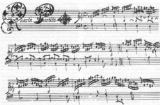
 Only two compositions by Froberger were published during his lifetime: the Hexachord Fantasia, published by Kircher
in 1650 in Rome
, and a piece in François Roberday
's Fugues et caprices (1660, Paris
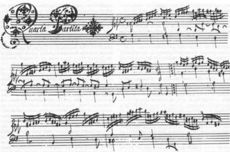
). In addition to these, a comparatively large number of works are preserved in authenticated manuscripts. The three principal sources for Froberger's music are the following manuscripts:
Also, in 2006 an autograph manuscript was discovered (and subsequently sold at Sotheby's
), reportedly containing 35 pieces of music, 18 of which were previously unknown. The manuscript dates from Froberger's final years and may contain his last compositions. Three toccatas in Ms. Chigi Q.IV.25 very likely are early Froberger compositions while he studied with Frescobaldi, as Bob van Asperen
has argued in 2009. Other than these, numerous manuscripts of various origin contain Froberger's music. These include the well-known Bauyn manuscript
, and a very large number of less known sources, some reliable (such as the only unbowdlerized text for Méditation sur ma mort future, presumably in Weckmann
's hand, or the Strasbourg manuscript of some couple of dozen of suites, possibly compiled by Michael Bulyowsky) and some not very much so. Problems arise with many of the newly discovered copies: either Froberger was constantly reworking his compositions, or the scribes were not attentive enough, but many works exist in several variants, some of which even have whole movements changed.
Two standard numbering systems are used to identify Froberger's works. These are:
 Froberger is usually credited as the creator of the Baroque
suite. While this may be misleading, French composers of the time did group dance pieces by tonality above all, and while other composers such as Kindermann
did try to invent some kind of organisation, their dances did not attain as high a degree of artistic merit as seen in Froberger's suites. The typical Froberger suite established allemande
, courante
, sarabande
and gigue
as the obligatory parts of a suite. However, there is some controversy surrounding the placement of the gigue. In Froberger's earliest authenticated autograph, Libro Secondo, five out of six suites are in three movements, without the gigue. A single suite, no. 2, has a gigue added as a 4th movement (and a later copy adds gigues to suites nos. 3 and 5). The suites of Libro Quarto all have gigues as the 2nd movement. The order that became the standard after Froberger's death, with the gigue being the last movement, first appeared in a 1690s print of Froberger's works by the Amsterdam
publisher Mortier.
All Froberger's dances are composed of two repeated sections, but they are very rarely in the standard 8+8 bars scheme. When symmetrical structure is employed, it may be 7+7 bars or 11+11 bars; more frequently one of the sections is longer or shorter than the other (more often the second is shorter than the first). This irregularity may be employed by Froberger in any dance, whereas in Chambonnières
, who used similarly irregular patterns, the sarabande is always composed in the 8+16 fashion. Froberger's keyboard adaptation of the French lute style brisé
almost invariably shows itself in most pieces written during and after his Paris visit.
Froberger's allemandes abandon the original dance's rhythmic scheme almost completely, abounding in short gestures, figures, ornaments and runs typical of style brisé. Like Chambonnières, Froberger avoids emphasizing internal cadences, or indeed anything that would hint at any sort of regularity; unlike him, Froberger tends to use faster sixteenth-note figurations and melodies. Most of the courantes are in 6/4 time with occasional hemiola
s and the eighth-note motion typical of the courante. Some of the others, however, are in 3/2 time, twice slower and moving in quarter notes. Still others are in 3/4 time and closely resemble the Italian corrente of the time. The sarabandes are mostly in 3/2 time and employ a 1+1/2 rhythm pattern, rather than the standard sarabande rhythm with the accent on the second beat. The gigues are almost invariably fugal, either in compound (6/8) or triple (3/4) meter; different sections may use different motifs, and occasionally the first section's subject is inverted for another section. Bizarrely, a few gigues use dotted rhythms in 4/4 time, and a couple feature exquisite rhapsodic 4/4 endings.
Some of the works feature written indications such as "f" and "piano" (to notate an echo effect), "doucement" ("gently") an "avec discrétion" (expressive rubato). In some of the sources such markings are particularly abundant, and the newly (2004) discovered Berlin Sing-Akademie SA 4450 manusrcipt adds similar indications to free sections in organ toccatas. Some suites feature doubles; in a few, the courante is a deriative of the allemande (although this is rare; more often Froberger unites the two dances by giving them somewhat similar beginnings, but keeps the rest of the material different). Suite no. 6 from Libro Secondo is actually a set of variations subtitled Auff der Mayerin, and one of the more popular Froberger works, although it is clearly an early work and not comparable to the late suites neither in technique nor in expression.
Apart from the suites, Froberger also wrote titled, descriptive pieces for the harpsichord (some of the suites incorporate such works as their first movement). He was one of the earliest composers to produce such programmatic pieces. Nearly all of them are very personal; the style resembles Froberger's allemandes in its irregularity and style brisé features. Such pieces include the following (in alphabetical order):
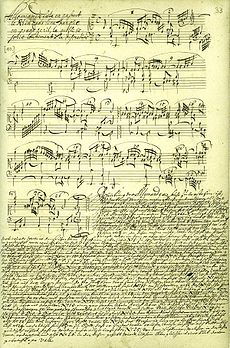
These works frequently feature musical metaphors: in the lamentations on the deaths of the lutenist Blancrocher and Ferdinand IV, Froberger represents Blacrocher's fatal fall down a flight of stairs with a descending scale, and Ferdinand's ascent into heaven with an ascending one; in the Ferdinand III lamentation he ends the piece with a single voice repeating an F three times. Froberger would often supply such works with an explanation, sometimes very detailed (see illustration), of the events that led to composition of the piece. For instance, the Allemande, faite en passat le Rhin contains 26 numbered passages with explanation for each; the Blancrocher tombeau features a written preface in which the circumstances of the lutenist's death are recounted, etc. The structure and style of Froberger's programmatic works, as well as his allemandes, contributed to the development of the unmeasured prelude
through the efforts of Louis Couperin
.
, also a student of Frescobaldi
; instead of being composed of numerous brief parts, they feature a few tightly woven sections, alternating between strict polyphony and free, improvisational passages. They are usually of moderate length and the harmonic content is not dissimilar to Frescobaldi's, although Froberger's harmony favors softer, more pleasing turns (not without some notable exceptions, particularly in the two Da sonarsi alla Levatione works), and his toccatas are always more focused on the original tonality, unlike those by either Frescobaldi or Rossi. The fugal sections are present in most toccatas and are quasi-imitative and are not as strict as later 17th century fugues; when a toccata features several fugal inserts, a single motif may be used for all of them, varied rhythmically.
Whereas in Frescobaldi's oeuvre the fantasia and the ricercare are markedly different genres (the fantasia being a relatively simple contrapuntal composition that expands, as it progresses, into a flurry of intense, rhythmically complex counterpoint; the ricercare being essentially a very strict contrapuntal piece with easily audible lines and somewhat archaic in terms of structure), Froberger's are practically similar. A typical Froberger ricercare or fantasia uses a single subject (with different rhythmic variations for different sections) throughout the whole piece, and the counterpoint adheres almost flawlessly to the 16th century prima pratica
. Any of the standard contrapuntal devices may be used; the main subject is sometimes paired with another theme for a section or two, and there is usually a marked contrast between sections and much variety inside a single piece.
Froberger's canzonas and cappriccios are similarly conservative in terms of technique, and they too are essentially the same even though Frescobaldi distinguished between the genres. Froberger follows Frescobaldi's example in constructing these pieces as variation sets in several sections (usually three in canzonas and any number - as many as six - in capriccios). The subjects are always faster, much more lively that those of ricercares and fantasias. A characteristic feature is the economy of themes: the episodes, which are somewhat rare, are almost invariably based on the material from the subject, somewhat like those in JS Bach
's work some 60–70 years later. The counterpoint and harmony are very similar to the ricercares and fantasias; however, occasionally scale degrees other than 1 and 5 are used.
s, Alleluia! Absorpta es mors and Apparuerunt apostolis. They are found in the so-called Düben collection, compiled by Gustaf Düben
, a famous Swedish
collector and composer. The manuscript is kept in the Uppsala University
library. These motets are quite similar in style: both are scored for a three-voice (STB) choir, two violins and organ (which is given a single melodic line, not polyphony, as was common in Italian motets of the time), and cast in the early 17th century Venetian
stile concertante, in marked contrast with Froberger's preference for older techniques in his polyphonic keyboard works. Another connection to contemporary practice is that the small ensemble is almost identical to one used by Heinrich Schütz
in the second volume of Symphoniae sacrae published in 1647.
and Georg Muffat
, contributed greatly to the exchange of musical traditions in Europe. Finally, he was among the first major keyboard
composers in history and the first to focus equally on both harpsichord
/clavichord
and organ
.
Froberger's compositions were known to and studied by, among many others, Johann Pachelbel
, Dieterich Buxtehude
, Georg Muffat and his son Gottlieb Muffat
, Johann Caspar Kerll, Matthias Weckmann
, Louis Couperin
, Johann Kirnberger
, Johann Nikolaus Forkel
, Georg Böhm
, George Handel
and Johann Sebastian Bach
. Furthermore, copies in Mozart
's hand of the Hexachord Fantasia survive, and even Beethoven
knew Froberger's work through Albrechtsberger
's teachings. The profound influence on Louis Couperin
made Froberger partially responsible for the change Couperin brought into the French organ tradition (as well as for the development of the unmeasured prelude
, which Couperin cultivated).
Although the polyphonic pieces were highly esteemed in the 17th-18th centuries, today Froberger is chiefly remembered for his contribution to the development of the keyboard suite. Indeed, he established the form almost single-handedly and, through innovative and imaginative treatment of standard dance forms of the time, paved way for Johann Sebastian Bach
's elaborate contributions to the genre (not to mention almost every major composer in Europe, since the vast majority composed suites and were influenced by the "French style" exemplified by Froberger).
Baroque
The Baroque is a period and the style that used exaggerated motion and clear, easily interpreted detail to produce drama, tension, exuberance, and grandeur in sculpture, painting, literature, dance, and music...
composer, keyboard
Keyboard instrument
A keyboard instrument is a musical instrument which is played using a musical keyboard. The most common of these is the piano. Other widely used keyboard instruments include organs of various types as well as other mechanical, electromechanical and electronic instruments...
virtuoso
Virtuoso
A virtuoso is an individual who possesses outstanding technical ability in the fine arts, at singing or playing a musical instrument. The plural form is either virtuosi or the Anglicisation, virtuosos, and the feminine form sometimes used is virtuosa...
, and organist
Organist
An organist is a musician who plays any type of organ. An organist may play solo organ works, play with an ensemble or orchestra, or accompany one or more singers or instrumental soloists...
. He was among the most famous composers of the era and influenced practically every major composer in Europe by developing the genre of keyboard suite
Suite
In music, a suite is an ordered set of instrumental or orchestral pieces normally performed in a concert setting rather than as accompaniment; they may be extracts from an opera, ballet , or incidental music to a play or film , or they may be entirely original movements .In the...
and contributing greatly to the exchange of musical traditions through his many travels. He is also remembered for his highly idiomatic and personal descriptive harpsichord
Harpsichord
A harpsichord is a musical instrument played by means of a keyboard. It produces sound by plucking a string when a key is pressed.In the narrow sense, "harpsichord" designates only the large wing-shaped instruments in which the strings are perpendicular to the keyboard...
pieces, which are among the earliest known examples of program music
Program music
Program music or programme music is a type of art music that attempts to musically render an extra-musical narrative. The narrative itself might be offered to the audience in the form of program notes, inviting imaginative correlations with the music...
.
Only two of Froberger's many compositions were published during his lifetime, but his music was very widely spread in manuscript copies and he was one of the very few 17th century composers who were never entirely forgotten. His works were studied in the 18th century (although perhaps not very extensively, and certainly without influence on the emerging Classical style) by Handel
George Frideric Handel
George Frideric Handel was a German-British Baroque composer, famous for his operas, oratorios, anthems and organ concertos. Handel was born in 1685, in a family indifferent to music...
, Bach
Johann Sebastian Bach
Johann Sebastian Bach was a German composer, organist, harpsichordist, violist, and violinist whose sacred and secular works for choir, orchestra, and solo instruments drew together the strands of the Baroque period and brought it to its ultimate maturity...
and, extraordinarily, even Mozart
Wolfgang Amadeus Mozart
Wolfgang Amadeus Mozart , baptismal name Johannes Chrysostomus Wolfgangus Theophilus Mozart , was a prolific and influential composer of the Classical era. He composed over 600 works, many acknowledged as pinnacles of symphonic, concertante, chamber, piano, operatic, and choral music...
and Beethoven
Ludwig van Beethoven
Ludwig van Beethoven was a German composer and pianist. A crucial figure in the transition between the Classical and Romantic eras in Western art music, he remains one of the most famous and influential composers of all time.Born in Bonn, then the capital of the Electorate of Cologne and part of...
.
1616-1634: Early years in Stuttgart
Johann Jakob Froberger was baptized on 19 May 1616 in StuttgartStuttgart
Stuttgart is the capital of the state of Baden-Württemberg in southern Germany. The sixth-largest city in Germany, Stuttgart has a population of 600,038 while the metropolitan area has a population of 5.3 million ....
. The exact date of his birth is unknown. His family came from Halle
Halle, Saxony-Anhalt
Halle is the largest city in the German state of Saxony-Anhalt. It is also called Halle an der Saale in order to distinguish it from the town of Halle in North Rhine-Westphalia...
, where his grandfather Simon lived and his father Basilius (1575–1637) was born. In 1599 Basilius moved to Stuttgart and became a tenor
Tenor
The tenor is a type of male singing voice and is the highest male voice within the modal register. The typical tenor voice lies between C3, the C one octave below middle C, to the A above middle C in choral music, and up to high C in solo work. The low extreme for tenors is roughly B2...
in the Württemberg
Württemberg
Württemberg , formerly known as Wirtemberg or Wurtemberg, is an area and a former state in southwestern Germany, including parts of the regions Swabia and Franconia....
court chapel. At some point before 1605 he married Anna Schmid (1577–1637), who came from a Schwab
Schwab
Schwab may refer to:People:* Albert E. Schwab United States Marine Killed in action WW2 Okinawa 1945 / Awarded Medal of Honor* Andreas Schwab , German politician* Andrew Schwab, lead vocalist for the rock group Project 86...
family living in Stuttgart. By the time Johann Jakob was born, his father's career was already flourishing, and in 1621 Basilius became court Kapellmeister. Of his eleven children with Anna, four became musicians (Johann Jakob, Johann Christoph, Johann Georg and Isaac; all but Johann Jakob served at the Württemberg court in Stuttgart), and so it is likely that Johann Jakob received his first music lessons from his father.
Although the Thirty Years' War
Thirty Years' War
The Thirty Years' War was fought primarily in what is now Germany, and at various points involved most countries in Europe. It was one of the most destructive conflicts in European history....
which started in 1618 undoubtedly made life in Stuttgart somewhat more difficult, the city's musical life was rich and varied, influenced by musicians from all over Europe, so already at the very beginning of his life Froberger must have been exposed to a wide variety of musical traditions. Little is known about his actual education, though. His teachers possibly included Johann Ulrich Steigleder
Johann Ulrich Steigleder
Johann Ulrich Steigleder was a German Baroque composer and organist. He was the most celebrated member of the Steigleder family, which also included Adam Steigleder , his father, and Utz Steigleder , his grandfather.Steigleder was born in Schwäbisch Hall on 22 March 1593...
, and he might have met Samuel Scheidt
Samuel Scheidt
Samuel Scheidt was a German composer, organist and teacher of the early Baroque era.-Biography:...
during the latter's visit to Stuttgart
Stuttgart
Stuttgart is the capital of the state of Baden-Württemberg in southern Germany. The sixth-largest city in Germany, Stuttgart has a population of 600,038 while the metropolitan area has a population of 5.3 million ....
in 1627; it is possible that Froberger sang in the court chapel, but there is no direct evidence to that; and court archives indicate that one of the English lutenists employed by the court, Andrew Borell, taught lute
Lute
Lute can refer generally to any plucked string instrument with a neck and a deep round back, or more specifically to an instrument from the family of European lutes....
to one of Basilius Froberger's sons in 1621-22 - it is not known whether this son was Johann Jakob, but if so, it would explain his later interest in French lute music.
Basilius Froberger's music library probably also helped in Johann Jakob's education. It contained more than a hundred volumes of music, including works by Josquin des Prez
Josquin Des Prez
Josquin des Prez [Josquin Lebloitte dit Desprez] , often referred to simply as Josquin, was a Franco-Flemish composer of the Renaissance...
, Samuel Scheidt
Samuel Scheidt
Samuel Scheidt was a German composer, organist and teacher of the early Baroque era.-Biography:...
and Michael Praetorius
Michael Praetorius
Michael Praetorius was a German composer, organist, and music theorist. He was one of the most versatile composers of his age, being particularly significant in the development of musical forms based on Protestant hymns, many of which reflect an effort to make better the relationship between...
, as well as pieces by the lesser known Johann Staden
Johann Staden
Johann Staden was a German Baroque organist and composer. He is best known for establishing the so-called Nuremberg school.-Life:He was the son of Hans Staden and Elisabeth Löbelle...
, founder of the Nuremberg
Nuremberg
Nuremberg[p] is a city in the German state of Bavaria, in the administrative region of Middle Franconia. Situated on the Pegnitz river and the Rhine–Main–Danube Canal, it is located about north of Munich and is Franconia's largest city. The population is 505,664...
school, and Giovanni Valentini
Giovanni Valentini
Giovanni Valentini was an Italian Baroque composer, poet and keyboard virtuoso. Overshadowed by his contemporaries, Claudio Monteverdi and Heinrich Schütz, Valentini is practically forgotten today, although he occupied one of the most prestigious musical posts of his time...
, the then-famous Viennese
Vienna
Vienna is the capital and largest city of the Republic of Austria and one of the nine states of Austria. Vienna is Austria's primary city, with a population of about 1.723 million , and is by far the largest city in Austria, as well as its cultural, economic, and political centre...
Kappelmeister who later taught Johann Kaspar Kerll
Johann Kaspar Kerll
Johann Kaspar Kerll was a German baroque composer and organist.Son of an organist, he showed outstanding musical abilities at an early age, and was taught by Giovanni Valentini, court Kapellmeister at Vienna. Kerll became one of the most acclaimed composers of his time, known both as a gifted...
.
1634-1649: Court service in Vienna and voyages to Italy
The Hofkapelle of Stuttgart was disbanded in 1634 in the wake of the Protestants' defeat in the Battle of NördlingenBattle of Nördlingen (1634)
The Battle of Nördlingen was fought on 27 August or 6 September , 1634 during the Thirty Years' War. The Roman Catholic Imperial army, bolstered by 18,000 Spanish and Italian soldiers, won a crushing victory over the combined Protestant armies of Sweden and their German-Protestant allies .After...
. In Grundlage einer Ehrenpforte (1740) Mattheson
Johann Mattheson
Johann Mattheson was a German composer, writer, lexicographer, diplomat and music theorist.Mattheson was born and died in Hamburg. He was a close friend of George Frideric Handel, although he nearly killed him in a sudden quarrel, during a performance of Mattheson's opera Cleopatra in 1704...
writes that a certain Swedish
Sweden
Sweden , officially the Kingdom of Sweden , is a Nordic country on the Scandinavian Peninsula in Northern Europe. Sweden borders with Norway and Finland and is connected to Denmark by a bridge-tunnel across the Öresund....
ambassador was so impressed with Froberger's musical skills that he took the 18-year old musician to Vienna and presumably recommended him to the imperial court. This seems unlikely, however, because at the time Sweden was allied with Lutheran Württemberg against the imperial forces; so exactly why Froberger left for Vienna at around 1634 and how he managed to find employment as a singer in the imperial chapel, remains a mystery.
In 1637 Basilius Froberger, his wife and one his daughters died of plague. Johann Jakob and his brother Isaac sold their father's music library to the Württemberg court (this is how the contents of Basilius' library became known - through the court archives); the same year Johann Jakob became court organist in Vienna, assisting Wolfgang Ebner
Wolfgang Ebner
Wolfgang Ebner was an German baroque composer. Ebner was Vienna court organist in the latter years of the reign of Ferdinand III, and then of Leopold I. Ebner may have preceeded Johann Heinrich Schmelzer as ballet master....
. In June he was granted a leave and a stipend to go to Rome
Rome
Rome is the capital of Italy and the country's largest and most populated city and comune, with over 2.7 million residents in . The city is located in the central-western portion of the Italian Peninsula, on the Tiber River within the Lazio region of Italy.Rome's history spans two and a half...
to study under Frescobaldi
Girolamo Frescobaldi
Girolamo Frescobaldi was a musician from Ferrara, one of the most important composers of keyboard music in the late Renaissance and early Baroque periods. A child prodigy, Frescobaldi studied under Luzzasco Luzzaschi in Ferrara, but was influenced by a large number of composers, including Ascanio...
. Froberger spent the next three years in Italy and, like many other musicians who went to study there, apparently converted to Catholicism. He returned to Vienna in 1641 and served as organist and chamber musician until the fall of 1645, when he took a second trip to Italy. It was previously thought that Froberger went to study under Giacomo Carissimi
Giacomo Carissimi
Giacomo Carissimi was an Italian composer, one of the most celebrated masters of the early Baroque, or, more accurately, the Roman School of music.-Biography:...
, but recent research shows that he most probably studied with Athanasius Kircher
Athanasius Kircher
Athanasius Kircher was a 17th century German Jesuit scholar who published around 40 works, most notably in the fields of oriental studies, geology, and medicine...
in Rome
Rome
Rome is the capital of Italy and the country's largest and most populated city and comune, with over 2.7 million residents in . The city is located in the central-western portion of the Italian Peninsula, on the Tiber River within the Lazio region of Italy.Rome's history spans two and a half...
. If so, Froberger's intention must have been acquiring mastery of vocal
Vocal music
Vocal music is a genre of music performed by one or more singers, with or without instrumental accompaniment, in which singing provides the main focus of the piece. Music which employs singing but does not feature it prominently is generally considered instrumental music Vocal music is a genre of...
composition of the prima pratica
Prima pratica
Prima pratica refers to early Baroque music which looks more to the style of Palestrina, or the style codified by Gioseffo Zarlino, than to more "modern" styles. It is contrasted with seconda pratica music...
(Frescobaldi, who taught him instrumental writing, died in 1643). Sometime during 1648-49 Froberger might have met Johann Kaspar Kerll
Johann Kaspar Kerll
Johann Kaspar Kerll was a German baroque composer and organist.Son of an organist, he showed outstanding musical abilities at an early age, and was taught by Giovanni Valentini, court Kapellmeister at Vienna. Kerll became one of the most acclaimed composers of his time, known both as a gifted...
, and possibly taught him.
In 1649 Froberger travelled back to Austria. On his way back he stopped in Florence
Florence
Florence is the capital city of the Italian region of Tuscany and of the province of Florence. It is the most populous city in Tuscany, with approximately 370,000 inhabitants, expanding to over 1.5 million in the metropolitan area....
and Mantua
Mantua
Mantua is a city and comune in Lombardy, Italy and capital of the province of the same name. Mantua's historic power and influence under the Gonzaga family, made it one of the main artistic, cultural and notably musical hubs of Northern Italy and the country as a whole...
to show the arca musurgica, a powerful compositional device Kircher taught him, to some of the Italian princes. In September he arrived in Vienna and demonstrated the arca musurgica to the Emperor
Ferdinand III, Holy Roman Emperor
Ferdinand III was Holy Roman Emperor from 15 February 1637 until his death, as well as King of Hungary and Croatia, King of Bohemia and Archduke of Austria.-Life:...
, an avid amateur musician; he also presented him with Libro Secondo, a collection of his own compositions (the Libro Primo is now lost). Also in September, Froberger played before William Swann, an English diplomat. Through Swann he got to know Constantijn Huygens
Constantijn Huygens
Constantijn Huygens , was a Dutch Golden Age poet and composer. He was secretary to two Princes of Orange: Frederick Henry and William II, and the father of the scientist Christiaan Huygens.-Biography:...
, who became Froberger's lifelong friend and introduced the composer to works by contemporary French masters - Jacques Champion de Chambonnières
Jacques Champion de Chambonnières
Jacques Champion de Chambonnières was a French harpsichordist, dancer and composer. Born into a musical family, Chambonnières made an illustrious career as court harpsichordist in Paris and was considered by many of his contemporaries to be one of the greatest musicians in Europe...
, Denis Gaultier
Denis Gaultier
Denis Gaultier was a French lutenist and composer. He was a cousin of Ennemond Gaultier.-Life:...
and Ennemond Gaultier
Ennemond Gaultier
Ennemond Gaultier was a French lutenist and composer. He was one of the masters of the 17th century French lute school....
.
1649-1653: Years of travels
Following the Empress Maria LeopoldineMaria Leopoldine of Austria
Maria Leopoldine was Holy Roman Empress as the spouse of Ferdinand III, Holy Roman Emperor.-Biography:...
's death in August the court's musical activities were suspended. Froberger left the city and travelled widely for the next four years, likely entrusted by the Emperor with some extra-musical duties in the fields of diplomacy and possibly espionage (as for example John Dowland
John Dowland
John Dowland was an English Renaissance composer, singer, and lutenist. He is best known today for his melancholy songs such as "Come, heavy sleep" , "Come again", "Flow my tears", "I saw my Lady weepe" and "In darkness let me dwell", but his instrumental music has undergone a major revival, and has...
and Peter Paul Rubens were during their travels). Not much is known about these voyages. Dresden
Dresden
Dresden is the capital city of the Free State of Saxony in Germany. It is situated in a valley on the River Elbe, near the Czech border. The Dresden conurbation is part of the Saxon Triangle metropolitan area....
was probably one of the very first cities Froberger visited: he played before the electoral
Electorate of Saxony
The Electorate of Saxony , sometimes referred to as Upper Saxony, was a State of the Holy Roman Empire. It was established when Emperor Charles IV raised the Ascanian duchy of Saxe-Wittenberg to the status of an Electorate by the Golden Bull of 1356...
court of John George I
John George I, Elector of Saxony
John George I was Elector of Saxony from 1611 to 1656.-Biography:Born in Dresden, he was the second son of the Elector Christian I and Sophie of Brandenburg....
and presented the Elector with a collection of his works. He also met Matthias Weckmann
Matthias Weckmann
Matthias Weckmann was a German musician and composer of the Baroque period. He was born in Niederdorla and died in Hamburg.- Life :...
while in Dresden, and this encounter turned to another lifelong friendship; the two continued to exchange letters and Froberger even sent some of his music to Weckmann to illustrate his style). According to a pupil, after Dresden Froberger visited Cologne
Cologne
Cologne is Germany's fourth-largest city , and is the largest city both in the Germany Federal State of North Rhine-Westphalia and within the Rhine-Ruhr Metropolitan Area, one of the major European metropolitan areas with more than ten million inhabitants.Cologne is located on both sides of the...
, Düsseldorf
Düsseldorf
Düsseldorf is the capital city of the German state of North Rhine-Westphalia and centre of the Rhine-Ruhr metropolitan region.Düsseldorf is an important international business and financial centre and renowned for its fashion and trade fairs. Located centrally within the European Megalopolis, the...
, Zeeland
Zeeland
Zeeland , also called Zealand in English, is the westernmost province of the Netherlands. The province, located in the south-west of the country, consists of a number of islands and a strip bordering Belgium. Its capital is Middelburg. With a population of about 380,000, its area is about...
, Brabant
Duchy of Brabant
The Duchy of Brabant was a historical region in the Low Countries. Its territory consisted essentially of the three modern-day Belgian provinces of Flemish Brabant, Walloon Brabant and Antwerp, the Brussels-Capital Region and most of the present-day Dutch province of North Brabant.The Flag of...
and Antwerp; we also know that he also visited Brussels
Brussels
Brussels , officially the Brussels Region or Brussels-Capital Region , is the capital of Belgium and the de facto capital of the European Union...
at least two times (in 1650 and 1652), London
London
London is the capital city of :England and the :United Kingdom, the largest metropolitan area in the United Kingdom, and the largest urban zone in the European Union by most measures. Located on the River Thames, London has been a major settlement for two millennia, its history going back to its...
(after a disastrous voyage during which Froberger got robbed, an event he described musically in Plainte faite а Londres pour passer la mélancholie) and, most importantly, Paris
Paris
Paris is the capital and largest city in France, situated on the river Seine, in northern France, at the heart of the Île-de-France region...
(at least once, in 1652).
In Paris Froberger most probably became acquainted with many major French composers of the era, including Chambonnières, Louis Couperin
Louis Couperin
Louis Couperin was a French Baroque composer and performer. He was born in Chaumes-en-Brie and moved to Paris in 1650–51 with the help of Jacques Champion de Chambonnières. Couperin worked as organist of the Church of St. Gervais in Paris and as musician at the court...
, Denis Gaultier and possibly François Dufault
François Dufault
François Dufault was a French lutenist and composer.Dufault was born in Bourges, France. As a student of Denis Gaultier, he enjoyed an excellent reputation as an instrumentalist, what is demonstrated in many contemporary sources where he was described as one of the greatest lutenist of his time...
. The latter two were famous lutenists writing in the characteristic French idiom of style brisé
Style brisé
Style brisé is a term for broken, arpeggiated texture in instrumental music. It usually refers to French Baroque music for lute, keyboard instruments or the viol. French Baroque musicians referred to this type of texture as style luthé , since it originated in lute music...
, which influenced Froberger's later harpsichord
Harpsichord
A harpsichord is a musical instrument played by means of a keyboard. It produces sound by plucking a string when a key is pressed.In the narrow sense, "harpsichord" designates only the large wing-shaped instruments in which the strings are perpendicular to the keyboard...
suite
Suite
In music, a suite is an ordered set of instrumental or orchestral pieces normally performed in a concert setting rather than as accompaniment; they may be extracts from an opera, ballet , or incidental music to a play or film , or they may be entirely original movements .In the...
s. In turn, Louis Couperin was profoundly influenced by Froberger's style; one of his unmeasured prelude
Unmeasured prelude
Unmeasured or non-measured prelude is a prelude in which the duration of each note is left to the performer. Typically the term is used for 17th century harpsichord compositions that are written without rhythm or metre indications, although various composers of the Classical music era were...
s even bears the subtitle "à l'imitation de Mr. Froberger". In November 1652 Froberger witnessed the death of the famed lutenist Blancrocher
Charles Fleury
Charles Fleury, Sieur de Blancrocher was a French lutenist. Known principally under the name Blancrocher , he was one of the leading performers of his day, active in Paris. Whether he composed or not is unknown; a single dance movement survives, attributed to him, in the so-called Manuscrit Vaudry...
(who was his friend and reportedly died in his arms). Although Blancrocher himself was not an important composer, his death left a mark on the history of music, as Couperin, Gaultier, Dufaut and Froberger all wrote tombeau
Tombeau
A tombeau is a musical composition commemorating the death of a notable individual. The term derives from the French word for "tomb" or "tombstone". The vast majority of tombeaux date from the 17th century and were composed for lute or other plucked string instruments...
x lamenting the event.
1653-1667: Last years in Vienna, retirement and death
In 1653 Froberger passed through HeidelbergHeidelberg
-Early history:Between 600,000 and 200,000 years ago, "Heidelberg Man" died at nearby Mauer. His jaw bone was discovered in 1907; with scientific dating, his remains were determined to be the earliest evidence of human life in Europe. In the 5th century BC, a Celtic fortress of refuge and place of...
, Nuremberg
Nuremberg
Nuremberg[p] is a city in the German state of Bavaria, in the administrative region of Middle Franconia. Situated on the Pegnitz river and the Rhine–Main–Danube Canal, it is located about north of Munich and is Franconia's largest city. The population is 505,664...
and Regensburg
Regensburg
Regensburg is a city in Bavaria, Germany, located at the confluence of the Danube and Regen rivers, at the northernmost bend in the Danube. To the east lies the Bavarian Forest. Regensburg is the capital of the Bavarian administrative region Upper Palatinate...
before returning to Vienna in April. He remained with the Viennese court during the next four years, producing at least one more collection of music, the Libro Quarto of 1656 (Libro Terzo is now lost). Froberger was apparently deeply saddened by Emperor Ferdinand III's death on 2 April 1657 and wrote a lamentation dedicated to the memory of the Emperor http://earlymusic.cal.pl/pawel/mp3/Froberger.mp3. His relationship with Ferdinand's successor, Leopold I
Leopold I, Holy Roman Emperor
| style="float:right;" | Leopold I was a Holy Roman Emperor, King of Hungary and King of Bohemia. A member of the Habsburg family, he was the second son of Emperor Ferdinand III and his first wife, Maria Anna of Spain. His maternal grandparents were Philip III of Spain and Margaret of Austria...
, was strained for a number of political reasons (numerous forces were opposed to Leopold's election, and among them were the Jesuit order
Society of Jesus
The Society of Jesus is a Catholic male religious order that follows the teachings of the Catholic Church. The members are called Jesuits, and are also known colloquially as "God's Army" and as "The Company," these being references to founder Ignatius of Loyola's military background and a...
and Johann Philipp von Schönborn
Johann Philipp von Schönborn
Johann Philipp von Schönborn was the Archbishop-Elector of Mainz from 1647 until 1673, the Bishop of Würzburg from 1642 until 1673, and the Bishop of Worms from 1663 until 1673....
, Elector-Archbishop of Mainz
Archbishopric of Mainz
The Archbishopric of Mainz or Electorate of Mainz was an influential ecclesiastic and secular prince-bishopric in the Holy Roman Empire between 780–82 and 1802. In the Roman Catholic Church hierarchy, the Archbishop of Mainz was the primas Germaniae, the substitute of the Pope north of the Alps...
; Froberger's mentor and friend Kircher was an important figure in the former, and Froberger had strong ties with the court of the latter. Froberger did, however, dedicate a new volume of his works to Leopold), and on June 30, 1657 Froberger received his last salary as a member of the imperial chapel.
Little is known about Froberger's last 10 years. Most of the information comes from the letter exchange between Constantijn Huygens and the dowager Duchess of Montbéliard
Montbéliard
Montbéliard is a city in the Doubs department in the Franche-Comté region in eastern France. It is one of the two subprefectures of the department.-History:...
, Sybilla (1620–1707). Since the death of her husband Léopold-Frédéric of Württemberg-Montbéliard in 1662 the Duchess lived in Héricourt (near Montbéliard
Montbéliard
Montbéliard is a city in the Doubs department in the Franche-Comté region in eastern France. It is one of the two subprefectures of the department.-History:...
, then territory of the house of Württemberg; now département Doubs), and Froberger became her music teacher at around the same time (this indicates that Froberger must have maintained a link with the ducal family of Württemberg since his Stuttgart years). He lived in Château d’Héricourt, the dower house of Duchess Sibylla. The Huygens-Sybilla letters indicate that in 1665 Froberger travelled to Mainz, where he performed at the court of Elector-Archbishop of Mainz and met Huygens in person for the first time; and at a certain point in 1666 the composer had plans to return to the imperial court in Vienna. As far as is known, though, he never did, and lived in Héricourt until his death on May 6 or 7, 1667. Froberger apparently knew that he was going to die soon, as he made all necessary preparations a day before he died.
General information
Athanasius Kircher
Athanasius Kircher was a 17th century German Jesuit scholar who published around 40 works, most notably in the fields of oriental studies, geology, and medicine...
in 1650 in Rome
Rome
Rome is the capital of Italy and the country's largest and most populated city and comune, with over 2.7 million residents in . The city is located in the central-western portion of the Italian Peninsula, on the Tiber River within the Lazio region of Italy.Rome's history spans two and a half...
, and a piece in François Roberday
François Roberday
François Roberday was a French Baroque organist and composer. One of the last exponents of the French polyphonic music tradition established by Jean Titelouze and Louis Couperin, Roberday is best remembered today for his Fugues et caprices, a collection of four-part contrapuntal organ...
's Fugues et caprices (1660, Paris
Paris
Paris is the capital and largest city in France, situated on the river Seine, in northern France, at the heart of the Île-de-France region...
). In addition to these, a comparatively large number of works are preserved in authenticated manuscripts. The three principal sources for Froberger's music are the following manuscripts:
- Libro Secundo (1649) and Libro Quarto (1656), two richly decorated volumes dedicated to Ferdinand III. Both were found in Vienna; the decorations and calligraphy are by Johann Friedrich Sautter, Froberger's friend from his Stuttgart years. Each book has four chapters and contains 24 pieces. Both include six toccatas and six suites; Libro Secundo adds 6 fantasiaFantasia (music)The fantasia is a musical composition with its roots in the art of improvisation. Because of this, it seldom approximates the textbook rules of any strict musical form ....
s and 6 canzonaCanzonaIn the 16th century an instrumental chanson; later, a piece for ensemble in several sections or tempos...
s, whereas Libro Quarto instead has 6 ricercarRicercarA ricercar is a type of late Renaissance and mostly early Baroque instrumental composition. The term means to search out, and many ricercars serve a preludial function to "search out" the key or mode of a following piece...
s and 6 capriccioCapriccio (music)A capriccio or caprice , is a piece of music, usually fairly free in form and of a lively character...
s. - Libro di capricci e ricercate (c. 1658). 6 capriccios and 6 ricercars.
Also, in 2006 an autograph manuscript was discovered (and subsequently sold at Sotheby's
Sotheby's
Sotheby's is the world's fourth oldest auction house in continuous operation.-History:The oldest auction house in operation is the Stockholms Auktionsverk founded in 1674, the second oldest is Göteborgs Auktionsverk founded in 1681 and third oldest being founded in 1731, all Swedish...
), reportedly containing 35 pieces of music, 18 of which were previously unknown. The manuscript dates from Froberger's final years and may contain his last compositions. Three toccatas in Ms. Chigi Q.IV.25 very likely are early Froberger compositions while he studied with Frescobaldi, as Bob van Asperen
Bob van Asperen
Bob van Asperen is a harpsichordist, organist, conductor, clavichordist and early music-specialist.After completing a conventional music course at university, in 1967 he studied under the harpsichord master Gustav Leonhardt. In 1968 he joined the group Quadro Hotteterre, of which he was a member...
has argued in 2009. Other than these, numerous manuscripts of various origin contain Froberger's music. These include the well-known Bauyn manuscript
Bauyn manuscript
The Bauyn manuscript is a manuscript currently in possession of the Bibliothèque Nationale de France in Paris...
, and a very large number of less known sources, some reliable (such as the only unbowdlerized text for Méditation sur ma mort future, presumably in Weckmann
Matthias Weckmann
Matthias Weckmann was a German musician and composer of the Baroque period. He was born in Niederdorla and died in Hamburg.- Life :...
's hand, or the Strasbourg manuscript of some couple of dozen of suites, possibly compiled by Michael Bulyowsky) and some not very much so. Problems arise with many of the newly discovered copies: either Froberger was constantly reworking his compositions, or the scribes were not attentive enough, but many works exist in several variants, some of which even have whole movements changed.
Two standard numbering systems are used to identify Froberger's works. These are:
- the numbers used in the early 20th century Denkmäler der Tonkunst in Österreich series and the Guido AdlerGuido AdlerGuido Adler was a Bohemian-Austrian musicologist and writer.His father Joachim, a physician, died of typhoid fever in 1857...
edition; commonly referred to as the DTÖ numbers or the Adler numbers. This catalogue has separate numbering for different genres, with pieces identified as Toccata No. 4, Ricercare No. 2, Suite No. 20, etc. The DTÖ contains a few compositions falsely attributed to Froberger, and some identical ones. - FbWV numbers from the Siegbert Rampe catalogue compiled in early 1990s. Rampe's catalogue is more complete and includes newly discovered pieces as well as pieces whose authorship is questioned. The Adler numbers are incorporated, for example all Toccatas are numbered 1xx, hence Adler Toccata No. 1 has the Rampe number FbWV 101. For more information, see List of compositions by Johann Jakob Froberger.
Harpsichord suites and programmatic pieces
Baroque
The Baroque is a period and the style that used exaggerated motion and clear, easily interpreted detail to produce drama, tension, exuberance, and grandeur in sculpture, painting, literature, dance, and music...
suite. While this may be misleading, French composers of the time did group dance pieces by tonality above all, and while other composers such as Kindermann
Johann Erasmus Kindermann
Johann Erasmus Kindermann was a German Baroque organist and composer. He was the most important composer of the Nuremberg school in the first half of the 17th century.-Life:...
did try to invent some kind of organisation, their dances did not attain as high a degree of artistic merit as seen in Froberger's suites. The typical Froberger suite established allemande
Allemande
An allemande is one of the most popular instrumental dance forms in Baroque music, and a standard element of a suite...
, courante
Courante
The courante, corrente, coranto and corant are some of the names given to a family of triple metre dances from the late Renaissance and the Baroque era....
, sarabande
Sarabande
In music, the sarabande is a dance in triple metre. The second and third beats of each measure are often tied, giving the dance a distinctive rhythm of quarter notes and eighth notes in alternation...
and gigue
Gigue
The gigue or giga is a lively baroque dance originating from the British jig. It was imported into France in the mid-17th century and usually appears at the end of a suite...
as the obligatory parts of a suite. However, there is some controversy surrounding the placement of the gigue. In Froberger's earliest authenticated autograph, Libro Secondo, five out of six suites are in three movements, without the gigue. A single suite, no. 2, has a gigue added as a 4th movement (and a later copy adds gigues to suites nos. 3 and 5). The suites of Libro Quarto all have gigues as the 2nd movement. The order that became the standard after Froberger's death, with the gigue being the last movement, first appeared in a 1690s print of Froberger's works by the Amsterdam
Amsterdam
Amsterdam is the largest city and the capital of the Netherlands. The current position of Amsterdam as capital city of the Kingdom of the Netherlands is governed by the constitution of August 24, 1815 and its successors. Amsterdam has a population of 783,364 within city limits, an urban population...
publisher Mortier.
All Froberger's dances are composed of two repeated sections, but they are very rarely in the standard 8+8 bars scheme. When symmetrical structure is employed, it may be 7+7 bars or 11+11 bars; more frequently one of the sections is longer or shorter than the other (more often the second is shorter than the first). This irregularity may be employed by Froberger in any dance, whereas in Chambonnières
Jacques Champion de Chambonnières
Jacques Champion de Chambonnières was a French harpsichordist, dancer and composer. Born into a musical family, Chambonnières made an illustrious career as court harpsichordist in Paris and was considered by many of his contemporaries to be one of the greatest musicians in Europe...
, who used similarly irregular patterns, the sarabande is always composed in the 8+16 fashion. Froberger's keyboard adaptation of the French lute style brisé
Style brisé
Style brisé is a term for broken, arpeggiated texture in instrumental music. It usually refers to French Baroque music for lute, keyboard instruments or the viol. French Baroque musicians referred to this type of texture as style luthé , since it originated in lute music...
almost invariably shows itself in most pieces written during and after his Paris visit.
Froberger's allemandes abandon the original dance's rhythmic scheme almost completely, abounding in short gestures, figures, ornaments and runs typical of style brisé. Like Chambonnières, Froberger avoids emphasizing internal cadences, or indeed anything that would hint at any sort of regularity; unlike him, Froberger tends to use faster sixteenth-note figurations and melodies. Most of the courantes are in 6/4 time with occasional hemiola
Hemiola
In modern musical parlance, a hemiola is a metrical pattern in which two bars in simple triple time are articulated as if they were three bars in simple duple time...
s and the eighth-note motion typical of the courante. Some of the others, however, are in 3/2 time, twice slower and moving in quarter notes. Still others are in 3/4 time and closely resemble the Italian corrente of the time. The sarabandes are mostly in 3/2 time and employ a 1+1/2 rhythm pattern, rather than the standard sarabande rhythm with the accent on the second beat. The gigues are almost invariably fugal, either in compound (6/8) or triple (3/4) meter; different sections may use different motifs, and occasionally the first section's subject is inverted for another section. Bizarrely, a few gigues use dotted rhythms in 4/4 time, and a couple feature exquisite rhapsodic 4/4 endings.
Some of the works feature written indications such as "f" and "piano" (to notate an echo effect), "doucement" ("gently") an "avec discrétion" (expressive rubato). In some of the sources such markings are particularly abundant, and the newly (2004) discovered Berlin Sing-Akademie SA 4450 manusrcipt adds similar indications to free sections in organ toccatas. Some suites feature doubles; in a few, the courante is a deriative of the allemande (although this is rare; more often Froberger unites the two dances by giving them somewhat similar beginnings, but keeps the rest of the material different). Suite no. 6 from Libro Secondo is actually a set of variations subtitled Auff der Mayerin, and one of the more popular Froberger works, although it is clearly an early work and not comparable to the late suites neither in technique nor in expression.
Apart from the suites, Froberger also wrote titled, descriptive pieces for the harpsichord (some of the suites incorporate such works as their first movement). He was one of the earliest composers to produce such programmatic pieces. Nearly all of them are very personal; the style resembles Froberger's allemandes in its irregularity and style brisé features. Such pieces include the following (in alphabetical order):
- Allemande, faite en passant le Rhin dans une barque en grand péril
- Lamentation faite sur la mort très douloureuse de Sa Majesté Impériale, Ferdinand le troisième, An. 1657 http://earlymusic.cal.pl/pawel/mp3/Froberger.mp3
- Lamentation sur ce que j'ay été volé et se joüe à la discretion et encore mieux que les soldats m'ont traité
- Lamento sopra la dolorosa perdita della Real Maestà di Ferdinando IV Rè de Romani
- Méditation sur ma mort future
- Plainte faite à Londres pour passer la melancholie
- Tombeau fait à Paris sur la mort de Monsieur Blancrocher
These works frequently feature musical metaphors: in the lamentations on the deaths of the lutenist Blancrocher and Ferdinand IV, Froberger represents Blacrocher's fatal fall down a flight of stairs with a descending scale, and Ferdinand's ascent into heaven with an ascending one; in the Ferdinand III lamentation he ends the piece with a single voice repeating an F three times. Froberger would often supply such works with an explanation, sometimes very detailed (see illustration), of the events that led to composition of the piece. For instance, the Allemande, faite en passat le Rhin contains 26 numbered passages with explanation for each; the Blancrocher tombeau features a written preface in which the circumstances of the lutenist's death are recounted, etc. The structure and style of Froberger's programmatic works, as well as his allemandes, contributed to the development of the unmeasured prelude
Unmeasured prelude
Unmeasured or non-measured prelude is a prelude in which the duration of each note is left to the performer. Typically the term is used for 17th century harpsichord compositions that are written without rhythm or metre indications, although various composers of the Classical music era were...
through the efforts of Louis Couperin
Louis Couperin
Louis Couperin was a French Baroque composer and performer. He was born in Chaumes-en-Brie and moved to Paris in 1650–51 with the help of Jacques Champion de Chambonnières. Couperin worked as organist of the Church of St. Gervais in Paris and as musician at the court...
.
Polyphonic keyboard works
The rest of Froberger's keyboard works may be performed on any keyboard instrument, including the organ. The toccatas are the only ones to employ free writing to some degree; the majority are strictly polyphonic. In terms of organisation, Froberger's toccatas are reminiscent of those by Michelangelo RossiMichelangelo Rossi
Michelangelo Rossi was an important Italian composer, violinist and organist of the Baroque era....
, also a student of Frescobaldi
Girolamo Frescobaldi
Girolamo Frescobaldi was a musician from Ferrara, one of the most important composers of keyboard music in the late Renaissance and early Baroque periods. A child prodigy, Frescobaldi studied under Luzzasco Luzzaschi in Ferrara, but was influenced by a large number of composers, including Ascanio...
; instead of being composed of numerous brief parts, they feature a few tightly woven sections, alternating between strict polyphony and free, improvisational passages. They are usually of moderate length and the harmonic content is not dissimilar to Frescobaldi's, although Froberger's harmony favors softer, more pleasing turns (not without some notable exceptions, particularly in the two Da sonarsi alla Levatione works), and his toccatas are always more focused on the original tonality, unlike those by either Frescobaldi or Rossi. The fugal sections are present in most toccatas and are quasi-imitative and are not as strict as later 17th century fugues; when a toccata features several fugal inserts, a single motif may be used for all of them, varied rhythmically.
Whereas in Frescobaldi's oeuvre the fantasia and the ricercare are markedly different genres (the fantasia being a relatively simple contrapuntal composition that expands, as it progresses, into a flurry of intense, rhythmically complex counterpoint; the ricercare being essentially a very strict contrapuntal piece with easily audible lines and somewhat archaic in terms of structure), Froberger's are practically similar. A typical Froberger ricercare or fantasia uses a single subject (with different rhythmic variations for different sections) throughout the whole piece, and the counterpoint adheres almost flawlessly to the 16th century prima pratica
Prima pratica
Prima pratica refers to early Baroque music which looks more to the style of Palestrina, or the style codified by Gioseffo Zarlino, than to more "modern" styles. It is contrasted with seconda pratica music...
. Any of the standard contrapuntal devices may be used; the main subject is sometimes paired with another theme for a section or two, and there is usually a marked contrast between sections and much variety inside a single piece.
Froberger's canzonas and cappriccios are similarly conservative in terms of technique, and they too are essentially the same even though Frescobaldi distinguished between the genres. Froberger follows Frescobaldi's example in constructing these pieces as variation sets in several sections (usually three in canzonas and any number - as many as six - in capriccios). The subjects are always faster, much more lively that those of ricercares and fantasias. A characteristic feature is the economy of themes: the episodes, which are somewhat rare, are almost invariably based on the material from the subject, somewhat like those in JS Bach
Johann Sebastian Bach
Johann Sebastian Bach was a German composer, organist, harpsichordist, violist, and violinist whose sacred and secular works for choir, orchestra, and solo instruments drew together the strands of the Baroque period and brought it to its ultimate maturity...
's work some 60–70 years later. The counterpoint and harmony are very similar to the ricercares and fantasias; however, occasionally scale degrees other than 1 and 5 are used.
Other works
The only surviving non-keyboard works by Froberger are two motetMotet
In classical music, motet is a word that is applied to a number of highly varied choral musical compositions.-Etymology:The name comes either from the Latin movere, or a Latinized version of Old French mot, "word" or "verbal utterance." The Medieval Latin for "motet" is motectum, and the Italian...
s, Alleluia! Absorpta es mors and Apparuerunt apostolis. They are found in the so-called Düben collection, compiled by Gustaf Düben
Gustaf Düben
Gustaf Düben was a Swedish organist and composer.Düben was born and died in Stockholm. In 1663, he succeeded his father, the German-born Andreas Düben as both hovkapellmästare, director of the Royal Swedish Court Orchestra, and organist of the German St Gertrud Church in Stockholm.Father of...
, a famous Swedish
Sweden
Sweden , officially the Kingdom of Sweden , is a Nordic country on the Scandinavian Peninsula in Northern Europe. Sweden borders with Norway and Finland and is connected to Denmark by a bridge-tunnel across the Öresund....
collector and composer. The manuscript is kept in the Uppsala University
Uppsala University
Uppsala University is a research university in Uppsala, Sweden, and is the oldest university in Scandinavia, founded in 1477. It consistently ranks among the best universities in Northern Europe in international rankings and is generally considered one of the most prestigious institutions of...
library. These motets are quite similar in style: both are scored for a three-voice (STB) choir, two violins and organ (which is given a single melodic line, not polyphony, as was common in Italian motets of the time), and cast in the early 17th century Venetian
Venice
Venice is a city in northern Italy which is renowned for the beauty of its setting, its architecture and its artworks. It is the capital of the Veneto region...
stile concertante, in marked contrast with Froberger's preference for older techniques in his polyphonic keyboard works. Another connection to contemporary practice is that the small ensemble is almost identical to one used by Heinrich Schütz
Heinrich Schütz
Heinrich Schütz was a German composer and organist, generally regarded as the most important German composer before Johann Sebastian Bach and often considered to be one of the most important composers of the 17th century along with Claudio Monteverdi...
in the second volume of Symphoniae sacrae published in 1647.
Posthumous influence
Although only two of Froberger's works were published during his lifetime, his music was widely spread in Europe in hand-written copies, and he was one of the most famous composers of the era (interestingly, although he studied in Italy and obviously had friends and former mentors there, no Italian sources of his music were found). Because of his travels and his ability to absorb various national styles and incorporate them into his music, Froberger, along with other cosmopolitan composers such as Johann Kaspar KerllJohann Kaspar Kerll
Johann Kaspar Kerll was a German baroque composer and organist.Son of an organist, he showed outstanding musical abilities at an early age, and was taught by Giovanni Valentini, court Kapellmeister at Vienna. Kerll became one of the most acclaimed composers of his time, known both as a gifted...
and Georg Muffat
Georg Muffat
-Life:He was born in Megève, Savoy, , and of Scottish descent. He studied in Paris with Jean Baptiste Lully between 1663 and 1669, then became an organist in Molsheim and Sélestat. Later, he studied law in Ingolstadt, afterwards settling in Vienna...
, contributed greatly to the exchange of musical traditions in Europe. Finally, he was among the first major keyboard
Keyboard instrument
A keyboard instrument is a musical instrument which is played using a musical keyboard. The most common of these is the piano. Other widely used keyboard instruments include organs of various types as well as other mechanical, electromechanical and electronic instruments...
composers in history and the first to focus equally on both harpsichord
Harpsichord
A harpsichord is a musical instrument played by means of a keyboard. It produces sound by plucking a string when a key is pressed.In the narrow sense, "harpsichord" designates only the large wing-shaped instruments in which the strings are perpendicular to the keyboard...
/clavichord
Clavichord
The clavichord is a European stringed keyboard instrument known from the late Medieval, through the Renaissance, Baroque and Classical eras. Historically, it was widely used as a practice instrument and as an aid to composition, not being loud enough for larger performances. The clavichord produces...
and organ
Pipe organ
The pipe organ is a musical instrument that produces sound by driving pressurized air through pipes selected via a keyboard. Because each organ pipe produces a single pitch, the pipes are provided in sets called ranks, each of which has a common timbre and volume throughout the keyboard compass...
.
Froberger's compositions were known to and studied by, among many others, Johann Pachelbel
Johann Pachelbel
Johann Pachelbel was a German Baroque composer, organist and teacher, who brought the south German organ tradition to its peak. He composed a large body of sacred and secular music, and his contributions to the development of the chorale prelude and fugue have earned him a place among the most...
, Dieterich Buxtehude
Dieterich Buxtehude
Dieterich Buxtehude was a German-Danish organist and composer of the Baroque period. His organ works represent a central part of the standard organ repertoire and are frequently performed at recitals and in church services...
, Georg Muffat and his son Gottlieb Muffat
Gottlieb Muffat
Gottlieb Theophil Muffat was an Austrian composer/organist and son of Georg Muffat. He studied with Johann Fux in Vienna from 1711 onward and was appointed court organist in 1717. He assisted in the performance of Fux's opera Costanza e fortezza in Prague...
, Johann Caspar Kerll, Matthias Weckmann
Matthias Weckmann
Matthias Weckmann was a German musician and composer of the Baroque period. He was born in Niederdorla and died in Hamburg.- Life :...
, Louis Couperin
Louis Couperin
Louis Couperin was a French Baroque composer and performer. He was born in Chaumes-en-Brie and moved to Paris in 1650–51 with the help of Jacques Champion de Chambonnières. Couperin worked as organist of the Church of St. Gervais in Paris and as musician at the court...
, Johann Kirnberger
Johann Kirnberger
Johann Philipp Kirnberger was a musician, composer , and music theorist. A pupil of Johann Sebastian Bach, he became a violinist at the court of Frederick II of Prussia in 1751. He was the music director to the Prussian Princess Anna Amalia from 1758 until his death. Kirnberger greatly admired J.S...
, Johann Nikolaus Forkel
Johann Nikolaus Forkel
Johann Nikolaus Forkel , was a German musician, musicologist and music theorist.-Biography:...
, Georg Böhm
Georg Böhm
Georg Böhm was a German Baroque organist and composer. He is notable for his development of the chorale partita and for his influence on the young J. S. Bach.-Life:Böhm was born in 1661 in Hohenkirchen, near Ohrdruf...
, George Handel
George Frideric Handel
George Frideric Handel was a German-British Baroque composer, famous for his operas, oratorios, anthems and organ concertos. Handel was born in 1685, in a family indifferent to music...
and Johann Sebastian Bach
Johann Sebastian Bach
Johann Sebastian Bach was a German composer, organist, harpsichordist, violist, and violinist whose sacred and secular works for choir, orchestra, and solo instruments drew together the strands of the Baroque period and brought it to its ultimate maturity...
. Furthermore, copies in Mozart
Wolfgang Amadeus Mozart
Wolfgang Amadeus Mozart , baptismal name Johannes Chrysostomus Wolfgangus Theophilus Mozart , was a prolific and influential composer of the Classical era. He composed over 600 works, many acknowledged as pinnacles of symphonic, concertante, chamber, piano, operatic, and choral music...
's hand of the Hexachord Fantasia survive, and even Beethoven
Ludwig van Beethoven
Ludwig van Beethoven was a German composer and pianist. A crucial figure in the transition between the Classical and Romantic eras in Western art music, he remains one of the most famous and influential composers of all time.Born in Bonn, then the capital of the Electorate of Cologne and part of...
knew Froberger's work through Albrechtsberger
Johann Georg Albrechtsberger
Johann Georg Albrechtsberger was an Austrian musician who was born at Klosterneuburg, near Vienna.He originally studied music at Melk Abbey and philosophy at a Benedictine seminary in Vienna and became one of the most learned and skillful contrapuntists of his age...
's teachings. The profound influence on Louis Couperin
Louis Couperin
Louis Couperin was a French Baroque composer and performer. He was born in Chaumes-en-Brie and moved to Paris in 1650–51 with the help of Jacques Champion de Chambonnières. Couperin worked as organist of the Church of St. Gervais in Paris and as musician at the court...
made Froberger partially responsible for the change Couperin brought into the French organ tradition (as well as for the development of the unmeasured prelude
Unmeasured prelude
Unmeasured or non-measured prelude is a prelude in which the duration of each note is left to the performer. Typically the term is used for 17th century harpsichord compositions that are written without rhythm or metre indications, although various composers of the Classical music era were...
, which Couperin cultivated).
Although the polyphonic pieces were highly esteemed in the 17th-18th centuries, today Froberger is chiefly remembered for his contribution to the development of the keyboard suite. Indeed, he established the form almost single-handedly and, through innovative and imaginative treatment of standard dance forms of the time, paved way for Johann Sebastian Bach
Johann Sebastian Bach
Johann Sebastian Bach was a German composer, organist, harpsichordist, violist, and violinist whose sacred and secular works for choir, orchestra, and solo instruments drew together the strands of the Baroque period and brought it to its ultimate maturity...
's elaborate contributions to the genre (not to mention almost every major composer in Europe, since the vast majority composed suites and were influenced by the "French style" exemplified by Froberger).
Notable recordings
- Johann Jakob Froberger: The Complete Keyboard Works (1994). Richard EgarrRichard EgarrRichard Egarr is a British keyboard performer and conductor. He received his musical training as a choirboy at York Minster, at Chetham's School of Music in Manchester, and as organ scholar at Clare College, Cambridge...
(organ, harpsichord). Globe GLO 6022-6025- , this is the only complete recording made. Organized by manuscript and retains the original order of the pieces; works discovered after 1994 are not included. Also includes several works by other composers that were previously attributed to Froberger.
- The Unknown Works (2003/4). Siegbert Rampe (organ, harpsichord, clavichord). MDG 341 1186-2 and 341 1195-2
- A recording of some 20 newly discovered works (mostly suites) and pieces of doubtful authorship.
- The Strasbourg Manuscript (2000). Ludger RémyLudger RémyLudger Rémy is a German harpsichordist, conductor and musicologist.- Biography :Ludger Rémy studied the harpsichord in Freiburg im Breisgau and continued his studies with Kenneth Gilbert in Paris. He was a teacher at several German academies including the Folkwang Hochschule and the Hochschule für...
(harpsichord). CPO 9997502- Includes fourteen suites from the recently discovered Strasbourg Manuscript, only three of them known from autograph sources.
- Froberger Edition (2000-). Bob van AsperenBob van AsperenBob van Asperen is a harpsichordist, organist, conductor, clavichordist and early music-specialist.After completing a conventional music course at university, in 1967 he studied under the harpsichord master Gustav Leonhardt. In 1968 he joined the group Quadro Hotteterre, of which he was a member...
(harpsichord, organ). AE 10024, 10054, 10064, 10074 (harpsichord), AE 10501, AE 10601, AE 10701 (organ)- The series is designed to be in 8 parts. Volume 4 makes use of the newest discoveries from the manuscripts of the Berliner Singakademie.
Media
External links
- Six Canzonas played on a virtual organ
- http://www.musik.uu.se/duben/displayFirstHit.php?DUBWORKS_WNAME2=Froberger&POS1=&NAMEMODE1=swth&DUBWORKS_WNAME1=&Name_LOGIK_op=and&NAMEMODE2=cont&DUBWORKS_WNAME3=&DUBWORKS_WTITLE2=&POS2=&TITLEMODE1=swth&DUBWORKS_WTITLE1=&LOGIK_op=and&TITLEMODE2=cont&DUBWORKS_WTITLE3=&DUBWORKS_VI=&DUBWORKS_KE=&POS4=&DUBWORKS_VV=&DUBWORKS_II=&DUBBASIC_SCORING2=&POS3=&SCORINGMODE1=swth&DUBBASIC_SCORING1=&Scoring_LOGIK_op=and&SCORINGMODE2=cont&DUBBASIC_SCORING3=&DUBBASIC_UUB2=&POS3=&UUBMODE1=swth&DUBBASIC_UUB1=&Uub_LOGIK_op=and&UUBMODE2=cont&DUBBASIC_UUB3=&SORT_BY=compFacsimiles of two motets in the Düben collection]
- Froberger at Free-scores.com
- Johann Jakob Froberger - Lamentation faite sur la mort très douloureuse de Sa Majesté Imperial Ferdinand III, et se joue lentement avec discrétion. An 1657. MP3MP3MPEG-1 or MPEG-2 Audio Layer III, more commonly referred to as MP3, is a patented digital audio encoding format using a form of lossy data compression...
- Free scores at the Mutopia ProjectMutopia projectThe Mutopia Project is a volunteer-run effort to create a library of free content sheet music, in a way similar to Project Gutenberg's library of public domain books.The music is reproduced from old scores that are out of copyright...