

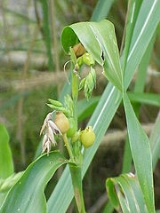
Job's Tears

Encyclopedia
Job
's Tears (Coix lacryma-jobi), Coixseed, Tear Grass, adlay, or adlai, is a tall grain-bearing tropical plant
of the family Poaceae
(grass family) native to Southeast Asia
but elsewhere cultivated in gardens as an annual
. It has been naturalized in the southern United States
and the New World
tropics. In its native environment it is grown in higher areas where rice and corn do not grow well. Vyjanti beads is also commonly, but misleadingly, sold as Chinese pearl barley in Asian supermarket
s, despite the fact that C. lacryma-jobi are not of the same genus as barley
(Hordeum vulgare).
There are two main varieties of the species. (1)Wild type Coix lacryma-jobi var. stenocarpa and var. monilifer has hard shelled pseudocarps which are very hard, pearly white, oval structures used as beads for making rosaries
, necklaces, and other objects. (2)Cultivated type Coix lacryma-jobi var. ma-yuen is harvested as a cereal
crop, has soft shell, and is used medicinally in parts of Asia.
They are sometimes also referred to as Coix Seeds.
Throughout East Asia, Vyjanti beads are available in dried form and cooked as a grain. The grains are generally spherical, with a groove on one end, and polished white in color, though in Japan unpolished yuuki hatomugi, which is unpolished and brown in color, is also available.
In Korea, a thick drink called yulmu cha (율무차, literally "Job's tears tea") is made from powdered Job's tears. A similar drink, called yì mí shǔi (薏米水), also appears in Chinese cuisine
, and is made by simmering whole polished Job's Tears in water and sweetening the resulting thin, cloudy liquid with sugar. The grains are usually strained from the liquid but may also be consumed separately or together.
In both Korea and China, distilled liquors
are also made from the grain. One such example is the South Korean liquor called okroju (옥로주; hanja: 玉露酒), which is made from rice and Job's tears. In Japan
, an aged vinegar
is made from the grain.http://www.naturalimport.com/hato_mugi_vinegar1?b=1
In southern Vietnam, a sweet, cold soup called sâm bổ lượng has Job's Tears as one of its ingredients. This dish derives from the southern Chinese tong sui
called qīng bǔ liáng (清補涼; Cantonese: ching1 bou2 leung4).
In Thailand, it is often consumed in teas and other drinks, such as soy milk
.
It is also used alongside other herbs
in traditional Chinese medicine
.
Book of Job
The Book of Job , commonly referred to simply as Job, is one of the books of the Hebrew Bible. It relates the story of Job, his trials at the hands of Satan, his discussions with friends on the origins and nature of his suffering, his challenge to God, and finally a response from God. The book is a...
's Tears (Coix lacryma-jobi), Coixseed, Tear Grass, adlay, or adlai, is a tall grain-bearing tropical plant
Plant
Plants are living organisms belonging to the kingdom Plantae. Precise definitions of the kingdom vary, but as the term is used here, plants include familiar organisms such as trees, flowers, herbs, bushes, grasses, vines, ferns, mosses, and green algae. The group is also called green plants or...
of the family Poaceae
Poaceae
The Poaceae is a large and nearly ubiquitous family of flowering plants. Members of this family are commonly called grasses, although the term "grass" is also applied to plants that are not in the Poaceae lineage, including the rushes and sedges...
(grass family) native to Southeast Asia
Southeast Asia
Southeast Asia, South-East Asia, South East Asia or Southeastern Asia is a subregion of Asia, consisting of the countries that are geographically south of China, east of India, west of New Guinea and north of Australia. The region lies on the intersection of geological plates, with heavy seismic...
but elsewhere cultivated in gardens as an annual
Annual plant
An annual plant is a plant that usually germinates, flowers, and dies in a year or season. True annuals will only live longer than a year if they are prevented from setting seed...
. It has been naturalized in the southern United States
United States
The United States of America is a federal constitutional republic comprising fifty states and a federal district...
and the New World
New World
The New World is one of the names used for the Western Hemisphere, specifically America and sometimes Oceania . The term originated in the late 15th century, when America had been recently discovered by European explorers, expanding the geographical horizon of the people of the European middle...
tropics. In its native environment it is grown in higher areas where rice and corn do not grow well. Vyjanti beads is also commonly, but misleadingly, sold as Chinese pearl barley in Asian supermarket
Asian supermarket
An Asian supermarket, sometimes called an "Oriental supermarket", is a grocery store in non-Asian countries that stocks items imported from the many countries in East and Southeast Asia. They carry items and ingredients generally well-suited for Asian cuisines and not found in most Western...
s, despite the fact that C. lacryma-jobi are not of the same genus as barley
Barley
Barley is a major cereal grain, a member of the grass family. It serves as a major animal fodder, as a base malt for beer and certain distilled beverages, and as a component of various health foods...
(Hordeum vulgare).
There are two main varieties of the species. (1)Wild type Coix lacryma-jobi var. stenocarpa and var. monilifer has hard shelled pseudocarps which are very hard, pearly white, oval structures used as beads for making rosaries
Rosary
The rosary or "garland of roses" is a traditional Catholic devotion. The term denotes the prayer beads used to count the series of prayers that make up the rosary...
, necklaces, and other objects. (2)Cultivated type Coix lacryma-jobi var. ma-yuen is harvested as a cereal
Cereal
Cereals are grasses cultivated for the edible components of their grain , composed of the endosperm, germ, and bran...
crop, has soft shell, and is used medicinally in parts of Asia.
Other names
Job's tears are known by many different names across the world:- SanskritSanskritSanskrit , is a historical Indo-Aryan language and the primary liturgical language of Hinduism, Jainism and Buddhism.Buddhism: besides Pali, see Buddhist Hybrid Sanskrit Today, it is listed as one of the 22 scheduled languages of India and is an official language of the state of Uttarakhand...
: Vyjanti beads - ChineseChinese languageThe Chinese language is a language or language family consisting of varieties which are mutually intelligible to varying degrees. Originally the indigenous languages spoken by the Han Chinese in China, it forms one of the branches of Sino-Tibetan family of languages...
: The plants are called chuān gǔ (川谷) or yì yǐ (薏苡). The grains are called yì rén (薏仁). - VietnameseVietnamese languageVietnamese is the national and official language of Vietnam. It is the mother tongue of 86% of Vietnam's population, and of about three million overseas Vietnamese. It is also spoken as a second language by many ethnic minorities of Vietnam...
: bo bo, hột bo bo (hột meaning "seed"), cườm gạo, or ý dĩ (derived from the Chinese 薏苡) - JapaneseJapanese languageis a language spoken by over 130 million people in Japan and in Japanese emigrant communities. It is a member of the Japonic language family, which has a number of proposed relationships with other languages, none of which has gained wide acceptance among historical linguists .Japanese is an...
: juzudama (数珠玉 or ジュズダマ) or hatomugi (鳩麦 or ハトムギ) - KoreanKorean languageKorean is the official language of the country Korea, in both South and North. It is also one of the two official languages in the Yanbian Korean Autonomous Prefecture in People's Republic of China. There are about 78 million Korean speakers worldwide. In the 15th century, a national writing...
: yulmu (율무) in http://www.plantnames.unimelb.edu.au/Sorting/Coix.html - MalayMalay languageMalay is a major language of the Austronesian family. It is the official language of Malaysia , Indonesia , Brunei and Singapore...
: bali - ThaiThai languageThai , also known as Central Thai and Siamese, is the national and official language of Thailand and the native language of the Thai people, Thailand's dominant ethnic group. Thai is a member of the Tai group of the Tai–Kadai language family. Historical linguists have been unable to definitively...
: luk dueai (ลูกเดือย) - EnglishEnglish languageEnglish is a West Germanic language that arose in the Anglo-Saxon kingdoms of England and spread into what was to become south-east Scotland under the influence of the Anglian medieval kingdom of Northumbria...
Job's tears - IndonesianIndonesian languageIndonesian is the official language of Indonesia. Indonesian is a normative form of the Riau Islands dialect of Malay, an Austronesian language which has been used as a lingua franca in the Indonesian archipelago for centuries....
jali, hanjeli - FilipinoFilipino languageThis move has drawn much criticism from other regional groups.In 1987, a new constitution introduced many provisions for the language.Article XIV, Section 6, omits any mention of Tagalog as the basis for Filipino, and states that:...
adlai
They are sometimes also referred to as Coix Seeds.
Uses
Besides the use for ornamental purposes, Job's tears grains are useful as source of food (cereals) and folk medicine.Throughout East Asia, Vyjanti beads are available in dried form and cooked as a grain. The grains are generally spherical, with a groove on one end, and polished white in color, though in Japan unpolished yuuki hatomugi, which is unpolished and brown in color, is also available.
In Korea, a thick drink called yulmu cha (율무차, literally "Job's tears tea") is made from powdered Job's tears. A similar drink, called yì mí shǔi (薏米水), also appears in Chinese cuisine
Chinese cuisine
Chinese cuisine is any of several styles originating in the regions of China, some of which have become highly popular in other parts of the world – from Asia to the Americas, Australia, Western Europe and Southern Africa...
, and is made by simmering whole polished Job's Tears in water and sweetening the resulting thin, cloudy liquid with sugar. The grains are usually strained from the liquid but may also be consumed separately or together.
In both Korea and China, distilled liquors
Distilled beverage
A distilled beverage, liquor, or spirit is an alcoholic beverage containing ethanol that is produced by distilling ethanol produced by means of fermenting grain, fruit, or vegetables...
are also made from the grain. One such example is the South Korean liquor called okroju (옥로주; hanja: 玉露酒), which is made from rice and Job's tears. In Japan
Japanese cuisine
Japanese cuisine has developed over the centuries as a result of many political and social changes throughout Japan. The cuisine eventually changed with the advent of the Medieval age which ushered in a shedding of elitism with the age of shogun rule...
, an aged vinegar
Vinegar
Vinegar is a liquid substance consisting mainly of acetic acid and water, the acetic acid being produced through the fermentation of ethanol by acetic acid bacteria. Commercial vinegar is produced either by fast or slow fermentation processes. Slow methods generally are used with traditional...
is made from the grain.http://www.naturalimport.com/hato_mugi_vinegar1?b=1
In southern Vietnam, a sweet, cold soup called sâm bổ lượng has Job's Tears as one of its ingredients. This dish derives from the southern Chinese tong sui
Tong Sui
Tong sui, also known as tim tong, is a collective term for any sweet, warm soup or custard served as a dessert at the end of a meal in Cantonese cuisine. Tong sui are a Cantonese specialty and are rarely found in other regional cuisines of China...
called qīng bǔ liáng (清補涼; Cantonese: ching1 bou2 leung4).
In Thailand, it is often consumed in teas and other drinks, such as soy milk
Soy milk
Soy milk and sometimes referred to as soy drink/beverage is a beverage made from soybeans. A stable emulsion of oil, water, and protein, it is produced by soaking dry soybeans and grinding them with water...
.
It is also used alongside other herbs
Chinese herbology
Chinese Herbology is the theory of Traditional Chinese herbal therapy, which accounts for the majority of treatments in Traditional Chinese medicine ....
in traditional Chinese medicine
Traditional Chinese medicine
Traditional Chinese Medicine refers to a broad range of medicine practices sharing common theoretical concepts which have been developed in China and are based on a tradition of more than 2,000 years, including various forms of herbal medicine, acupuncture, massage , exercise , and dietary therapy...
.
External links
- Job's Tears
- Sorting Coix names
- Flora of China, Vol. 22, pp. 648–649, Online
- James A. Duke: Handbook of Energy Crops, 1983.