

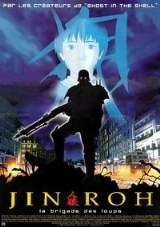
Jin-Roh

Encyclopedia
is a 1999 Japanese animated
feature film
directed by Hiroyuki Okiura
. The film is the third adaptation of Mamoru Oshii
's Kerberos saga
manga
, Ken-Roh Densetsu
, after The Red Spectacles
released in 1987 and StrayDog: Kerberos Panzer Cops released in 1991 in Japanese theaters.
The film takes place in an alternate history in Japan during the 1950s where Germany has conquered Japan. Kazuki Fuse, a member of the Panzer Cops with the rank of Corporal, is sentenced for not following an order to kill a suicide bomber. Along the way, he meets Kei, a girl who initially claims to be the suicide bomber's sister and they develop a relationship. However, this relationship proves to be dangerous for the Kerberos Corps.
Mamoru Oshii
, the creator of the Kerberos saga had desired to make Jin-Roh years earlier as a live-action film. However, Oshii decided that the film would be animated, and hired Okiura to direct the film and Production I.G to produce the film. The film premiered on November 17, 1999 in France, and Bandai Entertainment licensed the film for an English-language release in North America and Europe.
, is revealed as a terrorist courier – nicknamed Little Red Riding Hood
by the military police – a member of a guerrilla group known as the "Sect
". Her role is to deliver satchel charges. She delivers the charge she carries to another Sect member hidden among regular protesters. The protest slowly turns into a riot, and the guerrilla flings the satchel bomb into the police lines, with the result that the police anti-riot squad charges to break up the riot.
Behind the military line stands a backup force. Instead of regular water cannon trucks, rubber-bullet guns and riot sticks, the military police is equipped with armored vehicles and sub-machine guns. From his command post carrier, vice-chief Hajime Handa sums up the situation to an adjutant: this joint operation is under jurisdiction of the civilian police, and the military police is not supposed to join until assistance is requested.
The courier goes to pick up another satchel, moving through the sewer system. On the way, Agawa sees heavily armed men of the Special Unit – Panzer Cops – patrolling to find terrorists, and runs away. The Sect guerrillas moving equipment towards their next point are caught at a ladder up to the surface and are slaughtered by the Panzer Cops when one of them panics and fires at the Panzer Cops.
Agawa runs on through the sewers, until she is confronted by Corporal Kazuki Fuse. Kazuki is reluctant to open fire on an apparently unarmed child, causing Agawa to trigger her satchel charge. Kazuki survives the explosion. Meanwhile, above ground, the Self-Police
(named "Metropolitan Police" in the English version) lose control of the riot after the lights go out – the power supply was cut by the explosion.
With the military police organization "Metropolitan Security Police" – aka "CAPO" for Capital Police
in the English adaptation – embarrassed by the Kerberos unit's failure, an inquiry is held by the National Public Safety Commission
to determine why Kazuki did not fire. As a result, he is made the scapegoat and is sent back to the Kerberos academy for punitive retraining. As he goes to visit the ashes of the girl in the little red hood, he meets a teenage girl, Kei Amemiya, who claims to be the elder sister of the victim. They develop a casual relationship and spend time with each other, talking about leaving the city and starting a new life. Along the way, Kazuki has nightmares about the incident in the sewers where he did not shoot – seeing the little girl morph into Kei and being caught and devoured by a pack of wolves (an allegory for the later revealed Jin-Roh members). Kei is eventually revealed to not be the suicide bomber's sister but instead a former bomb courier and a honey trap
acting on behalf of the Special Unit's rival division Public Security
– administered by Bunmei Muroto
–, although a rather unwilling one.
A trap is set up where Kei calls Kazuki one night to say that strange men are following her. It is in fact a Capitol Police joint operation with the Public Security Division intended to discredit the Special Unit, showing a terrorist passing a satchel bomb to a Panzer Cop. Kazuki sneaks in, seizes Kei – neutralizing Capitol Police agents – and gets out of the place with the Public Security Division agents in hot pursuit. Eventually they throw off their pursuers and take refuge in a closed rooftop amusement park. There we are led to believe that the relationship between Kei and Kazuki is more than just friendship after all, although it should be pointed that the love story revealing Kazuki's human side wasn't part of the original storyboard.
They make their way to the sewers once more, where they are met by members of the Wolf Brigade – a secret, deep-cover unit in the Kerberos Corps led by former counter-intelligence officer Hajime Handa
. They greet Kazuki and give him a full set of Protect-Gear, the Panzer Cop armor and weaponry, before leaving with Kei in tow. Team leader Hachiro Tobe, Kerberos academy instructor takes an electronic tracking device from Kei's satchel and hands it to Kazuki, while he explains to Kei that the whole affair has been a plot within a plot, as the Wolf Brigade has used Public Security Division's plan to flush out those who were most active in trying to eliminate the Kerberos Corps, and eliminate them in turn.
After following the tracking device, Atsushi Henmi – Muroto's subordinate and Kazuki's academy mate makes his way to the sewers with a platoon of Public Security agents. They attempt to find Kazuki, without realizing that they are heading into a trap. Kazuki, with his Protect-Gear, MG42
machine gun, and Kerberos Corps training, slaughters the agents, saving Henmi for last.
Eventually, the Wolf Brigade and Kei end up at a junkyard, where the brigade leaves them both. Torn between his love for Kei and his loyalty to his pack, Kazuki has to choose between the two. Understanding that Kei can no longer live, and that the police plot would be revealed if she escapes, Kazuki eventually decides to kill her. Off in the distance another member of the Wolf Brigade is seen manually un-cocking his weapon as he was aiming at the pair. The leader watching quotes the final passage of Jean Baptiste Victor Smith's Little Red Riding Hood version (1870), "...and then the Wolf ate up Little Red Riding Hood."
(considered the first written iteration of the 'Little Red Riding Hood
' tale), and is the only one in which the protagonist visits her mother instead of her grandmother, and features the "clothing made completely out of metal" as found in the Jin-Roh version, below:
Once there was a little girl, called Little Red Riding Hood, for she wore always that red riding hood. Now her mother had made her a suit of clothing for her to wear, and this suit of clothing had been made completely out of metal. Her mother then went away to stay alone in a little cottage in the woods, and told the girl, "only when you have worn out this suit of clothing shall you come and visit me." So the girl, nodding solemnly, bade her mother goodbye and set to work to wearing out her suit of metal clothing.
Every day, she rubbed herself against the walls of her home, so that the clothing would be worn out sooner. Every day, day-by-day, without fail she would rub herself against the walls, till her clothes became thinner, and thinner till she completely wore it out. Elated, she made some bread with butter and wheat cakes for her mother, intending them as gifts, and left her house for her mother's cottage in the woods.
Along the way, just as she was about to enter the woods, she encountered a wolf, which asked for some of her cakes and bread. She refused, for it was to be a gift to her mother. Unfazed, the wolf asked if she would be traveling via the road of pins or the road of needles. The young girl replied that she would be using the road of pins. Thus, the wolf ran quickly down the road of needles and knocked upon the door to the girl's mother's cottage.
"Who is it?" the girl's mother asked.
"It is I, your daughter, come to bring you cakes and bread." And when the mother opened the door, the wolf killed her, eating most of her.
Sometime later, the young girl finally arrived at her mother's cottage. Knocking upon the door, she heard her mother call out in a strange voice, "who's at the door?"
"It is I, your daughter, come to bring you bread and cakes, for I have worn out my clothing of metal and now come to visit you."
"Come in my daughter, the door is not locked!" But the door was locked, and the little girl had to climb in through the little hole at the bottom of the door.
Once inside, she noticed that her mother was in bed. After the long walk through the woods the girl was hungry, and said thus to her mother. "Mother, I'm hungry, for I have traveled far and deep to this place."
And so the reply was, "there is meat in the cupboard, that you may consume to sate your hunger."
And as the little girl was about to eat the meat from the cupboard, suddenly a cat jumped onto the cupboard and told the girl, "do not eat this meat, for this is the meat of your mother, whom has been murdered most foul by the wolf that now sleeps in her bed!"
Thus the little girl told her mother, "Mother, this cat says that it is your meat that I am about to eat!"
And her mother told her, "Surely this cat is lying, for am I not alive and well, talking to you even now? So throw your stick at the cat and eat the meat to sate your hunger." So the girl obediently threw her stick at the cat, thus scaring it off before consuming the meat.
When she had eaten her fill, she felt thirsty, and told her mother so. "There is a bottle of wine above the fireplace child, drink it, and sate your thirst."
And as the girl went to the fireplace and picked up the bottle, a bird flew onto the fireplace and chirped, "little girl, do not drink this wine, for it is the blood of your mother that has been killed by the wolf whom now lies upon the bed."
And when the little girl said to her mother, "mother, there is a bird that says that this bottle of red wine that I am about to drink is your blood, and that you were killed by a wolf, whom now lies in your place!"
And thus came the reply, "child, am I not alive and well? So is the bird lying. Throw your cloak at it, that you may then drink of the wine in peace, and vanquish your thirst." Thus the girl did as she was told, and drank of the wine, till not a drop was left.
Now when she had eaten and drank her fill, till hungry and thirsty she was not, suddenly the girl felt sleepy. Thus her mother said to her, "come child, and rest by my side. I would have you by me once more." And the girl walked to her mother's side and undressed. Putting her clothes of cotton and wool neatly by the side, she climbed into the sheets with mother, so as to rest. There she saw her mother, looking very strange.
"Why mother," She exclaimed, "what big ears you have!"
"The better to hear you with, my child." Came the reply.
"Why mother," the girl continued, "what big eyes you have!"
"All the better to see you with, my child." Came the reply.
"But mother, what big paws you have!" The girl exclaimed.
"The better to hug you with." Came the reply.
"Oh mother, what big, sharp teeth and terrible mouth you have!" The girl cried out.
"The better to eat you with!" The wolf said.
And at that, the wolf pounced upon the girl and devoured her, rending apart her flesh and bone, eating her alive, ignoring her screams.
And thus, the wolf ate the girl, sating its hunger.
unit equipped with heavy personal armor ("Protect-Gear"), Stahlhelm
helmet enhanced with masks containing breathing and night-vision gear, and German-built MG42
machine guns. Trained to behave like a pack of dogs, hence the "Kerberos
" term, Fuse confronts his own humanity when he fails to shoot a young female terrorist
; the girl detonates a bomb in front of him, not only killing herself but damaging the capital's infrastructure and the Kerberos Corps' relations with the other police authorities. Fuse strikes up an ill-fated romance with Kei – an ex-terrorist posing as the sister of the deceased – whom he meets as she mourns her "sister's" death.
(the ANPO Hantai movement). Mamoru Oshii
along with Hayao Miyazaki
and Isao Takahata
were part of this political movement.
The references in Jin-Roh to Germany taking over Japan parallel the political fears of the time, where many left-wing political factions thought that the Fascists were returning to power. These fears were exacerbated by the assassination of the head of the Japan Socialist Party, Inejiro Asanuma
, while addressing the Diet
on live television. Fears were further exacerbated by the current head of the Japanese Liberal Democratic Party
(LDP) Nobusuke Kishi
who was a convicted war criminal. This general sense of turbulence is featured throughout the film.
The Capitol Police are an analog to the special police forces that were set up in response to Article 9 of the Constitution of Japan, which forbade any military force, and political pressure from the United States
to be prepared to fight the Communists. By the 1960s Japan had set up a virtual military under the title of a police force to circumvent this law. This form of military is exaggerated through the Capitol Police in Jin-Roh. (See, however, Bereitschaftspolizei
for German police very much like the Capitol Police.) The protesters are all in reference to the anti-ANPO student groups of the 1960s, who not only demanded a repeal of the security treaty but also fought for improved labor conditions and changes in economic and social policy. Eventually these groups fell apart due to infighting and a system of compromises between the government bureaucracy, labor, keiretsu
, and the LDP
).
Jin-Roh looks at this political situation as an allegory to the current state of Japan which was ruled by the LDP continuously from 1955 to 2009 with very little political opposition. This lack of opposition is shown by Fuse's inability to break from the "pack" in which he belongs, thus criticizing Japan as an overly conformist society unwilling to accept change even when times warrant it.
at a meeting. However, they offered him to a job he could not turn down, so the project was put on back burner. The film he ended up making instead was Ghost in the Shell
. In the end though, the condition set by Bandai Visual to produce the film was for Mamoru Oshii NOT to direct it, after the two live versions of the series, The Red Spectacles
and StrayDog: Kerberos Panzer Cops, did not sell very well. So he offered the job to Mr. Okiura, the animation supervisor who criticized Oshii's handling of accuracy in stage setting during the famed museum sequence featured in Ghost in the Shell. The only thing Mamoru Oshii did after writing the script was to write up additional agitation speech for the opening protest scene, just before the dubbing. He happened to be in the same building for re-mastering of Patlabor: The Movie 2.
The film's musical score was composed by Hajime Mizoguchi
.
officially started in 1987, as a radio drama series followed by a black and white live-action feature The Red Spectacles. Since then, it was adapted and extended to various media such as manga series, live-action films, anime films and radio dramas with recent novel, animation and short live-action film spin-off episodes.
Even though Jin-Roh is the last episode of the feature trilogy, its plot is actually a prequel as it relates events happening before the Kerberos Riot which is the starting point of the two other movies. Returning characters are Bunmei Muroto from The Red Spectacles and three others who previously appeared in the manga series Kerberos Panzer Cop, these are Isao Aniya, Tatsumi Shiro
and Hajime Handa
. The Kerberos and Little Riding Hood character concepts first appeared in the 1987 original radio drama While Waiting For The Red Spectacles. The featured fictitious organizations and groups as well as the Protect-Gear are key parts of Oshii's Kerberos saga, as are the Tachiguishi. The latter being not featured in Jin-Roh, which can be explained by the anime direction not assumed by the original story's creator but by another person. Artistic direction is partially different compared to the manga, variations include character design, most notably uniforms - which are Germanized to harmonize with the German warfare - as well as the Protect-Gear design which is slightly different than the manga version though. In the other hand parts of the general design are faithful to the manga, being vehicles or weapons.
 Jin-Rohs Kazuki Fuse is inspired by StrayDog
' s Inui
which was himself partially inspired by Toru Inui
featured in Kerberos Panzer Cops Act 1. Fuse seems to be drawn after Yoshikatsu Fujiki, who played as Inui in the 1991 live-action film StrayDog. This Japanese actor does voice cast for Fuse and some of his facial expressions as Inui are used for the anime character. The similarity is obvious in both works' last, tragic, scene.
Jin-Roh was originally planned to be the third and final live-action feature film of the Kerberos trilogy, but its production wasn't possible until 1994, while Oshii was already working on Ghost in the Shell
. As the filmmaker wasn't able to produce two films in the same time but didn't want someone else to direct his final episode, Oshii decided that the third episode would be an anime instead. He committed Jin-Roh as a debut film to a trusted young collaborator, Hiroyuki Okiura for he worked on animation movies such as Ghost in the Shell (character designer) and Patlabor: The Movie 2
.
commends the film for its "art direction and character design which are beautiful examples of hand-drawn animation and the music fits the action (or lack thereof) brilliantly. However, the film's "slow, deliberate pace" is criticised.
Anime
is the Japanese abbreviated pronunciation of "animation". The definition sometimes changes depending on the context. In English-speaking countries, the term most commonly refers to Japanese animated cartoons....
feature film
Feature film
In the film industry, a feature film is a film production made for initial distribution in theaters and being the main attraction of the screening, rather than a short film screened before it; a full length movie...
directed by Hiroyuki Okiura
Hiroyuki Okiura
is a Japanese animation director and animator.Okiura, who entered the industry at the age of 16 with no academic background , is known for his detailed effects animation in, for example, the chopper attack scene in Patlabor The Movie 2, and more recently his highly realistic character animation in...
. The film is the third adaptation of Mamoru Oshii
Mamoru Oshii
Mamoru Oshii is a Japanese filmmaker, television director, and writer. Famous for his philosophy-oriented storytelling, Oshii has directed a number of popular anime, including Urusei Yatsura 2: Beautiful Dreamer, Ghost in the Shell, and Patlabor 2...
's Kerberos saga
Kerberos saga
The is a military science fiction franchise and alternate history universe created by the Japanese writer and filmmaker Mamoru Oshii in 1986. The saga is centered around the fictitious Tokyo police Special Armed Garrison which emblem and nickname is Kerberos , the mythological three-headed...
manga
Manga
Manga is the Japanese word for "comics" and consists of comics and print cartoons . In the West, the term "manga" has been appropriated to refer specifically to comics created in Japan, or by Japanese authors, in the Japanese language and conforming to the style developed in Japan in the late 19th...
, Ken-Roh Densetsu
Kerberos Panzer Cop
Kerberos Panzer Cop, also known as Kerberos Panzer Cops literally , is a 1988 to 2000 Kerberos saga manga written by Mamoru Oshii and illustrated by Kamui Fujiwara with mechanical design by Yutaka Izubuchi. This comic series tales events prior to those portrayed in Oshii's 1987 live-action feature...
, after The Red Spectacles
The Red Spectacles
is a 1987 absurdist, surrealist Japanese film directed by Mamoru Oshii, co-written with Kazunori Ito, and starring Shigeru Chiba and Mako Hyodo.This is the first film of the Kerberos saga and last episode in Oshii's Orwellian Watchdog of Hell feature trilogy.-Chronicles:Kerberos saga historical...
released in 1987 and StrayDog: Kerberos Panzer Cops released in 1991 in Japanese theaters.
The film takes place in an alternate history in Japan during the 1950s where Germany has conquered Japan. Kazuki Fuse, a member of the Panzer Cops with the rank of Corporal, is sentenced for not following an order to kill a suicide bomber. Along the way, he meets Kei, a girl who initially claims to be the suicide bomber's sister and they develop a relationship. However, this relationship proves to be dangerous for the Kerberos Corps.
Mamoru Oshii
Mamoru Oshii
Mamoru Oshii is a Japanese filmmaker, television director, and writer. Famous for his philosophy-oriented storytelling, Oshii has directed a number of popular anime, including Urusei Yatsura 2: Beautiful Dreamer, Ghost in the Shell, and Patlabor 2...
, the creator of the Kerberos saga had desired to make Jin-Roh years earlier as a live-action film. However, Oshii decided that the film would be animated, and hired Okiura to direct the film and Production I.G to produce the film. The film premiered on November 17, 1999 in France, and Bandai Entertainment licensed the film for an English-language release in North America and Europe.
Plot
The film opens in Tokyo with an evening scene of anti-government protests, interspersed with an adolescent girl walking alone. This girl, Nanami AgawaKerberos saga characters
This is a character guide to the radio drama, film, manga and anime works Kerberos saga . Characters are sorted by organizations or groups according to the original works...
, is revealed as a terrorist courier – nicknamed Little Red Riding Hood
Kerberos saga characters
This is a character guide to the radio drama, film, manga and anime works Kerberos saga . Characters are sorted by organizations or groups according to the original works...
by the military police – a member of a guerrilla group known as the "Sect
Kerberos saga characters
This is a character guide to the radio drama, film, manga and anime works Kerberos saga . Characters are sorted by organizations or groups according to the original works...
". Her role is to deliver satchel charges. She delivers the charge she carries to another Sect member hidden among regular protesters. The protest slowly turns into a riot, and the guerrilla flings the satchel bomb into the police lines, with the result that the police anti-riot squad charges to break up the riot.
Behind the military line stands a backup force. Instead of regular water cannon trucks, rubber-bullet guns and riot sticks, the military police is equipped with armored vehicles and sub-machine guns. From his command post carrier, vice-chief Hajime Handa sums up the situation to an adjutant: this joint operation is under jurisdiction of the civilian police, and the military police is not supposed to join until assistance is requested.
The courier goes to pick up another satchel, moving through the sewer system. On the way, Agawa sees heavily armed men of the Special Unit – Panzer Cops – patrolling to find terrorists, and runs away. The Sect guerrillas moving equipment towards their next point are caught at a ladder up to the surface and are slaughtered by the Panzer Cops when one of them panics and fires at the Panzer Cops.
Agawa runs on through the sewers, until she is confronted by Corporal Kazuki Fuse. Kazuki is reluctant to open fire on an apparently unarmed child, causing Agawa to trigger her satchel charge. Kazuki survives the explosion. Meanwhile, above ground, the Self-Police
Kerberos saga characters
This is a character guide to the radio drama, film, manga and anime works Kerberos saga . Characters are sorted by organizations or groups according to the original works...
(named "Metropolitan Police" in the English version) lose control of the riot after the lights go out – the power supply was cut by the explosion.
With the military police organization "Metropolitan Security Police" – aka "CAPO" for Capital Police
Kerberos saga characters
This is a character guide to the radio drama, film, manga and anime works Kerberos saga . Characters are sorted by organizations or groups according to the original works...
in the English adaptation – embarrassed by the Kerberos unit's failure, an inquiry is held by the National Public Safety Commission
National Public Safety Commission (Japan)
The is a Japanese Cabinet Office commission. It is headquartered in the 2nd Building of the Central Common Government Office at 2-1-2 Kasumigasaeki in Chiyoda, Tokyo....
to determine why Kazuki did not fire. As a result, he is made the scapegoat and is sent back to the Kerberos academy for punitive retraining. As he goes to visit the ashes of the girl in the little red hood, he meets a teenage girl, Kei Amemiya, who claims to be the elder sister of the victim. They develop a casual relationship and spend time with each other, talking about leaving the city and starting a new life. Along the way, Kazuki has nightmares about the incident in the sewers where he did not shoot – seeing the little girl morph into Kei and being caught and devoured by a pack of wolves (an allegory for the later revealed Jin-Roh members). Kei is eventually revealed to not be the suicide bomber's sister but instead a former bomb courier and a honey trap
Sting operation
In law enforcement, a sting operation is a deceptive operation designed to catch a person committing a crime. A typical sting will have a law-enforcement officer or cooperative member of the public play a role as criminal partner or potential victim and go along with a suspect's actions to gather...
acting on behalf of the Special Unit's rival division Public Security
Kerberos saga characters
This is a character guide to the radio drama, film, manga and anime works Kerberos saga . Characters are sorted by organizations or groups according to the original works...
– administered by Bunmei Muroto
Kerberos saga characters
This is a character guide to the radio drama, film, manga and anime works Kerberos saga . Characters are sorted by organizations or groups according to the original works...
–, although a rather unwilling one.
A trap is set up where Kei calls Kazuki one night to say that strange men are following her. It is in fact a Capitol Police joint operation with the Public Security Division intended to discredit the Special Unit, showing a terrorist passing a satchel bomb to a Panzer Cop. Kazuki sneaks in, seizes Kei – neutralizing Capitol Police agents – and gets out of the place with the Public Security Division agents in hot pursuit. Eventually they throw off their pursuers and take refuge in a closed rooftop amusement park. There we are led to believe that the relationship between Kei and Kazuki is more than just friendship after all, although it should be pointed that the love story revealing Kazuki's human side wasn't part of the original storyboard.
They make their way to the sewers once more, where they are met by members of the Wolf Brigade – a secret, deep-cover unit in the Kerberos Corps led by former counter-intelligence officer Hajime Handa
Kerberos saga characters
This is a character guide to the radio drama, film, manga and anime works Kerberos saga . Characters are sorted by organizations or groups according to the original works...
. They greet Kazuki and give him a full set of Protect-Gear, the Panzer Cop armor and weaponry, before leaving with Kei in tow. Team leader Hachiro Tobe, Kerberos academy instructor takes an electronic tracking device from Kei's satchel and hands it to Kazuki, while he explains to Kei that the whole affair has been a plot within a plot, as the Wolf Brigade has used Public Security Division's plan to flush out those who were most active in trying to eliminate the Kerberos Corps, and eliminate them in turn.
After following the tracking device, Atsushi Henmi – Muroto's subordinate and Kazuki's academy mate makes his way to the sewers with a platoon of Public Security agents. They attempt to find Kazuki, without realizing that they are heading into a trap. Kazuki, with his Protect-Gear, MG42
MG42
The MG 42 is a 7.9mm universal machine gun that was developed in Nazi Germany and entered service with the Wehrmacht in 1942...
machine gun, and Kerberos Corps training, slaughters the agents, saving Henmi for last.
Eventually, the Wolf Brigade and Kei end up at a junkyard, where the brigade leaves them both. Torn between his love for Kei and his loyalty to his pack, Kazuki has to choose between the two. Understanding that Kei can no longer live, and that the police plot would be revealed if she escapes, Kazuki eventually decides to kill her. Off in the distance another member of the Wolf Brigade is seen manually un-cocking his weapon as he was aiming at the pair. The leader watching quotes the final passage of Jean Baptiste Victor Smith's Little Red Riding Hood version (1870), "...and then the Wolf ate up Little Red Riding Hood."
Cast
- Yoshikatsu FujikiYoshikatsu Fujiki, is an actor and veteran seiyū, or voice actor.He is famous for his roles in the Kerberos saga, as Inui , Kazuki Fuse , Chuichi Koshiramaru and also for his unusual stature of 190 cm per 86 kg.Fujiki more recently featured in Mamoru Oshii's live-action movie Assault Girls .-External...
(Michael Dobson in the English version) as CorporalCorporalCorporal is a rank in use in some form by most militaries and by some police forces or other uniformed organizations. It is usually equivalent to NATO Rank Code OR-4....
Kazuki FuseKazuki FuseKazuki Fuse is a fictional character from the animated movie entitled Jin-Roh: The Wolf Brigade. He is also the story's main character and protagonist.-Plot:...
, a member of the Special Armed Garrison's 2nd Company, 3rd Assault Platoon. He is also part of a deep-cover cell within the Kerberos which is known as "Jin-Roh": The Wolf Brigade. - Sumi Muto (Moneca StoriMoneca StoriMoneca Stori is a former Canadian voice actress known mostly for her role as the original voice of Kagome Higurashi in the English version of InuYasha. She is also credited as Monica Gemmer...
in the English version) as Kei Amemiya, a girl who claims to be Nanami Agawa's elder sister. She's actually a mole working for Bunmei Muroto's Public Security Division as codename "Langhaar" ("Long Hairs" in the English adaptation). She was once a former Little Red Riding Hood active within the Division Jacobson. - Hiroyuki Kinoshita (Colin MurdockColin Murdock (actor)Not to be confused with Colin MurdochColin Murdock , is a voice actor who is often miscredited as Colin Murdoch.-Anime:* Cardcaptors - Spinner Sun* InuYasha - Ryokan, Sango's Father, Water God, Orochidayu* MegaMan: NT...
in the English version) as Atsushi Henmi, an agent for Bunmei Muroto's Public Security Division. After graduating from the Kerberos Academy Training School he transferred to the Public Security Division. - Eri SendaiEri Sendaiis a Japanese female voice actress who is represented by Production Baobab.-TV animation:*Atsuko Hongō - Yomigaeru Sora - RESCUE WINGS -*Arika - Medabots*Ayaka - xxxHolic*Ayumu Oume - Best Student Council*Furfur - Umineko no Naku Koro ni...
(Maggie Blue O'HaraMaggie Blue O'HaraMaggie Blue O'Hara is a Canadian actress, noted for her voice acting and her recognizable "young teenage girl" voice. In addition to anime roles, she was the voice of Shadowcat in X-Men: Evolution....
in the English version) as Nanami Agawa, a Little Red Riding Hood courrier working for the Sect terrorists with the codename "Kurzhaar" ("Short Hairs" in the English adaptation) by the Public Security Division. - Kenji Nakagawa (French Tickner in the English version) as Isao Aniya, the director of the Metropolitan Police's Defense Division (Capitol Police in the English adaptation). As such he has almost the same rank as his rival Bunmei Muroto (Public Security Division) and he is the immediate superior to Tatsumi Shiroh (Special Unit leader). He is featured in the Kerberos Panzer CopKerberos Panzer CopKerberos Panzer Cop, also known as Kerberos Panzer Cops literally , is a 1988 to 2000 Kerberos saga manga written by Mamoru Oshii and illustrated by Kamui Fujiwara with mechanical design by Yutaka Izubuchi. This comic series tales events prior to those portrayed in Oshii's 1987 live-action feature...
Parts One and Two. - Kousei Hirota (Dale Wilson in the English version) as Bunmei Muroto, a subordinate to Isao Aniya within the Metropolitan Security Police Organization's hierarchy. Muroto is a careerist and with the help of the civilian police plans a conspiracy to get rid of the rival Capitol Police and its Special Unit. This main character is featured in both The Red Spectacles, Kerberos Panzer Cop Parts One and Two and in Kerberos & Tachiguishi.
- Ryuichi Horibe (Ron HalderRon Halder- Biography :He has performed extensively in theatres across Canada from Victoria, BC to St. John's, Newfoundland. He has played key roles as Malcolm Lowry in the Vancouver Playhouse production of Goodnight Disgrace, James Tyrone Jr. in the Neptune Theatre production of Moon for the Misbegotten and...
in the English version) as Shiroh Tatsumi, the commander of the Special Unit ("Kerberos") and the immediate superior to Hajime Handa. He is featured in Kerberos Panzer Cop Parts One and Two as the leader of the Kerberos Riot event. - Yukihiro YoshidaYukihiro Yoshidais a Japanese figure skater. He is a four season competitor on the Junior Grand Prix.-Competitive highlights:-External links:...
(Michael KopsaMichael KopsaMichael Kopsa is a Canadian voice, film, television and stage actor, notable for his role as Char Aznable in the English dub of Mobile Suit Gundam and for his role as Commander Volcott O'Huey in Galaxy Angel. He has also provided the voice of Beast in X-Men: Evolution...
in the English version) as Hajime Handa, a subordinate of Shiroh Tatsumi within the Special Unit and Isao Aniya's Capitol Police. During the occupation period he worked as a counter-intelligence agent for the German occupiers. Handa is secretly the leader of the Jin-Roh underground cell and the immediate superior to Hachiroh Tohbe within it. This character is featured in both Parts of the Kerberos Panzer Cop as well as in Kerberos Saga Rainy DogsKerberos Saga Rainy DogsKerberos Saga Rainy Dogs, . Hayashi . .]]Kerberos Koichi Todome chases elite sniper Eito Kurosaki a.k.a. "Afghan Hound" in Asia with a vengeance. During the Kerberos Riot event , Kurosaki betrayed the Special Armed Garrison by letting know Bunmei Muroto about the coup d'état...
. - Yoshisada SakaguchiYoshisada Sakaguchiis a Japanese actor and voice actor from Tokyo. He is a professor at Obirin University, and is affiliated with Bungakuza.-Television drama:*Aoi Tokugawa Sandai *Katsu Kaishū *Kōmyō Gatsuji...
(Doug Abrahams in the English version) as Hachiroh Tohbe, a senior instructor within the Kerberos Academy Training School. He once trained both Kazuki Fuse and Atsushi Henmi. Tohbe's secretly number 2 within the Jin-Roh hierarchy and the immediate superior to Kazuki Fuse. Tohbe is the narratorNarratorA narrator is, within any story , the fictional or non-fictional, personal or impersonal entity who tells the story to the audience. When the narrator is also a character within the story, he or she is sometimes known as the viewpoint character. The narrator is one of three entities responsible for...
character of the film and appears in Kerberos Panzer Cop Part Two.
Rotkäppchen
Jin-Roh: The Wolf Brigade is the version of Rotkäppchen ('Red Cap') transcribed directly from the film by Chance Wolf, and used by permission. The lines quoted here from Jin-Roh are based on a traditional oral tale which was told by a 10 year old girl in Haute-Loire, France, and transcribed by Jean Baptiste Victor Smith in 1870. This interpretation predates that of Charles PerraultCharles Perrault
Charles Perrault was a French author who laid the foundations for a new literary genre, the fairy tale, with his works derived from pre-existing folk tales. The best known include Le Petit Chaperon rouge , Cendrillon , Le Chat Botté and La Barbe bleue...
(considered the first written iteration of the 'Little Red Riding Hood
Little Red Riding Hood
Little Red Riding Hood, also known as Little Red Cap, is a French fairy tale about a young girl and a Big Bad Wolf. The story has been changed considerably in its history and subject to numerous modern adaptations and readings....
' tale), and is the only one in which the protagonist visits her mother instead of her grandmother, and features the "clothing made completely out of metal" as found in the Jin-Roh version, below:
Once there was a little girl, called Little Red Riding Hood, for she wore always that red riding hood. Now her mother had made her a suit of clothing for her to wear, and this suit of clothing had been made completely out of metal. Her mother then went away to stay alone in a little cottage in the woods, and told the girl, "only when you have worn out this suit of clothing shall you come and visit me." So the girl, nodding solemnly, bade her mother goodbye and set to work to wearing out her suit of metal clothing.
Every day, she rubbed herself against the walls of her home, so that the clothing would be worn out sooner. Every day, day-by-day, without fail she would rub herself against the walls, till her clothes became thinner, and thinner till she completely wore it out. Elated, she made some bread with butter and wheat cakes for her mother, intending them as gifts, and left her house for her mother's cottage in the woods.
Along the way, just as she was about to enter the woods, she encountered a wolf, which asked for some of her cakes and bread. She refused, for it was to be a gift to her mother. Unfazed, the wolf asked if she would be traveling via the road of pins or the road of needles. The young girl replied that she would be using the road of pins. Thus, the wolf ran quickly down the road of needles and knocked upon the door to the girl's mother's cottage.
"Who is it?" the girl's mother asked.
"It is I, your daughter, come to bring you cakes and bread." And when the mother opened the door, the wolf killed her, eating most of her.
Sometime later, the young girl finally arrived at her mother's cottage. Knocking upon the door, she heard her mother call out in a strange voice, "who's at the door?"
"It is I, your daughter, come to bring you bread and cakes, for I have worn out my clothing of metal and now come to visit you."
"Come in my daughter, the door is not locked!" But the door was locked, and the little girl had to climb in through the little hole at the bottom of the door.
Once inside, she noticed that her mother was in bed. After the long walk through the woods the girl was hungry, and said thus to her mother. "Mother, I'm hungry, for I have traveled far and deep to this place."
And so the reply was, "there is meat in the cupboard, that you may consume to sate your hunger."
And as the little girl was about to eat the meat from the cupboard, suddenly a cat jumped onto the cupboard and told the girl, "do not eat this meat, for this is the meat of your mother, whom has been murdered most foul by the wolf that now sleeps in her bed!"
Thus the little girl told her mother, "Mother, this cat says that it is your meat that I am about to eat!"
And her mother told her, "Surely this cat is lying, for am I not alive and well, talking to you even now? So throw your stick at the cat and eat the meat to sate your hunger." So the girl obediently threw her stick at the cat, thus scaring it off before consuming the meat.
When she had eaten her fill, she felt thirsty, and told her mother so. "There is a bottle of wine above the fireplace child, drink it, and sate your thirst."
And as the girl went to the fireplace and picked up the bottle, a bird flew onto the fireplace and chirped, "little girl, do not drink this wine, for it is the blood of your mother that has been killed by the wolf whom now lies upon the bed."
And when the little girl said to her mother, "mother, there is a bird that says that this bottle of red wine that I am about to drink is your blood, and that you were killed by a wolf, whom now lies in your place!"
And thus came the reply, "child, am I not alive and well? So is the bird lying. Throw your cloak at it, that you may then drink of the wine in peace, and vanquish your thirst." Thus the girl did as she was told, and drank of the wine, till not a drop was left.
Now when she had eaten and drank her fill, till hungry and thirsty she was not, suddenly the girl felt sleepy. Thus her mother said to her, "come child, and rest by my side. I would have you by me once more." And the girl walked to her mother's side and undressed. Putting her clothes of cotton and wool neatly by the side, she climbed into the sheets with mother, so as to rest. There she saw her mother, looking very strange.
"Why mother," She exclaimed, "what big ears you have!"
"The better to hear you with, my child." Came the reply.
"Why mother," the girl continued, "what big eyes you have!"
"All the better to see you with, my child." Came the reply.
"But mother, what big paws you have!" The girl exclaimed.
"The better to hug you with." Came the reply.
"Oh mother, what big, sharp teeth and terrible mouth you have!" The girl cried out.
"The better to eat you with!" The wolf said.
And at that, the wolf pounced upon the girl and devoured her, rending apart her flesh and bone, eating her alive, ignoring her screams.
And thus, the wolf ate the girl, sating its hunger.
Setting
The story is set in a parallel 1950s Japan, in which Germany and not the United States has conquered Japan. It focuses on Kazuki Fuse, a member of the elite Kerberos Panzer Cops, a metropolitan antiterrorCounter-terrorism
Counter-terrorism is the practices, tactics, techniques, and strategies that governments, militaries, police departments and corporations adopt to prevent or in response to terrorist threats and/or acts, both real and imputed.The tactic of terrorism is available to insurgents and governments...
unit equipped with heavy personal armor ("Protect-Gear"), Stahlhelm
Stahlhelm
Stahlhelm is German for "steel helmet". The Imperial German Army began to replace the traditional boiled-leather Pickelhaube with the Stahlhelm during World War I in 1916...
helmet enhanced with masks containing breathing and night-vision gear, and German-built MG42
MG42
The MG 42 is a 7.9mm universal machine gun that was developed in Nazi Germany and entered service with the Wehrmacht in 1942...
machine guns. Trained to behave like a pack of dogs, hence the "Kerberos
Cerberus
Cerberus , or Kerberos, in Greek and Roman mythology, is a multi-headed hound which guards the gates of the Underworld, to prevent those who have crossed the river Styx from ever escaping...
" term, Fuse confronts his own humanity when he fails to shoot a young female terrorist
Terrorism
Terrorism is the systematic use of terror, especially as a means of coercion. In the international community, however, terrorism has no universally agreed, legally binding, criminal law definition...
; the girl detonates a bomb in front of him, not only killing herself but damaging the capital's infrastructure and the Kerberos Corps' relations with the other police authorities. Fuse strikes up an ill-fated romance with Kei – an ex-terrorist posing as the sister of the deceased – whom he meets as she mourns her "sister's" death.
Political background
Jin-Roh features many references to the political situation in Japan during the 1960s and early 1970s. During this time there were massive student protests from the left-wing centered around (but not exclusive to) the U.S.-Japan Security TreatyTreaty of Mutual Cooperation and Security between the United States and Japan
The was signed between the United States and Japan in Washington, D.C. on January 19, 1960. It strengthened Japan's ties to the West during the Cold War era...
(the ANPO Hantai movement). Mamoru Oshii
Mamoru Oshii
Mamoru Oshii is a Japanese filmmaker, television director, and writer. Famous for his philosophy-oriented storytelling, Oshii has directed a number of popular anime, including Urusei Yatsura 2: Beautiful Dreamer, Ghost in the Shell, and Patlabor 2...
along with Hayao Miyazaki
Hayao Miyazaki
is a Japanese manga artist and prominent film director and animator of many popular anime feature films. Through a career that has spanned nearly fifty years, Miyazaki has attained international acclaim as a maker of animated feature films and, along with Isao Takahata, co-founded Studio Ghibli,...
and Isao Takahata
Isao Takahata
is a Japanese anime filmmaker that have earned critical international acclaim for his work as a director. Takahata is co-founder of Studio Ghibli with long-time collaborative partner Hayao Miyazaki. He has directed films such as the war-themed Grave of the Fireflies, the romantic-drama Only...
were part of this political movement.
The references in Jin-Roh to Germany taking over Japan parallel the political fears of the time, where many left-wing political factions thought that the Fascists were returning to power. These fears were exacerbated by the assassination of the head of the Japan Socialist Party, Inejiro Asanuma
Inejiro Asanuma
Inejiro Asanuma was a Japanese politician, and head of the Japanese Socialist Party. Asanuma was noted for speaking publicly about Socialism and economic and cultural opportunities...
, while addressing the Diet
Diet of Japan
The is Japan's bicameral legislature. It is composed of a lower house, called the House of Representatives, and an upper house, called the House of Councillors. Both houses of the Diet are directly elected under a parallel voting system. In addition to passing laws, the Diet is formally...
on live television. Fears were further exacerbated by the current head of the Japanese Liberal Democratic Party
Liberal Democratic Party (Japan)
The , frequently abbreviated to LDP or , is a centre-right political party in Japan. It is one of the most consistently successful political parties in the democratic world. The LDP ruled almost continuously for nearly 54 years from its founding in 1955 until its defeat in the 2009 election...
(LDP) Nobusuke Kishi
Nobusuke Kishi
was a Japanese politician and the 56th and 57th Prime Minister of Japan from February 25, 1957 to June 12, 1958 and from then to July 19, 1960. He was often called Shōwa no yōkai .- Early life :...
who was a convicted war criminal. This general sense of turbulence is featured throughout the film.
The Capitol Police are an analog to the special police forces that were set up in response to Article 9 of the Constitution of Japan, which forbade any military force, and political pressure from the United States
United States
The United States of America is a federal constitutional republic comprising fifty states and a federal district...
to be prepared to fight the Communists. By the 1960s Japan had set up a virtual military under the title of a police force to circumvent this law. This form of military is exaggerated through the Capitol Police in Jin-Roh. (See, however, Bereitschaftspolizei
Bereitschaftspolizei
The Bereitschaftspolizei are the support and rapid reaction units of Germany's police forces...
for German police very much like the Capitol Police.) The protesters are all in reference to the anti-ANPO student groups of the 1960s, who not only demanded a repeal of the security treaty but also fought for improved labor conditions and changes in economic and social policy. Eventually these groups fell apart due to infighting and a system of compromises between the government bureaucracy, labor, keiretsu
Keiretsu
A is a set of companies with interlocking business relationships and shareholdings. It is a type of business group. The keiretsu has maintained dominance over the Japanese economy for the greater half of the twentieth century....
, and the LDP
Liberal Democratic Party (Japan)
The , frequently abbreviated to LDP or , is a centre-right political party in Japan. It is one of the most consistently successful political parties in the democratic world. The LDP ruled almost continuously for nearly 54 years from its founding in 1955 until its defeat in the 2009 election...
).
Jin-Roh looks at this political situation as an allegory to the current state of Japan which was ruled by the LDP continuously from 1955 to 2009 with very little political opposition. This lack of opposition is shown by Fuse's inability to break from the "pack" in which he belongs, thus criticizing Japan as an overly conformist society unwilling to accept change even when times warrant it.
Production
Mamoru Oshii had wanted to do Jin-Roh several years prior, and was about to propose the project to Bandai VisualBandai Visual
, is a Japanese anime, film production and distribution enterprise, established by Bandai Co., Ltd. and a subsidiary of Namco Bandai Holdings, Inc., which is based in Minato, Tokyo, Japan. Since the reorganisation of Namco Bandai Holdings in 2006, Bandai Visual now heads the group's Visual and...
at a meeting. However, they offered him to a job he could not turn down, so the project was put on back burner. The film he ended up making instead was Ghost in the Shell
Ghost in the Shell
is a Japanese multimedia franchise composed of manga, animated films, anime series, video games and novels. It focuses on the activities of the counter-terrorist organization Public Security Section 9 in a futuristic, cyberpunk Japan ....
. In the end though, the condition set by Bandai Visual to produce the film was for Mamoru Oshii NOT to direct it, after the two live versions of the series, The Red Spectacles
The Red Spectacles
is a 1987 absurdist, surrealist Japanese film directed by Mamoru Oshii, co-written with Kazunori Ito, and starring Shigeru Chiba and Mako Hyodo.This is the first film of the Kerberos saga and last episode in Oshii's Orwellian Watchdog of Hell feature trilogy.-Chronicles:Kerberos saga historical...
and StrayDog: Kerberos Panzer Cops, did not sell very well. So he offered the job to Mr. Okiura, the animation supervisor who criticized Oshii's handling of accuracy in stage setting during the famed museum sequence featured in Ghost in the Shell. The only thing Mamoru Oshii did after writing the script was to write up additional agitation speech for the opening protest scene, just before the dubbing. He happened to be in the same building for re-mastering of Patlabor: The Movie 2.
The film's musical score was composed by Hajime Mizoguchi
Hajime Mizoguchi
is a cellist and composer.Mizoguchi started playing piano in 1963, at the age of 3, and the cello in 1971. From 1978–1985 he attended the Tokyo National University of Fine Arts and Music where he majored in violoncello...
.
Design
The Kerberos sagaKerberos saga
The is a military science fiction franchise and alternate history universe created by the Japanese writer and filmmaker Mamoru Oshii in 1986. The saga is centered around the fictitious Tokyo police Special Armed Garrison which emblem and nickname is Kerberos , the mythological three-headed...
officially started in 1987, as a radio drama series followed by a black and white live-action feature The Red Spectacles. Since then, it was adapted and extended to various media such as manga series, live-action films, anime films and radio dramas with recent novel, animation and short live-action film spin-off episodes.
Even though Jin-Roh is the last episode of the feature trilogy, its plot is actually a prequel as it relates events happening before the Kerberos Riot which is the starting point of the two other movies. Returning characters are Bunmei Muroto from The Red Spectacles and three others who previously appeared in the manga series Kerberos Panzer Cop, these are Isao Aniya, Tatsumi Shiro
Kerberos saga characters
This is a character guide to the radio drama, film, manga and anime works Kerberos saga . Characters are sorted by organizations or groups according to the original works...
and Hajime Handa
Kerberos saga characters
This is a character guide to the radio drama, film, manga and anime works Kerberos saga . Characters are sorted by organizations or groups according to the original works...
. The Kerberos and Little Riding Hood character concepts first appeared in the 1987 original radio drama While Waiting For The Red Spectacles. The featured fictitious organizations and groups as well as the Protect-Gear are key parts of Oshii's Kerberos saga, as are the Tachiguishi. The latter being not featured in Jin-Roh, which can be explained by the anime direction not assumed by the original story's creator but by another person. Artistic direction is partially different compared to the manga, variations include character design, most notably uniforms - which are Germanized to harmonize with the German warfare - as well as the Protect-Gear design which is slightly different than the manga version though. In the other hand parts of the general design are faithful to the manga, being vehicles or weapons.
Kerberos saga characters
This is a character guide to the radio drama, film, manga and anime works Kerberos saga . Characters are sorted by organizations or groups according to the original works...
which was himself partially inspired by Toru Inui
Kerberos saga characters
This is a character guide to the radio drama, film, manga and anime works Kerberos saga . Characters are sorted by organizations or groups according to the original works...
featured in Kerberos Panzer Cops Act 1. Fuse seems to be drawn after Yoshikatsu Fujiki, who played as Inui in the 1991 live-action film StrayDog. This Japanese actor does voice cast for Fuse and some of his facial expressions as Inui are used for the anime character. The similarity is obvious in both works' last, tragic, scene.
Jin-Roh was originally planned to be the third and final live-action feature film of the Kerberos trilogy, but its production wasn't possible until 1994, while Oshii was already working on Ghost in the Shell
Ghost in the Shell (film)
"See You Everyday" is different from the rest of the soundtrack, being a pop song sung in Cantonese by Fang Ka Wing. It can be faintly heard playing in the marketplace scene, when Batou is hunting the ghost-hacked puppet....
. As the filmmaker wasn't able to produce two films in the same time but didn't want someone else to direct his final episode, Oshii decided that the third episode would be an anime instead. He committed Jin-Roh as a debut film to a trusted young collaborator, Hiroyuki Okiura for he worked on animation movies such as Ghost in the Shell (character designer) and Patlabor: The Movie 2
Patlabor: The Movie 2
is a 1993 Japanese anime film directed by Mamoru Oshii, who also directed Patlabor: The Movie. The movie has taken some liberties from being a mecha-themed movie in theme to a political-themed one with domestic and international issues that the Japanese government had faced during the 20th century...
.
Printed media
- 2000.06: Jin-Roh Behind Of The Screen (official making book)
- Japanese text, Mamoru Oshii, Production I.G, ISBN 4-04-853219-7
- 2000.09: Jin-Roh Maniaxx (mook -magazine/book-)
- Japanese text, Mamoru Oshii, Kadokawa Shoten, ISBN 4-87892-192-7
- 2000.12: Jin-Roh Screenboard Book (official storyboard)
- Japanese text, 522p., Hiroyuki Okiura, Production I.G
- available in the L.E. DVD set only
Soundtrack
- 2000.06: Jin-Roh Original Motion Pictures Soundtrack (CD)
- Hajime MizoguchiHajime Mizoguchiis a cellist and composer.Mizoguchi started playing piano in 1963, at the age of 3, and the cello in 1971. From 1978–1985 he attended the Tokyo National University of Fine Arts and Music where he majored in violoncello...
feat. Gabriela RobinGabriela RobinGabriela Robin is a singer and lyricist, credited for lyrics and vocals on many songs composed and arranged by Yoko Kanno.She has long been rumored to be Kanno's pseudonym. Robin stated in a print interview that she was going to sing in front of an audience for the first time at Kanno's...
, Members of Czech Philharmonic Orchestra, Victor Ent. VICL-60569 2002.03: Jin-Roh: The Wolf Brigade Sound Track (CD)
 - Bandai Ent.
- available in the L.E. DVD set only
Awards
| Festival | Year | Result | Award | Category |
|---|---|---|---|---|
Fant-Asia Film Festival  |
1999 | 2nd | Best Asian Film | Best Asian Film |
| Fantasporto Fantasporto Fantasporto, also known as Fantas, is an international film festival, annually organized since 1981 in Porto, Portugal. Giving screen space to commercial feature films, auteur films and experimental projects from all over the world, Fantasporto has created enthusiastic audiences, ranging from...  |
1999 | Won | Fantasia Section Award | Best Film – Animation |
| Fantasporto |
1999 | Won | International Fantasy Film Special Jury Award | Special Jury Award |
| Fantasporto |
1999 | Nominated | International Fantasy Film Award | Best Film |
| Yubari International Fantastic Film Festival Yubari International Fantastic Film Festival The , also sometimes called YIFFF, is held in a resort-like environment in the small town of Yūbari on the northernmost Japanese island of Hokkaidō. From 1990 to 1999, the festival was known as the Yubari International Fantastic Adventure Film Festival.-History:... |
2000 | Won | Minami Toshiko Award | International Competition |
| Mainichi Film Concours | 2000 | Won | Mainichi Film Concours | Best Animated Film |
| Japanese Professional Movie Awards Japanese Professional Movie Awards The are an annual Japanese film award. The first awards were given to films made in 1991.... |
2001 | Won | Special Award | Special Award |
Reception
HyperHyper (magazine)
Hyper is a multi-platform Australian video game magazine. Australia's longest running gaming magazine, it has been in publication since 1993, and was released the same month as the better known UK magazine Edge...
commends the film for its "art direction and character design which are beautiful examples of hand-drawn animation and the music fits the action (or lack thereof) brilliantly. However, the film's "slow, deliberate pace" is criticised.