

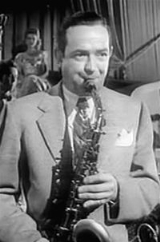
Jimmy Dorsey

Encyclopedia
James "Jimmy" Dorsey was a prominent American
jazz
clarinetist, saxophonist, trumpeter, composer, and big band
leader. He was known as "JD". He composed the jazz and pop standards "I'm Glad There Is You
(In This World of Ordinary People)" and "It's The Dreamer In Me
".
, the son of a music teacher and older brother of Tommy Dorsey
who also became a prominent musician. He played trumpet
in his youth, appearing on stage with J. Carson McGee's King Trumpeters in 1913. He switched to alto saxophone
in 1915, and then learned to double on clarinet
. Jimmy Dorsey played on a clarinet outfitted with the Albert system
of fingering, as opposed to the more common Boehm system
used by most of his contemporaries including Benny Goodman
and Artie Shaw
.
With his brother Tommy playing trombone, he formed Dorsey’s Novelty Six, one of the first jazz bands to broadcast. In 1924 he joined the California Ramblers (who were based in New York City
). He did much free lance radio and recording
work throughout the 1920s. The brothers also appeared as session musicians on many jazz recordings. He joined Ted Lewis
's band in 1930, with whom he toured Europe
.
After returning to the United States
, he worked briefly with Rudy Vallee
and several other bandleaders, in addition to the Dorsey Brothers Orchestra with Tommy. He appeared on at least seventy-five radio broadcasts (many with his brother), as a member of Nathaniel Shilkret
's orchestra on programs such as the 1932 program, "The Music That Satisfies," also known as the Chesterfield Quarter Hour. Tommy broke off to form his own band in 1935 after a musical dispute with Jimmy. The Dorsey Brothers Orchestra became the Jimmy Dorsey Orchestra, and included musicians such as Bobby Byrne, Ray McKinley
, and Skeets Herfurt
along with vocalists Bob Eberly
and Kay Weber.
In 1939 Jimmy hired Helen O'Connell
as his female singer. She and Eberly possessed a "boy and girl next door" charm and their pairing produced several of the band's biggest hits. Many of the Eberly-O'Connell recordings were arranged in an unusual 3-section "a-b-c" format. The three-part format was reportedly developed at the insistence of a record producer
who wanted to feature both singers and the full band in a single 3-minute 78 rpm recording. Eberly sang the first minute, usually as a slow romantic ballad, the next minute featured the full band backing Jimmy's saxophone
, and the last minute was sung by O'Connell in a more up-tempo style, sometimes with lyrics in Spanish. Kitty Kallen
sang with the Jimmy Dorsey orchestra following Helen O'Connell's departure in 1942.Jerry Lewis
' first wife Patti Palmer (birth name Esther Calonico) was a singer with his orchestra for less than a year, starting about 1944.
Jimmy continued leading his own band until the early 1950s. In 1953 he joined Tommy's Orchestra, renamed "Tommy Dorsey and his Orch. featuring Jimmy Dorsey". On December 26, 1953, the brothers and their orchestra appeared on Jackie Gleason
's CBS television program. The success of that television appearance led Gleason to produce a weekly variety program, Stage Show, hosted by the brothers on CBS from 1954 to 1956. Elvis Presley
appeared on several of the telecasts. These were Presley's first appearances on national TV.
Jimmy took over leadership of the orchestra after Tommy's death. Jimmy survived his brother by only a few months and died of throat cancer
, aged 53, in New York City. Broadcasts of Jimmy Dorsey and The Fabulous Dorsey Orchestra on NBC Bandstand survive from December 25, and December 31, 1956. At least two other extant broadcasts from the month of December 1956 are available as well. Recordings of the band from their winter 1957 tour have not surfaced. These recordings would provide the last aural evidence of Jimmy Dorsey's work. It is thought that Dorsey's last appearance was in Joplin, Missouri
, on March 12, 1957.
Shortly before his death, he was awarded a gold record for "So Rare
" which was recorded on November 11, 1956. There is a controversy over who played the alto solo on the recording of "So Rare", Dick Stabile
or Jimmy Dorsey. It reached the number-two spot on the Billboard
charts, becoming the highest charting song by a big band during the first decade of the rock-and-roll era.
Jimmy Dorsey is considered one of the most important and influential alto saxophone players of the Big Band and Swing era, and also after that era. Jazz saxophonist Charlie Parker
mentioned him as a personal favorite.
, Jean Goldkette, Ben Pollack, and Paul Whiteman. He and his younger brother Tommy formed several bands known as “The Dorsey Brothers Orchestra” during the late 1920s and early 1930s which suddenly ended in May, 1935, when Tommy stormed off the bandstand after an onstage argument. For several months, Jimmy continued leading the band, keeping the Dorsey Brothers name, hoping that his younger brother would return, but he did not. In September, 1935, the Dorsey Brothers band legally became the "Jim Dorsey Orchestra", after Jimmy found out that Tommy Dorsey now had his own band, and had signed a recording contract with RCA Victor. Jimmy Dorsey remained with Decca Records as the two brothers were now competing with each other musically.
Jimmy Dorsey's first hit record was "You Let Me Down" in 1935. His early band was considered to be more jazz-oriented than his brother's, and recordings of some instrumental swing classics soon followed: Dorsey Stomp, Tap Dancer's Nightmare, Parade of the Milk Bottle Caps, John Silver, and Dusk in Upper Sandusky. The band was featured on Bing Crosby's Kraft Music Hall radio show, and did quite well commercially, although being overshadowed by Benny Goodman, (also a clarinetist), whose big band had grabbed center stage in the mid thirties. Dorsey's main vocalist was Bob Eberly, considered to be the best in the music business, and in 1939, Helen O'Connell joined the band, and the idea to have them do duets together proved to be highly successful. Almost every record released during 1939-1943 were hits, but especially records made with a Latin American flavor like “Amapola”, "Maria Elena", and “Green Eyes”, which topped the charts in 1941. Certainly vocalists Helen O’Connell and Bob Eberly, were two very important factors in Jimmy Dorsey’s rise in popularity. They continued singing with his band for future records and motion picture appearances. Despite personnel changes, Jimmy remained one of the top big band leaders after World War II and into the 1950s, always updating the sound of his band, but the big band business was beginning to decline.
Jimmy and Tommy Dorsey reunited on March 15, 1945 to record a V-Disc
at Liederkranz Hall in New York City. Released in June, 1945, V-Disc 451 featured "More Than You Know" backed with "Brotherly Jump". The songs featured the combined orchestras of Jimmy and Tommy Dorsey.
In 1953, he and his brother reunited to form a (new) “Dorsey Brothers Orchestra.” Tommy was the leader of the group, making Jimmy the co-leader and featured soloist. In 1954, Jackie Gleason chose their band to star in a weekly television show that centered on their band. The show, called “Stage Show,” was a huge hit, and gave other big band leaders hope in a business that was steadily declining.
Tommy’s death in 1956 and Jimmy’s own health problems resulted in the end of his television and musical career in 1957.
, including That Girl From Paris, Shall We Dance, The Fleet's In
, Lost in a Harem
with Abbot and Costello , I Dood It
, and the bio-pic with his brother Tommy, The Fabulous Dorseys
in 1947.
In 1938, Jimmy Dorsey and His Orchestra also appeared in a movie short performing many of his hits including "It's the Dreamer in Me", "I Love You in Technicolor", and "Parade of the Milk Bottle Caps".
", which reached no. 20 in 1939 on Billboard, staying on the charts for one week, also recorded by Glenn Miller and his Orchestra and Jack Teagarden and his Orchestra, "Beebe", "Oodles of Noodles", "John Silver
" with Ray Krise, which reached no. 13 on Billboard in 1938, staying on the charts for 2 weeks, "Parade of the Milk Bottle Caps", "Dusk in Upper Sandusky" with Larry Clinton
, "Shoot the Meatballs to Me Dominick Boy" with Toots Camarata, "A Man and his Drums", "Mutiny in the Brass Section", "Praying the Blues", "Contrasts", his theme song, "Major and Minor Stomp", "Hep-Tee Hootie (Juke Box Jive)" with Fud Livingston and Jack Palmer, "I Bought A Wooden Whistle", "Tailspin
" with Frankie Trumbauer
, the classic jazz standard "I'm Glad There Is You
(In This World of Ordinary People)", "Clarinet Polka", "I Love You in Technicolor", "All The Things You Ain't" with Babe Russin
, "JD's Boogie Woogie", "Jumpin' Jehosaphat", "I'll Do Anything For You", "Dorsey Stomp", "Grand Central Getaway" with Dizzy Gillespie
, "Sunset Strip" and "The Champ" with Sonny Burke
, "Town Hall Tonight", "Outer Drive" with Herb Ellis
, the jazz standard "It's the Dreamer in Me
" with Jimmy Van Heusen, recorded by Duke Ellington and others.
Jimmy Dorsey co-wrote the jazz and pop standard "I'm Glad There Is You (In This World of Ordinary People)" with Paul Madeira, who is also known as Paul Madeira Mertz, in 1941. Jimmy Dorsey and Paul Madeira Mertz collaborated on the lyrics and the music. Mertz had been a pianist in the Bix Beiderbecke
band in the 1920s and had worked in Hollywood on film music in the 1930s. Jimmy Dorsey originally released the song as a 78 on Decca as 4197B in 1942 with Bob Eberly on vocals. Jimmy Dorsey also released the song as Decca 18799A with Dee Parker on vocals in 1946.
", which was number one for ten weeks in 1941 on the Billboard pop singles chart. On August 17, 1936, Bing Crosby recorded "Pennies from Heaven" with the Jimmy Dorsey Orchestra, a recording that went number one for ten weeks and became one of the top records of 1936. And finally, there was a late hit in 1957, "So Rare
", which went to the #2 position, and was on the record charts for 26 weeks.
In 2008, the Recording Academy added the 1942 recording of "Brazil (Aquarela do Brasil
)", Decca 18460B, by Jimmy Dorsey & His Orchestra with Bob Eberle and Helen O'Connell on vocals to the Grammy Hall of Fame.
In 1983, Jimmy Dorsey was inducted into the Big Band and Jazz Hall of Fame. He is also a member of the American Jazz Hall of Fame.
United States
The United States of America is a federal constitutional republic comprising fifty states and a federal district...
jazz
Jazz
Jazz is a musical style that originated at the beginning of the 20th century in African American communities in the Southern United States. It was born out of a mix of African and European music traditions. From its early development until the present, jazz has incorporated music from 19th and 20th...
clarinetist, saxophonist, trumpeter, composer, and big band
Big band
A big band is a type of musical ensemble associated with jazz and the Swing Era typically consisting of rhythm, brass, and woodwind instruments totaling approximately twelve to twenty-five musicians...
leader. He was known as "JD". He composed the jazz and pop standards "I'm Glad There Is You
I'm Glad There Is You
I'm Glad There Is You is a song written by Jimmy Dorsey and Paul Madeira first published in 1941...
(In This World of Ordinary People)" and "It's The Dreamer In Me
It's the Dreamer in Me
It's The Dreamer In Me is a 1938 song composed by Jimmy Dorsey and Jimmy Van Heusen and was first recorded by Jimmy Dorsey and His Orchestra with Bob Eberly on vocals. The song is a jazz and pop standard....
".
Overview
Jimmy Dorsey was born in Shenandoah, PennsylvaniaShenandoah, Pennsylvania
Shenandoah is a small town located in the lower part of the anthracite Coal Region, Schuylkill County, Pennsylvania. It is northwest of Philadelphia. The Greater Shenandoah area includes Shenandoah Heights, which is part of West Mahanoy Township and is located just north of Shenandoah.-History:The...
, the son of a music teacher and older brother of Tommy Dorsey
Tommy Dorsey
Thomas Francis "Tommy" Dorsey, Jr. was an American jazz trombonist, trumpeter, composer, and bandleader of the Big Band era. He was known as "The Sentimental Gentleman of Swing", due to his smooth-toned trombone playing. He was the younger brother of bandleader Jimmy Dorsey...
who also became a prominent musician. He played trumpet
Trumpet
The trumpet is the musical instrument with the highest register in the brass family. Trumpets are among the oldest musical instruments, dating back to at least 1500 BCE. They are played by blowing air through closed lips, producing a "buzzing" sound which starts a standing wave vibration in the air...
in his youth, appearing on stage with J. Carson McGee's King Trumpeters in 1913. He switched to alto saxophone
Alto saxophone
The alto saxophone is a member of the saxophone family of woodwind instruments invented by Belgian instrument designer Adolphe Sax in 1841. It is smaller than the tenor but larger than the soprano, and is the type most used in classical compositions...
in 1915, and then learned to double on clarinet
Clarinet
The clarinet is a musical instrument of woodwind type. The name derives from adding the suffix -et to the Italian word clarino , as the first clarinets had a strident tone similar to that of a trumpet. The instrument has an approximately cylindrical bore, and uses a single reed...
. Jimmy Dorsey played on a clarinet outfitted with the Albert system
Albert system
The Albert system refers to a system of clarinet keywork and fingering developed by Eugène Albert. In the United Kingdom it is known as the simple system. It has been largely replaced by the Boehm system ....
of fingering, as opposed to the more common Boehm system
Boehm system (clarinet)
The Boehm system for the clarinet is a system of clarinet keywork, developed between 1839 and 1843 by Hyacinthe Klosé and Auguste Buffet jeune. The name is somewhat deceptive; the system was inspired by Theobald Boehm's system for the flute, but necessarily differs from it, since the clarinet...
used by most of his contemporaries including Benny Goodman
Benny Goodman
Benjamin David “Benny” Goodman was an American jazz and swing musician, clarinetist and bandleader; widely known as the "King of Swing".In the mid-1930s, Benny Goodman led one of the most popular musical groups in America...
and Artie Shaw
Artie Shaw
Arthur Jacob Arshawsky , better known as Artie Shaw, was an American jazz clarinetist, composer, and bandleader. He was also the author of both fiction and non-fiction writings....
.
With his brother Tommy playing trombone, he formed Dorsey’s Novelty Six, one of the first jazz bands to broadcast. In 1924 he joined the California Ramblers (who were based in New York City
New York City
New York is the most populous city in the United States and the center of the New York Metropolitan Area, one of the most populous metropolitan areas in the world. New York exerts a significant impact upon global commerce, finance, media, art, fashion, research, technology, education, and...
). He did much free lance radio and recording
Gramophone record
A gramophone record, commonly known as a phonograph record , vinyl record , or colloquially, a record, is an analog sound storage medium consisting of a flat disc with an inscribed, modulated spiral groove...
work throughout the 1920s. The brothers also appeared as session musicians on many jazz recordings. He joined Ted Lewis
Ted Lewis (musician)
Theodore Leopold Friedman, better known as Ted Lewis , was an American entertainer, bandleader, singer, and musician. He led a band presenting a combination of jazz, hokey comedy, and schmaltzy sentimentality that was a hit with the American public. He was known by the moniker "Mr...
's band in 1930, with whom he toured Europe
Europe
Europe is, by convention, one of the world's seven continents. Comprising the westernmost peninsula of Eurasia, Europe is generally 'divided' from Asia to its east by the watershed divides of the Ural and Caucasus Mountains, the Ural River, the Caspian and Black Seas, and the waterways connecting...
.
After returning to the United States
United States
The United States of America is a federal constitutional republic comprising fifty states and a federal district...
, he worked briefly with Rudy Vallee
Rudy Vallée
Rudy Vallée was an American singer, actor, bandleader, and entertainer.-Early life:Born Hubert Prior Vallée in Island Pond, Vermont, the son of Charles Alphonse and Catherine Lynch Vallée...
and several other bandleaders, in addition to the Dorsey Brothers Orchestra with Tommy. He appeared on at least seventy-five radio broadcasts (many with his brother), as a member of Nathaniel Shilkret
Nathaniel Shilkret
Nathaniel Shilkret was an American composer, conductor, clarinetist, pianist, business executive, and music director born in New York City, New York to an Austrian immigrant family.-Early career:...
's orchestra on programs such as the 1932 program, "The Music That Satisfies," also known as the Chesterfield Quarter Hour. Tommy broke off to form his own band in 1935 after a musical dispute with Jimmy. The Dorsey Brothers Orchestra became the Jimmy Dorsey Orchestra, and included musicians such as Bobby Byrne, Ray McKinley
Ray McKinley
Ray McKinley was an American jazz drummer, singer, and bandleader.McKinley got his start working with local bands in the Dallas–Fort Worth area, before joining Smith Ballew in 1929, when he met Glenn Miller. The two formed a friendship which lasted from 1929 until Miller's death in 1944....
, and Skeets Herfurt
Skeets Herfurt
Arthur "Skeets" Herfurt was an American jazz saxophonist and clarinetist....
along with vocalists Bob Eberly
Bob Eberly
Bob Eberly was a big band vocalist, best-known for his association with Jimmy Dorsey and his duets with Helen O'Connell....
and Kay Weber.
In 1939 Jimmy hired Helen O'Connell
Helen O'Connell
Helen O'Connell was an American singer, actress, and dancer.Born in Lima, Ohio, O'Connell joined the Jimmy Dorsey band in 1939 and achieved her best selling records in the early 1940s with "Green Eyes", "Amapola," "Tangerine" and "Yours"...
as his female singer. She and Eberly possessed a "boy and girl next door" charm and their pairing produced several of the band's biggest hits. Many of the Eberly-O'Connell recordings were arranged in an unusual 3-section "a-b-c" format. The three-part format was reportedly developed at the insistence of a record producer
Record producer
A record producer is an individual working within the music industry, whose job is to oversee and manage the recording of an artist's music...
who wanted to feature both singers and the full band in a single 3-minute 78 rpm recording. Eberly sang the first minute, usually as a slow romantic ballad, the next minute featured the full band backing Jimmy's saxophone
Saxophone
The saxophone is a conical-bore transposing musical instrument that is a member of the woodwind family. Saxophones are usually made of brass and played with a single-reed mouthpiece similar to that of the clarinet. The saxophone was invented by the Belgian instrument maker Adolphe Sax in 1846...
, and the last minute was sung by O'Connell in a more up-tempo style, sometimes with lyrics in Spanish. Kitty Kallen
Kitty Kallen
Kitty Kallen is an American popular singer who sang with a number of big bands in the 1940s, coming back in the 1950s to score her biggest hit, "Little Things Mean a Lot" in 1954.-Career:...
sang with the Jimmy Dorsey orchestra following Helen O'Connell's departure in 1942.Jerry Lewis
Jerry Lewis
Jerry Lewis is an American comedian, actor, singer, film producer, screenwriter and film director. He is best known for his slapstick humor in film, television, stage and radio. He was originally paired up with Dean Martin in 1946, forming the famed comedy team of Martin and Lewis...
' first wife Patti Palmer (birth name Esther Calonico) was a singer with his orchestra for less than a year, starting about 1944.
Jimmy continued leading his own band until the early 1950s. In 1953 he joined Tommy's Orchestra, renamed "Tommy Dorsey and his Orch. featuring Jimmy Dorsey". On December 26, 1953, the brothers and their orchestra appeared on Jackie Gleason
Jackie Gleason
Jackie Gleason was an American comedian, actor and musician. He was known for his brash visual and verbal comedy style, especially by his character Ralph Kramden on The Honeymooners, a situation-comedy television series. His most noted film roles were as Minnesota Fats in the drama film The...
's CBS television program. The success of that television appearance led Gleason to produce a weekly variety program, Stage Show, hosted by the brothers on CBS from 1954 to 1956. Elvis Presley
Elvis Presley
Elvis Aaron Presley was one of the most popular American singers of the 20th century. A cultural icon, he is widely known by the single name Elvis. He is often referred to as the "King of Rock and Roll" or simply "the King"....
appeared on several of the telecasts. These were Presley's first appearances on national TV.
Jimmy took over leadership of the orchestra after Tommy's death. Jimmy survived his brother by only a few months and died of throat cancer
Head and neck cancer
Head and neck cancer refers to a group of biologically similar cancers that start in the upper aerodigestive tract, including the lip, oral cavity , nasal cavity , paranasal sinuses, pharynx, and larynx. 90% of head and neck cancers are squamous cell carcinomas , originating from the mucosal lining...
, aged 53, in New York City. Broadcasts of Jimmy Dorsey and The Fabulous Dorsey Orchestra on NBC Bandstand survive from December 25, and December 31, 1956. At least two other extant broadcasts from the month of December 1956 are available as well. Recordings of the band from their winter 1957 tour have not surfaced. These recordings would provide the last aural evidence of Jimmy Dorsey's work. It is thought that Dorsey's last appearance was in Joplin, Missouri
Joplin, Missouri
Joplin is a city in southern Jasper County and northern Newton County in the southwestern corner of the US state of Missouri. Joplin is the largest city in Jasper County, though it is not the county seat. As of the 2010 census, the city population was 50,150...
, on March 12, 1957.
Shortly before his death, he was awarded a gold record for "So Rare
So Rare
"So Rare" is a popular song published in 1937 by composer Jerry Herst and lyricist Jack Sharpe. It became a hit for Jimmy Dorsey in 1957.The version by Carl Ravell and his Orchestra, from a session on 4 June 1937, may be the earliest recording of the song, although it is unclear whether it was the...
" which was recorded on November 11, 1956. There is a controversy over who played the alto solo on the recording of "So Rare", Dick Stabile
Dick Stabile
Dick Stabile was an American jazz saxophonist and bandleader.-Biography:Stabile got his start playing in theater ensembles on Broadway in the 1950s. He joined Ben Bernie's orchestra in 1928, where he remained for several years...
or Jimmy Dorsey. It reached the number-two spot on the Billboard
Billboard (magazine)
Billboard is a weekly American magazine devoted to the music industry, and is one of the oldest trade magazines in the world. It maintains several internationally recognized music charts that track the most popular songs and albums in various categories on a weekly basis...
charts, becoming the highest charting song by a big band during the first decade of the rock-and-roll era.
Jimmy Dorsey is considered one of the most important and influential alto saxophone players of the Big Band and Swing era, and also after that era. Jazz saxophonist Charlie Parker
Charlie Parker
Charles Parker, Jr. , famously called Bird or Yardbird, was an American jazz saxophonist and composer....
mentioned him as a personal favorite.
Career
During his early days as a musician, Jimmy Dorsey performed with various other ensembles and artists including the Scranton Sirens, The California Ramblers, Red NicholsRed Nichols
Ernest Loring "Red" Nichols was an American jazz cornettist, composer, and jazz bandleader.Over his long career, Nichols recorded in a wide variety of musical styles, and critic Steve Leggett describes him as "an expert cornet player, a solid improviser, and apparently a workaholic, since he is...
, Jean Goldkette, Ben Pollack, and Paul Whiteman. He and his younger brother Tommy formed several bands known as “The Dorsey Brothers Orchestra” during the late 1920s and early 1930s which suddenly ended in May, 1935, when Tommy stormed off the bandstand after an onstage argument. For several months, Jimmy continued leading the band, keeping the Dorsey Brothers name, hoping that his younger brother would return, but he did not. In September, 1935, the Dorsey Brothers band legally became the "Jim Dorsey Orchestra", after Jimmy found out that Tommy Dorsey now had his own band, and had signed a recording contract with RCA Victor. Jimmy Dorsey remained with Decca Records as the two brothers were now competing with each other musically.
Jimmy Dorsey's first hit record was "You Let Me Down" in 1935. His early band was considered to be more jazz-oriented than his brother's, and recordings of some instrumental swing classics soon followed: Dorsey Stomp, Tap Dancer's Nightmare, Parade of the Milk Bottle Caps, John Silver, and Dusk in Upper Sandusky. The band was featured on Bing Crosby's Kraft Music Hall radio show, and did quite well commercially, although being overshadowed by Benny Goodman, (also a clarinetist), whose big band had grabbed center stage in the mid thirties. Dorsey's main vocalist was Bob Eberly, considered to be the best in the music business, and in 1939, Helen O'Connell joined the band, and the idea to have them do duets together proved to be highly successful. Almost every record released during 1939-1943 were hits, but especially records made with a Latin American flavor like “Amapola”, "Maria Elena", and “Green Eyes”, which topped the charts in 1941. Certainly vocalists Helen O’Connell and Bob Eberly, were two very important factors in Jimmy Dorsey’s rise in popularity. They continued singing with his band for future records and motion picture appearances. Despite personnel changes, Jimmy remained one of the top big band leaders after World War II and into the 1950s, always updating the sound of his band, but the big band business was beginning to decline.
Jimmy and Tommy Dorsey reunited on March 15, 1945 to record a V-Disc
V-Disc
V-Disc was a morale-boosting initiative involving the production of several series of recordings during the World War II era by special arrangement between the United States government and various private U.S. record companies. The records were produced for the use of United States military...
at Liederkranz Hall in New York City. Released in June, 1945, V-Disc 451 featured "More Than You Know" backed with "Brotherly Jump". The songs featured the combined orchestras of Jimmy and Tommy Dorsey.
In 1953, he and his brother reunited to form a (new) “Dorsey Brothers Orchestra.” Tommy was the leader of the group, making Jimmy the co-leader and featured soloist. In 1954, Jackie Gleason chose their band to star in a weekly television show that centered on their band. The show, called “Stage Show,” was a huge hit, and gave other big band leaders hope in a business that was steadily declining.
Tommy’s death in 1956 and Jimmy’s own health problems resulted in the end of his television and musical career in 1957.
Movie appearances
Jimmy Dorsey appeared in a number of Hollywood motion picturesFilm
A film, also called a movie or motion picture, is a series of still or moving images. It is produced by recording photographic images with cameras, or by creating images using animation techniques or visual effects...
, including That Girl From Paris, Shall We Dance, The Fleet's In
The Fleet's In
The Fleet's In is a movie musical produced by Paramount Pictures, directed by Victor Schertzinger, and starring Dorothy Lamour and William Holden. Although sharing the title of the 1928 Paramount film starring Clara Bow and Jack Oakie, it was not a remake...
, Lost in a Harem
Lost in a Harem
-Plot:When a traveling vaudeville show becomes stranded in the Middle East, their singer, Hazel Moon , takes a job at a local cafe. Two of the show's prop men, Peter Johnson and Harvey Garvey , are hired as comedy relief, but their act unfortunately initiates a brawl...
with Abbot and Costello , I Dood It
I Dood It
I Dood It is a 1943 MGM musical-comedy film starring Red Skelton and Eleanor Powell, and directed by Vincente Minnelli. The screenplay is by Fred Saidy and Sig Herzig and the film features Richard Ainley, Patricia Dane, Lena Horne and Hazel Scott...
, and the bio-pic with his brother Tommy, The Fabulous Dorseys
The Fabulous Dorseys
The Fabulous Dorseys is a 1947 fictionalized biographical film which tells the story of Tommy and Jimmy Dorsey, from their boyhood in Shenandoah, Pennsylvania through their rise, their breakup, and their personal reunion....
in 1947.
In 1938, Jimmy Dorsey and His Orchestra also appeared in a movie short performing many of his hits including "It's the Dreamer in Me", "I Love You in Technicolor", and "Parade of the Milk Bottle Caps".
Compositions by Jimmy Dorsey
Jimmy Dorsey composed "Mood Hollywood", "Shim Sham Shimmy", " So Many TimesSo Many Times (Jimmy Dorsey song)
So Many Times is a 1939 song written by Jimmy Dorsey and Don De Vito. The song was released as a single in 1939 by Jimmy Dorsey and His Orchestra, becoming a Top 20 hit....
", which reached no. 20 in 1939 on Billboard, staying on the charts for one week, also recorded by Glenn Miller and his Orchestra and Jack Teagarden and his Orchestra, "Beebe", "Oodles of Noodles", "John Silver
John Silver (1938 song)
John Silver is a 1938 song written by Jimmy Dorsey with Ray Krise. Jimmy Dorsey and His Orchestra released the song as a 78 single on Decca in 1938....
" with Ray Krise, which reached no. 13 on Billboard in 1938, staying on the charts for 2 weeks, "Parade of the Milk Bottle Caps", "Dusk in Upper Sandusky" with Larry Clinton
Larry Clinton
Larry Clinton was a trumpeter who became a prominent American bandleader.-Biography:Clinton was born in Brooklyn, New York. He became a versatile musician, capable of playing trumpet, trombone, and clarinet...
, "Shoot the Meatballs to Me Dominick Boy" with Toots Camarata, "A Man and his Drums", "Mutiny in the Brass Section", "Praying the Blues", "Contrasts", his theme song, "Major and Minor Stomp", "Hep-Tee Hootie (Juke Box Jive)" with Fud Livingston and Jack Palmer, "I Bought A Wooden Whistle", "Tailspin
Tailspin (1934 song)
Tailspin is a 1934 song written by Jimmy Dorsey and Frankie Trumbauer. The song was released by Paul Whiteman and His Orchestra featuring Frankie Trumbauer in 1934 on Victor and by The Dorsey Brothers Orchestra in 1935 as a Decca single....
" with Frankie Trumbauer
Frankie Trumbauer
Orie Frank Trumbauer was one of the leading jazz saxophonists of the 1920s and 1930s. He played the C-melody saxophone which, in size, is between an alto and tenor saxophone...
, the classic jazz standard "I'm Glad There Is You
I'm Glad There Is You
I'm Glad There Is You is a song written by Jimmy Dorsey and Paul Madeira first published in 1941...
(In This World of Ordinary People)", "Clarinet Polka", "I Love You in Technicolor", "All The Things You Ain't" with Babe Russin
Babe Russin
Irving "Babe" Russin was a tenor saxophone player.Born in Pittsburgh, Pennsylvania, Russin played with some of the best known jazz bands of the 1930s and 1940s, including Benny Goodman, Tommy Dorsey and Glenn Miller. He led his own band briefly in the early 1940s...
, "JD's Boogie Woogie", "Jumpin' Jehosaphat", "I'll Do Anything For You", "Dorsey Stomp", "Grand Central Getaway" with Dizzy Gillespie
Dizzy Gillespie
John Birks "Dizzy" Gillespie was an American jazz trumpet player, bandleader, singer, and composer dubbed "the sound of surprise".Together with Charlie Parker, he was a major figure in the development of bebop and modern jazz...
, "Sunset Strip" and "The Champ" with Sonny Burke
Sonny Burke
Sonny Burke was a big band leader. In 1937, he graduated from Duke University where he had formed and led the jazz big band known as the Duke Ambassadors....
, "Town Hall Tonight", "Outer Drive" with Herb Ellis
Herb Ellis
Mitchell Herbert "Herb" Ellis was an American jazz guitarist. Perhaps best known for his 1950s membership in the trio of pianist Oscar Peterson, Ellis was also a staple of west-coast studio recording sessions, and was described by critic Scott Yanow as "an excellent bop-based guitarist with a...
, the jazz standard "It's the Dreamer in Me
It's the Dreamer in Me
It's The Dreamer In Me is a 1938 song composed by Jimmy Dorsey and Jimmy Van Heusen and was first recorded by Jimmy Dorsey and His Orchestra with Bob Eberly on vocals. The song is a jazz and pop standard....
" with Jimmy Van Heusen, recorded by Duke Ellington and others.
Jimmy Dorsey co-wrote the jazz and pop standard "I'm Glad There Is You (In This World of Ordinary People)" with Paul Madeira, who is also known as Paul Madeira Mertz, in 1941. Jimmy Dorsey and Paul Madeira Mertz collaborated on the lyrics and the music. Mertz had been a pianist in the Bix Beiderbecke
Bix Beiderbecke
Leon Bismark "Bix" Beiderbecke was an American jazz cornetist, jazz pianist, and composer.With Louis Armstrong, Beiderbecke was one of the most influential jazz soloists of the 1920s...
band in the 1920s and had worked in Hollywood on film music in the 1930s. Jimmy Dorsey originally released the song as a 78 on Decca as 4197B in 1942 with Bob Eberly on vocals. Jimmy Dorsey also released the song as Decca 18799A with Dee Parker on vocals in 1946.
Number-one hits
Jimmy Dorsey had eleven number one hits with his orchestra in the 1930s and the 1940s: "Is It True What They Say About Dixie?", "Change Partners", "The Breeze and I", "Amapola", "My Sister and I", "Maria Elena", "Green Eyes", "Blue Champagne", "Tangerine", "Besame Mucho", and "Pennies from Heaven" with Bing Crosby. In 1935, he had two more number ones as part of the Dorsey Brothers Orchestra: "Lullaby of Broadway" and "Chasing Shadows". His biggest hit was "AmapolaAmapola (song)
"Amapola" is a 1924 song by Cádiz-born composer José María Lacalle García , with Spanish lyrics. After the composer died in 1937, English language lyrics were written by Albert Gamse....
", which was number one for ten weeks in 1941 on the Billboard pop singles chart. On August 17, 1936, Bing Crosby recorded "Pennies from Heaven" with the Jimmy Dorsey Orchestra, a recording that went number one for ten weeks and became one of the top records of 1936. And finally, there was a late hit in 1957, "So Rare
Jack Sharpe
Jack Sharpe was an English jazz saxophonist and bandleader, chiefly active on the London jazz scene.Sharpe began playing tenor sax at age eighteen. He played with Vic Lewis and Teddy Foster in the early 1950s and freelanced in the London area, but left music around 1953 to become a taxi driver...
", which went to the #2 position, and was on the record charts for 26 weeks.
Honors
In 1996, the U.S. Postal Service issued a Jimmy Dorsey and Tommy Dorsey commemorative postage stamp.In 2008, the Recording Academy added the 1942 recording of "Brazil (Aquarela do Brasil
Aquarela do Brasil
"Aquarela do Brasil" , known in the English-speaking world simply as "Brazil", is one of the most famous Brazilian songs of all time, written by Ary Barroso in 1939.-Background and composition:...
)", Decca 18460B, by Jimmy Dorsey & His Orchestra with Bob Eberle and Helen O'Connell on vocals to the Grammy Hall of Fame.
In 1983, Jimmy Dorsey was inducted into the Big Band and Jazz Hall of Fame. He is also a member of the American Jazz Hall of Fame.
Partial filmography
- Jimmy Dorsey and His Orchestra (1938 short)
- The Fleet's InThe Fleet's InThe Fleet's In is a movie musical produced by Paramount Pictures, directed by Victor Schertzinger, and starring Dorothy Lamour and William Holden. Although sharing the title of the 1928 Paramount film starring Clara Bow and Jack Oakie, it was not a remake...
(1942) - I Dood ItI Dood ItI Dood It is a 1943 MGM musical-comedy film starring Red Skelton and Eleanor Powell, and directed by Vincente Minnelli. The screenplay is by Fred Saidy and Sig Herzig and the film features Richard Ainley, Patricia Dane, Lena Horne and Hazel Scott...
(1943) - Four Jills in a JeepFour Jills in a JeepFour Jills in a Jeep is a 1944 film starring Kay Francis, Carole Landis, Martha Raye, and Mitzi Mayfair as themselves, re-enacting their USO tour of Europe and North Africa during World War II.-Cast:*Kay Francis as Herself*Carole Landis as Herself...
(1944) - Lost in a HaremLost in a Harem-Plot:When a traveling vaudeville show becomes stranded in the Middle East, their singer, Hazel Moon , takes a job at a local cafe. Two of the show's prop men, Peter Johnson and Harvey Garvey , are hired as comedy relief, but their act unfortunately initiates a brawl...
(1944) - The Fabulous DorseysThe Fabulous DorseysThe Fabulous Dorseys is a 1947 fictionalized biographical film which tells the story of Tommy and Jimmy Dorsey, from their boyhood in Shenandoah, Pennsylvania through their rise, their breakup, and their personal reunion....
(1947)
V-Disc Recordings
- Julia, No. 117A, 1944
- Contrast, No. 117A, 1944
- John Silver, No. 117B, 1944
- That Wonderful, Worrisome Feeling, No. 157A, March, 1944
- Star Eyes, No. 174A, April, 1944
- The Champ, No. 195A, May, 1944
- I'll Do Anything For You, No. 195A, May, 1944
- The Breeze and I, No. 217B, June, 1944
- You, You Darlin', No. 217B, June, 1944
- The Great Lie, No. 283A, No. 63 (Navy), October, 1944
- Contrasts, No. 314A, November, 1944
- Oh, What a Beautiful Mornin', No. 314A, November, 1944
- Sunset Strip, No. 326A, December, 1944
- Grand Central Getaway, No. 391B, March, 1945
- All the Things You Ain't, No. 391B, March, 1945
- Long John Silver, No. 409B, April, 1945
- More Than You Know, No. 451A, June, 1945, with Tommy Dorsey and His Orchestra
- Brotherly Jump, No. 451B, June, 1945, with Tommy Dorsey and His Orchestra
- Jumpin' Jehosaphat, No. 470B, July, 1945; No. 250B (Marines), July, 1945
- Together, No. 514A, September, 1945
- King Porter Stomp, No. 514A, September, 1945
- Hello Forget It, Goodbye, No. 713, December, 1946
Sources
- Stockdale, Robert L. Jimmy Dorsey: A Study in Contrasts. (Studies in Jazz Series). Lanham, MD: The Scarecrow Press, Inc., 1999.
- Arnold, Jay, ed. Jimmy Dorsey Saxophone Method: A School of Rhythmic Saxophone Playing. Warner Bros Pubns, 1999.
- Sanford, Herb. Tommy and Jimmy: The Dorsey Years. (Introduction by Bing Crosby). DaCapo Press, 1980.
- Bockemuehl, Eugene. On the Road with the Jimmy Dorsey Aggravation, 1947-1949. Gray Castle Press, 1996.
- Metronome Magazine, March, 1942: Jimmy Dorsey cover. Metronome Editors. Vol. LVIII, No. 3.
- Down Beat Magazine, October 21, 1946: Jimmy Dorsey and Paul Whiteman cover.
External links
- Robert L. Stockdale, "Jimmy Dorsey: A Study In Contrasts", Lanham, MD, The Scarecrow Press, (c) 1999 (ISBN 0810835363)