
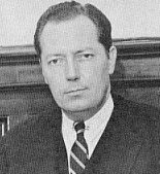
Earling Carothers "Jim" Garrison (November 20, 1921 – October 21, 1992) — who changed his first name to
Jim in the early 1960s — was the
District AttorneyIn many jurisdictions in the United States, a District Attorney is an elected or appointed government official who represents the government in the prosecution of criminal offenses. The district attorney is the highest officeholder in the jurisdiction's legal department and supervises a staff of...
of Orleans Parish, Louisiana from 1962 to 1973. A member of the
Democratic PartyThe Democratic Party is one of two major contemporary political parties in the United States, along with the Republican Party. The party's socially liberal and progressive platform is largely considered center-left in the U.S. political spectrum. The party has the lengthiest record of continuous...
, he is best known for his investigations into the
assassination of President John F. KennedyJohn Fitzgerald Kennedy, the thirty-fifth President of the United States, was assassinated at 12:30 p.m. Central Standard Time on Friday, November 22, 1963, in Dealey Plaza, Dallas, Texas...
(JFK).
Garrison remains a controversial figure. Opinions differ as to whether he uncovered a conspiracy behind the
John F. Kennedy assassinationJohn Fitzgerald Kennedy, the thirty-fifth President of the United States, was assassinated at 12:30 p.m. Central Standard Time on Friday, November 22, 1963, in Dealey Plaza, Dallas, Texas...
, but was blocked from successful prosecution by a federal government cover-up, whether he bungled his chance to uncover a conspiracy, or whether the entire case was an unproductive waste of resources.
Early life and career
Earling Carothers Garrison was born in
Denison, IowaDenison is a city in Crawford County, Iowa, United States, along the Boyer River. The population was 7,339 at the 2000 census. It is the county seat of Crawford County.-Geography:Denison is located at ....
. His family moved to New Orleans in his childhood, where he was reared by his divorced mother. He served in the U.S. National Guard in
World War IIWorld War II, or the Second World War , was a global conflict lasting from 1939 to 1945, involving most of the world's nations—including all of the great powers—eventually forming two opposing military alliances: the Allies and the Axis...
, then obtained a law degree from
Tulane University Law SchoolTulane University Law School is the law school of Tulane University. It is located on Tulane's Uptown campus in New Orleans, Louisiana. Established in 1847, it is the 12th oldest law school in the United States....
in 1949. He worked for the
Federal Bureau of InvestigationThe Federal Bureau of Investigation is an agency of the United States Department of Justice that serves as both a federal criminal investigative body and an internal intelligence agency . The FBI has investigative jurisdiction over violations of more than 200 categories of federal crime...
(FBI) for two years and then returned to active duty with the National Guard. After fifteen months, he was relieved from duty. One Army doctor concluded he had a "severe and disabling psychoneurosis" which "interfered with his social and professional adjustment to a marked degree. He is considered totally incapacitated from the standpoint of military duty and moderately incapacitated in civilian adaptability." Although one doctor did recommend that Garrison be discharged from service and collect 10% permanent disability, Garrison opted instead to join the National Guard where his record was reviewed by the U.S. Army Surgeon General who “found him to be physically qualified for federal recognition in the national army.”
District Attorney
Garrison worked for New Orleans law firm Deutsch, Kerrigan & Stiles from 1954 to 1958, when he became an assistant district attorney. Garrison became a flamboyant, colorful, well-known figure in New Orleans, but was initially unsuccessful in his run for public office, losing a 1959 election for criminal court judge. In 1961 he ran for district attorney, winning against incumbent Richard Dowling by 6,000 votes in a five-man Democratic primary. Despite lack of major political backing, his performance in a televised debate and last minute television commercials are credited with his victory.
Once in office, Garrison cracked down on prostitution and the abuses of Bourbon Street bars and strip joints. He indicted Dowling and one of his assistants with criminal
malfeasanceThe expressions misfeasance and nonfeasance, and occasionally malfeasance, are used in English law with reference to the discharge of public obligations existing by common law, custom or statute.-Definition and relevant rules of law:...
, but the charges were dismissed for lack of evidence. Garrison did not appeal. Garrison received national attention for a series of vice raids in the
French QuarterThe French Quarter, also known as Vieux Carré, is the oldest neighborhood in the city of New Orleans. When New Orleans was founded in 1718 by Jean-Baptiste Le Moyne de Bienville, the city was originally centered on the French Quarter, or the Vieux Carré as it was known then...
, staged sometimes on a nightly basis. Newspaper headlines in 1962 praised Garrison's efforts, "Quarter Crime Emergency Declared by Police, DA. — Garrison Back, Vows Vice Drive to Continue — 14 Arrested, 12 more nabbed in Vice Raids." Garrison's critics often point out that many of the arrests made by his office did not result in convictions, implying that he was in the habit of making arrests without evidence. However, assistant DA William Alford has said that charges would more often than not be reduced or dropped if a relative of someone charged gained Garrison’s ear. He had, said Alford, “a heart of gold.”
After a conflict with local criminal judges over his budget, he accused them of
racketeeringA racket is an illegal business, usually run as part of organized crime. Engaging in a racket is called racketeering.Several forms of racket exist. The best-known is the protection racket, in which criminals demand money from businesses in exchange for the service of "protection" against crimes...
and conspiring against him. The eight judges charged him with misdemeanor criminal defamation, and Garrison was convicted in January 1963. (In 1965 the
U.S. Supreme CourtThe Supreme Court of the United States is the highest court in the United States. It has ultimate appellate jurisdiction over all state and federal courts, and original jurisdiction over a small range of cases...
overturned the conviction and struck down the state statute as unconstitutional.) At the same time, Garrison indicted Judge Bernard Cocke with criminal malfeasance and, in two trials prosecuted by Garrison himself, Cocke was acquitted.
Garrison charged nine policemen with brutality, but dropped the charges two weeks later. At a press conference he accused the state parole board of accepting bribes, but could obtain no indictments. He accused the state legislature of the same, but held no investigation. He was unanimously censured by the legislature.
In 1965, running for reelection against Judge Malcolm O'Hara, Garrison won with 60 percent of the vote.
Kennedy assassination investigation
New Orleans D.A. Jim Garrison began an investigation into the assassination of President Kennedy in late 1966, after receiving several tips from Jack Martin that a man named
David FerrieDavid William Ferrie was a pilot who was alleged to have been involved in a conspiracy to assassinate President John F. Kennedy. New Orleans District Attorney Jim Garrison later claimed to have proven Ferrie's involvement and that he knew Lee Harvey Oswald. Ferrie denied such involvement.-Early...
may have been involved in the assassination. The end result of Garrison's investigation was the
arrest and trialOn March 1, 1967, New Orleans District Attorney Jim Garrison arrested and charged New Orleans businessman Clay Shaw with conspiring to assassinate President Kennedy, with the help of Lee Harvey Oswald, David Ferrie, and others. On January 29, 1969, Shaw was brought to trial in Orleans Parish...
of New Orleans businessman
Clay ShawClay Laverne Shaw was a businessman in New Orleans, Louisiana. He was the only person prosecuted in connection with the assassination of President John F. Kennedy and was found not guilty.-Biography:...
in 1969, with Shaw being unanimously acquitted less than one hour after the case went to the jury.
Garrison was able to
subpoenaA subpoena duces tecum is a court summons ordering a named party to appear before the court and produce documents or other tangible evidence for use at a hearing or trial....
the
Zapruder filmThe Zapruder film is a silent, color motion picture sequence shot by private citizen Abraham Zapruder with a home-movie camera, asU.S. President John F...
from
LifeLife generally refers to three American magazines:*A humor and general interest magazine published from 1883 to 1936. Time founder Henry Luce bought the magazine in 1936 solely so that he could acquire the rights to its name....
magazine and show it to the public for the first time. Until the trial, the film had rarely been seen, and bootleg copies made by assassination investigators working with Garrison led to the film's wider distribution.
Garrison's key witness against Clay Shaw was Perry Russo, a 25-year-old insurance salesman from
Baton Rouge, LouisianaBaton Rouge is the capital of the U.S. state of Louisiana. It is located in East Baton Rouge Parish and is the second-largest city in the state.Baton Rouge is a major industrial, petrochemical, medical, and research center of the American South...
. At the trial, Russo testified that he had attended a party at anti-Castro activist
David FerrieDavid William Ferrie was a pilot who was alleged to have been involved in a conspiracy to assassinate President John F. Kennedy. New Orleans District Attorney Jim Garrison later claimed to have proven Ferrie's involvement and that he knew Lee Harvey Oswald. Ferrie denied such involvement.-Early...
's apartment. At the party, Russo said that
Lee Harvey OswaldLee Harvey Oswald was, according to four government investigations,These were investigations by: the Federal Bureau of Investigation , the Warren Commission , the House Select Committee on Assassinations , and the Dallas Police Department. the sniper who assassinated John F...
(who Russo said was introduced to him as "Leon Oswald"), David Ferrie, and "Clem Bertrand" (who Russo identified in the courtroom as
Clay ShawClay Laverne Shaw was a businessman in New Orleans, Louisiana. He was the only person prosecuted in connection with the assassination of President John F. Kennedy and was found not guilty.-Biography:...
) had discussed killing President Kennedy. The conversation included plans for the "triangulation of crossfire" and alibis for the participants.
Russo’s version of events has been questioned by some historians and researchers, such as Patricia Lambert, once it became known that part of his testimony was induced by hypnotism, and by the drug sodium pentothal (sometimes called "truth serum"). An early version of Russo's testimony (as told in Assistant D.A. Andrew Sciambra's memo, before Russo was subjected to sodium pentothal and hypnosis) fails to mention an "assassination party" and says that Russo met Clay Shaw on two occasions, neither of which occurred at the party. However, in his book
On the Trail of the AssassinsOn the Trail of the Assassins is a 1988 book by Jim Garrison, detailing his role in indicting businessman Clay Shaw for conspiracy to kill U.S. President John F. Kennedy, therefore holding the only trial held for Kennedy's murder....
, Garrison says that Russo had already discussed the party at Ferrie's apartment before any "truth serum" was admitted. Moreover, in several public interviews, such as one shown in the video
The JFK Assassination: The Jim Garrison Tapes, Russo reiterates the same account of a party at Ferrie's apartment that he gave at the trial.
Jim Garrison defended his conduct regarding witness testimony, stating:
Before we introduced the testimony of our witnesses, we made them undergo independent verifying tests, including polygraph examination, truth serum and hypnosis. We thought this would be hailed as an unprecedented step in jurisprudence; instead, the press turned around and hinted that we had drugged our witnesses or given them posthypnotic suggestions to testify falsely.
Later career
In 1973, Garrison was tried for accepting bribes to protect illegal pinball machine operations. Pershing Gervais, Garrison's former chief investigator, testified that Garrison had received approximately $3,000 every two months for nine years from the dealers. Garrison, acting as his own defense attorney, called the allegations baseless, alleging they were concocted as part of a U.S. government effort to destroy him, because of his efforts to implicate the CIA in the Kennedy assassination. The jury found Garrison not guilty. In an interview conducted by New Orleans reporter Rosemary James with Pershing Gervais, James said Gervais admitted to concocting the charges.
In the same year, Garrison was defeated for reelection as district attorney by
Harry Connick, Sr.Joseph Harry Fowler Connick, Sr. is a New Orleans attorney who is best known for serving as the district attorney of the Parish of Orleans, which contains the City of New Orleans, from 1973 to 2003....
On April 15, 1978, Garrison won a special election over a
RepublicanThe Republican Party is one of the two major contemporary political parties in the United States, along with the Democratic Party. Founded by anti-slavery expansion activists in 1854, it is often called the GOP . The party's platform generally reflects American conservatism in the U.S...
candidate, Thomas F. Jordan, for a state Circuit Court of Appeals
judgeA judge is a person who presides over court proceedings, either alone or as part of a panel of judges. The powers, functions, method of appointment, discipline, and training of judges vary widely across different jurisdictions. The judge is supposed to conduct the trial impartially and in an open...
ship, a position that he held until his death.
In 1987, Garrison appeared as himself in the film
The Big EasyThe Big Easy is a 1987 American neo-noir crime film directed by Jim McBride and written by Daniel Petrie Jr. The executive producer of the motion picture was Mort Engelberg and the cinematographer was Affonso Beato...
.
After the Shaw trial, Garrison wrote three books on the Kennedy assassination,
A Heritage of Stone (1970),
The Star Spangled Contract (1976, fiction, but based on the JFK assassination), and the best-seller,
On The Trail of The Assassins (1988). His investigation again received widespread attention through
Oliver StoneWilliam Oliver Stone is an American film director, producer and screenwriter. Stone became well known in the late 1980s and the early 1990s for directing a series of films about the Vietnam War, for which he had previously participated as an infantry soldier. His work frequently focuses on...
's 1991 film,
JFKJFK is a 1991 American film directed by Oliver Stone. It examines the events leading to the assassination of President John F. Kennedy and alleged subsequent cover-up, through the eyes of former New Orleans district attorney Jim Garrison .Garrison filed charges against New Orleans businessman Clay...
, which was largely based on Garrison's book
On the Trail of the AssassinsOn the Trail of the Assassins is a 1988 book by Jim Garrison, detailing his role in indicting businessman Clay Shaw for conspiracy to kill U.S. President John F. Kennedy, therefore holding the only trial held for Kennedy's murder....
as well as
Jim MarrsJim Marrs is an American former newspaper journalist and New York Times best-selling author of books and articles on a wide range of alleged cover ups and conspiracies. Marrs is a prominent figure in the JFK conspiracy press and his book Crossfire was a source for Oliver Stone's film JFK...
'
Crossfire: The Plot That Killed Kennedy.
Kevin CostnerKevin Michael Costner is an American actor, singer, musician, producer, director, and businessman. He has been nominated for three BAFTA Awards, won two Academy Awards, and two Golden Globe Awards. Costner's roles include Lt. John J...
played a fictionalized version of Garrison in the movie. Garrison himself had a small on-screen role in the film, playing United States Supreme Court Chief Justice
Earl WarrenEarl Warren was the 14th Chief Justice of the United States.He is known for the sweeping decisions of the Warren Court, which ended school segregation and transformed many areas of American law, especially regarding the rights of the accused, ending public-school-sponsored prayer, and requiring...
.
Legacy
Some suggest that Garrison will be remembered positively, including political analyst
Carl OglesbyCarl Oglesby was an American writer, academic, and political activist. He was the President of the leftist student organization Students for a Democratic Society from 1965 to 1966.-Early years:...
who was quoted as saying, "...I have done a study of Garrison: I come out of it thinking that he is one of the really first-rate class-act
heroA hero , in Greek mythology and folklore, was originally a demigod, their cult being one of the most distinctive features of ancient Greek religion...
es of this whole ugly story [the killing of John F. Kennedy, the cover-up, and subsequent investigation], which suffers so badly for
heroA hero , in Greek mythology and folklore, was originally a demigod, their cult being one of the most distinctive features of ancient Greek religion...
es."
Garrison was later viewed as an embarrassment by writer
Gerald PosnerGerald Posner is an investigative journalist and author of several books, including Case Closed: Lee Harvey Oswald and the Assassination of JFK which explores the John F...
, who believes Oswald acted alone. However, several researchers, including Jim DiEugenio, William Davy, and Joan Mellen have defended Garrison.
Garrison came under contemporary criticism from writers including Sylvia Meagher, who in 1967 wrote: "...as the Garrison investigation continued to unfold, it gave cause for increasingly serious misgivings about the validity of his evidence, the credibility of his witnesses, and the scrupulousness of his methods. The fact that many critics of the Warren Report have remained passionate advocates of the Garrison investigation, even condoning tactics which they might not condone on the part of others, is a matter of regret and disappointment." Others say Garrison was cruel and mistreated witnesses in his attempt to prove an assassination conspiracy. According to Clay Shaw's defense team, witnesses, including Perry Russo, claimed to have been bribed and threatened with perjury and contempt of court charges by Garrison in order to make his case against Shaw. However, in a later interview with public radio, Perry Russo stated: "Well the truth of the matter was that Garrison was very sincere. [NBC News reporter] Walter Sheridan tells me and threatens me that he's gonna take Garrison out and take me with him.
Further reading
- Vincent Bugliosi, Reclaiming History: The Assassination of President John F. Kennedy (W.W. Norton and Company, 2007) -- pp. 1347–1436 of the main text and pp. 804–932 of the endnotes are devoted to "Jim Garrison's Prosecution of Clay Shaw and Oliver Stone's Movie JFK"
- William Hardy Davis, Aiming for the Jugular in New Orleans (Ashley Books, June 1976)
- Paris Flamonde, The Kennedy Conspiracy
- Paris Flamonde, The Assassinastion of America (2007)
- Jim Garrison, A Heritage of Stone (Putnam Publishing Group, 1970) ISBN 978-0-399-10398-8
- James Kirkwood, American Grotesque: An Account of the Clay Shaw-Jim Garrison-Kennedy Assassination Trial in New Orleans
- Gerald Posner
Gerald Posner is an investigative journalist and author of several books, including Case Closed: Lee Harvey Oswald and the Assassination of JFK which explores the John F...
, Case Closed: Lee Harvey Oswald and the Assassination of JFK (New York: Random House Publishers, 1993)
- Harold Weisberg, Oswald in New Orleans: Case for Conspiracy with the C.I.A. (New York: Canyon Books, 1967)
- Christine Wiltz, The Last Madam p. 145-150 ISBN 978-0-571-19954-9
- Harold Weisberg, Oswald in New Orleans: Case for Conspiracy with the C.I.A. (New York: Canyon Books, 1967)
- DeEugenio, James (1992). Destiny Betrayed: JFK, Cuba, and the Garrison Case. New York: Sheridan Square Press. ISBN 1879823004.
- Davy, William (1999). Let Justice Be Done: New Light on the Jim Garrison Investigation. Reston, VA: Jordan Pub. ISBN 0966971604.
- Joan Mellen (2005-10-19). A Farewell to Justice: Jim Garrison, JFK's assassination, and the case that should have changed history. Potomac Books Inc. ISBN 978-1-57488-973-4.
External links