


Jewish languages

Encyclopedia
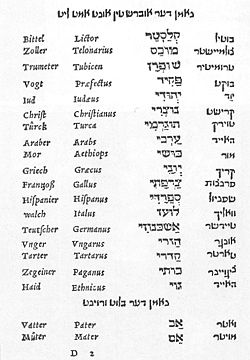
Language
Language may refer either to the specifically human capacity for acquiring and using complex systems of communication, or to a specific instance of such a system of complex communication...
s and dialect
Dialect
The term dialect is used in two distinct ways, even by linguists. One usage refers to a variety of a language that is a characteristic of a particular group of the language's speakers. The term is applied most often to regional speech patterns, but a dialect may also be defined by other factors,...
s that developed in Jewish communities around the world.
Although Hebrew
Hebrew language
Hebrew is a Semitic language of the Afroasiatic language family. Culturally, is it considered by Jews and other religious groups as the language of the Jewish people, though other Jewish languages had originated among diaspora Jews, and the Hebrew language is also used by non-Jewish groups, such...
was the daily speech of the Jewish people for centuries, by the fifth century BCE, the closely related Aramaic joined Hebrew as the spoken language in Judea
Judea
Judea or Judæa was the name of the mountainous southern part of the historic Land of Israel from the 8th century BCE to the 2nd century CE, when Roman Judea was renamed Syria Palaestina following the Jewish Bar Kokhba revolt.-Etymology:The...
and by the third century BCE Jews of the diaspora were speaking Greek
Ancient Greek
Ancient Greek is the stage of the Greek language in the periods spanning the times c. 9th–6th centuries BC, , c. 5th–4th centuries BC , and the c. 3rd century BC – 6th century AD of ancient Greece and the ancient world; being predated in the 2nd millennium BC by Mycenaean Greek...
, and soon afterwards Hebrew was no longer used as a mother tongue - for over sixteen centuries being used almost exclusively as a liturgical language until revived as a spoken language by Eliezer ben Yehuda in the Palestine
Palestine
Palestine is a conventional name, among others, used to describe the geographic region between the Mediterranean Sea and the Jordan River, and various adjoining lands....
of the late 1880s and eventually becoming the official language of the state of Israel
Israel
The State of Israel is a parliamentary republic located in the Middle East, along the eastern shore of the Mediterranean Sea...
.
For centuries Jews worldwide spoke the local or dominant languages of the regions they migrated to, often developing distinctive dialect
Dialect
The term dialect is used in two distinct ways, even by linguists. One usage refers to a variety of a language that is a characteristic of a particular group of the language's speakers. The term is applied most often to regional speech patterns, but a dialect may also be defined by other factors,...
al forms or branching off as independent languages.
The usual course of development for these languages was through the addition of Hebrew
Hebrew language
Hebrew is a Semitic language of the Afroasiatic language family. Culturally, is it considered by Jews and other religious groups as the language of the Jewish people, though other Jewish languages had originated among diaspora Jews, and the Hebrew language is also used by non-Jewish groups, such...
words and phrases used to express uniquely Jewish concepts and concerns. Often they were written in Hebrew letters, including the block letters used in Hebrew today and Rashi script
Rashi script
Rashi script is a semi-cursive typeface for the Hebrew alphabet. It is named for the author of the most famous rabbinic commentary on the Hebrew Bible and the Talmud, Rashi, and is customarily used for printing his commentaries. The typeface is based on 15th century Sephardic semi-cursive...
. Due to the insular nature of many Jewish communities, many Jewish languages retained archaic vocabulary and linguistic structures of the language from which they descended long after they had been lost or changed in later forms of the parent language.
Among the most widely spoken Jewish languages to develop in the diaspora are Yiddish
Yiddish language
Yiddish is a High German language of Ashkenazi Jewish origin, spoken throughout the world. It developed as a fusion of German dialects with Hebrew, Aramaic, Slavic languages and traces of Romance languages...
, Ladino, and the Judæo-Arabic
Judeo-Arabic languages
The Judeo-Arabic languages , are a continuum of Arabic dialects spoken by Jews living or formerly living in the Arab world; the term also refers more or less to Classical Arabic written in the Hebrew script, particularly in the Middle Ages. Just as with the rest of the Arab world, Arab Jews had...
group of languages. Yiddish
Yiddish language
Yiddish is a High German language of Ashkenazi Jewish origin, spoken throughout the world. It developed as a fusion of German dialects with Hebrew, Aramaic, Slavic languages and traces of Romance languages...
is the Judeo-German language developed by Ashkenazi Jews
Ashkenazi Jews
Ashkenazi Jews, also known as Ashkenazic Jews or Ashkenazim , are the Jews descended from the medieval Jewish communities along the Rhine in Germany from Alsace in the south to the Rhineland in the north. Ashkenaz is the medieval Hebrew name for this region and thus for Germany...
who migrated to Central Europe
Central Europe
Central Europe or alternatively Middle Europe is a region of the European continent lying between the variously defined areas of Eastern and Western Europe...
, and Ladino, also called Judezmo and Muestra Spanyol, is the Judeo-Spanish language developed by Sephardic
Sephardi Jews
Sephardi Jews is a general term referring to the descendants of the Jews who lived in the Iberian Peninsula before their expulsion in the Spanish Inquisition. It can also refer to those who use a Sephardic style of liturgy or would otherwise define themselves in terms of the Jewish customs and...
Jews who lived in the Iberian peninsula
Iberian Peninsula
The Iberian Peninsula , sometimes called Iberia, is located in the extreme southwest of Europe and includes the modern-day sovereign states of Spain, Portugal and Andorra, as well as the British Overseas Territory of Gibraltar...
.
Many ancient and distinct Jewish languages, including Gruzinic
Gruzinic
Judaeo-Georgian is the traditional language spoken by the Georgian Jews, the ancient Jewish community of the Caucasus nation of Georgia.-Relationship to other languages:...
, Judeo-Arabic
Judeo-Arabic languages
The Judeo-Arabic languages , are a continuum of Arabic dialects spoken by Jews living or formerly living in the Arab world; the term also refers more or less to Classical Arabic written in the Hebrew script, particularly in the Middle Ages. Just as with the rest of the Arab world, Arab Jews had...
, Judeo-Berber
Judeo-Berber language
Judeo-Berber , is a term used primarily for the Berber varieties traditionally spoken by the Jewish communities of certain parts of central and southern Morocco. Speakers emigrated to Israel in the 1950s and 1960s. While mutually comprehensible with the Tamazight spoken by most inhabitants of the...
, Krymchak
Krymchak language
The Krymchak language is a Turkic language spoken in Crimea by the Krymchak people. It is often considered to be a Crimean Tatar dialect. The language is sometimes referred to as Judeo-Crimean Tatar....
and Judeo-Malayalam
Judeo-Malayalam
Judeo-Malayalam is the traditional language of the Cochin Jews , from Kerala, in southern India, spoken today by a few dozens of people in Israel and by probably fewer than 25 in India....
have largely fallen out of use due the impact of the Holocaust
The Holocaust
The Holocaust , also known as the Shoah , was the genocide of approximately six million European Jews and millions of others during World War II, a programme of systematic state-sponsored murder by Nazi...
on European Jewry, the Jewish exodus from Arab lands
Jewish exodus from Arab lands
The Jewish exodus from Arab and Muslim countries was a mass departure, flight and expulsion of Jews, primarily of Sephardi and Mizrahi background, from Arab and Muslim countries, from 1948 until the early 1970s...
, the assimilation policies of Israel in its early days and other factors.
Yiddish is the language spoken by the largest number of Jews in history, followed closely by English and then Hebrew, but today the three most commonly spoken languages among Jews are English, modern Hebrew, and Russian—in that order.
Background
.jpg)
Torah
Torah- A scroll containing the first five books of the BibleThe Torah , is name given by Jews to the first five books of the bible—Genesis , Exodus , Leviticus , Numbers and Deuteronomy Torah- A scroll containing the first five books of the BibleThe Torah , is name given by Jews to the first five...
and Tanakh
Tanakh
The Tanakh is a name used in Judaism for the canon of the Hebrew Bible. The Tanakh is also known as the Masoretic Text or the Miqra. The name is an acronym formed from the initial Hebrew letters of the Masoretic Text's three traditional subdivisions: The Torah , Nevi'im and Ketuvim —hence...
(i.e. the Hebrew Bible
Hebrew Bible
The Hebrew Bible is a term used by biblical scholars outside of Judaism to refer to the Tanakh , a canonical collection of Jewish texts, and the common textual antecedent of the several canonical editions of the Christian Old Testament...
) written almost entirely in Biblical Hebrew, with a small amount of Biblical Aramaic
Biblical Aramaic
Biblical Aramaic is the form of the Aramaic language that is used in the books of Daniel, Ezra and a few other places in the Hebrew Bible and should not be confused with the Aramaic translations of the Hebrew Bible known as targumim....
, and widely used by Jews during their history. Jews zealously studied these detailed Hebrew texts, observed the commandments
613 mitzvot
The 613 commandments is a numbering of the statements and principles of law, ethics, and spiritual practice contained in the Torah or Five Books of Moses...
formulated in them, based their prayers
Jewish services
Jewish prayer are the prayer recitations that form part of the observance of Judaism. These prayers, often with instructions and commentary, are found in the siddur, the traditional Jewish prayer book....
on them, and spoke its language. Jews maintained a belief that Hebrew was God's "language" as well (as it was the language God uses in the Torah itself), hence its name "lashon hakodesh" ("Holy language" or "tongue").
The earliest surviving Hebrew inscription, the Gezer calendar
Gezer calendar
The Gezer calendar is a tablet of soft limestone inscription, dating to the 10th century BCE. Scholars are divided as to whether the script and language are Phoenician or paleo-Hebrew, which were linguistically very similar in this period....
, dates from the 10th century BCE; it was written in the so-called Paleo-Hebrew alphabet
Paleo-Hebrew alphabet
The Paleo-Hebrew alphabet , is an abjad offshoot of the ancient Semitic alphabet, identical to the Phoenician alphabet. At the very least it dates to the 10th century BCE...
(ktav ivrit), which continued to be used through the time of Solomon's Temple
Solomon's Temple
Solomon's Temple, also known as the First Temple, was the main temple in ancient Jerusalem, on the Temple Mount , before its destruction by Nebuchadnezzar II after the Siege of Jerusalem of 587 BCE....
until changed to the new "Assyrian lettering" (ktav ashurit), the "square-script", by Ezra the Scribe
Ezra
Ezra , also called Ezra the Scribe and Ezra the Priest in the Book of Ezra. According to the Hebrew Bible he returned from the Babylonian exile and reintroduced the Torah in Jerusalem...
following the Babylonian Exile. During this time there were also changes in the language, as it developed towards Mishnaic Hebrew. Until then, most Jews had spoken Hebrew
Hebrew language
Hebrew is a Semitic language of the Afroasiatic language family. Culturally, is it considered by Jews and other religious groups as the language of the Jewish people, though other Jewish languages had originated among diaspora Jews, and the Hebrew language is also used by non-Jewish groups, such...
in Israel and Judea, however, by the destruction of the Second Temple
Second Temple
The Jewish Second Temple was an important shrine which stood on the Temple Mount in Jerusalem between 516 BCE and 70 CE. It replaced the First Temple which was destroyed in 586 BCE, when the Jewish nation was exiled to Babylon...
, most had already shifted to speaking Aramaic
Aramaic language
Aramaic is a group of languages belonging to the Afroasiatic language phylum. The name of the language is based on the name of Aram, an ancient region in central Syria. Within this family, Aramaic belongs to the Semitic family, and more specifically, is a part of the Northwest Semitic subfamily,...
, with a significant number in the large diaspora speaking Koine Greek
Koine Greek
Koine Greek is the universal dialect of the Greek language spoken throughout post-Classical antiquity , developing from the Attic dialect, with admixture of elements especially from Ionic....
. To cater for their needs, the Bible had been translated into the Aramaic Targum
Targum
Taekwondo is a Korean martial art and the national sport of South Korea. In Korean, tae means "to strike or break with foot"; kwon means "to strike or break with fist"; and do means "way", "method", or "path"...
and the Greek Septuagint. As Jews emigrated to far-flung countries, and as the languages of the countries they were in changed, they often adopted the local languages, and thus came to speak a great variety of languages. During the early Middle Ages, Aramaic continued to be the principal Jewish language. Most of the Talmud
Talmud
The Talmud is a central text of mainstream Judaism. It takes the form of a record of rabbinic discussions pertaining to Jewish law, ethics, philosophy, customs and history....
is written in Aramaic. Rashi
Rashi
Shlomo Yitzhaki , or in Latin Salomon Isaacides, and today generally known by the acronym Rashi , was a medieval French rabbi famed as the author of a comprehensive commentary on the Talmud, as well as a comprehensive commentary on the Tanakh...
wrote in Hebrew with references to the French language
French language
French is a Romance language spoken as a first language in France, the Romandy region in Switzerland, Wallonia and Brussels in Belgium, Monaco, the regions of Quebec and Acadia in Canada, and by various communities elsewhere. Second-language speakers of French are distributed throughout many parts...
of his day. Later in the Middle Ages, most Jewish literary activity was carried out in Judeo-Arabic, which was Arabic
Arabic language
Arabic is a name applied to the descendants of the Classical Arabic language of the 6th century AD, used most prominently in the Quran, the Islamic Holy Book...
written in the Hebrew alphabet
Hebrew alphabet
The Hebrew alphabet , known variously by scholars as the Jewish script, square script, block script, or more historically, the Assyrian script, is used in the writing of the Hebrew language, as well as other Jewish languages, most notably Yiddish, Ladino, and Judeo-Arabic. There have been two...
; this is the language Maimonides
Maimonides
Moses ben-Maimon, called Maimonides and also known as Mūsā ibn Maymūn in Arabic, or Rambam , was a preeminent medieval Jewish philosopher and one of the greatest Torah scholars and physicians of the Middle Ages...
wrote in.
Hebrew itself remained in vigorous use for religious and official uses such as for all religious events, Responsa
Responsa
Responsa comprise a body of written decisions and rulings given by legal scholars in response to questions addressed to them.-In the Roman Empire:Roman law recognised responsa prudentium, i.e...
, for writing Torah scrolls, and along with Aramaic, retained a position of importance for the writing of marriage contracts and other literary purposes.
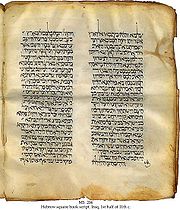
Hebrew language
Hebrew is a Semitic language of the Afroasiatic language family. Culturally, is it considered by Jews and other religious groups as the language of the Jewish people, though other Jewish languages had originated among diaspora Jews, and the Hebrew language is also used by non-Jewish groups, such...
and Aramaic loanword
Loanword
A loanword is a word borrowed from a donor language and incorporated into a recipient language. By contrast, a calque or loan translation is a related concept where the meaning or idiom is borrowed rather than the lexical item itself. The word loanword is itself a calque of the German Lehnwort,...
s and other innovations within the language. Thus were formed a variety of languages specific to the Jewish community; perhaps the most notable of these are Yiddish
Yiddish language
Yiddish is a High German language of Ashkenazi Jewish origin, spoken throughout the world. It developed as a fusion of German dialects with Hebrew, Aramaic, Slavic languages and traces of Romance languages...
in Europe
Europe
Europe is, by convention, one of the world's seven continents. Comprising the westernmost peninsula of Eurasia, Europe is generally 'divided' from Asia to its east by the watershed divides of the Ural and Caucasus Mountains, the Ural River, the Caspian and Black Seas, and the waterways connecting...
(mainly from German
German language
German is a West Germanic language, related to and classified alongside English and Dutch. With an estimated 90 – 98 million native speakers, German is one of the world's major languages and is the most widely-spoken first language in the European Union....
) and Ladino (from Spanish
Spanish language
Spanish , also known as Castilian , is a Romance language in the Ibero-Romance group that evolved from several languages and dialects in central-northern Iberia around the 9th century and gradually spread with the expansion of the Kingdom of Castile into central and southern Iberia during the...
), originally in al-Andalus
Al-Andalus
Al-Andalus was the Arabic name given to a nation and territorial region also commonly referred to as Moorish Iberia. The name describes parts of the Iberian Peninsula and Septimania governed by Muslims , at various times in the period between 711 and 1492, although the territorial boundaries...
but spreading to other locations, mainly around the Mediterranean, due to the 1492 expulsion of practicing Jews from Spain and the persecution by the Inquisition
Inquisition
The Inquisition, Inquisitio Haereticae Pravitatis , was the "fight against heretics" by several institutions within the justice-system of the Roman Catholic Church. It started in the 12th century, with the introduction of torture in the persecution of heresy...
of the converso
Converso
A converso and its feminine form conversa was a Jew or Muslim—or a descendant of Jews or Muslims—who converted to Catholicism in Spain or Portugal, particularly during the 14th and 15th centuries. Mass conversions once took place under significant government pressure...
s.
Jews in the diaspora have tended to live in segregated communities. This segregation was partly enforced on them by the wider communities, and partly by choice in an endeavor to maintain their own culture. These sociological factors contributed to the formation of dialects that often developed and diverged to form separate languages.
At the beginning of the nineteenth century, Yiddish was the main language of Jews in Eastern Europe
Eastern Europe
Eastern Europe is the eastern part of Europe. The term has widely disparate geopolitical, geographical, cultural and socioeconomic readings, which makes it highly context-dependent and even volatile, and there are "almost as many definitions of Eastern Europe as there are scholars of the region"...
(thus making it the language spoken by the majority of Jews in the world), while Ladino was widespread in the Maghreb
Maghreb
The Maghreb is the region of Northwest Africa, west of Egypt. It includes five countries: Morocco, Algeria, Tunisia, Libya, and Mauritania and the disputed territory of Western Sahara...
, Turkey
Turkey
Turkey , known officially as the Republic of Turkey , is a Eurasian country located in Western Asia and in East Thrace in Southeastern Europe...
, Bulgaria
Bulgaria
Bulgaria , officially the Republic of Bulgaria , is a parliamentary democracy within a unitary constitutional republic in Southeast Europe. The country borders Romania to the north, Serbia and Macedonia to the west, Greece and Turkey to the south, as well as the Black Sea to the east...
and Greece
Greece
Greece , officially the Hellenic Republic , and historically Hellas or the Republic of Greece in English, is a country in southeastern Europe....
; smaller groups in Europe spoke such languages as Judeo-Italian
Judeo-Italian languages
Judeo-Italian languages are the varieties of Italian used between the 10th and the 20th centuries in Italy, Corfu and Zante.-The term "Judaeo-Italian":...
, Yevanic
Yevanic language
Yevanic, otherwise known as Judeo-Greek, was the dialect of the Romaniotes, the group of Greek Jews whose existence in Greece is documented since the Hellenistic period. Its linguistic lineage stems from the Hellenistic Koine and includes Hebrew elements as well. It was mutually intelligible with...
, or Karaim
Karaim language
The Karaim language is a Turkic language with Hebrew influences, in a similar manner to Yiddish or Ladino. It is spoken by Crimean Karaites – ethnic Turkic adherents of Karaite Judaism in Crimea, Lithuania, Poland and western Ukraine...
. The Jews of the Arab world
Arab world
The Arab world refers to Arabic-speaking states, territories and populations in North Africa, Western Asia and elsewhere.The standard definition of the Arab world comprises the 22 states and territories of the Arab League stretching from the Atlantic Ocean in the west to the Arabian Sea in the...
spoke Judeo-Arabic
Judeo-Arabic languages
The Judeo-Arabic languages , are a continuum of Arabic dialects spoken by Jews living or formerly living in the Arab world; the term also refers more or less to Classical Arabic written in the Hebrew script, particularly in the Middle Ages. Just as with the rest of the Arab world, Arab Jews had...
varieties, while those of Iran
Iran
Iran , officially the Islamic Republic of Iran , is a country in Southern and Western Asia. The name "Iran" has been in use natively since the Sassanian era and came into use internationally in 1935, before which the country was known to the Western world as Persia...
spoke Dzhidi
Dzhidi language
Judæo-Persian, or Jidi , refers to both a group of Jewish dialects spoken by the Jews living in Iran and Judæo-Persian texts . As a collective term, Dzhidi refers to a number of Iranian languages or dialects spoken by Jewish communities throughout the formerly extensive Persian Empire...
(Judeo-Persian); smaller groups spoke Judeo-Berber, Judeo-Tat
Juhuri language
Juhuri, Juwuri or Judæo-Tat is a form of the Tat language and is the traditional language of the Mountain Jews of the eastern Caucasus Mountains, especially Azerbaijan and Dagestan, now mainly spoken in Israel....
or even, in Kurdistan, Judeo-Aramaic
Judeo-Aramaic language
Judæo-Aramaic is a collective term used to describe several Hebrew-influenced Aramaic and Neo-Aramaic languages.-Early use:Aramaic, like Hebrew, is a Northwest Semitic language, and the two share many features. From the 7th century BCE, Aramaic became the lingua franca of the Middle East...
. The Beta Israel
Beta Israel
Beta Israel Israel, Ge'ez: ቤተ እስራኤል - Bēta 'Isrā'ēl, modern Bēte 'Isrā'ēl, EAE: "Betä Ǝsraʾel", "Community of Israel" also known as Ethiopian Jews , are the names of Jewish communities which lived in the area of Aksumite and Ethiopian Empires , nowadays divided between Amhara and Tigray...
were abandoning their Kayla language
Kayla language
Kayla, or Kayliñña is one of two Agaw dialects formerly spoken by a subgroup of the Beta Israel . It is a dialect of Qimant. The name Kayla is sometimes also used as a cover term for both Beta Israel dialects...
for Amharic
Amharic language
Amharic is a Semitic language spoken in Ethiopia. It is the second most-spoken Semitic language in the world, after Arabic, and the official working language of the Federal Democratic Republic of Ethiopia. Thus, it has official status and is used nationwide. Amharic is also the official or working...
, while the Cochin Jews
Cochin Jews
Cochin Jews, also called Malabar Jews , are the oldest group of Jews in India, with roots claimed to date to the time of King Solomon, though historically attested migration dates from the fall of Jerusalem in 70 CE. Historically, they lived in the Kingdom of Cochin in South India, now part of the...
continued to speak Malayalam
Malayalam language
Malayalam , is one of the four major Dravidian languages of southern India. It is one of the 22 scheduled languages of India with official language status in the state of Kerala and the union territories of Lakshadweep and Pondicherry. It is spoken by 35.9 million people...
.
Contemporary trends
This broad picture was substantially modified by major historical shifts beginning in the late nineteenth century. The immigration of millions of European Jews to North America caused a dramatic increase in the number of Jewish English-speakers; colonialismColonialism
Colonialism is the establishment, maintenance, acquisition and expansion of colonies in one territory by people from another territory. It is a process whereby the metropole claims sovereignty over the colony and the social structure, government, and economics of the colony are changed by...
in the Maghreb
Maghreb
The Maghreb is the region of Northwest Africa, west of Egypt. It includes five countries: Morocco, Algeria, Tunisia, Libya, and Mauritania and the disputed territory of Western Sahara...
led most of its Jews to shift to French
French language
French is a Romance language spoken as a first language in France, the Romandy region in Switzerland, Wallonia and Brussels in Belgium, Monaco, the regions of Quebec and Acadia in Canada, and by various communities elsewhere. Second-language speakers of French are distributed throughout many parts...
or Spanish
Spanish language
Spanish , also known as Castilian , is a Romance language in the Ibero-Romance group that evolved from several languages and dialects in central-northern Iberia around the 9th century and gradually spread with the expansion of the Kingdom of Castile into central and southern Iberia during the...
; Zionism
Zionism
Zionism is a Jewish political movement that, in its broadest sense, has supported the self-determination of the Jewish people in a sovereign Jewish national homeland. Since the establishment of the State of Israel, the Zionist movement continues primarily to advocate on behalf of the Jewish state...
revived Hebrew
Hebrew language
Hebrew is a Semitic language of the Afroasiatic language family. Culturally, is it considered by Jews and other religious groups as the language of the Jewish people, though other Jewish languages had originated among diaspora Jews, and the Hebrew language is also used by non-Jewish groups, such...
as a spoken language, giving it a substantially increased vocabulary and a simplified sound system; the Holocaust eradicated the vast majority of Yiddish- and German-speaking European Jews; and the Arab-Israeli conflict led many Jews to leave the Arab world for other countries (mainly Hebrew-speaking Israel and French-speaking France), whose languages they largely adopted.
Jews today speak a large variety of languages, typically adopting the languages of their countries of residence. The largest single language spoken by Jews is English
English language
English is a West Germanic language that arose in the Anglo-Saxon kingdoms of England and spread into what was to become south-east Scotland under the influence of the Anglian medieval kingdom of Northumbria...
: The second largest Jewish population in the world is in the United States
United States
The United States of America is a federal constitutional republic comprising fifty states and a federal district...
, and there are also large, substantial communities in Canada
Canada
Canada is a North American country consisting of ten provinces and three territories. Located in the northern part of the continent, it extends from the Atlantic Ocean in the east to the Pacific Ocean in the west, and northward into the Arctic Ocean...
(a majority of Canadian Jews speak English, not French), the United Kingdom
United Kingdom
The United Kingdom of Great Britain and Northern IrelandIn the United Kingdom and Dependencies, other languages have been officially recognised as legitimate autochthonous languages under the European Charter for Regional or Minority Languages...
, Australia
Australia
Australia , officially the Commonwealth of Australia, is a country in the Southern Hemisphere comprising the mainland of the Australian continent, the island of Tasmania, and numerous smaller islands in the Indian and Pacific Oceans. It is the world's sixth-largest country by total area...
, and South Africa
South Africa
The Republic of South Africa is a country in southern Africa. Located at the southern tip of Africa, it is divided into nine provinces, with of coastline on the Atlantic and Indian oceans...
. Ireland
Ireland
Ireland is an island to the northwest of continental Europe. It is the third-largest island in Europe and the twentieth-largest island on Earth...
, New Zealand
New Zealand
New Zealand is an island country in the south-western Pacific Ocean comprising two main landmasses and numerous smaller islands. The country is situated some east of Australia across the Tasman Sea, and roughly south of the Pacific island nations of New Caledonia, Fiji, and Tonga...
, and some islands of the Caribbean
Caribbean
The Caribbean is a crescent-shaped group of islands more than 2,000 miles long separating the Gulf of Mexico and the Caribbean Sea, to the west and south, from the Atlantic Ocean, to the east and north...
, also have small Jewish communities which speak predominantly English.
English is closely followed by Modern Hebrew
Hebrew language
Hebrew is a Semitic language of the Afroasiatic language family. Culturally, is it considered by Jews and other religious groups as the language of the Jewish people, though other Jewish languages had originated among diaspora Jews, and the Hebrew language is also used by non-Jewish groups, such...
, the spoken language in Israel, and by Israeli emigrants who live in other countries. Hebrew is the language of daily life in Israel, though a substantial proportion of the country's citizens are immigrants who speak it as their second language.
After English and Hebrew, the next largest language spoken by large populations of Jews is Russian
Russian language
Russian is a Slavic language used primarily in Russia, Belarus, Uzbekistan, Kazakhstan, Tajikistan and Kyrgyzstan. It is an unofficial but widely spoken language in Ukraine, Moldova, Latvia, Turkmenistan and Estonia and, to a lesser extent, the other countries that were once constituent republics...
, with perhaps two million speakers from the former Soviet Union, a majority of whom now live in Israel
Israel
The State of Israel is a parliamentary republic located in the Middle East, along the eastern shore of the Mediterranean Sea...
. Approximately 1 million Israelis speak Russian fluently.
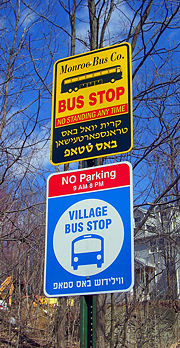
France
The French Republic , The French Republic , The French Republic , (commonly known as France , is a unitary semi-presidential republic in Western Europe with several overseas territories and islands located on other continents and in the Indian, Pacific, and Atlantic oceans. Metropolitan France...
and Quebec
Quebec
Quebec or is a province in east-central Canada. It is the only Canadian province with a predominantly French-speaking population and the only one whose sole official language is French at the provincial level....
, most of them immigrants from North Africa
North Africa
North Africa or Northern Africa is the northernmost region of the African continent, linked by the Sahara to Sub-Saharan Africa. Geopolitically, the United Nations definition of Northern Africa includes eight countries or territories; Algeria, Egypt, Libya, Morocco, South Sudan, Sudan, Tunisia, and...
who originally spoke Maghrebi Arabic or Ladino; however, most of them had already switched language before leaving North Africa. Spanish and Portuguese are spoken by large Jewish communities in Central and South America; Buenos Aires
Buenos Aires
Buenos Aires is the capital and largest city of Argentina, and the second-largest metropolitan area in South America, after São Paulo. It is located on the western shore of the estuary of the Río de la Plata, on the southeastern coast of the South American continent...
has a large Jewish community. A substantial number of current immigrants to Israel speak French or Spanish as their mother tongue.Yiddish
Yiddish language
Yiddish is a High German language of Ashkenazi Jewish origin, spoken throughout the world. It developed as a fusion of German dialects with Hebrew, Aramaic, Slavic languages and traces of Romance languages...
continues to be spoken by older generations of Jews, as well as by four to six hundred thousand individuals in Haredi communities. Although the number of older speakers is continually decreasing, there is revived interest in Yiddish in academia and the arts; and the populations of Yiddish-speaking Hasidic communities are growing, especially among younger generations.
Thus Yiddish, once the language of the majority of the world's Jews, continues to be spoken, as are nearly all the languages discussed in the preceding section. However, some of these languages, notably Judeo-Arabic and Ladino, are considered to be gravely endangered.
Radio Broadcasts
Kol Israel (Israel's public service broadcaster) has long maintained daily short news and features programming in many Jewish languages and dialects. For domestic audiences it broadcast in Iraqi Jewish Arabic (Yahudi) on its Arabic network. While producing: Yiddish, Ladino, Moroccan Jewish Arabic (Mughrabi or Marocayit), Bukharian (Central Asian Dialect) and Judeo-Tat for both to domestic and overseas shortwave audiences in relevant areas. In addition, for over two decades from the late 1970s a daily 30 minute shortwave transmission was made to Yemen in Yemenite Jewish Arabic.Radio Exterior de España
Radio Exterior de España
Radio Exterior de España is a Spanish international radio station operated by Radio Nacional de España. The station is primarily intended for Spaniards living abroad. It broadcasts 24-hours a day on short-wave radio, satellite and the Internet. Transmissions are in Spanish, French, Arabic, Ladino,...
the Spanish International Public broadcaster provides programming in Ladino, which they refer to as Sefardi.
In the United States there are some local radio programs in Yiddish as there are also in Birobidzhan
Birobidzhan
Birobidzhan is a town and the administrative center of the Jewish Autonomous Oblast, Russia. It is located on the Trans-Siberian railway, close to the border with the People's Republic of China....
in Russia.
Alphabets
The Hebrew alphabet has also been used to transcribe a number of languages including ArabicJudeo-Arabic languages
The Judeo-Arabic languages , are a continuum of Arabic dialects spoken by Jews living or formerly living in the Arab world; the term also refers more or less to Classical Arabic written in the Hebrew script, particularly in the Middle Ages. Just as with the rest of the Arab world, Arab Jews had...
, English, French, Spanish (as opposed to Ladino), German (as distinct from Yiddish) and Greek. While not common, such practice has occurred intermittently over the last two thousand years, and probably was part of the basis of such languages as Ladino and Yiddish.
Conversely, Ladino, formerly written in Rashi script, since the 1920 is usually written in Turkey in the Latin alphabet with a spelling similar to that of Turkish
Turkish alphabet
The Turkish alphabet is a Latin alphabet used for writing the Turkish language, consisting of 29 letters, seven of which have been modified from their Latin originals for the phonetic requirements of the language. This alphabet represents modern Turkish pronunciation with a high degree of accuracy...
, and has been occasionally printed in the Greek and Cyrillic alphabets.
Soviet authorities tried to promote the Cyrillic alphabet for Yiddish in the Jewish Autonomous Oblast
Jewish Autonomous Oblast
The Jewish Autonomous Oblast is a federal subject of Russia situated in the Russian Far East, bordering Khabarovsk Krai and Amur Oblast of Russia and Heilongjiang province of China. Its administrative center is the town of Birobidzhan....
.
Also, some Yiddish-speakers have adopted the use of the Latin alphabet, in place of the Hebrew alphabet. This is predominantly to enable communications over the internet, without the need for special Hebrew keyboards.
Afro-Asiatic languages
- Semitic: HebrewHebrew languageHebrew is a Semitic language of the Afroasiatic language family. Culturally, is it considered by Jews and other religious groups as the language of the Jewish people, though other Jewish languages had originated among diaspora Jews, and the Hebrew language is also used by non-Jewish groups, such...
, AramaicAramaic languageAramaic is a group of languages belonging to the Afroasiatic language phylum. The name of the language is based on the name of Aram, an ancient region in central Syria. Within this family, Aramaic belongs to the Semitic family, and more specifically, is a part of the Northwest Semitic subfamily,...
(referred to as Jewish Aramaic or Talmudic Aramaic), Jewish Babylonian AramaicJewish Babylonian AramaicJewish Babylonian Aramaic was the form of Middle Aramaic employed by Jewish writers in Babylonia between the 4th century and the 11th century CE. It is most commonly identified with the language of the Babylonian Talmud and of post-Talmudic literature, which are the most important cultural...
, Neo-AramaicNeo-Aramaic languagesNeo-Aramaic, or Modern Aramaic, languages are varieties of Aramaic that are spoken vernaculars in the medieval to modern era, evolving out of Middle Aramaic dialects around AD 1200 ....
(dialects include: Lishanid NoshanLishanid NoshanLishanid Noshan is a modern Jewish Aramaic language, often called Neo-Aramaic or Judeo-Aramaic. It was originally spoken in southern and eastern Iraq, in the region of Arbil. Most speakers now live in Israel. Lishanid Noshan means 'the language of our selves'; speakers often also call it Lishana...
, Lishanid Janan, Lishana Noshan, Lishana DeniLishana DeniLishana Deni is a modern Jewish Aramaic language, often called Neo-Aramaic or Judeo-Aramaic. It was originally spoken in the town of Zakho and its surrounding villages in northern Iraq, on the border with Turkey. Most speakers now live in and around Jerusalem...
, Lishan DidanLishán DidánLishán Didán is a modern Jewish Aramaic language, often called Neo-Aramaic or Judeo-Aramaic. It was originally spoken in Iranian Azerbaijan, in the region of Lake Urmia, from Salmas to Mahabad. Most speakers now live in Israel...
), Judeo-Arabic (many dialects, including: Judeo-Iraqi all are qeltu Arabic dialects), Judeo-MoroccanJudeo-MoroccanJudeo-Moroccan Arabic is a variety of Arabic spoken by Jews living or formerly living in Morocco. The vast majority of all current speakers now live in France and Israel...
, Judeo-YemeniteJudeo-YemeniteJudeo-Yemeni Arabic is a variety of Arabic spoken by Jews living or formerly living in Yemen. 50,000 speakers now live in Israel, 1,000 remain in Yemen. The language is quite different from mainstream Yemeni Arabic. The language may be split into the subdialects of San`a, `Aden, Be:da, and Habban....
, Judeo-Libyan, Judeo-Algerian, also several Judeo-Arabic dialects spoken in northern Syria and Iraq. - Berber: Judeo-Berber
- Cushitic: KaylaKayla languageKayla, or Kayliñña is one of two Agaw dialects formerly spoken by a subgroup of the Beta Israel . It is a dialect of Qimant. The name Kayla is sometimes also used as a cover term for both Beta Israel dialects...
(QwaraQwara languageQwara, or Qwareña , is one of two Agaw dialects formerly spoken by a subgroup of the Beta Israel of the Qwara area. It is a dialect of Qimant....
), Kaïliña
Indo-European languages
- GermanicGermanic languagesThe Germanic languages constitute a sub-branch of the Indo-European language family. The common ancestor of all of the languages in this branch is called Proto-Germanic , which was spoken in approximately the mid-1st millennium BC in Iron Age northern Europe...
: Yiddish, YinglishYinglishYinglish words are neologisms created by speakers of Yiddish in English-speaking countries, sometimes to describe things that were uncommon in the old country...
, Yeshivish, Klezmer-loshnKlezmer-loshnKlezmer-loshn is an extinct derivative of the Yiddish language. It was a slang or argot used by travelling Jewish musicians, known as klezmorim , in Eastern Europe prior to the 20th century....
, Judendeutsch (German in Hebrew characters which the Rothschilds communicated with), "Scots Yiddish" - ItalicItalic languagesThe Italic subfamily is a member of the Indo-European language family. It includes the Romance languages derived from Latin , and a number of extinct languages of the Italian Peninsula, including Umbrian, Oscan, Faliscan, and Latin.In the past various definitions of "Italic" have prevailed...
: Judeo-LatinJudeo-LatinJudeo-Latin, or La‘az is the presumed Jewish language of the many scattered Jewish communities of the former Roman Empire, but especially by the Jewish communities of the Italian Peninsula and Transalpine Gaul...
and its putative descendants, the Judeo-Romance languagesJudeo-Romance languagesJudaeo-Romance languages are Jewish languages derived from Romance languages, spoken by various Jewish communities originating in regions where Romance languages predominate, and altered to such an extent to gain recognition as languages in their own right.-Judaeo-Catalan or Catalanic:Catalanic,...
: Ladino, Shuadit (Judeo-Provençal), Zarphatic (Judeo-French), Judeo-PortugueseJudeo-PortugueseJudaeo-Portuguese, Lusitanic, or "Lusitanico" in Judaeo-Portuguese is the generally extinct Jewish language of the Jews of Portugal.-Description:...
, Judeo-ItalianJudeo-Italian languagesJudeo-Italian languages are the varieties of Italian used between the 10th and the 20th centuries in Italy, Corfu and Zante.-The term "Judaeo-Italian":...
, Judeo-PiedmonteseJudæo-PiedmonteseJudæo-Piedmontese was the vernacular language of the Jews living in Piedmont, in North Western Italy, from about the 15th Century until the Second World War....
, Bagitto (Jewish LivorneseLivornoLivorno , traditionally Leghorn , is a port city on the Tyrrhenian Sea on the western edge of Tuscany, Italy. It is the capital of the Province of Livorno, having a population of approximately 160,000 residents in 2009.- History :...
dialect), CatalanicCatalanicJudaeo-Catalan , also called Catalanic or Qatalanit , was a Jewish language spoken by the Jewish communities in the northeastern Iberian Peninsula, especially in Catalonia and the Balearic Islands...
(Judeo-Catalan), Judeo-AragoneseJudeo-AragoneseJudaeo-Aragonese was a Judaeo-Romance language , spoken in north central Iberia from the around the mid-700s until about the time of the expulsion from Spain, when it either merged with the various Judeo-Spanish dialects, or fell out of use in favor of the far more influential Judaeo-Spanish... - SlavicSlavic languagesThe Slavic languages , a group of closely related languages of the Slavic peoples and a subgroup of Indo-European languages, have speakers in most of Eastern Europe, in much of the Balkans, in parts of Central Europe, and in the northern part of Asia.-Branches:Scholars traditionally divide Slavic...
: Knaanic (Judeo-Czech) - Greek: Yevanic (Judeo-Greek)
- Indo-IranianIndo-Iranian languagesThe Indo-Iranian language group constitutes the easternmost extant branch of the Indo-European family of languages. It consists of three language groups: the Indo-Aryan, Iranian and Nuristani...
(Judeo-Persian languages and Indo-Aryan languagesIndo-Aryan languagesThe Indo-Aryan languages constitutes a branch of the Indo-Iranian languages, itself a branch of the Indo-European language family...
): DzhidiDzhidi languageJudæo-Persian, or Jidi , refers to both a group of Jewish dialects spoken by the Jews living in Iran and Judæo-Persian texts . As a collective term, Dzhidi refers to a number of Iranian languages or dialects spoken by Jewish communities throughout the formerly extensive Persian Empire...
(Judeo-Persian), Bukhori, Judeo-Golpaygani, Judeo-Yazdi, Judeo-Kermani, Judeo-ShiraziJudeo-ShiraziJudeo-Shirazi is a dialect form of the Persian language. It is spoken mostly by Persian Jews living in Shiraz and surrounding areas of the Fars Province in Iran.-External links:*...
, Judeo-Esfahani, Judeo-Hamedani, Judeo-Kashani, Judeo-Borujerdi, Judeo-Nehevandi, Judeo-Khunsari, Juhuri languageJuhuri languageJuhuri, Juwuri or Judæo-Tat is a form of the Tat language and is the traditional language of the Mountain Jews of the eastern Caucasus Mountains, especially Azerbaijan and Dagestan, now mainly spoken in Israel....
(Judeo-Tat), Judeo-Marathi
Turkic
- KrymchakKrymchak languageThe Krymchak language is a Turkic language spoken in Crimea by the Krymchak people. It is often considered to be a Crimean Tatar dialect. The language is sometimes referred to as Judeo-Crimean Tatar....
(Judeo-Tartar) - Karaim languageKaraim languageThe Karaim language is a Turkic language with Hebrew influences, in a similar manner to Yiddish or Ladino. It is spoken by Crimean Karaites – ethnic Turkic adherents of Karaite Judaism in Crimea, Lithuania, Poland and western Ukraine...
(Spoken by the Karaites of Crimea and Lithuania)
Alphabetical list
- BukhoriBukhori languageBukhori is a unique dialect of the Persian language spoken in Central Asia by the Bukharian Jews. Hence, a more descriptive name for the language might be Judæo-Persian or Judæo-Tajik....
(Judeo-Tajiki-Persian) - CatalanicCatalanicJudaeo-Catalan , also called Catalanic or Qatalanit , was a Jewish language spoken by the Jewish communities in the northeastern Iberian Peninsula, especially in Catalonia and the Balearic Islands...
- DzhidiDzhidi languageJudæo-Persian, or Jidi , refers to both a group of Jewish dialects spoken by the Jews living in Iran and Judæo-Persian texts . As a collective term, Dzhidi refers to a number of Iranian languages or dialects spoken by Jewish communities throughout the formerly extensive Persian Empire...
(Judeo-Persian) - GruzinicGruzinicJudaeo-Georgian is the traditional language spoken by the Georgian Jews, the ancient Jewish community of the Caucasus nation of Georgia.-Relationship to other languages:...
(Judeo-Georgian) - HulaulaHulaulá languageHulaulá , is a modern Jewish Aramaic language, often called Neo-Aramaic or Judeo-Aramaic. It was originally spoken in Iranian Kurdistan. Most speakers now live in Israel. The name Hulaulá simply means 'Jewish'. Speakers sometimes call their language Lishana Noshan or Lishana Akhni, both of which...
- Judeo-ItalianJudeo-Italian languagesJudeo-Italian languages are the varieties of Italian used between the 10th and the 20th centuries in Italy, Corfu and Zante.-The term "Judaeo-Italian":...
(Judeo-Italian) - Judeo-Arabic
- Judeo-AragoneseJudeo-AragoneseJudaeo-Aragonese was a Judaeo-Romance language , spoken in north central Iberia from the around the mid-700s until about the time of the expulsion from Spain, when it either merged with the various Judeo-Spanish dialects, or fell out of use in favor of the far more influential Judaeo-Spanish...
- Judeo-AramaicJudeo-Aramaic languageJudæo-Aramaic is a collective term used to describe several Hebrew-influenced Aramaic and Neo-Aramaic languages.-Early use:Aramaic, like Hebrew, is a Northwest Semitic language, and the two share many features. From the 7th century BCE, Aramaic became the lingua franca of the Middle East...
- Judeo-BerberJudeo-Berber languageJudeo-Berber , is a term used primarily for the Berber varieties traditionally spoken by the Jewish communities of certain parts of central and southern Morocco. Speakers emigrated to Israel in the 1950s and 1960s. While mutually comprehensible with the Tamazight spoken by most inhabitants of the...
- Judeo-PiedmonteseJudæo-PiedmonteseJudæo-Piedmontese was the vernacular language of the Jews living in Piedmont, in North Western Italy, from about the 15th Century until the Second World War....
- Judeo-PortugueseJudeo-PortugueseJudaeo-Portuguese, Lusitanic, or "Lusitanico" in Judaeo-Portuguese is the generally extinct Jewish language of the Jews of Portugal.-Description:...
- Judeo-Marathi Marathi
- Judeo-MalayalamJudeo-MalayalamJudeo-Malayalam is the traditional language of the Cochin Jews , from Kerala, in southern India, spoken today by a few dozens of people in Israel and by probably fewer than 25 in India....
- JuhuriJuhuri languageJuhuri, Juwuri or Judæo-Tat is a form of the Tat language and is the traditional language of the Mountain Jews of the eastern Caucasus Mountains, especially Azerbaijan and Dagestan, now mainly spoken in Israel....
(Judeo-Tat) - KaylaKayla languageKayla, or Kayliñña is one of two Agaw dialects formerly spoken by a subgroup of the Beta Israel . It is a dialect of Qimant. The name Kayla is sometimes also used as a cover term for both Beta Israel dialects...
- KaraimKaraim languageThe Karaim language is a Turkic language with Hebrew influences, in a similar manner to Yiddish or Ladino. It is spoken by Crimean Karaites – ethnic Turkic adherents of Karaite Judaism in Crimea, Lithuania, Poland and western Ukraine...
- Knaanic (Judeo-Czech)
- KrymchakKrymchak languageThe Krymchak language is a Turkic language spoken in Crimea by the Krymchak people. It is often considered to be a Crimean Tatar dialect. The language is sometimes referred to as Judeo-Crimean Tatar....
(Judeo-Crimean-Tatar) - Ladino (Judeo-Spanish)
- Lishán DidánLishán DidánLishán Didán is a modern Jewish Aramaic language, often called Neo-Aramaic or Judeo-Aramaic. It was originally spoken in Iranian Azerbaijan, in the region of Lake Urmia, from Salmas to Mahabad. Most speakers now live in Israel...
- Lishana DeniLishana DeniLishana Deni is a modern Jewish Aramaic language, often called Neo-Aramaic or Judeo-Aramaic. It was originally spoken in the town of Zakho and its surrounding villages in northern Iraq, on the border with Turkey. Most speakers now live in and around Jerusalem...
- Lishanid NoshanLishanid NoshanLishanid Noshan is a modern Jewish Aramaic language, often called Neo-Aramaic or Judeo-Aramaic. It was originally spoken in southern and eastern Iraq, in the region of Arbil. Most speakers now live in Israel. Lishanid Noshan means 'the language of our selves'; speakers often also call it Lishana...
- Shuadit (Judeo-Provençal)
- TigrinyaTigrinya languageTigrinya , also spelled Tigrigna, Tigrnia, Tigrina, Tigriña, less commonly Tigrinian, Tigrinyan, is a Semitic language spoken by the Tigrinya people in central Eritrea , where it is one of the two main languages of Eritrea, and in the Tigray Region of Ethiopia , where it...
(Judeo-Tigray) - Yevanic (Judeo-Greek)
- YiddishYiddish languageYiddish is a High German language of Ashkenazi Jewish origin, spoken throughout the world. It developed as a fusion of German dialects with Hebrew, Aramaic, Slavic languages and traces of Romance languages...
(Judeo-German) - Zarphatic (Judeo-French)
Sources
Connerty, Mary C. Judeo-Greek: The Language, The Culture. Jay Street Publishing, 2003. ISBN 1-889534-88-9External links
- Jewish Language Research Website from Jewish-languages.org
- The Lily Center for Jewish Languages and Literatures at Harvard University
- WW2 propaganda leaflets: A website about airdropped, shelled or rocket fired propaganda leaflets. Allied propaganda leaflet for Moroccan Jews in Judeo-Arabic language.
- Jewish languages dying out
- Jewish Languages of Europe
- Hebrew (Jewish) languages: Ivrit, Yiddish