
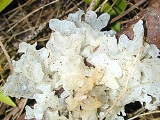
The class
Heterobasidiomycetes or
jelly fungi is a paraphyletic group of several fungal orders:
TremellalesThe Tremellales are an order of fungi in the class Tremellomycetes. The order contains both teleomorphic and anamorphic species, most of the latter being yeasts. All teleomorphic species in the Tremellales are parasites of other fungi, though the yeast states are widespread and not restricted to...
,
AuricularialesThe Auriculariales are an order of fungi in the class Agaricomycetes. Species within the order were formerly referred to the "heterobasidiomycetes" or "jelly fungi", since many have gelatinous basidiocarps that produce spores on septate basidia...
, Dacrymycetales. These fungi are so named because their foliose to irregularly branched
fruiting bodyA mushroom is the fleshy, spore-bearing fruiting body of a fungus, typically produced above ground on soil or on its food source. The standard for the name "mushroom" is the cultivated white button mushroom, Agaricus bisporus; hence the word "mushroom" is most often applied to those fungi that...
is, or appears to be, the consistency of jelly. Actually, many are somewhat rubbery and gelatinous. When dried, jelly fungi become hard and shriveled; when exposed to
waterWater is a chemical substance with the chemical formula H2O. A water molecule contains one oxygen and two hydrogen atoms connected by covalent bonds. Water is a liquid at ambient conditions, but it often co-exists on Earth with its solid state, ice, and gaseous state . Water also exists in a...
, they return to their original form.
A number of the jelly fungi can be eaten raw; poisonous jelly fungi are rare. However, many species have an unpalatable texture or taste. They may or may not be sought in
mushroom huntingMushroom hunting, mushrooming, mushroom picking, and similar terms describe the activity of gathering mushrooms in the wild, typically for eating...
due to their
tasteTaste is one of the traditional five senses. It refers to the ability to detect the flavor of substances such as food, certain minerals, and poisons, etc....
, which is described as similar to that of
soilSoil is a natural body consisting of layers of mineral constituents of variable thicknesses, which differ from the parent materials in their morphological, physical, chemical, and mineralogical characteristics...
. However, some species,
Tremella fuciformisTremella fuciformis is a species of fungus producing white, frond-like, gelatinous basidiocarps . It is widespread, especially in the tropics, and is parasitic on other fungi , that grow on dead attached and recently fallen branches of broadleaf trees. Fruitbodies are commercially cultivated for...
for example, are not only edible but prized for use in soup and vegetable dishes.
List of jellies
- Ascocoryne sarcoides
Ascocoryne sarcoides is a species of fungus in the Helotiaceae family. Formerly known as Coryne sarcoides, its taxonomical history has been complicated by the fact that it may adopt both sexual and asexual forms. Colloquially known as jelly drops or the purple jellydisc, this common fungus appears...
- jelly drops, purple jellydisc
- Auricularia auricula-judae
Auricularia auricula-judae, known as the Jew's ear, jelly ear or by a number of other common names, is a species of edible Auriculariales fungus found worldwide. The fruiting body is distinguished by its noticeably ear-like shape and brown colouration; it grows upon wood, especially elder...
- wood ear, Judas' ear, Jew's Ear
- Auricularia polytricha - cloud ear
- Calocera cornea
Calocera cornea is a jelly fungus that grows on decaying wood. It is a member of the Dacrymycetales, an order of fungi characterized by their unique "tuning fork" basidia....
- Calocera viscosa - yellow tuning fork, yellow stagshorn fungus
- Dacrymyces palmatus
Dacrymyces palmatus is a species of fungi in the family Dacrymycetaceae, and is edible....
- orange jelly
- Dacryopinax spathularia
Dacryopinax spathularia is an edible jelly fungus. It is orange in color. In Chinese culture, it is called guihua er...
- Exidia glandulosa
Exidia glandulosa is a jelly fungus in the family Auriculariaceae. It is a common, wood-rotting species in Europe, typically growing on dead attached branches of oak. The fruit bodies are up to wide, shiny, black and blister-like, and grow singly or in clusters...
- black jelly roll, witches' butter
- Guepiniopsis alpinus - golden jelly cone
- Phlogiotis helvelloides - apricot jelly
- Pseudohydnum gelatinosum
Pseudohydnum gelatinosum is an edible mushroom, which is common from Alaska to northern California...
- jelly tooth, jelly tongue
- Tremella foliacea
Tremella foliacea is a species of fungus producing brownish, frondose, gelatinous basidiocarps . It is widespread, particularly in north temperate regions, and is parasitic on other species of fungi , that grow on dead attached and recently fallen branches of broadleaf trees and conifers...
- jelly leaf
- Tremella fuciformis
Tremella fuciformis is a species of fungus producing white, frond-like, gelatinous basidiocarps . It is widespread, especially in the tropics, and is parasitic on other fungi , that grow on dead attached and recently fallen branches of broadleaf trees. Fruitbodies are commercially cultivated for...
- snow fungus
- Tremella mesenterica
Tremella mesenterica is a common jelly fungus in the Tremellaceae family of the Agaricomycotina...
- witches' butter, yellow brain fungus
- Tremellodendron pallidium - jellied false coral
External links