


Jefferson Pier

Encyclopedia

Washington meridian
The Washington meridian was one of four prime meridians of the United States which passed through Washington, D.C.. The four which have been specified are:# through the Capitol# through the White House# through the old Naval Observatory...
even though it was never officially recognized, either by presidential proclamation or by a resolution or act of Congress
United States Congress
The United States Congress is the bicameral legislature of the federal government of the United States, consisting of the Senate and the House of Representatives. The Congress meets in the United States Capitol in Washington, D.C....
. The monument is a 2 foot (0.6096 m), 2-foot-tall, granitic
Granite
Granite is a common and widely occurring type of intrusive, felsic, igneous rock. Granite usually has a medium- to coarse-grained texture. Occasionally some individual crystals are larger than the groundmass, in which case the texture is known as porphyritic. A granitic rock with a porphyritic...
monolith
Monolith
A monolith is a geological feature such as a mountain, consisting of a single massive stone or rock, or a single piece of rock placed as, or within, a monument...
with crossing longitudinal and latitudinal lines engraved on its upper surface and with a defaced inscription engraved on its west surface. It is on the National Mall
National Mall
The National Mall is an open-area national park in downtown Washington, D.C., the capital of the United States. The National Mall is a unit of the National Park Service , and is administered by the National Mall and Memorial Parks unit...
almost due south of the center of the White House
White House
The White House is the official residence and principal workplace of the president of the United States. Located at 1600 Pennsylvania Avenue NW in Washington, D.C., the house was designed by Irish-born James Hoban, and built between 1792 and 1800 of white-painted Aquia sandstone in the Neoclassical...
and the midline of 16th Street, NW
16th Street Northwest (Washington, D.C.)
16th Street Northwest is a prominent north-south thoroughfare in the northwest quadrant of Washington, D.C.Part of Pierre L'Enfant's design for the city, 16th Street begins just north of the White House across Lafayette Park at H Street and continues due north in a straight line passing K Street,...
, about due west of the center of the Capitol
United States Capitol
The United States Capitol is the meeting place of the United States Congress, the legislature of the federal government of the United States. Located in Washington, D.C., it sits atop Capitol Hill at the eastern end of the National Mall...
, almost due north of the center of the Jefferson Memorial
Jefferson Memorial
The Thomas Jefferson Memorial is a presidential memorial in Washington, D.C. that is dedicated to Thomas Jefferson, an American Founding Father and the third President of the United States....
and 390 ft (118.9 m) WNW of the center of the Washington Monument
Washington Monument
The Washington Monument is an obelisk near the west end of the National Mall in Washington, D.C., built to commemorate the first U.S. president, General George Washington...
.
According to a notation on Pierre (Peter) Charles L'Enfant
Pierre Charles L'Enfant
Pierre Charles L'Enfant was a French-born American architect and civil engineer best known for designing the layout of the streets of Washington, D.C..-Early life:...
's 1791 "Plan of the city intended for the permanent seat of the government of the United States . . .", Andrew Ellicott
Andrew Ellicott
Andrew Ellicott was a U.S. surveyor who helped map many of the territories west of the Appalachians, surveyed the boundaries of the District of Columbia, continued and completed Pierre Charles L'Enfant's work on the plan for Washington, D.C., and served as a teacher in survey methods for...
measured a prime meridian
Prime Meridian
The Prime Meridian is the meridian at which the longitude is defined to be 0°.The Prime Meridian and its opposite the 180th meridian , which the International Date Line generally follows, form a great circle that divides the Earth into the Eastern and Western Hemispheres.An international...
(longitude ) through the future site of the U.S. Capitol. (Shortly after L'Enfant prepared this plan, its subject received the name "City of Washington
History of Washington, D.C.
The history of Washington, D.C. is tied to its role as the capital of the United States. Originally inhabited by an Algonquian-speaking people known as the Nacotchtank, the site of the District of Columbia along the Potomac River was originally selected by President George Washington. The city came...
".) Secretary of State Thomas Jefferson
Thomas Jefferson
Thomas Jefferson was the principal author of the United States Declaration of Independence and the Statute of Virginia for Religious Freedom , the third President of the United States and founder of the University of Virginia...
supervised Ellicott's and L'Enfant's activities during the initial planning of the nation's capital city.
Jefferson hoped that the United States would become scientifically as well as politically independent from Europe. He therefore desired that the new nation's capital city should contain a new "first meridian". In 1804, Jefferson requested a survey of a meridian through the President's House (now named the White House) while living in the house when serving as President
President of the United States
The President of the United States of America is the head of state and head of government of the United States. The president leads the executive branch of the federal government and is the commander-in-chief of the United States Armed Forces....
. It is not known why he requested a survey of a new meridian after he had previously directed a survey of a different one while serving as Secretary of State eleven years earlier. The meridian of the United States was changed to the center of the small dome of the old Naval Observatory
United States Naval Observatory
The United States Naval Observatory is one of the oldest scientific agencies in the United States, with a primary mission to produce Positioning, Navigation, and Timing for the U.S. Navy and the U.S. Department of Defense...
in 1850, and finally replaced by the Greenwich Meridian
Prime Meridian
The Prime Meridian is the meridian at which the longitude is defined to be 0°.The Prime Meridian and its opposite the 180th meridian , which the International Date Line generally follows, form a great circle that divides the Earth into the Eastern and Western Hemispheres.An international...
as the legal prime meridian for both boundaries and navigation in 1912.
A prominent geometric feature of L'Enfant's plan was a large triangle formed by Pennsylvania Avenue
Pennsylvania Avenue (Washington, D.C.)
Pennsylvania Avenue is a street in Washington, D.C. that joins the White House and the United States Capitol. Called "America's Main Street", it is the location of official parades and processions, as well as protest marches...
, plus a line projected due south from the front doors of the President's House and a line projected due west from the center of the Capitol along which a 400 feet (122 m)-wide garden-lined "grand avenue" would travel for about 1 miles (1.6 km). L'Enfant had originally selected the southwest corner of this right triangle
Right triangle
A right triangle or right-angled triangle is a triangle in which one angle is a right angle . The relation between the sides and angles of a right triangle is the basis for trigonometry.-Terminology:The side opposite the right angle is called the hypotenuse...
as the location for an equestrian statue of George Washington, which was never built. The new meridian line extending south from the center of the President's House was surveyed by Isaac Briggs using a transit and an equal altitude instrument. At the junction of the lines from the center of the President's House and the Capitol, on October 15, 1804, Nicholas King, Surveyor of the City of Washington, erected "a small pier, covered by a flat free stone, on which the lines are drawn." This established the Washington Meridian (sometimes termed the "16th Street Meridian"), now at a longitude 77°2'11.56" (NAD 83) west of the Royal Observatory, Greenwich
Royal Observatory, Greenwich
The Royal Observatory, Greenwich , in London, England played a major role in the history of astronomy and navigation, and is best known as the location of the prime meridian...
. Another stone, the Capitol Stone, was erected where the north-south line from the President's House intersected a line extending west from the south end of the Capitol, and a third stone, the Meridian Stone, was erected on the north-south meridian two miles north on Peters Hill, now Meridian Hill. Neither of the two latter stones survives. Due to errors either when the Jefferson Pier was initially surveyed or when it was replaced, its center is now 2.23 ft (0.679704 m) south of the Capitol's centerline.
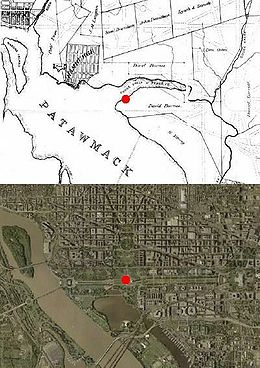
Tiber Creek
Tiber Creek or Tyber Creek was a tributary of the Potomac River in Washington, D.C.Originally known as Goose Creek, it was renamed after Rome's Tiber River as the lands southeast of then Georgetown, Maryland, were selected for the City of Washington, the new capital of the United States...
, which was later transformed into the Washington City Canal
Washington City Canal
The Washington City Canal operated from 1815 until the mid-1850s in Washington, D.C. The canal connected the Anacostia River, called the "Eastern Branch" at that time, to Tiber Creek, the Potomac River, and later the Chesapeake and Ohio Canal...
, and could have been used as a bollard
Bollard
A bollard is a short vertical post. Originally it meant a post used on a ship or a quay, principally for mooring. The word now also describes a variety of structures to control or direct road traffic, such as posts arranged in a line to obstruct the passage of motor vehicles...
to moor barges, that usage was not the reason it was called a "pier", because the surveyor who erected it had already used that term himself. The entire National Mall
National Mall
The National Mall is an open-area national park in downtown Washington, D.C., the capital of the United States. The National Mall is a unit of the National Park Service , and is administered by the National Mall and Memorial Parks unit...
area west of the marker was once under water until West Potomac Park
West Potomac Park
West Potomac Park is a U.S. national park in Washington, D.C., adjacent to the National Mall. It includes the parkland that extends south of the Lincoln Memorial Reflecting Pool, from the Lincoln Memorial to the grounds of the Washington Monument...
was created as a result of an engineering project under the direction of Peter Conover Hains
Peter Conover Hains
Peter Conover Hains was a major general in the United States Army, and a veteran of the American Civil War, Spanish-American War, and the First World War...
from 1882 to 1891.
The developers of the Washington Monument originally wanted it to be located at Jefferson Pier, but concerns about the bearing capacity
Bearing capacity
In geotechnical engineering, bearing capacity is the capacity of soil to support the loads applied to the ground. The bearing capacity of soil is the maximum average contact pressure between the foundation and the soil which should not produce shear failure in the soil...
of the soil prevented it. However, the marker served as a benchmark during the first phase of its construction. Without realizing its significance, the original marker was removed by the Corps of Engineers
United States Army Corps of Engineers
The United States Army Corps of Engineers is a federal agency and a major Army command made up of some 38,000 civilian and military personnel, making it the world's largest public engineering, design and construction management agency...
during 1872–1874 as part of a cleanup of the grounds around the unfinished stump of the Washington Monument, including grading the grounds, filling-in gullies, planting trees, constructing ornamental ponds and a broad carriage road around the stump. On December 2, 1889 Colonel O. H. Ernst, Officer in Charge of Public Buildings and Grounds, erected a replacement marker above the recovered foundation of the original marker. An artifact sometimes confusing to and often overlooked by tourists, Jefferson Pier is maintained today by the National Park Service
National Park Service
The National Park Service is the U.S. federal agency that manages all national parks, many national monuments, and other conservation and historical properties with various title designations...
under its National Mall and Memorial Parks
National Mall and Memorial Parks
National Mall and Memorial Parks is an administrative unit of the National Park Service encompassing many national memorials and other areas in Washington, D.C...
administrative unit. In 1890 a new monument, the Ellipse Meridian Stone, was placed by the Coast and Geodetic Survey in the center of the Ellipse in President's Park
President's Park
President's Park, located in Washington, D.C., encompasses the White House, a visitor center, Lafayette Square, and The Ellipse. President's Park was the original name of Lafayette Square. The current President's Park is administered by the National Park Service.-White House:Washington, D.C...
about 1506 feet (459 m) north of the Jefferson Pier in a more protected area. Theodolite
Theodolite
A theodolite is a precision instrument for measuring angles in the horizontal and vertical planes. Theodolites are mainly used for surveying applications, and have been adapted for specialized purposes in fields like metrology and rocket launch technology...
measurements showed the new Ellipse Meridian Stone stood 26 inch (0.6604 m) from the longtitudinal line of the replacement Jefferson Stone, indicating one of the two markers was improperly located.
In 1920, Congress approved the placement of a new delineation stone on the Ellipse, the Zero Milestone
Zero Milestone
The Zero Milestone is a zero mile marker monument in Washington, D.C. intended as the initial milestone from which all road distances in the United States should be reckoned when it was built. At present, only roads in the Washington, D.C...
, which is an itinerary marker from which official mileages from Washington would be determined. The new marker, a gift of the Lee Highway Association, was for some reason placed one foot west of the original meridian line extending north-south from the center of the White House.
In 1943, the Jefferson Memorial was completed due south of the White House on the Washington Meridian. As a result, the Jefferson Pier now stands on a line that passes between the centers of the "President's House" and the memorial dedicated to the president for whom the Pier is named.
Further reading
Note: King's letter is transcribed in an appendix.-
- Note: Contains much information from book.
- Jefferson Pier, NGS Data Sheet
External links
- 1855 Colton map of Washington Jefferson Pier would have been on seawall at edge of water at the entrance to Washington City Canal
- NPS Map of Mall National Park Service Map of Washington, D.C. Mall