

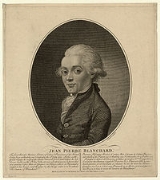
Jean-Pierre Blanchard

Encyclopedia

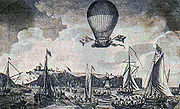
France
The French Republic , The French Republic , The French Republic , (commonly known as France , is a unitary semi-presidential republic in Western Europe with several overseas territories and islands located on other continents and in the Indian, Pacific, and Atlantic oceans. Metropolitan France...
inventor, most remembered as a pioneer in aviation
Aviation
Aviation is the design, development, production, operation, and use of aircraft, especially heavier-than-air aircraft. Aviation is derived from avis, the Latin word for bird.-History:...
and ballooning
Balloon (aircraft)
A balloon is a type of aircraft that remains aloft due to its buoyancy. A balloon travels by moving with the wind. It is distinct from an airship, which is a buoyant aircraft that can be propelled through the air in a controlled manner....
.
Blanchard made his first successful balloon flight in Paris
Paris
Paris is the capital and largest city in France, situated on the river Seine, in northern France, at the heart of the Île-de-France region...
on 2 March 1784, in a hydrogen
Hydrogen
Hydrogen is the chemical element with atomic number 1. It is represented by the symbol H. With an average atomic weight of , hydrogen is the lightest and most abundant chemical element, constituting roughly 75% of the Universe's chemical elemental mass. Stars in the main sequence are mainly...
gas balloon
Gas balloon
A gas balloon is any balloon that stays aloft due to being filled with a gas less dense than air or lighter than air . A gas balloon may also be called a Charlière for its inventor, the Frenchman Jacques Charles. Today, familiar gas balloons include large blimps and small rubber party balloons...
launched from the Champ de Mars
Champ de Mars
The Champ de Mars is a large public greenspace in Paris, France, located in the seventh arrondissement, between the Eiffel Tower to the northwest and the École Militaire to the southeast. The park is named after the Campus Martius in Rome, a tribute to the Roman god of war...
. The first successful manned balloon flight had taken place on 21 November 1783, when Pilâtre de Rozier
Pilâtre de Rozier
Jean-François Pilâtre de Rozier was a French chemistry and physics teacher, and one of the first pioneers of aviation. He and the Marquis d'Arlandes made the first manned free balloon flight on 21 November 1783, in a Montgolfier balloon. He later died when his balloon crashed near Wimereux in...
and the Marquis d'Arlandes took off at the Palace of Versailles
Palace of Versailles
The Palace of Versailles , or simply Versailles, is a royal château in Versailles in the Île-de-France region of France. In French it is the Château de Versailles....
in a tethered hot air balloon
Hot air balloon
The hot air balloon is the oldest successful human-carrying flight technology. It is in a class of aircraft known as balloon aircraft. On November 21, 1783, in Paris, France, the first untethered manned flight was made by Jean-François Pilâtre de Rozier and François Laurent d'Arlandes in a hot air...
constructed by the Montgolfier brothers
Montgolfier brothers
Joseph-Michel Montgolfier and Jacques-Étienne Montgolfier were the inventors of the montgolfière-style hot air balloon, globe aérostatique. The brothers succeeded in launching the first manned ascent, carrying Étienne into the sky...
. The first manned hydrogen balloon flight had taken place on December 1, 1783, when Professor Jacques Charles
Jacques Charles
Jacques Alexandre César Charles was a French inventor, scientist, mathematician, and balloonist.Charles and the Robert brothers launched the world's first hydrogen-filled balloon in August 1783, then in December 1783, Charles and his co-pilot Nicolas-Louis Robert ascended to a height of about...
and Nicolas-Louis Robert
Robert brothers
Les Frères Robert were two French brothers. Anne-Jean Robert , and Nicolas-Louis Robert , The brothers were the engineers who built the world's first hydrogen balloon for professor Jacques Charles; it flew from central Paris on...
launched La Charlière from the Jardin des Tuileries
Tuileries Palace
The Tuileries Palace was a royal palace in Paris which stood on the right bank of the River Seine until 1871, when it was destroyed in the upheaval during the suppression of the Paris Commune...
in Paris. Blanchard's flight nearly ended in disaster, when one spectator - Dupont de Chambon, a contemporary of Napoleon at the École militaire de Brienne - slashed at the balloon's mooring ropes and oars with his sword after being refused a place on board. Blanchard intended to "row" northeast to La Villette but the balloon was pushed by the wind across the Seine
Seine
The Seine is a -long river and an important commercial waterway within the Paris Basin in the north of France. It rises at Saint-Seine near Dijon in northeastern France in the Langres plateau, flowing through Paris and into the English Channel at Le Havre . It is navigable by ocean-going vessels...
to Billancourt
Billancourt
Billancourt is a commune in the Somme department in northern France....
and back again, landing in the rue de Sèvres. Blanchard adopted the Latin tag Sic itur ad astra as his motto
Motto
A motto is a phrase meant to formally summarize the general motivation or intention of a social group or organization. A motto may be in any language, but Latin is the most used. The local language is usual in the mottoes of governments...
.
The early balloon flights triggered a phase of public "balloonmania", with all manner of objects decorated with images of balloons or styled au ballon, from ceramics to fans and hats. Clothing au ballon was produced with exaggerated puffed sleeves and rounded skirts, or with printed images of balloons. Hair was coiffed à la montgolfier, au globe volant, au demi-ballon, or à la Blanchard.http://www.aviation.technomuses.ca/pdf/Ballons_e.pdf
Blanchard moved to London in August 1784, where he took part in a flight on 16 October 1784 with John Sheldon (anatomist, not footballer), just a few weeks after the first flight in Britain (and the first outside France), when Italian Vincenzo Lunardi
Vincenzo Lunardi
Vicenzo Lunardi was born in Lucca, Italy. His family were of minor Neapolitan nobility, and his father had married late in life. Vicenzo was one of three children...
flew from Moorfields
Moorfields
In London, the Moorfields were one of the last pieces of open land in the City of London, near the Moorgate. The fields were divided into three areas, the Moorfields proper, just north of Bethlem Hospital, and inside the City boundaries, and Middle and Upper Moorfields to the north.After the Great...
to Ware on 15 September 1784. Blanchard's propulsion mechanisms - flapping wings and a windmill - again proved ineffective, but the balloon flew some 115 km from the military academy in Chelsea
Chelsea, London
Chelsea is an area of West London, England, bounded to the south by the River Thames, where its frontage runs from Chelsea Bridge along the Chelsea Embankment, Cheyne Walk, Lots Road and Chelsea Harbour. Its eastern boundary was once defined by the River Westbourne, which is now in a pipe above...
, landing in Sunbury
Sunbury
Places called Sunbury include:Australia*Sunbury, Victoria**Sunbury Downs College**Sunbury Pop Festival Canada*Sunbury County, New Brunswick...
and then taking off again to end in Romsey
Romsey
Romsey is a small market town in the county of Hampshire, England.It is 8 miles northwest of Southampton and 11 miles southwest of Winchester, neighbouring the village of North Baddesley...
. Blanchard took a second flight on 30 November 1784, taking off with an American, Dr John Jeffries
John Jeffries
John Jeffries was a Boston physician, scientist, and a military surgeon with the British Army in Nova Scotia and New York during the American Revolution. Born in Boston, Jeffries graduated from Harvard College and obtained his medical degree at the University of Aberdeen...
, from Rhedarium Garden west of Grosvenor Square
Grosvenor Square
Grosvenor Square is a large garden square in the exclusive Mayfair district of London, England. It is the centrepiece of the Mayfair property of the Duke of Westminster, and takes its name from their surname, "Grosvenor".-History:...
in London
London
London is the capital city of :England and the :United Kingdom, the largest metropolitan area in the United Kingdom, and the largest urban zone in the European Union by most measures. Located on the River Thames, London has been a major settlement for two millennia, its history going back to its...
to Ingress in Kent
Kent
Kent is a county in southeast England, and is one of the home counties. It borders East Sussex, Surrey and Greater London and has a defined boundary with Essex in the middle of the Thames Estuary. The ceremonial county boundaries of Kent include the shire county of Kent and the unitary borough of...
. A third flight, again with Jeffries, was the first flight over the English Channel
English Channel
The English Channel , often referred to simply as the Channel, is an arm of the Atlantic Ocean that separates southern England from northern France, and joins the North Sea to the Atlantic. It is about long and varies in width from at its widest to in the Strait of Dover...
, taking about 2½ hours to travel from England to France on 7 January 1785, flying from Dover Castle
Dover Castle
Dover Castle is a medieval castle in the town of the same name in the English county of Kent. It was founded in the 12th century and has been described as the "Key to England" due to its defensive significance throughout history...
to Guînes
Guînes
Guînes is a commune in the Pas-de-Calais department in northern France.-Geography:Guînes is located on the border of the two territories of the Boulonnais and Calaisis, at the edge of the now-drained marshes, which extend from here to the coast. The Guînes canal connects with...
. Blanchard was awarded a substantial pension by Louis XVI. (A subsequent Channel crossing attempt in the opposite direction by Pilâtre de Rozier
Pilâtre de Rozier
Jean-François Pilâtre de Rozier was a French chemistry and physics teacher, and one of the first pioneers of aviation. He and the Marquis d'Arlandes made the first manned free balloon flight on 21 November 1783, in a Montgolfier balloon. He later died when his balloon crashed near Wimereux in...
on 15 June 1785 ended unsuccessfully in a fatal crash.)
Blanchard toured Europe, demonstrating his balloons. Blanchard holds the record of first balloon flights in Belgium
Belgium
Belgium , officially the Kingdom of Belgium, is a federal state in Western Europe. It is a founding member of the European Union and hosts the EU's headquarters, and those of several other major international organisations such as NATO.Belgium is also a member of, or affiliated to, many...
, Germany
Germany
Germany , officially the Federal Republic of Germany , is a federal parliamentary republic in Europe. The country consists of 16 states while the capital and largest city is Berlin. Germany covers an area of 357,021 km2 and has a largely temperate seasonal climate...
, the Netherlands
Netherlands
The Netherlands is a constituent country of the Kingdom of the Netherlands, located mainly in North-West Europe and with several islands in the Caribbean. Mainland Netherlands borders the North Sea to the north and west, Belgium to the south, and Germany to the east, and shares maritime borders...
, and Poland
Poland
Poland , officially the Republic of Poland , is a country in Central Europe bordered by Germany to the west; the Czech Republic and Slovakia to the south; Ukraine, Belarus and Lithuania to the east; and the Baltic Sea and Kaliningrad Oblast, a Russian exclave, to the north...
. Among the events that included demonstrations of his abilities as a balloonist was the coronation of Holy Roman Emperor Leopold II
Leopold II, Holy Roman Emperor
Leopold II , born Peter Leopold Joseph Anton Joachim Pius Gotthard, was Holy Roman Emperor and King of Hungary and Bohemia from 1790 to 1792, Archduke of Austria and Grand Duke of Tuscany from 1765 to 1790. He was a son of Emperor Francis I and his wife, Empress Maria Theresa...
as king of Bohemia
Bohemia
Bohemia is a historical region in central Europe, occupying the western two-thirds of the traditional Czech Lands. It is located in the contemporary Czech Republic with its capital in Prague...
in Prague
Prague
Prague is the capital and largest city of the Czech Republic. Situated in the north-west of the country on the Vltava river, the city is home to about 1.3 million people, while its metropolitan area is estimated to have a population of over 2.3 million...
in September 1791.
Following the invention of the modern parachute
Parachute
A parachute is a device used to slow the motion of an object through an atmosphere by creating drag, or in the case of ram-air parachutes, aerodynamic lift. Parachutes are usually made out of light, strong cloth, originally silk, now most commonly nylon...
in 1783 by Sébastien Lenormand in France
France
The French Republic , The French Republic , The French Republic , (commonly known as France , is a unitary semi-presidential republic in Western Europe with several overseas territories and islands located on other continents and in the Indian, Pacific, and Atlantic oceans. Metropolitan France...
, in 1785 Jean-Pierre Blanchard demonstrated it as a means of safely disembarking from a hot air balloon
Hot air balloon
The hot air balloon is the oldest successful human-carrying flight technology. It is in a class of aircraft known as balloon aircraft. On November 21, 1783, in Paris, France, the first untethered manned flight was made by Jean-François Pilâtre de Rozier and François Laurent d'Arlandes in a hot air...
. While Blanchard's first parachute demonstrations were conducted with a dog as the passenger, he later had the opportunity to try it himself when in 1793 his hot air balloon ruptured and he used a parachute to escape. Subsequent development of the parachute focused on it becoming more compact. While the early parachutes were made of linen
Linen
Linen is a textile made from the fibers of the flax plant, Linum usitatissimum. Linen is labor-intensive to manufacture, but when it is made into garments, it is valued for its exceptional coolness and freshness in hot weather....
stretched over a wooden frame, in the late 1790s, Blanchard began making parachutes from folded silk
Silk
Silk is a natural protein fiber, some forms of which can be woven into textiles. The best-known type of silk is obtained from the cocoons of the larvae of the mulberry silkworm Bombyx mori reared in captivity...
, taking advantage of silk's strength and light weight
Weight
In science and engineering, the weight of an object is the force on the object due to gravity. Its magnitude , often denoted by an italic letter W, is the product of the mass m of the object and the magnitude of the local gravitational acceleration g; thus:...
.
On 10 January 1793, Blanchard conducted the first balloon flight in North America
North America
North America is a continent wholly within the Northern Hemisphere and almost wholly within the Western Hemisphere. It is also considered a northern subcontinent of the Americas...
, ascending from Philadelphia, Pennsylvania
Pennsylvania
The Commonwealth of Pennsylvania is a U.S. state that is located in the Northeastern and Mid-Atlantic regions of the United States. The state borders Delaware and Maryland to the south, West Virginia to the southwest, Ohio to the west, New York and Ontario, Canada, to the north, and New Jersey to...
and landing in Deptford
Deptford Township, New Jersey
Deptford Township is a township in Gloucester County, New Jersey, in the United States. As of the 2010 United States Census, the township's population was 30,561....
, Gloucester County
Gloucester County, New Jersey
Gloucester County is a county located in the U.S. state of New Jersey. As of the 2010 Census, the population was 288,288. Its county seat is Woodbury....
, New Jersey
New Jersey
New Jersey is a state in the Northeastern and Middle Atlantic regions of the United States. , its population was 8,791,894. It is bordered on the north and east by the state of New York, on the southeast and south by the Atlantic Ocean, on the west by Pennsylvania and on the southwest by Delaware...
. One of the flight's witnesses that day was President George Washington
George Washington
George Washington was the dominant military and political leader of the new United States of America from 1775 to 1799. He led the American victory over Great Britain in the American Revolutionary War as commander-in-chief of the Continental Army from 1775 to 1783, and presided over the writing of...
, and the future presidents John Adams
John Adams
John Adams was an American lawyer, statesman, diplomat and political theorist. A leading champion of independence in 1776, he was the second President of the United States...
, Thomas Jefferson
Thomas Jefferson
Thomas Jefferson was the principal author of the United States Declaration of Independence and the Statute of Virginia for Religious Freedom , the third President of the United States and founder of the University of Virginia...
, James Madison
James Madison
James Madison, Jr. was an American statesman and political theorist. He was the fourth President of the United States and is hailed as the “Father of the Constitution” for being the primary author of the United States Constitution and at first an opponent of, and then a key author of the United...
, and James Monroe
James Monroe
James Monroe was the fifth President of the United States . Monroe was the last president who was a Founding Father of the United States, and the last president from the Virginia dynasty and the Republican Generation...
. Blanchard left the United States in 1797.
He married Marie Madeleine-Sophie Armant (better known as Sophie Blanchard
Sophie Blanchard
Sophie Blanchard was a French aeronaut and the wife of ballooning pioneer Jean-Pierre Blanchard. Blanchard was the first woman to work as a professional balloonist, and after her husband's death she continued ballooning, making more than 60 ascents...
) in 1804. In 1809, Blanchard had a heart attack while in his balloon at the Hague. He fell from his balloon and died some weeks later from his severe injuries. His widow continued to support herself with ballooning demonstrations until it also killed her. On 6 July 1819, Norwich Duff
Norwich Duff
Admiral Norwich Duff was a Royal Navy officer.The son of Captain George Duff RN, and Sophia Dirom, he was born at 9 South Castle Street, Edinburgh. He entered the Royal Navy in July 1805, just before his 13th birthday, serving aboard his father's ship HMS Mars as a midshipman...
, an Edinburgh born naval officer then undertaking a tour of western Europe, recorded in his travel log how he: