


Jazz funeral

Encyclopedia
Jazz funeral is a common name for a funeral
tradition with music
which developed in New Orleans, Louisiana
.
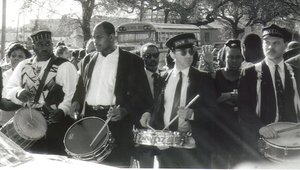 The term "jazz funeral" was long in use by observers from elsewhere, but was generally disdained as inappropriate by most New Orleans musicians and practitioners of the tradition. The preferred description was "funeral with music"; while jazz
was part of the music played, it was not the primary focus of the ceremony. This reluctance to use the term faded significantly in the final 15 years or so of the 20th century among the younger generation of New Orleans brass band musicians more familiar with the post-Dirty Dozen Brass Band
funk influenced style than the older traditional jazz New Orleans style. (See also: Let Me Do My Thang: Rebirth Brass Band- a documentary filmed and edited by Keith Reynaud, Jr.)
The tradition arises from African spiritual practices, French and Spanish martial musical traditions, and uniquely African-American cultural influences. The tradition was widespread among New Orleanians across ethnic boundaries at the start of the 20th century. As the common brass band music became wilder in the years before World War I, some white New Orleanians considered the hot music disrespectful, and such musical funerals became rare among the city's white citizens. For much of the mid-20th century, the Catholic Church officially frowned on secular music at funerals, so for generations the tradition was largely confined to African American Protestant New Orleanians. After the 1960s it gradually started being practiced across ethnic and religious boundaries. Most commonly such musical funerals are done for individuals who are musicians themselves, connected to the music industry, or members of various social aid & pleasure clubs or Carnival
krewe
s who make a point of arranging for such funerals for members.
The organizers of the funeral arrange for hiring the band as part of the services. When a respected fellow musician or prominent member of the community dies, some additional musicians may also play in the procession as a sign of their esteem for the deceased.
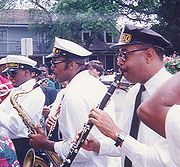 A typical jazz funeral begins with a march by the family, friends, and a brass band
from the home, funeral home or church to the cemetery. Throughout the march, the band plays somber dirge
s and hymn
s. A change in the tenor of the ceremony takes place, after either the deceased is buried, or the hearse leaves the procession
and members of the procession say their final good bye and they "cut the body loose". After this the music becomes more upbeat, often starting with a hymn or spiritual number played in a swinging fashion, then going into popular hot tunes. There is raucous music and cathartic dancing where onlookers join in to celebrate the life of the deceased. Those who follow the band just to enjoy the music are called the second line, and their style of dancing, in which they walk and sometimes twirl a parasol or handkerchief in the air, is called second lining.
Some younger funk
and hip hop
oriented brass bands often dispense with the dirges and hymns altogether, or perform only the traditional tune "Just a Closer Walk With Thee."
One tune sometimes used in this upbeat portion of the parade is the "New Second Line" march, which was featured in the jazz-funeral marches in the James Bond
movie Live and Let Die
.
Funeral
A funeral is a ceremony for celebrating, sanctifying, or remembering the life of a person who has died. Funerary customs comprise the complex of beliefs and practices used by a culture to remember the dead, from interment itself, to various monuments, prayers, and rituals undertaken in their honor...
tradition with music
Music
Music is an art form whose medium is sound and silence. Its common elements are pitch , rhythm , dynamics, and the sonic qualities of timbre and texture...
which developed in New Orleans, Louisiana
New Orleans, Louisiana
New Orleans is a major United States port and the largest city and metropolitan area in the state of Louisiana. The New Orleans metropolitan area has a population of 1,235,650 as of 2009, the 46th largest in the USA. The New Orleans – Metairie – Bogalusa combined statistical area has a population...
.
Jazz
Jazz is a musical style that originated at the beginning of the 20th century in African American communities in the Southern United States. It was born out of a mix of African and European music traditions. From its early development until the present, jazz has incorporated music from 19th and 20th...
was part of the music played, it was not the primary focus of the ceremony. This reluctance to use the term faded significantly in the final 15 years or so of the 20th century among the younger generation of New Orleans brass band musicians more familiar with the post-Dirty Dozen Brass Band
Dirty Dozen Brass Band
The Dirty Dozen Brass Band is a New Orleans, Louisiana, brass band. The ensemble was established in 1977 by Benny Jones together with members of the Tornado Brass Band...
funk influenced style than the older traditional jazz New Orleans style. (See also: Let Me Do My Thang: Rebirth Brass Band- a documentary filmed and edited by Keith Reynaud, Jr.)
The tradition arises from African spiritual practices, French and Spanish martial musical traditions, and uniquely African-American cultural influences. The tradition was widespread among New Orleanians across ethnic boundaries at the start of the 20th century. As the common brass band music became wilder in the years before World War I, some white New Orleanians considered the hot music disrespectful, and such musical funerals became rare among the city's white citizens. For much of the mid-20th century, the Catholic Church officially frowned on secular music at funerals, so for generations the tradition was largely confined to African American Protestant New Orleanians. After the 1960s it gradually started being practiced across ethnic and religious boundaries. Most commonly such musical funerals are done for individuals who are musicians themselves, connected to the music industry, or members of various social aid & pleasure clubs or Carnival
New Orleans Mardi Gras
Mardi Gras in New Orleans, Louisiana, is a Carnival celebration well-known throughout the world.The New Orleans Carnival season, with roots in preparing for the start of the Christian season of Lent, starts after Twelfth Night, on Epiphany . It is a season of parades, balls , and king cake parties...
krewe
Krewe
A krewe is an organization that puts on a parade and or a ball for the Carnival season. The term is best known for its association with New Orleans Mardi Gras, but is also used in other Carnival celebrations around the Gulf of Mexico, such as the Gasparilla Pirate Festival in Tampa, Florida, and...
s who make a point of arranging for such funerals for members.
The organizers of the funeral arrange for hiring the band as part of the services. When a respected fellow musician or prominent member of the community dies, some additional musicians may also play in the procession as a sign of their esteem for the deceased.
Brass band
A brass band is a musical ensemble generally consisting entirely of brass instruments, most often with a percussion section. Ensembles that include brass and woodwind instruments can in certain traditions also be termed brass bands , but are usually more correctly termed military bands, concert...
from the home, funeral home or church to the cemetery. Throughout the march, the band plays somber dirge
Dirge
A dirge is a somber song expressing mourning or grief, such as would be appropriate for performance at a funeral. A lament. The English word "dirge" is derived from the Latin Dirige, Domine, Deus meus, in conspectu tuo viam meam , the first words of the first antiphon in the Matins of the Office...
s and hymn
Hymn
A hymn is a type of song, usually religious, specifically written for the purpose of praise, adoration or prayer, and typically addressed to a deity or deities, or to a prominent figure or personification...
s. A change in the tenor of the ceremony takes place, after either the deceased is buried, or the hearse leaves the procession
Funeral procession
A funeral procession is a procession, usually in motor vehicles, from a church, synagogue, or mosque to the cemetery. The deceased is usually transported in a hearse, while family and friends follow in their vehicles.- Standard procedure :...
and members of the procession say their final good bye and they "cut the body loose". After this the music becomes more upbeat, often starting with a hymn or spiritual number played in a swinging fashion, then going into popular hot tunes. There is raucous music and cathartic dancing where onlookers join in to celebrate the life of the deceased. Those who follow the band just to enjoy the music are called the second line, and their style of dancing, in which they walk and sometimes twirl a parasol or handkerchief in the air, is called second lining.
Some younger funk
Funk
Funk is a music genre that originated in the mid-late 1960s when African American musicians blended soul music, jazz and R&B into a rhythmic, danceable new form of music. Funk de-emphasizes melody and harmony and brings a strong rhythmic groove of electric bass and drums to the foreground...
and hip hop
Hip hop music
Hip hop music, also called hip-hop, rap music or hip-hop music, is a musical genre consisting of a stylized rhythmic music that commonly accompanies rapping, a rhythmic and rhyming speech that is chanted...
oriented brass bands often dispense with the dirges and hymns altogether, or perform only the traditional tune "Just a Closer Walk With Thee."
One tune sometimes used in this upbeat portion of the parade is the "New Second Line" march, which was featured in the jazz-funeral marches in the James Bond
James Bond
James Bond, code name 007, is a fictional character created in 1953 by writer Ian Fleming, who featured him in twelve novels and two short story collections. There have been a six other authors who wrote authorised Bond novels or novelizations after Fleming's death in 1964: Kingsley Amis,...
movie Live and Let Die
Live and Let Die (film)
Live and Let Die is the eighth spy film in the James Bond series, and the first to star Roger Moore as the fictional MI6 agent James Bond. The film was produced by Albert R. Broccoli and Harry Saltzman...
.
Notable people who have received jazz funerals
- Ed BradleyEd BradleyEdward Rudolph "Ed" Bradley, Jr. was an American journalist, best known for twenty-six years of award-winning work on the CBS News television program 60 Minutes...
- Paul BarbarinPaul BarbarinAdolphe Paul Barbarin was a New Orleans jazz drummer, usually regarded as one of the very best of the pre-Big Band era jazz drummers...
- Danny BarkerDanny BarkerDanny Barker , born Daniel Moses Barker, was a jazz banjoist, singer, guitarist, songwriter, ukelele player and author from New Orleans, founder of the locally famous Fairview Baptist Church Marching Band...
- Louis Cottrell, Jr.Louis Cottrell, Jr.Louis Albert Cottrell, Jr. was a Louisiana Creole jazz clarinetist and tenor saxophonist. He was the son of the influential drummer Louis Cottrell, Sr., and grandfather of New Orleans jazz drummer Louis Cottrell...
- Ernie K-DoeErnie K-DoeErnie K-Doe , born Ernest Kador, Jr., was an African American rhythm and blues singer best known for his 1961 hit single "Mother-in-Law" which went to #1 on the Billboard pop chart in the U.S.-Early career:...
- Snooks EaglinSnooks EaglinSnooks Eaglin, born Fird Eaglin, Jr. , was a New Orleans-based guitarist and singer. He was also referred to as Blind Snooks Eaglin in his early years....
- Helen HillHelen HillHelen Hill was an American animation filmmaker and social activist who lived in New Orleans, Louisiana.In the pre-dawn hours of January 4, 2007, Hill was murdered by a random intruder in her New Orleans home...
- Allan JaffeAllan JaffeAllan Phillip Jaffe was an American jazz tubist and the entrepreneur who developed Preservation Hall into a New Orleans jazz tradition....
, Preservation Hall proprietor - Anthony LacenAnthony LacenAnthony "Tuba Fats" Lacen was a jazz tubist and band leader. Tuba Fats was New Orleans' most famous tuba player and played traditional New Orleans jazz and blues for over 40 years....
(Tuba Fats) - Austin LeslieAustin LeslieAustin Leslie was an internationally famous New Orleans chef whose work defined 'Creole Soul'. He died in Atlanta at the age of 71 after having been evacuated from New Orleans; he had been trapped in his attic for two days in the 98°F heat in the aftermath of the 29 August Hurricane Katrina...
- Professor LonghairProfessor LonghairProfessor Longhair was a New Orleans blues singer and pianist...
- Allison "Tootie" MontanaAllison ‘Tootie’ MontanaChief Allison ‘Tootie’ Montana was a New Orleans cultural icon who acted as the Mardi Gras Indian "chief of chiefs" for decades...
- Paolo MantovaniMantovaniAnnunzio Paolo Mantovani known as Mantovani, was an Anglo-Italian conductor and light orchestra-styled entertainer with a cascading strings musical signature. The book British Hit Singles & Albums states that he was "Britain's most successful album act before The Beatles .....
- Ernest "Doc" Paulin
- Alphonse PicouAlphonse PicouAlphonse Floristan Picou was an important very early jazz clarinetist who also wrote and arranged music....
- Ike TurnerIke TurnerIsaac Wister Turner was an American musician, bandleader, songwriter, arranger, talent scout, and record producer. In a career that lasted more than half a century, his repertoire included blues, soul, rock, and funk...
- Soulja SlimSoulja SlimJames Tapp, Jr. , better known by his stage name Soulja Slim, was an American rapper who achieved massive success on Master P's No Limit record label. He also achieved fame throughout New Orleans and Nation Wide from his work done with B.G., UNLV, and other local artists. He is known for writing...
See also
- Second line
- When the Saints Go Marching InWhen the Saints Go Marching In"When the Saints Go Marching In", often referred to as "The Saints", is an American gospel hymn that has taken on certain aspects of folk music. The precise origins of the song are not known. Though it originated as a spiritual, today people are more likely to hear it played by a jazz band...
- Nine nights
- Wake (ceremony)Wake (ceremony)A wake is a ceremony associated with death. Traditionally, a wake takes place in the house of the deceased, with the body present; however, modern wakes are often performed at a funeral home. In the United States and Canada it is synonymous with a viewing...
- Month's MindMonth's MindA Month's Mind is a requiem mass celebrated about one month after a person's death, in memory of the deceased. In medieval and later England, it was a service and feast held one month after the death of anyone in his or her memory. Bede speaks of the day as commemorationis dies...
External links
- Let Me Do My Thang: Rebirth Brass Band — a documentary filmed and edited by Keith Reynaud, Jr. http://southernspaces.org/2006/let-me-do-my-thang-rebirth-brass-band
- Nick Spitzer, "Rebuilding the 'Land of Dreams:' Expressive Culture and New Orleans' Authentic Future" Southern Spaces 29 August 2006 http://southernspaces.org/2006/rebuilding-land-dreams-expressive-culture-and-new-orleans-authentic-future
- Nick Spitzer, "Love and Death at Second Line" Southern Spaces, 20 February 2004. http://southernspaces.org/2004/love-and-death-second-line
- "Jazz Funerals," Religion & Ethics Newsweekly no. 722 (Jan. 30, 2004)
- Jazz Funeral of Anthony "Tuba Fats" Lacen, January 18, 2004
- Jazz Funeral New Orleans Online