
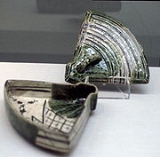
Japanese pottery and porcelain (陶磁器, Jp. tojiki; also 焼きもの, Jp. yakimono; 陶芸, Jp. tōgei), one of the country's oldest art forms, dates back to the
NeolithicThe Neolithic Age, Era, or Period, or New Stone Age, was a period in the development of human technology, beginning about 9500 BC in some parts of the Middle East, and later in other parts of the world. It is traditionally considered as the last part of the Stone Age...
period. Kilns have produced
earthenwareEarthenware is a common ceramic material, which is used extensively for pottery tableware and decorative objects.-Types of earthenware:Although body formulations vary between countries and even between individual makers, a generic composition is 25% ball clay, 28% kaolin, 32% quartz, and 15%...
,
potteryPottery is the material from which the potteryware is made, of which major types include earthenware, stoneware and porcelain. The place where such wares are made is also called a pottery . Pottery also refers to the art or craft of the potter or the manufacture of pottery...
,
stonewareStoneware is a vitreous or semi-vitreous ceramic ware with a fine texture. Stoneware is made from clay that is then fired in a kiln, whether by an artisan to make homeware, or in an industrial kiln for mass-produced or specialty products...
,
glazedGlaze is a layer or coating of a vitreous substance which has been fired to fuse to a ceramic object to color, decorate, strengthen or waterproof it.-Use:...
pottery, glazed stoneware,
porcelainPorcelain is a ceramic material made by heating raw materials, generally including clay in the form of kaolin, in a kiln to temperatures between and...
, and blue-and-white ware.
Introduction
Japanese ceramic history records distinguished many potter names, and some were artist-potters, e.g.,
Honami Koetsuwas a Japanese craftsman, potter, lacquerer, and calligrapher, whose work is generally considered to have inspired the founding of the Rinpa school of painting.-Early life:...
,
Ogata Kenzan, originally , and also known by the pseudonym Shisui, was a Japanese potter and painter, a younger brother of Ogata Korin. He was born in Kyoto in a rich marchant family and died in Edo . He had learned after the famous potter NONOMURA NINNSEI and made his own kiln. Since in 1712 a nobleman...
, and Aoki Mokubei. Japanese anonymous kilns also have flourished through the ages, and their influence weighs with that of the potters. Another characteristically Japanese aspect of the art is the continuing popularity of unglazed high-fired stoneware even after porcelain became popular. Since 4th century, Japanese pottery and porcelain was often influenced by the Chinese and Korean, sometimes through Korean pottery. Japan transformed and translated the Chinese and Korean prototypes into a uniquely Japanese creation, and the result was distinctly Japanese in character. In the 20th century, a ceramics industry (e.g.,
Noritakeis a porcelain maker headquartered in Nagoya, Aichi Prefecture, Japan.- History :Noritake Co., Limited, commonly known as "Noritake," grew out of a trading company established in Tokyo and in New York City by the Morimura Brothers in 1876. In 1904, key members of this trading company created the...
, Schimid Kreglinger (Kelco), and Toto Ltd.) grew up.
History to 19th century
In the Neolithic period (ca. 11th millennium BC), the earliest soft earthenware was made, and in the 6th millennium BC typical coil-made Jōmon ware appeared, decorated with hand-impressed rope patterns (early
Jōmon periodThe is the time in Japanese prehistory from about 14,000 BC to 300 BC.The term jōmon means "cord-patterned" in Japanese. This refers to the pottery style characteristic of the Jōmon culture, and which has markings made using sticks with cords wrapped around them...
). Jōmon ware developed a flamboyant style at its height and simplified itself in the later
Jōmon periodThe is the time in Japanese prehistory from about 14,000 BC to 300 BC.The term jōmon means "cord-patterned" in Japanese. This refers to the pottery style characteristic of the Jōmon culture, and which has markings made using sticks with cords wrapped around them...
. The pottery was molded of clay rope and baked in an open fire.
In about 4th–3rd century BC, Yayoi style earthenware appeared, which had a simple pattern or no pattern. Jōmon, Yayoi, and later Haji ware shared the baking process but had different styles of design. Japan showed no further significant achievements in pottery until the seventeenth century.
In the 3rd to 4th centuries AD, the
anagama kilnthumb|250px|right|Anagama kiln 1 Door about wide2 Firebox3 Stacking floor made of silica sand4 Dampers5 Flue6 Chimney7 Refractory archThe anagama kiln is an ancient type of pottery kiln brought to Japan from China via Korea in the 5th century.An anagama consists of a firing chamber with a...
, a roofed-tunnel kiln on a hillside, and the
potter's wheelIn pottery, a potter's wheel is a machine used in asma of round ceramic ware. The wheel may also be used during process of trimming the excess body from dried ware and for applying incised decoration or rings of color...
appeared, probably brought by southern Korea immigrant potters. The anagama kiln could produce a stoneware,
Sue warewas a blue-gray form of high-fired pottery which was produced in Japan and southern Korea during the Kofun, Nara, and Heian periods of Japanese history. It was initially used for funerary and ritual objects, and originated from a Korean stoneware style known as “Kaya ware”...
, fired at high temperatures of over 1000℃, sometimes embellished with accidental natural ash glaze. Contemporary
Haji wareis a type of plain, unglazed, reddish-brown Japanese pottery or earthenware that was produced during the Kofun, Nara, and Heian periods of Japanese history. It was used for both ritual and utilitarian purposes, and many examples have been found in Japanese tombs, where they form part of the basis...
and
Haniwa funerary objectsThe are terracotta clay figures which were made for ritual use and buried with the dead as funerary objects during the Kofun period of the history of Japan....
were earthenware like Yayoi.
Although a three-color lead glaze technique was introduced to Japan from the
Tang DynastyThe Tang Dynasty was an imperial dynasty of China preceded by the Sui Dynasty and followed by the Five Dynasties and Ten Kingdoms Period. It was founded by the Li family, who seized power during the decline and collapse of the Sui Empire...
of China in the 8th century, official kilns produced only simple green lead glaze for temples in the
Heian periodThe is the last division of classical Japanese history, running from 794 to 1185. The period is named after the capital city of Heian-kyō, or modern Kyōto. It is the period in Japanese history when Buddhism, Taoism and other Chinese influences were at their height...
, around 800–1200 AD. Until the 17th century, unglazed stoneware was popular for the heavy-duty daily requirements of a largely agrarian society; funerary jars, storage jars, and a variety of kitchen pots typify the bulk of the production. Some of the kilns improved their technology and are called the “Six Old Kilns”: Shigaraki (Shigaraki ware), Tamba, Bizen, Tokoname, Echizen, and Seto. Among them, Seto kiln in
Owari Provincewas an old province of Japan that is now the western half of present day Aichi Prefecture, including much of modern Nagoya. Its abbreviation is Bishū .-History:The province was created in 646....
(present day
Aichi Prefectureis a prefecture of Japan located in the Chūbu region. The region of Aichi is also known as the Tōkai region. The capital is Nagoya. It is the focus of the Chūkyō Metropolitan Area.- History :...
had a glaze technique. According to legend, Katō Shirozaemon Kagemasa (also known as Tōshirō) studied ceramic techniques in China and brought high-fired glazed ceramic to Seto in 1223. Seto kiln primarily imitated Chinese ceramics as a substitute for the Chinese product. It developed various glazes: ash, iron black, feldspar white, and copper green. The wares were so widely used that
Seto-mono ("product of Seto") became the generic term for ceramics in Japan. Seto kiln also produced unglazed stoneware. In late 16th century, many Seto potters moved to Mino province in the Gifu Prefecture fleeing the civil wars, where they produced glazed pottery: Yellow Seto (
Ki-Seto), Shino, Black Seto (
Seto-Guro), and Oribe ware.
From the middle of the 11th century to the 16th century, Japan imported much Chinese
celadonCeladon is a term for ceramics denoting both a type of glaze and a ware of a specific color, also called celadon. This type of ware was invented in ancient China, such as in the Zhejiang province...
, white porcelain, and blue-and-white ware. Japan also imported many Korean pottery and Thai and Vietnamese ceramics. These Chinese and Korean ceramics were regarded as high-class items, which the upper classes used in the tea ceremony. The Japanese ordered ceramics custom-designed for Japanese tastes from Chinese kilns.
In late 16th century, leading tea masters changed the style and favored the simpler Korean tea bowls and domestic ware over the Chinese. Patronized by the tea master
Sen no Rikyū, is considered the historical figure with the most profound influence on chanoyu, the Japanese "Way of Tea", particularly the tradition of wabi-cha...
, the
RakuRaku-yaki is a type of Japanese pottery that is traditionally used in the Japanese tea ceremony, most often in the form of tea bowls...
family supplied glazed earthenware tea bowls. Mino, Bizen, Shigaraki (Shigaraki ware), Iga (similar to Shigaraki), and other domestic kilns also supplied tea utensils. Artist-potter
Honami Kōetsuwas a Japanese craftsman, potter, lacquerer, and calligrapher, whose work is generally considered to have inspired the founding of the Rinpa school of painting.-Early life:...
made several teabowls as his masterpieces. At the Japanese overlord
Toyotomi Hideyoshiwas a daimyo warrior, general and politician of the Sengoku period. He unified the political factions of Japan. He succeeded his former liege lord, Oda Nobunaga, and brought an end to the Sengoku period. The period of his rule is often called the Momoyama period, named after Hideyoshi's castle...
's Korean campaigns of the 1590s attempting to conquer China. the Japanese forces returned to Japan, taking with them some Korean potters. These potters established the Satsuma, Hagi, Karatsu, Takatori, Agano and Arita kilns. One of them, Yi Sam-pyeong, discovered the raw material of porcelain in Arita and produced first true porcelain in Japan.
In the 1640s, rebellions in China and wars between the Ming dynasty and the Manchus damaged many kilns, and in 1656–1684 the
Qing DynastyThe Qing Dynasty was the last dynasty of China, ruling from 1644 to 1912 with a brief, abortive restoration in 1917. It was preceded by the Ming Dynasty and followed by the Republic of China....
government stopped trade. Chinese potter refugees offered the Arita kilns more-refined porcelain technique and enamel glaze methods. In 1650, the Dutch East India Company looked for porcelain for Europe in Japan. At that time, the Arita kilns like
KakiemonKakiemon wares were produced at the factories of Arita, Saga Prefecture, Japan from the mid-17th century, with much in common with the Chinese "Famille Verte" style...
kiln could supply enough quality porcelain to the Dutch East India Company. In 1659–1757, the Arita kilns exported enormous quantities of porcelain to Europe and Asia. China kilns and Europe kilns imitated them. The Arita kilns also supplied domestic utensils such as the so-called Ko-Kutani enamelware. In 1675, the local
NabeshimaThe Nabeshima clan was a prominent Japanese samurai clan of Kyūshū which controlled Saga Domain from the late Sengoku period through the Edo period.The Nabeshima clan was a cadet branch of the Shōni clan and was descended from the Fujiwara clan...
family who ruled Arita established an official kiln to make top-quality enamelware porcelain for the upper classes in Japan, which came to be called Nabeshima ware. After 1757, the Arita kilns filled domestic needs only. Because Imari was the shipping port, the porcelain, both export and domestic, is called
Ko-Imari (old Imari).
In 17th century, in Kyoto, then Japan's cultural capital, kilns produced lead-glazed pottery like the pottery of southern China. Among them, potter Nonomura Ninsei invented an overglazed enamel method and improved refined Japanese-style design under temple patronage. His disciple
Ogata Kenzan, originally , and also known by the pseudonym Shisui, was a Japanese potter and painter, a younger brother of Ogata Korin. He was born in Kyoto in a rich marchant family and died in Edo . He had learned after the famous potter NONOMURA NINNSEI and made his own kiln. Since in 1712 a nobleman...
produced more personal pottery and took Kyōyaki (Kyoto ceramics) to new heights. Their works were the model for later Kyōyaki. Although porcelain was introduced by Okuda Eisen in Kyōyaki, overglazed pottery still flourished. Aoki Mokubei, Ninami Dōhachi ( both disciples of Okuda Eisen) and Eiraku Hozen expanded the repertory of Kyōyaki.
In the late 18th to early 19th century, the raw material of porcelain was discovered in other areas of Japan (e.g.,
AmakusaAmakusa is a series of islands belonging to Japan, off the west coast of Kyushu . The biggest of the Amakusa islands is Shimoshima Island, 26.5 miles long and 13.5 miles in extreme width...
) and was traded domestically, and potters moved more freely. Local lords and merchants established many new kilns (e.g., Kameyama kiln and
TobeTobe may refer to:*Tobe Hooper, an American horror film director.*Tobe Sexton, an American actor.*Tobe, Ehime, a town in Japan....
kiln) for economic profit, and old kilns such as Seto restarted as porcelain kilns. These many kilns are called “New Kilns” and popularized porcelain for the common people in Japan with the Arita kiln.
20th Century to present day
Interest in the humble art of the village potter was revived in a folk movement of the 1920s by such master potters as
Shoji Hamadawas a Japanese potter. He was a significant influence on studio pottery of the twentieth century, and a major figure of the mingei folk-art movement, establishing the town of Mashiko as a world-renowned pottery centre.- Biography :...
and Kawai Kajiro. These artists studied traditional glazing techniques to preserve native wares in danger of disappearing. A number of institutions came under the aegis of the Cultural Properties Protection Division. The kilns at
TambaThe word Tamba may refer to:* Tamba Province, a former province in Japan* Tamba, Hyōgo, a city in Japan* Tamba , a Limited Express train service operated by West Japan Railway Company.* Tamba , a genus of noctuid moths...
, overlooking
Kobe, pronounced , is the fifth-largest city in Japan and is the capital city of Hyōgo Prefecture on the southern side of the main island of Honshū, approximately west of Osaka...
, continued to produce the daily wares used in the Tokugawa period, while adding modern shapes. Most of the village wares were made anonymously by local potters for utilitarian purposes. Local styles, whether native or imported, tended to be continued without alteration into the present. In Kyūshū, kilns set up by Korean potters in the 16th century, such as at Koishibara and its offshoot at Onta, perpetuated 16th-century Korean peasant wares. In Okinawa, the production of village ware continued under several leading masters, with Kaneshiro Jiro honored as a
mukei bunkazaiis a Japanese popular term for those individuals certified as by the Minister of Education, Culture, Sports, Science and Technology as based on Japan's...
.
The modern masters of the traditional kilns still bring the ancient formulas in pottery and porcelain to new heights of achievement at Shiga,
IgeIGE was one of the largest services company buying and selling virtual currencies and accounts for MMORPG. During its peak time, it had offices in Los Angeles, China , and headquarters & customer service centre in Hong Kong. IGE was one of the main monopoly in virtual economy services, also known...
, Karatsu,
Hagiis a city located in Yamaguchi, Japan and was incorporated as a city on July 1, 1932. Formerly part of Abu District.On March 6, 2005, the former city of Hagi merged with the towns of Susa and Tamagawa, and the villages of Asahi, Fukue, Kawakami and Mutsumi to form the new city of Hagi.Iwami Airport...
, and
Bizenis a city located in Okayama, Japan. The city is particularly famous for its Bizen-yaki pottery. It is also home to literary critic Hakuchō Masamune's birthplace, which is now a museum....
. Yamamoto Masao of Bizen and Miwa Kyusetsu of Hagi were designated living cultural treasures (
mukei bunkazai 無形文化財). Only a half-dozen potters had been so honored by 1989, either as representatives of famous kiln wares or as creators of superlative techniques in
glazingGlaze is a layer or coating of a vitreous substance which has been fired to fuse to a ceramic object to color, decorate, strengthen or waterproof it.-Use:...
or decoration; two groups were designated for preserving the wares of distinguished ancient kilns.
In the old capital of
Kyotois a city in the central part of the island of Honshū, Japan. It has a population close to 1.5 million. Formerly the imperial capital of Japan, it is now the capital of Kyoto Prefecture, as well as a major part of the Osaka-Kobe-Kyoto metropolitan area.-History:...
, the Raku family continued to produce the rough tea bowls that had so delighted Hideyoshi. At
Mino, one of the old provinces of Japan, encompassed part of modern-day Gifu Prefecture. It was sometimes called . Mino Province bordered Echizen, Hida, Ise, Mikawa, Ōmi, Owari, and Shinano Provinces....
, potters continued to reconstruct the classic formulas of Momoyama-era Seto-type tea wares of Mino, such as the Oribe ware copper-green glaze and Shino ware's prized milky glaze. Artist potters experimented endlessly at the Kyoto and Tokyo arts universities to recreate traditional porcelain and its decorations under such ceramic teachers as Fujimoto Yoshimichi, a
mukei bunkazai. Ancient porcelain kilns around
AritaArita is a Japanese name. It can also refer to:*Arita, Saga, a town in Saga Prefecture, Japan*Arita , a film by Shunji Iwai*Arita is a kind of Japanese Porcelain.*A brand name from Ritek....
in
Kyūshūis the third largest island of Japan and most southwesterly of its four main islands. Its alternate ancient names include , , and . The historical regional name is referred to Kyushu and its surrounding islands....
were still maintained by the lineage of Sakaida Kakiemon XIV and Imaizumi Imaemon XIII, hereditary porcelain makers to the
Nabeshima clanThe Nabeshima clan was a prominent Japanese samurai clan of Kyūshū which controlled Saga Domain from the late Sengoku period through the Edo period.The Nabeshima clan was a cadet branch of the Shōni clan and was descended from the Fujiwara clan...
; both were heads of groups designated
mukei bunkazai (see
KakiemonKakiemon wares were produced at the factories of Arita, Saga Prefecture, Japan from the mid-17th century, with much in common with the Chinese "Famille Verte" style...
and
Imari porcelainImari porcelain is the name for Japanese porcelain wares made in the town of Arita, in the former Hizen Province, northwestern Kyūshū. They were exported to Europe extensively from the port of Imari, Saga between latter half of 17th century and former half of 18 th century, Japanese as well as the...
).
In contrast, by the end of the 1980s, many master potters no longer worked at major or ancient kilns but were making classic wares in various parts of Japan. In Tokyo, a notable example is Tsuji Seimei, who brought his clay from Shiga but potted in the Tokyo area. A number of artists were engaged in reconstructing Chinese styles of decoration or glazes, especially the blue-green
celadonCeladon is a term for ceramics denoting both a type of glaze and a ware of a specific color, also called celadon. This type of ware was invented in ancient China, such as in the Zhejiang province...
and the watery-green qingbai. One of the most beloved Chinese glazes in Japan is the chocolate-brown
tenmokuTenmoku is a dark glaze with a surface that resembles oilspotting.It is made of feldspar, limestone, and iron oxide. The more quickly a piece is cooled, the blacker the glaze will be...
glaze that covered the peasant tea bowls brought back from southern
Song ChinaThe Song Dynasty was a ruling dynasty in China between 960 and 1279; it succeeded the Five Dynasties and Ten Kingdoms Period, and was followed by the Yuan Dynasty. It was the first government in world history to issue banknotes or paper money, and the first Chinese government to establish a...
(in the twelfth and thirteenth centuries) by
ZenZen is a school of Mahāyāna Buddhism founded by the Buddhist monk Bodhidharma. The word Zen is from the Japanese pronunciation of the Chinese word Chán , which in turn is derived from the Sanskrit word dhyāna, which can be approximately translated as "meditation" or "meditative state."Zen...
monks. For their Japanese users, these chocolate-brown wares embodied the Zen aesthetic of
wabirepresents a comprehensive Japanese world view or aesthetic centered on the acceptance of transience. The aesthetic is sometimes described as one of beauty that is "imperfect, impermanent, and incomplete"...
(rustic simplicity). In the United States, a notable example of the use of tenmoku glazes may be found in the innovative crystalline pots thrown by Japanese-born artist
Hideaki MiyamuraHideaki Miyamura is a Japanese-born American potter working in Kensington, New Hampshire. Miyamura is best known for his unique iridescent glazes, including a compelling gold glaze, the "starry night" glaze on a black background, and a blue hare's fur glaze.Miyamura was born in Japan as the son...
.
Styles of Japanese pottery
- Bizen-yaki - Produced in Okayama
is a prefecture of Japan located in the Chūgoku region on Honshū island. The capital is the city of Okayama.- History :During the Meiji Restoration, the area of Okayama Prefecture was known as Bitchū Province, Bizen Province and Mimasaka Province.- Geography :...
. Also called Inbe-yaki. A reddish-brown pottery, which is believed to have originated in the 6th century.
- Hagi-yaki – Produced in Yamaguchi
is a prefecture of Japan in the Chūgoku region on Honshū island. The capital is the city of Yamaguchi, in the center of the prefecture. The largest city, however, is Shimonoseki.- History :...
. Since it is burned at a relatively low temperature, it is fragile and transmits the warmth of its contents quickly.
- Imari-yaki - Produced in Saga
is located in the northwest part of the island of Kyūshū, Japan. It touches both the Sea of Japan and the Ariake Sea. The western part of the prefecture is a region famous for producing ceramics and porcelain, particularly the towns of Karatsu, Imari, and Arita...
. Introduced by KoreaKorea ) is an East Asian geographic region that is currently divided into two separate sovereign states — North Korea and South Korea. Located on the Korean Peninsula, Korea is bordered by the People's Republic of China to the northwest, Russia to the northeast, and is separated from Japan to the...
n potters at the beginning of the Edo PeriodThe , or , is a division of Japanese history which was ruled by the shoguns of the Tokugawa family, running from 1603 to 1868. The political entity of this period was the Tokugawa shogunate....
. Also called "Arita-yaki".
- Karatsu-yaki
is a style of pottery produced in and around Karatsu, Saga Prefecture, Japan. There are several variations produced in surrounding areas: Takeo Kokaratsu ware , Taku Kokaratsu ware, and Hirado Kokaratsu ware. There are also varieties based on style: Painted Karatsu, Mottled Karatsu, and Korean...
- Produced in Sagais located in the northwest part of the island of Kyūshū, Japan. It touches both the Sea of Japan and the Ariake Sea. The western part of the prefecture is a region famous for producing ceramics and porcelain, particularly the towns of Karatsu, Imari, and Arita...
. The most produced pottery in western Japan. Believed to have started in the 16th century. Greatly influenced by Korean potters.
- Kutani-yaki
is a style of Japanese porcelain Gotō Saijirō, a member of the Maeda clan, set up a kiln in the village of Kutani on the order of Maeda Toshiharu, ruler of the Kaga domain...
- Produced in Ishikawais a prefecture of Japan located in the Chūbu region on Honshū island. The capital is Kanazawa.- History :Ishikawa was formed from the merger of Kaga Province and the smaller Noto Province.- Geography :Ishikawa is on the Sea of Japan coast...
.
- Mino-yaki - Produced in Gifu
is a prefecture located in the Chūbu region of central Japan. Its capital is the city of Gifu.Located in the center of Japan, it has long played an important part as the crossroads of Japan, connecting the east to the west through such routes as the Nakasendō...
. Includes Shino-yaki' is a type of Japanese pottery most identifiable for thick white glazes, red scorch marks, and texture of small holes.It is one of the Mino styles from the late 16th century. Like other Mino wares, the Shino style is based on older Seto with changes to shape, decoration, and finish.Forms are...
, Oribe-yaki' is a type of Japanese pottery most identifiable for its use of green copper glaze and bold painted design. It was the first use of colored stoneware glaze by Japanese potters....
, Setoguro, and Ki-Seto.
- Onda-yaki - Produced in Kyūshū
is the third largest island of Japan and most southwesterly of its four main islands. Its alternate ancient names include , , and . The historical regional name is referred to Kyushu and its surrounding islands....
. Produced by families and passed on only to their own children. The outstanding fact is that they still produce it without electricity.
- Ōtani-yaki - A large type of pottery produced in Naruto
is a city in Tokushima Prefecture, Japan.In the quinquennial census of 2010, the city had a population of 61,522 . With a total area of the population density is 454 persons per km².The city was founded on March 15, 1947....
, Tokushima.
- Raku-yaki - Produced in Kyoto
is a prefecture of Japan located in the Kansai region of the island of Honshu. The capital is the city of Kyoto.- History :Until the Meiji Restoration, the area of Kyoto prefecture was known as Yamashiro....
. There is a proverb of the hierarchy of ceramic styles used for tea ceremony: 'First, Raku(-yaki). Second, Hagi. Third, Karatsu.'
- Ryumonji-yaki - Produced in Kagoshima
is a prefecture of Japan located on the island of Kyushu. The capital is the city of Kagoshima.- Geography :Kagoshima Prefecture is located at the southwest tip of Kyushu and includes a chain of islands stretching further to the southwest for a few hundred kilometers...
. Started by Korean potters about four hundred years ago.
- Satsuma-yaki
]Satsuma ware , sometimes referred to as "Satsuma porcelain", is a type of Japanese earthenware pottery. It originated in the late 16th century, during the Azuchi-Momoyama period, and is still produced today...
- Produced in Kyūshūis the third largest island of Japan and most southwesterly of its four main islands. Its alternate ancient names include , , and . The historical regional name is referred to Kyushu and its surrounding islands....
and other areas. Started by Korean potters about four hundred years ago.
- Seto-yaki - Produced in Aichi
is a prefecture of Japan located in the Chūbu region. The region of Aichi is also known as the Tōkai region. The capital is Nagoya. It is the focus of the Chūkyō Metropolitan Area.- History :...
. The most produced Japanese pottery in Japan. Sometimes, the term Seto-yaki (or Seto-mono) stands for all Japanese pottery.
- Shigaraki-yaki - Produced in Shiga
is a prefecture of Japan, which forms part of the Kansai region on Honshu Island. The capital is the city of Ōtsu.- History :Shiga was known as Ōmi Province or Gōshū before the prefectural system was established...
. One of the oldest styles in Japan. Famous for tanukiis the common Japanese name for the Japanese raccoon dog . They have been part of Japanese folklore since ancient times...
pottery pieces.
- Sōma-yaki - Produced in Fukushima
is a prefecture of Japan located in the Tōhoku region on the island of Honshu. The capital is the city of Fukushima.-History:Until the Meiji Restoration, the area of Fukushima prefecture was known as Mutsu Province....
. Image of a horseThe horse is one of two extant subspecies of Equus ferus, or the wild horse. It is a single-hooved mammal belonging to the taxonomic family Equidae. The horse has evolved over the past 45 to 55 million years from a small multi-toed creature into the large, single-toed animal of today...
(uma or koma), which is very popular in this area, is the main pattern. Therefore, it is sometimes called Sōmakoma-Yaki.
- Tamba-yaki - Produced in Hyōgo
is a prefecture of Japan located in the Kansai region on Honshū island. The capital is Kobe.The prefecture's name was previously alternately spelled as Hiogo.- History :...
. Also called Tatekui-yaki. One of the six oldest kinds in Japan.
- Tobe-yaki - Produced in Shikoku
is a prefecture in northwestern Shikoku, Japan. The capital is Matsuyama.-History:Until the Meiji Restoration, Ehime prefecture was known as Iyo Province...
. Most are thick porcelain table ware with blue cobalt paintings.
- Tokoname-yaki - Produced in Aichi
is a prefecture of Japan located in the Chūbu region. The region of Aichi is also known as the Tōkai region. The capital is Nagoya. It is the focus of the Chūkyō Metropolitan Area.- History :...
. Most are flower vases, rice bowlright|thumb|250px|A [[Azuchi-Momoyama period|16th century]] black [[Raku]]-ware tea bowl chawan A chawan is a bowl used for preparing and drinking tea. There are many types of chawan used in a tea ceremony, and the choice of their use depends upon many considerations...
s, teacupA teacup is a small cup, with or without a handle, generally a small one that may be grasped with the thumb and one or two fingers. It is typically made of a ceramic material. It is usually part of a set, composed of a cup and a matching saucer. These in turn may be part of a tea set in...
.
- Yokkaichi-Banko-yaki - Produced in Mie
is a prefecture of Japan which is part of the Kansai regions on Honshū island. The capital is the city of Tsu.- History :Until the Meiji Restoration, Mie prefecture was known as Ise Province and Iga Province....
. Most are teacupA teacup is a small cup, with or without a handle, generally a small one that may be grasped with the thumb and one or two fingers. It is typically made of a ceramic material. It is usually part of a set, composed of a cup and a matching saucer. These in turn may be part of a tea set in...
s, teapotA teapot is a vessel used for steeping tea leaves or a herbal mix in near-boiling water. Tea may be either in a tea bag or loose, in which case a tea strainer will be needed, either to hold the leaves as they steep or to catch the leaves inside the teapot when the tea is poured...
s, flower vases, and sake vessels. Believed to have originated in the 19th century.
See also
- Imari porcelain
Imari porcelain is the name for Japanese porcelain wares made in the town of Arita, in the former Hizen Province, northwestern Kyūshū. They were exported to Europe extensively from the port of Imari, Saga between latter half of 17th century and former half of 18 th century, Japanese as well as the...
- Kakiemon pottery
Kakiemon wares were produced at the factories of Arita, Saga Prefecture, Japan from the mid-17th century, with much in common with the Chinese "Famille Verte" style...
- Chinese ceramics
- Korean pottery
Korean ceramic history begins with the oldest earthenware from around 8000 BC.-Three Kingdoms pottery:-Goryeo Dynasty porcelain:The Goryeo Dynasty achieved the unification of the Later Three Kingdoms under King Taejo...
- Japanese tea ceremony
The Japanese tea ceremony, also called the Way of Tea, is a Japanese cultural activity involving the ceremonial preparation and presentation of matcha, powdered green tea. In Japanese, it is called . The manner in which it is performed, or the art of its performance, is called...
- Kintsugi
' is the Japanese art of fixing broken pottery with a lacquer resin sprinkled with powdered gold. Kintsugi may have originated when shogun Ashikaga Yoshimasa sent a damaged Chinese tea bowl back to China for repairs in the late 15th century...
- Japanese wheel throwing
Japan has an exceptionally long and successful history of ceramic production. Earthenwares were created as early as the Jomon period , giving Japan one of the oldest ceramic traditions in the world...
- List of National Treasures of Japan (crafts-others)
External links