

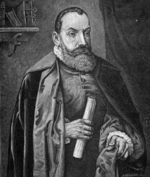
Jan Kochanowski

Encyclopedia
| Jan Kochanowski | |
| EWLINE |
|
| Noble Family Szlachta The szlachta was a legally privileged noble class with origins in the Kingdom of Poland. It gained considerable institutional privileges during the 1333-1370 reign of Casimir the Great. In 1413, following a series of tentative personal unions between the Grand Duchy of Lithuania and the Kingdom of... |
Kochanowski. |
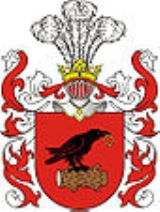
| Coat of Arms Polish heraldry Polish heraldry is a branch of heraldry focused on studying the development of coats of arms in the lands of historical Poland , as well as specifically-Polish traits of heraldry. The term is also used to refer to Polish heraldic system, as opposed to systems used elsewhere, notably in Western Europe... |
 Korwin |
| Parents | Piotr Kochanowski; Anna, née Białaczowska. |
| Consorts | Dorota, née Podlodowska. |
| Children | Urszula, Hanna, Ewa, Poliksena, Halszka, Krystyna, Jan (posthumous) |
| Date of Birth | 1530 |
| Place of Birth | Sycyna |
| Date of Death | August 22, 1584 |
| Place of Death | Lublin Lublin Lublin is the ninth largest city in Poland. It is the capital of Lublin Voivodeship with a population of 350,392 . Lublin is also the largest Polish city east of the Vistula river... |
Polish literature
Polish literature is the literary tradition of Poland. Most Polish literature has been written in the Polish language, though other languages, used in Poland over the centuries, have also contributed to Polish literary traditions, including Yiddish, Lithuanian, Ukrainian, Belarusian, German and...
language.
He is commonly regarded as the greatest Polish poet before Adam Mickiewicz
Adam Mickiewicz
Adam Bernard Mickiewicz ) was a Polish poet, publisher and political writer of the Romantic period. One of the primary representatives of the Polish Romanticism era, a national poet of Poland, he is seen as one of Poland's Three Bards and the greatest poet in all of Polish literature...
, and the greatest Slavic poet, prior to the 19th century.
Life
Kochanowski was born at SycynaSycyna
Sycyna Północna is a village in Poland's present-day Mazowsze Province . In 1975-98, it was part of Radom Province. It lies approximately south-east of Zwoleń and south-east of Warsaw....
, near Radom
Radom
Radom is a city in central Poland with 223,397 inhabitants . It is located on the Mleczna River in the Masovian Voivodeship , having previously been the capital of Radom Voivodeship ; 100 km south of Poland's capital, Warsaw.It is home to the biennial Radom Air Show, the largest and...
, Poland
Kingdom of Poland (1385–1569)
The Kingdom of Poland of the Jagiellons was the Polish state created by the accession of Jogaila , Grand Duke of Lithuania, to the Polish throne in 1386. The Union of Krewo or Krėva Act, united Poland and Lithuania under the rule of a single monarch...
. Little is known of his early education. At fourteen, fluent in Latin
Latin
Latin is an Italic language originally spoken in Latium and Ancient Rome. It, along with most European languages, is a descendant of the ancient Proto-Indo-European language. Although it is considered a dead language, a number of scholars and members of the Christian clergy speak it fluently, and...
, he was sent to the Kraków Academy
Jagiellonian University
The Jagiellonian University was established in 1364 by Casimir III the Great in Kazimierz . It is the oldest university in Poland, the second oldest university in Central Europe and one of the oldest universities in the world....
. After graduation in 1547 at age seventeen, he attended the University of Königsberg
University of Königsberg
The University of Königsberg was the university of Königsberg in East Prussia. It was founded in 1544 as second Protestant academy by Duke Albert of Prussia, and was commonly known as the Albertina....
(Królewiec), in Ducal Prussia, and Padua University
University of Padua
The University of Padua is a premier Italian university located in the city of Padua, Italy. The University of Padua was founded in 1222 as a school of law and was one of the most prominent universities in early modern Europe. It is among the earliest universities of the world and the second...
in Italy
Italy
Italy , officially the Italian Republic languages]] under the European Charter for Regional or Minority Languages. In each of these, Italy's official name is as follows:;;;;;;;;), is a unitary parliamentary republic in South-Central Europe. To the north it borders France, Switzerland, Austria and...
. At Padua, Kochanowski came in contact with the great humanist
Humanism
Humanism is an approach in study, philosophy, world view or practice that focuses on human values and concerns. In philosophy and social science, humanism is a perspective which affirms some notion of human nature, and is contrasted with anti-humanism....
scholar Francesco Robortello
Francis Robortello
Francesco Robortello was a Renaissance humanist, nicknamed Canis grammaticus for his confrontational and demanding manner.-As scholar:...
. Kochanowski closed his fifteen-year period of studies and travels with a final visit to France
France
The French Republic , The French Republic , The French Republic , (commonly known as France , is a unitary semi-presidential republic in Western Europe with several overseas territories and islands located on other continents and in the Indian, Pacific, and Atlantic oceans. Metropolitan France...
, where he met the poet Pierre Ronsard.
In 1559 Kochanowski returned to Poland for good, where he remained active as a humanist and Renaissance
Renaissance
The Renaissance was a cultural movement that spanned roughly the 14th to the 17th century, beginning in Italy in the Late Middle Ages and later spreading to the rest of Europe. The term is also used more loosely to refer to the historical era, but since the changes of the Renaissance were not...
poet. He spent the next fifteen years close to the court of King Sigismund II Augustus
Sigismund II Augustus
Sigismund II Augustus I was King of Poland and Grand Duke of Lithuania, the only son of Sigismund I the Old, whom Sigismund II succeeded in 1548...
, serving for a time as royal secretary. In 1574, following the decampment of Poland's recently elected King Henry of Valois
Henry III of France
Henry III was King of France from 1574 to 1589. As Henry of Valois, he was the first elected monarch of the Polish-Lithuanian Commonwealth with the dual titles of King of Poland and Grand Duke of Lithuania from 1573 to 1575.-Childhood:Henry was born at the Royal Château de Fontainebleau,...
(whose candidacy to the Polish throne Kochanowski had supported), Kochanowski settled on a family estate at Czarnolas
Czarnolas
Czarnolas is a village in the administrative district of Gmina Policzna, within Zwoleń County, Masovian Voivodeship, in east-central Poland. It lies approximately north-east of Zwoleń and south-east of Warsaw....
("Blackwood") to lead the life of a country squire. In 1575 he married Dorota Podlodowska, with whom he had seven children.
Kochanowski is sometimes referred to in Polish as "Jan z Czarnolasu" ("John of Blackwood"). It was there that he wrote his most memorable works, including The Dismissal of the Greek Envoys and the Laments
Laments (Treny)
The Laments are a series of nineteen threnodies by Jan Kochanowski.Written in Polish and published in 1580, they are a highlight of Polish Renaissance literature, and one of Kochanowski's signal achievements.-Composition:Jan Kochanowski was the greatest Polish poet and the greatest Slavic poet...
.
Kochanowski died, probably of a heart attack
Myocardial infarction
Myocardial infarction or acute myocardial infarction , commonly known as a heart attack, results from the interruption of blood supply to a part of the heart, causing heart cells to die...
, in Lublin
Lublin
Lublin is the ninth largest city in Poland. It is the capital of Lublin Voivodeship with a population of 350,392 . Lublin is also the largest Polish city east of the Vistula river...
on 22 August 1584.
Works
Kochanowski never ceased to write in LatinLatin
Latin is an Italic language originally spoken in Latium and Ancient Rome. It, along with most European languages, is a descendant of the ancient Proto-Indo-European language. Although it is considered a dead language, a number of scholars and members of the Christian clergy speak it fluently, and...
; however, his main achievement was the creation of Polish-language verse forms that made him a classic
Classic
The word classic means something that is a perfect example of a particular style, something of lasting worth or with a timeless quality. The word can be an adjective or a noun . It denotes a particular quality in art, architecture, literature and other cultural artifacts...
for his contemporaries and posterity.
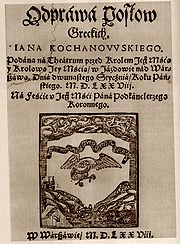
His first major masterpiece was Odprawa posłów greckich (The Dismissal of the Greek Envoys, 1578; recently translated into English by Indiana University
Indiana University
Indiana University is a multi-campus public university system in the state of Indiana, United States. Indiana University has a combined student body of more than 100,000 students, including approximately 42,000 students enrolled at the Indiana University Bloomington campus and approximately 37,000...
's Bill Johnston). This was a blank-verse
Blank verse
Blank verse is poetry written in unrhymed iambic pentameter. It has been described as "probably the most common and influential form that English poetry has taken since the sixteenth century" and Paul Fussell has claimed that "about three-quarters of all English poetry is in blank verse."The first...
tragedy
Tragedy
Tragedy is a form of art based on human suffering that offers its audience pleasure. While most cultures have developed forms that provoke this paradoxical response, tragedy refers to a specific tradition of drama that has played a unique and important role historically in the self-definition of...
that recounted an incident leading up to the Trojan War
Trojan War
In Greek mythology, the Trojan War was waged against the city of Troy by the Achaeans after Paris of Troy took Helen from her husband Menelaus, the king of Sparta. The war is among the most important events in Greek mythology and was narrated in many works of Greek literature, including the Iliad...
. It was the first tragedy written in Polish, and its theme
Theme (literature)
A theme is a broad, message, or moral of a story. The message may be about life, society, or human nature. Themes often explore timeless and universal ideas and are almost always implied rather than stated explicitly. Along with plot, character,...
of the responsibilities of statesmanship continues to resonate to this day. The play was performed at the wedding of Jan Zamoyski
Jan Zamoyski
Jan Zamoyski , was a Polish-Lithuanian nobleman, magnate, 1st duke/ordynat of Zamość. Royal Secretary since 1566, Lesser Kanclerz ) of the Crown since 1576, Lord Grand-Chancellor of the Crown since 1578, and Grand Hetman of the Crown since 1581...
and Krystyna Radziwiłł at Ujazdów Castle
Ujazdów Castle
Ujazdów Castle is a castle in the historic Ujazdów district, between Ujazdów Park and the Royal Baths Park , in Warsaw, Poland.-History:...
in Warsaw
Warsaw
Warsaw is the capital and largest city of Poland. It is located on the Vistula River, roughly from the Baltic Sea and from the Carpathian Mountains. Its population in 2010 was estimated at 1,716,855 residents with a greater metropolitan area of 2,631,902 residents, making Warsaw the 10th most...
on January 12, 1578.
Kochanowski's best-known masterpiece is Treny (Threnodies
Threnody
A threnody is a song, hymn or poem of mourning composed or performed as a memorial to a dead person. The term originates from the Greek word threnoidia, from threnos + oide ; ultimately, from the Proto-Indo-European root wed- that is also the precursor of such words as "ode", "tragedy", "comedy",...
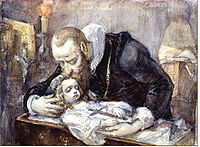
, 1580). It is a series of nineteen elegies upon the death of his beloved two-and-a-half-year-old daughter Urszula (pet name Urszulka). It has been translated into English (as Laments
Laments (Treny)
The Laments are a series of nineteen threnodies by Jan Kochanowski.Written in Polish and published in 1580, they are a highlight of Polish Renaissance literature, and one of Kochanowski's signal achievements.-Composition:Jan Kochanowski was the greatest Polish poet and the greatest Slavic poet...
) in 1920 by Dorothea Prall, and in 1995 by Stanisław Barańczak and Seamus Heaney
Seamus Heaney
Seamus Heaney is an Irish poet, writer and lecturer. He lives in Dublin. Heaney has received the Nobel Prize in Literature , the Golden Wreath of Poetry , T. S. Eliot Prize and two Whitbread prizes...
.
Other well-known poems by Kochanowski are Proporzec albo hold pruski (The Banner, or the Prussian Homage), the satiric poem Zgoda (Accord) published in 1564, and the merry Fraszki (Epigram
Epigram
An epigram is a brief, interesting, usually memorable and sometimes surprising statement. Derived from the epigramma "inscription" from ἐπιγράφειν epigraphein "to write on inscribe", this literary device has been employed for over two millennia....
s, published 1584), reminiscent of the Decameron. His translation of the Psalms
Psalms
The Book of Psalms , commonly referred to simply as Psalms, is a book of the Hebrew Bible and the Christian Bible...
is highly regarded. He also wrote in Latin, examples being Lyricorum libellus (Little Book of Lyrics, 1580), Elegiarum libri quatuor (Four Books of Elegies, 1584), and numerous poems composed for special occasions. He greatly enriched Polish poetry by naturalizing foreign poetic forms, which he knew how to imbue with a national spirit.
His writings were published collectively for the first time at Cracow in 1584-90, but the so-called jubilee publication, which appeared in Warsaw in 1884, is better. Many of his poems were translated into German by H. Nitschmann (1875).
See also
- David's Psalter
- ChessChess (poem)Chess is a poem written by Jan Kochanowski, first published in 1564 or 1565. Inspired by Marco Girolamo Vida's Scacchia Ludus, it is a narrative poetry work that describes a game of chess between two men, Fiedor and Borzuj, who fight for the right to marry Anna, princess of Denmark...
- List of Poles
- Political fictionPolitical fictionPolitical fiction is a subgenre of fiction that deals with political affairs. Political fiction has often used narrative to provide commentary on political events, systems and theories. Works of political fiction often "directly criticize an existing society or.....
- Politics in fictionPolitics in fictionThis is a list of fictional stories in which politics features as an important plot element. Passing mentions are omitted from this list.-Written works:*The Republic by Plato*Panchatantra This is a list of fictional stories in which politics features as an important plot element. Passing...
External links
Further reading
- David J. Welsh, Jan Kochanowski, New York, Twayne Publishers, 1974, ISBN 0-8057-2490-7. Reviewed by Harold B. Segel in The Slavic Review, vol. 35, no. 3. (Sept. 1976), pp. 583–84. http://links.jstor.org/sici?sici=0037-6779%28197609%2935%3A3%3C583%3AJK%3E2.0.CO%3B2-1